Tag Archives: Heinlein

574. Learning Spaceflight

I learned how to fly in space before spaceflight existed, from science fiction writers who, in turn, learned it from pioneers like Robert Goddard, Willy Ley, Herman Oberth, and Wernher von Braun. Or Tsiolkovsky in Russia. The pioneers’ tool was mathematics. They speculated, then looked at those speculations through the unblinking eye of calculations. They taught everyone how to fly in space long before NASA existed. Later some of them worked for NASA.

When I was researching for a post on Apollo Eight, I encountered reference to the barbecue roll. I had known about that maneuver from science fiction, long before Apollo Eight.

The barbecue roll is needed because vehicle in deep space is surrounded by vacuum with sunlight impinging on one side and sub-polar cold on the other. In low Earth orbit, that condition only lasts 45 minutes of every 90 minute orbit followed by pure cold in the Earth’s shadow. Apollo Eight was the first manned vehicle to endure that temperature imbalance on a long term basis — roughly five days. That’s a lot of stress.

The solution, used on Apollo Eight, then Apollo’s Ten through Seventeen, was to spin the craft about it’s long axis. It was called the barbecue roll, as in a rotisserie. You can hear that phrase used in the movie Apollo 13, and it will probably appear on the movie First Man when it comes out in October.

Anyone who had read any science fiction knows about spinning ships to provide artificial gravity. That’s not what we are talking about. The barbecue roll was quite slow, the distance from center of craft to skin was small, and any pseudo-gravity produced was probably imperceptible. The entire purpose of the roll was to equalize heat distribution by exposing all parts of the skin to heat, then cold, in sequence.

Long before there were real spacecraft, I had read about this maneuver in early science fiction, probably multiple times. It made me want to know who thought it up, which scientist first wrote about it, and how many decades before it was needed was it speculated into existence.

It struck me as a prime example of the kind of thing the pioneers did while they were writing the rules of the game, long before the game was ever played.

I looked for answers and struck out. I spent far too many hours reading the same few references on the internet, usually repeated without credit, or reading technical articles. The papers scientists and engineers write are long on facts, but short on history.

Somewhere, somewhen, somebody was dreaming about his imagined spacecraft out in a long orbit between the planets, and figured out how to equalize temperature. It might have happened several times independently. I would love to have been there, in the dormitory lounge of some engineering department, or in a meeting of enthusiasts at some model rocket club, or in the bedroom of some kid like Asimov in America or Clarke in Great Britain or some kid whose name I can’t even guess in Russia. What fun to be there when some nerd (before the word existed) slapped his head and said, “Hey, listen to this!”

Of course that moment in inaccessible, but somewhere, sometime, somebody wrote down his speculations in a paper that only enthusiasts would ever read. That is what I could have reasonably hoped to find. If you have any clues where I could continue the search, please reply to this post.

What I finally did find was one partial reference in Heinlein’s The Rolling Stones, quoted here:

The weather outside the orbit of Mars is a steady ‘clear but cold’; no longer would they need reflecting foil against the Sun’s rays. Instead one side of the ship was painted with carbon black and the capacity of the air-heating system was increased by two coils.

I clearly remember, from several sources, the notion of painting part of a vehicle black to better absorb solar energy as ships moved out further from the sun. One nagging memory has a ship painted with white and black stripes and spun. Heinlein did not spin his ship; he distributed heat to the cold side via refrigerant coils. In that particular novel, Heinlein had to maintain a non-spinning ship for plot reasons. In science fiction, physics start the ball rolling but plot determines where that ball ends up.

We’ll look closer at The Rolling Stones as a textbook for spaceflight within the solar system on Monday.

562. Davy

This is one of my best stories series.

I re-read. It is my equivalent of brainless television. There are books that I frequently re-inhabit in order to once again enjoy the people, scenery, and action.

There are also books I read only once, and never need to read again. They become such a part of me that I still remember them decades later.

Edgar Pangborn provided two such books, Davy and The Trial of Calista Blake. I read each of them only once, between 1964 and 1967. I have never forgotten them, nor have I ever wanted to return to them. They were life changing, if read at the right age.

===========

I grew up in an era of fear. The bomb hung over us all, and fiction followed the trends of the day. Speaking from memory, not scholarship, it seems to me that it was the end of the exclusivity of science fiction. Events that would have once interested only the few and the faithful, were turning up on the best seller list. Books like Fail-Safe and On the Beach were called science fiction, and I suppose technically, they were. But they didn’t taste like science fiction because they were written by mainstream writers with different sensibilities. That may not be a legitimate complaint, but in truth they tasted like steak with no salt.

The flip side of the here-comes-the-bomb novels was an endless cavalcade of post-holocaust dystopias. The first book I read, the first day I discovered libraries, Star Man’s Son by Andre Norton, was one of those. There were dozens to follow; maybe hundreds. They mostly ran together in a mass of future sadness, but a few were memorable.

Davy stood out because it’s horny orphan protagonist got such joy out of life. He found a French horn in the rubble and taught himself to play it, which always made the book seem more like fantasy than science fiction. If you know French horns, you’ll understand.

We spend much of the book watching Davy go from ignorance to knowledge. The cover of the edition I read compares him to Tom Jones (the novel, not the singer) and that seems fair.

Davy’s world is the northeastern United States, a couple of centuries after the nukes fell. The names are scrambled but mostly decipherable. The state religion is the Holy Murican Church and belief is not optional. Davy falls in with anti-religious dissidents, which suits his doubter’s personality.

The novel is carried by Davy as a questioning, ebullient youth, but saved from silliness by a brooding feeling that all will not be roses. The story arc makes everything work. We see young Davy growing up as told by his older self, but we are spared the works of his maturity. There will be striving, battle, despair, and betrayal when the mature Davy attempts to mold the world to his liking, only to have it fall apart in his hands. That is the part of the story another novelist would have concentrated on, but we see it only in brief flashes. Then we are at the final chapter, a kind of coda in which Davy totals up his gains and losses and prepares for a final, hopeless journey.

What we have here is the joy of youth, overlain by the elegiac sadness of hopeless struggle against human inadequacy. Heinlein could have written it, but it would have had little heart because his protagonist would have stood above the fray, superior to the mass of humanity. Davy partook of the same human conditions that he fought against. Just like the rest of us. That made Davy stand out as something better that the rest of the dystopias. It made the novel a work of art to move the soul — at least if you read it at sixteen, while waiting for the bomb to fall.

542. Characters

Characters in science fiction are . . . different. Let’s look at a few.

I have little interest in sterling characters who fight for the right, without a blemish or a flaw. That’s a good thing actually, since no one else does either. My only exception is Kimball Kinnison (of the Lensman series). That’s him overhead, walking with his buddies Tregonsee and Worsel.

I have no interest in literary characters who live their little lives and make novels out of the trivialities of existence. Here is a test; if a book seems to only have readers because it is required in college literature classes, maybe you should just go read some science fiction.

I like people — and characters — who do their job and a little more; who don’t think that the sun rises and sets in themselves, but who are also not passively afraid to assert themselves.

I don’t like villains who are deeply and intractably evil. I make use of such characters if I need them, but I keep them off stage. They are boring, seen up close.

I like my villains to be like my other people, rational and a little bigger than life, but affected by a flaw of character or aligned to the wrong side. They are usually selfish, but good heroes always have a bit of selfishness as well.

An interesting hero is necessary; an interesting villain is a nice bonus.

I don’t expect other authors to have similar taste, and some of my favorite books have characters I would not have chosen to write. Genly Ai comes to mind. If you don’t recognize him, he is the character through which we experience Ursula le Guin’s the Left Hand of Darkness. It is a fine book, and he does the job her story requires of him, but he is a bit of a cypher. I like Sparrowhawk better, and that is probably a big part of why I like A Wizard of Earthsea better.

And then there’s Alvin (or any other character that Arthur C. Clarke ever wrote). The City and the Stars, in either of its incarnations, (See 332. and 333.) is a mind expanding tour of the universe, but its protagonist is dull, dull, dull.

Zelazny’s characters are universally smart assed, universally delightful, and hard to tell apart.

Heinlein’s characters are all Heinlein.

534. A Writer Lives for Libraries (3)

Just before I entered high school, the shrinking population of our county caused two school districts to consolidate. They built a new high school and bussed students in from miles away. One room of that new high school was full of empty shelves with boxes of new books sitting on the floor. Since I already knew the English teacher/librarian, and since I was a hard worker (and he wasn’t) I got to empty those boxes and fill those shelves. There is no better way to learn a library than from the ground up.

There were piles of books on science, and I read most of them. There was a copy of Heinlein’s Stranger in a Strange Land which had just been published. It would have been banned if any of the Baptists had gotten hold of it, but I was probably the only one to read it. That was the book in which Heinlein made sex seem dull. They can’t all be winners.

I graduated from high school, went to college, got married, went into the Navy, and returned to graduate school at the University of Chicago, where I got to use the Regenstein Library. Then I started writing. Wherever we went, my wife got a job at the local library — often in the bookmobile.

I has some success writing but not enough to live on, so I got a credential and made teaching middle school my day job. I kept that day job for twenty-seven years, still writing but with much diminished output. Then I retired and I went back to writing full time.

Once, during that period, the school where I was teaching had a special day in celebration of reading. My teacher friend Crystal invited several of us to talk to her class about our early reading habits.

I went to the local library and found an original copy of Star Man’s Son still on the shelf. It wasn’t the same copy — I was fifteen hundred miles from the library where I started out — but it was the same edition. It probably came off the same press the same week.

Thank God for libraries that never throw anything away. When my turn came, I was able to hold it up and say, “Here is the first book I ever checked out.” Then I could hold up copies of Jandrax and A Fond Farewell to Dying and say, “And here are the books I’ve written, because long ago I learned to love to read.”

Now I live in the foothills of the Sierras and, coincidentally enough, I am once again equidistant from three cities. Each one is a county seat, and each one has a library.

One is the city where I lived for all my teaching years. Its library is in a newer and larger building now, and the books are reasonably up to date. I go there often.

One of the other libraries is old and poor. They have lots of books, but some of them are older than I am. They have a full selection of Buchans, mostly in identical bindings from some original matched set. They have a matched set of Jules Verne, as well, and both sets are battered and worn. As I walk up and down the shelves, I see lots of books that I saw in my first library fifty years ago.

I’m glad to have a library where everything is up to date, but it is also nice to have a place where I can step back into the past, to pick up copies of those books I didn’t have time to read when I first encountered them. Not every good book was written this decade.

Now turn off the computer and go check out a book.

528. Repeat, with Variations

You hear it said — author Joe Doakes has written the same book thirty times. The phrase is sometimes supercilious and often has more than a touch of envy hidden in it. The implication is, “Hell, I could do that.”

True confession: I couldn’t. Sometimes I feel good about that, and sometimes I wish I could do that, because repetition is one of the main paths to $ucce$$. I keep telling myself it is not the only path.

If you are, or want to be, a writer, you should examine this notion from the viewpoint of a reader, standing in front of a shelf of books, with only enough money and time to buy and read one of them.

The one with the naked woman catches your eye (male viewpoint assumed; for alternate gender, insert your own preference) but you’ve been burned by that advertising gimmick before. One looks likely, but you’ve never read anything by that author before, so you hesitate. If you could find a book by a favorite author, you would be reassured. If you could find a book by your favorite author, featuring a favorite character, your satisfaction would be almost certain.

It’s that simple. In addition, the author has the advantage of not having to invent a new main character for each book. It might be that finding something new for an old character to do would become tedious, but I can’t report on that from personal experience. No wonder publishers want books that can become the first of a new series.

We are talking about comfort food books here; true escapist reading for the times when you want to think, but only just a little. Television substitutes. Something for the long-haul trucker to read at night to take his mind off the fact that his wife is two thousand miles away, and what he would really like to be doing is . . .; you get the picture.

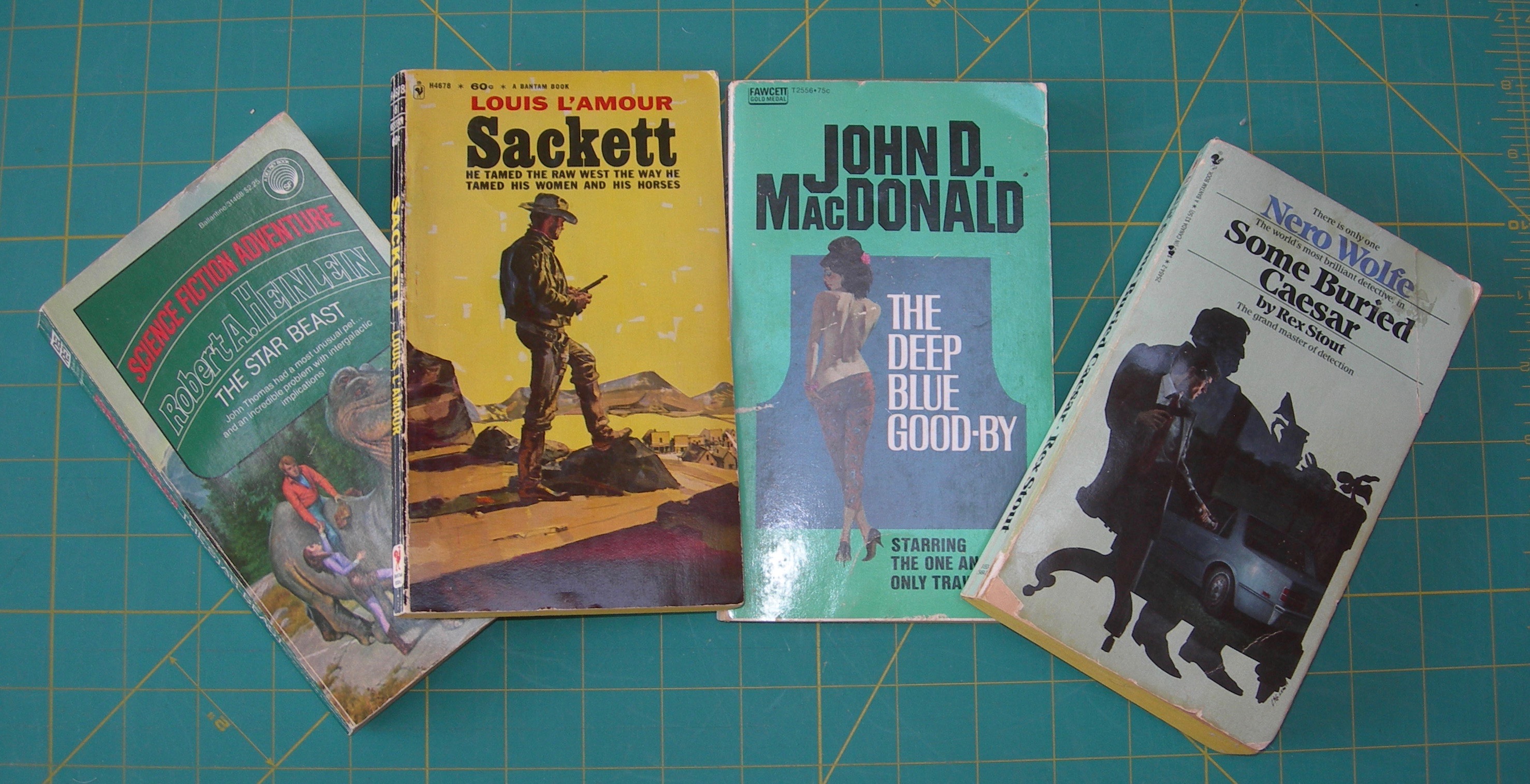
For me, during my first twenty years of writing, my go-to escape was Louis L’amour. I was writing science fiction and fantasy; he was writing westerns. He didn’t exactly write the same book fifty times. If he had, I couldn’t tell his good ones from his bad ones, and he had both. (Read Flint or Conagher, but avoid The Haunted Mesa.)

After beating my head against the typewriter (this was pre-computer) for a few hours, I would pick up a Louis L’amour western and ride off across the plains. Thoughts of interstellar travel were banished until the imagination well refilled itself. It was good stuff, but I don’t read him much any more. I have them all memorized.

I also have Heinlein in the photo at the top, which is a little unfair. He was not guilty of writing the same novel over and over (people who have only read from the second half of his career may disagree), but he only had one character. Male, female, both alternating, old, young — it didn’t matter. Every one was the Heinlein character, so if you liked one of his books, you were likely to like the rest. And if not, not.

The Travis McGee books are a clinic in how to do a series character who can continue to repeat with variations. No one ever did branding as well as John D. MacDonald. Every book contained a color in the title. He wrote The Deep Blue Good-by, Nightmare in Pink, A Purple Place for Dying, the Quick Red Fox, and seventeen more shades. You could recognize a McGee book from across the bookstore. MacDonald’s biography was titled The Red Hot Typewriter. In it, he explained that before he committed to the series, he wrote the first two novels to see if he could stand to be married to McGee for decades. For more, see 49. The Green Ripper.

The Spencer novels belong here as well. I read with pleasure through the first ten or so; each one was reasonably unique and expanded his character. The next thirty were increasingly dreary repetitions; they provided a quick escape and as quickly faded from memory. I still occasionally re-read one of the early novels, but the rest were all one-and-done.

Today, when the writing stalls, I rinse my mind out with Nero Wolfe and Archie Goodwin. I can’t say I really like them, but I always know what to expect.

519. The Lensmen (2)

Continued from Monday . . .

If you find the style of Galactic Patrol too old fashioned after two chapters, move on; you were born too late to enjoy it. But if you don’t stay, you will miss a menagerie of strange aliens, both sentient and otherwise.

No one has read all of science fiction, but I’ve read a lot. And in my slice of the SF universe, I have never found a writer who created more or weirder creatures than Doc Smith. I’ll describe just two; first Worsel:

. . . there was hurtling downward toward them a veritable dragon: a nightmare’s horror of hideously reptilian head, of leathern wings, of viciously fanged jaws, of frightfully taloned feet,  of multiple knotty arms, of long, sinuous heavily-scaled serpent’s body.

This is the creature who will become the second most formidable Lensman, and Kennison’s best friend. A third Lensman was Tregonsee:

This . . .apparition was at least erect, which was something. His body was the size and shape of an oil-drum. Beneath this massive cylinder of a body were four short, blocky legs upon which he waddled about with surprising speed. Midway up the body, above each leg, there sprouted out a ten-foot-long, writhing, boneless, tentacular arm, which toward the extremity branched out into dozens of lesser tentacles, ranging in size from hair-like tendrils up to mighty fingers two inches or more in diameter. Tregonsee’s head was merely a neckless, immobile, bulging dome in the center of the flat upper surface of his body — a dome bearing neither eyes nor ears, but only four equally-spaced toothless mouths and four single, flaring nostrils.

These are the minions of civilization; the baddies look worse.

Are these aliens too weird to be believable? Actually, the opposite is true. When we move beyond our solar system, if we don’t find aliens so outré that no science fiction writer could have predicted them, I’ll eat my keyboard.

Part of the power of these descriptions comes from E. E. Smith’s writing style. In flipping through the internet while writing this, I ran across a comment that if the Lensman series were to be offered for publication today, it would not be accepted. That is absolutely true, but it is also true that without the Lensman series, there would be no Star Wars, nor any other space opera. The Lensman series set the pattern that all others would follow, and nothing that came after was as good as the original.

Heinlein was Smith’s friend, and our best picture of him comes from RAH. He said that Smith was the original of the Gray Lensman, and that his wife was the original of Clarissa MacDougal, Kinnison’s sometime companion-in-adventure and wife-to-be.

Much of the charm of the series lies in Kennison’s Boy Scout incorruptibility. Those who say he has no personality are wrong. He simply has a personality that is out of the modern norm. Like Jesus. — which is exactly what he should be, as the end product of thousands of years of Arisan work in perfecting human DNA.

All this works, and the hundreds of weird aliens work, because E. E. Smith’s writing style is essentially naive. His rolling cascades of description could only come from someone who is incapable of embarrassment.

It’s been a long time since that kind of writer has been in vogue, and that day will probably never come again. But if you can achieve the right mind-set, you can still be amazed. The six paperback novels are available in any good used book store. Pass the clerk a ten-spot and the wonders of the universe will be yours.

517. The Three Stages of Heinlein

This is one of the fifteen that hit the sweet spot.

As I look back over my five hundred plus posts, I find Heinlein mentioned more than any other writer. I’m not going to repeat all that I have said, but I will provide links for you to see for yourselves.

You might think RAH is my favorite, but he isn’t. That would probably be Zelazny. When I was new to science fiction, in the fifties and sixties, it would have been Andre Norton. However, Heinlein is the one I most enjoy reading. His prose sings, but in an odd kind of way. He is like a weird uncle who sits by the fire telling lies and funny stories, occasionally laughing out loud at his own jokes, and getting serious just often enough to keep from looking like a clown.

But he does it so well.

Heinlein has been through three stages as an author. At first he was the master of compact, carefully plotted works, both short stories and novels. That was what publishers demanded at the time and he produced some masterpieces. I reviewed five of them in one post.

Then came Stranger in a Strange Land, his most popular book, and a dud, for my taste. That was the start of his inflated period, which continued until his death, as his books got longer and more discursive. He gets a lot of criticism for long windedness, and deserves all of it, but some of those works are my favorites.

Alongside his early work, Heinlein produced a number of juveniles (as they were called then) and some of them were of top quality. I reviewed several briefly, just this month. At the end of his list of juveniles is the book that Scribners rejected, Starship Troopers. It is another favorite of many, myself decidedly not included.

Heinlein had a thing for group sex and a short but pleasant relationship with the rock group Jefferson Starship.

Actually, I’ve talked about RAH more than I had realized. Maybe I need to give him a rest for a couple of years.

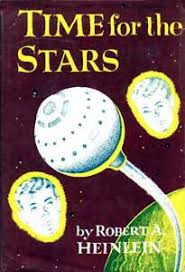
513. Heinlein’s Time for the Stars

Yesterday (June 25) I had a request from a reader for advice on which Heinleins to read after Stranger and Starship Troopers. I replied that my favorites were Door into Summer for the old compact Heinleins, Time Enough for Love for the later, long-winded ones, and Time for the Stars among the juveniles.

The exchange reminded me of a post I had written but not published, because I had an excess of Heinlein related posts going at the time. Here it is, slightly updated and finally published.

===============

Time for the Stars is one of my favorite Heinlein juveniles. I am using it here as a foil to Spirit Deer, in talking about core stories.

Spirit Deer was my first novel, written for adults but very short. I later stripped it of wife and adult friends, and turned into a juvenile. It appeared in Serial between June 5th and August 10th of last year. See 364. The Core Story and 398. Summing up Spirit Deer.

If you strip Time for the Stars and Spirit Deer both down to the core, and they are quest stories. The explorers on the torch ship Lewis and Clark are ostensibly seeking knowledge, but for the young communication techs (i.e. telepaths) that quest in inextricably bound up with a search for maturity. Tim, in Spirit Deer, is seeking survival, and a return to normalcy, but he cannot achieve that without finding maturity.

If you haven’t read Time for the Stars (and why haven’t you?), here is a brief summary.

Tom and Pat Bartlett are twin brothers who are part of an experiment to see if telepathy exists. They go along as a joke, and find that it is not a joke. The “secret language” they have used all their lives turns out to actually be telepathy. What they think other people can’t understand, they in fact cannot hear.

The discovery that makes this more than a parlor trick is that true telepaths can communicate long distances — proven as far as Pluto — and their contact does not show a speed of light time lag. Now relativistic starships can go out from star to star without having to return home to bring back their data.

Tom goes to space and Pat, the dominating twin, stays behind. Tom learns to assert his independence, especially as his stay-behind twin ages much more rapidly. The trip is grueling, the exploration dangerous, and eventually Tom returns home, still young while his twin has grown old.

That is all the summary I can give without spoilers, but how much do you need?

The voyage of the Lewis and Clark is a long trip away and a quick return. Tim, in Spirit Deer, has a quick plunge into the wild and a long return. They differ in detail, but the arc is home — away — home again.

There aren’t more than a billion stories with that arc, significantly including the Heinlein juveniles Starman Jones, Tunnel in the Sky, and Have Spacesuit — Will Travel, all of which are excellent. Upon returning home, these story’s characters characters are changed by their experiences. Jones’ life is most changed, with some losses and great gains. Rod Walker of Tunnel finds a career. Kip Russell of Spacesuit gets on with plans for his life, but his options are immensely augmented.

All four are Heinlein at his best.

505. Heinlein and the Hippies

I have come to realize the value of a post title in finding readers, but I try to avoid bait and switch. To provide a balancing bit of honesty, this isn’t about the effect Stranger in a Strange Land had on the Free Love generation, but on the relationship between Heinlein and one particular group of hippies, the Jefferson Airplane, aka the Jefferson Starship.

For the relationship of hippies to Stranger, see 160. Stranger in a Strange Land. That way I don’t have to tell you again that I read it early and found it to be a dud.

As for me, I was a half-way hippie. I opposed the war, grew a beard, let my hair go long, and dressed in rumpled casual. The wild, multi-colored garb of TV hippies was largely a media invention. Real hippies wore Army surplus because it was cheap, which was also one of my sartorial motivations.

However, I didn’t do drugs and I was in the wrong place in the wrong time. My college roommate spent the Summer of Love in California; I spent it looking for archaeological sites in the backwoods of Michigan. He told me all about it when he came back in the fall; I had been out of touch and didn’t even know it had happened.

The only thing I understood as it happened in 1967 was the music, blaring out of the car radio as our survey crew drove around looking for archeology sites. I particularly liked that new group the Jefferson Airplane.

Which brings me to the heart of the post. In 1969, Paul Kantner wrote Heinlein a letter asking permission to quote from his work. I knew this, after a fashion, from contemporary gossip, and it was evident in the lyrics soon after, but I didn’t get confirmation until the second volume of Heinlein’s biography came out (see below). I’ll quote some of Heinlein’s reply:

I am pleased by your courtesy . . . Bits and pieces from my stories have been used by many people . . . and it is rare indeed for anyone to bother to ask my permission.

Heinlein gave permission and went on to ask for some autographed albums in return, since he was a fan of their work. Who knew?

The album Blows Against the Empire came out about a year later, by Paul Kantner and the Jefferson Starship. Despite the title. it was actually a compendium band filling in the time between the breakup of Jefferson Airplane and its later rebirth as Jefferson Starship.

It would be impossible to overstate how much music from this era was fueled by LSD. If you seek out the full lyrics, you’ll see how many drug references I have left out of what follows:

from the cut Hijack

You know – a starship circling in the sky – it ought to be ready by 1990
They’ll be building it up in the air ever since 1980
People with a clever plan can assume the role of the mighty
And hijack the starship
Carry 7000 people past the sun
And our babes’ll wander naked thru the cities of the universe

7000 Gypsies swirling together
Offering to the sun in the name of the weather
Gonna hijack – hijack the starship

from the cut Starship

Out – the one remaining way to go
Free – the only way to fall
The light in the night is the sun
And it can carry you around the planetary ground
And the planetary whip of the sun

Mankind gone from the cage
All the years gone from your age

If you are at all familiar with Heinlein, you will recognize that this imagery is from the novel Methuselah’s Children, originally serialized in 1941, which was also the first appearance of Lazarus Long. Of course Kantner reworked it. The hijackers are not Howards fleeing for their lives, but drug-fired hippies whose faith in everything turning out well is a bit laughable in hindsight.

Like all the first half dozen Jefferson Airplane or Starship albums, I loved it. If you are younger than old, there is an excellent change that you’ve never heard music that shows the spirit of innovation and experimentation that was the hallmark of the 60’s. The music that appears on TV flashback programming is fine stuff, but it is also the tame stuff. The raw stuff doesn’t get replayed.

If you are curious, give this album an online listen, although you may not care for it.

==========

Robert A. Heinlein, vol. 2, The Man Who Learned Better by William H. Patterson, Jr, p. 312. FYI, the subtitle does not refer to a change of heart by Heinlein, but is RAH’s idea of one of the three or four basic plots in fiction, and one he often used.

375. Science vs. Magic (1)

This is another set of posts which acts as a backdrop to one of the panels I am scheduled to be on at Westercon this year. In this case the panel is Science & Technology versus Magic: what makes this such a compelling trope? In part it draws on a very old post, 37. Fantasy, Whatever that is.

It has been a grand ride.

Since I started reading science fiction and fantasy in the late fifties, I have seen the rise of Amber, Witch World, the Dorsai, the Lensmen, LeGuin, Zelazny, Ellison, Varley, Ballard, and hundred of others. I was there for the Tolkien revival and the revival of other fantasy writers under Ballantine.

Through the years, avid readers waged war on one another over the most trivial of notions — just like any other family. It used to be that, if you called science fiction “sci fi” (never mind SyFy) you were being disrespectful. You had to call the genre science fiction, or maybe SF.

However, if you called it SF, then you had to argue whether that stood for science fiction of speculative fiction or . . . I’ve forgotten what the lesser contenders were.

Mimeographs and postage stamps were the internet of the early sixties. Whole forests went to the pulp mills to make paper to support arguments about what was or was not science fiction, whether fantasy was worth considering, and where one ended and the other began. Then Heinlein published Glory Road and sent shock waves through the SF community by landing with one foot squarely in each camp.

I mention all this because, although my publications so far have been science fiction, I have spent more time and taken more satisfaction writing fantasy.

Things have changed — somewhat. Today, everything goes, but you still have to declare yourself. I recently dealt with a publisher who required that you shoehorn your submission into one of about forty SF/fantasy sub-categories. Let’s call this generating chaos through an excessive allegiance to order.

All of this is probably subsumed under Clarke’s Third Law. Or, look at it this way: the Creation as given in Genesis is fact, allegory, or fantasy depending on whether you are a fundamentalist, a religious liberal, or an atheist.

Put still another way, if it tastes like fantasy, it is (for you) and if it tastes like science fiction, it is (for you).

But maybe not for the rest of us.

Clarke’s third law:
Any sufficiently advanced technology is indistinguishable from magic

Heinlein on technology:
I try never to get a machine sore at me. There’s no theory for that but every engineer knows it.

“The car won’t start unless you hold your mouth just right.”
folk wisdom known to all owners of elderly automobiles

So what do we mean by science and technology, and what do we mean by magic?

Does anybody care?

I think the general answer is, “No”. Most readers just want a fun ride, whether with ray guns or magic wands. You, on the other hand, did sign up for Science & Technology vs. Magic, so I’m going to assume you do care. Before we go any further, let’s try to answer the question. It may prove difficult — especially if there really isn’t any difference — but let’s try.

Science is a rigorous and careful attempt to discover the nature of the universe by observation and experimentation. Okay, that seems reasonable. I think we can be provisionally satisfied with that, and move on.

Technology is a little trickier. A computer is technology, sure. But so is a flaked stone spear point. That spear point didn’t flake itself. But what about the stick that a chimp picks up and uses to get ants out of an anthill?

Nothing is ever easy, is it? Let’s just file technology as a sub-set of science and move on, or we we’ll never get to the fun stuff.

Magic is harder to define. We’ll tackle that next Tuesday, because on Monday I have to devote a post to things that are happening with Sprit Deer, over on the Serial side of the website.

Click here for next post.