Tag Archives: Jandrax

590. The Road to Corlay

Cold curtains of November rain came drifting slowly up the valley like an endless procession of phantom mourners following an invisible hearse. From beneath an overhang of limestone a boy and an old man squatted side by side and gazed disconsolately out across the river to the dripping forest on the far bank. Suddenly a salmon leaped — a flicker of silver in the gloom and a splash like a falling log. The boy’s eyes gleamed. “Ah,” he breathed. “Did you see him?”
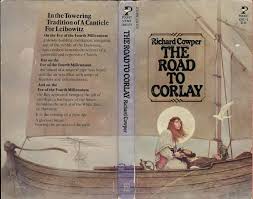
That’s a lot of description for an opening paragraph. Hemingway would have hated it, but it works perfectly to present the quasi-medieval setting and elegiac mood of The Road to Corlay.

The novel came out in paperback from Pocket Books in 1979. I read it some time that year and it made a permanent impression, so much so that I named it as one of my fifteen favorite books earlier this year. The impression, however, was of its quality and was not accompanied by anything like a scene by scene recollection.

I had to read it again, and I am glad that I did.

What appears between the covers of the Pocket Books version is a novella called The Piper at the Gates of Dawn (Hugo and Nebula nominee for 1977) and a short novel called The Road to Corlay. Together they tell one seamless story, but it will be easier here to talk about them separately.

Beware — I normally avoid spoilers but I can’t do it in this case.

The Piper at the Gates of Dawn is allegorical, but don’t let that put you off. Allegory is often just a lazy author’s attempt to achieve false profundity, but Cowper does it right. My personal test for allegory is, “Does the writing stand by itself? Would I like it as well if I didn’t know the story it mimics?” The Piper at the Gates of Dawn passes this test easily.

 It takes place on the eve of the new millennium, 2999 AD, in a post-flood England. The waters began rising in the 1980s due to global warming. (Yes, I said global warming, even though this story was begun in the 1970s.) By the time Piper opens, technological society is a thing of the past and the Church Militant rules the land.

Here is the only real weakness in the underlying story. Why revive Catholicism as villain? In the 70s its power was essentially dead in Britain, and its resurgence is merely assumed, never explained. I can only chalk it up to the extreme Englishness of the novel. Brits have been seeing the Catholic Church as bogeyman since Bloody Mary’s reign of terror in the 1550s. If this novel had been written by an American (like Davy was), we would probably have seen cold, heartless Puritans hanging witches instead.

Logical or not, the Church Militant makes a good foil, and offers a medieval tone without needing a lot of backstory.

The story itself — that is, the plot — can be summarized quickly. Tom, a boy of about thirteen and Old Peter, a storyteller, are walking toward York where Tom is supposed to enter a Church school. Tom has the ability, taught to him by a wizard, to play his pipes so that he can control animals and make people see visions. He also knows a lot more about unfolding events than a boy should know. His playing amplifies Old Peter’s storytelling so that by the time they reach York, they are raking in money and followers.

Tom is a very docile and agreeable lad, but every time he gives in to Peter’s schemes, it moves him closer to his own destiny. Peter seems to have no clue that this is happening. We are not told that Tom is manipulating, but he never seems surprised when things go his way.

The world is in turmoil with prophesies of the coming of the White Bird of Kinship at the turn of the millennium. Once in York, at the end of the year, Tom slips away to play his pipes for the gathered crowd. The White Bird descends upon the land, but just at the climax of the event Tom is killed by the bolt from a crossbow.

Piper is allegorical, certainly, but not a true allegory. It is a retelling of the Christ story, but with more differences than similarities.

We have the self-sacrificed innocent, but he has preached no sermons and promulgated no gospel. We have Gyre, who fires the bolt but has no memory of the deed or the reason for it. There is a touch of Judas here, but only a touch, and that lies primarily in his regret.

We have the White Bird, which even a character within the story recognizes as being like the Holy Spirit, but the death of Tom does not bring about any redemption. It only causes the Bird’s descent to misfire.

We have Old Peter who takes Gyre with him to spread the word of what has happened, like two apostles after the resurrection. But there was no resurrection and the Bird has flown away. Peter and Gyre are not actually spreading the word of what has happened, but of what is still to come, and here we find a trace of John the Baptist.

It isn’t a Christ story, but a slightly Christlike story. And it is not an ending, but a beginning. The Piper at the Gates of Dawn is the most emotionally unified and satisfying part of the overall story, but it demands the follow-up provided by The Road to Corlay

=============

I sometimes hear reviewers say that, while they are ready to meet the characters in the opening chapter of a novel they don’t want to have to do it all over again on page fifty. My novel Jandrax caused great irritation to one reviewer for that very reason, but sometimes a complicated story requires a rotating cast of characters.

The Road to Corlay is that kind of work. It begins eighteen years after the boy Tom’s death. Old Peter and Gyre have been spreading the gospel of the White Bird of Kinship, but they remain mostly off stage. All the characters are new, and many of them won’t live to see the end of the book.

The Church Militant has tried to absorb the new religion into itself, but now its leaders change tactics. An proscription for heresy is released, and all the people we will come to care about become the hunted.

In researching for this post, I ran across a review of another Cowper novel which contained the lines, “This novel has real people in it that you can care about . . . just don’t expect too many laughs.” He could have been talking about The Road to Corlay.

The novel begins with two fishermen dragging in body bound to a spar. It is Thomas of Norwich, the second of three Thomases in the book. That is a little confusing, but a necessary part of the story. He is alive, but he shouldn’t be after all his days in the water. It will take the rest of the novel to answer why this is and what it means. He comes into the hands of Jane, who is gifted with huesh, which is something like ESP crossed with foreseeing. She enters his mind, but finds two men there, one being Thomas himself, the other a stranger she can barely touch.

It is in chapter two that the disaffection starts for most reviewers, including Joachim Boaz and Thomas Anderson, two reviewers I enjoy and respect.

In this new chapter the scene changes to 1986, a decade in the future from Cowper’s perspective. It is a familiar world of cars and hospitals, and of scientists working at the edge of current knowledge. A scientist name Carver is having a chemically induced OBBE (out of body experience) and his colleagues can’t wake him up. No one is worried at first, but then he sinks fast and the chapter ends with him in danger. We know from what Jane said in the last chapter that Carver is the other man in Thomas of Norwich’s head.

And it is raining — has been raining for months. Without ever saying so, Cowper has let us know that the rising of the waters has begun.

Let’s dispose of this 1986 intrusion, if it is an intrusion, before we get back to 3018. Everybody seems to hate it, but I didn’t mind it at all. On a visceral level, it was a relief every three chapters to spend a few pages somewhere that my new friends weren’t being hunted down.

More importantly, 1986 is a counterpoise to the future. It isn’t there to give backstory; that could have been done in a few carefully chosen sentences of authorial omniscience. It shows that the past and the future are the same. The scientists with their machinery basically don’t know what the hell is going on. The people like Jane who use and are used by huesh, don’t know where it comes from or why it works. The central purveyors of the new religion basically don’t know how any of it works, or what is going to happen next. Confusion is the human norm in all eras, which perfectly agrees with my prejudices.

Meanwhile, back in 3018: Thomas of Norwich takes refuge with Jane’s family. Only a small portion of the population has embraced Kinship, but those who have take care of each other. Jane is troubled, not only by the other man inside Thomas, but because she hueshed Thomas washed up on the beach, drowned. In her experience, huesh foreseeings never fail, and she has become fond of Thomas.

(Speaking of things to hate, I hate this kind of foreshadowing, but once again, Cowper made it work.)

Thomas has a mission, to find Gyre, who killed the boy Tom and became his greatest advocate, and to carry the boy’s pipes and written testament to safety in France. Jane takes him part way on that journey by boat, and is later attacked, then rescued. She learns that her family has been killed and she is herself now a refugee. She and Thomas come together again and he comforts her in her grief. In their days together, fondness has already turned to love, and now that leads to a night of lovemaking. Shortly after, they are captured together, and held for those who are hunting them.

Meanwhile, in a separate strand of the story, Brother Francis is sent by Cardinal Constant, head of the English Church Militant and prime mover against the Kinsmen, in search of knowledge about the boy who died. Francis travels from place to place, tracing the boy’s history, and hearing from those he has touched. He is slowly converted to Kinship, so as he nears the end of his journey, he changes sides. When he finds Gyre, he does not turn him over to the Church, but chooses to help him.

Gyre offers to play on the boy’s pipes, so Francis can hear an echo of an echo of the melody that is converting the world.

Raising his head abruptly the dying Kinsman gazed up at the vaulted ceiling and cried with a voice so strong it seemed almost as if it must be coming from some other throat than his: “Boy, show now at the end that I am forgiven! You know that I shot in ignorance of what I did! Speak you now through my darkness that his darkness may become light!”

He drew a deep, panting breath, raised the twin mouthpieces to his lips, and fixing the Advocate Sceptic with an unwavering gaze he began to play.

The Road to Corlay is a long and complicated story, but none of it would mean anything if it weren’t so beautifully written.

Gyre passes the pipes and testament to Francis and dies. Francis goes on, now looking for Thomas of Norwich to deliver them to him, but he finds him captive of the Church. Using his standing as a priest, since no one knows of his apostasy, he effects a rescue, but Thomas is killed.

Jane, with her unborn son, the pipes and the testament, escapes to France where her coming son Tom will fulfill his destiny.

=============

Tom the boy who died by crossbow, Thomas of Norwich who inherited his pipes and testament, Tom the unborn son in Jane’s womb at book’s end (who I’m told is the primary figure in the two sequels) — clearly we have a reincarnation sub-text going on here unexplained.

We also have a sub-text of repetitions. The birth of Christianity, medieval days, the rise of technological hubris smashed back by a flood (again, just like Noah), the rebirth of a quasi-medieval society and a new Church Militant, followed by the birth of Kinship (the primitive, original Christianity?). From what little I know of the two sequels, Kinship wins out, becomes the great power, and is itself corrupted.

To my eye, this all looks very Hindu, with age after age, and avatar after avatar of basically the same Gods, repeating variations of the same myths. I’ll say more on that in a month or so when I deal with the Earthsea books.

=============

Now I’m going to take you down the rabbit hole of my Southern Baptist childhood by way of this quotation:

. . . midway out in the Somersea a three masted barque, its white sails drooping like tired petals, floated becalmed above it’s own reflection. High above it a solitary star twinkled, a silver drop suspended from an invisible thread.

There are white boats in the offing in several places in this novel — white like the White Bird. In this case with “white sails drooping like a tired” (bird?). A three masted barque — where else have we seen something that looks like three upright wooden masts crossed by yards? Oh, yes, on the hill at Calvary? And where but above the manger did a solitary star twinkle?

You doubt me? I don’t blame you, but this is the world of types and symbols scattered through a sea of parables that I grew up in. This book speaks to me the same way, with little hints and teases that float untethered through the text. No? Then tell me, if that barque is not symbolic — even if my reading of it was not precise — why was it there? It had no place in the plot.

These are the little touches — images and turns of phrase — scattered throughout The Road to Corlay which make it read like a new scripture to those of us who spent our childhoods reading the original Christian scripture.

=============

I don’t understand all of The Road to Corlay; I’m not supposed to. If all its meaning could be reduced to reason, Cowper could have nailed it to some college door like the ninety-five theses, and it would have been mummified in a philosophy text.

Instead, he gave us a fable. I understand that impulse. In 1975, fresh out of graduate school, I wrote my first novel, and was seduced. I could say things in fiction that I could never say any other way.

Thomas of Norwich, trying to explain how it felt to play the song of the White Bird, said:

“I knew the supreme joy of possessing something that can only exist in the giving.”

I get it. That’s how it feels every time I write, but it seems too arrogant to admit, so let’s just keep it between ourselves.

558. Serial Packaging

Publishing novels serially is a very old idea. Most of Charles Dickens work came out that way.

What I’ve done over the last few years in the blog Serial is a bit different. Dickens novels came out in pieces while he was writing them. Everything in my blog Serial was already finished, then had to be reverse engineered into serial form.

I actually made a brief attempt at writing on the go, although it appeared in A Writing Life while Serial was occupied by another story. It wasn’t for me. If you’re curious how things came out in the experiment, you can go to Mud Prolog, Mud 1, Mud 2,  and Mud 3 to see the results. I have a lot of emotional investment in the novel Mud and some day I will probably return to it, but not as a serial in progress.

When Dickens wrote his serialized novels, the size required for each chunk was known in advance and the chunks were big. David Copperfield, for example, was a novel of 358,551 words. I know this by downloading it from Project Gutenberg, transferring it to my word processor, and using the word count function. You might make note of that; it is a useful technique.

David Copperfield was published in twenty monthly installments. That makes each installment was about 18,000 words. In SFWA (Science Fiction Writers of America) terms, each installment was of novella length.

My typical serial post has been about 600 to 800 words.

Dickens serialized in order to sell to a market which could not afford books. At the same time, serializing boosted sales of this novels when they came out later in book form. Most successful nineteenth century authors followed the same pattern.

The big names in twentieth century science fiction also wrote serial novels, although they were shorter and presented in fewer but longer installments. In the golden age of SF, serial publication might be the only way to get a novel into print. A few years later, when the paperback revolution came about, those old magazines were mined for their novels.

In my case, nothing but Mud was in progress at the time it was posted. Some of the things presented had been published, some had not, one was presented as a excerpt from a completed novel, and one was a fragment from a novel I’ll probably never finish. Jandrax was annotated to such a degree that it almost forms a writing primer, and How to Build a Culture was entirely a how-to.

Everything I have presented in Serial has been to assure continued readership of the website. It’s a trick. Leave ‘em hanging, and they’ll come back. And the whole website was originally to assure a readership for my then upcoming novel Cyan, and for others that would follow.

That was the plan anyway, but the website quickly became something I valued for itself and man has it been fun.

I’ve enjoyed revisiting old friends. I’ve learned a lot from a close re-reading of old material, especially regarding pacing. Since I posted four days a week, each post had to be relatively short. That kept me from running out of material too soon, and kept each reading experience brief for the sake of the daily reader. I didn’t originally choose the 600 to 800 word length — it just evolved.

The actual process of taking a novel and breaking it into pieces has been a fascinating, frustrating, and rewarding experience. It typically begins with a completed novel, which may be decades old and which will already have been polished to a high shine. Nevertheless, I find a few errors.

The first step is to reduce the novel to individual pages. I use a stationary belt sander to remove the gummed spine. How’s that for getting down to how-to basics? These pages then have to be scanned one at a time with an OCR program (optical character recognition) to make them readable to the word processor. Then I have to find all the thousands of errors that crept in during OCR work. It takes a week, at least.

Now using a word processor version, I have to re-read the novel, looking for natural breaks in the action. I type a non-word at each break. I use breakbreak. Then I can use the find function to jump from break to break.

I then highlight what I have chosen, use the word count function, and type in the number of words. If it seems too short or too long, I adjust.

That takes care of post #1. Now to repeat.

Jandrax required 92 posts. Raven’s Run required 150. Some posts make sense on their own, but some require that I start with a sentence or two from the previous day’s post. I use bold-italic to denote this repeat.

All this takes place on a single word processor file. I then make individual files of each post-to-be. This is a backup to what will actually appear on the website. At this point, I run the spell checker one last time, even though by now I have read each section repeatedly with an eye out for errors.

The last step is copying from word processor file to the website.

Tedious? Yes. Fun? Absolutely. If you don’t enjoy re-reading your own work, why do you write?

If memory is nagging at you, then yes, a very different version of this appeared in a previous post a couple of years ago.

557. The Things We Read Together

When I began this website in 2015, it was to be in two equal but very different formats. The blog called A Writing Life was mostly  to be in the form of mini-essays, and the blog called Serial was to be a place to showcase my writing. Both halves worked out very well until recently when the well ran dry for Serial.

Here is part of what I said in the first Serial post, August 29, 2015.

Introduction to Serial

Starting September first, this space will be home to serial fiction.

Serial fiction has a long history. Going back at least to Dickens, it has been used to serve the needs of the publisher. How long each serial installment was, how many installments there were, and how long a time fell between each installment was calculated to fill issues of periodicals and bring readers back. For science fiction novelists, serialization has always been a way build an audience before a book is published, and earn a few extra dollars at the same time.

So what’s in it for you?

Free reads, for one thing.

When I first began to consider serial publication in this website, I had a particular kind of reader in mind. I envisioned a train or bus commuter, or a bored backseater in a car pool, surrounded by distractions. (Not a driver. If you’re driving right now, turn off your damned smart phone!) I thought that kind of a reader would appreciate a short presentation, half a satisfying read and half a tease for tomorrow’s installment.

As it turned out, I don’t think very many commuters ever read Serial. From feedback, I think it was read mostly by other bloggers.

Running two blogs on one site renders the results of  the stats provided by WordPress pretty questionable, but as nearly as I can judge about the same number of readers have enjoyed Serial as they have A Writing Life.

When I began to sort each story into episodes, it became apparent that each has a natural rhythm which has to be honored. Some stories have larger blocks of text between natural breaks, and this rhythm varies within each story as well. One size episode does not fit all, but there will still be five episodes each week, of somewhat varying length.

The process of serializing is a complex one, which I will talk about next Monday.

Shortly after each story concludes, it will be permanently archived on the Backfile page. If you prefer to read a story all at once, just wait. That is, if you can avert your eyes from the daily presentation.

Once again, according to stats which don’t seem too reliable, the Backfile page remained largely unread. Too bad, there is a treasure trove of stories there.

Over the years, Serial has allowed me to provide a variety of types of fiction and non-fiction, and some that was a little of both. Jandrax was reprinted there, but not simply as a serialized novel. It was annotated, so that you could look over my shoulder as I told about the writing of it, and admitted to the things that now make me cringe. The novel fragment Voices in the Walls told the story of its writing, explained how it came to remain uncompleted, and gave an outline of what might have been.

To Go Not Gently was the cover story of the a 1978 issue of Galaxy. It was also the original novella form of A Fond Farewell to Dying. The Serial blog rescued it from oblivion.

All good things must end, or at least pause. In September of 2018 I put Serial on hiatus because I had run out of suitable materials. I revived it briefly during Christmas, and may do so again in the future. Stay tuned.

Serial Education

Continued from last week, when I started to talk about what has already appeared in Serial.

Starting January 20, 2016, I presented a long fragment of the unfinished novel Voices in the Walls. I won’t give details, since you can read for yourself, but it was a teaching event. I interlaced the novel fragment with a chance to look over my shoulder as I worked. That turned it into a how-to for new writers.

#           #           #

Here is a bit of unavoidable nerdishness. I should have transferred Voices to Backfile. I didn’t. Time is short and work is long, and I never found the time to get it done.

You can still read old multiple posts, but it can be a major PITA (pain in  . . . ) because they are presented in archives last-first, and you want to read them first-first. Worse still, archives does not distinguish between AWL posts and Serial posts, so you have to read every alternate one.

It isn’t really hard if you know the secret. Here’s how it is done. At the bottom of each post are right and left arrows to the next/previous post. If you start with the first post of VITW, read it, then click the right arrow, it will take you to the next post. Unfortunately, in my world that will be the same-day post over in AWL. Slide down through that post and click the right arrow to go to the next day’s post of Serial. And so forth.

It goes quickly after a few clicks to get into rhythm. Try it. VITW is worth your time.

#           #           #

The entire novel Jandrax followed. It was and is available in used bookstores both locally and on Amazon, so it was not a lost work, but I included it with annotations. If you just want to read Jandrax, buy a used copy. Clicking through 92 posts isn’t worth 95 cents. But if you want to read the annotations in which I discuss why I did what I did, and confess to my screw-ups, it’s all there for you to enjoy.

more tomorrow

451. The Blurb

Every writer hates blurbs. If the term blurb is unfamiliar to you, it refers to the written material on the outside of a paperback novel that ostensibly tells the reader what the story inside is  about. It is supposed to be a way for the reader to judge quickly whether or not to make a purchase.

However publishers have no intention of telling you why you shouldn’t buy one of their books, so looking for an accurate blurb is a bit like Diogenes looking for an honest man. Thomas Anderson of Schlock Value, whose quirky reviews I never miss, wages an ongoing war against dishonest blurbs.

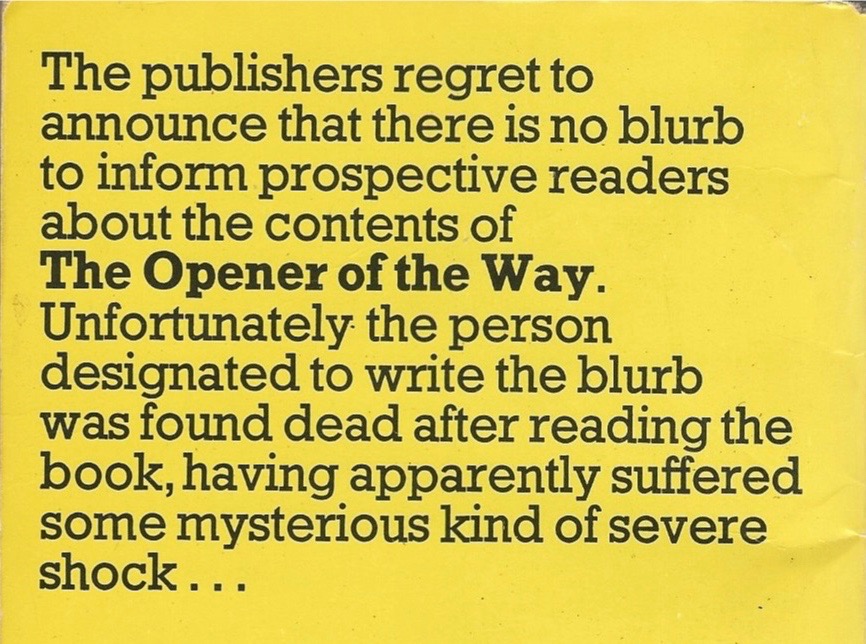
Yesterday I ran across Robert Bloch’s The Opener of the Way in a used bookstore. I’m not a fan of Bloch, nor of horror, but I bought it because I had to have a copy of the back blurb. I’ve reproduced the top half of it in the scan above. The bottom half, in extreme fine print, says:

(Actually, the Opener of the Way is a first-rate collection of ten terrifying tales of horror and the macabre, including some of the finest ever written about Ancient Egyptian curses, vampires, pacts with the Devil and others. We hope you ‘enjoy’ them . . .)

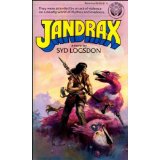
The fine print was more honest than most and the top part was downright clever. It isn’t usually that way. For example, the blurb on the back of my first novel Jandrax says:

As a scout he’d tamed four planets — and more women than most men ever see . . .

Now in truth, there is only one sentence in the novel that mentions, in passing, that first-in scouts are famous for being rowdy when between assignments.

The back blurb on Jandrax is in three parts, each flamboyant in the style you would find on old westerns. Setting aside the gosh-wow tone, the first and third section are accurate enough in content, but that middle section makes Jandrax sound like astro-porn.

There are two problems with this. Anyone who buys the book expecting a sexy, racy delight, will be terribly disappointed. And anyone who wants a serious portrayal of how space exploration might actually look will probably turn away. Based on the phrase more women than most men ever see, I wouldn’t buy the book myself.

True cliché: You only get one chance to make a first impression. The blurb is where authors make their first impression, and if the publisher blows it, authors are the ones who suffer. 

My second novel A Fond Farewell to Dying has a front blurb that says (in all caps):

WHAT PRICE LIFE? SURRENDER YOUR BODY! GIVE UP YOUR SOUL!

Yech! Sorry folks, that also has nothing to do with the story inside. Neither does the angel blowing the last trump over four zombies in boxes, but bad cover art is a subject for another post. FFTD is about an atheist who tries to come up with a mechanical version of immortality, and succeeds without the universe taking revenge on him for hubris. The front cover, both art and blurb, gives a very different impression. In fact, I saw FFTD for sale on a spinner rack of Christian paperbacks in a supermarket. Someone there certainly got a surprise.

The back blurb was lengthy, given in three paragraphs. The first two were reasonably accurate, but the third was wildly misleading. That inaccuracy irritated me no end, but most blurbs are much worse. They often look like they were mixed up and placed on the wrong book.

I challenge you to take a handful of science fiction paperback novels which you have already read, look at the blurbs, and decide if they have anything to do with the novel as you remember it. If you get one match out of five tries you’ve probably won the jackpot.

Still, the opening statement in this post may be an overstatement. Perhaps every long-time writer used to hate blurbs would be more accurate. When Cyan was being prepared for publication, the folks at EDGE asked me to write my own blurb, and I have to admit that compressing a novel into a sentence or two is hard. I appreciated the chance, but now I have no one to blame.

449. Go Google Yourself

Cover by artist E. Rachael Hardcastle

This is mostly for and about writers; but then, most of you are or want to be writers.
There are two kinds of people in this world: those who Google themselves and those who don’t.
There are two kinds of people who Google themselves: those who admit it and those who don’t.
Me, I just do it for business reasons. That’s my story and I’m sticking to it.

All this came up because of a young author I occasionally converse with through post replies. J. M. Williams just published his first book The Adventures of Iric (a flash fiction collection). On the cover, his name appeared as JM Williams and he asked his followers about which worked better — J. M. or JM.

Actually, he has bigger problems than that. J. M. Williams, written either way, is not sufficiently unique in our internet world. When I went to Amazon to buy his book, he was nowhere to be found. Instead, the J. M. Williams who wrote A Legacy of Magi: A Mystic’s Path popped up. Different book, different author.

This is the second time I have had this problem. I met Thomas Watson, author of the War of the Second Iteration series at Westercon, picked up his book Chance Encounters, and found him a pleasant person to talk to. When I wanted to see what a short story sold separately as an e-publication looked like, I went to Amazon and bought one by Thomas Watson. Bad idea; it was a mess, full of blood, guts, and bad writing, because it was by a different Thomas Watson.

If J. M. Williams and Thomas Watson have this problem, what would it be like for John Smith?

If these seem like shameless plugs, so be it. I liked Chance Encounters. I have just begun Adventures of Iric and am enjoying it already.

Personally, I have the childhood misfortune of being Sydney Franklin Logsdon. The first name is from my father, who was named after a great aunt. The middle name is from my grandfather. Logsdon is unspellable and unpronouncable. That triple consonant — gsd — does not roll off the tongue. Even shortened to Syd, my name is a little girlie, which was a big deal growing up in an Oklahoma cow town. In high school I went by Log, except for a few of the smart alecks in math class who called me Logarithm.

An odd name turned out to be a godsend on the internet. The first time I googled my name, it was mostly me, not a thousand strangers using my name. When I bought the URL for my website (sydlogsdon.com), no one else had snatched it up.

J. M. Williams’ announcement of his first novel reminded me that I hadn’t googled myself recently, so I did it again.

I found a few posts by or about Sydney Logsdon, a young girl who is heavily into sports and into posting pictures of herself. The last time I did a self-google, about a year ago, she was all over the internet, but not so much this time. Perhaps she moved on, or maybe she got married and is still out there under her new name.

I found one obituary of my father — different middle name — with misspellings and no mention of children. The internet has a lot of accuracy problems.

I found a Myspace music mix by Sydney Logsdon aka dumbgirl98. She is probably a namesake I don’t want to meet.

I found quite a few references to my newest novel Cyan. I found a ton of advertisements from used bookstores selling Jandrax or A Fond Farewell to Dying. One of them was in French. I even saw one in German, touting Todesgesänge, the translation of FFTD. It had a review I couldn’t read.

I found a review I hadn’t seen before for FFTD. In English, this time. That also gave me a new old-SF review site to follow.

I found somebody with my name telling how to make slime.

I found a number of sites selling illegal copies of my novels as ebooks. You won’t be surprised to see that I am not including a link to any of them.

What I didn’t see, was a hundred other people using my name. I dodged that bullet.

If you are a writer, or want to be, and your name is Avant B. Jones, don’t use A. B. Jones as the name on your novel. If your name is Bill Smith, you might consider a pseudonym. It’s a matter of branding, and it gives you something to think about while you are waiting for your first book to hit the internet.

415. Life-long Day Job

After twenty some years of teaching
science, I finally got a lab.  SL

Continuing from Monday’s post — Jandrax came out and I went back to writing full time. Those were the years of A Fond Farewell to Dying, Todesgesanga (FFTD translated to German) Valley of the Menhir, Scourge of Heaven, Who Once Were Kin, and the first iteration of Cyan. I know you’ve never seen half of those books, but you will. I promise.

There is no better feeing than sitting down every day and writing, when the results are good. And they were. However, there are few more frustrating feelings than writing good books that don’t sell. After most of a decade of full time writing, it was clear that I couldn’t go on that way, and equally clear that I couldn’t quit. I needed a day job that would leave me some time for writing.

My wife suggested that I substitute teach. The pay was good (compared to minimum wage) and I didn’t have to look for jobs. I signed up, and the jobs came to me. It worked as a stopgap.

I couldn’t do it again, after being an actual teacher. Substitute teaching is to teaching, as going to the dentist is to being a dentist. The best one word description is probably painful.

However, I didn’t feel that way at the time. Yes, the job was boring, and yes, it was glorified babysitting, but I had made a shocking discovery.

I liked the kids. A lot.

You have to understand, I was an only child, raised on a farm, having little contact with other kids. I never had children of my own — by choice. To me, babies are just pre-humans. Kids under ten bore the hell out of me. But these kids were interesting and fun to be around.

I had discovered that middle school kids are more fun than a bucket of puppies. I realize that I am a minority in that opinion, and I also realize that part of my feeling comes from not having to take them home with me, but there it is.

Most teachers want to teach high school or fourth grade. Not me. My days as a substitute teacher in high school were dismal. My days teaching kindergarten were horrific. But middle school was my Goldilocks age — not too young, not too old.

By that time I had two masters degrees, so it didn’t take long to tack on a teaching credential. I took a job in one of the schools where I had substituted and I was still there twenty-seven years later.

In my mind, it was a day job. I continued writing. I continued working on the novels which weren’t quite right, and I wrote Raven’s Run. Years went by. I wrote a novel about teaching, Symphony in a Minor Key, which is running over in Serial right now.

I could tell you all about my first years, describe my first room, and give you insights into the joys and pains of teaching — except that I already have, in Symphony.

After about ten years, it was obvious that I wan’t going to get back to full time writing any time soon. After another decade, I admitted to myself that I wasn’t just a writer who was teaching. I was a teacher. It took me that long to be able to say it without having it sound like a defeat. I never stopped being a writer. I just became a teacher as well. I had two careers, parallel and simultaneous, and there was nothing wrong with that.

I was a writer, and a good one. I was a teacher, and a good one. Nothing wrong with that. After about twenty five years, I could even call myself a teacher out loud.

Now I am a retired teacher, and a full time writer again, with a new book out and another working its way through the computer. But I wouldn’t trade those years of teaching for anything.

384. How to Sign an Ebook

I was involved in a book signing years ago, and had/will have two at Westercon. [Two weeks from now as I write this, one week ago as you read it.] Which begs the question — how do you sign an eBook? I’ll answer that below, but first . . .

Jandrax came out in 1978, and the Stacey’s book store in the local mall invited me to do a signing.

READERS PLEASE NOTE: THIS POST HAS BEEN HIJACKED BY REALITY.

After writing that last sentence, I did a quick internet search to see what happened to Stacey’s. I knew it disappeared later, but I couldn’t remember what year. I discovered that my Stacey’s was a spin-off of the well known San Francisco store and I had to work my way through obituaries to that great institution. I finally found someone who knew the fate of my local store. It closed in 1994. To quote my source

 . . . in 1994, Borders and Waldenbooks joined forces – and like a tidal wave of orcs, they swept across the land, mercilessly engulfing independent bookstores. Ashes to ashes, Stacey’s.  RIP, The Bookstore in Modesto.

Waldenbooks? I had completely forgotten them. They used to be at the other end of the mall, but they too are gone with the wind. I liked that store. I also liked both of the Borders stores that were within driving distance. Barnes and Nobel wiped them out years ago.

The upside is that Barnes and Nobel is also a fine bookstore with two local outlets. Today it is beleaguered by Amazon. If they go I’ll miss them, too.

I also miss The Bookstore, a true independent in another location across town. It was replaced by a Christian bookstore. The Christian bookstore went out of business later. Apparently, not even God can fight The Big Book Monopoly.

Because I like old books, and because I am usually short of cash, I shop at used bookstores. There are half a dozen in my five county area, but I also know of another ten, all of which have gone bankrupt in the last two decades. Ironically, when I want an old book that isn’t available locally, I buy from used bookstores on the internet — brokered by Amazon.

If you want to buy my latest novel, Cyan, you have to go to Amazon for now, where you can download it or order it in paperback. On July 17 it will become available everywhere. That is, everywhere on the internet.

The internet giveth, and the internet taketh away. That’s not a battle cry, just a recognition of the reality of change.

So back to what I was saying:  Jandrax came out in 1978, and the Stacey’s book store in the local mall invited me to do a signing. It was great fun, although most people stopped, smiled, looked, and left without buying a copy.

When things got slow, the manager explained some of the financial realities of his life. He said that when books came in, and didn’t sell, it would cost too much to send them back. They simply ripped the covers off and sent them back instead, for full credit against their account. Then they threw the coverless books into the dumpster.

He pulled a copy of Silmarillion, just published, off the shelf, tore off the cover, and gave it to me. He said he would return the cover and it wouldn’t cost him a dime.

I took it. I didn’t want to insult my host, but I felt guilty at the time, and I still do. It sits on a shelf in my library, an odd souvenir of my book signing. I still haven’t been able to force myself through it, so it remains unread. Tolkien without hobbits is a hard go.

I thought of that event three years later when A Fond Farewell to Dying came out with a cover that was — not beautiful. It didn’t sell. I had a vision of book store managers everywhere taking one look at the cover, deciding it wouldn’t sell, ripping it off for credit, and tossing FFTD into the dumpster, as unread as my copy of Silmarillion. Maybe that is just me making excuses.

Maybe not.

So here we are, back in the present. I have two book signings coming at Westercon, and Cyan is primarily an eBook. What to do? EDGE, my publisher, allows me to buy print-on-demand copies, so I ordered 50. I’ll keep some for myself and take the others along.

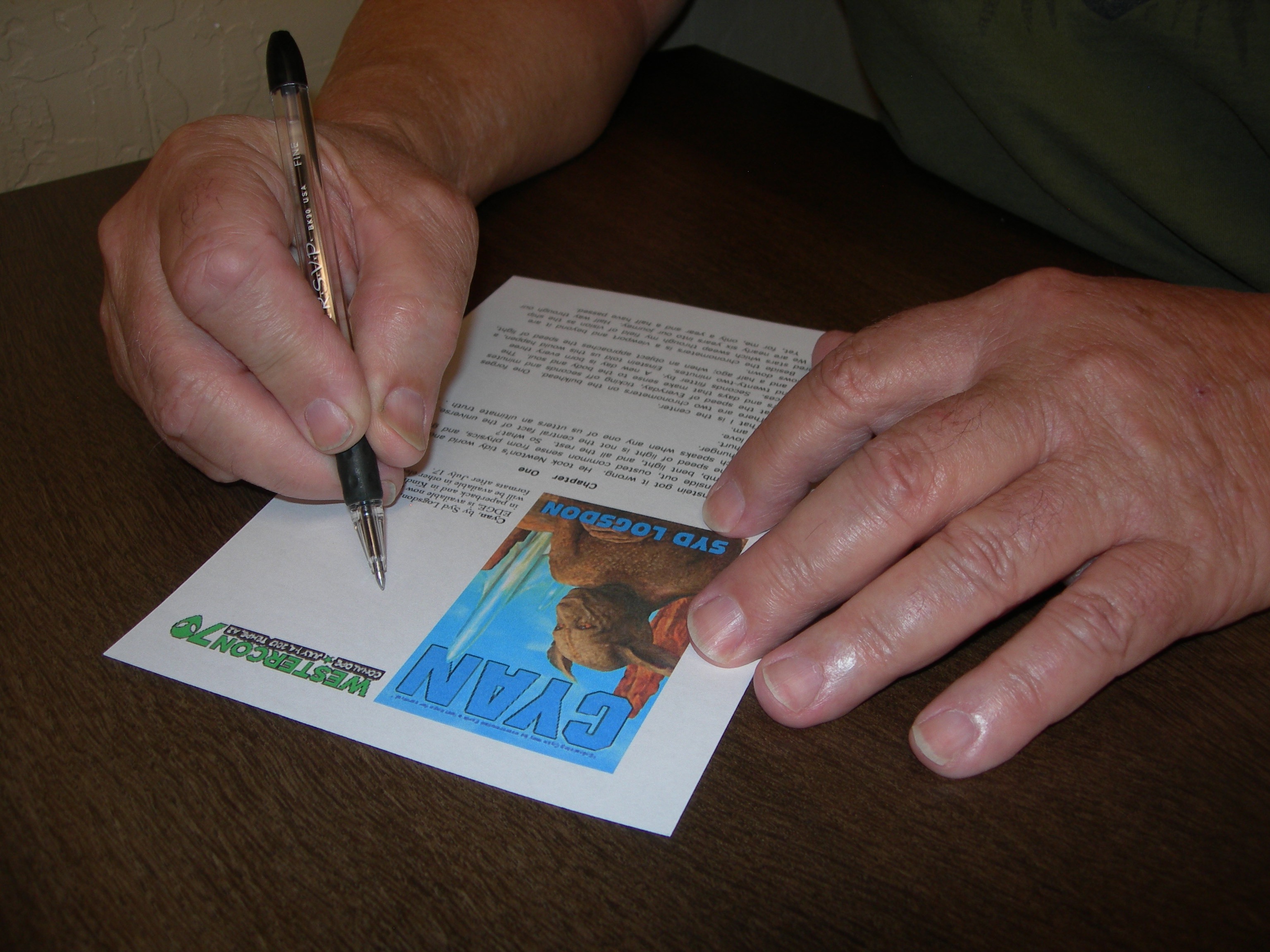
For the other thousand people at Westercon, I am making up a half-page, double-sided sheet with a thumbnail of Cyan’s cover, the Westercon logo, and a sample of text from chapter one. It amounts to a come-on for the eBook and a weird souvenir for those who attend Westercon. At least it gives me something to sign at the “book” signing.

Still, it was more fun signing a physical book.

Alien Autopsy (3)

Imagined alien life forms can range from nearly human to outrageously strange. They can be imagined to meet story needs, or imagined first, with stories arising from their peculiarities.

Actually we can do even more. We can imagine whole ecologies. And again, we can go from minimalist to extreme. Arzor from Norton’s Beast Master is suspiciously like the American southwest, but Dune is a desert with an ecology quite a bit developed beyond any desert on Earth.

My first science fiction novel Jandrax [see note at the bottom of the page] is set on a deeply frozen planet, with only the equatorial region ice free. The only area I developed was a plain roughly a thousand miles across, centering on a massive freshwater lake. I stranded a starship with a load of fundamentalist passengers and a relatively unreligious crew, and watched the fireworks as they found two quite different ways of coping with the local ecology.

The area in question never sees rain, but during the cold season, snow and sleet falls, then melts during the (slightly) warm season. Viewed locally, this results in a dead season of snow, a brief season of wild plant growth during which massive migratory herds move through, and then a long season of dry, warm aftermath until the churned and destroyed vegetation is covered with new snow, where it and its seeds will wait for the next melt.

Viewed from the starship stranded in orbit, there is a moving line of green, eating up a mass of white, and followed by a growing gray, brown temporary desert.

I won’t tell you what happens to the people. That would be a spoiler to a book I’m hoping you will still read. Instead, let’s look at the alien creatures, starting with the herbivores.

Herbies are burrow bodied, tapir headed, fleet and harmless. Humpox don’t get much description, but don’t need it, with that name. Trihorns are as deadly as they sound. All are mammals, as are the carnivorous longnecks and krats. There are also huge carnivorous toothed birds called leers. They ended up on the cover.

These are the deliberately realistic creatures, all mammals and birds, devised in an era when warm blooded dinosaurs had not yet reached public awareness. In another part of the book, there is an interlude on an island which may be a hallucination or perhaps an encounter with the local version of God. Here the rules of realism don’t fully apply, and we find winged people who would never stand up to the laws of aerodynamics, and an insufferably cute, seal-faced, plump flying mammal called a dilwildi.

The example of Jandrax goes straight to the notion of purpose. Weird critters for the sake of weird critters is entirely valid. I love a weird critter novel. But Jandrax was my first full fledged novel, designed to show human interaction in a harsh, ice-age environment. It contains an entire religion, devised for the purpose of providing conflict. The ecology of the world was central to the story, and it was developed, but the individual alien creatures just needed to look right in an ice age environment. Nortonian minimalism is at work here.

#               #               #

I was in high school when I  first read Richard McKenna ’s novella Hunter, Come Home. It was a deeply moving, human story of manhood, honor, and love. It also had a second dimension, the description of an entire sentient ecosystem in peril and fighting back.

Here is a brief summary. Mordinmen were descendants of a lost Earth colony which had fought a generations long war against the dinosaur-like creatures which inhabited their planet. Manhood had become symbolized by the killing of a dino, but now the dinos were scarce and poor families, like Roy Craig’s, could no longer afford a hunt.

Mordinmen had now claimed another planet and were setting about to destroy its native ecosystem, in order to rebuild it in the image of their home planet. Red dots (successful hunters) were running the show, assisted by blankies like Roy who was working toward the time he could make his kill on the new planet. Hired as specialists, the Belconti biologists were providing the virus-like Thanasis used to destroy the native life.

When the story begins, the fight to transform this new planet has been going on for decades, and it is failing. Now the Mordinmen, against warnings by the Belacaonti, are about to unleash newer, harsher, more dangerous plague on the planet.

That’s about as far as I can summarize without a spoiler alert. Roy Craig wants more than anything to be a full fledged member of his machismo society, but his blanky status leaves him marginalized and frustrated. At the same time, he is drawn to the relatively gentle society of the Belaconti with whom is is working, symbolized for him by the woman Midori Blake.

Other than the dinosaur like creatures imported by the Mordinmen, there is only one other alien species — the entire planet they are all on. The native life of the planet is totally interconnected, essentially a one-world-tree (shades of Gaia).

There is a three way contrast in Hunter, Come Home. The Mordinmen, from a macho society built on killing are placed in contrast to the Belaconti, scientists who understand and treasure the ecosystem they are trying to destroy, and they in turn are contrasted to the interlocked, semi-sentient native life of the planet. Roy and Midori are each caught in conflicting loyalties as the planned apocalypse moves forward.

This is one of those cases where world building, culture building, and alien species building work together seamlessly. more tomorrow

Click here for next post.

[You can find Jandrax in used book stores. It is also available on this website, in an annotated form. Eventually it will be placed in Backfile, but I’ve been busy. I you want to read it here and now, your best bet for navigation is to begin by clicking the March 2016 archive and find Jandrax 2, then read and slide up, skipping every other post — archives alternates posts from the two blogs on this site. It is a bit of a pain. You can get Jandrax most days through Amazon’s cadre of used book stores. If you want the annotated version, in which I explain the various foibles of a young author, I plan to put it into an easily accessed form in Backfile, as soon after Westercon as I can find the time.]

253. Handgun Accuracy

2-gunsOver in Serial, the chapter Raven’s Run 42 came out yesterday. This post was supposed to stand across from it, but Leonard Cohen’s death caused me to push Handgun Accuracy back a day to make room for an appreciation of what he meant to me.

Everything in the night drive through Martigues and the Barre Lagoon in yesterday’s post is from research. I was never there. But I was in Marseille and everything there is from experience. You have to have some first hand knowledge, mixed with research, if you want to look like you know everything.

The bit with the .45 automatic is also accurate, and from experience. I only fired an M1911A1 once in the Navy, in boot camp, but years later I acquainted myself with it and a large variety of other handguns at a firing range near my home. I spent an hour a week there, every Tuesday for a year, and became proficient with the two dozen styles and calibers they had for rent. That was partly for writing research, and partly because we live in a dangerous world.

You have to be able to describe handgun usage accurately for the kind of fiction I write. And yes, this post title has that double meaning, like the NRA bumper sticker that says Gun Control Means Using Both Hands. I could never resist a bad joke.

Accuracy is important in science fiction weaponry as well. In Jandrax, Jan’s “express pistol” was a technologically advanced weapon that was fairly fully explained, while the other weapons were nineteenth century technology because they were meant to be repairable on a frontier world.

In Cyan, due out soon, the explorers are operating in the near future. I decided to give them handguns only slightly advanced over the present day for their initial exploration, as in:

“Gus carried a comped 12mm magnum semi-automatic in a cross draw holster.“

This led the proofreader at EDGE to highlight comped and write “?”. (See 134. The Long Road to Cyan (2) for details on proofreading in the modern era.)

Comped actually refers to mid-twentieth century technology. I replied:

Comped, pronounced compt, not comp-ed, is a standard term. It comes from compensated, and refers to a series of slits on either side of the front sight of a heavy handgun, which redirects some of the expanding gasses upward, counteracting muzzle flip. Gun nerds will know the term; others will just be puzzled.

The cross draw holster is reasonable, but it is mentioned early because it sets up a plot point I would need about forty pages later.  And 12mm magnum will certainly ruffle the hackles of purists, but again, it is so named for a reason. The largest caliber presently designated in millimeters is 10mm and magnum is applied to a new, more powerful version of an old caliber. This means the 12mm magnum is two generations away – which is what I was looking for, a near-future version of present day technology.

I made these automatics obsolete during the colonization phase by introducing a handgun called a fletcher which was, in essence, a hand held rocket launcher. If you need a powerful, hand held weapon with little recoil, replacing bullets with mini-rockets is the simplest way forward.

You can only use phasers in Star Trek novels and no self respecting science fiction author will ever say “ray gun” again, but fletchers – certainly under a different name – will probably be available within a decade or so. High caliber handguns have just about reached the limits of human hand strength, even though all of them are comped today.

Keep your eye on future issues of Field and Stream for new developments.