
Tag Archives: literature

66. Five by Dickens

DSCN3975 Everybody knows the story of Scrooge. Everybody from Alistair Sim to the Muppets to his namesake duck has played him. I won’t waste your time talking about the story, but have you read him?

Everybody knows Dickens, but did you like him when you met him? I didn’t, in high school. Great Expectations was the most boring, pointless, excruciatingly unending experience of my reading life. My only expectation was that it had to end eventually, and my only hope was never to have to read Dickens again.

A Christmas Carol isn’t like that at all. It is a joy to read.

Marley was dead, to begin with. There is no doubt whatever about that. The register of his burial was signed by the clergyman, the clerk, the undertaker, and the chief mourner. Scrooge signed it. And Scrooge’s name was good upon ‘Change for anything he chose to put his hand to.

You can’t beat writing like that. And it’s short; it makes its point and shuts up.

There seems to be something magical, or at least natural, about novella length. A Christmas Carol and The Old Man and the Sea were both novellas, and either would have been destroyed if it had been stretched out to novel length.

(TOM&TS a novel? Forfend! You’d need the heart of a bookseller to make that claim.)

Dickens was in financial and artistic trouble when he wrote A Christmas Carol and it was the making of the rest of his career. You can get the whole story of its origin from either The Man Who Invented Christmas by Les Standiford or Inventing Scrooge by Carlo De Vito.

A Christmas Carol was prefigured by the story of Gabriel Grub, chapter 29 of The Pickwick Papers, a story within a story which is often reprinted separately today under the title “The Story of the Goblins Who Stole a Sexton.” Old Grubb was so miserable that he chose to spend Chrismas night in a graveyard to avoid human contact. Goblins caught him there and put him through miseries which led to his redemption. The parallel is obvious.

After the ringing success of A Christmas Carol, Dickens wrote another Christmas novella during each of the succeeding four years. These five little books were published together during Dickens lifetime as Christmas Books. That version, with original illustrations, is avaliable from the series The Oxford Illustrated Dickens.

That volume often appears in bookstores seasonally, but you don’t have to seek it out. There will be some kind of Dickens Christmas collection every year. I have in front of me A Christmas Carol and other Christmas Classics, 2012, Fall River Press, which has the five novellas and seventeen other Dickens seasonal stories. Again, however, there is nothing special about any particular version. The stories have been around a hundred and seventy years and they don’t change.

Yesterday, I saw this year’s version in Barnes and Noble, leather bound, red, with gold and white pen style illustrated cover. This version is called A Christmas Carol and other Christmas Stories. It looks like the kind of book you would put in the living room to impress your snooty guests, but the stories inside don’t care about the cover.

As a point of honesty, I slipped into the B&N website just now to confirm my memory. This version was the 300th book that came up when I searched Dickens Christmas. Obviously more people buy Dickens than read him.

A few years ago I decided to read one of the other stories each year at Christmas time. That isn’t as logical as it seems, since Christmas is not a time of leisure. I eventually got through three and a half of the other four. I read The Chimes first and enjoyed it. It was something of a Christmas Carol reprise, and not as good as the original, but worth reading. A Cricket on the Hearth was once the most popular of these books. I didn’t get through it, not because I wasn’t enjoying it, but because that was the year time did me in. I still plan to read it someday. Maybe June would be better. The other two were worthwhile but not earth shaking.

For the sake of completeness, the Dickens Christmas books, in order, are:
     A Christmas Carol
     The Chimes
     A Cricket on the Hearth
     The Battle of Life
     The Haunted Man
Symphony Christmas, 8 of 10

Because I intend to publish the novel from which this excerpt comes, Symphony Christmas will not be placed in Backfile.

They left together in Carmen’s car because they had a date to do some Christmas shopping at the mall. Neil had to get gifts for his mother and grandfather because this year school was running all the way to the twenty-third. He would have a day to drive to Oregon and no time to shop once he got there.

While they were walking through J. C. Penney’s, Neil said, “You know Rosa Alvarez?”

“Sure.”

“If you had to, could you pick out clothes that would fit her?”

“I guess so. Why?”

“She’s kind of chubby.”

“I know what she looks like. Why did you ask if I could pick out clothes for her?”

“Do you think her parents would mind if I bought her a jacket? She has been coming to school without one and it is really getting cold in the mornings.”

“I’m sure they wouldn’t mind, Neil. I could let them know so they won’t buy her one for Christmas, if they had planned to. When did you decide to do this?”

Neil shrugged, feeling embarrassed for no good reason. “I don’t know, she just looks so miserable every morning. She always heads for my room to warm up.”

Carmen smiled. “She doesn’t come there just to warm up. You have a fan club.”

That embarrassed Neil even more and Carmen laughed again.

She bought the jacket for him. It was nothing Neil would have chosen, but she assured him it was stylish as well as warm. He bought lesser presents for a dozen of his other students whose parents were poor. Carmen said, “Can you afford all this?”

“The only other people I have to buy for are my mother and grandfather.”

“And me!”

“Well, that goes without saying.”

“Say it anyway.”

He faced her suddenly and drew her back between some racks of clothing. His face was serious as he said, “Carmen, you are very precious to me. If I haven’t said it before, I’m saying it now.”

“Wow!” She put her hand on his chest and kissed him quickly. Then she pulled away and said, “People are looking. I don’t want the kids to catch us necking behind the lingerie.”

Neil was a little hurt by her response, until he saw moments later that she was wiping a tear from her eye. Sometimes – often – he didn’t know what to make of her.

“Carmen, I don’t want to give these presents at school. I don’t like to have the other kids feel that I’ve singled some of them out. Can you help me see that they get them?”

“Do you want to take them to their homes?”

“I’d rather stay behind the scenes. Could you see to it that they get them? Or I could take care of the little ones, but would you see to it that Rosa gets the jacket?”

“Why don’t you do it yourself?”

“I don’t want to intrude.”

She looked closely at him and said, “Are you sure that’s the reason?”    continued

Symphony Christmas, 7 of 10

Because I intend to publish the novel from which this excerpt comes, Symphony Christmas will not be placed in Backfile.

The morning after his candy trick, Stephanie had come to him with a proposition. Her church collected cans for the needy every Christmas. She thought their class should do the same thing.

Neil thought it was a wonderful idea. He called Mrs. Hagstrom and discussed it with her to make sure that the parents would not have any objection. The biggest problem Stephanie’s project presented was identifying the needy in the community and getting food to them without putting them in the spotlight.  Fortunately, Delores Zavala had lived in the district all her life and knew every adult, child, car, cat, dog, and everyone’s financial condition. She proved invaluable and Stephanie turned out to be an eleven year old dynamo. Within three days she had organized all her friends, and their friends, and their friends. That meant every child in the sixth grade. Two weeks after the idea was born, there was a seven foot stack of canned goods in the corner of Neil’s classroom.

*****

December was a busy month for them all, but particularly for Carmen whose mother became ill and began to take all her spare time. After two weeks Carmen was looking tired and complaining that she wasn’t getting any Christmas shopping done. Neil offered to sit with her mother to give her an evening off. Carmen accepted and Neil found, to his surprise, that Maria de la Vega spoke no English. Carmen had been so much at ease in her job, and so confident in the world she shared with him, that he had assumed her family was educated and English speaking.

He ended up having a great time. Mrs. de la Vega was past the worst of her illness and her zest for life had returned. She waited until Carmen had gone out, then got up and cooked Neil a delicious Mexican meal, ignoring his protests, and carrying on a one sided conversation in Spanish. Only their gestures and laughter were bilingual.

Carmen chewed him out royally for letting her mother out of bed. Neil said, “How was I to stop her?  Carmen had to admit that it would have been impossible.

Several days later, Carmen came in to see his can tree. She had only just heard of it from Delores. She said, “Why didn’t you tell me what you were doing? I would have ben glad to help.”

“I really didn’t do that much,” Neil explained. “Stephanie Hagstrom and her mother were the force behind it, and Delores agreed to do the distribution for us.”

“How did you ever get it started? I’ve tried to get my seventh graders to have some social conscience all year, and I’ve gotten nowhere.”

Neil explained about the candy trick. She said, “Good. Good. We need more of that kind of thing.” Then she gave him a dazzling smile, looked around to see that no students were near, and gave him a quick kiss.

“”What was that for? Not that I’m complaining.”

“That, Neil McCrae, is because you are a nice guy.”

“It took you long enough to notice.”

Her gaiety went away. Neil said, “What’s wrong?”

“Nothing. I don’t want to talk about it.”

“Are you sure?”

She nodded. “Someday I will,” she promised, “but not just now.”   continued

Symphony Christmas, 6 of 10

Because I intend to publish the novel from which this excerpt comes, Symphony Christmas will not be placed in Backfile.

Elanor has just realized something the other kids missed.

Elanor beamed.

Stephanie half raised her hand, withdrew it, then raised it again. Neil was pleased at this crack in her normal self-confidence. He nodded, and she said, “I guess it was fair that you gave the poor kids more candy. But now you said you are going to make it all even.”

“That’s right, I am. I do like to be fair.”

Stephanie squirmed in a perplexity of near understanding. Every atom of her body was involved in the moment. She said, “But then – why did you do it?”

“I didn’t do it for the poor kids.”

She just shook her head. She still didn’t get it.

“I did it for the rich kids.”

She was still blank, but trying so hard to understand.

“I did it so the kids who always get everything could just once, in one tiny way, know what it feels like to see others get something they want while they get nothing.”

Neil instructed his class to evaluate the lesson. If they wanted, they could look at it like Mr. Campbell would, or they could tell how it had affected them personally. Most of them wrote willingly; kids always do when they have something they really want to say.

That night he read their papers. Stephanie had said:

I always get a lot for Christmas and for birthdays. I always say thank you to my parents. I really do appreciate them. They are very good to me and I know it. 

Sometimes I see other kids parents being mean to them. They won’t let them play baseball or buy them things and I think how sad it would be to be like that. But sometimes I guess they don’t have much choice. Like if they have lost their jobs and they don’t have much money. I think it would be sad to live like that and I am glad my Daddy has a good job so we can live in a nice house and have nice things.

Your class made me see what it would be like to not have anything and to see other people get things. I wouldn’t like that, but I guess I needed to see it, so thank you Mr. McCrae for showing me.

Rosa had written:

We used to have alot at Christmas until my daddy lost his job, but we are still luky I guess cause we have more than some other poeple have  We hav plenty to eat even if it is beans alot of the time.  I like beans anyway  and if I don’t get nothing for chirismas this year thats alright because I got alot last year.

It would be easy, Neil thought, to see Stephanie as spoiled and Rosa as some kind of angel, but that wasn’t so. They were both just sweet eleven year old girls who hadn’t had much experience in the world. Giving them some of that experience was Neil’s job.    continued

Symphony Christmas, 5 of 10

Because I intend to publish the novel from which this excerpt comes, Symphony Christmas will not be placed in Backfile.

The class couldn’t decide whether to be upset at having to wait to read their papers, or happy at the thought of getting music instead of work. The last few students put down their pencils and Neil started the tape. Garfunkle sang with sweet melancholy about Mary, born in a trailer, who shone like a gem in a five-and-dime store. Without the music, the words would have meant little. With the music, it became a lament for loneliness and abandonment that even eleven year olds could understand.

After the last chord had died away, Neil shut off the machine and began to rewind. Laura Diaz said in a small voice, “Mr. McCrae, can we hear it again?” A dozen of the students added their appeals to hers.

“Sure,” Neil agreed. “First let me give you these. I typed up the words and ran them off so you could understand them better.”

This time through about half of the children followed the printed sheets as the music played.

“That was neat!”

“Yeah, but sad.”

“Neat but sad is exactly what I think of it,” Neil agreed. “Does anybody want to hear it one more time?”

They did, and it carried them to the break.

*****

When they came back, Oscar Teixeira accused him of deception by announcing, “Mr. McCrae, this wasn’t a real party and I never did get my candy!”

“You’re right. It wasn’t and you didn’t. This was something I cooked up to teach you something. We will have a real party on the twenty-third, and you will get your share of the candy in about five more minutes.

“Meanwhile, I want you all to think back to how you felt when you got your candy.”

Their faces told him that they remembered, and he could plot who had and hadn’t gotten candy by their smiles and frowns.

“All right, who can tell me why I gave more candy to some than to others?”

“‘Cause you wanted to,”  Tony replied.

Neil ignored him. Finally Sean Kelly said, “You gave lots of candy to the good kids and not much to the ones who aren’t good.”

“How much did you get, Sean?”

Those who sat near him and had seen his single piece of candy, laughed. Sean held up one finger.

“Sean, do you think you are a bad kid?”

“Well, I have been getting in trouble with Duarte.”

“Yes, you have, but that doesn’t make you a bad kid. And that wasn’t why I distributed the candy the way I did. I had another reason in mind.”

Duarte said in sudden disbelief, “You gave the Mexican kids more than you did the white kids!”

“Did I? If I did it was an accident. Or rather, it was because my reason has something to do with how your parents live.”

Suddenly Elanor had a realization  She shouted out, “You gave the poor kids more than you did the rich kids!” Then she raised her hand, because she had forgotten to do so in her excitement at understanding something the “smart” kids had missed.

“Elanor, you are absolutely right.”    continued

Symphony Christmas, 4 of 10

Because I intend to publish the novel from which this excerpt comes, Symphony Christmas will not be placed in Backfile.

Neil has distributed Christmas candy unevenly around his class of sixth graders.

“Mr. McCrae,” Stephanie Hagstrom demanded, standing bolt upright beside her seat in surprise and dismay, “what are you doing?  You can’t give some people more candy than others.  You just can’t.”

All the children were looking at him now. He nodded sagely and said, “Why can’t I?”

“It’s not fair.”

“Why do I have to be fair?”

Tony Caraveli was probably the only one enjoying the exercise. He had a pile of candy and he liked confusion. He shouted out, “Because the school board will get you for it.”

Neil had to grin. “Tony, you have a beautiful sense of how things really work. You are right. The school board would get mad at me. But what if I chose to ignore them?”

“You won’t.”

That part of the conversation wasn’t going where Neil wanted it to go, so he turned back to Stephanie who was still standing in the aisle looking like Liberty Leading the People. He asked, “Why do I have to be fair?  Is life fair?”

“Yes,” she said defiantly.

He raised his eyebrows and invited the rest of the class to comment. They all but shouted Stephanie down, and the essence of their opinion was that life was not fair. “All right,” he said, “I want you to think of one time when life was not fair to you.”

Almost every hand went up. Neil waved his arms and said, “Wait! Just wait. I want you to take three minutes to think of the very worst way life has been unfair to you. Now think!”

They couldn’t wait. They couldn’t stand it. They twitched; they seethed; they bubbled. It was like watching a pressure cooker. Finally Neil said, “Okay.”

This time, every hand went up, but Neil simply got to his feet and began distributing paper. “I want you to write down what you just thought of,” he said, and a collective sigh rolled through the room. 

“Mr. McCrae,” Bob Thorkelson whined, “can’t we just tell you?  Please.”

Neil shook his head.

“Please!”

“Write it.”

They knew from long experience that there was no appeal to the command to write. They took up their pencils and within seconds the room was silent except for the scratching of graphite on paper.

Meanwhile, Neil got his tape deck out from under the desk and put the Garfunkle tape in it. He had already cued it to the second cut on the back side. When most of the students had laid their pencils aside and raised their hands again, Neil said, “Since it’s a party, I thought we’d have some music.”

“Mr. McCrae,” Tanya wanted to know, “don’t we get to read our papers?”

“Later.”    continued

Symphony Christmas, 3 of 10

Because I intend to publish the novel from which this excerpt comes, Symphony Christmas will not be placed in Backfile.

Rosa desperately needed for someone to hold her, and tell her she was good and pure and valuable.

Neil could not. He could not touch Rosa, or any of his girls.  Carmen could and did, Fiona did when she was so inclined, Pearl mothered them all, and students came from everywhere to be hugged by Donna Clementi. But no student ventured near Glen Ulrich; and Tom Wright, young and friendly as he was, kept them at arm’s length.

Women teachers can hug and touch. It is expected of them. It is “motherly”. But let a man teacher touch his girls and he is a lecher; let him touch his boys and he is a pervert.

It isn’t fair, but it is the way of the world.

After a while, Neil went to his tape collection and put on Art Garfunkle’s first solo album. He juggled the fast forward until he found the cut he wanted, then listened to it twice through. Then he took pencil and paper and ran it through until he had the words copied down, then typed them onto a ditto master. 

*****

On his way to school the next morning, Neil stopped to buy a bag of Christmas candies. The first hour, the students read, and when they returned from their break to start the second period, Neil announced that they were going to have an early Christmas party.

That met with uniform approval, and none of it was silent. He added, “Just stay in your seats. Rafael, please give everyone a paper towel to use as a plate. I have some Christmas candy I’ll distribute as soon as Rafael has finished.”

Rafael worked quickly and a festive atmosphere filled the room. Neil waited until the boy had taken his seat again, then went around giving out candy.

He gave Duarte one piece, Sean one piece, Rafael five pieces, Laura Diaz eight pieces, Raul Fuentes six pieces, Stephanie one piece, and Oscar no candy at all; and so on, around the room.

As soon as they noticed, the fireworks began.

“Hey, you got more than I did.”

“Mr. McCrae, I only got one piece!” (This Neil ignored.)

“Get your hand out of my pile.” – “But you got more than I did.” – “So what?  Its mine now.”

“Mr. McCrae . . .?”

“Hey, what’s going on?”

“That’s no fair!”

“That’s cheap!”    continued

62. A Christmas Booklist

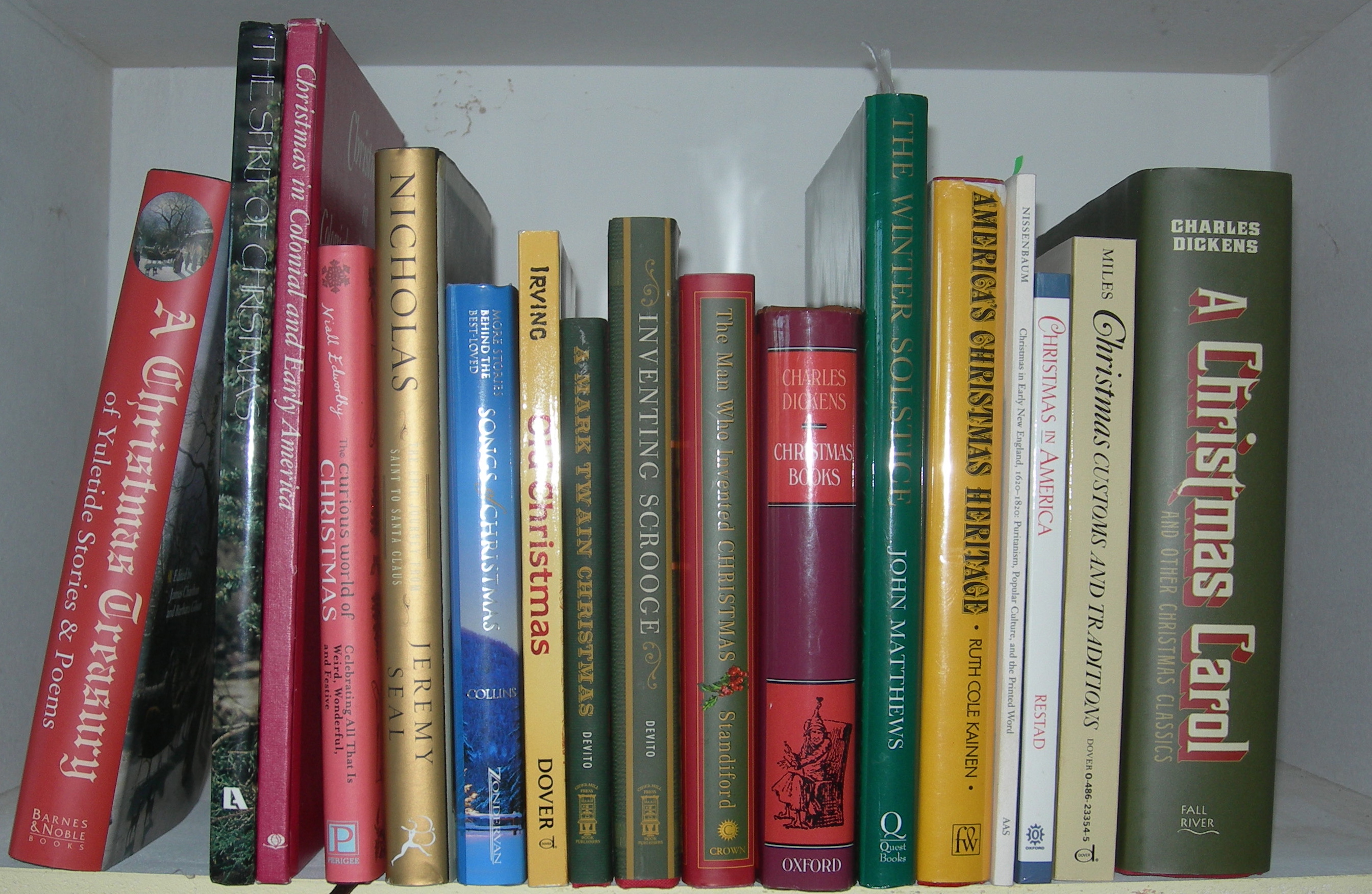
DSCN3974 Here is the annotated booklist I promised you yesterday. You could also Google Christmas or old Christmas, or search either of those subjects on Amazon. I suggest you do. This is not a best list because there are too many books on Christmas for anyone to have read them all. This is simply a list of what I’ve discovered over the years, minus the clinkers. Some of these are easy to find, others will lead you through the back stacks of used bookstores, but there’s no harm in that.

A Christmas Carol by Dickens has to head any list. He also wrote many other Christmas works and gets his own post next Wednesday, the 23rd.

Washington Irving had a powerful influence on Christmas, which is largely forgotten today. Among his followers was Clement Moore of Night Before Christmas fame. They also get their own post, on Christmas Eve.

The rest of this list is in order from decorator froth to historical complexity.

Go to any bookstore and you will find dozens of Christmas cookbooks and books on Christmas decor, sometimes with historical tidbits. You’re on you own here, with one exception. The Spirit of Christmas series by Leisure Arts is classy, has been around since about 1990, and fills up ten pages of Amazon with choices.

Christmas in Colonial and Early America, 1975, by World Book, is an early, sepia toned version of this kind of book with a little more meat in it’s history.

For almost two decades, Ace Collins has been writing books titled Stories Behind . . . , beginning with Stories Behind the Best-loved Songs of Christmas. The title tells the tale; the individual stories are interesting and heart felt.

The Curious World of Christmas is lightweight and breezy, a book of short entries which can be digested one little bite at a time.

The only recent Christmas book I can’t recommend is Nicholas, by Jeremy Seal. I found it dark and tedious, and couldn’t get past page 42, but if you want a detailed look at how St. Nicholas became Santa, it’s the only work I know completely devoted to that subject.

The Man Who Invented Christmas by Les Standiford and Inventing Scrooge by Carlo De Vito each tell the story of the genesis of Charles Dickens’ most famous story. As a writer and a lover of Christmas, I couldn’t choose between them. Read the one that is easier for you to find. Then read the other one next Christmas.

A Mark Twain Christmas has been sitting on my next shelf for a couple of weeks. I will give it a tentative approval based on a thumb-through, and the fact that it is also by Carlo De Vito.

A Christmas Treasury of Yuletide Stories and Poems by Charlton and Gilson has works by every famous author you’ve ever heard of, from St. Matthew through The Adventure of the Blue Carbuncle.

Ruth Kainen’s America’s Christmas Heritage contains well written regional histories of Christmas at a level of detail that is satisfying without being overwhelming.

John Matthews’ The Winter Solstice has a look similar to the decorator/cookbook works above, but with a unique twist. It concentrates on the Roman, Celtic, and Germanic contribution to Christmas. It feels like the Middle Ages, without falling into the trap of New Age Gaia worship.

Christmas Customs and Traditions by Clement Miles is a Dover reprint of a 1912 work. It is an old fashioned history of the evolution of Christmas from Roman times to what was then the present.

Christmas in America by Penne Restad is a scholarly telling of the history of American Christmas. 172 pages of text, 36 pages of notes. You get the picture; a book for the overeducated Christmas nerd, but it is still a good read.

The remaining “recommendations” are probably over the top.

I have in front of me Christmas in Early New England, 1620-1820: Puritanism, Popular Culture, and the Printed Word by Stephen Nissenbaum, published by the American Antiquarian Society. I have already confessed to having two masters degrees, one in Social Science and one in History. This is the kind of thing I used to read for a living. I still read them, but only if they are on a subject that really interests me. Nissenbaum taught at Amhurst; you will find his original research referenced in many of the less scholarly books above. His book The Battle for Christmas was a Pulitzer Prize finalist, but a scholarly work of 400 pages is not something to take on casually. I confess to not owning it; I read it on interlibrary loan years ago. If, however, you are a Christmas nerd and a history buff, it is available in paperback. Go for it; what have you got to lose?

Now it’s your turn. Since blog posts hang around forever, any reply you make to add your Christmas recommendations will remain attached, even if I repost this next Christmas.

Symphony Christmas, 2 of 10

Because I intend to publish the novel from which this excerpt comes, Symphony Christmas will not be placed in Backfile.

Neil is reading papers written by his sixth grade class.

Lauren Turner wrote:

Every year we go to my granmas house for christmas. she has a great big living room where we all put our presents. I get presents from my mom and dad but nobody else gives them to me. I mean I get presents, but my brother always gets twice as many and they are always neater than mine and i don’t think its fair ! ! ! !

Oscar Teixeira wrote:

My Dad gets me chemistry sets and sport shirts and ties and last year he got me a calculator. What I really want is a baseball mitt and a football.

Stephanie Hagstrom’s paper was well written, in beautiful handwriting, and decorated with candy canes in all four corners.  She detailed what presents she got last year, told how happy she was to have Christmas with her parents, and told what she expected to get this year.

Rosa Alvarez’s paper was not so well written, although it showed great progress for her. It said:

This year I don’t think we will have much of a Christmas because my Daddy has lost his job and Mommy’s job at the bank doesn’t give us much money.  My Oldest brother has gone back to Mexico, but Daddy said that what money we have will go to buy toys fo the little kids.  That’s OK, I don’t mind.

Neil lay back on his couch and wiped his eyes.

He remembered fellow teacher Carmen’s voice the first day they had looked at his students’ folders. Carmen had told him about Rosa. Then she had passed him Stephanie’s folder, and had said, “This is Rosa’s competition. She will take all your time if you let yourself be seduced by success. Stephanie will sound smart because she had mastered English; Rosa will sound stupid because she has not.

“The Stephanies of this world always get more than their fair share.”

He thought about them for a long time. He loved both girls, not merely in a vague way as he did all his students, but intensely and personally because they had both come early to his attention and he knew them well. Stephanie knew her own worth; her parents had taught it to her early. But Rosa was one of the meek ones. She desperately needed for someone to hold her, and tell her she was good and pure and valuable.    continued

Symphony Christmas, 1 of 10

This is from the novel Symphony in a Minor Key, a complex book with a number of intertwined story strands. This excerpt describes the experiences of Neil McCrae, a teacher, during Christmas 1989, leaving out a good deal of material you would have to read the whole novel to follow. I particularly like this piece because it is not a story. It doesn’t have a beginning, middle, and end, and everything is not wrapped up in a shiny Christmas bow at finis.

Symphony Christmas
Because I intend to publish the novel from which this excerpt comes, Symphony Christmas will not be placed in Backfile.

On the day appointed for Neil’s evaluation, the principal came earlier than Neil had expected and sat down before the tardy bell had rung. The more mature students tried to look at him without seeming to do so. The others just stared. Neil rapped the desk for attention and took roll. Then he said, “I had intended to tell you today that Mr. Campbell would be coming by for evaluations, but he has gotten here sooner than I had expected. How many of you have been through these teacher evaluations before?”

Probably all of them had; a third of them remembered it well enough to raise their hands.

“Who can tell me what their previous teacher told them at evaluation time?”

Tony Caraveli thought he could remember. Neil distrusted the devilish look in his eye, but told him to go ahead.

“Make me look good!” Tony said.

The children all laughed, but it had a nervous and restrained sound. Bill Campbell did not react, which made them more nervous. Neil said, “Whoever told you that was probably joking.  Who else can tell me?”

Sabrina said, “Ms. Thompson told us to just be ourselves and act like there wasn’t anyone in the room.”

“Good. That is just what I want you to do. Ignore Mr. Campbell; it won’t hurt his feelings.”

This time the children’s laughter was more relaxed, and Bill acknowledged it with a wave of his hand.

Neil read to his class for twenty minutes from The House Without a Christmas Tree. He led a discussion about the story, and from that drew the children into talking about how their families celebrated the season. Neil made notes from their discussion on the chalkboard, then told them to write a paper on Christmas in their homes.

Neil’s lesson plan had been worthwhile but unexceptional. He had not intended for it to be earth shaking, but when he sat at home that night reading the papers, he found that he had cut close to the bone.

Casey Kruger wrote:

We don’t hav Christmas at our house.  My parents say that it is a peagan rittul.  Jesus was born in a stabul and din’t have any presents, so we don’t have any present either.  I wish we did.

I would really like to have a real Christmas this year.  continued