Tag Archives: memoir

334. Making Videos for Cyan

I know from visiting your websites, that a lot, maybe most, of you either are or want to be writers. I’ve talked about some of the mechanics of that, especially in posts 133 and 134. During the last month, I’ve learned some more about how books are marketed in the age of the internet. I’ve had to make videos.

That proved harder than I thought it would, partly because of technology. Don’t think I’m a Luddite – I’ve been a computer nut since 1986 – but I don’t own a video camera. i don’t have kids to record as they grow, and I have no interest is seeing myself moving about on the computer screen.

Most of those who make videos to promote their books do so on their smart phones. I don’t have a smart phone. It is my firm belief that Alexander Graham Bell was an emissary of the Devil. I communicate the way God intended, by email, where I can correct my mistakes before I push send.

I finally used the camera built into my Mac. It makes a shaky, Skype-like picture, but that works well enough if you hold still and go into talking-head mode.

I didn’t want to ramble, so I wrote a script and tried out some videos. They stank (that’s the grammatically correct word that morphed into stunk about twenty years ago). It turns out that a glib, casual, conversational tone takes a hell of a lot of rewrites. I should have remembered that. I had to learn it two years ago when I wrote my first posts. I don’t mean numbers 1, 2, 3 . . .. I mean the ones you never saw because I trash-canned them.

Writing two masters theses and a bunch of novels did not prepare me to write posts. I had to learn a whole new, casual style. This month I learned that written-casual is not the same as spoken-casual — even if it is written as a script before it is spoken. It took quite a few tries to make the transition.

Eventually I made three videos for Brian at EDGE and he will put them on Youtube. They are an introduction to Cyan, the story of why I wrote Cyan, and a reading from Cyan. The first is already up; click here.

I’ve also tacked on the script I used in the Introduction to Cyan.

____________________

Hi. Welcome to my world, or at least to one of them. I’ve always been a fan of near future novels of exploration. There are so many things about traveling at sub-light speed that make for a great story.

Besides, it won’t be long until scientists have charted the actual planets around all the nearby stars. Then we won’t be able to make up our own planets.

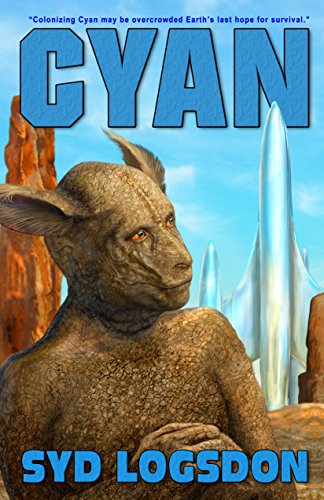
Put those ideas together and you have Cyan, which is the name of me newest novel and the name of the planet that it takes place on.

In the year 2080 a crew of five men and five women, scientists all, set out for Procyon where they find a planet that stands straight up in orbit, with bands of unvarying climates. About 45 degrees north, is paradise.

But paradise with teeth — virgin, wild, beautiful, but very dangerous. Keir, our crewleader’s task is to keep his fellow explorers alive. He’s good at his job, but on a planet crowded with predators, that may not be enough.

For these scientists from vastly overcrowded earth, after years confined within the starship, the beauty and emptiness of Cyan is intoxicating.

They have one year to decide if Cyan is suitable for colonists, and it turns out to be perfect. But then one of the scientists picks up a flaked stone. This is not a natural occurrence. Someone, or some thing, has made it.

The explorers have discovered the Cyl.

The Cyl are a stone age group. They look nothing like man and their intelligence is low, but they are about to become much more. Evolution moves quickly under Procyon’s intense radiation, and the Cyl are poised to make the leap to full intelligence.

Earth needs Cyan to ease its massive population, and the Cyl need to be left alone to find their own destiny. Lines are drawn among the explorers and the resolution of the problem threatens to tear them apart.

____________________

When you get your copy of Cyan, you will see that this introduction actually only covers the first fifth of the novel. Giving a full summary would have made the video far too long.

333. Arthur C. Clarke: The Big Re-write

This is a follow-on to yesterday’s post.

There is an intellectual challenge in comparing Clarke’s Against the Fall of Night to his The City and the Stars. I could easily see someone writing a thesis in an English Literature program comparing the two in great detail. That would certainly make more sense that a thousandth thesis on Joyce’s Ulysses.

Clarke’s first version of the work, written, published, and praised, just wouldn’t let go of his mind. I get that; it happen to me twice. (The won’t let go part, not the published and praised part.) My second serious novel, Valley of the Menhir, came to me as a fragment and grew piecemeal over four decades. Cyan rolled along smoothly, and was almost finished (at about half it’s present length) when I ran into a problem I couldn’t solve without destroying the basic structure of the book. It sat in manuscript for years before I realized a way out of my dilemma.

Of course Against the Fall of Night was already out there, but the idea that a book could nag at a writer for years and finally cause a rewrite — even after it was published — makes perfect sense to me.

Truthfully, however, these two novels are the same story. Clarke would not agree, but I think he stood too close to both his works to judge. There are differences between the two, of course, and Clarke considered them significant. They don’t seem so to me.

In the introduction to Against the Fall of Night, Clarke said:

Between 1937 and 1946, at least five versions, of ever increasing length, were developed.

He also said this, which we already noted yesterday:

. . . undoubtedly, much of the emotional basis came from my transplantation from the country (Somerset) to the city (London), when I joined the British Civil Service in 1936. The conflict between a pastoral and an urban way of life has haunted me ever since.

Many people before Clarke had written to that theme without creating anything as lasting as the city Diaspar. Many people after Clarke recycled Diaspar, under many names in many novels. The movie Logan’s Run comes to mind. Yesterday I spent an hour in a local used bookstore and saw several forgettable (and actually forgotten) novels where the hero escapes from or is exiled from a sealed city and finds himself in a sylvan, or at least archaic, world.

I am glad to have reread The City and the Stars, and to have read Against the Fall of Night for the first time, but I don’t think I could recommend either to a modern audience. The writing style is not stilted, but it doesn’t sing. The premise is good, but a modern reader will have seen it already in a hundred novels published since mid-last-century. Finally, Clarke fails in his stated prime intention. He does not give a sense of deep time. When he says that some aspect of Diaspar has lasted a billion years, he could have said a thousand years instead, and the feeling would have been the same. I don’t fault him for this; I think the task was an impossible one. A thousand years or a billion years are both the same size when measured against the only yardstick that matters — “Longer than I will live.”

Diaspar, glorious as it is in Clarke’s description, had stood for billions of years and then was utterly changed by one young man is what appears to be about a year. Such an effortless transition has neither resonance nor believability. What Alvin does is powerful and meaningful, and Clarke’s creation of Diaspar, Lys, the Seven Suns, and Vanamonde is worthy of praise. But the changes that happen come too easily for full satisfaction as a novel.

Both versions of the story of Diaspar were great books for their time. Nevertheless, a modern reader encountering them today might shrug and say, “This is all old stuff. I’ve seen all this before.” He would not realize that these two novels, through their many imitators, are the reason the ideas seem familiar.

This all reminds me of Jekyll and Hyde. Almost no one has read the original, unless forced to in a literature class, but everyone knows the story. So which is great — the imitators everyone has seen, or the original everyone has forgotten?

332. Arthur C. Clarke: The Two Diaspars

In 1949, Arthur C. Clarke wrote his first novel Against the Fall of Night. Four years later, he rewrote it, and gave it a new title, The City and the Stars. Clarke himself said that only about 25% of the first novel resided in the second. My arithmetic doesn’t add up with his. I see them as much closer to each other than that; in some ways, barely different.

If you want details, go to the Wikipedia article on the latter novel. There is a section of comparison between the two books where the differences are laid out, but I find them superficial.

I read Against the Fall of Night for the first time this month. The City and the Stars, on the other hand, was one of the first proper science fiction novels of my childhood, and a major influence on me.

I read it soon after I found the local public library. Clarke, Asimov, Heinlein, Norton and dozens of lesser science fiction writers were suddenly available, where I had previously only had Tom Swift Jr. to read. About then I was probably reading three books a week, and at least half were extremely forgettable.

This would have been about 1960 or 1961, when I was thirteen or fourteen. Clarke was my main man then. That seems entirely appropriate; I was just really learning to think, and Clarke was all head. By the seventies, I couldn’t read him any more. His prose doesn’t sing and his characters have neither heart nor cojones. They weren’t quite wooden, but they were at least cloistered.

Actually, most of all, they were extremely British. And so are these two novels. Here is a quote:

Since that far-off day, Man had explored the Universe and returned again to Earth — had won an empire, and had it wrestled from his grasp. p. 97

That’s from The City and the Stars, the one I read as a child. At that time my understanding of the twentieth century was shallow indeed. Reading it again fifty-some years later, it is clear that the novel is largely a product of its time and place. Clarke had just moved from Somerset to London and found the transition difficult. Hence the contrast between Diaspar the uber-city and Lys the sylvan paradise. Both books revolve around the elegiac feeling of a time when mankind had forged a stellar empire and then withdrawn to Earth when (as his main character believes) they were driven back from what they had conquered.

World War II had just concluded. It had driven a stake through the heart of the British Empire. India won its independence in 1947, and the fifties saw one after another of the old colonies become new countries. At home in Britain, it was a time of deep austerities as the British tried do rebuild their nation out of the ruins of war. 

America suffered during the war; I do not disparage her losses, but no one bombed our cities to rubble, nor destroyed our economy. The fifties in Britain were not like the happy days of hot rods, tract housing, TV, freeways, and kitchen appliances.

Reading Against the Fall of Night or The City and the Stars today, as an adult aware of twentieth century history, that background informs my reading much as it surely informed Clarke’s writing. In both novels, the closed city of Diaspar is the last bastion of mankind in an Earth gone to desert, in a universe on which man has turned his back. Alvin, the hero, is mankind’s last hope of recovery from those great losses. more tomorrow

326. Dogwood Spring

The California dogwoods are in bloom. Today (March 20) my wife and I took a drive along our favorite semi-secret road to see them. The road isn’t really secret, nor even secluded, but it is off the beaten track. People who don’t live on it, rarely use it. We wound through twists and turns, admiring the green fields and placid cattle, down a steep trail to a hairpin curve at the bottom where a vernal creek rushes through a culvert.

In summer, this is a pool and a trickle, but it has been an exceptionally wet spring and the steep hill behind the pool now provides a double waterfall. We stopped. I admired the bounty of water while my wife took pictures of the dogwoods.

Just at the point where the pool empties into the culvert, there was a clump of grass, rooted in a crack in the rock, partially submerged in the rushing stream. You could see that it had only been growing a few weeks, and shortly the water will fall. When that happens, there will not be soil enough to support the clump, and it will die. But for now, the clump of grass was wiggling and tossing in the water, happy as a hummingbird.

This quatrain occurred to me as I watched.

Though the bee did not come,
And the fruit did not form,
            It does not follow
That the blossom lived in vain.

Like any natural poem, you could apply it to a number of situations. Any un- or under-published author will know what I mean.

317. SF in the Wild

Cyan is now available for pre-order through Amazon, with the eBook arriving April 17th. Meanwhile, I plan to repeat a few year old-posts that were designed to stir the blood of would-be readers just before an earlier release date that didn’t happen.

——————————-

This post was originally number 128.          If you are what you eat, I used to be beefsteak, fried okra, and hominy. That comes from growing up in Oklahoma. I also lived outdoors most of the hours of every spring, summer, and fall day, and way too many hours of every winter day. That comes from growing up on a working farm.

If you are what you read, then I used to be an Andre Norton protagonist, at least in my imagination. Although I never met or corresponded with her, Andre Norton was something of a long distance mentor.

Alice Mary Norton legally changed her name to Andre Norton early on, in an era when being a woman was no help to a science fiction writer. I didn’t know that when I first read her; I thought Andre Norton was a man. Not that I thought about it much, but she didn’t write like a girl. Looking back, I see that she actually wrote like a person, but I wasn’t that sophisticated then.

One reason Norton got away with writing gender neutral fiction was that her characters spent most of their time alone. Even in their relationships with others of their own kind, they were loners, if not complete outcasts.

Star Man’s Son was the first Norton I read. In it, Fors spent all but a few pages on a quest away from his people; that was a pattern to which Norton frequently returned. I could easily identify with the solo quest while I spent endless hours alone on a tractor. The only variations in my daily life were whether I was pulling a disk or a hay rake, and which Norton novel was replaying in my head.

Every time Shann Lantee on Warlock, or Naill Renfro on Janus, or any of a dozen other young men found himself stranded alone, or nearly alone, on an alien world, I could look up from my tractor seat at the Oklahoma prairie and say, “Yup, been there.”

The best thing about Norton’s characters was that they didn’t whine about being alone. They liked it. So did I.

I didn’t live in a city until I went to college. I spent my adult life living in the suburbs of a reasonably small city, and taught school in a very small town. As soon as I could retire, I moved to a few acres in the foothills. I would move further out if I could afford it.

I was born not liking cities, and my opinion never changed. It should be no surprise that my first novel was about a hunter surviving alone in the woods, or that my first science fiction novel Jandrax was about a hundred or so humans stranded on an alien world.. My three fantasy novels have a rural and medieval feel. David Singer, in A Fond Farewell to Dying, is a mountain boy who has to go urban to get his life’s work done. And Cyan, due out soon, begins with ten explorers on an empty world, then continues with the story of the peopling that world by hyper-urbanized refugees from an overcrowded Earth.

You write what you’ve lived.

315. Apprentice in Science

fleming-schola-rs-1966For eight weeks in 1965, I was a Fleming Fellow (see yesterday’s post).

The gist of the program was that a Fellow was assigned to a research scientist as something like an apprentice. My personal research had been a hybrid of ecology and space science (see Tuesday’s post) Nothing like that was available in a medical research facility; instead, I was assigned to Dr. Gunnar Sevelius who was doing research on determining renal flow through use of radioisotopes. He had just finished editing Radioisotopes and Circulation the preceding year.

Dr. Sevelius gave me a small lab room and access to a supply of radioactive iodine, along with sensors for radioactivity and a strip chart recorder. He sat me down to talk about his work and tell me what he expected from me. He treated me as if I could figure things out for myself – which I could. I didn’t see him often after that, although I hung out with his young lab assistants.

I don’t need to give a lot of detail here. It has all been superseded.

Everything sophisticated in science was crude when it was being developed. Any kid in a high school metal shop today could reproduce one of Goddard’s original rockets — but only because Goddard taught them how. Any trained technician can slide you into a machine and look at images of the inside of your head — but only because to the work done by people like Dr. Sevelius. Everything at OMRF was cutting edge for 1965, and probably none of those machines are even stored in dusty basements any more. Science moves on, and quickly.

Computers? Video monitors? Forget it. A strip chart recorder had a moving roll of paper, a moving head with roll of typewriter ribbon and a striker that made a dash on the paper every time the sensor detected radioactivity. An image of a pair of kidneys looked something like this:

renal

You can see a strip chart recorder at the top of this post. That’s me in 1965, with a haircut that was already going out of fashion.

I learned a lot that summer, not least that I would never again spend eight weeks in a windowless room doing repetitive research. I love the results of science, but the doing of it can be damned boring. I also got to test myself against other smart kids, and be satisfied with the result. Every other Fleming fellow had done more sophisticated work than I had, but they were the products of sophisticated high school science programs, or the children of scientists.

There were lectures and activities for us. I met a scientist who had done research on the reaction of elephants to LSD — two years before I chose to avoid it when it became mind candy.

I learned about Michigan State, and was encouraged to apply there. I got a tour of the basement where research was being done using a sensory deprivation tank. Fifteen years later that became the basis for my second published novel.

I learned about the infamous Dr. Sexauer. From a former fellow, I got the names of two of my former incarnations, in a late night seance. Tidac and Javernan became characters in my three fantasy novels. I wrote about that incident, and it led to an odd occurrence. The OMRF was trying to find all its Fleming Fellows to prepare for the 60th anniversary of the program. I had mentioned the name of the girl who seemed to be running the ouija board. The OMRF had googled her name, found my post, and connected with me. It was good to hear from them again.

When I returned to my tiny high school that fall, I had touched the larger world and I would never turn back.

314. Fleming Fellows

300px-oklahoma_medical_research_foundation_nimaphoto by Nima Kasraie

The Oklahoma Medical Research Foundation is a major research institution, but not a household word. Let me explain its importance in my life.

Everything that happens to a writer passes into his memory, sinks to the bottom, and grinds around there, knocking sparks off every other experience. Years later, it emerges, transmogrified, as stories or parts of stories.

My soul as a writer and as a human being was forged on a small farm, working essentially full time in addition to going to school. I was an only child. School and home were kept strictly separated. Except for one treasured cousin, none of my school friends ever entered my house.

I was a very smart child in a very small place. I worked hard, got strong, and loved the outdoor life, but my mind lived in other worlds, brought to me by books of science fiction. I decided to become a scientist. In that pursuit, I was torn between space science and ecology. When I was a high school junior, I put those two together (yesterday’s post).

That same year, among the many standardized tests we took, was the test to become a Fleming Fellow. There was also an application to be filled out in which I was to explain my aspirations and offer any personal projects to prove my capacity. I wrote up my ecosystem in space project.

I was notified that I was a finalist, and scheduled for an interview in Oklahoma City. At that time, I knew almost nothing about the fellowship or the OMRF.

Incorporated in 1946, the Oklahoma Medical Research Foundation was dedicated in 1949 by Nobel Laureate Sir Alexander Fleming. In 1957, OMRF started a summer program for students, which was quickly named the Fleming Scholar Program. It has evolved over the years, but in that era, from four to seven Oklahoma High School juniors were recruited, and spent eight weeks at the OMRF the following summer.

In the spring of 1965, I sat before a panel of scientists for my interview. I had expected questions on science. Instead, they asked questions on meaning and morality. What did I think of the bombing of Hiroshima? What did I think of capital punishment? Behind the questioning, they were clearly trying to find out my level of self-confidence, as the interview became quite adversarial at times. After I said that I was still uncertain about my stance on executions, one of the scientists asked, rather sharply, “Don’t you think it is our duty to think about such things?” I remember being irritated at his high-handedness. I snapped back, “I didn’t say I hadn’t thought about it. I said I hadn’t decided yet.”

I said to the panel that I intended to pursue a Ph.D. The whole panel tried to convince me that I should be getting an M.D. instead. I held my ground, and when the interview was over, one of the panelists admitted that most of them had Ph.D.s, not M.D.s.

Fortunately, self-confidence – or arrogance, if you prefer – is something I have never lacked. I received a Fellowship. I’ll tell you about it tomorrow.

313. Weightless Ecology

ecoopwegt-lessI’ve been putting off this post since I started the blog. It’s embarrassing. I’m proud of what I did, but telling it makes me feel a little like one of those old guys who never stops talking about the night his forward pass won the big game.

Still, if I hadn’t done what I’m going to tell you about today, I would never have done what I did the summer after (tomorrow’s post), and if not for that, I would still be driving a tractor in Oklahoma. So here goes.

1964-5 was my junior year in high school. That was the year I took both junior and senior English because I was running out of classes to take, and that was the year I discovered science fairs. We didn’t have one in our tiny school, but their was a regional competition one county over. I had recently discovered Shirley Moore’s Science Projects Handbook, which was the bible for the science nuts (nerd wasn’t a word yet) of my generation.

America was in space; the Mercury project was completed and Gemini was waiting in the wings. I was enthralled with space, but also with ecology. Rachel Carson’s Silent Spring was about to make ecology a household word, but no one in my world had heard of it yet. I decided to put the two together and build an “Ecosystem Operable in Weightlessness”.

Lets get real. Boy scientist builds spaceship and flies to Arcturus only happens in the very old pulp stories. I wasn’t going to build something that would actually fly in space. It was an exercise in design, with as much building as I could pull off with limited resources.

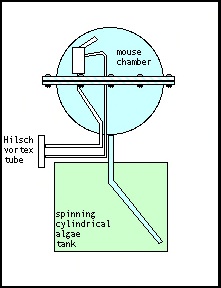
The idea was that at that time NASA needed to keep to keep some creature in weightlessness long enough to see what it would do to its body. Laika the Russian space dog hadn’t lasted long, and the longest Mercury flight had been 34 hours. I proposed a design that would put two mice in a closed ecosystem with algae. It was set up so that the algae tank would spin to provide just enough gravity to keep the water separate from the air, but the mice would be weightless in a separate chamber.

The fun was in the details. The mice would be housed in a two part plexiglas bubble, with a wire mesh floor at its equator. Waste would pass through he mesh, carried by the airstream and drop down into the algae tank.

That part actually got built. I made the algae tank of plexiglas, heated and formed around two round pieces of wood. I blew two half domes with a plywood form, an air compressor dragged up from shop class, and an oven borrowed from the home-ec teacher.

As I’ve said before, most of my education came outside of the classroom, thanks to indulgent teachers. They did the right thing, but it would get them fired if they did it today.

I bolted the half domes together through flanges formed during the blowing process. With two mice, Hing and Ho (named after the meerkats in Andre Norton’s Beast Master) in the upper chamber of the dome and a mass of Ankistrodesmus from a local stream in the algae chamber, connected by an aquarium pump, the ecosystem was as far finished as I could manage by the time of the science fair.

The physical result was limited by my resources, but the design went much further. To transfer the food to the mice, I had designed a pump, patterned after a Wankel engine (all the rage in Popular Mechanics that year). It was to send algae laden water up through a tube where it would be flushed over a fine mesh screen. The water would return to the tank on the airstream, leaving the algae for the mice to eat.

I did actually experiment with feeding them Ankistrodesmus. I strained it out of the water, dried it over a light bulb and passed the algae wafer into the mice’s cage. They went wild. You would have thought it was ice cream.

The design called for a small tube to carry a continuous airstream from above the algae water to strike the inside center of the upper dome, bringing the mice fresh air and carrying away waste as it returned. There a larger tube would carry the waste to the bottom of the algae tank.

To get water to the mice under weightlessness, the design called for the airstream from the algae tank to first pass through a Hilsch vortex tube, which split the airstream into hot and cold halves. The cold half was to pass between two thin metal plates. The warm (and moist) half of the air was to play onto the outside of these plates, leading to condensation and a continuous source of water for the mice to drink.

So why am I telling you this? Because this was the first step toward my future.

I didn’t know that at the time. I just did it because it was a challenge and more fun than I had ever had, but it led to a Fleming Fellowship, and that changed my life. more tomorrow.

312. Popular Science

full-futurecars-4When I was twelve or thirteen, my great grandfather said to me, “I used to read Popular Mechanics. You should, too.” And he handed me a quarter. It was the best piece of advice any relative ever gave me.

I bought my first popular science magazine, and I was hooked. I was soon buying three a month every month, and occasionally a fourth. Science and Mechanics, no longer published, was the best. Popular Science came next, then Popular Mechanics. Mechanix Illustrated was a lame imitation, but I always looked and occasionally bought, if there was a particularly interesting article.

In school, I usually devoured my science textbooks by the end of the first month of the school year. They provided an important, basic, bare bones understanding. But the popular science magazines put exciting flesh and blood on those bones. I learned more science from those three popular science magazines than I ever learned from a textbook.

Those were the days when GEMs were new. Ground effect machines, that is. There were articles that explained how they worked (what shape plenum chamber do you prefer?) but better still, there were articles that showed guys who had built their own out of plywood and a lawn mower engine, flying down the street of their suburban neighborhoods, six inches off the ground.

When I sent ten scientists to explore Cyan, they used skimmers, which were clearly ground effect machines.

There were always articles on how to take care of your car, and there was the new car issue every fall. You didn’t have to be a science nut to like cars.

There were always stories about the newest, hottest jet plane, including a story about a new safety device that gave pre-recorded error messages into the earphones of a pilot. The Air Force had discovered that the pilot never missed the message if the recording was a sultry female voice. Any thirteen year old boy in America could have told them that. The illustration of that article was a realistic drawing of a helmeted pilot with a tiny, bikini-clad femme whispering into his ear the words that would save him.

These guys knew their target audience.

Not everything between those covers would be politically correct today. I remember the pistol crossbow, a powerful hand-held weapon that shot sharpened six-inch pieces of quarter inch rod. Try making that in your seventh grade shop class. Maybe you could get a merit badge in Boy Scouts?

Probably not.

There were always articles on how to build something in your shop, about the latest tools, or about how to build the tools you couldn’t afford. I was hooked on that, too. My father was a farmer, not a craftsman. If a nail in a board would do the job, he was satisfied, and moved on to the next of an unending set of chores. I wanted more. I wanted to be a craftsman. Today I am, and these are the magazines that got me started on that path.

Eventually, I stopped reading popular science magazines. You can only read so many thousand articles at that level until you have absorbed enough. I moved on, but I didn’t forget how powerfully they ignite young imaginations.

When I became a teacher in a small middle school, all the other teachers were happy to load science onto me, and I was glad to accept. I taught all subjects the first year, but after that it was “science-and”. Every year I taught more science and less “and”.

The first year I subscribed to Popular Mechanics and Popular Science (Science and Mechanics was long dead), and soon I added Smithsonian Air and Space. I bought a magazine rack at a garage sale and put it up in my room. I never threw a magazine away until it was too tattered to read, and after a few years there were a hundred magazines in the rack.

Occasionally, at the end of an hour, there would be a few minutes to spare and I would say, “You can either do homework for another class, or read one of the science magazines.” It was the best advice I ever gave them.

And nobody chose homework.

309. Two Hands and a Knife

There has been an interesting rhubarb in the back stacks of Amazon, where that company acts as a conduit to a battalion of independent used bookstores. The controversy concerns a book/two books which is/are Two Hands and a Knife.

How’s that for convolution? Do I have your attention yet?

In 2003, Terry Gibson wrote a book called Two Hands and a Knife, a young adult survival story set in the Canadian wilderness. It garnered mixed and confusing reviews. It was almost as if the readers were reviewing two different books.

It turned out, they were.

In 1956, Warren Hastings Miller had also written a book called Two Hands and a Knife. I remember it well. I was in fifth grade at the time, in a tiny school, with no access to bookstores. Our school held a TAB book fair, and I bought Miller’s book. It was superb. I remember it better today, than I remember the books I read last week.

To be fair, it was also probably the first book I ever bought.

When Two Hands and a Knife came back onto my radar about a year ago, and seemed to be claimed by some modern author, my suspicions were aroused. Had some schmuck found an old copy and resold it as his own work?

No, it turns out, he hadn’t.

I made my way to the Amazon page which has a Look inside function and read the first chapters of the 2003 version. It was an entirely different book with the same title and similar plot. Of course, young-man-survives-the-wilderness is a sub-genre of its own, so plot similarities would be inevitable. Remember Hatchet?

Some of the reviewers of the 2003 book were clearly remembering their own distant childhood as well. Some reviewed Gibson’s book in glowing terms that showed clearly they had not read it, but were remembering the Miller book. Some noticed the difference, with disappointment. One hated Gibson’s book enough to give it one star and a “don’t buy”. A few reviewers had clearly read only Gibson’s book, and loved it.

If you’re curious, go to the page and go clear to the bottom. There are supposed to be eight reviews, but every time I go to this page, I only find five or six, and not always the same ones.

By now I’ve read enough of Terry Gibson’s book to know that it is reasonably well written, but not completely to my taste. Fair enough; I’m no longer the target audience. I have tried to find out who the author is, with little success. I did finally get a look at the back of the paperback cover in Google books and picked up this minimal biography.

Terry is a retired self-employed businessman. His love of the outdoors has taken him from North America and Europe to deep within the Amazon rain forest. It’s this ‘call of the wild’ that inspired Two Hands And A Knife, his first novel.  He currently resides in central Illinois with his wife Patricia.

This puts him pretty much in my generation. Did he read the Miller book as a child? Or not? Was it floating around in his sub-conscious? Or was Gibson’s book a conscious homage to Miller’s?

Don’t misunderstand. The 2003 book is not a rip-off, despite the crack you’ll find in Goodreads. It is an independent work. But we all have influences, ideas come from somewhere, and I find the entire process fascinating. In point of fact, Miller’s original Two Hands and a Knife was floating around in the back and front of my mind when I wrote my first novel Spirit Deer.

So Terry Gibson, if you someday google your own book title on a lazy afternoon, and stumble across this post, drop me a response. I’d love to talk.