Tag Archives: memoir

363. Masters: Coming to America

What sort of country would (the United States) have now if the Indians had had an Immigration Service when the Pilgrims set out in 1620?
John Masters

When I first read John Masters, something he said stuck with me. Before going to Westercon this year, I wanted to run down that quotation, and in doing so I found much more worth sharing. What he said about writing will appear here later, but today I want to give his insights on immigration, or, as he called it, his Seven Year’s War with the U. S. Immigration authorities.

For reasons detailed in his book, John Masters decided that, though he was an Englishman, there was no life for him in England, and that America should become his home. He applied for an immigrant visa, knowing that the British yearly quota of 65,000 was never filled. His reactions to the questions asked on the application form were humorous, but too long to place here. Apparently the questions were as inane then as they are now. (see 329. Green Card Blues and 361. Take This Test)

A week or so later, he was told that he would have to wait about four and a half years. He had been placed on the Indian quota. He went back to inquire and was told that American law only recognized the place of his birth, not his actual citizenship. Never mind that he was born in a British military hospital. Never mind that he was born of a British mother and a British father, stationed in the British army in a British controlled area. Never mind that a child born of an American parent (and it only takes one) anywhere in the world is an American citizen. Never mind that he was born in 1914, and India didn’t become a country until 1947. He was born in India, so he was on the India quota.

It was a good thing he hadn’t been born while his father was stationed in Greece. The Greek quota was eighty-one years. (Yes, that is not a misprint. 81 years.)

Masters decided to withdraw his application for an Immigrant visa, get a visitor’s visa, and work things out later. That was not allowed. Since he had applied for an immigrant visa, he was no longer eligible for a visitor’s visa. Too many others when facing impossible waits had made that same move, then disappeared once they were in America.

As you might guess, as a British Army officer with plenty of friends, he was eventually allowed a visitor’s visa, came to America, and managed to stay permanently, although with many additional bureaucratic battles.

Good thing he wasn’t actually Indian.

More to the point in 2017, good thing he wasn’t Mexican, or poor, or not a native English speaker.

Master’s comments on writing will come in later posts.

362. Masters of India

     Wasn’t it barely a week since I had thrilled to learn what was inscribed on the base of the Statue of LIberty:
          Give me you tired, your poor,
          Your huddled masses yearning to breathe free . . .
     What generosity, I had thought, what a marvel of welcome!
                         John Masters

We’ll let that quotation hang there, and return to it later. This post, and several more, are connected to John Masters’ third installment of autobiography, Pilgrim Son.

I read the first installment of his autobiography, Bugles and a Tiger, during the 1970s. Normally a military biography would be the last thing to interest me. Furthermore, I was in the Navy against my will at the time, it that made it even more unlikely. However, Masters was a famous novelist specializing in India, so I read Bugles . . ., and I was impressed.

I had just finished four years studying South Asia and was about to return to another year of the same. My experience had shown me that there is wisdom (and stupidity) in writing on all sides of any issue. Wiser’s The Hindu Jajmani System (anthropologist), Nehru’s The Discovery of India (nationalist agitator, then national leader) and Masters’ various works (officer in the British Army in India) all showed accurate views from different perspectives.

I skipped Masters’ second autobiography, The Road Past Mandalay because I had no interest in sharing the horrors of WW II’s Burmese campaign, but Pilgrim Son was about the start of his life as a writer. I was beginning to write, so I ate it up.

That was nearly four decades ago. One particular story from that book stayed with me, and sent me back to seek it out again. I found that the whole book was a gem, far better than I remembered, and with more than one brief bit worth sharing.

For one thing, Masters had a lot to say about immigrants. That had not stuck in my memory because it was not an issue in the early eighties when I first read Pilgrim Son.

I have to set the stage by reminding American readers, whose world historical knowledge is typically shallow, that India is an ancient culture, but is new as a nation. Until mid-last century, it was controlled by Britain. In 1947, what was then India was partitioned into India and Pakistan, and each part became a self-governing nation. Decades later, Pakistan also split, into Pakistan and Bangladesh. What had once been a more-or-less uniform culture divided into hundreds of petty kingdoms, was first unified under British rule, then split into three modern nations.

After several hundred years, members of the British Army and of the British governing class, many of whom had lived in India for generations, had to take ship for England. John Masters was one of those Englishmen who was born in India, had lived his life there, and now found himself an immigrant to his other homeland. He soon found that there was nothing for him in England, and became an immigrant to America, where he began his writing career. more tomorrow

359. Westercon Who?

I always think of Westercon as a big deal, but really, most people have never heard of it. Star Trek conventions, sure. Comicon, oh yes: especially since The Big Band Theory showed our four nerds in attendance.

Worldcon is the mother of all science fiction conventions, genealogically, although not in size. It began in 1939. Hugo Awards are handed out at Worldcon.

In 1948, local science fiction fans in the Los Angeles area decided to hold their own convention, because Worldcons were being held on the east coast, and coast to coast travel in 1948 was no small chore. The first Westercon drew 77 people — the first Worldcon had drawn 300.

You might say they have both grown since then. Conventions have also fragmented into specialty venues for fans of fantasy, comics, Star Trek, Star Wars, zombies, manga/anime and who knows how many others.

I love science fiction, but I’m not a fan. That means I read it a lot, read everything my favorite authors write, re-read frequently, and eventually became a writer myself. But since I’m not gregarious, and no one in my world shared my interest, I never talked to anyone about science fiction. Until this blog, that is.

Fans talk about their favorites, and also the %*#*@ jerks who are ruining the genre. They used to write fanzines, and now they produce webzines, websites, and pod casts. And they produce conventions, go to conventions, and volunteer at conventions.

I guess this website takes me half-way into fandom, since I have written quite a few appreciations of Heinlein, Clarke, Norton and others of my favorites. And now I’m volunteering as a presenter at Westercon 70 in Tempe, Arizona over the fourth of July weekend this year.

I’ve actually done this before (see How to Build a Culture), but it has been a while. I’m tentatively scheduled to be on five panels:

What made the golden age golden?
Fantasy world building
Alien autopsy: the biology of ET
Science & Technology versus Magic: what makes this such a compelling trope?
Fake it ’til you make it: a survivor’s guide for the introverted author

I’m not the kind of guy who can flop down behind a table with three or four people I’ve never met and pontificate. Not gregarious; as I said above. I will be preparing my thoughts on these topics over the next month, and as I do, I’ll be sharing them in the form of posts. That way you will be in on things, even it you don’t make it to Tempe. This will work well with Spirit Deer in Serial. That short, short novel is going to turn into a bit of a how-to through posts over on this side, and that will work well alternating with how-to posts made in preparation for Westercon.

This should be fun.

356. Raven and Ian

Raven and Ian are saying goodbye today over in Serial. I’ll miss them. I read A Writing Life and Serial every day, just like some of you. In my case, it is a final check for typos, but I still feel for my characters.

If you write, and you don’t enjoy reading your own work, what is the point?

Will we see them again? Will Raven find what she is looking for? Will they come together again at the end?

Beats me.

I do know that if they find final happiness, it will be an epilog, not a novel. Settled, happy people make for good lives, but not good stories.

As for Ian, he has that Cameron Davis thing hanging over his head. I have some ideas about that.

In his immediate future, there is a meeting with an old friend of his mentor Joe Dias’, who has need of a troubleshooter. It seems that in 1990, most of the world opposes German reunification, including Bush One. A healed Germany might pose a threat, and a broken Germany provides a lot of opportunities for a lot of different groups of people.

Then there is that legendary (or is it) cache of Luger pistols, built in the last days of the Third Reich and hidden away to arm a future Nazi resurgence. Or to arm any one of several other groups who are after them. And there is that girl, whose brother was imprisoned in East Berlin when Ian was stationed there, years earlier. She shows up again. And there is Sergeant Davenport, Ian’s mentor when he was in Berlin, now in federal prison.

Ian has a lot of backstory to present. Will he get the chance?

Beats me.

I’m willing, but Ian in Berlin (it doesn’t have a title yet) is only one of a dozen stories waiting to be written. Which one I will start next depends on a lot of factors. I’ll let you know.

*          *          *

When I began placing Raven’s Run in Serial, I had intended to publish it independently as an eBook. I had hoped and planned to make an announcement of its publication date in this post. Such publication will probably still happen, but marketing Cyan has taken up so much of my time that it has been moved to the indeterminate future.

Most of the things I have presented in Serial have been moved afterward to Backfile and remain there to be read by anyone who checks in. Even To Go Not Gently is there, and Jandrax will be there later, although both were published years ago.  To Go Not Gently is from an issue of Galaxy that is not almost impossible to find, and Jandrax has so much commentary in the posted version that it has become a virtual how-to, and needs to live a separate life from copies still available in used book stores.

Those presentations which I intend to publish independently, such as Raven’s Run, will to be removed from Serial and not placed in Backfile, but this may not happen immediately.

Jandrax is still there because it takes a lot of time to make the transition. Marking out the virtual chapters is a real pain, as is transferring bits that originally appeared in A Writing Life, but eventually it will be placed en bloc so that it is easier to read. For now it remains as 92 individual posts in Serial and a few more in A Writing Life.

Also for now, Raven’s Run will remain as individual posts in Serial for a while. That way you won’t be stranded if you came in late and are still catching up.

Confusing? Welcome to my life.

354. Cattle Junkies

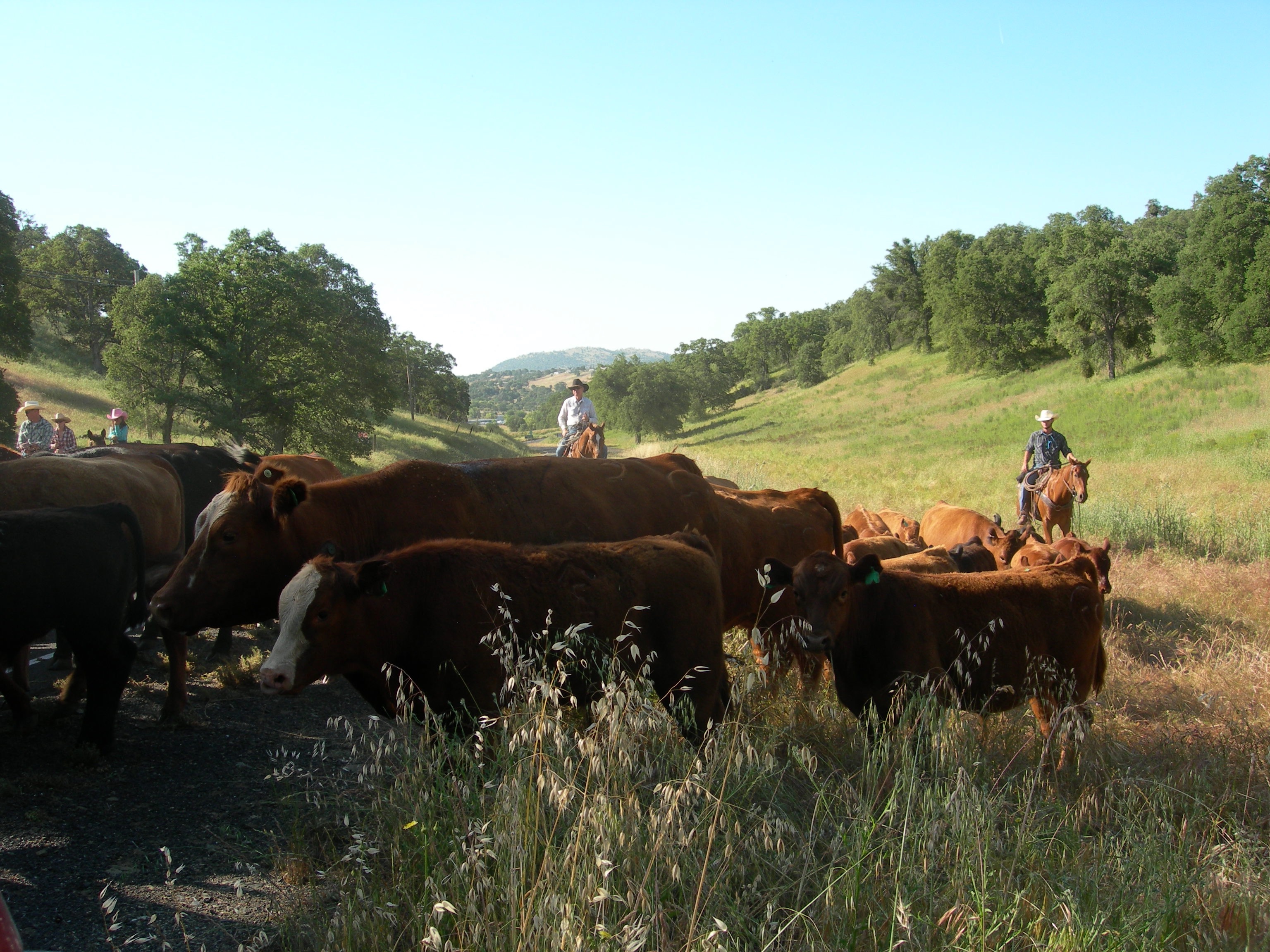
This morning (May 3rd) they moved the cattle toward their high pastures. Where I live, that movement normally happens twice a year.

Here in the foothills of the Sierras, we are coming to the end of the green season, in a year that was unseasonably wet. For five or six months every year the hills are covered with lush grass and cattle. The rest of the year is dry, burned brown, and mostly free of livestock. Most of the cattle that disappear in May migrate directly to your local grocery store meat counter. Some of the mothers and calves which will provide next spring’s herds move up the mountain to summer pasture.

Mostly, this is by trucks hauling specialized trailers. You see them everywhere on the roads and in the fields during this season. But one local rancher still holds a biannual cattle drive. I get the impression that some the herders are paid hands, but most are volunteers. After all, if you were a cowboy, or worked cattle from your pickup truck and wished you were a cowboy, wouldn’t you jump at a chance to join a cattle drive? Even if it only lasted three days?

They pass only a short distance from my house, and my wife and I never miss an opportunity to watch.

I grew up on a dairy farm in Oklahoma. Twice a day from age eleven until I left for college I was in the close company of cows, and I miss them. My wife just loves animals of any kind.

What does this have to do with A Writing Life? If you were Truman Capote, probably nothing. If you were Gore Vidal — well maybe. After all, Vidal worked for a time for his grandfather who was Senator from Oklahoma. But probably nothing; Vidal, like so many writers, was an urban type.

I’m quite the opposite, and the natural world permeates my writing. While I will never write an Andre Norton pastiche about herding frawns across Arzor (a statement Norton aficionados will instantly recognize), watching the cattle go by is likely to inspire me to rush to the keyboard. Like I just did.

I took these pictures, and picked those which would leave place and people unidentifiable. We all like some privacy.

=================

“Post”script, May 17: By coincidence, the second herd of the spring drive went by about six hours ago.

351. Who Is Listening?

When EDGE accepted Cyan for publication, I was less than enthused about publishing in eBook format. I’ve changed my mind.

It wasn’t the notion that science fiction authors should embrace technology that got to me. It was who responded to my website.

Building a website has been a learning experience, and I sometimes feel I’ve only begun. At first, no one was reading, but I expected that. Eventually, views began. Even later, likes began. I kept writing. I knew that gaining readership is a long-haul process.

I found it addictive to view the websites of the people who responded to me. One of the most surprising things I found was the number of respondents who were clearly from somewhere in the world other than America.

I regularly put out eight posts a week, many of which require research, and I have a life to live. That doesn’t leave me a lot of time to spend under the hood of WordPress, but I did find 

           https://wordpress.com/stats/day/(insert your own url here) 

which lets you click see how many views and visitors you had on any given day. More interesting, it shows a map that tells you which countries those views came from.

I was blown away.

To be specific, these are the results from this year, January 1 through April 21.

USA                    45%
Canada              28%
India                   8%
Australia            5%
U K                      4%
Switzerland       3%
South Africa       2%
Hong Kong       about 1%
Morocco           about 1%
Ukraine             about 1%
Romania          about 1%
Singapore        about 1%
Ireland             about 1%
Czech Rep.      less than 1%
Spain               less than 1%
Philippines      less than 1%
Japan               less than 1%
Kenya              less than 1%
Germany         less than 1%
Jordan             less than 1%
Israel               less than 1%

Global, indeed.

So, back to the initial statement — Yes, I would like to have Cyan on every bookstore shelf and in every library, not just available on line. However, no matter what happens from now on, I will insist that whatever I publish in the future will also be released as an eBook.

This goes back the the very beginning, to my childhood. Growing up on a farm, at first I had only G&D books (Tom Swift and the like) purchased from a local hobby store. Then I found the county library. I didn’t see a real bookstore until I was in college.

Those books were my window to the world.

Today, a book hungry young person with access to the internet can find — and afford — eBooks, even if her or she lives in India, South Africa, or Ukraine. I like that, and I’m proud to be part of it.

347. Prenatal Algebra

I wrote a post some time ago on the subject of No Child Left Behind, without saying one good thing about the program. I know almost nothing about Common Core, since it came on the scene just as I was leaving. When I retired, I retired. I enjoyed my days of teaching, but twenty-seven years was enough.

Without reference to the latest nonsense, I can say as a general and probably universal rule that a lot of BS floats down onto teachers from above. And from whom?

Everyone knows the saying, “Those who can, do, and those who can’t, teach.” Like most sayings, it isn’t always true, but sometimes it feels true. There is another saying that only teachers know. “Those who can, do, those who can’t, teach, and those who can’t teach, teach teachers.” Again, not universally true, but I have known some Professors of Education who fit the aphorism with sad precision. And I’ve seen a lot of self-appointed experts who make the circuit of schools, giving training programs they devised themselves, who could spin out reams of self-evident drivel as if they were conveying the word of God.

It makes you wonder. Could it be that they weren’t fitted by their education to work outside of the schools, but they would do anything to get away from kids? I don’t know. I never knew any of them personally. I can tell you that of the hundred or so trainers I endured while teaching, only one or two had anything worthwhile to say.

I can also tell you that there should be a banner on the State Board of Education building that reads, “If it doesn’t work, do more of it.” They double down on every bad idea.

________________

The French scholar Jean Piaget, studying children back in the 1930s, discovered that there are stages of readiness for learning. If you try to teach a skill before the readiness is there, it won’t take. I can’t say that is a shocking conclusion. What is shocking is that eighty years later the educational establishment is pretending that it isn’t true.

Everyone can learn. Okay, that’s probably true, but an administrator who says it, means this: Everyone can learn everything. And that’s a lie.

Worse, in their actions, in the textbooks they approve and the tests they give, they are really saying: Everyone can learn everything, and all at the same age, on the schedule we set. And that’s just bullshit.

In California about the time I retired, students in eighth grade had to take algebra, whether they were ready or not, whether they could pass or not — whether they would ever be ready or not. But as soon as they were in ninth grade, and presumably a year more advanced, they could opt out of algebra and take something easier.

Read that three times and it still won’t make sense.

The general rule is this: the state assigns a skill to a certain grade. Some kids get it, some don’t. Does the state let the latter group try when they’re older and more mentally developed? No. They say the students lacked readiness, but they don’t mean readiness in the way Piaget meant it. The state thinks readiness can be taught, so teachers have to try.

If students can’t understand algebra in eighth grade, the schools could teach it to those who are ready, and teach another year of more basic math to the others. Fat chance. Instead the state requires pre-algebra of seventh graders so they will be ready for algebra in eighth. And when that doesn’t work? Let’s try pre-pre-algebra in sixth grade? Where will it end — with expectant mothers sleeping with opened algebra books on their baby bumps?

Read that three times. No, read it 4(2N+3) where N=9 times. It still won’t make sense.

Like it says in the title, get ready for prenatal algebra.

________________

All right, if any of you are young and want to change the world by becoming teachers, more power to you. You are needed.

But first, buy yourself a big pair of hip boots. It’s a swamp out there.

346. Science, just for fun

rat-hereTeaching should be fun for teacher and student alike. That’s my perspective, but I have to admit that I had it easy on that front because I taught science. Science is full of falling things, and flying things, and squishy things, and stinky things. If I had to teach English, or social studies, or math, I would certainly have a different view of how much fun teaching is.

Here is an example. CH4 is the formula for methane gas. Teaching chemical formulas could get a little obscure and uninteresting if you let it, but there are always “interesting facts” that you can throw in to help keep things rolling. For instance, methane is what comes out of the gas pipes that you cook with if you live in a city. It’s also what comes out of cows and ends up in the news as a bovine generated greenhouse gas. If you leave a stove on without lighting it, you smell it, but methane is odorless. How does this happen? The gas company puts a chemical in with the methane that stinks when fresh, but burns up without stinking if a fire is lit.

This is the point when some wiseacre will say, “If methane is odorless, why do farts stink?”

And you can answer with a straight face, “Well, if you consider where they come from, and what the gasses have to push their way through, and the little particles they are carrying with them . . .”

If you can’t make science fun, you probably shouldn’t be teaching it.

One of the things that come up in middle school science is the conservation of matter. Matter is neither created nor destroyed, except in nuclear reactions; it just changes form. Methane gas combines with oxygen to create carbon dioxide and water. You know the equation, and you’ve probably had to balance it. My students had to do it, too. You have to do the work if you are going to learn.

But there is nothing wrong with spicing things up occasionally with an illustrative story. Even Jesus used parables.

Consider the story of Billy, who never believed what he was told.

I would begin this story with a drawing on the board like the one at the top of this post, except that there would be a cartoon of a dead rat, on its back, where the word “rat” is.

The story begins — When Billy came into science class one day, his teacher had put a dead rat on a scale and covered it with a bell jar. The scale read 7262.5 grams, the weight of the bell jar plus the rat. Billy’s teacher said, “This is part of a two week long experiment. Don’t touch the setup.” Then he taught something else.

The next day, things didn’t change. After the third day, the rat had started to swell up. (I didn’t take two weeks for this. The whole story took about fifteen minutes. At this point I erased and redrew the rat with a distended belly.)

By Friday, the rat was huge, and it was all Billy could do to keep from lifting the bell jar and poking it. But he didn’t. Even though the rat was huge, the scale still said 7262.5 grams.

Over the weekend, the rat blew up. When Billy came in on Monday, there was nothing left but a skeleton wrapped in a busted skin, with a few oozing guts. The air around the rat was kind of brown and the scale still said 7262.5 grams

(At this point I had redrawn the rat to match the description. This was also the point when I elicited from my students just what was happening and why the scale still read the same.)

Billy just didn’t get it. He couldn’t understand why the scale stayed the same when the rat was reduced to almost nothing. His teacher had explained that the rat’s mass had been converted to gasses which were trapped in the bell jar. Since the gasses could not escape, the scale had no reason to change.

Billy didn’t believe it. It had to be a trick. While his teacher was across the room, helping one of his fellow students, Billy slipped up to the teacher’s desk, took hold of the bell jar, tipped it back . . .

There was a pop and a hiss as the bell jar came unstuck. The scale dropped to 6571.3 grams. The students in the room screamed, leaped up holding their noses and yelling at Billy, and ran for the back of the room . . .

You get the point. They got the point. And we had a lot of fun besides.

344. Teachers

This is teacher appreciation week, and I certainly do appreciate teachers. Most of them anyway. I’ve known a few who needed to find another profession, and a very few who needed to be shot. Sorry if that offends you, but I stand by it.

The overwhelming majority of the teachers I have known have been hard working, caring, dedicated and competent. I understand that better than most people, because I was one of them, and working along side of them. How I came to be a teacher, is another story.

First I wanted to be an astronaut, but claustrophobia and bad eyesight killed that dream before I got to high school. Then I wanted to be a scientist studying ecology, but I got to college when everyone was infatuated with the double helix, ten years before ecology burst on the scene. I studied South Asia as an anthropology major for five years, through my first MA, before reality set in and I realized that I would hate the field work. That was when I started writing, and started my second MA in History. Now I had found something I could have loved writing and teaching at the college level, but about that time there were two would-be professors for every available position.

Timing is a killer.

Money got short so I decided to do a little substitute teaching. It was a revelation.

I taught kindergarten one day and it was a disaster. I taught fourth graders — every teacher’s first choice — and almost died of boredom. I taught middle school — every teacher’s nightmare — and loved it. So I went back to college (for the fourth time), got a credential and spent the next twenty-seven years teaching sixth, seventh and eighth graders.

I have been told several times by parents that there is a special place in heaven for me because I chose to teach middle school kids. I don’t see it that way. Middle school kids are more fun than a bucket of puppies, if you don’t have to take them home with you at the end of the day. I think those parents may have been projecting some of their own feelings.

I remember one meet-the-parents night, sitting down with one of my girl students and her mother. The girl had been a fine student, not troublesome at all, and I had thought of her as mature for her age. Sitting next to her mother, she squirmed like an eight year old, talked back, and generally gave her mother hell. It was amazing to see how different her at-home personality was from her at-school persona.

Not having middle school kids at home probably accounts, in part, for liking them so much in the classroom.

I’ll tell you another secret about teaching. It takes all kinds — assuming decency and competence. Some kids will think you are great because of what you teach, or because of how you teach, or because your personality happens to mesh with theirs. Other kids will hate you for exactly the same reasons. These are your choices — if you are a good teacher, some will love you and some will hate you. If you are a bad teacher, most of them will hate you, and a few will just be happy to go to class without having to work..

If you want to be universally loved, you should choose another profession.

339. Teaching Space

I taught middle school science for twenty-seven years. It was often fun, but not always. Helping the kids make projects to demonstrate simple machines was a blast, but chemistry was no fun at all. It was a challenge to make astronomy appeal to my kids, but I think I managed.

Teaching space had its ups and downs.

The space race had everything, exploration, political intrigue, danger – both in space and in the Cold War which was the real reason for going to space – technology and a chance to participate. When I taught Gemini IV, I would put two chairs on their backs on a table and have two students lie back in them to represent McDivitt and White. Then I would take “Ed White” for a  space walk.

I was big and they were small. I would pick “Ed” up by the waist and take him spinning and “floating” around the classroom before he returned to the capsule. Great fun for both of us. I always chose the smallest student to play Ed White and, of course, always a boy. Sorry feminists, but if you think about it for a moment, you’ll see why.

I could use the movies Apollo 13 and parts of The Right Stuff, and that was a big help. But the space race was teaching history. What was happening in the world outside the classroom during my teaching career was less fun.

The Space Shuttles were practical. Five craft made 135 trips into space, expanded our knowledge, launched the Hubble, and built the ISS. They called the shuttle NASA’s pick-up truck. It was a good analogy, but what twelve year old wants to go to space in a pick-up truck?

Nothing was really new, just more and better of the same old stuff. Nobody was going beyond low Earth orbit.

(“When are we going to the moon again, Teacher? When are we going to Mars?”
“Damned if I know kid. It’s beginning to look like never.)

There were promising new programs. I watched several of them as they were announced, begun, and then cancelled. I’ll recap them later.

I taught the space shuttle with more enthusiasm than I actually felt. We followed its progress, and there was a lot of it during my teaching career. There was also tragedy.

When the Challenger blew up, my class wasn’t watching. Our school got TV’s for the classrooms a couple of years later, so I didn’t know what had happened until recess when I went to the teacher’s lounge and saw faces suitable for a wake on my fellow teachers. It was a long afternoon, first explaining to the students what had occurred, and then going on with our work as if nothing had happened.

I didn’t face another day like that until 9/11.

I remember sitting with my friends in the teacher’s lounge after Challenger blew up, listening to the radio. When the announcer said that the mission commander had flown fighter jets during Viet Nam, I knew that he had found a more honorable death than that war could have given him.

When Columbia returned from orbit the last time, I was excited to see it. By that time I had moved to the foothills. Columbia’s flight path was to pass north of my new house, and I was up before daylight to watch its fire trail across the sky from my balcony. Instead, I only saw dense fog. I waited around until the projected time and at least heard it’s sonic boom. Five minutes later and a thousand miles to the east, it broke up and fell to earth.

It was Saturday morning. I had two days before it would be time to talk to my students about what had happened.