Tag Archives: memoir

317. SF in the Wild

Cyan is now available for pre-order through Amazon, with the eBook arriving April 17th. Meanwhile, I plan to repeat a few year old-posts that were designed to stir the blood of would-be readers just before an earlier release date that didn’t happen.

——————————-

This post was originally number 128.          If you are what you eat, I used to be beefsteak, fried okra, and hominy. That comes from growing up in Oklahoma. I also lived outdoors most of the hours of every spring, summer, and fall day, and way too many hours of every winter day. That comes from growing up on a working farm.

If you are what you read, then I used to be an Andre Norton protagonist, at least in my imagination. Although I never met or corresponded with her, Andre Norton was something of a long distance mentor.

Alice Mary Norton legally changed her name to Andre Norton early on, in an era when being a woman was no help to a science fiction writer. I didn’t know that when I first read her; I thought Andre Norton was a man. Not that I thought about it much, but she didn’t write like a girl. Looking back, I see that she actually wrote like a person, but I wasn’t that sophisticated then.

One reason Norton got away with writing gender neutral fiction was that her characters spent most of their time alone. Even in their relationships with others of their own kind, they were loners, if not complete outcasts.

Star Man’s Son was the first Norton I read. In it, Fors spent all but a few pages on a quest away from his people; that was a pattern to which Norton frequently returned. I could easily identify with the solo quest while I spent endless hours alone on a tractor. The only variations in my daily life were whether I was pulling a disk or a hay rake, and which Norton novel was replaying in my head.

Every time Shann Lantee on Warlock, or Naill Renfro on Janus, or any of a dozen other young men found himself stranded alone, or nearly alone, on an alien world, I could look up from my tractor seat at the Oklahoma prairie and say, “Yup, been there.”

The best thing about Norton’s characters was that they didn’t whine about being alone. They liked it. So did I.

I didn’t live in a city until I went to college. I spent my adult life living in the suburbs of a reasonably small city, and taught school in a very small town. As soon as I could retire, I moved to a few acres in the foothills. I would move further out if I could afford it.

I was born not liking cities, and my opinion never changed. It should be no surprise that my first novel was about a hunter surviving alone in the woods, or that my first science fiction novel Jandrax was about a hundred or so humans stranded on an alien world.. My three fantasy novels have a rural and medieval feel. David Singer, in A Fond Farewell to Dying, is a mountain boy who has to go urban to get his life’s work done. And Cyan, due out soon, begins with ten explorers on an empty world, then continues with the story of the peopling that world by hyper-urbanized refugees from an overcrowded Earth.

You write what you’ve lived.

315. Apprentice in Science

fleming-schola-rs-1966For eight weeks in 1965, I was a Fleming Fellow (see yesterday’s post).

The gist of the program was that a Fellow was assigned to a research scientist as something like an apprentice. My personal research had been a hybrid of ecology and space science (see Tuesday’s post) Nothing like that was available in a medical research facility; instead, I was assigned to Dr. Gunnar Sevelius who was doing research on determining renal flow through use of radioisotopes. He had just finished editing Radioisotopes and Circulation the preceding year.

Dr. Sevelius gave me a small lab room and access to a supply of radioactive iodine, along with sensors for radioactivity and a strip chart recorder. He sat me down to talk about his work and tell me what he expected from me. He treated me as if I could figure things out for myself – which I could. I didn’t see him often after that, although I hung out with his young lab assistants.

I don’t need to give a lot of detail here. It has all been superseded.

Everything sophisticated in science was crude when it was being developed. Any kid in a high school metal shop today could reproduce one of Goddard’s original rockets — but only because Goddard taught them how. Any trained technician can slide you into a machine and look at images of the inside of your head — but only because to the work done by people like Dr. Sevelius. Everything at OMRF was cutting edge for 1965, and probably none of those machines are even stored in dusty basements any more. Science moves on, and quickly.

Computers? Video monitors? Forget it. A strip chart recorder had a moving roll of paper, a moving head with roll of typewriter ribbon and a striker that made a dash on the paper every time the sensor detected radioactivity. An image of a pair of kidneys looked something like this:

renal

You can see a strip chart recorder at the top of this post. That’s me in 1965, with a haircut that was already going out of fashion.

I learned a lot that summer, not least that I would never again spend eight weeks in a windowless room doing repetitive research. I love the results of science, but the doing of it can be damned boring. I also got to test myself against other smart kids, and be satisfied with the result. Every other Fleming fellow had done more sophisticated work than I had, but they were the products of sophisticated high school science programs, or the children of scientists.

There were lectures and activities for us. I met a scientist who had done research on the reaction of elephants to LSD — two years before I chose to avoid it when it became mind candy.

I learned about Michigan State, and was encouraged to apply there. I got a tour of the basement where research was being done using a sensory deprivation tank. Fifteen years later that became the basis for my second published novel.

I learned about the infamous Dr. Sexauer. From a former fellow, I got the names of two of my former incarnations, in a late night seance. Tidac and Javernan became characters in my three fantasy novels. I wrote about that incident, and it led to an odd occurrence. The OMRF was trying to find all its Fleming Fellows to prepare for the 60th anniversary of the program. I had mentioned the name of the girl who seemed to be running the ouija board. The OMRF had googled her name, found my post, and connected with me. It was good to hear from them again.

When I returned to my tiny high school that fall, I had touched the larger world and I would never turn back.

314. Fleming Fellows

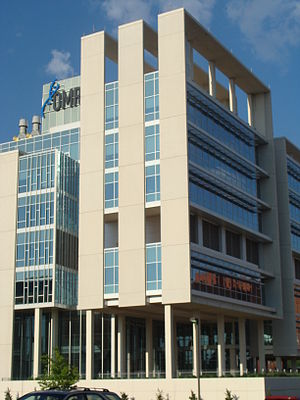
300px-oklahoma_medical_research_foundation_nimaphoto by Nima Kasraie

The Oklahoma Medical Research Foundation is a major research institution, but not a household word. Let me explain its importance in my life.

Everything that happens to a writer passes into his memory, sinks to the bottom, and grinds around there, knocking sparks off every other experience. Years later, it emerges, transmogrified, as stories or parts of stories.

My soul as a writer and as a human being was forged on a small farm, working essentially full time in addition to going to school. I was an only child. School and home were kept strictly separated. Except for one treasured cousin, none of my school friends ever entered my house.

I was a very smart child in a very small place. I worked hard, got strong, and loved the outdoor life, but my mind lived in other worlds, brought to me by books of science fiction. I decided to become a scientist. In that pursuit, I was torn between space science and ecology. When I was a high school junior, I put those two together (yesterday’s post).

That same year, among the many standardized tests we took, was the test to become a Fleming Fellow. There was also an application to be filled out in which I was to explain my aspirations and offer any personal projects to prove my capacity. I wrote up my ecosystem in space project.

I was notified that I was a finalist, and scheduled for an interview in Oklahoma City. At that time, I knew almost nothing about the fellowship or the OMRF.

Incorporated in 1946, the Oklahoma Medical Research Foundation was dedicated in 1949 by Nobel Laureate Sir Alexander Fleming. In 1957, OMRF started a summer program for students, which was quickly named the Fleming Scholar Program. It has evolved over the years, but in that era, from four to seven Oklahoma High School juniors were recruited, and spent eight weeks at the OMRF the following summer.

In the spring of 1965, I sat before a panel of scientists for my interview. I had expected questions on science. Instead, they asked questions on meaning and morality. What did I think of the bombing of Hiroshima? What did I think of capital punishment? Behind the questioning, they were clearly trying to find out my level of self-confidence, as the interview became quite adversarial at times. After I said that I was still uncertain about my stance on executions, one of the scientists asked, rather sharply, “Don’t you think it is our duty to think about such things?” I remember being irritated at his high-handedness. I snapped back, “I didn’t say I hadn’t thought about it. I said I hadn’t decided yet.”

I said to the panel that I intended to pursue a Ph.D. The whole panel tried to convince me that I should be getting an M.D. instead. I held my ground, and when the interview was over, one of the panelists admitted that most of them had Ph.D.s, not M.D.s.

Fortunately, self-confidence – or arrogance, if you prefer – is something I have never lacked. I received a Fellowship. I’ll tell you about it tomorrow.

313. Weightless Ecology

ecoopwegt-lessI’ve been putting off this post since I started the blog. It’s embarrassing. I’m proud of what I did, but telling it makes me feel a little like one of those old guys who never stops talking about the night his forward pass won the big game.

Still, if I hadn’t done what I’m going to tell you about today, I would never have done what I did the summer after (tomorrow’s post), and if not for that, I would still be driving a tractor in Oklahoma. So here goes.

1964-5 was my junior year in high school. That was the year I took both junior and senior English because I was running out of classes to take, and that was the year I discovered science fairs. We didn’t have one in our tiny school, but their was a regional competition one county over. I had recently discovered Shirley Moore’s Science Projects Handbook, which was the bible for the science nuts (nerd wasn’t a word yet) of my generation.

America was in space; the Mercury project was completed and Gemini was waiting in the wings. I was enthralled with space, but also with ecology. Rachel Carson’s Silent Spring was about to make ecology a household word, but no one in my world had heard of it yet. I decided to put the two together and build an “Ecosystem Operable in Weightlessness”.

Lets get real. Boy scientist builds spaceship and flies to Arcturus only happens in the very old pulp stories. I wasn’t going to build something that would actually fly in space. It was an exercise in design, with as much building as I could pull off with limited resources.

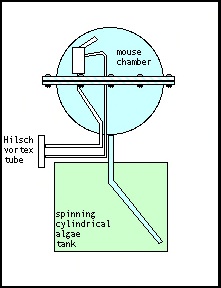
The idea was that at that time NASA needed to keep to keep some creature in weightlessness long enough to see what it would do to its body. Laika the Russian space dog hadn’t lasted long, and the longest Mercury flight had been 34 hours. I proposed a design that would put two mice in a closed ecosystem with algae. It was set up so that the algae tank would spin to provide just enough gravity to keep the water separate from the air, but the mice would be weightless in a separate chamber.

The fun was in the details. The mice would be housed in a two part plexiglas bubble, with a wire mesh floor at its equator. Waste would pass through he mesh, carried by the airstream and drop down into the algae tank.

That part actually got built. I made the algae tank of plexiglas, heated and formed around two round pieces of wood. I blew two half domes with a plywood form, an air compressor dragged up from shop class, and an oven borrowed from the home-ec teacher.

As I’ve said before, most of my education came outside of the classroom, thanks to indulgent teachers. They did the right thing, but it would get them fired if they did it today.

I bolted the half domes together through flanges formed during the blowing process. With two mice, Hing and Ho (named after the meerkats in Andre Norton’s Beast Master) in the upper chamber of the dome and a mass of Ankistrodesmus from a local stream in the algae chamber, connected by an aquarium pump, the ecosystem was as far finished as I could manage by the time of the science fair.

The physical result was limited by my resources, but the design went much further. To transfer the food to the mice, I had designed a pump, patterned after a Wankel engine (all the rage in Popular Mechanics that year). It was to send algae laden water up through a tube where it would be flushed over a fine mesh screen. The water would return to the tank on the airstream, leaving the algae for the mice to eat.

I did actually experiment with feeding them Ankistrodesmus. I strained it out of the water, dried it over a light bulb and passed the algae wafer into the mice’s cage. They went wild. You would have thought it was ice cream.

The design called for a small tube to carry a continuous airstream from above the algae water to strike the inside center of the upper dome, bringing the mice fresh air and carrying away waste as it returned. There a larger tube would carry the waste to the bottom of the algae tank.

To get water to the mice under weightlessness, the design called for the airstream from the algae tank to first pass through a Hilsch vortex tube, which split the airstream into hot and cold halves. The cold half was to pass between two thin metal plates. The warm (and moist) half of the air was to play onto the outside of these plates, leading to condensation and a continuous source of water for the mice to drink.

So why am I telling you this? Because this was the first step toward my future.

I didn’t know that at the time. I just did it because it was a challenge and more fun than I had ever had, but it led to a Fleming Fellowship, and that changed my life. more tomorrow.

312. Popular Science

full-futurecars-4When I was twelve or thirteen, my great grandfather said to me, “I used to read Popular Mechanics. You should, too.” And he handed me a quarter. It was the best piece of advice any relative ever gave me.

I bought my first popular science magazine, and I was hooked. I was soon buying three a month every month, and occasionally a fourth. Science and Mechanics, no longer published, was the best. Popular Science came next, then Popular Mechanics. Mechanix Illustrated was a lame imitation, but I always looked and occasionally bought, if there was a particularly interesting article.

In school, I usually devoured my science textbooks by the end of the first month of the school year. They provided an important, basic, bare bones understanding. But the popular science magazines put exciting flesh and blood on those bones. I learned more science from those three popular science magazines than I ever learned from a textbook.

Those were the days when GEMs were new. Ground effect machines, that is. There were articles that explained how they worked (what shape plenum chamber do you prefer?) but better still, there were articles that showed guys who had built their own out of plywood and a lawn mower engine, flying down the street of their suburban neighborhoods, six inches off the ground.

When I sent ten scientists to explore Cyan, they used skimmers, which were clearly ground effect machines.

There were always articles on how to take care of your car, and there was the new car issue every fall. You didn’t have to be a science nut to like cars.

There were always stories about the newest, hottest jet plane, including a story about a new safety device that gave pre-recorded error messages into the earphones of a pilot. The Air Force had discovered that the pilot never missed the message if the recording was a sultry female voice. Any thirteen year old boy in America could have told them that. The illustration of that article was a realistic drawing of a helmeted pilot with a tiny, bikini-clad femme whispering into his ear the words that would save him.

These guys knew their target audience.

Not everything between those covers would be politically correct today. I remember the pistol crossbow, a powerful hand-held weapon that shot sharpened six-inch pieces of quarter inch rod. Try making that in your seventh grade shop class. Maybe you could get a merit badge in Boy Scouts?

Probably not.

There were always articles on how to build something in your shop, about the latest tools, or about how to build the tools you couldn’t afford. I was hooked on that, too. My father was a farmer, not a craftsman. If a nail in a board would do the job, he was satisfied, and moved on to the next of an unending set of chores. I wanted more. I wanted to be a craftsman. Today I am, and these are the magazines that got me started on that path.

Eventually, I stopped reading popular science magazines. You can only read so many thousand articles at that level until you have absorbed enough. I moved on, but I didn’t forget how powerfully they ignite young imaginations.

When I became a teacher in a small middle school, all the other teachers were happy to load science onto me, and I was glad to accept. I taught all subjects the first year, but after that it was “science-and”. Every year I taught more science and less “and”.

The first year I subscribed to Popular Mechanics and Popular Science (Science and Mechanics was long dead), and soon I added Smithsonian Air and Space. I bought a magazine rack at a garage sale and put it up in my room. I never threw a magazine away until it was too tattered to read, and after a few years there were a hundred magazines in the rack.

Occasionally, at the end of an hour, there would be a few minutes to spare and I would say, “You can either do homework for another class, or read one of the science magazines.” It was the best advice I ever gave them.

And nobody chose homework.

309. Two Hands and a Knife

There has been an interesting rhubarb in the back stacks of Amazon, where that company acts as a conduit to a battalion of independent used bookstores. The controversy concerns a book/two books which is/are Two Hands and a Knife.

How’s that for convolution? Do I have your attention yet?

In 2003, Terry Gibson wrote a book called Two Hands and a Knife, a young adult survival story set in the Canadian wilderness. It garnered mixed and confusing reviews. It was almost as if the readers were reviewing two different books.

It turned out, they were.

In 1956, Warren Hastings Miller had also written a book called Two Hands and a Knife. I remember it well. I was in fifth grade at the time, in a tiny school, with no access to bookstores. Our school held a TAB book fair, and I bought Miller’s book. It was superb. I remember it better today, than I remember the books I read last week.

To be fair, it was also probably the first book I ever bought.

When Two Hands and a Knife came back onto my radar about a year ago, and seemed to be claimed by some modern author, my suspicions were aroused. Had some schmuck found an old copy and resold it as his own work?

No, it turns out, he hadn’t.

I made my way to the Amazon page which has a Look inside function and read the first chapters of the 2003 version. It was an entirely different book with the same title and similar plot. Of course, young-man-survives-the-wilderness is a sub-genre of its own, so plot similarities would be inevitable. Remember Hatchet?

Some of the reviewers of the 2003 book were clearly remembering their own distant childhood as well. Some reviewed Gibson’s book in glowing terms that showed clearly they had not read it, but were remembering the Miller book. Some noticed the difference, with disappointment. One hated Gibson’s book enough to give it one star and a “don’t buy”. A few reviewers had clearly read only Gibson’s book, and loved it.

If you’re curious, go to the page and go clear to the bottom. There are supposed to be eight reviews, but every time I go to this page, I only find five or six, and not always the same ones.

By now I’ve read enough of Terry Gibson’s book to know that it is reasonably well written, but not completely to my taste. Fair enough; I’m no longer the target audience. I have tried to find out who the author is, with little success. I did finally get a look at the back of the paperback cover in Google books and picked up this minimal biography.

Terry is a retired self-employed businessman. His love of the outdoors has taken him from North America and Europe to deep within the Amazon rain forest. It’s this ‘call of the wild’ that inspired Two Hands And A Knife, his first novel.  He currently resides in central Illinois with his wife Patricia.

This puts him pretty much in my generation. Did he read the Miller book as a child? Or not? Was it floating around in his sub-conscious? Or was Gibson’s book a conscious homage to Miller’s?

Don’t misunderstand. The 2003 book is not a rip-off, despite the crack you’ll find in Goodreads. It is an independent work. But we all have influences, ideas come from somewhere, and I find the entire process fascinating. In point of fact, Miller’s original Two Hands and a Knife was floating around in the back and front of my mind when I wrote my first novel Spirit Deer.

So Terry Gibson, if you someday google your own book title on a lazy afternoon, and stumble across this post, drop me a response. I’d love to talk.

308. All I Really Need to Know

dscn4338All I Really Need to Know I Learned in Kindergarten

All I Really Need to Know I Learned from my Dogs

Please don’t throw rocks at me, but that kind of prissy, perfect, and pretentious tag line activates my gag reflex. Let me suggest a different, more realistic take on life.

Everything I need to know, I learned in the dairy barn.

I’m not talking about a modern milk factory, but a real, old fashioned 1950s kind of dairy. To find one today, you’d have to go to a third world country.

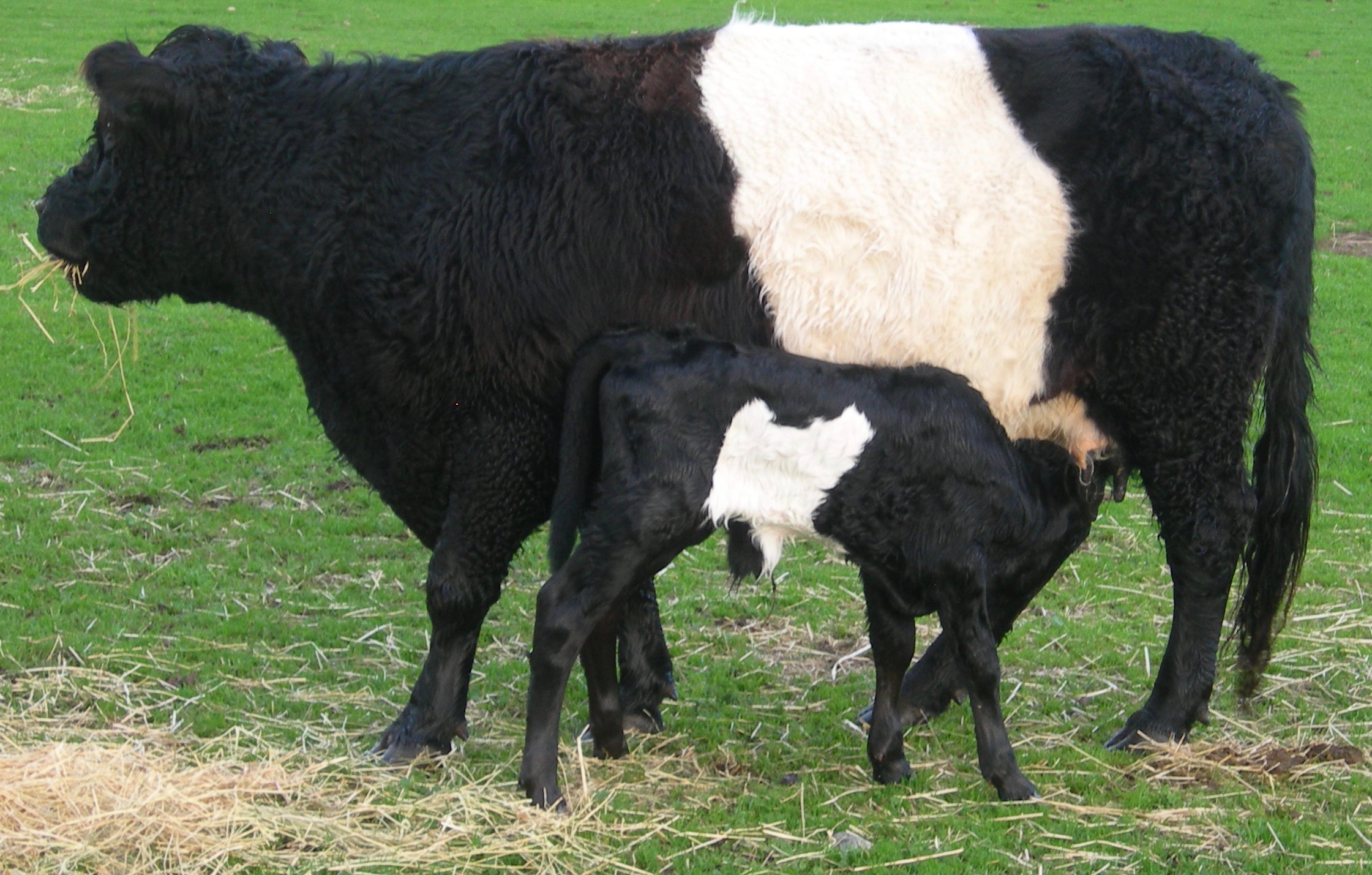
You’ve all seen milk and yoghurt ads showing perfectly clean, starkly black and white Holsteins standing knee deep in green, green grass. Erase that picture from your mind. It never happened.

Holstein calves come out of the womb clean, but from three days after birth they will never be black and white again. They are brown to the knees from the dust and dirt – and other things – that boil up when they walk. Their tails become a black club of matted cockle burs – and that other thing.

The grass in the ads looks so perfect because no creature is allowed to graze there before the ad is shot. Turn a herd of cattle out and in four days it will be matted, scarred, pockmarked with hoofprints, and covered with steaming piles of the fertilizer which completes the circle of life.

No complaints, you understand. A herd of cattle on a green meadow is beautiful, but the grass will be eaten down, and the ground itself will look like a billion angry golfers have been making divots. It will be nothing like pristine.

It all comes down, finally, to this. Cows produce three things. One is a clear, yellow, somewhat odorous liquid, which they produce in copious volumes. One is a brown to green semi-solid, and they produce mountains of this. One is the thick, white liquid that feeds the nation.

You can’t get the one you want, until you figure out how to handle the other two.

Just like life.

307. Give Me Air

I exist for open spaces. I lived a long time in a small city, but I could walk to the edge of town in five minutes. I spent four years at Michigan State, but that campus was a sylvan paradise. I only lived in a true inner city once, and it almost killed me.

It was Chicago. I know people who love Chicago – Andrew Greeley made a carreer out of loving that city – but they didn’t live where I did. 53rd street, student housing for the University of Chicago, a few blocks from the true south side. The same general area where President Obama got his start.

No, I didn’t meet him. He was in Hawaii, still in middle school, when I was at Chicago.

I never felt more at home intellectually, or more adrift in every other aspect of my life, than the year I spent there. It wasn’t just the dirt and the crowding and the nightly killings. It was that I would have to drive for hours through packed traffic to get to see open space. Without a car, I could have walked until my heart broke and never have reached the open sky.

I left after nine months with a master’s degree and a permanent case of cold chills.

When Keir Delacroix, in the novel Cyan, finds himself stranded on Earth after returning from exploring that virgin planet, I knew how he felt, and I knew where I had to put him. Chicago.

* * * * * * * * * *

The sky was slate gray to match Keir’s mood.    

Snow had been trickling down from ruptures in the sooty sky since noon, and now the dark of evening was upon him. He squatted against the bole of a smog blasted tree, staring at the house where he had been born. It was a half century older now than it had been then, although Keir was only thirty-nine. Even then, it had been old; a two story cottage subdivided to hold a dozen apartments. Now it had endured fifty more years of smog, fifty new layers of winter soot from a thousand chimneys, and half century more of the assault of air borne chemicals from the steel plants.

The orbital factories around L-5 were supposed to have removed the stigma of pollution, but even they were unable to cope with the needs of an Earth groaning under the weight of twenty billion people.

Someone came out the front door. Like Keir, he was bundled against the cold and he kept his right hand in the pocket of his coat. He looked around uneasily, saw no one but Keir, and advanced across the lawn. The grass was dead and brown, withdrawn from the sidewalk near the street to leave a barrier of frozen mud.

Keir drew a deep lungful of cannabis and threw the drag away.

The man was lean to the point of emaciation. His eyes were sunken in deep hollows. Keir nodded a greeting, but he only responded, “What do you want?”

“Nothing,” Keir answered. “Not a damned thing in this world!”

It was not the answer the stranger had looked for, but Keir let it hang between them for a moment before he went on, “I was born in that house – grew up there. In the little apartment to the left at the head of the stairs.”

“Who are you?”

“Keir Delacroix.”

The man knew him; it was written on his face. “What do you want with us?” he demanded. His voice was as tight as his face, all hard edges and deep hollows.

Keir sighed and shook his head. “Like I said; nothing. I don’t even know you.”

“I think you had better move along.” The stranger gestured with the hand in his pocket, and Keir finally decided that he did not have a gun. It was a foolish and dangerous bluff. Keir rose stiffly and threw back his shoulders to ease the strain of sitting too long in one position. The man stepped sharply backward toward safety.

Keir only shook his head and turned away.

303. Local Color


dscn4367I first saw California in 1969
,
on my honeymoon. A year later, my wife and I moved here temporarily while I waited to go into the Navy. Then came four years in southern California, stationed at the naval hospital inside Pendleton. Then a year in Chicago for a Masters degree, then back to the central valley.

It took me twenty years to get used to the climate and to feel truly at home.

I became a writer, more or less full time, then eventually, a teacher. I never stopped writing, and about ten years into my day job – which I had for twenty-seven years – I wrote a novel based on my teaching experiences called Symphony in a Minor Key. I presented the Christmas chapter in December of 2015.

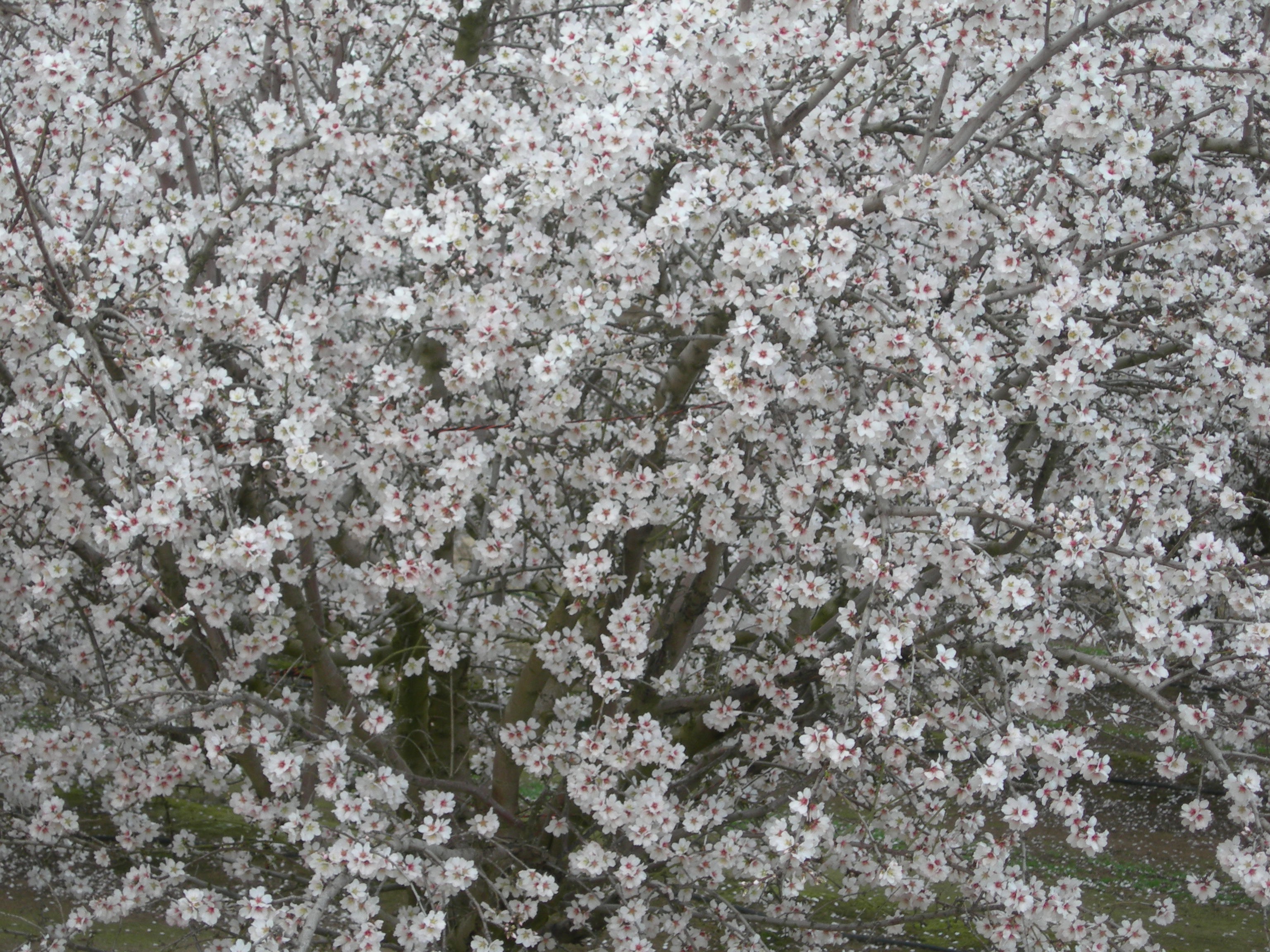
Driving around yesterday I saw the first almond blossoms of the year, and it reminded me of that novel. Within a week, the entire central valley of California will be alive with blossoms, California’s brief efflorescence of spring before the long, harsh days of summer. We have seasons, they’re just skewed early.

Here is a brief almond blossom excerpt.

**********

For the next two days, Neil’s afternoon class moved as smoothly as a well oiled bearing. It was amazing what the absence of one child could do.  When Saturday rolled around, Carmen took Neil for a ride without giving him a hint of their destination.  She had packed a picnic basket, and she set a course that circled northward across the river, then eastward toward Riverbank.

It was February eleventh.  In the midwest, there was a foot of new snow on the ground, but spring had come to California.  Almost overnight, the almond orchards had come to full blossom.  Everywhere Carmen took him, the trees were covered with pure white flowers, and already the wind was shaking the first of them free to cover the ground like a fragrant snowfall.

They stopped half a mile up a dirt orchard road.  Carmen spread a blanket under the trees, in a patch of sunlight.  It was just too chilly to be quite comfortable, so after they ate they put the food away and wrapped the blanket around them as they waited out the day, encircled by ten thousand acres of flowers.

302. The Drought Has Broken

dscn4470What is weather to a writer? If you live in the city, it might invoke a passing mood,. Beyond the city, where I live, it is everything.

I grew up on a farm, living in the glorious outdoors sixteen hours a day for half the year, and the other half freezing my #%*# off six hours a day milking cows. Weather was everything. Through the middle of my life, when I lived in cities, weather was mildly interesting. Now I live on three acres in the Sierra foothills, and weather is back with a vengeance.

I posted a picture at the top. This is an fold in the hills which is dry ninety percent of the year, and recently has been dry all year for half a decade. This is what it looks like now.

The drought has broken. Grass is green and knee deep in my yard. Yesterday was Valentines Day or, as my wife and I call it, the first day of spring.

That began as a joke. When we first came to where we live now, I bought her a tomato plant and we planted it together on Valentines Day, with high hopes and no expectations. A few months later we were eating tomatoes from it.

It doesn’t always work that way. In another year, a hard freeze on April 15th killed everything in the garden. Taxes and a hard freeze on the same day — it seemed appropriate. Life is like that in the real world. Sometimes you get the bear; sometimes the bear gets you.

If all this talk of green grass in February is making you jealous, take heart. By May, the rains will stop and they won’t return until winter. When you are having a picnic in June, on green grass under the trees, with cool breezes, here in the foothills it will be a hundred degrees with dry brown hills in every direction. The rattlesnakes will be carrying their canteens again.

But for now, the drought has broken. The grass is green, the weather is clement, and the lakes are full. And my novel Cyan is due out this summer, after the long dry spell since Jandrax and A Fond Farewell to Dying.

The drought has broken. Finally.

********

I have to offer a PS to my metaphorical connection of our breaking drought and the end of my publishing dry spell. Three days after I wrote this post for today’s release, the Oroville dam about two hundred miles north of here, hit the national news for excessive water and a failing spillway. Be careful what you ask for.