Tag Archives: politics

Running From President 2

Billy Joe Barker, newsman, regular contributor to the Tulsa World was a long time Republican. He had a dalliance with liberalism during the sixties when he thought he was a hippie. He had the hair for it back then, and it’s the only part of that era he misses. By the mid-seventies he was back to a buzz cut and back to being a Republican.

Billy Joe hated Hillary, passionately. He was a Ted Cruz supporter, despite the hesitation Okies have for anything from Texas, but Cruz didn’t last. Billy Joe really tried to like Donald Trump, but he couldn’t. The last straw was watching Trump’s first interview with his new running mate Mike Pence. After that, Barker had a continuing  vision of Edgar Bergen with Charlie McCarthy on his knee. He gave up on Trump even before Cruz said, “Vote your conscience.”

Barker couldn’t begin to support Hillary, couldn’t stand the Libs and Greenies, and knew there was no hope for a third party. He was flummoxed. That’s when he decided to use the Tulsa World to push a pseudo-candidacy. He didn’t care who he ran, it was just a joke in a political season that had lost any taste of humor. He needed someone like Pat Paulsen, back when Billy Joe was briefly a hippie.

On the same day that he came to that conclusion, he read about Leap Alan Hed in Reader’s Digest. The article told about Leap celebrating birthdays only on years with a leap day, and about his claim to be 16 even though he was born in 1952. Billy Joe Barker had found his candidate.

First he had to locate him; that took two days. Leap had moved to Dannebrog, Nebraska, a bustling metropolis of 307 people. Wiki says 306, but that was before Leap moved in. Billy Joe called him long distance. That took a day of phone tag since Leap didn’t have a phone, and had to take the call at a neighbor’s house.

Billy Joe explained his proposition. Leap almost fell off his chair laughing. He said, “You’ve got to be out of your damned mind. The second worst part of what you want me to do is the campaigning. The worst part is, if I lie well enough, I might win. The answer is no!”

Billy wrote up his weekly column for the Tulsa World, telling the story of his aborted search for a candidate. At the end, he said, “If only crazy people run for the office of President, then Leap Alan Hed is the sanest person in America. He really doesn’t want the job.”

Beware of what you ask for. Or what you don’t ask for. more tomorrow

564. The Tale of Leap Alan Hed

In 2016, after a month and a half of extremely serious writing about race in America. I decided to celebrate with a bit of total nonsense. I chose to do it on Leap Day, because what better time for silliness than a day that only comes every fourth year.

I had intended it to be a one time bit of humor about an accidental President. It wasn’t anti-Trump, because at that time the idea that Donald Trump would become president was a million miles from anyone’s mind.

I went on with my life, getting ready for the release of Cyan and writing blogs on writing, science, and science fiction. I wasn’t worried about Trump. I was worried about Clinton. I eventually voted for her, while holding my nose, but my sympathies were with Bernie, or some other Democrat. Apparently a lot of people felt the same way.

I was aware of Trump, but I wasn’t thinking much about him. I just hoped the Republican candidate would be someone I could vote for if Clinton became the Democratic candidate.

By July, Trump was in the race and looking more and more ugly. But lest we forget, the prospects of Clinton as President didn’t look that good to a lot of us either. 2106 was beginning to stack up as a lose-lose situation. Reasonable candidates were failing fast in both parties.

I brought Leap Alan Hed, the nobody who won the Presidency by accident, back for a reprise and continued his story throughout the summer and fall. I bid him farewell the night before the election and faced reality with a post written in September but posted the day after the election.

In September I reprised the poem Hungry, about a border wall. That is another prophetic piece that I wish weren’t so accurate.

All the things I wrote fearfully about that summer have come true, along with more misery than I could have anticipated. Now I am bringing Leap back for a re-run, beginning today over in Serial. Everything has been tweaked to read smoothly, but ninety-nine percent remains unchanged.

Think of this as a presidential campaign in an alternate universe. And besides, politics aside, it’s just a good story about a nice guy who found himself in completely over his head. These posts have never been put in one place before, to simply be enjoyed as a story.

Running From President 1

In 2016, after a month and a half of extremely serious writing about race in America. I decided to celebrate with a bit of total nonsense. It didn’t work out the way I had anticipated. For a longer version of that story, look at today’s AWL post.

This is the story of Leap Alan Hed and his unintended write-in bid for the presidency. Think of this as a presidential campaign in an alternate universe.

======

Once upon a time – 1952, I think it was — there was a kid who was born on Leap Day.

His Dad was named Alan Hed, and he wanted to give his son the same name, but his wife had a quirky sense of humor. She told the nurse to call the boy Leap, as in Leap Alan Hed. When he was really young, his dad called him Alan and his mother called him Leap, but when he got old enough for school, his kindergarten teacher — who was a mean bastard, anyway  — called him Leap A. Hed. That brought about a sudden parent conference and after that the dad got his way, and the boy tried to forget that his first name was Leap.

People wouldn’t let him forget, and finally he gave in and refused to answer to a Alan any more. He went further. He decided that if he was going to be the boy with all those nicknames:

Leap Boy
Leap Frog
Leap for Cover
Leap Forward
Leap Back
.  .  .  and of course, still, interminably, Leap Ahead  .  .  .

.  .  .  if he was going to have to put up with all those stupid names, he was going to go all the way. I refused to celebrate his birthday on the twenty-eighth of February or the first of March. He only celebrated it on February twenty-ninth.

Worse, he counted his age by birthdays. When he was sixteen, he started putting his age down as four. He spent a lot of time talking to the principal about that, but they finally got tired of the whole business. You might say he out-stubborned them.

He couldn’t out-stubborn the draft board. When they said he was eighteen and he said he was four, they didn’t buy it. He claimed discrimination under the Civil Rights Act. He might have made it all the way to the Supreme Court, but when the 1969 draft lottery was held, February twenty-ninth drew number 285, so the draft board dropped the case.

After that his life calmed down. He never married (he claimed he was too young) and the IRS was indulgent. They figured he would regret his claims when he wasn’t eligible for Social Security until he was 260 years old.

Unfortunately for Leap – or Leap Boy, as the media eventually called him – some joker heard about his claims and put him up for President in 2016. This is the story of that event. more tomorrow

549. The Saturn Rockets

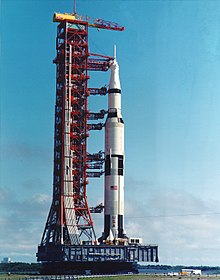
Saturn V

This post is called The Saturn Rockets, plural, because there were two if you speak loosely, or three if you are picky. If we were looking at all of the rockets of the Apollo program, we would have to add Little Joe. Getting men to the moon was a complex operation.

The pre-Apollo manned missions used modified military missiles as launch vehicles. Atlas was designated for Mercury, but delays in achieving reliability caused the first two Mercury flights to be sub-orbital on Redstone missiles. Gemini used Titan II missiles throughout the program.

The Saturn rockets are often said to be designed from the start as space launch vehicles, not military missiles. That is a somewhat limited view. The program that eventually produced the Saturns began in 1956 and ran through an amazing number of paper iterations before anything ever left the ground. “Saturn” development was simultaneous with the developments of Atlas, Titan, and other military missiles, and kept changing as those other missiles refined rocket technology.

The same infighting family of scientists and engineers developed Saturn and all American military missiles, the same set of companies built them, and the same government paid for it all. Saturn was developed through NASA and was never planned to carry warheads, but the entire American manned space program was a child of the cold war. The civilian vs. military distinction is a bit of sleight of hand.

By 1959, the possible types of Saturn rockets had been reduced to eight configurations. Eventually three were built.

Saturn I was designed to put spacecraft into low Earth orbit. Saturn V was designed to put men on the moon, and later tasked with launching Skylab. See 297. Skylab 1 and 298. Skylab 2.

Remember Little Joe? That was an existing rocket that was used early to test out the Apollo capsule’s abort mechanism.

Ten Saturn I rockets flew;. Five were in Saturn development flights. Five others carried early, unmanned versions of Apollo spacecraft, as well as Pegasus micrometeorite satellites.

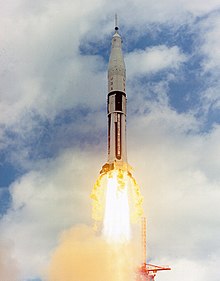
The Saturn I was replaced by the more powerful Saturn IB (shown at left) in 1966. Saturn IB became a workhorse for heavy, low Earth orbit launches.

The first Saturn IB topped by an unmanned CSM was launched in a mission then called Apollo 1. Later, after the deaths of three astronauts in the capsule fire, there was a mass renumbering of past flights in order to call their mission Apollo 1. It was an entirely understandable gesture, but it causes confusion to this day.

Two more Saturn IBs were launched in 1966, then the first Saturn V was launched. The next launch was to test an unmanned LEM in low Earth orbit. That flight fell to the Saturn IB which had been involved in the “Apollo One” disaster, since the capsule fire had not damaged the launch vehicle. Another Saturn V launch in 1968 completed the unmanned phase of Apollo.

On October 11, 1968, the first manned Apollo craft achieved orbit. Manned missions are what we all remember, but by that time there had been seven abort tests, sixteen launches of Saturn I, IB, and V vehicles, and twelve major ground simulation tests.

Apollo 7 was the only manned Apollo mission to use a Saturn IB. Apollo 9 was also a flight to low Earth orbit, but it used a Saturn V because it was  a full, close-in dress rehearsal and first launching of a manned LEM.

The other ten Apollo mission used the Saturn V, cementing a picture of that rocket into everyone’s mind.

After the end of Apollo, a Saturn V launched Skylab. Three subsequent launches of Saturn IBs took up the astronauts who manned it.

The last manned use of Saturn IB was to carry an Apollo CSM to rendezvous with a Soyuz vehicle in 1975.

545. Lottery Day at the Big Casino

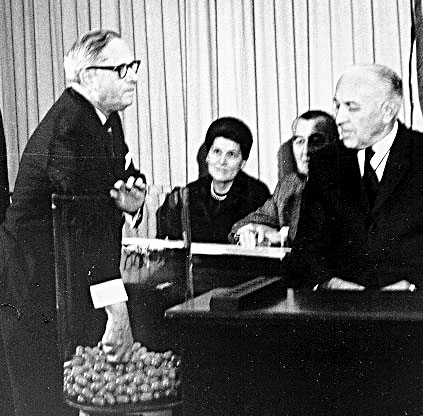
Rep. Pirnie draws the first number.

The place was a class at Michigan State University, just about this time fifty years ago. I wasn’t in the room, so I may be wrong on a few details, but the basic story spread quickly all over campus.

The professor was a young radical. There were a lot of those at MSU in the late 60s. Finals were near when he announced that grades would be given out a little differently this year. He opened a notebook and began to call roll. As he did, an assistant drew notes from a bowl. The professor read, “Adams.” The assistant took a folded paper from the bowl, opened it, and said C. The professor read, “Baker,” and the assistant said F.

As you may guess, it left the room in an uproar. I’m sure the actual grades were given in the normal manner, but the young professor had made his point.

About a week later, a similar lottery took place nationwide, televised, and determined life or death for thousands of young Americans. I was listening closely, because I was a contestant. It was the first draft lottery since World War II.

There were three of us paying attention, my two college roommates and I. One of them didn’t have to worry; he had blown his knee out as a high school wrestler and was 4-F. That’s a medical deferment. The other roommate and I were on student deferments, but we were both going to graduate in June. He drew a high number and never served. I wasn’t so lucky.

I have said often that the draft leveled the playing field. It was a favorite saying in that era that Viet Nam was a war where black people were sent to kill yellow people for the sake of white people. Without the draft, that would have been even closer to the truth.

I wasn’t feeling so charitable when that bastard got to my birthday and pulled a 41.

Ain’t it fun to gamble in the big casino?

544. Apollo 7

We are coming up on the fiftieth anniversary of the first moon landing.

Apollo One, the fire on the pad that caused the deaths of Grissom, White and Chaffee, took place February 21, 1967, causing a long delay. About a year and a half later things were just getting back up to speed. Apollo 7, the first successful manned flight took place on October 11, 1968.

The fiftieth anniversary of that flight was about a month ago, and I missed posting about it. That’s hard for me to believe, since I have been following the space program since 1957.

Purchased today, foot to butt kit, for self-application, apply immediately.

Apollo 7 is too important to simply mention, and too controversial for someone out of the loop to cover with authority. Nevertheless, here is a thumbnail.

Mission Commander Wally Schirra’s attitude toward NASA after the Apollo one disaster was — not positive. The space program had grown into a massive source of funds for companies. Engineers and the builders in the trenches were fully committed to excellence, however top brass decisions were sometimes questionable. The choice of North American Aviation to build the Command Module was controversial. McDonnell Aircraft had built the Mercury and Gemini craft, and many pointed out that the shift to North American Aviation wasted the talent and experience that had made the space program a success so far.

To put it bluntly, the Apollo Command Module NAA originally turned out was a lemon, and everybody knew it.

During the year and a half from the disaster to the launch of Apollo 7, Wally Schirra made it his personal mission to see to it that the craft he and his fellow astronauts were to ride in was of top quality. He was abrasive and relentless, and when Apollo 7 flew successfully, it was largely because of his persistence.

The flight, which he considered an engineering test mission, was cluttered up with scientific and PR projects. When they interfered with testing out the craft, he refused to do them. In space, where nobody could override his decisions. His acerbic interchanges with ground control would have banned him from future missions, but he had already announced that he would retire at the end of the flight. What could NASA do?

Apollo 7, the first manned Apollo mission, was an engineering success but a failure in personal politics. Eisele and Cunningham were never allowed to fly again, but the subsequent missions had a CSM that they could trust.

Wally Schirra became the only astronaut to fly on Mercury, Gemini, and Apollo missions.

======

I have recently worked out a series of posts covering events in the run-up to the moon landing. As I was doing so, I also became aware of another, less joyful anniversary. Since it took place on December first, which is a Saturday this year, I will skip Wednesday’s post and fill you in this Friday.

540. Where Are the Vets?

Here are some statistics, tailored for those who read this blog. I know most of you are young. I see your pictures on your likes, and I check out your websites.  I’m not young, so I see changes you may not be aware of.

Harry Truman, Dwight Eisenhower, John Kennedy, Lyndon Johnson, Richard Nixon, Gerald Ford, Jimmy Carter, Ronald Reagan, and both presidents Bush all served in the military in wartime. Regan and Bush Two served stateside in wartime; the others all saw combat.

Bill Clinton, Barack Obama, and Donald Trump did not serve.

In the current House of Representatives only 70 of 435 have served in the military. In the current Senate, only 13 of 100 have served. Those numbers will go up slightly with the incoming congress.

Veterans were not so under represented in previous congresses.

These figures relate the the reduced number of persons in the military. That is not quite the same as a smaller military, since the persons now serving tend to spend more years in service. Draftees from previous eras tended to go home as soon as they were allowed to do so.

I come from a long line of draftees. My father served in Europe in WW II, was wounded, and remained during the occupation of Germany. His younger brother was drafted, trained, and was on a ship “heading for Japan to die” (his words) when the US dropped the A bomb. He ended up in the occupation of Japan. I joined the Navy, Vietnam era, but not by choice. My draft number was 41, which meant my number was up (in both senses of the word) before I finished college. And no, I did not see combat.

I hated the draft and I still do, but it had one positive aspect. It leveled the playing field. More Americans had to step up, whether they wanted to or not, and that led to more protests. Without the draft, we would have been in Vietnam much longer.

Today is the hundredth anniversary of the end of WW I. All those veterans are gone. WW II ended in 1945. Very few of the vets from my father’s generation are still around.

America left Vietnam in 1973. Any vet who saw that day at age 18 would be 63 today. That was also the last  year American’s were drafted.

I’m not suggesting a return to the draft, God forbid. I have no particular agenda at all; I just want to give you this to think about.

A country which everyone has to defend, or at least has to stand in jeopardy of military service, is a very different thing from a country that depends on a volunteer military.

Better? Worse? That will be your decision going forward.

======

The numbers in this post come from PBS.

Trump World

I’ve been working on Like Clockwork, my latest steampunk novel. Today I was rereading a chapter from about the middle of the manuscript when this caught my attention. Let me share a few paragraphs.

“But lately it has all been falling apart.”

“You must expect that. Not everyone believed in the Founder’s ideas completely. One little girl didn’t believe at all. After He left, there was no one to answer prayers, and belief doesn’t last forever.”

“Are you saying that You — He — one or both of You  — answered prayers?”

“Of course not. But We did have the capacity to convince people that their prayers were being answered, even when they got the opposite of what they asked for. Any good religion can do that. You people are very easy to convince.”

Okay, I see the uncomfortable resemblance too, but I wasn’t thinking of Trump when I wrote this. Honest!

Then I read on and found another thought two pages later:

“So how do we get our world back to reality?”

“Reality? Never heard of it. You don’t get back to reality, you create reality. Didn’t you understand a word I said? If you want a different reality, tear this one down, and build a new one.”

Now that I can stand behind.

523. Monkeying Around

This is about accuracy in discourse, and therefore applicable to writers, but it won’t seem so at first. Stick with me a few paragraphs and you’ll see.

The last week of August, there was a primary in Florida. In the aftermath, Ron DeSantis said the voters would “monkey this up” if they voted for his black opponent, and was slammed for making a racist comment.

Really?

I remember the Monkees, back in the Precambrian. Their theme song contained the words

Hey, hey, we’re the Monkees.
People say we monkey around.

I knew they were a fake band, but I never realized they were racists.

Knee-jerk liberals (that’s me, by the way) can look pretty silly when we overreach. Even people I respect were calling the monkey reference a racist dog whistle, and maybe it is. But let’s apply a little logic, in the form of Occam’s Razor.

What is the simplest and most likely explanation for the statement? There is no old saying “monkey this up” but there is an old saying “monkey around” and it is a simple extension to make that “monkey around and screw this up”. Millions of people have said that over the years, with no racial intent. My guess is that DeSantis was thinking “f—- this up”, and cleaned it up for television.

But I could be wrong. I don’t know the man and what I do know doesn’t impress me. “Monkey this up” may in fact be racist code, with built in plausible denial. If so, it worked beautifully. By assuming the worst, the liberal press has given the man massive publicity, and come off looking like fools.

As writers, on the other hand, we are in the business of not being misunderstood. See, I told you I would bring this around to writing.

Recently, I was revising an old novel. A young man and woman were about to move into a physical relationship, which was not not a love match. She was more excited than he was, because she lived in a small village, and he was the first male of her own age she had seen in a long time. He was planning to travel on in the spring, alone. He would tell her that in another line or two. This is what I wrote, years ago:

When he loosened the strings of her robe, she did not protest.

When I wrote that, the image in the mind of a reader would have exactly matched what I meant to say. There would have been no thought that he was forcing himself on her, or that she was reluctant in any way. In point of fact, if you had read a few sentences before and after, she was steaming.

That was then. Now, in the age of #Me Too, the phrase did not protest might be read differently than I intended when I wrote it. So I changed the line to read:

When he began to loosen the strings of her robe, she moved to hurry the process.

That is a pretty subtle change. To my mind, the two lines mean exactly the same thing, but they might not mean the same thing to a modern reader.

Readers read what we say, not what we meant to say. Communication isn’t entirely in our hands — readers do misread from time to time — but we have to do our best not to monkey things up. And no, that was not a racist dog whistle. That’s just me kicking the liberal press one more time for falling into a trap.

(Some) politicians (may) be in the business of doublespeak. They may bask in the comfort of plausible denial. Writers are not in that business. Our job is to say what we really mean, so skillfully that the reader is not confused about our intentions.

That is actually a fairly hard job.