Tag Archives: politics

477. They Never Flew (2)


NASP

Continuing from 472. Teaching Space and 474. They Never Flew (1), this post will discuss three manned space programs that never happened.

Eisenhower, Kennedy, Johnson, and Nixon were the presidents who took us into space. Whatever you think of any of them, they will always have that marked down on the positive side of their ledger.

Other presidents aspired to join them. How much of their thinking was patriotic for America, patriotic for all of mankind, or pure political calculation, is way outside the realm of my knowledge. I’m going to give them all benefit of the doubt and just talk about the programs themselves. You can spin motives any way that suits you.

Regan proposed NASP, the National AeroSpace Plane, also called the X-30. In his 1986 State of the Union, he said that we should produce a vehicle which would be “a new Orient Express that could, by the end of the next decade, take off from Dulles Airport and accelerate up to twenty-five times the speed of sound, attaining low earth orbit or flying to Tokyo within two hours.” It was an exciting idea, coming out of DARPA where it had begun as a black project.

NASP was supposed to produce two prototype planes, but neither was ever built. That doesn’t mean that it was a political scam. The technological difficulties of the project were staggering.

In detail, NASP was cutting edge. As an idea, the horizontal launch of a spacecraft was old in science fiction. There it was usually accomplished by electromagnetic technology, with ground based and powered launchers and only maneuvering fuel on the vehicle itself. See many early Heinleins, especially Starman Jones and The Moon is a Harsh Mistress.

One reason rockets take off vertically is to get mostly out of the atmosphere before achieving speed. That way, massive friction is only a reentry issue, when it can be used to advantage.

NASP was a jet, not a rocket. It had to operate primarily inside the atmosphere. This has the advantage of avoiding carrying oxidizer, but has a series of disadvantages. Friction heating is an obvious one. In addition, its engine would have to operate in three modes — as a relatively conventional jet at takeoff, as a ramjet once sufficient speed had been achieved, then as a scramjet (supersonic ramjet) once it passed the speed of sound.

At that time, no one had successfully built a scramjet, and NASP didn’t make it happen. The first scramjet, the X-43, made a brief flight in 2001, eight years after NASP was cancelled.

No one has successfully built a skin that can withstand reentry level heating on a continuous basis, either. NASP was too far ahead of its time. I spent a few years explaining to my kids how it was supposed to work — before it didn’t work, and silently crept away.

Then came Venturestar, which, if it had been successfully completed, would have done what the Space Shuttle was originally designed to do. It was to be a vertically launched, completely reusable, single stage to orbit vehicle with a wider and more efficient lifting body that would have allowed it to land, in emergencies, on shorter runways than the Space Shuttle.

To do all this, it would require new and untested technologies, including composite material LH tanks, a new tile-free heat resistant skin, and an aerospike engine. The project was divided into two parts. To demonstrate the feasibility of the new technologies, a one-third size, unmanned model of the VentureStar, called the X-33 was to be built and tested, and only then was a full sized VentureStar to be constructed.

Things did not go well. When the X-33 was partially completed a version of its composite LH tank was tested and failed to hold pressure. Alternatives existed, but the decision was made to cancel the project. The funding for the X-33 was a complex mixture of commercial and governmental funds, and continuation depended on all parties agreeing. That didn’t happen. The Air Force was still part of the mix, as with MISS and the Dyna-Soar, as with the black missions by the Space Shuttle, but their request for continued funding was denied. The Air Force eventually got the X-37b instead. The X-33, and with it the VentureStar, disappeared. For a view that the cancellation should not have happened, click this link.

From the perspective of a science teacher, VentureStar had been a godsend, full of all the excitement the Shuttle and NASP had lacked. Once it failed, my kids had no future in space that they could personally dream about.

Then came Project Constellation. By that time, my days as a teacher were coming to a close, so I did not have to face the daunting task of generating enthusiasm for a cobbled up rerun. Ares I, the small booster, was built out of Space Shuttle leftovers and Ares V, the large booster looked suspiciously like a Saturn V reboot. The Orion Crew Exploration Vehicle was an oversized Apollo capsule and the Altair moon lander was a LEM on steroids. Not only was Project Constellation going to do again what had been done forty years earlier, it was going to use essentially the same hardware.

I didn’t buy it. I didn’t try to sell it to my kids. It died four years after it was floated.

The future isn’t dead. The Space Launch System continues where Constellation failed and private enterprise has more strongly entered the mix. Today’s science teachers should be able to say, “You might be the first person on Mars,” with a straight face. I continue to hope.

474. They Never Flew (1)

Continuing from 472. Teaching Space, this and the upcoming April 5 post will discuss the manned space programs that never happened.

Wikipedia lists seven manned pace programs which were canceled before they were launched, but this list is only technically accurate.

MISS, Man in Space Soonest, was a project from the early days when the Air Force planned to dominate space. The preliminary work was transferred to NASA when it was formed and became Project Mercury. Technically, MISS never flew; looked at more reasonably, MISS became Mercury, which was quite successful.

Dyan-Soar was a follow up Air Force project which planned to put a winged craft into low earth orbit, and subsequently turn that into an ultra-long range space bomber. It was contemporary to Project Mercury. There was not enough money or will to keep them both, so Dyna-Soar was cancelled, only to be reborn, in a manner of speaking, as the Space Shuttle. For details see 342. Dyna-Soar.

The Manned Orbital Development System, Blue Gemini, and the Manned Orbital Laboratory were successive names for the same secret project, designed to use modified Gemini craft to service an early one-use space station as an orbital observation post. It got to the point of one unmanned launch before being cancelled. It was made obsolete before it went into service by advances in unmanned reconnaissance satellites. For details see 256. The Space Station that Never Was.

By the time I started teaching, the era of manned space exploration was over, but there were plenty of manned space flights. The shuttle had 135 manned missions; Mercury, Gemini, Apollo, Skylab, and Apollo-Soyuz combined had only flown 35 manned mission. However, none of the Shuttle flights were explorations.

The early Shuttle flights were exciting and technologically innovative, but they only went where Mercury had gone two decades earlier. The flights quickly became routine. They were dangerous — Challenger and Columbia proved that — but danger alone does not bring excitement. Commuting on a freeway is dangerous, but only exciting during moments of imminent disaster.

The Space Shuttle was supposed to be a cost saving way to space, but it proved quite expensive. It was supposed to be reusable, but that turned out to be only partially true. It was supposed to be single stage to orbit, but it never was. Each launch had four components, not one. The fuel tank was only used once. The two solid fuel boosters had to be recovered from the ocean and refurbished each time. Only the orbiter was fully reusable, and it had massive problems with failing tiles.

A vast number of its flights were spent building and maintaining the International Space Station. Many scientists tried to stop the construction of the ISS, claiming that not much science would be done there, but the cost would cripple other exploration. They were not listened to. Politically, the ISS was a demonstration that the cold war was over and the US and Russia were now pals. You know how well that turned out.

From the viewpoint of science, plenty of exploration was going on in my kids’ era, but it all involved unmanned craft. From the viewpoint of a teacher trying to excite middle school kids, a Mars rover landing was great, but if it couldn’t be followed up by a statement like, “You may go there someday,” if fell relatively flat. None of the kids I taught in the eighties are going to Mars; by the time anyone gets there, those kids will be retired, and they knew it at the time.

The only manned space craft of my kids’ generation was the Space Shuttle, and it was only flying to low earth orbit. A lot of good science got done by the shuttle (and a lot of political nonsense) but it wasn’t the same. Mercury, Gemini, and Apollo were like going down the Amazon in a dugout canoe, with adventure around every corner. The shuttle was like driving to Sacramento on Highway 99. Dangerous, yes, but not exciting.

But every year there was hope. New manned space projects kept being proposed, and I studied all of them so I could teach my kids something that would excite them.

Regan had NASP; Clinton had VentureStar; Bush Two had Project Constellation. We’ll look at all three on April 5, and try to recapture the genuine excitement they generated, before they faded into history

467. Steel Drivin’ Man

So we come to the end of another Black History Month. I have said some new things, and repeated some posts that could not be said better. This is one of those repeats; it originally appeared as 88. John Henry, January 28, 2016.

The battle goes on, not just for “blacks” (who aren’t fully black) and “whites” (who aren’t fully white), gays, Latinos . . . the list goes on. If life permits, I’ll be back next year, beating the same drum. I won’t be here forever, but when I’m gone, you will still be here. It will be up to you then.

I have always wondered why John Henry is a folk hero.

Maybe it’s just a folk song. Maybe it isn’t supposed to make sense. I never worry about the fact that Stewball “never drank water, he only drank wine”; I do have a tendency to overthink things.

But let’s look at the facts. John Henry is big, strong, uneducated and very black. Symbolically black, even. As a ”little bitty baby” he picks up a hammer and accepts his fate. He works himself to death for white folks, while they stand around and bet against him. Then his wife takes over when he’s dead, and the story goes on unchanged.

Sounds pretty damned Jim Crow to me.

A technical point here, so it all makes sense. As a “steel drivin’ man”, John Henry is not spiking down rails to ties. He is digging tunnels. He is swinging a doublejack, a two handed medium weight sledge hammer. He is hitting a star drill, which is a steel rod about a yard long ending in a hardened cross bit. Every time John Henry hits the drill, another inch of rock is pulverized in the bottom of a hole. Between each stroke, his assistant turns the drill an eighth of a turn.

Men with John Henry’s job spent their days drilling holes in the face of a tunnel. Those holes were then filled with black powder or dynamite, depending on the era, and blasted. Then the drill men moved back in to do it all over again.

Imagine working in near darkness, covered with sweat and stone dust, breathing in the fumes from the last blast, damp and cold in winter, damp and hot in summer. Tough for John Henry; terrifying for his assistant, holding the drill steady, turning it only in that moment when the hammer is drawn back, and knowing that if John Henry ever misses, he’s dog meat.

It gets worse.

It is useful to those in power to have a large population of the powerless and hungry. Slaves fit that bill very well; so do new immigrants. Today we have the working poor, who are kept humble by the myth that if you can’t make it in America, it’s your own fault. You aren’t working hard enough (see post 5.Labor Day).

Immediately after the Civil War, white southerners found a way to get back some of their power and some of their slaves. They simply arrested and imprisoned newly freed blacks, then rented them out. They invented the chain gang. If you are trying to find historical reasons why blacks fill our prisons and why our police are so often corrupt, chances are pretty good your research will lead you to those events.

What does this have to do with John Henry? In searching for the man behind the legend, writer Scott Reynolds Nelson’s* discoveries suggest that John Henry was one of these convict-slaves.

John Henry was a man who could not break his chains, but was still a man for all that. His status as a black hero makes sense.

Still . . ., if I were borrowing all this to make a story, I would rewrite it so that John Henry used his hammer to brain the overseer. But, of course, the real John Henry could never do that, and today’s black community would not accept such a cheap answer, or such an easy road to freedom. It would not match up with their own experiences.

History is usually uglier than anything we novelists can invent.

——————–

*Scott Reynolds Nelson. Steel Drivin’ Man: John Henry, the Untold Story of an American Legend.

466. Nothing But White

The first African slaves arrived in America in 1619. That’s 399 years ago. If we count twenty-five years as a generation, that’s 16 generations.

Now, lets look at you and your ancestors. Chances are, they haven’t been in America for 16 generations. In fact, this being the internet, chances are you aren’t even in America, so let me explain.

Here in America, whether you are white or black is a big deal.

If you are from India, or Indonesia, or the Philippines, or just about any place else in the world, you are likely to have your own racial and ethnic issues. Your tangle may be different from our tangle, but it’s probably just as tangled.

Being black or white in America isn’t as big a deal as when I was a kid, but it’s still big. And that is true even though there is probably no American black who is actually, fully, and truly black. Don’t take my word for it. Here is what Langston Hughes, negro poet,  said in his autobiography:

You see, unfortunately, I am not black. There are lots of different kinds of blood in our family. 

Being white in America is a big deal too, in the other direction. And that is true even though very few whites are actually, fully, and truly white. Don’t take my word for it. In 1895, speaking against defining whiteness in the new South Carolina constitution, Congressman George Tillman said:

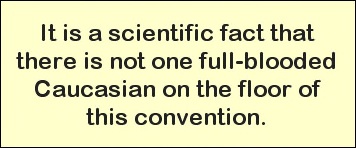
It is a scientific fact that there is not one full-blooded Caucasian on the floor of this convention. Every member has in him a certain mixture of… colored blood…It would be a cruel injustice and the source of endless litigation, of scandal, horror, feud, and bloodshed to undertake to annul or forbid marriage for a remote, perhaps obsolete trace of Negro blood.

A generation later, several southern states did define race, declaring that one black ancestor, however distant, was enough to turn a white man black. It was a sad day for those perceived to be black, and a bad day for truth.

Back to your ancestors. You had two parents (we’re speaking biologically here) and they had four parents and they had eight parents . . .; up the line 16 generations, that’s just under 33,000 ancestors sending their DNA down the line.

Can that be right? Let’s look. The first generation is you, alone, and for the rest we will need a chart.

generation     number of ancestors

               2                     2
               3                     4
               4                     8
               5                    16
               6                    32
               7                    64
               8                  128
               9                  256
               10                512
               11                1024
               12                2048
               13                4096
               14                8192
               15                16384
               16                32768

You have 32,768 great . . . great grand parents. If you are a “white” person in America, what are the chances that not one of them was out of Africa?

If you are just of the plane from rural Norway with ancestors going back unbroken into antiquity, as soon as you have a child with an American who has been here, that child’s number becomes 16384. You can run scenarios to lower the number, but it will never drop below BIG.

All right, let’s say you are a member of the Aryan Nation, and your father and his father were Klansmen all the way back to Appomattox Courthouse. You only marry white girls, and only natural blondes at that. What are the chances that her thirteenth great grandmother wasn’t partly black and passing for white?

You don’t think so? Your ancestors knew better back in the 1800s.

Let’s go at this from the other direction. Suppose one black woman was made pregnant by her master in the first generation. How many of her descendants would carry at least a trace of African DNA? All of them. How many would that be?

Historically, women bore many children, and many of them died while young. Let’s say that the average woman had four children who lived long enough to have children of their own. That original black woman would have one billion, seventy three million, seven hundred forty one thousand, eight hundred twenty four descendants.

You don’t believe me? Get out your calculator. No, better make it a spreadsheet. You don’t think I did that math with pencil and paper, do you?

What are the chances than none of those children passed for white, and begat a line of offspring who are convinced that they are actually, fully, and truly white?

Let me put it another way —

Donald Trump is partly black. David Duke is partly black. Steve Bannon is partly black. You’re partly black. I’m partly black.

And my relatives just disowned me. That’s mighty white of them!

465. Black, White, Aryan, Jew

This is a slightly rewritten republication of a post of the same name from 2016. It is important enough to say again, basically unchanged.

In America, race means black and white. It’s basically a construct. It is a handy visual tool we use so we can tell us from them.

We all partake of the same gene pool, varying only in the amount of various genes we possess. Take the whitest non-albino; put him on one end of the line. Take the blackest black and put him on the other. Assemble the millions of the rest of us and put us in between. There would be no break in the gradation.

Nevertheless, race is still here, so embedded in our national consciousness that the truth of our unity is swamped by the voice in our heads screaming, “I don’t care. Blacks are still blacks, and whites are still whites!”

This kind of confusion about basic reality leads to tragedy, and not only in America. Try this sentence:

In the days of the Third Reich, Germans persecuted Jews.

If this sentence sounds accurate, you are missing a few points. The Jews who were sent to the death camps were largely Germans. I am sure that was no comfort to them, and it isn’t the most salient fact about the situation. But it is important. If we put a wrong label on something, it makes it hard to think clearly about that thing. This process is still going on, as today’s politicians turn complexities into sound bites.

Hitler offered simplified and false solutions to real problems, based on the idea that there was a German race and a Jewish race. Jewish is not a race. It is a religion, and sometimes an ethnic group.

German is not a race. It is a language, and it is shared by several countries other than Germany. Germanism is also an attempt by the late-formed country of Germany to find national unity in a semi-mythical past.

Aryan is not a race. If you say Aryan in today’s world, it will evoke Hitler’s movement to elevate his blonde, blue-eyed “super race” to world supremacy. That super race is a myth made up of equal parts hatred and scientific misunderstanding.

In fact, the term Aryan originates in northern India, 3500 years ago. It refers to the “light skinned” conquerors who drove out or enslaved the dark skinned native population. The word Iranian is a modern variant of the word Aryan. As for the “light skinned” conquerors, think Koothrappali from the Big Bang Theory. The Aryans were light skinned only compared to the people they conquered.

Hitler should be rolling over in his grave at the thought, but he got his information third hand.

It started with Max Muller, an honest German born-scholar who spent his career at Oxford. Linguists of his day discovered the link between the languages of Europe and South Asia, and developed the notion of an Indo-European language family. They believed this family of languages originated in the southwestern steppes of Russia, and was introduced into South Asia through the Aryan invaders. Muller was a strong proponent of Aryan culture, considering it one of the greatest developments of mankind. By Aryan, he meant the culture of India. After others had misrepresented his ideas, he clarified that Aryan culture did not imply an Aryan race. No one listened.

As time passed, proponents of European superiority such as Arthur de Gobineau moved the origin place of the Indo-European language family to northern Europe, confused current notions of race (such as Nordic, Alpine, and Mediterranean) with the linguistic and cultural classification Aryan. They “invented” the Aryan race, which they considered to be light skinned in the European sense, the originators of civilization, and superior to all others.

The caramel skinned invaders of India had been thoroughly whitewashed.

The last member of this trio is Huston Stewart Chamberlain, born in England, raised in France, and ending his life in Germany, converted to German superiority by Wagner’s music. He wrote the Foundations of the Nineteenth Century, in which he saw the history of the world entirely in terms of conflict between the Aryan and Jewish races. It became a bible of Nazism, and Chamberlain became a mentor to Hitler.

Labels like Jew and Aryan matter, just as labels like black and white matter in America. A “Jew” in Nazi Germany might be a Zionist extremist who believed that God chose his people and would smite all his enemies. He might be a modernistic non-believer who had repudiated his Jewish ancestors, read Nietzsche, and listened to Wagner. He might even be some poor schmuck who just got misidentified. It would all be the same in Auschwitz.

The Aryans that Hitler believed in, didn’t exist at all.

461. Undesirables

Emigrants statue, Helmsdale, Scotland, commemorating the eviction of Highlanders from their land. A father and child and, hard to see in this photo, the mother looking back at her home which she will never see again.

Black History Month is human history month. I’ll have plenty to say about the position of blacks in America, but today they are not the most threatened group. As I write this, Congress is fighting over DACA.

Two Christmases ago I wrote a fictional story about a little girl who was going underground with her parents because Donald Trump had become president. One of my readers replied with a short fictional addition in which one of my characters said, “If only our parents had followed the law, we would be all right.” That reader had a right to his opinion, and I published his reply. I’m not here to disrespect him. I am here to disagree with him. Strongly.

Deportation is a kind of eviction. Eviction is the act saying, “You can’t stay in this place any more, because the rights to this place belong to someone else.” That someone is usually a person or a corporation. Deportation makes the same statement, except that the someone else is you and me.

Eviction is old. It has been around since Og the caveman kicked his mate’s brother out of the hut. It wasn’t long after that before force of boot was traded for force of law.

Between 1710 and 1850 in northern Scotland, Scots who had lived on their lands for hundreds of years were forced off, their houses burned, and their livelihoods destroyed. It was all quite legal. Scotland had become an adjunct nation to England, de facto. Ancient laws had been misrepresented and changed to match an English model. Clan chiefs, whose existence was traditionally enmeshed in reciprocal obligations with their clan, were now seen as landowners.

It equivalent to Donald Trump shifting his legal position from President of the United States to owner of the United States, but on a smaller scale.

These “landowners” forced their clansmen off the land, sometimes with great violence. In early clearances, they were moved to undesirable lands within Scotland. When this failed, later clearances moved them off to the Americas.

In Ireland, during the Famine, undesirable Irishmen were moved out by eviction or allowed to starve in place. Most of them went to the Americas.

It was a pretty practical solution. If you don’t want undesirables around, send them to America. Ironic, isn’t it, that those undesirables’ descendants are now about to evict a new set of undesirables from America.

Meanwhile in America, the American Indians . . . but you know that story. If you don’t, check out 247. The People’s President.

You may not realize that in 1941, all those undesirable Japanese with their rich farms in California were moved into relocation camps. It was supposed to be for our protection, because they might attack from within. Maybe; but if so, why did they never get their farms back. (266. The Other War)

So let’s get back to DACA. This is an act protecting persons brought to the United States illegally as children. They are American in every way but a technicality. They may well not speak any language other than English. They may never have stepped foot outside the United States.

Now we are going to send them home. Home? They are home.

Let’s consider a pair of hypothetical children. Jose was born in Mexico, an hour before his parents crossed the border illegally into the United States. Ramon’s parents were on the same trip north, looking for work. Ramon’s mother gave birth just an hour after they crossed the border, illegally, into the United States.

We’ll let Ramon stay. He is a citizen. We’ll deport Jose. That’s fair, isn’t it.

Maybe, but . . .

What about (hypothetical) Barta Kovacs? He was brought over in 1956 by his parents, who were refugees from the Hungarian Revolution. Today he is 64 years old. He never married, but he spent thirty years as a school teacher, rising to be principal of a local high school before running for office. He has been a State Senator in one of those northern states for eleven years, and now he’s ready to retire.

However, as he applied for Social Security it was discovered that there had been an irregularity in his application for citizenship years before. Technically, he has never been a citizen, even though he has spent 62 of his 64 years here, and has no memory of Hungary.

Will the present administration deport him back to Hungary? I don’t think so.

Good thing our hypothetical Barta Kovacs wasn’t Mexican.

460. White World

“Welcome to Black History Month,” said the old white guy.

You might wonder what I know about black history. The answer is, actually, quite a bit. I was a teenager during the height of the civil rights movement. I wasn’t involved, but I was watching and learning.

I grew up in Oklahoma in the fifties. That isn’t the South, but it’s close enough. We didn’t have blacks-only facilities in my town, because we didn’t have blacks. There were blacks in Tulsa where we shopped, and a few in Claremore, the county seat, but not in the rural areas I inhabited.

We called them negroes in polite conversation, but niggers most of the time. Sorry. It hurts my fingers to type that word, but I’m not going to lie to you. Nowadays, I use the term blacks because that is what they chose for themselves in the sixties. African-American came later, along with Native American. Both those terms sound to me like something made up by embarrassed white guys. I’ll stick with blacks, because that is what blacks wanted to be called when I first became fully aware of them as real people.

When I was very young, I didn’t have much of an opinion. I had never met a black person. There was one black man who farmed somewhere in the area. I saw him go by in his pickup once in a while, but that was as close to a black person as I had been.

I had also never met a Jew. I had never met a Spanish speaker, nor an Italian, nor a Mormon. Certainly not a Muslim; actually, I had never heard of Muslims. There was one Catholic boy who attended our school briefly. He wasn’t well treated and he didn’t stay long.

We didn’t have segregation. We had apartheid. I just didn’t know it at the time.

You get the picture. Not just white — WHITE. And not just Protestant, but Southern Baptist. And not just Southern Baptist, but small-town-Southern-Baptist; not like those liberals down in Tulsa. There were so many Baptists in town that the local high school didn’t have a prom.

That’s who I was when I was at ten. That’s not who I was by the time I was fifteen.

When those black people down south went marching, and were met with clubs and dogs and firehoses — when my father (and everybody else’s father) said it was their own fault, I couldn’t buy it. When I saw them bloodied and beaten, yet standing firm for freedom and dignity, I knew they were right and we were wrong.

When they fought for their own freedom, they also gave this Oklahoma white boy his freedom. They gave me a new way of looking at the world, and I am grateful to this day.

So the first year I was blogging, I wrote a month’s worth of posts on civil rights. Check any post between January 18, 2016 and February 18, 2016 if you want to see them. Last year I didn’t try to repeat myself. I had said everything I had to say.

This year, everybody who doesn’t look like me is in jeopardy all over again.

I’m an American white male. I have all the civil rights in the world. I also have an obligation to see that I am not the only one who has them.

So here I go again. Welcome to Black History Month.

455. Voices in the Walls

Annotated Links to
Voices in the Walls

Voices in the Walls is a fragment of a novel. It is still available in archives, but it would be impossible to navigate because it is entwined with A Writing Life posts and you would have to read long columns from bottom to top. Instead, I am going to provide a set of annotated links to make life easier.

Voices in the Walls was presented in Serial, parallel to the posts in A Writing Life that explored my position on race. You might want to read yesterday’s post for a quick summary of the novel’s genesis.

I wrote Voices in the Walls in the eighties, as a fictional way of presenting a young man who has to rethink his entire life when faced with with the fact that all his previous understanding of race is wrong. I used the opening days of Lincoln’s presidency, as the nation slid into war, as a vehicle for the story.

I never finished the novel, for reasons I explained yesterday, but it still means a lot to me. I also decided that, as an example of a writer’s struggle with a hard-headed idea, it might form a sort of how-to for writers. Enjoy.

Voices in the Walls 1  Setting the stage for the story.

Voices in the Walls 2  Setting the stage for the story.

Voices in the Walls 3  Prolog, and a discussion of bracketing.

Voices in the Walls 4  Why this novel and why 1861?

Voices in the Walls 5  Chap. 1 begins

Voices in the Walls 6  Chap. 1 continued

Voices in the Walls 7  Chap. 1 continued

Voices in the Walls 8  Chap. 1 continued

Voices in the Walls 9  Chap. 1 continued

Voices in the Walls 10  Chap. 1 continued

Voices in the Walls 11  Discussion inserted between chapters

Voices in the Walls 12  Chap.2 begins

Voices in the Walls 13  Chap. 2 continued

Voices in the Walls 14  Chap. 2 continued

Voices in the Walls 15  Chap. 2 continued

Voices in the Walls 16  Chap. 2 continued

Voices in the Walls 17  Chap. 3 begins

Voices in the Walls 18  Chap. 3 continued

Voices in the Walls 19  Chap. 3 continued

Voices in the Walls 20  Chap. 3 continued

Voices in the Walls 21  Chap. 4 begins

Voices in the Walls 22  Chap. 4 continued

Voices in the Walls 23    Chap. 4 continued

Voices in the Walls 24  Chap. 4 continued

Voices in the Walls 25  Chap. 5 begins

Voices in the Walls 26  Chap. 5 continued

Voices in the Walls 27  Chap. 5 continued

Voices in the Walls 28  Chap. 5 continued

Voices in the Walls 29  Chap. 5 ends, outline of the rest begins

Voices in the Walls 30  2 of 6, outline

Voices in the Walls 31  3 of 6, outline

Voices in the Walls 32  4 of 6, outline

Voices in the Walls 33  5 of 6, outline

Voices in the Walls 34  6 of 6, outline

454. Another Man’s Shoes

Another Martin Luther King day has rolled around. They always pose a problem for me.

What? You don’t care about my problems? Well, there is really no reason you should, except that this one is about trying to write honestly, which makes it a problem many of us share.

I grew up white in a conservative Oklahoma where blacks were not favored. That puts it gently. I watched the civil rights marches of the fifties and sixties on TV and decided I was on the wrong side of history. And humanity.

Then I became a writer, and that all needed to be explored. I did so in posts. Look at any post in A Writing Life from mid-January through the end of February of 2016 if you are curious.

I also tried to explore that story in a novel called Voices in the Walls. I began it in the eighties and made it through about seventy pages before I ran up against the essential issue — there was no way I could write about slavery from the inside, yet I had to in order to make the book work.

Matt Williams is a young southerner who is torn both ways at the outset of the Civil War. I put him through a series of events which sends him south to rescue a free black woman who has been recently captured. I pulled that part off without straining credulity, but once he is there I need for him to interact with escaping slaves and to see slavery from their perspective.

I had no problem with Matt’s perspective, and the overall novel is from a white viewpoint. However, he has to come to see the south from a slave’s viewpoint and when I reached that point in the book, a voice in the back of my head began screaming, “What right do you have to write that?”

Intellectually, the voice is bogus. It is the job of a fiction writer to crawl inside other people’s heads and speak through their mouths. I’ve done it innumerable times.

Emotionally, this particular voice is too loud to ignore.

Matt and his slave counterpart (I never got far enough to name him) each has to experience the other’s understanding of the world. That is what the novel is about. If a black writer can’t take the white position, and a white writer can’t take the black position, the story can never be told. I don’t accept that, and since I am a sympathetic white, I should be able to proceed.

I can’t. The voice in my head won’t shut up. It has been yammering at me for decades. It may just be one of those things that I am too locked into my own generation to ever get straight.

No problem. One of you will write it, sooner or later. Maybe one of you already has.

#                 #                 #

Voices in the Walls is still available in archives, but it would be impossible to navigate. Someday I will present it in another form, but for now, I am going to give you a set of annotated links in Wednesday’s post.

448. The Good King

Merry Christmas and why are you on the internet when you should be sitting by the Christmas tree?

Christmas is my favorite holiday. Of all the masses of Biblical knowledge I accumulated in my religious childhood and youth, the story of the Nativity is the only part that still moves me to joy.

I particularly enjoy Christmas carols, even the unsingable ones. However, I never understood the appeal of Good King Wenceslas until I saw and heard it in the movie Miracle Down Under, where it is sung by a poor family and some swagmen to the accompaniment of a washboard. Then I understood the bump-bump-bump-bump-bump-bump-bump non-melody as something that could be handled even by coarse voices without instruments.

I also paid attention to the lyrics for the first time. The King is watching over his people, and when a poor man is spotted gathering wood for his fire, the King goes to his hut with food. The final few lines are particularly moving, despite their awkwardness as they are tacked on as a sort of “moral of the story”.

Therefore, Christian men, be sure,
    wealth or rank possessing,
Ye who now will bless the poor,
    shall yourselves find blessing.

Not bad. Even today, we could use a President who understands that simple message.