Tag Archives: politics

447. Lupe Revisited

Last Christmas, I told the story of Lupe in a world where Donald Trump was going to be President. Now he is President, and things have not gotten better. Here is Lupe’s story again.

Ramon came in, stamping the snow from his feet, and shook the snow from his jacket before closing the door. The sun was low in the eastern sky behind him as Lupe moved up and hugged his leg. He smelled of sweat and manure and soured milk, but she didn’t mind. She had hugged him this way every morning for as long as she could remember, and he always smelled the same. For Lupe, the smell was as familiar and welcome as his cold fingers on the top of her head.

Every morning Ramon rose before the sun was up, and left the house. His daughter greeted him when he returned hours later, and saw him off again in the afternoon. She was usually asleep when he came home at night.

It is hard work milking cattle twice a day, and the pay is low. The cattle march in from the muddy lots to take their turns in the stalls, where fast moving men attach the milking machines. The cattle resent the process and the workers have to move quickly to avoid having their hands caught against he stanchions. It goes on for hours, in heat or cold, beginning every morning before daylight, and continuing again every evening until long after dark.

Lupe stepped aside to make room for her mother. Today she seemed worried; her voice was unusually sharp as she asked, “What did he say?”

Ramon said, “I didn’t tell him.”

I translate, of course. Every word was in Spanish.

“You got your money for the week?”

Lupe’s father nodded, “I told him I needed it today, to buy things for Christmas. I was afraid to tell him the truth. He is a good man, but it seemed best that he should not know.”

Lupe’s sister came out of the single bedroom with a cardboard box in her arms, tied up with twine. Lupe looked up with interest. It was not wrapped in paper, but any box is interesting so close to Christmas. Carmella put the box down on the floor and returned a moment later with blankets and bedding, also rolled up and also tied up with twine. Lupe asked what she was doing, but Carmella ignored her.

Her father carried the box and roll outside. Her mother came out of kitchen with a box of food, and that began a procession of boxes, coming from various parts of the house and out to the car. Lupe’s mother and sister had gathered their possessions during the pre-dawn, while Lupe slept.

Now Lupe dragged at her mothers leg asking questions, but she was ignored until Carmella pulled her aside and said, “We are going away.”

“Where?”

“I wish I knew Lupita. I wish I knew.”

“But why?”

“It’s only a month until he becomes President. Everyone here knows who we are. We have to go away, somewhere where people don’t know us.”

“But why? I was born here. This is home.”

“So was I, Lupe, but mother and father were not.”

When they pulled out an hour later, Lupe stared back at the little house where she had spent her whole, short life, until it disappeared around a bend. Then she looked out the windshield, past her mother and father’s silent heads. It was a long road, wet with melted snow. Her father would not leave the house tonight before the sun went down and go to the cows. There would be no more money, no more warmth, no more little house. It would be again as it had been, before the job at the cows, before she was born. Lupe knew what that was like from hearing her parents talk. Now it would be like that again.

*          *          *

Is Lupe real? She was born from the hundreds of little Mexican-American girls I taught over twenty-seven years. How many were undocumented? I never knew. I never asked. I didn’t need to know.

Is she real? She is as real as heartache. She is as real as fear. She is as real as dislocation, cold, hunger, and injustice.

446. Until Proven Innocent

When I started this post, my queue was full into the second week of January. News in the world outside my writing space has moved so quickly, however, that I am squeezing it in today. I’ll leave the four parts date-stamped and unchanged from what I originally wrote.

========

I am writing this on December sixth, 2017. Right now President Trump is announcing his decision to recognize Jerusalem as the capital of Israel, but that isn’t the only news story of the day. It just increases the chance that we will all be dead before I get around to posting this.

The other news story of the day is the Time magazine person (people, actually) of the year, The Silence Breakers. I have been bothered by this movement since it began, but until now it seemed too early to say so.

I don’t disagree with the women coming out with accusations. I applaud them. But there is a problem with bandwagons, and every news story I’ve seen so far falls into the same trap. They all say, “The women must be believed.”

No. This is false. Completely and utterly false.

The truth is, “The women must be listened to. Their accusations must be considered valid, and subjected to the same scrutiny as any other accusations.”

In shorter terms, “The women must not be automatically disbelieved.” That is a very different statement from, “The women must be believed.”

There are two problems here. The first is conflation. A pat on the butt isn’t the same as rape. The accusations against Weinstein are not of the same level as the accusations against Franken.  There is a mass of absolutely disgusting behavior coming to light, but it is not all of the same weight. Some of it, if proven, deserves life in prison. Some deserves a powerful slap across the face, by the victim, at the time, and nothing more. Most of it falls between those two extremes.

The second problem is guilt and innocence. Even if every accusation so far is valid (and that wouldn’t surprise me), I guarantee that by the time you read this, some innocent guy is going to be on trial in the court of public opinion for something he didn’t do. Women also lie.

“Not likely,” you say? Perhaps not so far, but give it time.

Let’s take a little trip, mentally, one hundred years back and to certain parts of America. I didn’t say the South, because it wasn’t just the South. At that time and in those places, if a white man said something, it was taken for the truth. If a black man said something contrary, he was lying.

It’s rather like the reaction a woman would have received if she had made an accusation ten years ago. I don’t want to go back to that situation, not even with the roles reversed.

I am in favor of this shift in public sentiment. I applaud and support the Silence Breakers. But while we are all reading today’s Time magazine, let’s also pull out that dog-eared copy of Arthur Miller’s The Crucible and give it another glance.

It’s very simple, and damned unsatisfying, that not every accusation is false (even if we like the guy) and not every accusation is true (even if we hate the guy).

Bandwagons are fun to ride on, but you wouldn’t want to get run over by one.

========

Time flies when you are making predictions. This morning (December 14) Senate Minority Leader Chuck Schumer reported to the FBI that forged sexual harassment claim was sent to news media. The supposed author of the documents denies having written it.

So it begins.

========

And now it is Saturday, December 17. Next Monday morning, Tavis Smiley will present on GMA his statement of innocence about charges leveled in the last few days. Is he actually innocent? Is he guilty?

I don’t know. And that is the point.

At any rate, if I don’t shoehorn this into the post queue now, it will be too late to bother.

========

And now, December 18, I have heard Smiley’s response. I need to say more, since I wrote an entire novel based around false accusations (Symphony in a Minor Key, over in Serial) but my posting schedule and my life schedule will push that into January. No problem; I don’t think this issue is going away any time soon. more later

444. Last Men on the Moon

left to right: Schmitt, Cernan (seated), and Evens

The last Apollo mission occurred forty-five years ago this week, with final departure from the moon on December 14th..

The three men who went to the moon on Apollo 17 were not the original choice. Astronaut crews during Apollo were selected well in advance, with primary and backup crews for each mission. The backup crew, as a unit, was supposed to fly on a subsequent mission, but not the very next one. That plan was frequently disrupted by events. Everyone probably remembers from the movie Apollo 13 that Mattingly was originally part of the Apollo 13 crew, but was bumped at the last minute in favor of Swigert because Mattingly had been exposed to rubella. The actual shuffling that took place was far more complicated than that.

As Apollo wound down and missions 18, 19, and 20 were cancelled, (see 441. The Last Apollo) nine astronauts were going to lose their chance at the moon. One of these men was Harrison Schmitt who had been slated for Apollo 18. He was one of the scientist astronauts recruited by NASA. Given the schedule at the time Apollo 18 was cancelled, none of these scientists would have flown. This was unacceptable to the scientific community; they lobbied for and got Schmitt moved up to Apollo 17, which cost Joe Engle his mission.

What happened to the men who got the Apollo axe? Obviously that is worth at least one post, possibly more, but my rotation pushes that into January or later.

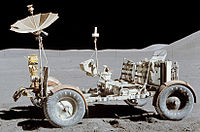
Eugene Cernan and Harrison Schmitt landed on the moon December 11. Their mission was J type, as were Apollo 15 and 16, which meant these missions were designed for a three day stay and included a Lunar Rover. This dune buggy looking vehicle allowed one or two astronauts to move further away from the Lunar Lander and greatly increased the usefulness of the mission.

Apollo 17 landed in the Taurus-Littrow region of the moon. This site allowed sampling a wide range of types of rock, as it consisted of an ancient lava flow, with surface broken by subsequent meteor strikes, and included secondary strikes. This means that ejecta from the nearby Tycho crater came to earth (came to Moon?) causing secondary, smaller craters at the Taurus-Littrow site. This allowed Schmitt to sample Tycho material even though an Apollo landing at Tycho never happened.

A few minutes before eleven PM, Greenwich Time, December 14, 1972, the last manned mission to the moon lifted off, to later rendezvous with the CSM and return to Earth. Gene Cernan was the last to enter the lunar Lander before take off. We’ll give him the final words:

“Too many years have passed for me to still be the last man to have left his footprints on the Moon. I believe with all my heart that somewhere out there is a young boy or girl with indomitable will and courage who will lift that dubious distinction from my shoulders and take us back where we belong. Let us give that dream a chance.”

==========

I’ve read a large number of memoirs by astronauts and others involved in space exploration. The Last Man on the Moon by Eugene Cernan and Don Davis is one of the best. If you want more of this story, that is the place to go for it.

441. The Last Apollo

“We leave as we came, and, God willing, we shall return, with peace and hope for all mankind.”        Cernan’s closing words on leaving the moon at the end of Apollo 17

Forty-five years ago, at 12:33 AM Eastern Time, the last manned moon flight took off from Cape Canaveral.

It was a stunt from the get-go. Kennedy’s speech, setting a goal of landing a man on the moon and returning him safely to the Earth, was a Trump-worthy brag. If we had failed, it would be laughed at today as just another empty promise made by a politician.

One man laid down the challenge and thousands of men and women carried out the promise.

But it was still a stunt. When Kennedy made his speech on May 25, 1961, Russian had put a man into orbit. We had not, although we had managed a sub-orbital flight. Atlas boosters were still blowing up on launch, so a smaller Redstone was used for Alan Shepard’s flight on May fifth.

NASA had only been in existence for three years. By any real or imagined yardstick, the Russians were far ahead in space.

By herculean efforts, NASA forged ahead through Mercury and Gemini. The fire aboard “Apollo One” set American efforts back significantly, and when launches began again, it looked like the Russians were going to land on the moon first.

There were Soviet problems however, particularly the repeated failure of their N-1 rocket. These doomed their attempt to reach the moon first, but NASA was not aware at the time.

NASA had problems of its own. The lunar lander was not ready when Apollo 7, the first actual manned Apollo flight, left for low Earth orbit in October of 1968. Only a year remained on Kennedy’s timeline, and the Soviets — we thought — were poised to land on the moon ahead of us. Something had to be done.

That something was the Apollo 8 journey to and around the moon, without a lander, for the Christmas season of 1968. We had been to the moon first (by an ad-man’s stretch of the truth), even if the Soviets became the first to land.

Apollo 9 tested the lunar lander in low Earth orbit. Apollo 10 (the most frustrating almost in human history) returned to the moon, deployed the lunar lander, and flew it to within wishing distance of the moon without landing.

Apollo 11 landed a man safely on the moon, and returned him safely to the Earth.

Now what?

For the Soviets, the answer was to turn away from the moon. Their N-1 mega-rocket had failed, and their manned modules and lander were stored away. The Soviets began a series of long flights and space stations, studying space from low Earth orbit.

For NASA there were nine more Saturn V rockets waiting to launch Apollo 12 through 20. It didn’t turn out that way. Apollo 12 landed in a different part of the moon, Apollo 13 suffered and explosion, didn’t land, and barely made it home.

Even before Apollo 13, Apollo 20 was cancelled so its Saturn V could be used to launch Skylab. Even before Apollo 14 landed, Apollo 18 and 19 were cancelled. Why? Because it was a stunt from the get-go. Apollo 11 met the deadline. To coin-counting bureaucrats, that was enough.

For those of us who see space exploration as the future of humanity, Apollo 11 was only the  beginning. Lunar exploration, a moon base, Mars. Venus — there should have been no end.

Bureaucrats did not agree. On Thursday, 1972, at 12:33 AM Eastern Time, the last manned moon flight took off from Cape Canaveral.

more next Thursday, the anniversary of the last liftoff from the Moon

439. Jose, Maria, y Jesus in Trumpland

[Don’t expect even handedness here.]

In English we call him Joseph, in Italian he is Giuseppe, in Basque he is Joseba, in Spanish he is just plain Jose.

In English we call her Mary, in Hebrew she is Miryam, in German she is Maria, and also in Spanish.

In English he is Jesus, in Cornish he is Jesu, in Italian he is Gesu, and in Spanish he is Jesus again, but pronounced Hey-sous.

We are going to walk with these three in this sermon for the Christmas season.

And it came to pass in those days, that there went out a decree from Caesar Augustus, that all the world should be taxed. And all went, every on into his own city. And Jose also went up from Galilee, out of the city of Nazareth, into Judaea, unto the city of David, which is called Bethlehem, to be taxed with Maria his espoused wife, being great with child.

Of course that could be written as Joseph and Mary, but surely they are the same couple, in any language. Jose was a carpenter. He built things out of wood to feed his family, and he paid his taxes like everybody else. All the world was to be taxed, and he had to go back to the place from which his people came.

Where would that be? Perhaps a land with cities named Sacramento for the Holy Sacrament, or maybe Atascadero, Alameda, Camarillo, El Segundo, or Escondido. Perhaps cities like Fresno, La Mesa, Madera, or Mariposa show where his people once lived. Certainly they must have lived in cities like Los Angeles, Merced, Paso Robles, Salinas, or San Francisco. Even if his people no longer own the land, certainly the city named after him, San Jose, must once have belonged to his people.

And so it was, that, while they were there, the days were accomplished that she should be delivered. And she brought forth her firstborn son, and wrapped him in swaddling clothes, and laid him in a manger, because there was no room for them in the inn.

I think Luke shortened this a bit. Was there only one inn in Bethlehem? We can see the young couple, going from place to place, Jose leading, Maria on a burro since she cannot walk so late in her pregnancy. Everywhere they are turned away. Are all the sleeping places truly full? It may be. Or perhaps something about the two of them, perhaps the color of their skin, makes the innkeepers turn them away. Luke does not tell us.

I see migrant housing everywhere I go in California and I think, perhaps, a manger was preferable.

Now they are in a place where their people once lived, but to which they are no longer welcome. And here, their son is born.

Donald Trump would call Him an anchor baby. I wonder what He will call Trump, when they finally meet.

And there were in the same country shepherds abiding in the field, keeping watch over their flock by night. And, lo, the angel of the Lord came upon them, and the glory of the Lord shone round about them: and they were sore afraid. And the angel said unto them, Fear not: for, behold, I bring you good tidings of great joy, which shall be to all people.

To all people. ALL people. Imagine that!

=============

Luke’s story is complete, but ours is not. It is up to every one of us to see that it turns out right.

428. Ve Speak Goot English

This is from today’s post in Serial:

(Language), Neil knew, was a real problem for those families who went back and forth between Mexico and the United States. The brightest children leaned to speak, read, and write English, but they were illiterate in Spanish. They could speak the lower class Spanish used in their homes, but they usually could not read or write it. Worse, their dialect was no more suitable for a good Mexican school than an American hillbilly dialect would have been suitable for a high school in Boston.

Fiction has its place. It can make us think and care, but plain old non-fiction can sometimes get things across more quickly. To wit:

We are a nation of immigrants. Everyone knows that.

Spanish is an immigrant language. Yep. Everyone knows that, too. However, so is English. If we we spoke a language that isn’t an immigrant language, we would all be speaking Cherokee, or one of several hundred other native tongues. Aztec, anyone?

English got here first. No, actually it didn’t. Of European languages, Old Norse got here first with the Vikings, but it didn’t last. Spanish got here second. English, French, Portuguese, German, Swedish — the list could get tedious if we let it — are all late comers.

English won.

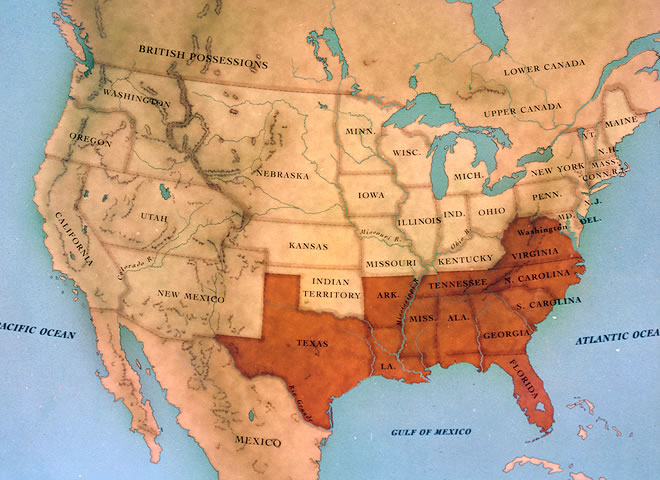
Now we are zeroing in on the truth. The French gave up the right to provide the language of choice for about half of the USA when Napoleon sold Jefferson the Louisiana Purchase. Spanish lost out as the language of choice in Florida, Texas, New Mexico, Utah, Nevada, Arizona, part of Colorado and Louisiana, tiny corners of Wyoming, Mississippi, Alabama, Kansas, and Oklahoma, and all of California at the point of a gun. Or, a bunch of guns. That’s roughly a third of the lower forty-eight.

Like it or not, it happened, and it is irreversible. English is the language of the US, despite the innumerable other languages spoken by our immigrants. They came here, procreated, the original speakers died, and their offspring now speak English.

So why are the Spanish speakers different? It is certainly not because of anything wrong with them. It’s quite simple. When Germans immigrated, they didn’t go back. Modern immigrant Spanish speakers, primarily Mexican, documented or undocumented, go back and forth.

Migrant labor is typically seasonal. Besides, wouldn’t you rather spend winter in Mazatlan than Minnesota if you could? Hordes of Anglos do it, and they don’t even speak the language.

Not all people of Spanish background move back and forth. Many of them came to the US and stayed. Tens of thousands of them were already here to greet the Anglo pioneers when they arrived. See map above! Millions of them don’t speak any Spanish, just as Nils Hansen of Kenosha, Wisconsin (hypothetical person) doesn’t speak Danish. There is a word for these people — Americans — and they don’t pose any language problem in the schools.

Those who do go back and forth are not going to stop doing so. It works for them. Summer labor in the US, then back to Mexico for its mild winters and lower costs is not just logical, it’s capitalism. It’s entrepreneurship. It’s survival for the Mexican families and cheap food for you. Drive by any field in California at harvest time and count the Anglos bending their backs in the sun. Your total will be zero.

A wall won’t change it. A path to citizenship won’t change it, either. The idea of a hermetically sealed border is a Trumpean delusion.

So where does that leave the children of migrants? In a tough spot, to be sure. They often don’t spend the whole school year in schools in America, and they often don’t enroll while they are in Mexico. Many don’t learn to speak, read, and write English as well as their Anglo or permanent Mexican American classmates. Some barely speak, read, or write English at all. They speak Spanish, but they often don’t read or write it.

Solutions? That would take a shelf of books, not a post.

424. Arthur C. Clarke and Russia

(Written last Thursday) This morning’s news brings new revelations about what Russia is doing to America through the internet. Or are they new? Didn’t Arthur C. Clarke warn us all that this was coming back in 1960 in his short story I Remember Babylon? Of course he did; Arthur has always been ahead of the curve.

I Remember Babylon? is actually dated and struck me as a bit naive when I first read it, but you might want to check out Arthur’s prescience as he gives you today’s headlines 57 years before they happened. After its original appearance in Playboy, the story was reprinted in Tales of Ten Worlds, available in your local used bookstore or on Amazon.

402. Nuclear Spacecraft

I taught middle school science for twenty-seven years, and always, whether I was supposed to or not, I taught the space program.

I grew up with space travel, first in fiction, then in fact. I loved it, and the kids I taught loved it, too. How much of that rubbed off from me, I’ll never know.

By the time I started teaching, the big show was over. When Gene Cernan stepped back into his LEM in 1972, it was the high water mark of manned space exploration. It’s been downhill since.

In the classic science fiction novel I had planned to serialize, Rip Foster is heading out toward the asteroid belt on the nuclear powered spacecraft Scorpius. That’s how we all thought the future would look. That’s how the future should have looked. Chemically powered rockets are simply not sufficient for exploring the solar system.

We have have nuclear power plants for electricity, nuclear submarines, nuclear aircraft carriers, even a nuclear cargo ship. Why not nuclear spacecraft? Weight? Do you really think we couldn’t have overcome that problem? Maybe it was the danger, but . . .

Here is a quiz for you. How many nuclear submarines are lying on the bottom of the ocean, tombs for sailors and ecological time bombs for the rest of us? Two from America and six from Russia. An additional Russian nuclear sub sank twice, but was raised both times.

How many nuclear and thermonuclear bombs have gone missing? The U.S. admits to eight. How many more are hidden under the umbrella of security? Your guess is as good as mine. How many have the Soviet’s lost? You ask them, I’m keeping my head down.

Did I mention Chernobyl and Fukushima?

Let me put it another way. When the Soviets launched Sputnik and initiated the space race, then followed up with a man in orbit before we could even launch a sub-orbital flight, we did an end-around and went to the moon.

If the Soviets had launched a nuclear powered space craft, we would have launched a nuclear powered space craft. Technology would not have stopped us. Fear of radiation would not have stopped us.

That was then, this is now. The best thing for manned space exploration today – though not for American interests or world peace – would be for the Chinese to launch a nuclear powered space craft. It wouldn’t even have to be a good one. Just the threat would be enough, and in a few decades ships like the Scorpius would be filling the solar system.

387. Buchan the Racist

Getting ready for Westercon, I prepared a set of notes, placed as posts, for the panel What made the golden age golden? I was under the impression that it would be history and homage, and made notes appropriate for that. I was wrong, and it isn’t the first time I have spent time off track by starting before I had full information. When i’m ready to start a project, I’m ready, and sometimes I pay the price.

After I had posted my notes-to-self, but long before Westercon, I received this description of the panel:

Heinlein and Asimov are two pillars of the Golden Age of Sci-Fi. But reading those works with modern eyes can reveal attitudes that would be unacceptable in modern times. What can we learn from the classics when we look past the sexist and racist attitudes that pervaded the works of that time? Can we still appreciate works that present unacceptable ideologies?

Well, that’s a bit of a different story. No problem. I am always ready to fight the forces of political correctness.

I’ve been to this rodeo before. Once, several years ago, I was looking at on-line reviews of John Buchan’s The 39 Steps. I don’t remember why, but I do remember a review that ripped Buchan as a racist for seemingly anti-Semitic statements in that novel. I wrote a counter-review; both have since disappeared.

For those who don’t know him, John Buchan was a popular British novelist of the early twentieth century. He is very much a pro-British patriot, with the prejudices that implies. Think Kipling light. And he was a racist, but not an anti-Semite. I say that not as a scholar, but as a fan, who has read and re-read his works.

If you read him at length, his distaste for African blacks comes through loud and clear. His Jews, on the other hand, show up as both heroes and villains, just like his Germans and his Englishmen. But if you only read a little, you can be fooled.

#                #                #

To follow through on this, I used one of my favorite techniques. I recommend that you put this into your bag of tricks. I went to Project Gutenberg, downloaded The 39 Steps in Rich Text format, then cut and pasted that into my word processor. Now I had all 41,264 words in a searchable form.

One more hint. RTF will be hard to read because its wide line-length makes it look like bad modern poetry. Just switch your word processor to horizontal format and it will be much easier to work with.

The reviewer who started this controversy had complained about Buchan because of the words of one of his characters, Scudder. If you don’t know the book, Scudder is a kind of amateur spy who finds out that bad people are about to start World War I, and catch England off guard. This is what Hannay, the main character, says, quoting Scudder:

The Jew is everywhere, but you have to go far down the backstairs to find him. Take any big Teutonic business concern.  If you have dealings with it the first man you meet is Prince von und Zu Something, an elegant young man who talks Eton-and-Harrow English.  But he cuts no ice.  If your business is big, you get behind him and find a prognathous Westphalian with a retreating brow and the manners of a hog.  He is the German business man that gives your English papers the shakes.  But if you’re on the biggest kind of job and are bound to get to the real boss, ten to one you are brought up against a little white-faced Jew in a bath-chair with an eye like a rattlesnake.  Yes, Sir, he is the man who is ruling the world just now, and he has his knife in the Empire of the Tzar, because his aunt was outraged and his father flogged in some one-horse location on the Volga.

Wow! That sounds pretty anti-Semitic, and the reviewer who started this conversation took it as proof positive. But let’s wait a minute. Assume that the character Scudder is the worst anti-Semite since Hitler — does it follow that Buchan hated Jews? I wrote a mass murderer into Cyan — does that mean I approve of mass murder?

You can’t read the words of a fictional character as the opinion of the author, especially if you are looking at a minor character of questionable honesty.

Scudder dies in chapter one and his quest is taken over by Richard Hannay, the actual main character in this and several other novels. If you look closely at the character of Hannay and a dozen other lead characters in two dozen other novels, then you will come closer to having a fair and defensible picture of Buchan’s attitude.

In point of fact, not only was Scudder a minor character, he was also a liar. The reviewer who cried bigot never found this out because he quit the novel early. I knew that he was, but I needed a quote as proof. To find this, I searched for the word Scudder in my Find and Replace function. His name appears 65 times in the book because Hannay keeps thinking about him. Click and read. Click and read. Click and read. I found the passage I remembered at the beginning of chapter four.

The little man had told me a pack of lies.  All his yarns about the Balkans and the Jew-Anarchists and the Foreign Office Conference were eyewash . . .

Hannay worries at Scudder’s diary, taken off his body, because it seems odd, almost as if it were a cypher, and Hannay is good at cyphers. Sure enough, the Jew-Anarchist plot is just a cover for a much deeper plot (not by Jews), which Hannay foils by the end of the book.

So, everybody was a nice, unbigoted person and it was all a misunderstanding? If it were only that simple.

Reread the first quote, if you can stomach it. How would that passage play in a book published in 2017? When it was published in 1915, the book was a hit. Nobody minded that passage at all.

After Hitler and the holocaust, anti-Semitism fell out of favor. Before that, it was everywhere, in Europe and America. An actually anti-Semitic book in England in 1915 would have raised no eyebrows.

Was Buchan a bigot? Yes and no. He was not anti-German, he was not anti-Semitic, but he was anti-African. How do I know? I have read more than a dozen of his books, some multiple times. You can’t know from assumptions, and you can’t know from reading one book.

Bringing this back to the Golden Age of science fiction, we should be able to read and appreciate authors like Heinlein when he depicts mannerisms that are foreign to us. (Or to be fair, foreign to you; I grew up in the same era and it all seems normal to me, even when I disagree with it.) The fact, for example, that Joan Freeman in Lost Legacy is the object of mild sexist teasing should not mask the fact that she is a full participant in the action.

Nevertheless, understanding is one thing, enjoyment is another. There is a limit, and it varies with each of us. For me, Heinlein sometimes seems silly, but I still read and enjoy everything but Farnham’s Freehold. That one goes on my never-again list, along with John Buchan’s anti-Black tirade Prester John.

POSTSCRIPT: As it turned out, everyone on the panel ignored the description and we just talked about how great the golden age was. The forces of political correctness never raised their heads.

386. Chief Seattle

Beware, I occasionally rant. Like today.

If this post had a descriptive sub-title in the nineteenth century style, the full spread would be:

Chief Seattle: White Man’s Indian
or, how a movie took a fine old man and turned him
into a puppet and a joke

How’s that for laying out a political agenda for all to see?

Yesterday and today I presented an ersatz Miwuk legend. Ersatz is a fancy word for “I just made it up”. I don’t apologize for that. Spirit Deer is a work of fiction, and I used Miwuk Indians as the basis for Tim’s knowledge because they were the resident Native American’s in the places he finds himself. (When I wrote the book in 1975, it wasn’t yet a crime to say Indian instead of Native American.) Later, I will also have a “family story” about his grandfather’s grandfather. That is also made up, to meet the needs of the novel. Again, no apologies. Fiction is fiction. Historical fiction has some responsibility for maintaining accuracy, but Spirit Deer isn’t even subject to that.

I wrote this novel, all of it, including the legends and family stories. It’s fiction, okay. If it were ever to be published, I would make sure that those facts were clearly stated.

Actually, that’s what I’m doing here.

There is a point to all this, beyond simply taking responsibility for what I have written. When I was a teacher, I came across a book called Brother Eagle, Sister Sky: A Message From Chief Seattle and also the supposed text of Chief Seattle’s speech. This took place decades ago, and I can’t remember which I saw first, but my Hemingway style “writer’s shit detector” went off like a siren. I was sure that this was another white guy putting words in an Indian’s (excuse me, Native American’s) mouth, after he was long dead and couldn’t set the record straight.

It turns out, I was right. The version of Chief Seattle’s speech in question, which comes complete with the statement, “I have seen a thousand rotting buffaloes on the prairies left by the white man who shot them from a passing train,” was written by screenwriter Ted Perry for the 1971 film Home. Those buffaloes were killed and rotted decades after Chief Seattle made his speech, and half a continent away. To be fair to Perry, he tried for years to claim credit for the speech and counter its false historicity, to no avail.

Actually, as fiction, or as a soupy environmental statement, it is a powerful piece of writing. But it has nothing to do with Chief Seattle.

The publication of Brother Eagle, Sister Sky led to a 1992 Newsweek article that named Perry as the author of the speech. In researching for this post, I also found a more complete article from the New York Times. You can check them out for yourself.

All this slapped me in the face four ways.

As a writer, I work hard to keep my fiction from telling lies, either morally or factually. I am a long time student of ecology, and I abhor the way a hard-edged science gets turned into a set of slogans. As an anthropologist (B.S., M.A., and two summers on archaeology digs), I hate the way Native Americans are rarely seen for themselves, but as savages or saints, according to whatever is the current fashion. I am a student of history as well, and . . . you get the picture.

You might have guessed by now that I can be irritated by lies, and seeing a screenwriter’s version of “Chief Seattle’s” speech accepted as history grinds all my gears.