Tag Archives: race

627. Banned Book Week

If you google special weeks, you will find a week for everything. Some of them are worthy; most are just plain goofy.

There’s nothing goofy about Banned Book Week.

My first encounter with banned books was in high school, when I became aware that Oklahoma and almost no other state had banned The Grapes of Wrath because it supposedly portrayed Oklahomans in a bad light. They didn’t much like the term Okie either.

I’m an Okie and I like the term, but if I had been walking down the streets of Bakersfield in the thirties, and people had been calling me that while spitting on me, I would probably have a different viewpoint.

When I was a boy, more than half a century ago, I said n— all the time. I quit when I grew up and learned better. Of course Black people will never come to accept the word like I accept Okie, and they shouldn’t. Okie was only a cuss word in parts of California for a brief time, a long time ago. N— has a different history.

While we are banning books, let’s go ahead and ban the word nigger.

See, you can’t do it. I’ve managed to use the abbreviation n— up to now, but I couldn’t write that sentence without spelling it out.

We have made not saying the word the key to survival in modern politics, but does a clean mouth insure a clean conscience, or a clean personal history? If you think so, I have a swamp I’m willing to sell you.

Shall we ban the idea behind the word? Good luck trying.

All this brings us back to books. Books should not be banned, except for a few.

What?!?!?!?

That’s a lot like saying I’m for free speech, but not for hate speech. Okay, define hate speech. Not give examples, that’s too easy. Define it.

It can’t be done.

Now, back to books again. Personally, I hate the *** series. I wish those books had never been written, but I’m afraid to even mention their name in this post. They have all but disappeared on their own, but if I were to mount a campaign to ban them, they would be back on the shelves and on their way to the best-seller list before the month was out. There would be websites defending them and websites condemning them and hash-tags like — no, I’m not going to tell you what the hash-tags would say.

Banning books is not only wrong, it is also self-defeating. If something bothers you — books, words, concepts, actions —  confront it. Banning it just drives it more deeply into the public consciousness.

If the media had not been so outraged in 2016 that they made  ***** the main subject of every newscast, we would have a different president today.

If the Ayatollah had not condemned The Satanic Verses, it would have died the quiet death it deserved. I know. I fought my way half way through the thing out of moral obligation before I tossed it. If it hadn’t been condemned, I would have quit after page three.

End of sermon.

Now here is a tidbit that I am adding just because it amuses me. The Index Librorum Prohibitorum is the list of books banned by the Catholic Church, beginning about 1600, going through various versions, and being finally dropped in 1966. Johannes Kepler and Immanuel Kant along with some translations of the Bible have all had the dubious honor of inclusion over the years.

When I wrote A Fond Farewell to Dying, set on a post nuclear war Earth, the main character wrote a book called Inquiry into Artificially Induced Immortality. I needed to have it banned, so I had to let the New Vatican located on Lake Titicaca (Rome having been nuked) reinstitute the Index just so my hero’s book could be on it.

607. Who Slammed the Door?

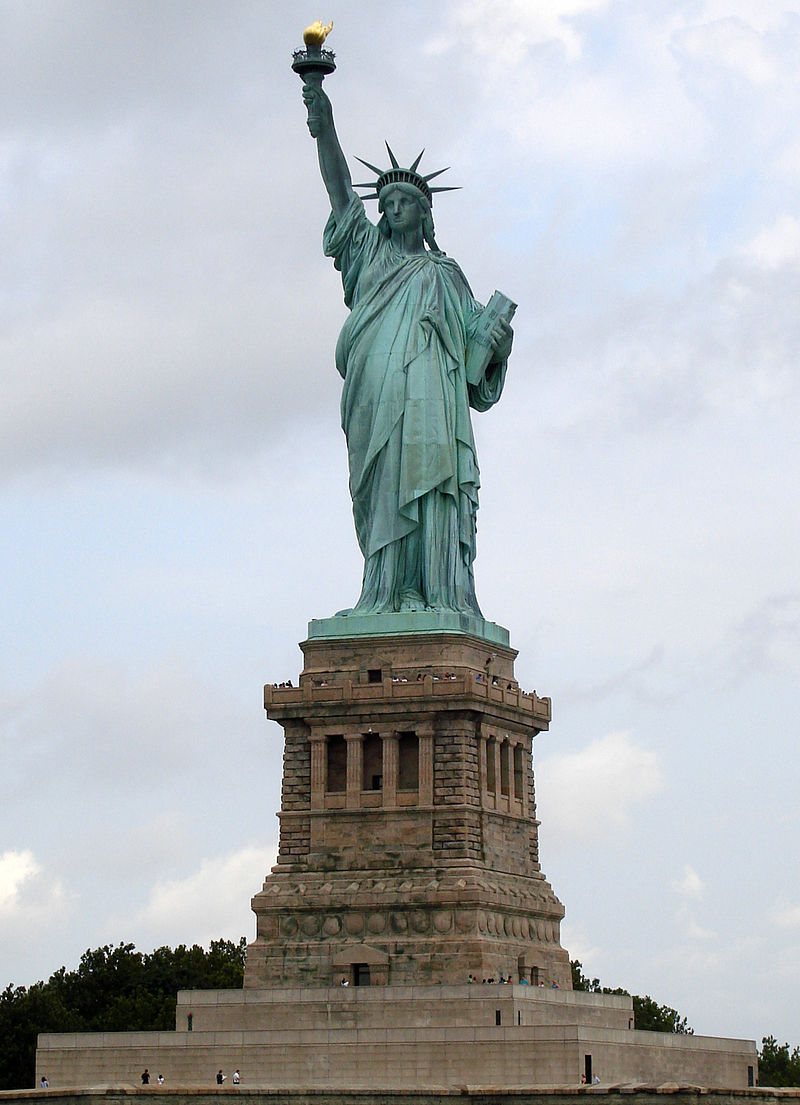
This is a July fourth poem, but everybody will be busy tomorrow, so I am posting it today.

Who Slammed the Door?

Land of the free,
Home of the brave,
What happened to your courage?

We have walked a thousand miles toward freedom.
Where did freedom go?

It is not trivial
             that they come in the night.
It is not trivial
             that they rape and kill.
It is not trivial
             to be hungry.
It is not trivial
             to be afraid.
It is not trivial
             to see your father disappear
             to see your mother disappear
             to know that you are next.

Would you walk a thousand miles             
             for a trivial reason?

In our homeland, they throw us in jail.
             In America, they throw us in jail.

In our homeland, they take parents
             from their children in the night.

In America, they take children
             from their parents in broad daylight.

Land of the free,
Home of the brave,
What happened to your courage?
             
Your compassion?
             Your understanding?
             Your humanity?

Land of the free,
Home of the brave,
Who slammed the door on freedom?

597. Who Speaks for Us?

A teacher in a classroom in Sierra Leone.

I had a post written for today, which I will now boot on down the road, maybe a couple of weeks.

My wife and I frequently watch a morning so-called news program, mostly because the hosts are pleasant people. This morning (that would be two days ago, Memorial Day) they took a moment from time to time to “remember those who served”, and went immediately to the men of Big Little Liars and promised an upcoming interview with Lamar Odom. Then they were going to do in in depth piece on where to find the best Memorial Day sales.

Yikes.

I left quickly. Most mornings all I wait for is a hit of good fellowship, a touch of news and weather, and I’m on to other things. Like writing this.

Their treatment of Memorial Day seemed to strike somewhere between grabbing for cheap emotions and checking off a box, but I’m going to give them a pass. I am not the one to judge, because I can’t be satisfied on the subject. Every time Memorial Day comes around I find myself caught between tears and anger, no matter how well things are presented. I have great respect for those who fought for freedom, but I don’t forget the atrocities committed in America’s name. I know that most Americans are offering genuine respect, and that some Americans are using Memorial Day to push military agendas, and a few are doing both at the same time.

I’m just going to have to let go of Memorial Day for another year. 

Lamar Odom is another matter. Mind you, I don’t know the man, and I avoid any news broadcast containing the word Kardashian. He probably has a story to tell, and certainly has the right to tell it.  Nevertheless, he represents something ugly about America — the Redemption Tour.

You are nobody in America until you’ve hit rock bottom, and clawed your way back up, in full public view.

If you’ve simply lived a wholesome, useful life, you don’t count. But if you’ve ripped off a charity, gotten dragged down by drugs, or cheated your kid’s way into college, welcome to celebrity. America is crying out to forgive you, if you can first tell them a stirring tale of depravity to keep them entertained.

Lamar Odom isn’t the problem; he just set me off. He dredged up something ugly from my past.

I was teaching middle school and we all turned out for a rally. It was one of those manufactured teaching moments, half sermon, half vaudeville, but it went wrong from the start. The presentation was by a batch of ex-cons, who had come to the school to tell our kids to go straight. Supposedly. In fact, it was anything but that. They were strutting baboons, flexing their muscles in their tight T-shirts, showing off their tattoos, and tearing phone books in half.

And, no, baboon is not a racist dog whistle this time. These were all white guys. It’s just an accurate description.

They told the kids, “Stay in school, keep on the straight and narrow, don’t end up in prison cause the guys there will eat you alive. You don’t want to end up like us.”

And the teenage boys all said under their breaths, “The hell we don’t!” These parodies of masculinity were exactly what they wanted to become.

Then one of the ex-prisoners began to harangue a tough looking Mexican-American student. He said, “I know you. I know what you’re thinking . . .” But he didn’t. He didn’t even know the boy’s name. He had never seen him before, but that didn’t stop him from calling the boy out.

It was always like that. Whenever somebody came to our school to make our students into better people, they always zeroed in on Mexicans as the ones they planned to reform.

Any teacher in the room could have told you the boy’s name. A lot of them could have told you his parents’ names, and would have had a pretty good idea of their income. Many of them would have known his sisters and brothers names, and would have taught them in years past. Some of those teacher had probably been in his home.

Any teacher in that gym could have stood in front of those children and have given them good advice about their futures — in fact they did just that every day in their classrooms. But those teachers hadn’t been to prison, so they were in the bleachers while the ex-cons cavorted like movie stars.

If you think I don’t believe in second chances, that isn’t the point. I don’t believe in parading your failures like badges of honor and I don’t believe you have to go low before you can go high.

There is nothing wrong with not going to prison.

Just go high, without bothering to go low first. Nobody will ever notice you. They won’t put you on television or in front of a gym full of kids, but that’s okay. We can live with that.

589.5 Tequila and Lederhosen

Cinco de Mayo caught me by surprise this year. It is an important holiday in California, and was particularly important to about half the kids I taught before I retired.

You will note that I did not say Mexican-American kids. Even before the advent of Trump, a surprisingly large number of (whatever) students didn’t like that name. Some wore a T-shirt that said:

Not Mexican-American
Not Hispanic
Not Chicano
MEXICAN!

I’ve already had my say on the subject of Cinco de Mayo. I invite you to check out these two older posts to see what that was.

One post had the full title: Juan Angus Georg Angelo O’Malley celebrates St. Patrick’s Day by drinking tequila and while wearing lederhosen under his kilt.

The other was titled: Who said you were Mexican?

566. The Negro Speaks of Rivers

The Negro Speaks of Rivers
by Langston Hughes

I’ve known rivers:
I’ve known rivers ancient as the world and older than the
     flow of human blood in human veins.

My soul has grown deep like the rivers.

I bathed in the Euphrates when dawns were young.
I built my hut near the Congo and it lulled me to sleep.
I looked upon the Nile and raised the pyramids above it.
I heard the singing of the Mississippi when Abe Lincoln
     went down to New Orleans, and I’ve seen its muddy
     bosom turn all golden in the sunset.

I’ve known rivers:
Ancient, dusky rivers.

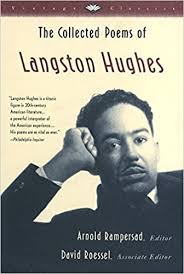
I am a great fan of Langston Hughes. I keep his complete works in my library, and I had hoped to dip into it to publish one of his less well known poems here during Black History Month. I couldn’t.

I try to stay on the sunny side of copyright law out of respect for authors and to keep out of jail. However, I am no lawyer, and copyright law in America is an incredible snarl, so I depend on others for my information. I went to Project Gutenberg, an organization dedicated to placing old literature in ebook format. They are well organized and quite careful about only using material in public domain. They have almost nothing by Hughes, so I googled, which only muddied the picture further.

I like to place pictures as teasers above each post. Other than the ones I have created myself, I get most of them from Wikipedia since they specify (if you click a couple of times on the picture) their copyright standing. I went there following this copyright question and found in Wikisource that:

This work (The Negro Speaks of Rivers) is in the public domain in the United States because it was published before January 1, 1924.

Most of Hughes work was published after that date.

It may seem odd to worry about the copyright status works by a man who died 52 years ago, but theft is theft, even if you are stealing from a dead man. I try not to steal, although sometimes I goof. I posted Hughes’s poem I, Too last Independence Day, not realizing that it was not in public domain. Of course, you can get a view of many copyrighted works on the Internet. I, Too appears in dozens of places.

I have a solution to this conundrum. Go out and buy a book of poems by Langston Hughes. Buy it for Black History Month if you care. Buy it for the beautiful poetry if you don’t care.

You can even go to a used book store to buy it. Resale of books never puts a penny in any author’s pocket, but it keeps their works alive.

560. We All Learn

Race has a persistent and powerful influence on America for something that really doesn’t exist.

Take the whitest non-albino in America and stand him on the western border of Kansas. Take the blackest black in America and stand him on the eastern border of Kansas. Now line up all the rest of us in a single line, whitest to blackest, in between those two. There would be no break in the continuum.

That should be no surprise to anyone. We have had black slaves (and their descendants) and white immigrants in America rubbing up against one another for four hundred years.

For four hundred years, white DNA patterns have been entering black America through force and black DNA patterns have been entering white America by passing. Lately, that DNA has been going both directions for kinder, gentler reasons.

It’s all been a giant blender — powered at first by hatred and eventually by love —- mixing up the vanilla with the chocolate. There is no use pretending that we are two races any more.

Right!

Try telling that to a white guy. Or try telling it to a black guy.

Clearly, there’s more to the story.

============

When I was growing up in rural Oklahoma in the fifties, the idea of two separate races seemed real and normal, but theoretical.

In my small town and the countryside around there were no black folks. Also no Jews. Nor Mexicans. No Italians either, come to think of it. There was one Catholic family who lived there briefly, but they didn’t last.

It was white, white, white, and Protestant, for as far as the eye could see, with one exception, —— Eddie. I’ll leave it to you to guess what word went into the blank; hint, it began with “N”.

The gentleman didn’t live in my community, but we saw him driving by in his pickup from time to time. He lived somewhere north; I never knew where. I never met him. I only knew him as a blurred, black face in a passing vehicle.

All the adults knew him and spoke well of him. He minded his own business; he took care of his family; he was a good farmer (wherever his farm was); he was quiet and he went his own way.

Now, if I weren’t talking about race, that would sound like a description of The Quiet Man. The archetype. The lone cowboy who rides into town, minds his own business and bothers no one. But don’t cross him because he takes no guff from anybody.

Nope, that’s not it at all. Not even close. But take away the last sentence — the one about “don’t cross him” — and change it to “gives no offense to anyone but quietly backs away”. Now you are closer to the truth. You have just defined the difference between The Quiet Man and Uncle Tom.

The Quiet Man knows his worth; Uncle Tom knows his place. Even growing up in whiteland, with no blacks around, I knew the difference.

============

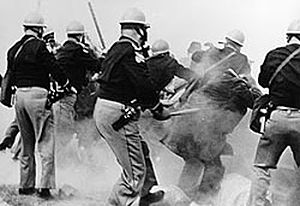
In my childhood, the only black folks I saw other than a blur on the highway, were on television. They were marching in Selma and across the South. And yes, now we are getting to why this post is coming on Martin Luther King Day.

My father called them troublemakers. He liked the phrase “outside agitators”, as well. I disagreed. I looked at the black people being washed down southern streets by fire hoses and said, “They’re right. We’re wrong.”

I didn’t say it out loud. I didn’t say much of anything out loud in those days except, “Yes, sir.” But a few years later when I escaped to college, I had decided for myself that black folks were as good as I was.

Now that may seem a rather obvious decision to you, but a lot of people from my generation and the one that followed never got the message. You see a lot of them now at rallies for a certain orange faced politician.

Martin Luther King and the tens of thousands he represented showed me an alternative to my father’s thinking. I thank them for giving me another option.

545. Lottery Day at the Big Casino

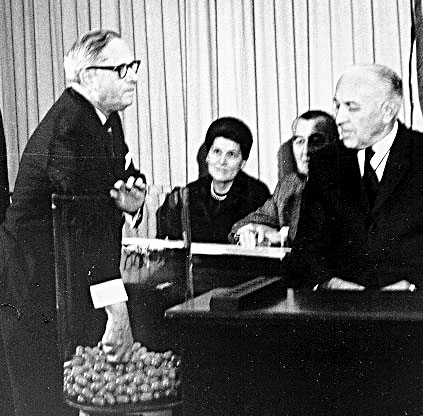
Rep. Pirnie draws the first number.

The place was a class at Michigan State University, just about this time fifty years ago. I wasn’t in the room, so I may be wrong on a few details, but the basic story spread quickly all over campus.

The professor was a young radical. There were a lot of those at MSU in the late 60s. Finals were near when he announced that grades would be given out a little differently this year. He opened a notebook and began to call roll. As he did, an assistant drew notes from a bowl. The professor read, “Adams.” The assistant took a folded paper from the bowl, opened it, and said C. The professor read, “Baker,” and the assistant said F.

As you may guess, it left the room in an uproar. I’m sure the actual grades were given in the normal manner, but the young professor had made his point.

About a week later, a similar lottery took place nationwide, televised, and determined life or death for thousands of young Americans. I was listening closely, because I was a contestant. It was the first draft lottery since World War II.

There were three of us paying attention, my two college roommates and I. One of them didn’t have to worry; he had blown his knee out as a high school wrestler and was 4-F. That’s a medical deferment. The other roommate and I were on student deferments, but we were both going to graduate in June. He drew a high number and never served. I wasn’t so lucky.

I have said often that the draft leveled the playing field. It was a favorite saying in that era that Viet Nam was a war where black people were sent to kill yellow people for the sake of white people. Without the draft, that would have been even closer to the truth.

I wasn’t feeling so charitable when that bastard got to my birthday and pulled a 41.

Ain’t it fun to gamble in the big casino?

523. Monkeying Around

This is about accuracy in discourse, and therefore applicable to writers, but it won’t seem so at first. Stick with me a few paragraphs and you’ll see.

The last week of August, there was a primary in Florida. In the aftermath, Ron DeSantis said the voters would “monkey this up” if they voted for his black opponent, and was slammed for making a racist comment.

Really?

I remember the Monkees, back in the Precambrian. Their theme song contained the words

Hey, hey, we’re the Monkees.
People say we monkey around.

I knew they were a fake band, but I never realized they were racists.

Knee-jerk liberals (that’s me, by the way) can look pretty silly when we overreach. Even people I respect were calling the monkey reference a racist dog whistle, and maybe it is. But let’s apply a little logic, in the form of Occam’s Razor.

What is the simplest and most likely explanation for the statement? There is no old saying “monkey this up” but there is an old saying “monkey around” and it is a simple extension to make that “monkey around and screw this up”. Millions of people have said that over the years, with no racial intent. My guess is that DeSantis was thinking “f—- this up”, and cleaned it up for television.

But I could be wrong. I don’t know the man and what I do know doesn’t impress me. “Monkey this up” may in fact be racist code, with built in plausible denial. If so, it worked beautifully. By assuming the worst, the liberal press has given the man massive publicity, and come off looking like fools.

As writers, on the other hand, we are in the business of not being misunderstood. See, I told you I would bring this around to writing.

Recently, I was revising an old novel. A young man and woman were about to move into a physical relationship, which was not not a love match. She was more excited than he was, because she lived in a small village, and he was the first male of her own age she had seen in a long time. He was planning to travel on in the spring, alone. He would tell her that in another line or two. This is what I wrote, years ago:

When he loosened the strings of her robe, she did not protest.

When I wrote that, the image in the mind of a reader would have exactly matched what I meant to say. There would have been no thought that he was forcing himself on her, or that she was reluctant in any way. In point of fact, if you had read a few sentences before and after, she was steaming.

That was then. Now, in the age of #Me Too, the phrase did not protest might be read differently than I intended when I wrote it. So I changed the line to read:

When he began to loosen the strings of her robe, she moved to hurry the process.

That is a pretty subtle change. To my mind, the two lines mean exactly the same thing, but they might not mean the same thing to a modern reader.

Readers read what we say, not what we meant to say. Communication isn’t entirely in our hands — readers do misread from time to time — but we have to do our best not to monkey things up. And no, that was not a racist dog whistle. That’s just me kicking the liberal press one more time for falling into a trap.

(Some) politicians (may) be in the business of doublespeak. They may bask in the comfort of plausible denial. Writers are not in that business. Our job is to say what we really mean, so skillfully that the reader is not confused about our intentions.

That is actually a fairly hard job.

522. First Black Astronauts

Dr. Ronald McNair, Guion Bulford, Frederick Gregory

I recently saw Leland Melvin’s new book Chasing Space and got a chance to look it over. It’s a good book, although in full disclosure I won’t finish it. I read and write for a living. so my time is limited. Additionally, I have already read more than dozen astronaut bios, so this one lacks newness for me, even though it might be just what you are looking for.

It got me thinking about the first black astronaut, if there were such a thing. We all know who the first woman astronaut was — Sally Ride. That is, if we continue our cold war prejudice against the Russians and ignore Valentina Tereshkova.

It would be neat and tidy if there were a first black astronaut, but it isn’t that simple. If you type the question into Google, it will return Guion Bluford. We’ll talk about him in a second, but there were others that came before him.

Ed Dwight was chosen by John F. Kennedy to join the astronaut corps. He was an Air Force test pilot with a degree in aeronautical engineering. While in training, he was the target of racism. When Kennedy was assassinated, Dwight withdrew from the astronaut program. A few years later, continued harassment led him to retire from the Air Force altogether. He became a noted sculptor in a second career.

Robert Henry Lawrence Jr. was the next African-American astronaut. At Edwards Air Force Base, Lawrence investigated unpowered glide return characteristics using an F-104 Starfighter, contributing greatly to knowledge necessary to the Space Shuttle program. He was assigned to the Air Force’s Manned Orbiting Laboratory program, but before he flew in space, he was killed in a crash landing while acting as a pilot instructor to a trainee. When the MOL project was abandoned, many of it’s astronauts transferred to NASA, where they became the backbone of the early Space Shuttle missions. Lawrence would almost certainly have been among them.

The “first black astronaut” falls out this way.

Ed Dwight was the first black astronaut trainee.

Robert Lawrence Jr. was the first black working astronaut. Remember that most of any astronaut’s time is spent in training and on-the-ground research. Actual flight in space makes up a tiny fraction of an astronaut’s career. Lawrence was as much a real astronaut as Roger Chaffee who died in the Apollo One fire just before his first flight.

Guion Bluford was the first black astronaut to actually fly in space in 1983 aboard the Challenger. He participated in four shuttle flights.

We also have to add Ronald McNair to the list of firsts. He was the first black astronaut to die on a space mission, when Challenger exploded. It was his second space shuttle mission.

Before 1978, there had been fifty-some American Mercury, Gemini, and Apollo astronauts and an additional few dozen assigned to other missions. Of, these only Lawrence had been black and there had been no women.

An up-to-date list of black astronauts can be found here. There are fourteen: Guion Bluford, Ronald McNair, Frederick Gregory, Charles Bolden, Mae Jemison, Bernard Harris Jr., Winston Scott, Robert Curbeam, Michael Anderson, Stephanie Wilson, Joan Higginbotham, Alvin Drew, Leland Melvin (whose book started this post), and Robert Satcher.

There are an additional eight who, for various reasons, never flew is space. Lawrence and Dwight are on that list.

I, Too

Here is a poem for the day after the Fourth of July. Langston Hughes wrote this in 1926.

I, Too

I, too, sing America.

I am the darker brother.
They send me to eat in the kitchen
When company comes,
But I laugh,
And eat well,
And grow strong.

Tomorrow,
I’ll be at the table
When company comes.
Nobody’ll dare
Say to me,
“Eat in the kitchen,”
Then.

Besides,
They’ll see how beautiful I am
And be ashamed—

I, too, am America.

Apparently, it isn’t tomorrow yet. But tomorrow is coming, and it’s up to us to help it along.