Tag Archives: race

462. The N Word

Another version of this post, with the same poem, appeared as 86. N —-

The N—– word. Everybody in America is afraid of it. Including me.

I could write it out plainly. In fact, I feel a little foolish writing a letter followed by dashes, especially since I used it in a post just a week ago, and will again in the poem below. But if I spelled it out, I would feel like a little kid cussing in front of his parents, then pretending he didn’t know they were there.

I grew up white in a community which had no blacks. So how do you learn to hate or fear someone you never see? Easy. You listen to your parents and their friends, and absorb their attitudes.

I didn’t come to hate, in part because my parents didn’t hate. But they did fear. If you study black-white relations in America, it is amazing how much fear there is on both sides. I certainly had my share, and I hated having it. But I couldn’t shake it, until I wrote and published this poem. It didn’t cure me, but it helped.

          Mother Tongue

               I saw a calf born.
His mother, in her need to clean him,
Knocked him over on his first rising,
And on his second rising.

In her need to make him safe,
she drove him to his knees.

               Words are like that –
A mother tongue that overwhelms us,
That makes us what we are,
and sometimes, what we should not be.

*****

When I see a black man, I hear “nigger”
Spoken sharply in my father’s voice.
I step back, my eyes grow tight,
Suspicion fires my blood,
And for one moment he is my enemy.

Then reason returns,
And I am shamed.

It is my father’s fear.
I would leave it in my father’s grave,
If I could . . .,  but I cannot!

I can only drive it down;
And bury it deep in shameful, hollow places.

461. Undesirables

Emigrants statue, Helmsdale, Scotland, commemorating the eviction of Highlanders from their land. A father and child and, hard to see in this photo, the mother looking back at her home which she will never see again.

Black History Month is human history month. I’ll have plenty to say about the position of blacks in America, but today they are not the most threatened group. As I write this, Congress is fighting over DACA.

Two Christmases ago I wrote a fictional story about a little girl who was going underground with her parents because Donald Trump had become president. One of my readers replied with a short fictional addition in which one of my characters said, “If only our parents had followed the law, we would be all right.” That reader had a right to his opinion, and I published his reply. I’m not here to disrespect him. I am here to disagree with him. Strongly.

Deportation is a kind of eviction. Eviction is the act saying, “You can’t stay in this place any more, because the rights to this place belong to someone else.” That someone is usually a person or a corporation. Deportation makes the same statement, except that the someone else is you and me.

Eviction is old. It has been around since Og the caveman kicked his mate’s brother out of the hut. It wasn’t long after that before force of boot was traded for force of law.

Between 1710 and 1850 in northern Scotland, Scots who had lived on their lands for hundreds of years were forced off, their houses burned, and their livelihoods destroyed. It was all quite legal. Scotland had become an adjunct nation to England, de facto. Ancient laws had been misrepresented and changed to match an English model. Clan chiefs, whose existence was traditionally enmeshed in reciprocal obligations with their clan, were now seen as landowners.

It equivalent to Donald Trump shifting his legal position from President of the United States to owner of the United States, but on a smaller scale.

These “landowners” forced their clansmen off the land, sometimes with great violence. In early clearances, they were moved to undesirable lands within Scotland. When this failed, later clearances moved them off to the Americas.

In Ireland, during the Famine, undesirable Irishmen were moved out by eviction or allowed to starve in place. Most of them went to the Americas.

It was a pretty practical solution. If you don’t want undesirables around, send them to America. Ironic, isn’t it, that those undesirables’ descendants are now about to evict a new set of undesirables from America.

Meanwhile in America, the American Indians . . . but you know that story. If you don’t, check out 247. The People’s President.

You may not realize that in 1941, all those undesirable Japanese with their rich farms in California were moved into relocation camps. It was supposed to be for our protection, because they might attack from within. Maybe; but if so, why did they never get their farms back. (266. The Other War)

So let’s get back to DACA. This is an act protecting persons brought to the United States illegally as children. They are American in every way but a technicality. They may well not speak any language other than English. They may never have stepped foot outside the United States.

Now we are going to send them home. Home? They are home.

Let’s consider a pair of hypothetical children. Jose was born in Mexico, an hour before his parents crossed the border illegally into the United States. Ramon’s parents were on the same trip north, looking for work. Ramon’s mother gave birth just an hour after they crossed the border, illegally, into the United States.

We’ll let Ramon stay. He is a citizen. We’ll deport Jose. That’s fair, isn’t it.

Maybe, but . . .

What about (hypothetical) Barta Kovacs? He was brought over in 1956 by his parents, who were refugees from the Hungarian Revolution. Today he is 64 years old. He never married, but he spent thirty years as a school teacher, rising to be principal of a local high school before running for office. He has been a State Senator in one of those northern states for eleven years, and now he’s ready to retire.

However, as he applied for Social Security it was discovered that there had been an irregularity in his application for citizenship years before. Technically, he has never been a citizen, even though he has spent 62 of his 64 years here, and has no memory of Hungary.

Will the present administration deport him back to Hungary? I don’t think so.

Good thing our hypothetical Barta Kovacs wasn’t Mexican.

460. White World

“Welcome to Black History Month,” said the old white guy.

You might wonder what I know about black history. The answer is, actually, quite a bit. I was a teenager during the height of the civil rights movement. I wasn’t involved, but I was watching and learning.

I grew up in Oklahoma in the fifties. That isn’t the South, but it’s close enough. We didn’t have blacks-only facilities in my town, because we didn’t have blacks. There were blacks in Tulsa where we shopped, and a few in Claremore, the county seat, but not in the rural areas I inhabited.

We called them negroes in polite conversation, but niggers most of the time. Sorry. It hurts my fingers to type that word, but I’m not going to lie to you. Nowadays, I use the term blacks because that is what they chose for themselves in the sixties. African-American came later, along with Native American. Both those terms sound to me like something made up by embarrassed white guys. I’ll stick with blacks, because that is what blacks wanted to be called when I first became fully aware of them as real people.

When I was very young, I didn’t have much of an opinion. I had never met a black person. There was one black man who farmed somewhere in the area. I saw him go by in his pickup once in a while, but that was as close to a black person as I had been.

I had also never met a Jew. I had never met a Spanish speaker, nor an Italian, nor a Mormon. Certainly not a Muslim; actually, I had never heard of Muslims. There was one Catholic boy who attended our school briefly. He wasn’t well treated and he didn’t stay long.

We didn’t have segregation. We had apartheid. I just didn’t know it at the time.

You get the picture. Not just white — WHITE. And not just Protestant, but Southern Baptist. And not just Southern Baptist, but small-town-Southern-Baptist; not like those liberals down in Tulsa. There were so many Baptists in town that the local high school didn’t have a prom.

That’s who I was when I was at ten. That’s not who I was by the time I was fifteen.

When those black people down south went marching, and were met with clubs and dogs and firehoses — when my father (and everybody else’s father) said it was their own fault, I couldn’t buy it. When I saw them bloodied and beaten, yet standing firm for freedom and dignity, I knew they were right and we were wrong.

When they fought for their own freedom, they also gave this Oklahoma white boy his freedom. They gave me a new way of looking at the world, and I am grateful to this day.

So the first year I was blogging, I wrote a month’s worth of posts on civil rights. Check any post between January 18, 2016 and February 18, 2016 if you want to see them. Last year I didn’t try to repeat myself. I had said everything I had to say.

This year, everybody who doesn’t look like me is in jeopardy all over again.

I’m an American white male. I have all the civil rights in the world. I also have an obligation to see that I am not the only one who has them.

So here I go again. Welcome to Black History Month.

455. Voices in the Walls

Annotated Links to
Voices in the Walls

Voices in the Walls is a fragment of a novel. It is still available in archives, but it would be impossible to navigate because it is entwined with A Writing Life posts and you would have to read long columns from bottom to top. Instead, I am going to provide a set of annotated links to make life easier.

Voices in the Walls was presented in Serial, parallel to the posts in A Writing Life that explored my position on race. You might want to read yesterday’s post for a quick summary of the novel’s genesis.

I wrote Voices in the Walls in the eighties, as a fictional way of presenting a young man who has to rethink his entire life when faced with with the fact that all his previous understanding of race is wrong. I used the opening days of Lincoln’s presidency, as the nation slid into war, as a vehicle for the story.

I never finished the novel, for reasons I explained yesterday, but it still means a lot to me. I also decided that, as an example of a writer’s struggle with a hard-headed idea, it might form a sort of how-to for writers. Enjoy.

Voices in the Walls 1  Setting the stage for the story.

Voices in the Walls 2  Setting the stage for the story.

Voices in the Walls 3  Prolog, and a discussion of bracketing.

Voices in the Walls 4  Why this novel and why 1861?

Voices in the Walls 5  Chap. 1 begins

Voices in the Walls 6  Chap. 1 continued

Voices in the Walls 7  Chap. 1 continued

Voices in the Walls 8  Chap. 1 continued

Voices in the Walls 9  Chap. 1 continued

Voices in the Walls 10  Chap. 1 continued

Voices in the Walls 11  Discussion inserted between chapters

Voices in the Walls 12  Chap.2 begins

Voices in the Walls 13  Chap. 2 continued

Voices in the Walls 14  Chap. 2 continued

Voices in the Walls 15  Chap. 2 continued

Voices in the Walls 16  Chap. 2 continued

Voices in the Walls 17  Chap. 3 begins

Voices in the Walls 18  Chap. 3 continued

Voices in the Walls 19  Chap. 3 continued

Voices in the Walls 20  Chap. 3 continued

Voices in the Walls 21  Chap. 4 begins

Voices in the Walls 22  Chap. 4 continued

Voices in the Walls 23    Chap. 4 continued

Voices in the Walls 24  Chap. 4 continued

Voices in the Walls 25  Chap. 5 begins

Voices in the Walls 26  Chap. 5 continued

Voices in the Walls 27  Chap. 5 continued

Voices in the Walls 28  Chap. 5 continued

Voices in the Walls 29  Chap. 5 ends, outline of the rest begins

Voices in the Walls 30  2 of 6, outline

Voices in the Walls 31  3 of 6, outline

Voices in the Walls 32  4 of 6, outline

Voices in the Walls 33  5 of 6, outline

Voices in the Walls 34  6 of 6, outline

454. Another Man’s Shoes

Another Martin Luther King day has rolled around. They always pose a problem for me.

What? You don’t care about my problems? Well, there is really no reason you should, except that this one is about trying to write honestly, which makes it a problem many of us share.

I grew up white in a conservative Oklahoma where blacks were not favored. That puts it gently. I watched the civil rights marches of the fifties and sixties on TV and decided I was on the wrong side of history. And humanity.

Then I became a writer, and that all needed to be explored. I did so in posts. Look at any post in A Writing Life from mid-January through the end of February of 2016 if you are curious.

I also tried to explore that story in a novel called Voices in the Walls. I began it in the eighties and made it through about seventy pages before I ran up against the essential issue — there was no way I could write about slavery from the inside, yet I had to in order to make the book work.

Matt Williams is a young southerner who is torn both ways at the outset of the Civil War. I put him through a series of events which sends him south to rescue a free black woman who has been recently captured. I pulled that part off without straining credulity, but once he is there I need for him to interact with escaping slaves and to see slavery from their perspective.

I had no problem with Matt’s perspective, and the overall novel is from a white viewpoint. However, he has to come to see the south from a slave’s viewpoint and when I reached that point in the book, a voice in the back of my head began screaming, “What right do you have to write that?”

Intellectually, the voice is bogus. It is the job of a fiction writer to crawl inside other people’s heads and speak through their mouths. I’ve done it innumerable times.

Emotionally, this particular voice is too loud to ignore.

Matt and his slave counterpart (I never got far enough to name him) each has to experience the other’s understanding of the world. That is what the novel is about. If a black writer can’t take the white position, and a white writer can’t take the black position, the story can never be told. I don’t accept that, and since I am a sympathetic white, I should be able to proceed.

I can’t. The voice in my head won’t shut up. It has been yammering at me for decades. It may just be one of those things that I am too locked into my own generation to ever get straight.

No problem. One of you will write it, sooner or later. Maybe one of you already has.

#                 #                 #

Voices in the Walls is still available in archives, but it would be impossible to navigate. Someday I will present it in another form, but for now, I am going to give you a set of annotated links in Wednesday’s post.

447. Lupe Revisited

Last Christmas, I told the story of Lupe in a world where Donald Trump was going to be President. Now he is President, and things have not gotten better. Here is Lupe’s story again.

Ramon came in, stamping the snow from his feet, and shook the snow from his jacket before closing the door. The sun was low in the eastern sky behind him as Lupe moved up and hugged his leg. He smelled of sweat and manure and soured milk, but she didn’t mind. She had hugged him this way every morning for as long as she could remember, and he always smelled the same. For Lupe, the smell was as familiar and welcome as his cold fingers on the top of her head.

Every morning Ramon rose before the sun was up, and left the house. His daughter greeted him when he returned hours later, and saw him off again in the afternoon. She was usually asleep when he came home at night.

It is hard work milking cattle twice a day, and the pay is low. The cattle march in from the muddy lots to take their turns in the stalls, where fast moving men attach the milking machines. The cattle resent the process and the workers have to move quickly to avoid having their hands caught against he stanchions. It goes on for hours, in heat or cold, beginning every morning before daylight, and continuing again every evening until long after dark.

Lupe stepped aside to make room for her mother. Today she seemed worried; her voice was unusually sharp as she asked, “What did he say?”

Ramon said, “I didn’t tell him.”

I translate, of course. Every word was in Spanish.

“You got your money for the week?”

Lupe’s father nodded, “I told him I needed it today, to buy things for Christmas. I was afraid to tell him the truth. He is a good man, but it seemed best that he should not know.”

Lupe’s sister came out of the single bedroom with a cardboard box in her arms, tied up with twine. Lupe looked up with interest. It was not wrapped in paper, but any box is interesting so close to Christmas. Carmella put the box down on the floor and returned a moment later with blankets and bedding, also rolled up and also tied up with twine. Lupe asked what she was doing, but Carmella ignored her.

Her father carried the box and roll outside. Her mother came out of kitchen with a box of food, and that began a procession of boxes, coming from various parts of the house and out to the car. Lupe’s mother and sister had gathered their possessions during the pre-dawn, while Lupe slept.

Now Lupe dragged at her mothers leg asking questions, but she was ignored until Carmella pulled her aside and said, “We are going away.”

“Where?”

“I wish I knew Lupita. I wish I knew.”

“But why?”

“It’s only a month until he becomes President. Everyone here knows who we are. We have to go away, somewhere where people don’t know us.”

“But why? I was born here. This is home.”

“So was I, Lupe, but mother and father were not.”

When they pulled out an hour later, Lupe stared back at the little house where she had spent her whole, short life, until it disappeared around a bend. Then she looked out the windshield, past her mother and father’s silent heads. It was a long road, wet with melted snow. Her father would not leave the house tonight before the sun went down and go to the cows. There would be no more money, no more warmth, no more little house. It would be again as it had been, before the job at the cows, before she was born. Lupe knew what that was like from hearing her parents talk. Now it would be like that again.

*          *          *

Is Lupe real? She was born from the hundreds of little Mexican-American girls I taught over twenty-seven years. How many were undocumented? I never knew. I never asked. I didn’t need to know.

Is she real? She is as real as heartache. She is as real as fear. She is as real as dislocation, cold, hunger, and injustice.

439. Jose, Maria, y Jesus in Trumpland

[Don’t expect even handedness here.]

In English we call him Joseph, in Italian he is Giuseppe, in Basque he is Joseba, in Spanish he is just plain Jose.

In English we call her Mary, in Hebrew she is Miryam, in German she is Maria, and also in Spanish.

In English he is Jesus, in Cornish he is Jesu, in Italian he is Gesu, and in Spanish he is Jesus again, but pronounced Hey-sous.

We are going to walk with these three in this sermon for the Christmas season.

And it came to pass in those days, that there went out a decree from Caesar Augustus, that all the world should be taxed. And all went, every on into his own city. And Jose also went up from Galilee, out of the city of Nazareth, into Judaea, unto the city of David, which is called Bethlehem, to be taxed with Maria his espoused wife, being great with child.

Of course that could be written as Joseph and Mary, but surely they are the same couple, in any language. Jose was a carpenter. He built things out of wood to feed his family, and he paid his taxes like everybody else. All the world was to be taxed, and he had to go back to the place from which his people came.

Where would that be? Perhaps a land with cities named Sacramento for the Holy Sacrament, or maybe Atascadero, Alameda, Camarillo, El Segundo, or Escondido. Perhaps cities like Fresno, La Mesa, Madera, or Mariposa show where his people once lived. Certainly they must have lived in cities like Los Angeles, Merced, Paso Robles, Salinas, or San Francisco. Even if his people no longer own the land, certainly the city named after him, San Jose, must once have belonged to his people.

And so it was, that, while they were there, the days were accomplished that she should be delivered. And she brought forth her firstborn son, and wrapped him in swaddling clothes, and laid him in a manger, because there was no room for them in the inn.

I think Luke shortened this a bit. Was there only one inn in Bethlehem? We can see the young couple, going from place to place, Jose leading, Maria on a burro since she cannot walk so late in her pregnancy. Everywhere they are turned away. Are all the sleeping places truly full? It may be. Or perhaps something about the two of them, perhaps the color of their skin, makes the innkeepers turn them away. Luke does not tell us.

I see migrant housing everywhere I go in California and I think, perhaps, a manger was preferable.

Now they are in a place where their people once lived, but to which they are no longer welcome. And here, their son is born.

Donald Trump would call Him an anchor baby. I wonder what He will call Trump, when they finally meet.

And there were in the same country shepherds abiding in the field, keeping watch over their flock by night. And, lo, the angel of the Lord came upon them, and the glory of the Lord shone round about them: and they were sore afraid. And the angel said unto them, Fear not: for, behold, I bring you good tidings of great joy, which shall be to all people.

To all people. ALL people. Imagine that!

=============

Luke’s story is complete, but ours is not. It is up to every one of us to see that it turns out right.

428. Ve Speak Goot English

This is from today’s post in Serial:

(Language), Neil knew, was a real problem for those families who went back and forth between Mexico and the United States. The brightest children leaned to speak, read, and write English, but they were illiterate in Spanish. They could speak the lower class Spanish used in their homes, but they usually could not read or write it. Worse, their dialect was no more suitable for a good Mexican school than an American hillbilly dialect would have been suitable for a high school in Boston.

Fiction has its place. It can make us think and care, but plain old non-fiction can sometimes get things across more quickly. To wit:

We are a nation of immigrants. Everyone knows that.

Spanish is an immigrant language. Yep. Everyone knows that, too. However, so is English. If we we spoke a language that isn’t an immigrant language, we would all be speaking Cherokee, or one of several hundred other native tongues. Aztec, anyone?

English got here first. No, actually it didn’t. Of European languages, Old Norse got here first with the Vikings, but it didn’t last. Spanish got here second. English, French, Portuguese, German, Swedish — the list could get tedious if we let it — are all late comers.

English won.

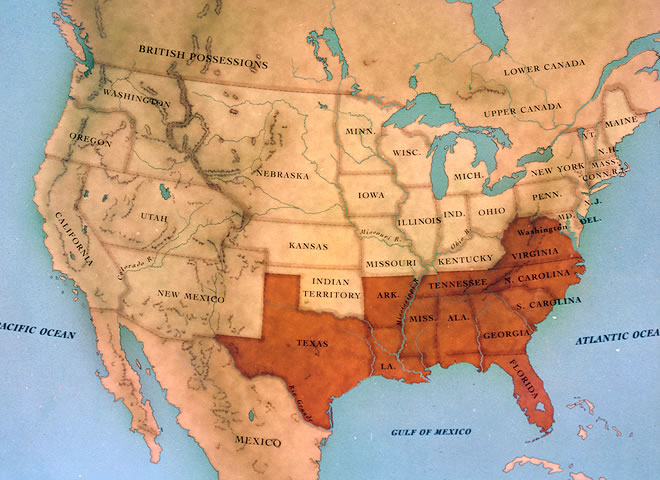
Now we are zeroing in on the truth. The French gave up the right to provide the language of choice for about half of the USA when Napoleon sold Jefferson the Louisiana Purchase. Spanish lost out as the language of choice in Florida, Texas, New Mexico, Utah, Nevada, Arizona, part of Colorado and Louisiana, tiny corners of Wyoming, Mississippi, Alabama, Kansas, and Oklahoma, and all of California at the point of a gun. Or, a bunch of guns. That’s roughly a third of the lower forty-eight.

Like it or not, it happened, and it is irreversible. English is the language of the US, despite the innumerable other languages spoken by our immigrants. They came here, procreated, the original speakers died, and their offspring now speak English.

So why are the Spanish speakers different? It is certainly not because of anything wrong with them. It’s quite simple. When Germans immigrated, they didn’t go back. Modern immigrant Spanish speakers, primarily Mexican, documented or undocumented, go back and forth.

Migrant labor is typically seasonal. Besides, wouldn’t you rather spend winter in Mazatlan than Minnesota if you could? Hordes of Anglos do it, and they don’t even speak the language.

Not all people of Spanish background move back and forth. Many of them came to the US and stayed. Tens of thousands of them were already here to greet the Anglo pioneers when they arrived. See map above! Millions of them don’t speak any Spanish, just as Nils Hansen of Kenosha, Wisconsin (hypothetical person) doesn’t speak Danish. There is a word for these people — Americans — and they don’t pose any language problem in the schools.

Those who do go back and forth are not going to stop doing so. It works for them. Summer labor in the US, then back to Mexico for its mild winters and lower costs is not just logical, it’s capitalism. It’s entrepreneurship. It’s survival for the Mexican families and cheap food for you. Drive by any field in California at harvest time and count the Anglos bending their backs in the sun. Your total will be zero.

A wall won’t change it. A path to citizenship won’t change it, either. The idea of a hermetically sealed border is a Trumpean delusion.

So where does that leave the children of migrants? In a tough spot, to be sure. They often don’t spend the whole school year in schools in America, and they often don’t enroll while they are in Mexico. Many don’t learn to speak, read, and write English as well as their Anglo or permanent Mexican American classmates. Some barely speak, read, or write English at all. They speak Spanish, but they often don’t read or write it.

Solutions? That would take a shelf of books, not a post.

387. Buchan the Racist

Getting ready for Westercon, I prepared a set of notes, placed as posts, for the panel What made the golden age golden? I was under the impression that it would be history and homage, and made notes appropriate for that. I was wrong, and it isn’t the first time I have spent time off track by starting before I had full information. When i’m ready to start a project, I’m ready, and sometimes I pay the price.

After I had posted my notes-to-self, but long before Westercon, I received this description of the panel:

Heinlein and Asimov are two pillars of the Golden Age of Sci-Fi. But reading those works with modern eyes can reveal attitudes that would be unacceptable in modern times. What can we learn from the classics when we look past the sexist and racist attitudes that pervaded the works of that time? Can we still appreciate works that present unacceptable ideologies?

Well, that’s a bit of a different story. No problem. I am always ready to fight the forces of political correctness.

I’ve been to this rodeo before. Once, several years ago, I was looking at on-line reviews of John Buchan’s The 39 Steps. I don’t remember why, but I do remember a review that ripped Buchan as a racist for seemingly anti-Semitic statements in that novel. I wrote a counter-review; both have since disappeared.

For those who don’t know him, John Buchan was a popular British novelist of the early twentieth century. He is very much a pro-British patriot, with the prejudices that implies. Think Kipling light. And he was a racist, but not an anti-Semite. I say that not as a scholar, but as a fan, who has read and re-read his works.

If you read him at length, his distaste for African blacks comes through loud and clear. His Jews, on the other hand, show up as both heroes and villains, just like his Germans and his Englishmen. But if you only read a little, you can be fooled.

#                #                #

To follow through on this, I used one of my favorite techniques. I recommend that you put this into your bag of tricks. I went to Project Gutenberg, downloaded The 39 Steps in Rich Text format, then cut and pasted that into my word processor. Now I had all 41,264 words in a searchable form.

One more hint. RTF will be hard to read because its wide line-length makes it look like bad modern poetry. Just switch your word processor to horizontal format and it will be much easier to work with.

The reviewer who started this controversy had complained about Buchan because of the words of one of his characters, Scudder. If you don’t know the book, Scudder is a kind of amateur spy who finds out that bad people are about to start World War I, and catch England off guard. This is what Hannay, the main character, says, quoting Scudder:

The Jew is everywhere, but you have to go far down the backstairs to find him. Take any big Teutonic business concern.  If you have dealings with it the first man you meet is Prince von und Zu Something, an elegant young man who talks Eton-and-Harrow English.  But he cuts no ice.  If your business is big, you get behind him and find a prognathous Westphalian with a retreating brow and the manners of a hog.  He is the German business man that gives your English papers the shakes.  But if you’re on the biggest kind of job and are bound to get to the real boss, ten to one you are brought up against a little white-faced Jew in a bath-chair with an eye like a rattlesnake.  Yes, Sir, he is the man who is ruling the world just now, and he has his knife in the Empire of the Tzar, because his aunt was outraged and his father flogged in some one-horse location on the Volga.

Wow! That sounds pretty anti-Semitic, and the reviewer who started this conversation took it as proof positive. But let’s wait a minute. Assume that the character Scudder is the worst anti-Semite since Hitler — does it follow that Buchan hated Jews? I wrote a mass murderer into Cyan — does that mean I approve of mass murder?

You can’t read the words of a fictional character as the opinion of the author, especially if you are looking at a minor character of questionable honesty.

Scudder dies in chapter one and his quest is taken over by Richard Hannay, the actual main character in this and several other novels. If you look closely at the character of Hannay and a dozen other lead characters in two dozen other novels, then you will come closer to having a fair and defensible picture of Buchan’s attitude.

In point of fact, not only was Scudder a minor character, he was also a liar. The reviewer who cried bigot never found this out because he quit the novel early. I knew that he was, but I needed a quote as proof. To find this, I searched for the word Scudder in my Find and Replace function. His name appears 65 times in the book because Hannay keeps thinking about him. Click and read. Click and read. Click and read. I found the passage I remembered at the beginning of chapter four.

The little man had told me a pack of lies.  All his yarns about the Balkans and the Jew-Anarchists and the Foreign Office Conference were eyewash . . .

Hannay worries at Scudder’s diary, taken off his body, because it seems odd, almost as if it were a cypher, and Hannay is good at cyphers. Sure enough, the Jew-Anarchist plot is just a cover for a much deeper plot (not by Jews), which Hannay foils by the end of the book.

So, everybody was a nice, unbigoted person and it was all a misunderstanding? If it were only that simple.

Reread the first quote, if you can stomach it. How would that passage play in a book published in 2017? When it was published in 1915, the book was a hit. Nobody minded that passage at all.

After Hitler and the holocaust, anti-Semitism fell out of favor. Before that, it was everywhere, in Europe and America. An actually anti-Semitic book in England in 1915 would have raised no eyebrows.

Was Buchan a bigot? Yes and no. He was not anti-German, he was not anti-Semitic, but he was anti-African. How do I know? I have read more than a dozen of his books, some multiple times. You can’t know from assumptions, and you can’t know from reading one book.

Bringing this back to the Golden Age of science fiction, we should be able to read and appreciate authors like Heinlein when he depicts mannerisms that are foreign to us. (Or to be fair, foreign to you; I grew up in the same era and it all seems normal to me, even when I disagree with it.) The fact, for example, that Joan Freeman in Lost Legacy is the object of mild sexist teasing should not mask the fact that she is a full participant in the action.

Nevertheless, understanding is one thing, enjoyment is another. There is a limit, and it varies with each of us. For me, Heinlein sometimes seems silly, but I still read and enjoy everything but Farnham’s Freehold. That one goes on my never-again list, along with John Buchan’s anti-Black tirade Prester John.

POSTSCRIPT: As it turned out, everyone on the panel ignored the description and we just talked about how great the golden age was. The forces of political correctness never raised their heads.

363. Masters: Coming to America

What sort of country would (the United States) have now if the Indians had had an Immigration Service when the Pilgrims set out in 1620?
John Masters

When I first read John Masters, something he said stuck with me. Before going to Westercon this year, I wanted to run down that quotation, and in doing so I found much more worth sharing. What he said about writing will appear here later, but today I want to give his insights on immigration, or, as he called it, his Seven Year’s War with the U. S. Immigration authorities.

For reasons detailed in his book, John Masters decided that, though he was an Englishman, there was no life for him in England, and that America should become his home. He applied for an immigrant visa, knowing that the British yearly quota of 65,000 was never filled. His reactions to the questions asked on the application form were humorous, but too long to place here. Apparently the questions were as inane then as they are now. (see 329. Green Card Blues and 361. Take This Test)

A week or so later, he was told that he would have to wait about four and a half years. He had been placed on the Indian quota. He went back to inquire and was told that American law only recognized the place of his birth, not his actual citizenship. Never mind that he was born in a British military hospital. Never mind that he was born of a British mother and a British father, stationed in the British army in a British controlled area. Never mind that a child born of an American parent (and it only takes one) anywhere in the world is an American citizen. Never mind that he was born in 1914, and India didn’t become a country until 1947. He was born in India, so he was on the India quota.

It was a good thing he hadn’t been born while his father was stationed in Greece. The Greek quota was eighty-one years. (Yes, that is not a misprint. 81 years.)

Masters decided to withdraw his application for an Immigrant visa, get a visitor’s visa, and work things out later. That was not allowed. Since he had applied for an immigrant visa, he was no longer eligible for a visitor’s visa. Too many others when facing impossible waits had made that same move, then disappeared once they were in America.

As you might guess, as a British Army officer with plenty of friends, he was eventually allowed a visitor’s visa, came to America, and managed to stay permanently, although with many additional bureaucratic battles.

Good thing he wasn’t actually Indian.

More to the point in 2017, good thing he wasn’t Mexican, or poor, or not a native English speaker.

Master’s comments on writing will come in later posts.