Tag Archives: science fiction

415. Life-long Day Job

After twenty some years of teaching
science, I finally got a lab.  SL

Continuing from Monday’s post — Jandrax came out and I went back to writing full time. Those were the years of A Fond Farewell to Dying, Todesgesanga (FFTD translated to German) Valley of the Menhir, Scourge of Heaven, Who Once Were Kin, and the first iteration of Cyan. I know you’ve never seen half of those books, but you will. I promise.

There is no better feeing than sitting down every day and writing, when the results are good. And they were. However, there are few more frustrating feelings than writing good books that don’t sell. After most of a decade of full time writing, it was clear that I couldn’t go on that way, and equally clear that I couldn’t quit. I needed a day job that would leave me some time for writing.

My wife suggested that I substitute teach. The pay was good (compared to minimum wage) and I didn’t have to look for jobs. I signed up, and the jobs came to me. It worked as a stopgap.

I couldn’t do it again, after being an actual teacher. Substitute teaching is to teaching, as going to the dentist is to being a dentist. The best one word description is probably painful.

However, I didn’t feel that way at the time. Yes, the job was boring, and yes, it was glorified babysitting, but I had made a shocking discovery.

I liked the kids. A lot.

You have to understand, I was an only child, raised on a farm, having little contact with other kids. I never had children of my own — by choice. To me, babies are just pre-humans. Kids under ten bore the hell out of me. But these kids were interesting and fun to be around.

I had discovered that middle school kids are more fun than a bucket of puppies. I realize that I am a minority in that opinion, and I also realize that part of my feeling comes from not having to take them home with me, but there it is.

Most teachers want to teach high school or fourth grade. Not me. My days as a substitute teacher in high school were dismal. My days teaching kindergarten were horrific. But middle school was my Goldilocks age — not too young, not too old.

By that time I had two masters degrees, so it didn’t take long to tack on a teaching credential. I took a job in one of the schools where I had substituted and I was still there twenty-seven years later.

In my mind, it was a day job. I continued writing. I continued working on the novels which weren’t quite right, and I wrote Raven’s Run. Years went by. I wrote a novel about teaching, Symphony in a Minor Key, which is running over in Serial right now.

I could tell you all about my first years, describe my first room, and give you insights into the joys and pains of teaching — except that I already have, in Symphony.

After about ten years, it was obvious that I wan’t going to get back to full time writing any time soon. After another decade, I admitted to myself that I wasn’t just a writer who was teaching. I was a teacher. It took me that long to be able to say it without having it sound like a defeat. I never stopped being a writer. I just became a teacher as well. I had two careers, parallel and simultaneous, and there was nothing wrong with that.

I was a writer, and a good one. I was a teacher, and a good one. Nothing wrong with that. After about twenty five years, I could even call myself a teacher out loud.

Now I am a retired teacher, and a full time writer again, with a new book out and another working its way through the computer. But I wouldn’t trade those years of teaching for anything.

414. Day Jobs

I  have had a lot of jobs in my life. The shortest lasted one day. I took a job as a rough carpenter, and spent a day putting blocking between rafters. I had a rough time of it. I had just spent four years indoors working in a naval hospital followed by a year in grad school, and I was out of shape by the standards of the farm boy I had once been. It was a hot summer day in California and I probably wasn’t worth my wages that day, but I would have gotten better. I had the skills for the job, but it was a physical challenge and I was up for it. Unfortunately, at the end of the day, the boss said that tomorrow I was to go to a site in Sonora to work. That was a town fifty miles away, not the state in Mexico. I realized that if I had to drive my dying car that far every day to get to work, it would cost me more in gasoline and repairs than I would make at minimum wage.

If you end the day with less money than you started, that isn’t a day job. That’s a mistake. However, when you write your first about the author for your first book or for your website, having worked at a lot of day jobs is an asset. It makes you look worldly and interesting.

Farm worker. That’s a job I didn’t get paid for at all. I started at age eleven and continued until I escaped to college.

Trim carpenter. That sounds skilled, and I am that skilled now. I wasn’t when I did the job, one summer between college terms. I was hired because the wages were so low that people who had the skills wouldn’t apply. I took the job because I was newly married and needed money to carry me through my last year of college.

Horticultural agent, peace corps. That’s a job I applied for, was accepted to, and really wanted, until Nixon did away with the deferment and I had to face my low draft number. I can’t count that one, since I never made it to India, to my eternal disappointment.

Cabinet maker. Another minimum wage job in a local shop to keep body and soul together while waiting for the Navy.

Surgical technician. Yes, really. I spent my naval career in the dental service of a naval hospital, stateside during the Viet Nam war, and happy not to be shot at. Since I was the only enlisted man with a college degree (the recruiter said, “College man? We’ll make you an officer.” Riiiiight!), I became head surgical tech. That meant standing across from the oral surgeon during about 2000 extractions of wisdom teeth.

Surgical nurse. I never count that one, because no one would believe me. The person who stands next to the doctor and hands him his instruments during an operation in the main OR is written down on the report as surgical nurse, whether they are a nurse or just have OJT. I did that maybe two hundred times while I was in the navy, usually on broken jaws, but occasionally on some pretty sophisticated maxillofacial reconstructions. Fascinating, but it didn’t make me a real nurse.

Writer. Nope, not a day job. A lifetime job, but you don’t make minimum wage.

County Red Cross Director. I earned that job. I had become a full time unpublished writer when I started as a Red Cross volunteer. I became a first aid and CPR instructor and taught hundreds of students, then became a member of the board of directors, and finally went full time for fifteen months. There weren’t a lot of applicants, since the job didn’t pay much above minimum wage. Non-profits are like that; they have to get money from donors, and it goes mostly to providing services, not cushy salaries — and that’s as it should be.

I was proud to work for the Red Cross and considered making it a career, but the bureaucracy is brutal. Besides, my first novel came out from Ballantine and I thought I was going to make a living at writing.

Stop laughing. It seemed possible in 1978. more on Wednesday

413. Wherefore Art Thou Steampunk

As they teach us in high school, when Juliet says, “Wherefore art thou Romeo?”, she means why are you called Romeo, and then goes into a long bit about identity. This post will do the same thing.

I have been writing a steampunk novel since July, and it is going quite well. I am roughly half way through the first draft, and doing my world building as I write. I am also researching what it means to be steampunk.

My justification for writing in an unknown genre is that it really isn’t all that unknown. It is a first cousin to science fiction, to fantasy, to horror, to the novels of Verne, to alternate history when limited to the near-Victorian, to Edisonade (a new name to me for a sub-genre I’ve been reading all my life — think Tom Swift), and to the old west with neo-mechanical devices (a genre that existed long before the Wild Wild West). I’ve been reading all of these, all my life.

The name steampunk was proposed by K. W. Jeter in a letter to Locus. Jetter, James P. Blaylock, and Tim Powers are three big names in early steampunk, but the genre has come a long way since then.

You would be surprised how much research into obscure subjects lies untapped in college libraries in the form of Ph.D. dissertations. I have learned to use the internet to seek them out, since so many of the things I am interested in are quite obscure.

Mike Perschon’s 2012 dissertation The Steampunk Aesthetic can be accessed at https://era.library.ualberta.ca/files/m039k6078#.WbA9kcdllBw. On that page, click Download the full-sized PDF if you want to follow me down that rabbit hole. If not, you could just try Perschon’s website http://steampunkscholar.blogspot.com.

No? Neither? I don’t blame you. Not many people have that much itch, so hang on and I will quote a few of Perschon’s conclusions.

Accordingly, this is not a study of Victorians or Victorianism, but rather a study of steampunk’s hodge-podge appropriation of elements from the Victorian period.

Non-speculative neo-Victorian writing is characterized by an adherence to realism that steampunk rarely cleaves to.

Steampunk (is) not . . . historical fiction per se, but . . .  speculative fiction— science fiction, fantasy, and horror, all mixed into one—that uses history as its playground, not classroom.

The most useful thing Perschon said, from my perspective, is that steampunk is not a genre, but an aesthetic. I had largely come to the same conclusion. The question for me has become not, “is it steampunk,” but rather, “does it taste like steampunk”.

I found that the more carefully I researched the Victorian past, both historically and technologically, the more I was attempting to make my novel fit a set of limitations. I was approaching it the same way I approached Cyan, where I first created a world with certain characteristics, then worked my story around it.

Steampunk doesn’t seem to work that way. In steampunk, an author has an idea of what his world looks like, then comes up with some quasi-magical dingus to make it work. Do you want your airship to be able to lift more and go faster? Invent a gas that never existed. In science fiction terms, it’s more Star Wars than Heinlein. There is nothing wrong with that, but I’m having a hard time wrapping my head around it.

In addition to academia. I am also half-way through a half-dozen recent steampunk novels. I would be further along, but I’ve been a bit busy writing my own. I’ll clue you in on those novels as I finish them.

409. Man Stuff

I wrote this last Thursday. The post, not the quotation.

          Marquart and Dael took a bench in a completed corner. “Tell me how you have things arranged,” he said.
          “None of the wardens will leave their houses until late in the morning. The first will arrive here about midday. We will have roast krytes ready by then . . .” Marquart waved away her recitation. He didn’t care about preparations for food and drink; he was satisfied that there would be plenty of both.
          “Who will sleep where? Who will arrive first, who will stay latest, who will want to get me alone to talk to, who will get drunk quickest, who is likely to pick a fight, and with whom?”
          “Oh, man stuff.”
                                          from Valley of the Menhir

Today, I was writing chapter eleven of my latest steampunk novel. So far my hero (I don’t do wimpy protagonists) has served aboard four dirigibles and has risen in rank from Sub Lieutenant to Lieutenant Commander, brevet, in the British air service. These craft are the result of an unscrupulous Brit who, through theft, intimidation, and assassination has crippled the German airship effort and stolen all their ideas.

Earlier this morning (as I wrote) Lieutenant Commander David James and I settled thirty passengers into their berths on the Henry V, a dirigible of war acting as a passenger vessel carrying diplomats the the Grand Durbar in Delhi. If you don’t know what a durbar is, you’ll find out in coming months. David hated every minute of it.

Then we got a break of several hours as he got to go back to his real job as the lowest member of the group of senior officers, seeing to details as the dirigible, nicknamed Harry in reference to Shakespeare, leaves London for Paris. We have been following David’s career for eleven chapters now, and he has done a little bit of everything as he worked his way up. He will do even more in the future, and we will (metaphorically) stand at his shoulder and give him our moral support.

Man stuff.

The year is 1887, Victoria is on the throne, and our Britain is even stronger than the real one was since they just won the German War, largely through a squad of spies and assassins that remains Britain’s guilty secret. David is one of the few Brits who knows this.

Now its time for me to take David by the shoulders and march him down to the lounge to preside, as a stand-in for the massively scarred Commander VanHoek, over the first evening meal of the cruise. He hates the idea. Actually, so do I. In writing, as in life, sometimes if you want to go to a certain place, the path to get there passes through places you would rather avoid.

I’ve been researching Victorian aristocratic gossip in order to build a world like yet unlike our own. It’s not my cup of Earl Grey, but it is the job I’ve taken on, and I will do it well. Well enough, in fact, to move my readers through the event without arousing their distaste. That’s the writer’s equivalent of “never let them see you sweat”.

Still, I’ll be glad when the dinner is over so David and I can get back down to the engineroom where we can try to get another horsepower out of those damned, recalcitrant McFarland engines.

Man stuff.

Blatant Commercialism

Greetings, new friends.

Recently, a number of new people have found their way to my website, and I am glad to see you. All my old friends have already heard this.

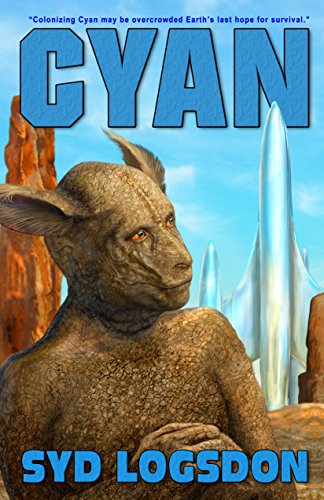
I began this website two years ago, shortly after finding out that my novel Cyan had been picked up by EDGE publishers of Canada. The original idea was to make myself and my writing known in order to find new readers for my novel. The website has grown well beyond that since.

Cyan came out in April as an ebook, and later became available in paperback as well. If you just found this website, you missed all the build up.

Cyan is a realistic, near-future science fiction novel about the exploration and colonization of a planet around a nearby star. With complications, of course.

If you click here, it will take you to the Amazon page where you can read reviews, see the blurb, and even use the Look Inside function to read a chapter or two. You can also click and buy.

If you do buy and like what you read, please take time to write a review. That way publishers will buy my next book. And then so can you.

End of commercial. Thanks for listening. SL

After the Storm

Postscript to Into the Storm
Not to be read by romantic types

You would have to be numb from the waist down not to feel the sexual tension in Lydia and Michael’s common flight.

How did you react to it; what did you think of their respective personalities? Is Lydia the perfect victim-heroine from romance literature, who will be the making of Michael – eventually? Is Michael the wounded warrior whose soul Lydia will save?

If you read Into the Storm that way,
you might want to avert your eyes
from the rest of this postscript.

For me, Lydia is a wimp and Michael is a jackass with a mommy-take-care-of-me complex. I couldn’t imagine spending further time with them if they were not going to change. In the original concept for a novel, Lydia was going to change a lot, as Michael’s true character was revealed.

First a bit of backstory. Their communion is not telepathy; it is technologically enabled transmission of thought and feelings, an offshoot of the memory taping technology of A Fond Farewell to Dying (short version, To Go Not Gently). Each person has to choose to be implanted. Michael has browbeaten Lydia into doing so, working on her guilt that she can walk while he can’t. She is kind and naive; he is ruthless. Living in each other’s heads, she has fallen completely under his domination.

He wants to go to live in the Martian colony where the lower gravity will allow him greater freedom. Lydia does not want to go, but shortly after Into the Storm she gives in. Her futile resistance to the move and her resentment begin to grow her a backbone. On Mars she works to support them both, and begins to find independence as Michael turns his attention elsewhere. She is fascinated by her work and he is bored with it, which gives her respite from his continual prying.

As she grows apart from Michael, she wants to have the transponder removed, but the surgical techniques that were readily available on Earth are not available on Mars. She literally can’t get Michael out of her head.

Time passes. Lydia’s importance grows and Michael’s childish need for thrills does not abate. He is exploring Phobos in a powered spacesuit, the celestial equivalent of the powered wings,  when he crashes. Lydia, in her new executive position, is coordinating the response to a Mars-wide crisis. She has access to ships which could rescue him, but she cannot spare them.

She has to save Mars with Michael’s dying voice crying in her head. Then she has to face the honest fact that his loss is less tragedy than relief.

Not quite a romantic ending.

#              #              #

I still think it was a good story, but it would have been no fun to write, and no fun for any reader who didn’t have her own hated Michael to make it meaningful. If you have a Michael of your own (or a Michelle, it works both ways), you have no doubt already fleshed out this outline in your own head, and are voicing an evil laugh under your breath.

For the rest of us, all that is left is Michael and Lydia’s flight, which is physically exciting, sexually arousing, and more than a little creepy.

Into the Storm 3

DSCN3989100 klicks, 200 klicks; speeds not to be measured on instruments; not for an artist; a master. Not for a man who had only fallen – once. He sensed their speed in the groaning of her titanium pinions and the growing strain on her arms.

She closed her eyes against the pain to come.

He arched their back and spread wings against their fall, arcing them upward and sideways through the turbulence of the interface and into a rising cell. The servos took the strain, but they communicated a portion of it to her. Pain, the instructor, the feedback; the pain would become unbearable before the fabric of her wings failed. Just before.

They shared the pain, but pain had become his world and this was his rising above it. His exultation. And it was her gift to him that she lent her body to this, for to her the pain was only pain, and she cried out against it.

Then they were climbing faster than ever, from the momentum gained in their plummet. She drew her pain in and made it a private thing that Michael could not feel. Later another, softer Michael would feel remorse for her pain. With hands and mouth, for his lower body was paralyzed, and with full knowledge that his own burning could never be satisfied, he would ravish her, putting all of his frustrations into her ecstasy. That he gave her freely, as she gave him this.

That was the Michael of endless nights and bitter days; but now, for one long moment of exultation, he was the Michael that had been, before misjudgment and arrogance had hurled his body to the ground.

Now, he soared.

Through the roof he called it. Augmented by the momentum gained in falling, propelled by the even beating of mechanical wings and buoyed by the rising cell of air, he took her through the rains and the lightnings and the pit-cold region where hail is born, upward through the thinning edges of the storm to where the air is still and the sun still shines. Through the roof.

With the last erg of upward force expended, Michael rolled over to float above the storm. From here the thunderheads were pearly white; billowing fields and valleys of cloud as peaceful as the sleep of childhood. They looked as if a man could walk across them to the end of the world. The sky was the dark blue of high altitude and the gray ring around the sun was itself encircled by a rainbow.

Hovering like some great eagle, above the tumult of the storm, with their height disguised by the carpet of clouds, her fear left her and her joy began.

For long minutes they glided, and she felt Michael slipping away. His ecstasy had ended. To dive again into the storm would be foolhardy; whatever Michael’s vitality, it was Lydia’s body they rode and she had reached her limit.

She felt his hesitation and knew his temptation. Just one more thrust into the clouds; just one more plunge into ecstasy and death.

She knew this and said nothing; and in her calm he found the courage to turn away from the storm and glide downward, carrying with him his tired and precious burden.

Come back Monday for a postscript to this story.

406. Arthur C. Clarke Invents the Modern World

If you hang a satellite over the equator, 22,300 miles up, it will appear to remain stationary. Everybody knows that, or should, since global communications is based on the fact. A generation ago, everyone in the science fiction world also knew that this cornerstone of modern society was “invented” or discovered by Arthur C. Clarke.

I’m not sure that Clarke is still generally remembered for this. The origins of everyday things tend to be forgotten.

Clarke’s observation first appeared  February 1945, in a letter written to the periodical Wireless World.

When Wireless World began in 1913, wireless had a completely different meaning than it has today. It referred to wireless telegraphy, invented by Marconi, which used radio waves, interrupted by a telegraph key, to send messages. That allowed ships at sea to send and receive messages.

Wireless World remained on the cutting edge of electronic technology. so it was the right place for Clarke to write his February 1945 letter, which included these words:

An “artificial satellite” at the correct distance from the earth would make one revolution every 24 hours; i.e, it would remain stationary above the same spot . . . Three repeater stations, 120 degrees apart in the correct orbit, could give . . . coverage to the entire planet.

In October of that same year, Clarke was back in print in Wireless World with his article Extra-Terrestrial Relays, in which he fleshed out his idea.


Fig 3. Three satellite stations would ensure complete coverage of the globe.
Illustration from the 1945 Wireless World article.

Clarke discussed the difficulties of early radio and television transmission. Radio, particularly the lower frequency AM radios in use then, were erratic. Sometimes they only carried a short distance from the transmitter; at other times, they would bounce off the ionosphere and travel for a thousand miles. Television signals, being higher frequency, did not bounce off the ionosphere and so were limited to line of sight.

Relaying through orbital repeaters was the answer to both range and reliability. An orbit of 42,000 kilometers above the center of the Earth would provide a geosynchronous station.

The figure given at the top of this post –23,300 miles — appeared in every early popularization of space travel. It is not only a switch to miles, but also that distance is above the surface of the Earth, not the center.

To power his satellite, Clarke suggests mirrors concentrating the sun’s rays to heat water in boilers for turbines to run generators. He also suggests that “photoelectric developments may make it possible to utilize the solar energy more directly”. That is exactly what happened; only thirteen years later, Vanguard became the first satellite to use solar cells.

Clarke then went on to specify what kind of rockets would be needed to place these geosynchronous satellites into orbit and predicted, correctly, that such rockets would soon be available.

He also said:

The advent of atomic power has at one bound brought space travel half a century nearer. It seems unlikely that we will have to wait as much as twenty years (i.e. 1965) before atomic-powered rockets could reach even the remoter planets with a fantastically small fuel/mass ration — only  a few per cent. The equations developed in the appendix still hold, but v(elocity) will be increased by a factor of about — a thousand.

Oh, if he had only been right about that, too. Then our world might come closer to resembling the world envisioned by Harold Goodwin in his Rip Foster novel.

Into the Storm 2

In word and deed, he demanded nothing of her, but when his soul cried out, she was bound.

She sensed his apprehension at their lack of altitude, and his hesitation, for this was her body that he piloted. Restraining her fears, she whispered, “Go ahead,” and felt the warm rush of his unspoken gratitude.

He banked away from the city, out over the open grain fields, fought the first gusts and rolled to enter the storm.

#              #              #

They passed through a veil of rain into the heart of the thunder. The sudden wind tore her hair to shreds and the crackling static turned it into a puffball of startled tendrils. She felt the current, like her fear, and the lightning cut the clouds above and below them. Michael arched their back in exultation as he caught the first rising wind, but it died quickly and they were plunged downward.

She felt his fear as a sudden beast leaping from the bush; not like her own familiar companion.

“Michael!” Her voice and presence drew him back from the memory of that mad plunge when his skill and power had not been sufficient to match the storm. That was then; this was now. And as quickly as she spoke, he mastered his fear and thrust it away like a secret shame. He threw their arms wide to catch the air and beat their wings unmercifully to escape the downdraft. She felt the pain in her arms and shoulders, and cried out.

Their descent eased as he shunted them sideways toward an interface. She thought that she could sense the ground just below them, but he kept their eyes skyward. Then they passed through shuddering turbulence into a cell of rising air. Gently at first, then with gut-wrenching acceleration, the winds tossed them upward and she felt Michael’s animal cry of delight escape her lips.

How far upward? The altimeter spun at the edge of their vision, but Michael refused to look at it. There was no altitude for Michael short of the ultimate. Through the roof.

But not this time. They passed upward through the layers where lightning bolts play tag and on out of the rain, through the sleety layers where hail is born and into the eternal gray night of the upper storm. There Michael turned them in a lazy arc, resting and reading the instruments as he prepared for the slingshot.

These were the moments she treasured. Here, fear could take its silken claws from her throat for a moment. Floating high, serene and spent; knowing that what had passed would never come again, yet knowing that in the moments and years to come, it would repeat in endless variation. Sated.

In her languor she sent tendrils of half formed thoughts in caresses of shared selfhood through Michael’s mind. Now they were intrusions, but he would remember and treasure them in the days to come. This she knew in their great sharing.

It seemed a small thing to give him, when she longed to ease his burning. But that was denied by his shattered body.

He chose adjacent cells with care and dove into the well of a downdraft. They fell with wings spread just enough to catch the falling air and throw them toward the earth. Past the hail, past the lightning, and into the rain. Outspeeding the raindrops so that they smashed against her face like upward falling rain. more tomorrow

Into the Storm 1

Into the Storm stands alone and without apologies, but it was intended as the opening of a novel. If you want to know where all this might have gone, you will find additional material in a postscript next Monday.

Into the Storm

Lydia spread her pinions as the pylon shivered beneath her. Dizzy with height, she swallowed back familiar bile and squeezed her eyes shut for one last moment of selfness.

“You are the eyes of my soul.”

She ignored Michael’s voice in her head and drew on all her strength to quell the shivering of her muscles. Thunderheads piled up in the west, clouds tumbling over one another in their haste to eat up the prairie. She retreated from confrontation to a safe, quiet corner of her mind, denying self and opening her mind to Michael while he waited with leashed impatience. The pylon swaying beneath her became as a great ocean swelling, and with her quietude established she whispered, “Now, Michael,” and he filled her.

#              #              #

Spreading their wings to the coming storm, he pumped quickly twice, rising from the pylon and settling again. Accustoming himself to her body. She rode on the left shoulder of his mind, bright eyed and frightened, but ready. Her gift to him; a pledge of her love. It filled him as he filled her and the gestalt threw tremblings through their shared body.

The storm was striding across the prairie, a juggernaut of cloud with lightning for eyes and skirts of rain.

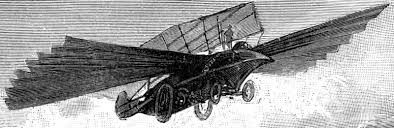
He spread their wings again and brought them forcibly downward. They cleared the pylon railing and fell, spreading their wings wide to catch the updraft. Upward then, with a beating of wings augmented by the rising tide of air. His mental picture – Daedalus rising with wings rooted in his flesh. Hers – a frail human suspended from synthetic wings, powered by servos and the rising wind.

Two hundred meters they rose as Michael churned the air with wings meant for soaring. Then he rolled gently left and volplaned toward the city below. Even in the heat of summer he would find an updraft there. The sky was impossibly blue, the sun hot on their wings in these last moments before the storm broke. They caught the updraft and circled the city — a jumble of glass, concrete and solar collectors. She retreated from seeing, concentrating instead on the steady beat of her arms as Michael swung them through the fastest rising currents. Michael was an artist at this; he had only fallen once.

He was neglecting his body. She sent her consciousness down the shivering wire of thought that bound them together, found him breathing slowly, his heart rhythm slow but steady, and returned. Cutting figure-eights against the sky above the city, Michael gained altitude, but she had almost waited too long. She sensed his impatience and shielded her memory so that he would not catch a picture of her clinging in terror to the ladder between the fourth and fifth levels while a gust shivered the pylon. Had the monitor seen her then, he would have ordered her off the tower. What would Michael think if her weakness denied him his one chance at ecstasy? more tomorrow