Tag Archives: science fiction

451. The Blurb

Every writer hates blurbs. If the term blurb is unfamiliar to you, it refers to the written material on the outside of a paperback novel that ostensibly tells the reader what the story inside is  about. It is supposed to be a way for the reader to judge quickly whether or not to make a purchase.

However publishers have no intention of telling you why you shouldn’t buy one of their books, so looking for an accurate blurb is a bit like Diogenes looking for an honest man. Thomas Anderson of Schlock Value, whose quirky reviews I never miss, wages an ongoing war against dishonest blurbs.

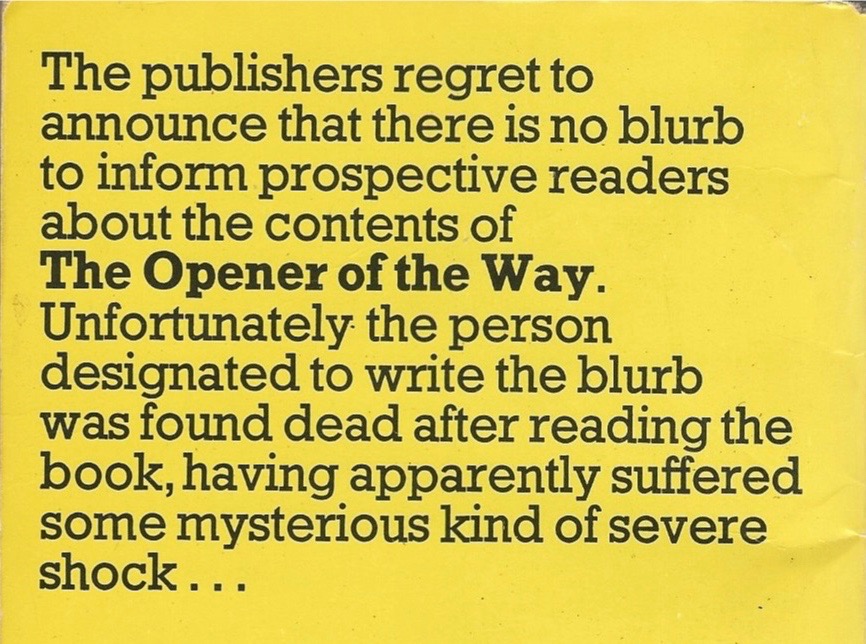
Yesterday I ran across Robert Bloch’s The Opener of the Way in a used bookstore. I’m not a fan of Bloch, nor of horror, but I bought it because I had to have a copy of the back blurb. I’ve reproduced the top half of it in the scan above. The bottom half, in extreme fine print, says:

(Actually, the Opener of the Way is a first-rate collection of ten terrifying tales of horror and the macabre, including some of the finest ever written about Ancient Egyptian curses, vampires, pacts with the Devil and others. We hope you ‘enjoy’ them . . .)

The fine print was more honest than most and the top part was downright clever. It isn’t usually that way. For example, the blurb on the back of my first novel Jandrax says:

As a scout he’d tamed four planets — and more women than most men ever see . . .

Now in truth, there is only one sentence in the novel that mentions, in passing, that first-in scouts are famous for being rowdy when between assignments.

The back blurb on Jandrax is in three parts, each flamboyant in the style you would find on old westerns. Setting aside the gosh-wow tone, the first and third section are accurate enough in content, but that middle section makes Jandrax sound like astro-porn.

There are two problems with this. Anyone who buys the book expecting a sexy, racy delight, will be terribly disappointed. And anyone who wants a serious portrayal of how space exploration might actually look will probably turn away. Based on the phrase more women than most men ever see, I wouldn’t buy the book myself.

True cliché: You only get one chance to make a first impression. The blurb is where authors make their first impression, and if the publisher blows it, authors are the ones who suffer. 

My second novel A Fond Farewell to Dying has a front blurb that says (in all caps):

WHAT PRICE LIFE? SURRENDER YOUR BODY! GIVE UP YOUR SOUL!

Yech! Sorry folks, that also has nothing to do with the story inside. Neither does the angel blowing the last trump over four zombies in boxes, but bad cover art is a subject for another post. FFTD is about an atheist who tries to come up with a mechanical version of immortality, and succeeds without the universe taking revenge on him for hubris. The front cover, both art and blurb, gives a very different impression. In fact, I saw FFTD for sale on a spinner rack of Christian paperbacks in a supermarket. Someone there certainly got a surprise.

The back blurb was lengthy, given in three paragraphs. The first two were reasonably accurate, but the third was wildly misleading. That inaccuracy irritated me no end, but most blurbs are much worse. They often look like they were mixed up and placed on the wrong book.

I challenge you to take a handful of science fiction paperback novels which you have already read, look at the blurbs, and decide if they have anything to do with the novel as you remember it. If you get one match out of five tries you’ve probably won the jackpot.

Still, the opening statement in this post may be an overstatement. Perhaps every long-time writer used to hate blurbs would be more accurate. When Cyan was being prepared for publication, the folks at EDGE asked me to write my own blurb, and I have to admit that compressing a novel into a sentence or two is hard. I appreciated the chance, but now I have no one to blame.

450. Centuries Are Nothing to India

It is a new year, and once again I find myself in India. Metaphorically that is, in my latest novel.

I went to college as a biology major and quickly switched to Anthropology. Everyone in the Biology department wanted to study DNA and I wanted to study ecology. It was 1966 and I was about ten years too early.

Once in the Anthropology department, I quickly found myself drawn to Indian studies. That is, South Asian studies, not the study of American Indians, as they were called before the days of political correctness.

I also found that common terminology doesn’t fit the larger world. What Americans call the Middle East is neither middle nor eastern. It is West Asia. East Asia is China and Japan. South Asia is Pakistan, India, Nepal, Bangladesh and Sri Lanka I fell in love with all the parts of South Asia, and never made it to any of them in the flesh. The Viet Nam war got in the way, and then novel writing got in the way.

I have visited variant Indias three times now in novels. A Fond Farewell to Dying (Pocket/Timescape, 1981) was set in a future following nuclear war and rising of the waters, in which India is the last nation having a modern, scientific culture. America is reduced to backwardness while Europe and northern Asia are blasted by nuclear fallout. David Singer, having renamed himself Ram David Singh, has left America to become a scientist in India, where he perfects a type of mechanically derived immortality which gets him into no end of trouble.

During my years of Indian studies, I ran across Rabindranath Tagore’s poem Sunset of the Century. I was so taken by it that I quoted part of it when I wrote A Fond Farewell to Dying, and quoted a shorter piece of it as the sub-title of this website.

Here is what I quoted in Fond Farewell:

Be not ashamed, my brothers, to stand before the proud and the powerful.
With your white robes of simpleness.
Let your crown be of humility, your freedom the freedom of the soul.
Build God’s throne daily on the ample bareness of your poverty.
And know that what is huge is not great and pride is not everlasting.

That last line is probably my favorite quotation of all time. I posted the complete poem two years ago. Tagore wrote it on the last day of the nineteenth century, looking back at centuries of oppression and forward to a new century of freedom.

India showed up again in Cyan but I won’t give out any spoilers on that.

My latest novel The Cost of Empire is a look at an India just beginning to push for independence in a steampunk flavored alternate universe. Rabindranath Tagore is an off-camera character, as the cousin of one of the main characters who has a habit of quoting him. I’ll let you know when it is finished.

449. Go Google Yourself

Cover by artist E. Rachael Hardcastle

This is mostly for and about writers; but then, most of you are or want to be writers.
There are two kinds of people in this world: those who Google themselves and those who don’t.
There are two kinds of people who Google themselves: those who admit it and those who don’t.
Me, I just do it for business reasons. That’s my story and I’m sticking to it.

All this came up because of a young author I occasionally converse with through post replies. J. M. Williams just published his first book The Adventures of Iric (a flash fiction collection). On the cover, his name appeared as JM Williams and he asked his followers about which worked better — J. M. or JM.

Actually, he has bigger problems than that. J. M. Williams, written either way, is not sufficiently unique in our internet world. When I went to Amazon to buy his book, he was nowhere to be found. Instead, the J. M. Williams who wrote A Legacy of Magi: A Mystic’s Path popped up. Different book, different author.

This is the second time I have had this problem. I met Thomas Watson, author of the War of the Second Iteration series at Westercon, picked up his book Chance Encounters, and found him a pleasant person to talk to. When I wanted to see what a short story sold separately as an e-publication looked like, I went to Amazon and bought one by Thomas Watson. Bad idea; it was a mess, full of blood, guts, and bad writing, because it was by a different Thomas Watson.

If J. M. Williams and Thomas Watson have this problem, what would it be like for John Smith?

If these seem like shameless plugs, so be it. I liked Chance Encounters. I have just begun Adventures of Iric and am enjoying it already.

Personally, I have the childhood misfortune of being Sydney Franklin Logsdon. The first name is from my father, who was named after a great aunt. The middle name is from my grandfather. Logsdon is unspellable and unpronouncable. That triple consonant — gsd — does not roll off the tongue. Even shortened to Syd, my name is a little girlie, which was a big deal growing up in an Oklahoma cow town. In high school I went by Log, except for a few of the smart alecks in math class who called me Logarithm.

An odd name turned out to be a godsend on the internet. The first time I googled my name, it was mostly me, not a thousand strangers using my name. When I bought the URL for my website (sydlogsdon.com), no one else had snatched it up.

J. M. Williams’ announcement of his first novel reminded me that I hadn’t googled myself recently, so I did it again.

I found a few posts by or about Sydney Logsdon, a young girl who is heavily into sports and into posting pictures of herself. The last time I did a self-google, about a year ago, she was all over the internet, but not so much this time. Perhaps she moved on, or maybe she got married and is still out there under her new name.

I found one obituary of my father — different middle name — with misspellings and no mention of children. The internet has a lot of accuracy problems.

I found a Myspace music mix by Sydney Logsdon aka dumbgirl98. She is probably a namesake I don’t want to meet.

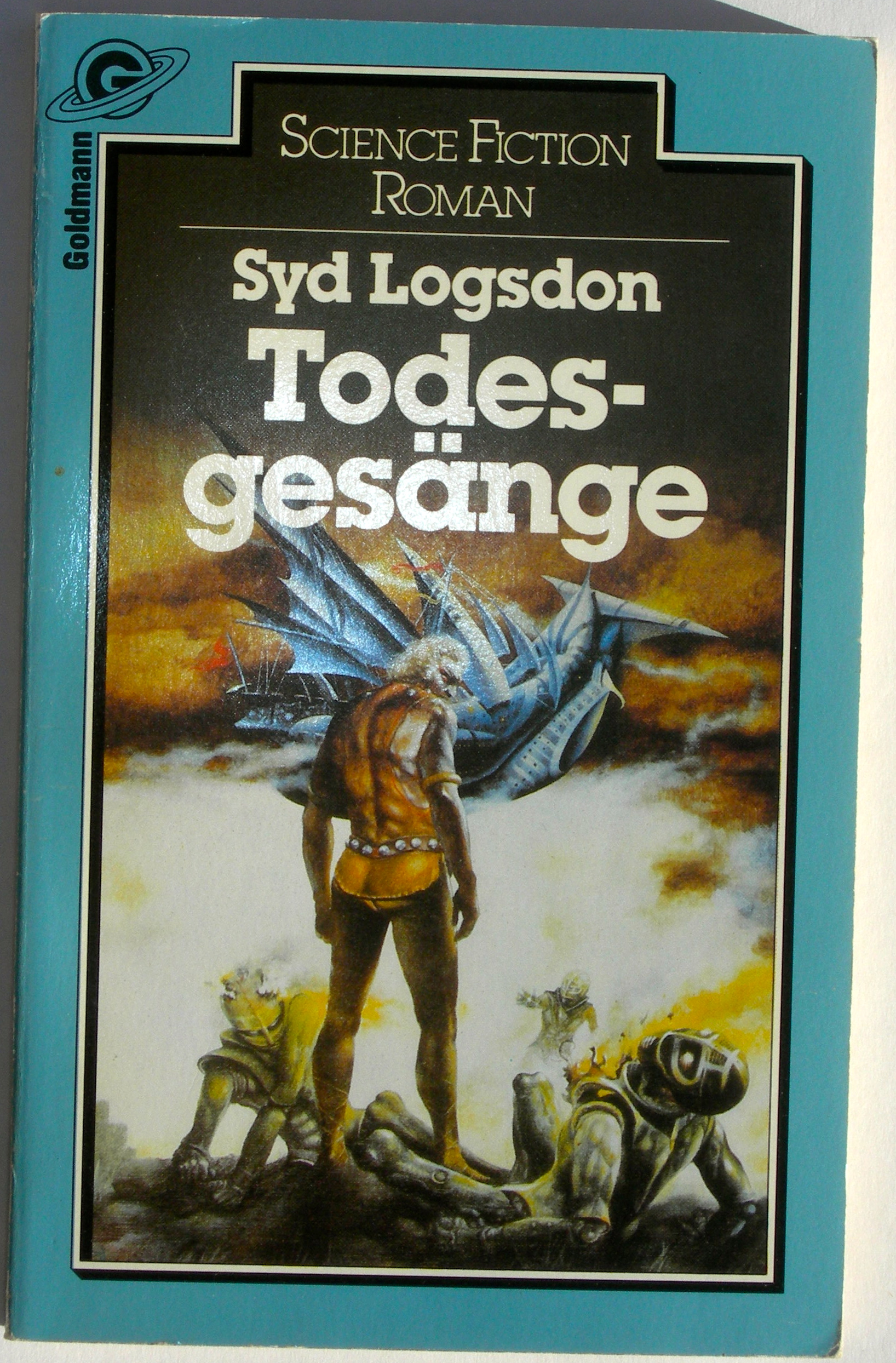
I found quite a few references to my newest novel Cyan. I found a ton of advertisements from used bookstores selling Jandrax or A Fond Farewell to Dying. One of them was in French. I even saw one in German, touting Todesgesänge, the translation of FFTD. It had a review I couldn’t read.

I found a review I hadn’t seen before for FFTD. In English, this time. That also gave me a new old-SF review site to follow.

I found somebody with my name telling how to make slime.

I found a number of sites selling illegal copies of my novels as ebooks. You won’t be surprised to see that I am not including a link to any of them.

What I didn’t see, was a hundred other people using my name. I dodged that bullet.

If you are a writer, or want to be, and your name is Avant B. Jones, don’t use A. B. Jones as the name on your novel. If your name is Bill Smith, you might consider a pseudonym. It’s a matter of branding, and it gives you something to think about while you are waiting for your first book to hit the internet.

438. Machine P

               Friends, I am amending this post as of June 1, 2018. I am changing it’s title from Machine P o r n. I have had more hits on this post than on anything I have written, but I have obviously just been generating frustration among those who clicked on purely because of the word P o r n. You will notice that I have also hidden the word itself from the view of crawlers.
              I like hits as much as the next blogger, but I’m not into misrepresentation. I am leaving the post otherwise intact, since it does have something non- p o r n ographic to say.

================================================

On Monday, we started talking about steampunk, then wandered into changes in science fiction and in real world technology. Picking up where we left off . . .

I always watch the PBS program A Craftsman’s Legacy. It is very steampunk, although that may not be obvious until later in this post. The most recent episode was a jeans maker. If I weren’t already hooked on the program, that’s something I would never have watched. In actual fact, the making of jeans was boring, but the program turned out to be twenty-five minutes of pure Machine P o r n. Through the whole show, every scene was an orgy of early twentieth century sewing machines of every specialized type, all whirring and clunking with their working parts in naked sight.

The only thing moving on a modern sewing machine is the needle, but there is a computer screen where you can tell it what to do. One modern machine will do more than a warehouse full of old ones, but but everything is hidden. It is a classic black box. It does stuff, but you don’t get to see how.

You can see the procession from hands-on to hands-off, and from visible to hidden in boy’s fiction. Tom Swift (later called Senior) could build anything with his own hands back in the twenties. Tom Swift Junior in the fifties and sixties could design anything, but he usually turned it over to his chief engineer to build the prototype. In the first Rick Brant book (1947), work on their moon rocket was delayed when they couldn’t get a certain type of tube (that’s valve in the British half of the world). By book number nine (1952), Rick was learning how to make printed circuits and was introduced to transistors. We watched him build a control unit, but once it was finished, it was sealed and no one else would ever see its guts.

Real science has followed the same progression. Galileo did his experiments by rolling lead balls down ramps. Today science requires a Large Hadron Collider.

Do I miss the good old days? Not at all. I’ve been living in the future since I was eight years old. I am pointing out that one byproduct of the Good New Days is that the working parts of everything are hidden, and that has consequences.

I spent the majority of my teaching career trying to make up for this loss. When I taught pulleys, I used homebuilt equipment with heavy weights so the kids could actually feel the difference when they changed the mechanical advantage. Every year, students were divided into teams of three or four and they all built gizmos, which were devices of their own design that carried out an assigned task. It was a different task every year and they were not allowed to take their work home, so Dad or older brother couldn’t cheat. All they had to work with was a shop full of tools, a pile of donated materials, and what they had learned. They had to see their gizmos in their heads and build them with their hands. No black boxes here.

Steampunk fits in here, as well. Steampunk is the meeting of the past and the future. As part of the past, it is familiar and understandable. It is also full of all the nineteenth, twentieth, and twenty-first centuries’ hopes and fears. Retrofuturistic is one word used to describe it, and it fits. Of course, as a word, retrofuturistic is as strange as the thing it points toward.

The clockwork aspect of steampunk is certainly one of its charms, especially in steampunk DIY and illustrations. We look at the pictures on the page, or the pictures in our mind while we read, and think, “I understand that. I could build that.”

And we could. Or at least the better, smarter self we all become when we sit down to read science fiction could.

In clockwork, once you take the back off the watch, everything is visible. If you look long enough, you can figure our what makes it tick.

437. Steampunk Clockwork

A great deal of the charm of typical (if such a thing exists) steampunk is that it replicates the sense of wonder of early science fiction, something that is missing 147 years after its beginnings. My math refers to the publication of Twenty Thousand Leagues Under the Sea in 1870. There have been a lot of stories in that century and a half, so it is just a little hard to come up with something new.

Fortunately for science fiction, there is a new crop of readers every generation. Things that seem old and overdone to long-time readers, seem new to them. When I first saw Weir’s The Martian I thought, “Again?”, but a half million readers on Goodreads rated it highly.

In old fashioned science fiction, the hero could do anything. And therefore, so could the reader.

Among that “anything” was a world of inventions that any boy genius could whip up in his basement. When I first read Tom Swift and his Electric Rifle (published 1911; it was left behind by my grandfather and I found it in the early fifties), Tom was just putting the finishing touches on his electric rifle, but before he headed for Africa with it, he whipped up a new flyer which was half aeroplane and half dirigible to use on the trip. Easy; any boy wonder could do it.

I haven’t seen that schtick since I was a kid in the fifties, and then it was usually in books from the thirties. I think we can blame Apollo. We all saw an entire nation spend a decade of time and billions of dollars to get to the moon. Thousands of workmen (and women) in all parts of the nation made the billion parts it took to undertake a moonshot. It no longer seems possible, even in science fiction, for Sheldon to build a moon rocket in a shed out back of the house.

When I was a kid, if I wanted to build a robot, it would have been made from tin cans, old sewing machines parts, and imagination. Now kids can build real ones (if their parents have enough money) out of plug and play components. Is that better? Is it worse? Decide for yourself, but it is different in a fundamental way.

It is all part of the digitalization of the world. And no, I’m not complaining. I’m writing this while sitting in front of a computer that makes my present life not only better, but possible.

Let’s hop into our time machine and watch it all happen. Let’s make it an even century.

In 1917, if you wanted to listen to the radio, the first thing you would do was build one, out of wire, a variable resistor, a capacitor, an appropriate piece of crystal, and a set of earphones. If you were really ambitious (or more likely, really poor) you could build the variable resistor and the capacitor as well. Everything would be in plain sight there on a pine board in front of you.

The next step was tube radios (that’s valve radios in the land of Britain). Tubes were an offshoot of incandescent light bulbs with more parts inside. Like light bulbs, you could see everything through the glass casing. Things had become more complicated, but you could still see the parts and follow their wiring.

Televisions worked like this as well, and as late as my childhood, hardware stores had a device with hundreds of sockets on top where you could plug in a tube from your TV or radio and check to see if it was burned out. They burned out frequently. If it was bad you could buy a replacement right there and fix the radio or TV yourself.

Then came printed circuits. You could still follow the wiring, but you had to turn the board over and look at the back side.

Then came transistors. They took the place of tubes, but they were tiny, anonymous nuggets with three wires and you could no longer see what their guts looked like. It was the beginning of major progress, and the beginning of the end of understanding.

Finally, integrated circuits arrived, and now you could no longer see the parts or the wires that connected them.

Now if something breaks, you throw it away. That isn’t really a problem, because things are cheaper, and the replacement is usually better than the thing discarded. In terms of practicality, things are better than ever.

In terms of understanding how our machines work, much has been lost.

But steampunk brings it all back. (more Wednesday)

435. Looking for Louis L’Amour

To revise or not to revise, that is the question. Actually, the question is how much to revise.

There are legendary writers who write rapidly, never revise, and turn out books like Hershey’s turns out chocolate bars. I recently read a third hand account of a writer who churned out a (very bad) science fiction novel over a long weekend. It was published, although probably it should not have been.

And then there’s Walt Whitman who was still changing parts of Leaves of Grass long after it was published. I guess I must be in the latter camp, since I’ve written three paragraphs of this post so far, and I have already changed three dozen words.

All this makes me remember the words of Luther Perkins, guitarist for Johnny Cash. He was famous for playing essentially the same riff on every song, and it always sounded great. Other guitarist were flying all over the fretboard at blinding speed, and being as quickly forgotten. Perkins said, “They’re looking for it. I’ve found it.”

I guess once you’ve found it, it gets easier. After four decades, I’m still searching. And rewriting. And revising, And polishing. It’s actually very soothing, but it is slow.

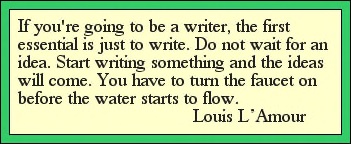
Louis L’Amour found it relatively early in his career. I became something of an expert on him during the seventies and eighties by reading and rereading his novels while taking breaks from my own writing. As a young writer, I could write a few paragraphs or even a half page, then I had to look at the ceiling for a while, waiting for the next thought to come.

Take heart, new writers; after four decades, things come a lot faster.

There were times, lots of times, when I had to do something to get my conscious mind off what I was writing so my subconscious could do its work. And not science fiction or fantasy; that is what I was trying to get away from. I needed something soothing and predictable, but written with a professional touch.

That’s a definition of the works of Louis L’Amour.

If my taste for L’Amour seems out of character for a science fiction and fantasy writer, remember I grew up on an Oklahoma farm in the fifties when every hero on TV rode a horse. I worked cattle every day, myself — but they were dairy cows and I was on foot. Everybody wore Stetsons and cowboy boots, and every farmer out on his John Deere tractor was a cowboy on a horse in his secret heart.

Go listen to some country western music; you’ll get the idea.

A single word description of L’Amour’s westerns would be consistent. A few were weak, a few were superb, most were strong examples of a type. His excellence was within a limited canvas. His historicals were weak and his one fantasy was a total dog.

Over a couple of decades, I read all his novels multiple times while waiting to find out what I was going to say next. (Except for The Haunted Mesa (1987); I could never get through that one a second time.) The same characteristic phrases appear at frequent intervals.

If you have written a long chunk of text, novel or not, finished or not, try this test. Choose a phrase that seems characteristic of you. Use the find function. If that phrase shows up fifty-seven times, you might want to think about that.

L’Amour’s moral and political positions are simple, firm, and unvarying — much like Heinlein, actually. An unsympathetic critic would say he wrote the same book fifty times. I think that pushes criticism of consistency too far. It would be better to say that he had a consistent moral position that channeled him into a certain type of story.

Personally, I tend to see both sides of every argument, whether in life or in my writing. Given a certain fictional situation, L’Amour would solve it in a certain characteristic way. I would see a hundred ways to solve it, and then go searching for solution number one hundred and one. It makes for slow writing.

L’Amour did not revise. I discovered that the first time I read Reilly’s Luck (1970). Early in the book the hero meets Wild Bill Hickok; when they part, L’Amour says that he never saw Hickok again. Forty pages later, Hickok and the hero meet up a second time, and Hickok loans him a gun.

You couldn’t make that kind of an error if you did even the most cursory revising. But that isn’t really surprising, considering how many books L’Amour’ wrote. He knocked them out like a chicken laying eggs. He couldn’t have done that if he had agonized over every book.

The two different styles of writing lead to two different approaches to revising. As writers, I don’t think we get to choose which camp we fall into. It’s a blessing or curse you are just born with.

430. The Rocket’s Red Glare

from Congreve’s original work.

“Oh, say can you see . . .”

No, this is not going to be about the NFL. It’s going to be about the rockets which figure into the anthem, into history, and into the steampunk novel The Cost of Empire, which I am now writing.

Rockets got their start in China, where they were used as fireworks and as military weapons. Just keep that in the back of your mind. We are going to start in the present and move backward in time, but not all the way to China.

When the average American sings the Star Spangled Banner — or mouths it, since it is a hard song to sing — it is unlikely that the image in his mind looks anything like the rockets which actually burst in air over Fort McHenry. My generation has V-2 rockets in our DNA, largely because early SF films used actual films of V-2 rockets as stand-ins before special effects were perfected. A later generation has Saturn-V rockets imprinted on their brain. To both, rockets are pointy ended cylinders with the flames coming out of the bottom.

Not so in 1814. The rockets that rained down on Fort McHenry looked more like fireworks rockets. They were called Congreves and a page of drawings of them is given at the top of the post. Some were explosive tipped. Some were parachute flares, which “gave proof through the night that our flag was still there.” All were guided, more or less, by a long stick that acted like a rudder, similar in function to the fins on a V-2.

They were nothing like accurate. That was the way of things before modern times. If you recall the battle of Agincourt in the movie version of Henry V, the English longbow men drew back together and fired hundreds of arrows simultaneously at a high trajectory, which rained down en masse on the French. The battle of Hastings was lost when King Harold Godwinson looked up at a bad moment and caught such an incoming arrow in the eye. Muskets in that era were also nothing like accurate, so lines of musket men firing together in the same direction managed to hit somebody, but probably not the targets they were aiming at.

William Congreve (not the playwrite and poet) gets credit and naming rights for the Congreve rocket, and he did make improvements, but his work was based on rockets captured in India.  Which brings me to why I’m writing this post. Here is a quote from The Cost of Empire. An Englishman who has gone native in India is speaking:

“About a hundred years ago this whole region was called Mysore and Hyder Ali was in charge. He fought the British and all the Indian princes around that kept shifting from the British side to his and back again. After he was killed, his son Tipu Sultan took over and formed an alliance with the French.

“It’s an old story. The same pattern happened all over India, as we British took over one region at a time. But this story has a kicker. Rockets.

“Rockets came from China. Everybody knows that, but they were widely used in India as well. Hyder Ali and Tipu Sultan used them extensively; some of their rocket brigades had over a thousand men. Rockets were made that exploded, that set fires, and even that had sword blades attached so when they came down spinning, they made a bloody mess of British ground troops.

“When the Mysore wars were over, the winners sent hundreds of captured rockets back to England. Congreve studied them and replicated them. The Congreve rockets we used all throughout the Napoleonic wars were just English versions of what Hyder Ali had used against us.”

The old guy is telling this story because a group calling themselves the Sons of Hyder Ali have built an arsenal full of rockets. They have bad feelings toward the British and a plan concerning the flotilla of dirigibles our hero is serving on.

I would tell you more, but that would be a spoiler.

426. The Five Plots of Time

It is a dubious tradition to produce articles like The Three Basic Plots of Fiction, or The Four Kinds of Traditional Hero. I’ll add my bit, even though I’m dubious myself.

The Five Master Plots of Time Travel Stories

This grouping came out as I was thinking about The Map of Time. Time travel has a long and tortured history as a set of concepts hung uncomfortably between science fiction and fantasy. None of it makes much scientific sense, although I do read a lot of actual (?) scientific theory which demonstrates that even scientists can waste their lives reading too much SF. It would make more sense to simply call all time travel stories fantasy, but they always require a time machine, so they must be science fiction — more or less.

Then again, Einstein would hate FTL stories. They violate relativity, but that doesn’t keep me from reading and writing them.

Let’s just tackle this mess in the spirit of fun.

Master plot #1.     A man tries to change history and fails. He is doomed to failure, no matter what, because the past can’t be changed. The entertainment in this kind of story is in making the reader think the hero will succeed, and fouling him up at the last minute in some clever way.

Master plot #2.     A man tries to change the past in some logically forbidden way. The classic form would be that our hero goes back to kill his father before our hero is born. The stars go out; the universe ends.

I am not fond of this form. It’s too much too simple. Perhaps a good writer could make it work if we know that the victim-to-be is the hero’s father, but the hero does not. (Shades of Oedipus!) Then we would anticipate that this is a type one story, and be taken by surprise when the hero succeeds and the stars go out. That might work, but I doubt it.

Master plot #3.     This is a variation on 1 and 2. A man tries to fix a tragedy by going back in time, but instead makes things worse. This is just a variation on the notion that, “You can’t make the world better, and you shouldn’t try. Just accept your fate.” Literature is filled with this Christianity based defeatism, epitomized by The Monkey’s Fist.

The Greeks called it hubris. I don’t buy it. For me, a man without hubris isn’t much of a man.

Master plot #4.     A man is in a world different from ours. He tries to change the past, succeeds, and his world morphs into the “real” world, i. e. ours. If the reader accepts that he is reading an alternate timeline story, and is taken by surprise by the ending, it can work. Brunner used this bit in Times Without Number, but that novel had enough quality to succeed even with a different ending. Zelazny did a beautiful variation in the short story The Game of Blood and Dust.

Master plot #5.     A man tries to change history, but instead creates a new timeline, or crosses over into an existing alternate timeline. This isn’t a trope; it’s a genre. Alternate timelines can be wonderful, but they are often cheap knock-offs, based on the notion that you don’t have to create anything, you just rearrange what already exists.

They aren’t even time travel stories, unless someone moves from one timeline to another. Pavane is an alternate timeline novel, but not a time travel story, since every actor in the novel remains tied to his own timeline throughout, and is never even aware of the existence of any other.

Okay, I will admit that any bright twelve year old could invent more plots, or could knock holes in these. I present them merely as a mental exercise — a fourth dimensional Rubik’s cube — for your amusement.

Have fun arguing.

425. Goodreads as Textbook

I bought The Key of Time several years ago from E. R. Hamilton’s, my favorite purveyor of remaindered books. It looked and sounded good, but so did the half dozen others that came in the same order. I put Key aside and it stayed in my to-read pile until I became immersed in Steampunk. It seemed to ooze Steampunk, so I dove in.

I planned to review it in this blog. You saw the results on Monday in post 423. 85 Pages: a review, so named because I couldn’t get past page 85.

That got me thinking about Goodreads. I’ve only been involved with Goodreads for about a year and a half, but I am impressed by the intelligence of most of the reviews. Since I discovered it, I have treated Goodreads almost like a textbook on what intelligent readers want.

Here are Goodreads’ stats on The Key of Time by Felix J. Palma, translated by Nick Caisto:

10289 ratings                2127 reviews                rating 3.37 out of  5

That’s a lot of ratings and reviews. Many Goodreads books have almost none. The 3.37 rating is fairly normal. It’s hard to find a book on Goodreads that doesn’t garner mixed reactions.

I decided to pick a few Goodreads reviewers who agreed and disagreed with my take. Here are some examples — or rather excerpts, for the sake of space and so I don’t step on anybody’s copyright.

Traci said, It was amazing.

. . . Do you enjoy magic tricks even though it’s all sleight of hand? . . . I loved every moment I spent with this new and talented author.  . . . one of my favorites, of the year. Beautifully written.

Did Palma get his act together after page 86? Were the last 524 pages better than what I read?Did I miss something?

Frances seemed to think so, with some reservations.

Frances said, (I) really liked it.

. . . I was beginning to wonder if I wanted to continue. At times I groaned (but it). . . . soon became compelling enough to finish. When I finally read the last page . . . I (was) . . .  pleased to have read such a creative and unique book.

I have to admit that I also felt compelled to continue as well, despite the insipid “hero” and glacial pace. It reminded me of all the times I’ve tried to read Dickens’ longer books. But this isn’t Dickens. It’s more like pretend-Dickens. For me it was finally more irritating than intriguing.

Velma said, (I) did not like it. and recommended the book for “someone willing to edit it, heavily.”

Time travel! Jack the Ripper! Automatons! What’s not to love?!? Well, as it turns out, almost everything. . . . it took every ounce of stick-to-it-iveness I could muster to get through this convoluted, interminable literary maze. WHERE, I ask you, was the EDITOR in this hot mess? . . . (Palma is) a decent, if grandiose, storyteller and he mimics to perfection the florid style of the period he set this novel in . . . But come on, Félix, enough with the meandering, the inconsistencies, the convenient last-minute reprieves . . . I was all set to love this book, what with it being about the re-writing of the history of the earliest science fiction and all, but it wasn’t to be . . .

Velma pretty much sums up my reaction. If you look at her whole review on Goodreads, she is even angrier than this excerpt shows.

What is the takeaway? About Goodreads, that is. I’ve had my say on Palma.

Goodreads won’t tell you if a book is good. It will tell you all the different things readers think about it. And that is its value — many looks from many directions. I will continue to check it out, after I read something. Whether I love a book or hate it, I always learn something from Goodreads reviews, even it is is just public taste.

424. Arthur C. Clarke and Russia

(Written last Thursday) This morning’s news brings new revelations about what Russia is doing to America through the internet. Or are they new? Didn’t Arthur C. Clarke warn us all that this was coming back in 1960 in his short story I Remember Babylon? Of course he did; Arthur has always been ahead of the curve.

I Remember Babylon? is actually dated and struck me as a bit naive when I first read it, but you might want to check out Arthur’s prescience as he gives you today’s headlines 57 years before they happened. After its original appearance in Playboy, the story was reprinted in Tales of Ten Worlds, available in your local used bookstore or on Amazon.