Tag Archives: science fiction

307. Give Me Air

I exist for open spaces. I lived a long time in a small city, but I could walk to the edge of town in five minutes. I spent four years at Michigan State, but that campus was a sylvan paradise. I only lived in a true inner city once, and it almost killed me.

It was Chicago. I know people who love Chicago – Andrew Greeley made a carreer out of loving that city – but they didn’t live where I did. 53rd street, student housing for the University of Chicago, a few blocks from the true south side. The same general area where President Obama got his start.

No, I didn’t meet him. He was in Hawaii, still in middle school, when I was at Chicago.

I never felt more at home intellectually, or more adrift in every other aspect of my life, than the year I spent there. It wasn’t just the dirt and the crowding and the nightly killings. It was that I would have to drive for hours through packed traffic to get to see open space. Without a car, I could have walked until my heart broke and never have reached the open sky.

I left after nine months with a master’s degree and a permanent case of cold chills.

When Keir Delacroix, in the novel Cyan, finds himself stranded on Earth after returning from exploring that virgin planet, I knew how he felt, and I knew where I had to put him. Chicago.

* * * * * * * * * *

The sky was slate gray to match Keir’s mood.    

Snow had been trickling down from ruptures in the sooty sky since noon, and now the dark of evening was upon him. He squatted against the bole of a smog blasted tree, staring at the house where he had been born. It was a half century older now than it had been then, although Keir was only thirty-nine. Even then, it had been old; a two story cottage subdivided to hold a dozen apartments. Now it had endured fifty more years of smog, fifty new layers of winter soot from a thousand chimneys, and half century more of the assault of air borne chemicals from the steel plants.

The orbital factories around L-5 were supposed to have removed the stigma of pollution, but even they were unable to cope with the needs of an Earth groaning under the weight of twenty billion people.

Someone came out the front door. Like Keir, he was bundled against the cold and he kept his right hand in the pocket of his coat. He looked around uneasily, saw no one but Keir, and advanced across the lawn. The grass was dead and brown, withdrawn from the sidewalk near the street to leave a barrier of frozen mud.

Keir drew a deep lungful of cannabis and threw the drag away.

The man was lean to the point of emaciation. His eyes were sunken in deep hollows. Keir nodded a greeting, but he only responded, “What do you want?”

“Nothing,” Keir answered. “Not a damned thing in this world!”

It was not the answer the stranger had looked for, but Keir let it hang between them for a moment before he went on, “I was born in that house – grew up there. In the little apartment to the left at the head of the stairs.”

“Who are you?”

“Keir Delacroix.”

The man knew him; it was written on his face. “What do you want with us?” he demanded. His voice was as tight as his face, all hard edges and deep hollows.

Keir sighed and shook his head. “Like I said; nothing. I don’t even know you.”

“I think you had better move along.” The stranger gestured with the hand in his pocket, and Keir finally decided that he did not have a gun. It was a foolish and dangerous bluff. Keir rose stiffly and threw back his shoulders to ease the strain of sitting too long in one position. The man stepped sharply backward toward safety.

Keir only shook his head and turned away.
301. Cyan in the Making (2)

This is a continuation of the Cover Design Questionnaire for Cyan.

Describe the main characters and their physical appearances.

Okay, I cheated a little on this one. When I first sat down to outline Cyan, I intended the crew to be truly multinational, and made sure that no two were from the same country. As I continued writing, it became clear that the Earth from which they came would not be that cooperative, so I transferred the crew to a single country, a successor of the US, and that’s how I described them here.

Also, when you see xxxxx xxxxx below, that is me restricting what you can read to avoid spoilers. 

All the ten original explorers are athletic, but normal looking. Like the original astronauts, they are of compact build; none are above 6 feet. They were chosen to be racially mixed, a goal made easy since their home nation is the USNA (formerly USA) after it has absorbed Canada, Mexico, and the Caribbean. The women of the group are independent souls. If an artist were to put one of them in a damsel-in-distress pose on the cover, she would hunt him down and beat the crap out of him.

Keir Delacroix, groundside crew leader, French ancestry, the most physically active crew member, survivalist, a generalist whose main job is keeping everyone else alive

Stephan Andrax, spaceside crew leader, Danish ancestry, more slender, he spends little time on Cyan

Tasmeen Rao, second in command in space and on the ground, Dravidian ancestry, from Trinidad, very dark smoky grey skin, darker than Leia, strong but so slender as to appear frail

Ramananda Rao, meteorologist, married to Tasmeen, similar in appearance, but without her seeming frailty

Leia Polanyi, paleontologist, African ancestry, of medium dark skin (think Uhura), small

Gus Leinhof, biologist, German ancestry, slightly older than the other crewmembers

Uke Tomiki, Japanese ancestry, powerful but slender body of a martial artist

Debra Brunner, biologist, mixed caucasian ancestry, movie star beautiful and hates it because it gets in the way of her work. No hipshot poses if she appears in illustration

Petra Crowley, geologist, xxxxx xxxxx xxxxx xxxxx xxxxx xxxxx

Viki Johanssen, anthropologist, Scandinavian ancestry, 6 feet tall, a powerful, lanky amazon, dirty blonde hair (really blonde, chopped short, and always dirty). xxxxx xxxxx xxxxx xxxxx xxxxx xxxxx xxxxx xxxxx xxxxx xxxxx xxxxx xxxxx xxxxx xxxxx xxxxx xxxxx xxxxx xxxxx

On Cyan, as explorers and later as colonists, they wore khaki and denim, with 12 mm automatic pistols in cross draw holsters on the left side – out of the way but easily accessible. If you need to draw Gus, he also carried a long barreled .22 revolver in an open holster low on his right. As the crew biologist, he used this to gather specimens without blowing them apart. Yes, it is a cowboy look, but it is how field biologists actually used to gather their specimens, before eco-consciousness and electro-miniaturized high tech equipment was available.

Who is your favorite/ Why? I like them all. Even the villain Curran has redeeming characteristics. Tasmeen is the one I would most like to meet, if she were a real person.

What sparked the book? Over the years, tales of exploration have always been my favorite kind of science fiction, but they are rare, and I couldnʼt think of one that took a planet all the way from initial exploration through colonization. It was the book I had always wanted to read, but I had to write it myself.

300. Cyan in the Making (1)

Three hundred posts in A Writing Life. That’s a milestone, more so since there are more than three hundred additional posts over in the companion blog Serial.

This calls for a celebration and, since this blog was begun in support of my upcoming novel Cyan, it seems like a good time to announce the publication dates.

==The dates that were here were accurate==
==when I gave them, but have been changed.==
Click here to go to  post 316 for corrected dates.

I’ve seen the cover and I like it, but I’m not allowed to show it yet. Sorry.

Close to a year ago, my communication with EDGE became more intense. Cyan was scheduled for a near future release, which ended up being delayed, but the back and forth was useful and fascinating. I had no idea that they would ask for so much input. Certainly I had almost no input when Jandrax and A Fond Farewell to Dying were published, long ago. (see 133. and 134.).

One of the questionnaire’s I filled out was on cover design. I’m going to share part of it with you, because it is interesting, and because it is a good teaser for the upcoming novel.

Cover Design Questionnaire (in part)
this was for the editors and to be forwarded to the artist

Primary genre? science fiction

A potential subgenre? hard SF; near neighborhood, near future stelar exploration; SF realism —every company had it own definitions for subgenres. The guiding principle of Cyan was to tell a story about the kind of things that probably will happen in the next century or so.

List three comparative novels for cover suggestions–I went to B&N today to see what this monthʼs crop of covers look like. They are all beautifully done but essentially interchangeable. None of the covers gave much of a clue of what is going on inside the book, with the exception of Kim Stanley Robinson’s Red, Blue, and Green Mars.

My take on covers is that they should give the reader an idea of what he is buying. Cyan is a realistic, day-after-tomorrow story of colonization and exploration, with no battles and no fantasy elements. Most of the covers I saw today could as easily have been put on video games; that wonʼt work for Cyan. Cyanʼs cover should have no Terminator wannabes, no Conan clones, no Frazetta girls, and no Dystopian ruins.

Seven phrases for google searches:

science fiction
Procyon
space exploration, fiction
space colonization, fiction
first contact
recombinant DNA
overpopulation, fiction

Hypothetically, pick a scene for the cover — A lot of things happen in Cyan; there are many scenes that would look good on a cover, but the one that most clearly conveys the overall sense of the book is the first ten minutes the crew spends on the ground. I will enclose the text of the scene. (To the artist, I didn’t enclose it here.)

If you do that scene, here is some backstory on the landing craft. Starships are built in space with unstreamlined, open structures. The landing craft is a squat cone with added complexities. It is fusion powered, so its tanks are small, but it has some cargo space for specimens. The tug, during the colonization phase, is similar in appearance but much larger, with a large cargo hold. Both are VTOL craft, landing upright. This is because of the absence of landing fields, but such craft have also become popular on Earth. Given compact fusion reactors, their inherent inefficiencies are of no consequence.

If you prefer to include the non-human characters, I have included an excerpt of Cyl on the hunt. I have also enclosed further descriptions of the Cyl. (Again,to the artist, not here.

this questionnaire excerpt concludes tomorrow

292. I’m back

dscn5448I’m back.

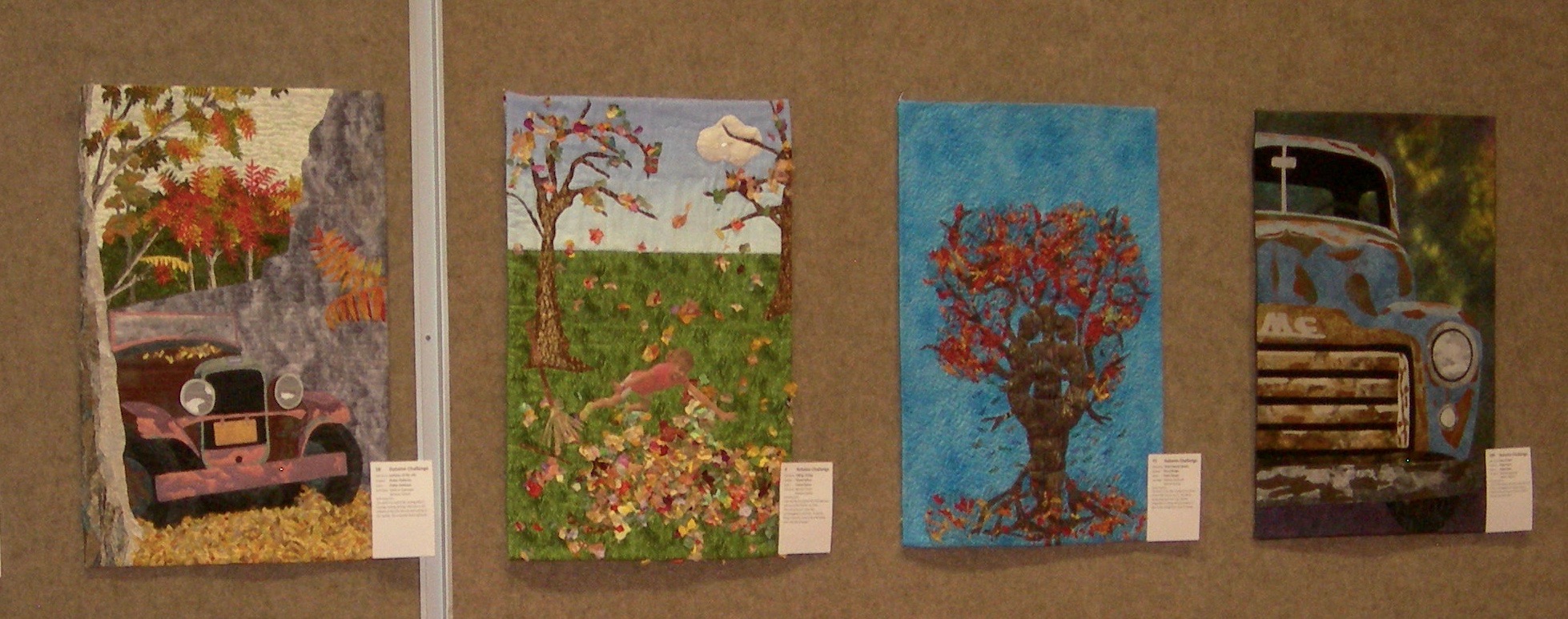
It’s been a weird month. Every two years my wife and I organize her guild’s quilt show. It’s a big deal and the amount of detail work is massive, but I won’t give any details. This is a blog about A Writing Life, not about the personal, private, non-writing life that sometimes jumps in with both feet. I did put in a photo of some of the quilts from the show as a teaser.

Things are progressing with Cyan, and I’ve been working hard to keep everything moving smoothly. One of the side effects of the excess of non-writing obligations is that I haven’t been able to work as unhurriedly on Cyan as I would prefer. I hate deadlines, and I am living in the middle of a snarl of them.

On January fifth I saw the first “rough” draft of Cyan’s cover. Excellent, exciting, and it looks like it will sell some books. That is of first importance. As much as we authors complain when covers are inaccurate, a naked female that sells books is always better than an accurate depiction that leaves books unsold.

By the way, this cover is not a naked female. It is a Cyl – and a rather well envisioned one at that – in a desert landscape looking up a the landing craft from the Darwin. It will all make sense when you read the book.

In the “rough” draft – which was slick, professional, and not rough at all – the Cyl was looking down toward stage left and there was no landing craft. On the more finished version I saw next, the Cyl had turned his head slightly left to look at the landing craft.

So what? So this was done by a skilled digital artist, using a high-end illustration program. You couldn’t turn the head of such a sophisticated image in a painting without starting from scratch. I know a little about this. I have been using graphics programs almost daily since the late eighties, making drawings of things I was about to build in the woodshop, drawing illustations for my science class, and designing dozens of oddball musical instruments and hundreds of quilts. I never had the opportunity to work with a really high-end program, nor had the time to spend on their leaning curve, but I recognize quality when I see it.

Even though the image looks finished, there are still a few tweaks coming, so EDGE is not letting me show you yet. As soon as I can, I will.

I have also been told that although Cyan will be an ebook, it will also be available in print-on-demand format. I’ll tell you more as things progress. It looks like the full release will be about the time of Westercon. For those of you in the eastern half of the US and the rest of the world, that is July fourth weekend.

So, I’m back, ready to pick up where I left off with a diverse mix of posts. Tomorrow we’ll look at the contributions of Gene Cernan, the astronaut who died two weeks ago.

268. Rick Brant Bibliography

Here is the list of the Rick Brant books I promised in last Thursday’s post. Numbers 1 through 18 were published by Grosset and Dunlap and widely distributed. They are hiding in thousands of dusty attics and can frequently be found in the children’s sections of used book stores, and used onlline through Amazon.

I have never seen books 19 through 24. although I’ve looked for them everywhere. According to Series Books numbers 19 through 23 were also published by G & D; I don’t dispute this, but clearly they were not well distributed. Also according to Series Books, number 24 was published by Manuscript Press. I have little to say about the last six books since I have not read them.

The list below is coded. KS (Kindle, single) means that the book is available for individual download to Kindle through Amazon. U (used) means the book is available used at reasonable prices, if you shop around or order through used bookstores carried by Amazon. $ (Egads!) means it is available used in the same way, but at ridiculous prices. I’ll buy these last six myself when I win the lottery.

GK (Gutenberg/Kindle) indicates an interesting phenomenon. These appear to be public domain works, and were made available for free through Project Gutenberg. Click to go to the Browse By Author:G page, then scroll down to Goodwin, Harold L.

I downloaded one novel into iBooks using EPUB format with images, and another into my desktop Kindle app using Kindle format with images. Both seem equally good. This was just a test for your sake; I still have treasured copies from my youth. While you are at Gutenberg, do yourself a favor and download the non-series SF novel Rip Foster —, under either variant title.

These Gutenberg books are also available from Amazon in the form of The Rick Brant Science-Adventure Series (Halcyon Classics). This Kindle download is a compendium of the eleven books available from Gutenberg. I had no reason to download it, but I have bought compendiums before and find them harder to navigate that individual titles. It’s your call.

KS  1.  The Rocket’s Shadow, 1947
KS  2.  The Lost City, 1947
KS  3.  Sea Gold, 1947
U    4.  100 Fathoms Under, 1947
U    5.  The Whispering Box Mystery, 1948
   6.  The Phantom Shark, 1949
GK  7.  Smugglers’ Reef, 1950
GK  8.  The Caves of Fear, 1951
U    9.   Stairway to Danger, 1952
GK 10. The Golden Skull, 1954
GK 11. The Wailing Octopus, 1956
GK 12. The Electronic Mind Reader, 1957
GK 13. The Scarlet Lake Mystery, 1958
GK 14. The Pirates of Shan, 1958
GK 15. The Blue Ghost Mystery, 1960
GK 16. The Egyptian Cat Mystery, 1961
GK 17. The Flaming Mountain, 1962
GK 18. The Flying Stingaree, 1963
$    19. The Ruby Ray Mystery, 1964
$    20. Veiled Raiders, 1965
$    21. Rocket Jumper, 1966
$    22. The Deadly Dutchman, 1967
$    23. Danger Below!, 1968
$    24. The Magic Talisman, 1990

I had considered doing a mini-review of each of the first 18, but I found a site that already has good mini-reviews of all 24. Go to http://tomswiftfanfiction.thehudsons.com/TS-Yahoo/author-TH-RickBrant.html . I’ve read these reviews and the eighteen I am familiar with are accurate, so I would trust the rest. This site also offers paperback (print on demand) versions of 19 – 24, but I can’t vouch for their legality regarding copyright issues.

*            *            *

I have been in contact with the people at Gutenberg. Most of that institution’s work is done by volunteers, including volunteer proofreaders. I would like to do that job myself, but only on a work I already love. Proofreading a novel is not like reading a novel. The experience is both long lasting and intense.

Gutenberg’s copyright research is also by volunteers, so the person I contacted could not tell me if more of the novels were copyright free, and therefore available to be proofread for release by Gutenberg. There are ways of finding out, and I am pursuing them. If anything comes of this, I’ll keep you updated.

267. Books Under the Christmas Tree

DSCN3974This is a slight reworking of post 60. Thank You, Harold Goodwin

I have a December birthday, which worked out well as a kid since books were my favorite gifts, and winter is a prime time for reading. The books I got were locally sourced and cheap, mostly published by Grosset and Dunlap, Whitman, or Golden. For anything by a normal publisher, I depended on libraries.

Nobody, not even Heinlein, wrote better juveniles than Harold Goodwin, although the comparison is apples to oranges. Heinlein’s juveniles were set in space and used future science reasonably extrapolated from the present. Goodwin’s stories, with one exception, were set in the present and built on extant science.

If you’ve never heard of Goodwin, its largely because he worked under the pseudonyms Blake Savage and John Blaine. If he gets no respect, it’s largely because he was published by Grosset and Dunlap. That meant Goodwin’s Rick Brant books shared bookstore space with Tom Swift, Jr and the Hardy Boys – series that were written to outline by anonymous authors.

I read all three G & D lines as a kid. They taught me to read and to love reading. But when I try to reread Hardy Boys books today, they come off dull and dumb. Tom Swift, Jr. – well, I can’t force myself through them.

Rick Brant holds up. A few years ago I reread the whole series from start to finish and they were as good as I remembered them. The same was true of Goodwin’s single outer space adventure, sometimes titled Rip Foster Rides the Gray Planet and sometimes Assignment in Space with Rip Foster. You won’t find Rip in a used bookstore, although he shows up occasionally in antique stores, right next to the BB guns and old, rusted roller skates. (See Monday’s post for a source.)

Rick Brant lived the perfect life. I would have traded with him in a heartbeat. He had adventures, twenty-six eventually, which he shared with Scotty (Don Scott) who was the ideal older brother figure. They appeared to be seventeen and eighteen in the first book and were still the same age forty-three years later. That’s good work if you can get it.

Rick lived with his family on Spindrift Island where his father was the head of a diverse group of scientists. Each had a different specialty, allowing for a wide range of stories, and they formed a dozen of the best uncle figures any boy could imagine.

Rick was bright and a bit precocious, but he wasn’t a wunderkind. Elsewhere he might have seemed nerdy, but on Spindrift he simply seemed a bright young scientist among brilliant experienced older scientists. He was always learning. He often saved the day, but he never had to save the world. In short, he seemed real.

The same timeliness that made the Rick Brant series perfect for its time makes it seem a bit dated today. A kid with a smart phone is not likely to be impressed when Rick invents a miniature walkie talkie, and that’s too bad. However, if you have a kid with an e-reader, and you can’t keep him supplied with enough good books, Rick Brant is available on the internet. For fifteen minutes of your time and no dollars, you can send him to Spindrift. The experience might surprise both of you.

Or maybe you remember reading one or two of these books yourself and want to indulge in a little nostalgia. Christmas is a good time for that. I’ll give you the details tomorrow.

263. Andre Norton’s Beast Master

Not every draft post actually gets posted. I started one a year ago in which I asked “What science fiction or fantasy world would you most like to live in?” That’s not the same as which one do you like to read about. I love the Dorsai books, but I wouldn’t be caught dead in any of them. Or, if I were caught in one, I probably would end up dead.

The question never reached the website, but in the draft I answered, “Arzor”, which is the planet in Andre Norton’s Beast Master novels.

In many ways, The Beast Master is the ultimate early Norton. Many of her protagonists are orphans, and Hosteen Storm is a hyper-orphan. He has lost not only his family, but his whole world. He is haunted not only by painful memories, but by an oath sworn during his childhood. He has to choose between the angers of the past and the promise of the future, and in choosing, eventually finds a new family.

Hosteen begins the novel as a man apart, loyal only to his team of mutated animals, with whom he communicates telepathically. This kind of communication is a trope that Norton has used liberally, at least since 1952 with Star Man’s Son. (Incidentally, the first novel I checked out on my first visit to a library.)

Hosteen, half Navaho, half Sioux, chose to enter the Beast Master Corps, where he was teamed with a dune cat, an African eagle, and a pair of meerkats,. This was decades before Timon brought meerkats to everyone’s attention. They trained together, then spent the Xix war engaged in reconnaissance and sabotage missions. Now Earth has been destroyed, and the team is all that Hosteen has left.

He musters out on Arzor, a frontier planet much like his native Arizona. It is exactly what he would have chosen, but in fact he is impelled to go there in pursuit of revenge on a man he has never met. Hosteen will wrestle with himself throughout the book, torn between his oath and his growing respect and liking for the would-be victim and his son Logan.

Arzor is a transmogrified Arizona, with modernized cowboys on variform horses. Frawns look a lot like bighorn sheep; the yoris is clearly a distant relative of a kimodo dragon; the norbies are really, really tall Indians with horns. If you are inclined to cynicism (as I normally am) this could come across as a crude mashup. I have to fall back on my favorite phrase, “Somehow, Norton makes it work.”

For my taste, the trick is to come just close enough to the familiar, while keeping just the right admixture of the outré. It’s a tricky, narrow path, and nobody does it better than Norton.

When Hosteen first meets the man he has sworn to kill, he turns aside from the confrontation for reasons he does not understand himself. He subsequently becomes involved in an expedition to the Arzorean back country, which postpones his confrontation, but becomes a deadly adventure in itself. He and his team, with the aid of his would-be victim’s son, overcome an old and deadly enemy.

Finally, Hosteen’s oath can no longer ignored . . . but, even though the novel is nearing sixty years old, I won’t spoil the ending for anyone who hasn’t read it yet.

Three years later, Norton wrote Lord of Thunder, a beast master sequel. which was quite good, though not up to the original. Four decades later, she wrote three more in the series in conjunction with Lyn McConchie: Beast Master’s Ark, Beast Master’s Circus, and Beast Master’s Quest. It seems that Norton liked Arzor as well.

The Beastmaster films are unrelated to the original, although the title is ripped off and the animal characters (two ferrets, an eagle and a panther vs. Norton’s two meerkats, an eagle and a dune cat) certainly looks suspicious. Caveat view-or.

262. Andre Norton’s Star Gate

When I say Star Gate, I don’t mean the TV series. I also don’t mean the movie it was based on. I mean the original, from decades earlier, a novel by Andre Norton.

Andre Norton’s Star Gate came out in 1958 but It didn’t make it to any library I frequented. It didn’t enter my life until a decade later when cheap SF and fantasy paperbacks became generally available. Someone has an original edition for sale on the internet for $299, but at that price, I’ll never see the hardback.

Kincar s’Rud is called to the deathbed of the chief and kinsman he expects to succeed, only to find that it is not to be. He is told that he is only half Gorthian. His father was one of the Star Lords from Earth. To avoid bringing a bloody division to his clan, Kincar must leave succession to a hated cousin.

After generations on Gorth, the people of Earth have departed, but Kincar is told that a few remain, preparing to work out a separate destiny. Among these are his half-kinsmen, whom he must join. On his way he examines the few things given him as heritage and finds a Tie, a green stone amulet that is a tie to the three gods who rule his world.

Kincar is awed to be in the presence of Star Lords, and it takes him some time to adapt to their presence. This remnant consists of those who have formed so deep a bond with Gorth that they cannot bear to leave, even though all other Earth men have gone. Despite the good that Earth men have done on Gorth over the years, they eventually became convinced that their presence was warping the culture of the native Gorthians, and that they must, from conscience, depart. The few who did not take the ships out are also planning to leave, but by a different route.

They are pursued by native Gorthians as they try to find a place of temporary refuge, where they can construct a gate which will take them to an alternate Gorth where the native population never evolved; a place where they can remain in the land they love without doing harm. The gate is constructed hurriedly while under attack. All pass through, but Kincar is struck down harshly. The Tie he wears has reacted badly with the off world technology of the gate.

Here is classic Norton, with a medieval culture in conflict with an advanced technological one, and with real magic residing uneasily alongside real science. Star Gate is truly science fiction, but the fantasy touches that made the Witch World novels so appealing are already in place. (Aside: in the first Witch World novel, Simon Tregarth enters that world through a gate, which may be magical or alien technology. Norton never says which, but it’s probably magical, considering where he ends up.)

Kincar and his kinsmen emerge from the gate in a Gorth, but which Gorth? They have to explore to find out, and it quickly becomes obvious that they are not in the one they wanted. In this new Gorth, the Star Lords never departed. Worse, these Star Lords are cruel tyrants who have enslaved the native population.

Kincar’s group decides to delay building another gate to pursue their dream world. Since Star Lords have so tainted this Gorth, they feel obligated to set things right. This brings Kincar into conflict with his evil alternate father and into an alliance with his hunted alternate self.

*****

A decade after I first read Star Gate, I ripped Norton off for one useful bit. On our Earth, if you had an ancestor named David who’s father was named John, he would be David Johnson or David Johnsen or David Jensen or David Johns. On Gorth, he would be David s’John. I liked that so well that I made it the basis for kinship terminology on the World of the Menhir. Thanks, Andre.

261. Andre Nortonʼs Sword Trilogy

This post and yesterday’s are about the Sword Trilogy, Andre Norton’s first multi-book story. You can read the posts in either order.

Some of Andre Nortonʼs earliest work came during and just after World War II, and today is called the Sword Trilogy. I reviewed the last and best of the three books yesterday. A few are available today in paperback reprints, but the original hardbacks mostly ended up in libraries and command high prices today. Fortunately, all three are available as e-books, if you can tolerate a boat load of typos.

The Sword is Drawn came first in 1944, and was one of Norton’s earliest books; the fifth, if bibliographies can be trusted. My library rescue copy was printed by Oxford University Press, London, 1946, presumably under wartime austerities. It is a slender, ragged volume that needs to be read with a delicate touch.

In a forward to the book, Norton praises the World Friends’ Club for their work in establishing “pen friend” relations between youths of various countries before 1939, and adds:

Now again letters are finding their way by sea and air all round the world. It is possible that in these friendships lies the hope of lasting peace and the vision of a new world.

The four sections of the novel are set off by letters from the young protagonist Lorens van Norries to his American friend Lawrence Kane. Lorens is the grandson of Joris van Norries, head of the House of Norries, renowned jewelers and bankers, but he has been raised as an outcast. In the opening paragraphs, Lorens visits his grandfather’s deathbed and finds that he has been raised away from the family for a reason. His grandfather has foreseen the coming of the Nazis and now entrusts Lorens with the location of the family treasure which he is to dedicate to regaining the Netherland’s freedom. Unfortunately, the Nazi’s are not fooled, and Lorens has to run for his life. He is transported to England by Dutch smugglers, turned underground fighters.

Lorens ends up in Java, still a Dutch possession with a House of Norries presence, and there the war catches up to him again as the Japanese invade. He fights his way through the jungle and ends up fleeing by air toward Australia, where his plane is shot down and he is crippled. Heroes who are physically or emotionally crippled, and fight through anyway seems to be a Norton specialty.

Healed, but unable to fight in the traditional manner, Lorens has an interlude in America where he enlists an underground organization to transport him back into occupied Holland. There he recovers the treasure entrusted to him and uses it to advance the Allied cause.

The Sword is Drawn is a disjointed book, a round-the-world stumble back to where it started. This may be a problem for some readers; I find it a strength, as it mimics the chaos of war. The Sword is Drawn is a moody book, informed by the vision of a people who have been ground down and are still fighting back.

And then the war was over. The second book of the Sword Trilogy, Sword in Sheath,  came out in 1949 and has a mood in stark contrast to the first. Lawrence Kane – sometimes called Kane, sometimes Dutch, but never Larry – and Sam Marusaki, are back from service in WWII which included OSS work. They are called in unofficially, ostensibly to find a missing airman but actually to look for Naziʼs who had gone to earth in the East Indies after the war. Kane is the pen-pal to whom Lorens van Norreys sent all those letters and, sure enough, van Norreys shows up by chapter three, where he and Kane meet face-to-face for the first time. At this meeting we find out that, after the close of the first book, van Norreys spent the remainder of the war in the Dutch underground.

Every verbal exchange between Kane and Sam is couched in light banter, which somehow, unbelievably, still sounds like Norton. Lorens, Kane, and Sam set out on a Dutch tramp steamer to explore the area around the Celebes, where they fall in with Abdul Hakroun, a pirate who is willing to fight Nazis if there is a profit in it for him. Several mysteries entangle them until they find a lost civilization, a missing treasure, and a stranded Nazi sub. All this sounds very predictable for an espionage novel, but Norton’s touch saves it. Still, it is the weakest of the three books.

260. Early Andre Norton: At Sword’s Point

This is not bait and switch. This week will be devoted to early Nortons, but the news of Fidel Castro’s death makes a few timely words necessary.

This morning I watched some of Castro’s victims being interviewed, people of middle age who were forced to flee their homes as children. Many were still mourning the loss of parents as their families were separated when they fled to America. It begs the question: how can the expulsion of Cubans from Cuba be wrong, and the mass deportation of undocumented American residents be right?

*          *          *          *          *

This post and tomorrow’s are about the Sword Trilogy, Andre Norton’s first multi-book story. The other posts this week are also devoted to very early Nortons.

In my library (spare bedroom) there is a shelf of books on languages, and prominent there is my collection of books on how to teach yourself Dutch or, more properly, Nederlandish. Why Dutch? Why not German which I sort of learned in high school, or Hindi which I kind of learned in college? I could give you logical reasons, but they wouldn’t be honest. The truth is, I fell in love with the Netherlands, and a Norton novel was the cause.

The book was At Sword’ Point. I read it in high school and I re-read it every few years after that until the last library discarded their last copy. Then I bought it used through mail-order. Naturally, it turned out to be a discarded library book. I have it on the desk as I type.

Quinn Anders shivered as he limped up a moss-greened walk to the square New England house and raised his hand to the polished brass eagle doing bored duty as a knocker.

In the first sentence we know that Quinn is not a fire breathing super hero. He shivers. He is also not a perfect physical specimen. He limped. We learn later that he has suffered from polio, a disease common in the era, and that his scholarly nature comes from time spent bedridden as a child. By the time Norton tells us this, we want to know. It is not a narrative intrusion, but an answer to questions she has already teased into our minds.

She also informs us that she is an old fashioned writer, not afraid to use more words than are necessary (the polished brass eagle doing bored duty as a knocker, for God’s sake) and that her writing will be circuitous. That’s Norton. If you don’t like that first sentence, you had better go read someone else.

It worked for that era (and for the multitude of Norton fans). When the novel was published in 1954, the Soviets were consolidating their hold on Eastern Europe and had just detonated their first H bomb. The missile race and the space race were in the near future and escaped Nazis filled popular literature.

Quinn Anders is seeking help in finding out what happened to his older brother, killed in an auto “accident” in the Netherlands. In fact, his brother was part of an unofficial underground, headed by Lorens van Norries, whom you will meet tomorrow; the group came together in resistance to the Nazis, and has changed enemies to resist the Soviets. Quinn goes to  the Netherlands to finish the book his late father began on an obscure order of knights from the Middle Ages. At the same time he is looking for clues to his brother’s death, and to the ancient, gem encrusted porcelain knight that was his brother’s last gift.

He succeeds, of course. No spoiler alert needed for that statement. He also finds himself accepted by a band of like minded adventurers. That is, he finds a family, which is a familiar pattern in Norton, and in young adult literature as a whole.

At Sword’ Point is well plotted and satisfying, but what lifts it above other Norton works is the brooding atmosphere of the Netherlands, half medieval and half modern. I fell in love with the place. It didn’t hurt that Lorens and Kane had had lives of their own in earlier books, which I discovered afterward. You’ll hear about them tomorrow.