Tag Archives: science fiction

238. The Worst Story

The Worst Story Ever Told

The rest of this week and all of next are devoted to fantasy. It’s a fluid category. In one sense, everything is fantasy. Science fiction almost always has some outré element, and it usually deals with science or engineering which hasn’t been invented yet, and probably never will be in the “real” world. The Iliad and the Odyssey are predicated on believing that the Gods are real. So is Pilgrim’s Progress, The Scarlet Letter, and most American fiction written before 1950.

We just need is a simple definition which separates science fiction from fantasy, so we can compare apples with apples. It probably doesn’t exist, but I’m going to throw something into the pond just to stir up the water.

Science fiction stories tell us to ask for the stars.
Fantasy stories tell us to be careful what we ask for.

**       **       **

The Gods have always told us to be careful what we ask for, and most men, frightened, have complied. A few have had the courage to complain, at least in poetry and song. Leonard Cohen, in Bird on a Wire, said:

I saw a beggar leaning on his wooden crutch,
He said to me, “You must not ask for so much.”
And a pretty woman leaning in her darkened door,
She cried to me, “Hey, why not ask for more?”

Khayyam in the Rubiyat, using pots as metaphors for human beings, said:

After a momentary silence spake
Some vessel of a more ungainly make:
  “They sneer at me for leaning all awry;
What! did the hand, then, of the Potter shake?”

**       **       **

Of those who knuckled under and said, “Be careful what you ask for,” no one has written a more damnable story than W.W. Jacobs’ The Monkey’s Paw. Morally, that is. As a piece of fiction, it is superb. As an apology for the status quo, no one has done better. That is to say, no one has done worse.

Without, the night was cold and wet.” So the story begins. Mr. White and his son are playing chess when Sergeant-Major Morris, back from India, comes visiting and tells the tale of a talisman, enspelled by a fakir, which grants three wishes to three men. The holy man “wanted to show that fate ruled people’s lives, and those who interfered with it did so to their sorrow.”

The first man had his three wishes. Morris does not know what the first two were, but the third was for death. Morris then had his three wishes, but he won’t discuss them. He hurls the talisman into the fire, but Mr. White recovers it and . . .

No, I can’t tell you any more. It’s all too horrible.

(But you can click the link above and read for yourself.)

Of course not all fantasy fits my baiting definition, and much that is not fantasy, does. I’m just poking the beast with a stick, because every time I read something that says, “Be careful what you ask for,” I am once again infuriated by the propaganda of surrender.

237. Rain

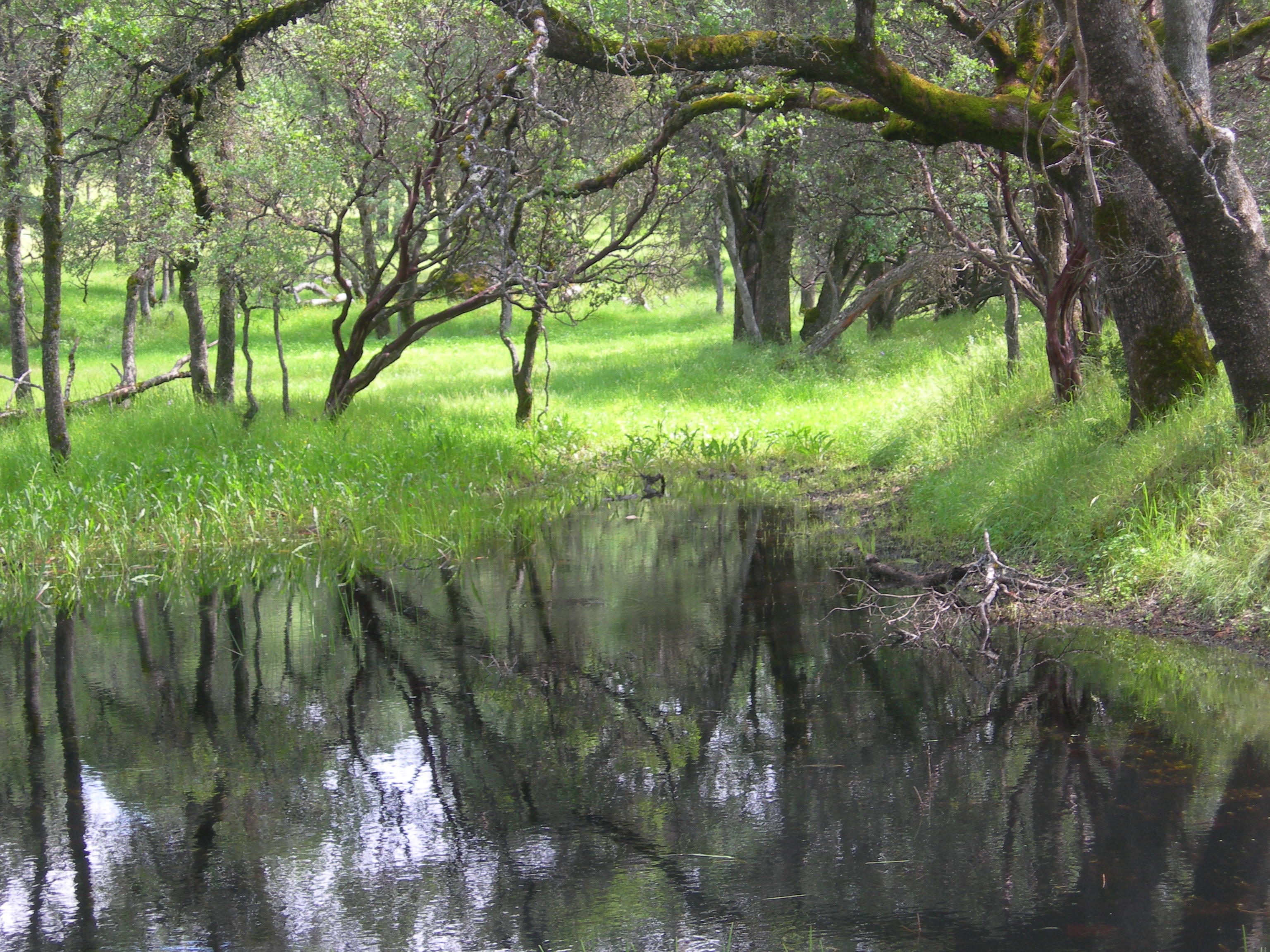
dscn4753This is a vernal pond, a few miles from my home. It will fill with water by Christmas and be dry again by Easter.

Let’s take a break from the world of politics and check into the latest meteorological phenomenon.

It rained last night.

That may not be a big deal to you, but here in the foothills of the Sierras it represents the change from one season to another in a climate that only has two seasons – dry and wet.

Our last rain came in mid-April. Six months without a drop. You may have heard that we are in a drought, but this is a different phenomenon. It is normal here for the last rain to come in mid-April, and normal for the first rain of the rainy (if that is the word) season to come in mid-October. Our drought is because we haven’t been getting enough rain between October and April.

So what does that have to do with my world of writing science fiction? Everything, really.

When I was young, my three favorite SF authors were Clarke, Heinlein, and Norton. Clarke’s stories always took place in artificial environments. Heinlein’s characters inhabited space ships, orbiting habitats, or frontier worlds; it didn’t matter, as long as they could talk incessantly, they were happy. Andre Norton characters, whether they were explorers, soldiers, spies, or interstellar traders, always spent their time outdoors, in wilderness or something like wilderness. The only cities you were likely to see in a Norton novel were in ruins, or the slums of the Dipple which any one of several young men were quick to flee from, usually into more trouble than they could imagine.

That suited me just fine. Her worlds were my world. In rural Oklahoma, I spent from May to September every year outside, usually driving a tractor, through rain, wind, dust, and heat. There were years when I watched the crops dry up and die under the relentless sun – and watched my Dad see six months work disappear before his eyes. There were other years when the rains came on time, the crops were good, and the pastures grew up heavy with grass; when the nights were a symphony of insect whirrings and the days were filled with bird songs and butterflies. Cliché? Paradise always sounds like a cliché.

It was the only life I knew, and I loved it, good years and bad, but I had to leave it, first for college, then to make a living. When I wrote my first book, I sent my protagonist into the mountains and lost him there, then let him find his way out. For my second book, Jandrax, I marooned a shipload of colonists on a barren, unexplored world, and watched them find a way to survive. In Cyan, coming out in a few months, I send a crew of ten to explore a rich new planet, then send them back to colonize.

I lived in a small city for most of my life. I could write about cities, but I don’t want to. My world is the world of nature –  even if it is nature on another planet.

So— it rained last night. About an inch, which isn’t much, even by Oklahoma standards, but the foothills only get thirteen inches in an average year. All the creekbeds remain empty and the hills remain covered with tall, dead grass in shades of brown, but within the soil, the change has begun. Seeds that have lain dormant since spring will be sprouting now, out of sight, and within a week there will be a faint haze of green, invisible beneath the long grass, but showing in the road ditches. This year’s grass will begin to flex its vegetive muscles, forcing its way upward through last year’s dead roots. Unnoticed, those roots will begin to loosen and be shoved aside until one day, a month from now, seemingly all at once, the old year’s grasses will tilt and fall, to disappear beneath the new green.

Suddenly all the brown will be gone and the new year’s grass will clothe every hillside. While the snows of winter cover the midwest, these Sierra foothills will be spring green, and the wildflowers will return.

234. Revisiting Columbus

A year ago today, I was anticipating a January 2016 release for my novel Cyan. Since Columbus had a brief appearance there, I published an excerpt on Columbus Day as a teaser. The novel’s release has been delayed, and very few people were reading that early in the blog’s history, so here is a reprise

*             *             *

Poor Columbus; he has taken a beating over the years. We don’t see him for what he was, with all his strengths and weaknesses, but through the lens of our own times. Here is a picture of how we might view him a century from now, when we have had to change our calendar to meet the demands of the rest of the world.

Anno Domini
A Latin phrase meaning the Year of our Lord.

Before sunrise on October 12, 1492, Anno Domini, a lookout for Columbus’ expedition sighted land. Columbus had found two new continents (although he did not know it), following his own powerful vision of how the Earth was constructed (a vision that was wrong), and began a five hundred year reign as king of explorers.

Half a millennium later, Columbus was dethroned. Even school children were now being taught that Columbus was not the only one who knew the world was round. Sailors and scholars had known that for hundreds of years before him.  Columbus’ great vision was that the Earth was small, and in that he was wrong. By the late twentieth century, it was certain that the Vikings got to America first, likely that St. Brendan beat Columbus there, and there were a dozen other putative explorers who had their champions.

Besides, American popular thought was in one of its Noble Savage stages, and it was politically correct to echo the Native Americans who complained that Columbus was a destroyer of races and cultures.

But even at the height of Columbus bashing, it was apparent that his voyage had differed in one significant detail from the other explorers who had preceded him. After Columbus, America was never lost again. After Columbus, and those other explorers who sailed close on his heels, the Earth became entirely known and entirely interconnected for the first time.

*****

In the year A. D. 2037 (as Christians measure time), at the Conclave of Mecca, the Islamic world announced that they would no longer recognize, speak with, acknowledge, or deal with any person, nation, or document which forced them to use a calendar based on Christianity.

At the International Bureau of Weights and Measures Convention in Buenos Aires two months later, a new calendar was established, based on a sidereal year. It would have neither weeks nor months since Islam and the rest of the world could not compromise on the issue of lunar months. It could not start at Jesus’ putative birth, nor at Mohammed’s, and it quickly became apparent that the new Standard Year should date from the midnight preceding the day the Earth became one planet for the first time.

This whole Standard Year business came about by accident. When I wrote Jandrax thirty plus years ago, I had no idea that I would write other stories in the same universe. After all, I stranded all those poor people so far out that no one would ever find them.

However, I began wondering what circumstances, beyond what I had already written, might cause Dumezil to invent his pan-Earth religion, and I wondered what Jan Andrax’s ancestors were like. That led me to make Stephan Andrax, Jan’s multi-great grandfather, spaceside commander of the Cyan expedition.

In Jandrax, I had pulled the date Standard Year 873 out of thin air. Now I had to backtrack and make it work for Cyan, which I did my making Standard Year Zero start with Columbus’ discovery of America.

233. Yearbooks Farewell

In an early science fiction novel/novella (A Fond Farewell to Dying/To Go Not Gently), I gave my protagonist a twenty year gap in his memory. To fill himself in on the events he missed, a friend of his suggests reading encyclopedia yearbooks, one by one.

It was a bad idea on two fronts. Shortly after I wrote that suggestion, Wikipedia drove paper encyclopedias out of business, and yearbooks were no more. My story was set a couple of centuries in the future, and long before we could get there, the immediate future had bit me where it hurts.

Even if that had not happened, it was a bad idea to trust yearbooks, as I found out when I tried it myself. I was planning to plot out a novel set in the sixties, so I accumulated yearbooks as a starting point for research. They were useless, and I kicked myself for not having realized in advance that they would be.

Almost everything the editors of the 1966 yearbook thought was important, turned out to be forgettable by the eighties. The important trends of that era only became obvious in retrospect.

1989 was like that, too. It was a pivotal year, but I missed it while I was living it.

I was alive, awake, and alert in 1989. I had recently returned from spending two summers in Europe. I was writing a teacher novel, and planning the novel Raven’s Run (now being posted in Serial), but I missed 1989’s significance. I didn’t really come to appreciate it until decades later when I was preparing to bring Raven’s Run up to date.

Basically, the cold war ended and the modern era began in 1989. When I realized that, I nudged Raven’s Run into that year so I could add a few events that I had missed when they happened, and set myself up for sequels.

I wrote a bracketing event, a meeting between Ian Gunn and a friend in Luisanne, Switzerland in 2012, where they are revealed as spies, or something like. (Raven’s Run 1) This leads to reminiscence and Ian begins to tell his friend of events that took place in 1989 – which becomes the novel.

I dropped these words into chapter 2:

It was April.  Ayatollah Kohmeni had a few months left to live, and no one had yet heard of Osama ben Ladin.  There were still two Germanies, two Berlins, and a wall; I had had my dealings with that wall a few years earlier, in uniform, when the cold war was even colder.

When I wrote chapter 2 in the mid-nineties, there were “two Germanies, two Berlins, and a wall”. I didn’t have to tell anyone. Not then – but posting Raven’s Run today, it has become necessary to remind my readers.

1989 was a pivotal year. If you don’t remember, or you weren’t born yet, take a look at Thursday’s post.

227. Mentors in Detection

“We are like dwarfs sitting on the shoulders of giants.”
             John of Salisbury, Issac Newton, and a million lesser lights attempting false humility.

What pen name? What market? What can we steal? . . . Correction. Not ‘steal.’ If you copy from three or more authors, it’s ‘research.’”
               Robert Heinlein, Time Enough For Love, and in a half dozen other novels in almost identical words.

There is very little in this world that is new and unique. We all borrow from those who went before. Some people borrow from giants, some borrow from pygmies.

Some people borrow from Shakespeare and screw it up royally. Some people borrow from third rate writers and turn the result into something memorable. But we all borrow.

I have made no secret of my mentors in science fiction, first Andre Norton, then Robert Heinlein. I write only a little like Norton and nothing like Heinlein (I would pay real money for his touch with humor.) Nevertheless, they both live in my head, all the time.

There are a thousand other authors whose work has moved me, but Norton and Heinlein got there early. Only Harold Goodwin (John Blaine) and the Bible got there sooner.

Over in Serial, my novel Raven’s Run is being serialized. It is a “men’s adventure”, a genre that is no longer recognized. In modern parlance, it would probably be classed as a thriller, although the tension level is really too low for that. It is also something like a detective novel, but not much. Genres today are so small and tightly defined, that RR crosses several of them. It resembles the Travis McGee books in that way.

In connection with mentors and influences, I will be covering three detective series next week along with one spy novel. McGee was a real influence on my writing. The two Fathers taught me a few things, but they are basically just stories I like. I’ll explain the Shrike when I get there, next Thursday.

Detective literature started with Holmes, both in the world at large and in my reading. I read him when I was in high school, and I still do, occasionally, although it is harder now that I can lip synch all the stories. I didn’t read other detective stories – or Westerns for that matter – until I was writing science fiction and fantasy full time and needed something to cleanse my mental palate between writing sessions.

McGee was by far the best and most influential. I’ll talk about him next Tuesday. Dashiell Hammet never appealed to me, but Raymond Chandler was superb. Robert Parker’s Spencer was great for the first ten books while he was imitating Chandler; after he started imitating himself, they went down hill fast. I enjoyed Chesterton and Greeley enough to give each his own post next week.

Quite a few of the authors who come to mind were actually writing spy stories, like the gritty early James Bonds before they degenerated into farce.

There were authors with a few books whose work stuck with me. E. C. Bentley’s Trent’s Last Case was worth reading. So were the few Bertram Lynch mysteries by John Vandercook. That particular series was a recent discovery, in ancient, battered copies at my favorite underfunded library – you know, the one that never throws away a book. Rex Stout’s Nero Wolfe is the series I am working my way through now, since I have read the covers off all my previous favorites.

To be certain that I didn’t forget any old friends, I went through several “best detective authors” lists on line. There I found Alistair MacLean (author – under a pen name – of The Black Shrike) and John Buchan. I would not have called them detective novelists, but they are among my favorites.

Not every detective lives in contemporary England or America. I fully enjoyed the five or six Cadfael novels I read before the spell wore off. I own and frequently reread every Judge Dee book, and Bony (Napoleon Bonaparte), the half aborigine Australian detective is very nearly my all time favorite.

226. Cyan is Not Forgotten

I’m not complaining, honest.

Publishing is a strange business, and you couldn’t pay me enough to be an editor. Still, I haven’t mentioned Cyan since May ninth, and that is a problem.

I started this website about a year ago in support of Cyan, which had been accepted for publication as an e-book. Not self published, which offers no guarantee of quality, but published by EDGE, Canada’s premier publisher of science fiction, fantasy, and horror.

So what happened? Nothing very terrible, or very unusual. The editor who was handling EDGE-lite, as they call their e-books, decided to work full time elsewhere. I would guess from the vagueness of some emails I received that this decision took a while to make. I don’t know any details, and I wouldn’t give them if I knew. I’m not a fan of gossip. Anyway, the handling of my book has changed to a new editor, and that always leads to delay.

I finally got the word of what had happened in July, from Brian the publisher.

I am writing this on September fifteenth; I have mentioned before that I hate deadlines, so I try to have my posts ready well in advance. I expect word soon on what will happen next, but I can’t wait any longer to comment.

I have followers who have been with me for over a year, and new people who drop in every day. The former have probably been wondering what happened, and the latter have never heard of Cyan. So here goes.

Cyan returns to the style of science fiction in which the restrictions of relativity were exploited as plot elements. It gives a full picture of the exploration and colonization of one planet through the eyes of characters who are somewhat larger than life, in a tone designed to attract the general reader as well as hard core SF fans.

The story begins en route to the Procyon system on board the starship Darwin with her crew of five men and five women, and details their explorations. The planet they discover, Procyon A III – Cyan – stands straight up in orbit, with no inclination and no seasons. It has bands of unvarying temperature, from burning desert at the equator to permanent icecaps. Near 40° latitude is a broad band of eternal springtime.

Just as the explorers are falling in love with Cyan, they discover a group of creatures who have the beginnings of intelligence and culture. For the first time, Man has encountered a truly sub-human species. They call the creatures Cyl. Viki Johanssen, their anthropologist, recommends denying colonization to protect them, but Keir Delacroix, the crew leader on whom the novel focuses, will not endorse her proposal. 

The remainder of the book deals with this conflict and much more.

This is the first part of the summary I sent EDGE; I have chopped the last 342 words to avoid spoilers.

Scattered among the last year of posts are discussions of and excerpts from Cyan. You could go to the tag cloud, but it wouldn’t help much. The earlier posts were not tagged (I was still learning how to do a blog) and many of the later ones bear mention of Cyan without being primarily based on it.

I could bring you an annotated index of Cyan posts, as I did for early posts at 212, or I might recycle them. It all depends on when Cyan is going to be published.

Cyan is not forgotten. Stay tuned.

220. Planets in Motion

planet story stick 5

Two hundred posts in a little under a year is something of a milestone. What began as an attempt to generate readers for my fiction has almost become a way of life.

I had planned to place this non-writing post as number 200, in celebration, until scheduling issues got in the way. You see, writing a blog isn’t the first activity that I began for the sake of my fiction — which then went on to take over my life. In the early eighties it was clear that I wan’t going to make a living writing novels, and needed a day job. I began working as a substitute teacher to earn some extra money. I was strong, loud, and male so they sent me to middle schools. Substitute teachers don’t like middle school. If you think back a bit, I won’t have to tell you why.

Maybe I’m odd, but I thought the kids were a hoot. I told the dispatcher that I actually liked middle school kids, and suddenly I had full employment. After a year, I went back for my credential (I already had two masters degrees) and got a job at one of the small rural middle schools where I had substituted. I taught there for twenty-seven years, mostly science.

It was an underfunded school and I was a carpenter, so I built a lot of my own science equipment. I shared some of that in posts 201 and 202. A lot of the curriculum sent down from the state was crap, and I was a writer, so I wrote a lot of my own material. I had less hassle from the bosses than most of my friends because good science teachers are hard to find. Ones who aren’t just biding their time, waiting for a chance to move on the high school, are even more rare.

I kept on writing, but at a reduced output. It wasn’t how I had planned my life, but it worked. I once figured out that about 4000 students passed through my classroom during my tenure. I’m proud of that.

Now that I’m retired, I am writing this blog and its sister blog Serial four days a week. Now that’s a day job. This post provides the details about the last big project I built for my science classroom. Pass this on to your science teacher friends.

From this point on, things get technical. If you are a planet geek or a DIY person, you will probably enjoy the details, even if you don’t need the product. Maybe you could make one for your kid’s school?

*****

You can show the scale of the solar system with a model you build yourself (see post 202), but showing how the planetary orbits interact with one another takes some time. I figured out how to do it near the end of my career by building a poster that changed over the course of a school year.

You need a piece of hardboard, 6 ft by 6 ft, 1/8 inch thick, a pint of black or blue-black paint, four tubes of artist’s acrylic (pale gray, blue, green, and red), a one-inch brass drawer pull, four foam daubers, (half inch diameter foam cylinders attached to the end of a dowel, used for laying down stencils), and a measuring device you will have to make yourself.

You find the center of the hardboard poster by running lines from corner to corner; they cross at the center. There you drill a 1/8 inch hole and feed the bolt for the drawer pull from the back. Add a matching nut on the front, tighten, then add a drop of Super Glue to keep things from moving. After you paint the board black or blue-back, spin the drawer pull onto the bolt to represent the sun.

For the four colored circles which will represent the inner planets in their initial position, you will need to go to the website www.theplanetstoday.com. Use the double headed date arrow at the top of the page to chose the date of your initial array. Use the measuring device (building instructions below) to establish each distance from the sun and, referring to the website, make your best visual estimate of where to initially put each planet on its trip around the sun.

At the outset, it won’t look like much, but every week you will add another four dots. By the end of the year Mercury will have circled the sun more than twice, Venus nearly once, Earth about eighty percent of the way, and Mars will have moved a fairly short distance – given the length of a typical school year. I put on new planet circles every Wednesday, since Wednesday almost never has a holiday.

Your students will soon have a clear picture of how the planets move in relationship to each other. When Venus is visible in the west at sunset, or in the east at sunrise, or is not visible at all in the night sky, your wall chart will show them why – assuming that you explain it to them, and keep them at least somewhat excited with assignments like, “What is that red dot in the sky, half way up from the eastern horizon at eight o’clock tonight?”.

The measuring device you will build allows you to place additional planet-circles at the appropriate places for subsequent weeks. It has a single 1/8 inch hole at the left, and eight larger holes. Once a week you will remove the drawer-pull-sun and put the small left hole over the bolt. Place the initial Mercury-hole over the previous week’s Mercury circle and put on a new pale-gray circle into the other Mercury hole, using a dauber. Repeat for all four planets —Mercury pale gray, Venus blue, Earth green, and Mars red. Replace the sun drawer pull and  you are done for the week.

planet story stick 3To build the measuring device, begin with a piece of hardboard 36 inches wide and seven inches high. Draw a line about 1 1/2 inches above the bottom and parallel to it. Clearly mark a point on the line about 1 inch from the left side. This will locate the sun-hole. When all further measurements have been made, an 1/8 hole will be bored at the sun-point and 5/8 inch holes will be drilled at the four pairs of planet-points. Don’t drill anything until all nine holes have been marked accurately.

So far, I have used feet and inches since we have been talking about carpentry. The rest of the dimensions will be in millimeters.

On the base line, measure 215 mm from the sun-point and put a point for Mercury. Continuing on the base line, and still measuring from the sun-point, put a point at 402 mm for Venus, a point at 557 mm for Earth, and a point at 848 mm for Mars.

Each planet needs a second hole, the distance between the two representing the distance the planet moves in one week. For me, these required four radii and four calculated angles. I have simplified (honest, it’s simpler) by giving dimensions above (perpendicular to) the base line, and back toward the sun (parallel to the base line).

For Mercury, this will be 104 mm up and 26 mm back toward the left.
For Venus, this will be 78 mm up and 8 mm back toward the left.
For Earth, this will be 67 mm up and 4 mm back toward the left.
For Mars, this will be 53 mm up and 2 mm back toward the left.

These twin dimensions place the pairs of planet-points at two points on a correctly dimensioned circle, representing the orbit.

Drill the sun hole 1/8 inch to match the bolt holding the drawer pull. Drill the eight planet points 5/8 inch to allow clearance for the 1/2 inch dauber. The outline of the measuring device can be trimmed down to any convenient shape, as long as it encloses all nine holes.
217. Interview, by G, part 2

There must be a thousand Democrats that would make a better president than Hillary, and a hundred thousand Republicans who would make a better president than Trump. That line is from yesterday’s post. Since this is part 2, you really should read part 1 before continuing.

G.: “If the choices are so unpalatable, would you choose one anyway?”

Leap: “Choice isn’t really the word. I would vote for Hillary if I could, but since I’m on the run from the media, there is no way I can get within miles of my polling place.”

G.: “You wouldn’t vote for a write-in, or a registered third party?”

Leap: “Third parties never win. Third party candidates don’t expect to win, they are just using the election to make a statement about their beliefs. If a third party candidate won, it would scare hell out of him. Just like me.”

G.: “So you don’t really like Hillary, you think third parties are throwing away your vote, and you don’t want the job. So why not Donald Trump?”

Leap: “The wall. A million reasons, but most of all, the wall.”

Leap continues: “Let me tell you a story. I worked as an engineer all my life. The company I worked for built farm equipment. Once, they sent me to California for a few years, to a plant near Salinas.

“There weren’t any undocumenteds in our facility, although more than half the staff were Mexican American. Several of them became my close friends, and they are the ones who opened my eyes to the facts.

“I spent a lot of time in the field, watching the equipment we built being used. Everywhere I went I saw swarms of migrant farm workers. Mexicans – that’s what everybody called them. Whether they were Mexican American, legal immigrants, or illegal immigrants didn’t matter. Mexicans. I saw how hard they worked and under what terrible conditions. I saw the shacks they lived in, and it didn’t seem right. It didn’t seem American.

“I asked my Mexican American friends back at the plant and they explained. Farm workers live in fear of immigration officers. Even the ones who are here legally know a whole community of those who aren’t, or at least are on the borderline of legality. Children who were born here, American citizens, live in fear that their parents will be deported.

“It makes them pliable. Deportation is a whip in the hands of their employers.

“A wall – what a joke. We have a wall. It doesn’t stop the hungry, because it isn’t supposed to stop the hungry. It exists to let workers through, and then remind them that if they step out of line, they will find themselves back on the other side.

“America couldn’t survive without a wall that lets through workers who will be silent and docile and work for slave wages under slave conditions.”

*****

Foolish Leap. He set up the interview to show how much he didn’t want to be a write-in candidate, the made the mistake of letting his passion show. He made the mistake of making sense, in a world that is hungry for sense, so of course he made his own life worse.

The interview galvanized the nation. Leap’s anti-candidacy went from being a curiosity to being a real alternative. New websites sprang up everywhere, along with tweets by the hundreds of thousand, and even a dozen fake Facebook accounts.

The biggest of them all was hashtag #Leapthewall. Commentators were forced to search for a new term to replace “went viral”. Viral didn’t do it justice.

And Leap went back on the run.

216. Interview, by G, part 1

If you are new to Leap’s plight, you can catch up at 178. Leap Boy, back in the news, 192. Billy Joe Takes a Leap, 200. The Last Sane Man and 203. Leap on the Bandwagon.

Leap Alan Hed is on the run, not from any crime, not from angry criminals, but from the insatiable news media. When Billy Joe Barker proposed him as a write-in candidate for President, they descended on his house and he fled. Now a couple of weeks have passed.

He went north at first, toward the Canadian border, but he couldn’t find a way to pass over without being spotted. He turned south-west and tried to lose himself in the Rockies, but things have changed there, too. Where every cirque and valley used to be filled with old-time prospectors, broken down cowboys, and overly hopeful hippies, now every mountaintop is capped by a mansion with a movie star living inside.

I’m not sure where he went after that. He didn’t confide much to me, and after the paranoia set in, I don’t know how much of what he said was true. Being on the run will do that to you.

The media was hot on his trail and they have almost infinite resources. They would have found him in no time if they had cooperated. Instead, they guarded their sources, set misinformational rumor afoot, and generally got in each other’s way.

Leap stayed one step ahead of them, but it wasn’t a life worth living. He finally decided to give an interview to satisfy the world’s curiosity, and get everyone off his back. Poor fool. Giving one interview was like the old story of the man who reached for a bucket of water to put out a fire, and found out too late that it was gasoline. But Leap was an innocent, and innocents are doomed.

He wrote a letter to G. at —BC news, proposed a time and place. They met in the home of a distant relative (who was himself harassed for the next three weeks).

*****

G. spoke to the camera, briefly outlining events to date, then asked, “Why did you run and why have you agreed to this interview?”

Leap described the siege of Dannebrog, and some of the things that had happened since, then said, “I’m hoping that telling my story will convince the American people that I am not someone they want to write in for President, and that I can just go home and get my life back. That would be a miracle.”

G.: “I’m not sure that is a miracle we can provide, but go ahead, tell us why you think Americans have become so fascinated by your candidacy.”

Leap: “I’m not a candidate. I’m not running for President. I’m running from President.”

Foolish Leap. He still didn’t understand the phenomenon he had become. Those three words – Running From President – which his farmer friend had said in Grand Island, became the stuff of a thousand headlines and a million tweets.

G.: “Why do you think America has embraced your non-candidacy, then?”

Leap: “Look at the alternatives. We have three hundred million people in America, and this is the best we can put up for President? There must be a thousand Democrats that would make a better president than Hillary, and a hundred thousand Republicans who would make a better president than Trump. But I am not one of them.” The interview continues tomorrow.

212. Old Posts Retrospective

I would have preferred to post this last Wednesday, one year after the first posts on this website. However, the introduction of Raven’s Run over on Serial took precedence.

I did some of my best post writing during that early period when no one was reading. Everything was fresh and new, and I was introducing myself for the first time. I reposted a few when it was appropriate, particularly in March of 2016 when I began Jandrax over in serial, but most of those early posts are still unread by those who are with me today.

Eventually, I plan an annotated index of all posts, but for now, here is a partial version so you can dip into the past if you want.

2. Turn Left at Chicago – How a fortuitous failure set me on the road to writing.

3. It Was 40 Years Ago Today – The act of sitting down to write a first novel.

6. Planet Oklahoma (1) – From birth to my first encounter with a library.

7. Planet Oklahoma (2) – A library changes my life.

9. Old Libraries – Old libraries, old books, and re-reading.

10. Book Words – Being the only person who reads

11. Why the Tractosaur Wouldn’t Go – Hearing and speaking Okie.

12. Why Okies Can’t Use the Dictionary – Mispronunciation guides.