Tag Archives: steampunk

437. Steampunk Clockwork

A great deal of the charm of typical (if such a thing exists) steampunk is that it replicates the sense of wonder of early science fiction, something that is missing 147 years after its beginnings. My math refers to the publication of Twenty Thousand Leagues Under the Sea in 1870. There have been a lot of stories in that century and a half, so it is just a little hard to come up with something new.

Fortunately for science fiction, there is a new crop of readers every generation. Things that seem old and overdone to long-time readers, seem new to them. When I first saw Weir’s The Martian I thought, “Again?”, but a half million readers on Goodreads rated it highly.

In old fashioned science fiction, the hero could do anything. And therefore, so could the reader.

Among that “anything” was a world of inventions that any boy genius could whip up in his basement. When I first read Tom Swift and his Electric Rifle (published 1911; it was left behind by my grandfather and I found it in the early fifties), Tom was just putting the finishing touches on his electric rifle, but before he headed for Africa with it, he whipped up a new flyer which was half aeroplane and half dirigible to use on the trip. Easy; any boy wonder could do it.

I haven’t seen that schtick since I was a kid in the fifties, and then it was usually in books from the thirties. I think we can blame Apollo. We all saw an entire nation spend a decade of time and billions of dollars to get to the moon. Thousands of workmen (and women) in all parts of the nation made the billion parts it took to undertake a moonshot. It no longer seems possible, even in science fiction, for Sheldon to build a moon rocket in a shed out back of the house.

When I was a kid, if I wanted to build a robot, it would have been made from tin cans, old sewing machines parts, and imagination. Now kids can build real ones (if their parents have enough money) out of plug and play components. Is that better? Is it worse? Decide for yourself, but it is different in a fundamental way.

It is all part of the digitalization of the world. And no, I’m not complaining. I’m writing this while sitting in front of a computer that makes my present life not only better, but possible.

Let’s hop into our time machine and watch it all happen. Let’s make it an even century.

In 1917, if you wanted to listen to the radio, the first thing you would do was build one, out of wire, a variable resistor, a capacitor, an appropriate piece of crystal, and a set of earphones. If you were really ambitious (or more likely, really poor) you could build the variable resistor and the capacitor as well. Everything would be in plain sight there on a pine board in front of you.

The next step was tube radios (that’s valve radios in the land of Britain). Tubes were an offshoot of incandescent light bulbs with more parts inside. Like light bulbs, you could see everything through the glass casing. Things had become more complicated, but you could still see the parts and follow their wiring.

Televisions worked like this as well, and as late as my childhood, hardware stores had a device with hundreds of sockets on top where you could plug in a tube from your TV or radio and check to see if it was burned out. They burned out frequently. If it was bad you could buy a replacement right there and fix the radio or TV yourself.

Then came printed circuits. You could still follow the wiring, but you had to turn the board over and look at the back side.

Then came transistors. They took the place of tubes, but they were tiny, anonymous nuggets with three wires and you could no longer see what their guts looked like. It was the beginning of major progress, and the beginning of the end of understanding.

Finally, integrated circuits arrived, and now you could no longer see the parts or the wires that connected them.

Now if something breaks, you throw it away. That isn’t really a problem, because things are cheaper, and the replacement is usually better than the thing discarded. In terms of practicality, things are better than ever.

In terms of understanding how our machines work, much has been lost.

But steampunk brings it all back. (more Wednesday)

430. The Rocket’s Red Glare

from Congreve’s original work.

“Oh, say can you see . . .”

No, this is not going to be about the NFL. It’s going to be about the rockets which figure into the anthem, into history, and into the steampunk novel The Cost of Empire, which I am now writing.

Rockets got their start in China, where they were used as fireworks and as military weapons. Just keep that in the back of your mind. We are going to start in the present and move backward in time, but not all the way to China.

When the average American sings the Star Spangled Banner — or mouths it, since it is a hard song to sing — it is unlikely that the image in his mind looks anything like the rockets which actually burst in air over Fort McHenry. My generation has V-2 rockets in our DNA, largely because early SF films used actual films of V-2 rockets as stand-ins before special effects were perfected. A later generation has Saturn-V rockets imprinted on their brain. To both, rockets are pointy ended cylinders with the flames coming out of the bottom.

Not so in 1814. The rockets that rained down on Fort McHenry looked more like fireworks rockets. They were called Congreves and a page of drawings of them is given at the top of the post. Some were explosive tipped. Some were parachute flares, which “gave proof through the night that our flag was still there.” All were guided, more or less, by a long stick that acted like a rudder, similar in function to the fins on a V-2.

They were nothing like accurate. That was the way of things before modern times. If you recall the battle of Agincourt in the movie version of Henry V, the English longbow men drew back together and fired hundreds of arrows simultaneously at a high trajectory, which rained down en masse on the French. The battle of Hastings was lost when King Harold Godwinson looked up at a bad moment and caught such an incoming arrow in the eye. Muskets in that era were also nothing like accurate, so lines of musket men firing together in the same direction managed to hit somebody, but probably not the targets they were aiming at.

William Congreve (not the playwrite and poet) gets credit and naming rights for the Congreve rocket, and he did make improvements, but his work was based on rockets captured in India.  Which brings me to why I’m writing this post. Here is a quote from The Cost of Empire. An Englishman who has gone native in India is speaking:

“About a hundred years ago this whole region was called Mysore and Hyder Ali was in charge. He fought the British and all the Indian princes around that kept shifting from the British side to his and back again. After he was killed, his son Tipu Sultan took over and formed an alliance with the French.

“It’s an old story. The same pattern happened all over India, as we British took over one region at a time. But this story has a kicker. Rockets.

“Rockets came from China. Everybody knows that, but they were widely used in India as well. Hyder Ali and Tipu Sultan used them extensively; some of their rocket brigades had over a thousand men. Rockets were made that exploded, that set fires, and even that had sword blades attached so when they came down spinning, they made a bloody mess of British ground troops.

“When the Mysore wars were over, the winners sent hundreds of captured rockets back to England. Congreve studied them and replicated them. The Congreve rockets we used all throughout the Napoleonic wars were just English versions of what Hyder Ali had used against us.”

The old guy is telling this story because a group calling themselves the Sons of Hyder Ali have built an arsenal full of rockets. They have bad feelings toward the British and a plan concerning the flotilla of dirigibles our hero is serving on.

I would tell you more, but that would be a spoiler.

426. The Five Plots of Time

It is a dubious tradition to produce articles like The Three Basic Plots of Fiction, or The Four Kinds of Traditional Hero. I’ll add my bit, even though I’m dubious myself.

The Five Master Plots of Time Travel Stories

This grouping came out as I was thinking about The Map of Time. Time travel has a long and tortured history as a set of concepts hung uncomfortably between science fiction and fantasy. None of it makes much scientific sense, although I do read a lot of actual (?) scientific theory which demonstrates that even scientists can waste their lives reading too much SF. It would make more sense to simply call all time travel stories fantasy, but they always require a time machine, so they must be science fiction — more or less.

Then again, Einstein would hate FTL stories. They violate relativity, but that doesn’t keep me from reading and writing them.

Let’s just tackle this mess in the spirit of fun.

Master plot #1.     A man tries to change history and fails. He is doomed to failure, no matter what, because the past can’t be changed. The entertainment in this kind of story is in making the reader think the hero will succeed, and fouling him up at the last minute in some clever way.

Master plot #2.     A man tries to change the past in some logically forbidden way. The classic form would be that our hero goes back to kill his father before our hero is born. The stars go out; the universe ends.

I am not fond of this form. It’s too much too simple. Perhaps a good writer could make it work if we know that the victim-to-be is the hero’s father, but the hero does not. (Shades of Oedipus!) Then we would anticipate that this is a type one story, and be taken by surprise when the hero succeeds and the stars go out. That might work, but I doubt it.

Master plot #3.     This is a variation on 1 and 2. A man tries to fix a tragedy by going back in time, but instead makes things worse. This is just a variation on the notion that, “You can’t make the world better, and you shouldn’t try. Just accept your fate.” Literature is filled with this Christianity based defeatism, epitomized by The Monkey’s Fist.

The Greeks called it hubris. I don’t buy it. For me, a man without hubris isn’t much of a man.

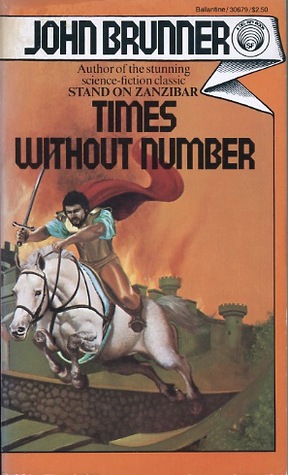
Master plot #4.     A man is in a world different from ours. He tries to change the past, succeeds, and his world morphs into the “real” world, i. e. ours. If the reader accepts that he is reading an alternate timeline story, and is taken by surprise by the ending, it can work. Brunner used this bit in Times Without Number, but that novel had enough quality to succeed even with a different ending. Zelazny did a beautiful variation in the short story The Game of Blood and Dust.

Master plot #5.     A man tries to change history, but instead creates a new timeline, or crosses over into an existing alternate timeline. This isn’t a trope; it’s a genre. Alternate timelines can be wonderful, but they are often cheap knock-offs, based on the notion that you don’t have to create anything, you just rearrange what already exists.

They aren’t even time travel stories, unless someone moves from one timeline to another. Pavane is an alternate timeline novel, but not a time travel story, since every actor in the novel remains tied to his own timeline throughout, and is never even aware of the existence of any other.

Okay, I will admit that any bright twelve year old could invent more plots, or could knock holes in these. I present them merely as a mental exercise — a fourth dimensional Rubik’s cube — for your amusement.

Have fun arguing.

425. Goodreads as Textbook

I bought The Key of Time several years ago from E. R. Hamilton’s, my favorite purveyor of remaindered books. It looked and sounded good, but so did the half dozen others that came in the same order. I put Key aside and it stayed in my to-read pile until I became immersed in Steampunk. It seemed to ooze Steampunk, so I dove in.

I planned to review it in this blog. You saw the results on Monday in post 423. 85 Pages: a review, so named because I couldn’t get past page 85.

That got me thinking about Goodreads. I’ve only been involved with Goodreads for about a year and a half, but I am impressed by the intelligence of most of the reviews. Since I discovered it, I have treated Goodreads almost like a textbook on what intelligent readers want.

Here are Goodreads’ stats on The Key of Time by Felix J. Palma, translated by Nick Caisto:

10289 ratings                2127 reviews                rating 3.37 out of  5

That’s a lot of ratings and reviews. Many Goodreads books have almost none. The 3.37 rating is fairly normal. It’s hard to find a book on Goodreads that doesn’t garner mixed reactions.

I decided to pick a few Goodreads reviewers who agreed and disagreed with my take. Here are some examples — or rather excerpts, for the sake of space and so I don’t step on anybody’s copyright.

Traci said, It was amazing.

. . . Do you enjoy magic tricks even though it’s all sleight of hand? . . . I loved every moment I spent with this new and talented author.  . . . one of my favorites, of the year. Beautifully written.

Did Palma get his act together after page 86? Were the last 524 pages better than what I read?Did I miss something?

Frances seemed to think so, with some reservations.

Frances said, (I) really liked it.

. . . I was beginning to wonder if I wanted to continue. At times I groaned (but it). . . . soon became compelling enough to finish. When I finally read the last page . . . I (was) . . .  pleased to have read such a creative and unique book.

I have to admit that I also felt compelled to continue as well, despite the insipid “hero” and glacial pace. It reminded me of all the times I’ve tried to read Dickens’ longer books. But this isn’t Dickens. It’s more like pretend-Dickens. For me it was finally more irritating than intriguing.

Velma said, (I) did not like it. and recommended the book for “someone willing to edit it, heavily.”

Time travel! Jack the Ripper! Automatons! What’s not to love?!? Well, as it turns out, almost everything. . . . it took every ounce of stick-to-it-iveness I could muster to get through this convoluted, interminable literary maze. WHERE, I ask you, was the EDITOR in this hot mess? . . . (Palma is) a decent, if grandiose, storyteller and he mimics to perfection the florid style of the period he set this novel in . . . But come on, Félix, enough with the meandering, the inconsistencies, the convenient last-minute reprieves . . . I was all set to love this book, what with it being about the re-writing of the history of the earliest science fiction and all, but it wasn’t to be . . .

Velma pretty much sums up my reaction. If you look at her whole review on Goodreads, she is even angrier than this excerpt shows.

What is the takeaway? About Goodreads, that is. I’ve had my say on Palma.

Goodreads won’t tell you if a book is good. It will tell you all the different things readers think about it. And that is its value — many looks from many directions. I will continue to check it out, after I read something. Whether I love a book or hate it, I always learn something from Goodreads reviews, even it is is just public taste.

419. Airship Flamel

As I mentioned previously, I found To Rule the Skies: An Airship Flamel Adventure when its author, Michael Tierney, liked one of my posts and I went to visit his website. I bought it as an eBook, which is an adventure in itself. I read eBooks on my desktop Mac. Things that come through iBooks work fine, but the Kindle download is a piece of crap. As you read, it jumps to a new page every few seconds without any input from the user. The only way to successfully read is with your finger lightly on the mouse, and that only works part of the time. This is particularly irritating since the old Kindle download worked fine.

Let me say at the outset that I loved this book. It was a hoot. However, I’m not sure how many of you will feel the same. It probably depends on your vision of what steampunk should be.

To Rule the Skies reminded me of the books I read when I was a kid back in the fifties. Then books were straightforward, violence was muted, and nobody had any literary pretensions. Irony was unknown.

You couldn’t write a book like that if it were set in today’s world, or in the past as seen from today. You can do it in steampunk. As Perschon said of Oppel’s Airborne, it was a time “before the cynicism and doubt the Great War produced. This is the Gilded Age; this is the time of Victorian Optimism.”

That attitude may not be realistic, but it is a breath of fresh air.

The plot resembled an episode of The Wild Wild West, but the crew of the airship Flamel was pure Victorian British. Stiff, long winded, formal, but that was its charm. The tone was somewhere between innocent naiveté and tongue in cheek.

After all, True Grit isn’t Louis L’Amour, and that is its charm. The same thing works here.

I think its time for an example.

Sparks flew at every connection and disconnection. Montgomery was worried that the chamber was imbalanced and he made ready to pull the switch that would break the connection to the umbilical.  “She canna take it any more!” he cried, and just as he did, the shaking stopped suddenly, and the plasma inside the chamber settled down to a slowly pulsing orange glow.  He spun in his chair and checked the gauges.  “All normal, Mr. MacIver!  The luminous matter reaction has started!”  Montgomery slumped in his chair relieved.

MacIver? Say that one out loud. And engineer Montgomery shouting, “She canna take it any more!” as he performs a miraculous repair on a dying piece of high tech machinery. The pop culture references come thick and fast.

I hope Michael Tierney isn’t insulted if I say it isn’t literature, but, man, is it fun.

418. India by Dirigible

Today the British dirigible Henry V, nicknamed Harry, reached western India, then traveled south from Goa — still in Portuguese hands in 1887 in our world and theirs — to Mangalore (now called Mangaluru) where they will follow the Netravathi River in their crossing of the Western Ghats.

God, I love writing novels

This morning, so far (I’m writing this on Sept. 29), I have four views of various posts. Three are from the USA and one is from India. That is no surprise. As I reported in a previous post, India is the third most common country of origin for those who view my blog, after the USA and Canada. I don’t understand why, but I like it a lot. I have had a strong connection with India since 1967.

(This is in textual parentheses because it is a parenthetical event. I took a brief break to watch Well Read on my local PBS and found a rerun of an interview by Indian author Anuradha Roy. It was both another connection, and a caution that what I know about India is small compared to a writer who is a native.)

During my first year in college, I switched to Anthropology because Biology was going through a phase where, if a study didn’t require an electron microscope, it wasn’t worth doing. I was there to study ecology, and couldn’t see spending my life wearing a white coat in an air conditioned lab. Anthropology seemed a better bet, and I soon became enthralled with India. I even ended up taking a year of Hindi, but a language you don’t speak, goes away. I could still tell you how to get to the Ajmiri hotel, and that’s about it.

When I  was about to graduate from college, my wife and I volunteered for the Peace Corps and were assigned to a project in Mysore, the Indian state which is now called Karnataka. Between my draft number and Nixon’s cancellation of the Peace Corps deferment, we never got to go. Instead, I spent the next four years in the Navy, and then returned to college for an MA where my thesis was on Indian village economics.

Then I became a writer, and I never got to India.

India, however, always remained a part of my writing. In A Fond Farewell to Dying, a young scientist from post-apocalyptic America goes to India which, two hundred years from now, is the only refuge of civilization. In the steamunk novel I am now writing (still in search of a good title) Lieutenant Commander James of the dirigible Henry V is caught up in a conflict between Britain at her peak and her Indian possessions which are beginning their long fight for freedom.

Incidentally, at the other end of the Netravathi River which was mentioned in the first paragraph, is Mysore, the region I was assigned to almost fifty years ago. I never made it in the flesh, but I’m looking forward to going there by dirigible.

God, I love writing novels

417. Sturgeon and Steampunk

If I’ve learned anything in my ongoing study of steampunk, it is that Sturgeon’s Law does not apply. [Sturgeon’s Law: Ninety percent of everything is shit.]

Sturgeon’s rule applies to science fiction, fantasy, literature approved for the college curriculum, and the work of prominent philosophers. It applies to fields where there is some objective means of determining quality.

Steampunk, on the other hand, is so wide ranging that it would be hard to find any two fans who agree on precisely what it is, far less what constitutes good steampunk.

After I read and reviewed Steampunk by the Vandermeers (see 411. Steampunk I II III), I checked out how it fared in Goodreads. The reviews were all over the map. More notably, when reviewers told what stories they liked or hated, no one liked or hated the same stories.

So if Sturgeon is not useful, let’s try this: [Logsdon’s addendum: I don’t like ninety percent of what I try to read.] That is why I’ve read so many first-twenty-pages-of-novels, without finishing them. I’m referring to all novels, not just steampunk.

The Addendum is not just a matter of putting my name beside Sturgeon’s. You could call it Wilkes Addendum, if your name were Wilkes, or Jones Addendum if your name were Jones. I suspect it would still hold. Quality and liking are not the same thing. I frequently read works that are marvelously written, but I simply can’t find any interest in them. That often happens when I dip into the Classics. It happened in some of the stories in the Vandermeer anthology.

On the flip side, some stories are pure fun, even though I can’t claim that they are intrinsically good.

This like/dislike issue comes up all the time when people “like” one of my posts. I always visit their websites. A lot of them are very young or deeply wounded, and are baring their souls. Occasionally I say hello, but mostly I withdraw silently, just happy that the internet is there for them.

Frequently I find a writer who is displaying his work. I always read, but rarely comment, because, “Who am I to judge?” It was under those circumstances that I recently read the first chapter of Echo by Kent Wayne (very much not steampunk). It is a fine piece of fiction, powerfully written, and it will clearly have much to say in coming chapters. It is also quite violent, and the character at the center is not someone I could like — yet, although there are hints of coming change. I short, I rank it high for quality, but I won’t read it further because it takes me places I don’t want to go. My shortest honest response would be, fine work, but not for me.

On the other hand, I also found Michael Tierney through a “like”, bought his purely steampunk ebook To Rule the Skies, and am presently 77% of the way through it. That’s an ebook workaround for the lack of pagination. The novel reads like Tom Swift, the Steampunk Professor and I love it for that very reason. I’ll devote a post to it shortly.

Another thing I have tentatively concluded is that lots of steampunk fans must also love Downton Abbey and Fear of Flying. I’ve lost track of how many heroes and heroines are members of the Victorian upper crust, the heroines also being spunky and liberated.

Oh well, it’s a big tent, with room for everybody. Most of the people inside seem to be wearing top hats with gears on them, but it isn’t required.

416. Steampunk I II III

If you go to Amazon, select books, and type in Steampunk, you will get a supposed 100 pages of 16 entries each. No, I didn’t tap through all of them.

In the novel I am presently working on, I had cause to quote Samuel Johnson’s A man who is tired of London, is tired of life. I think I could paraphrase that as a man who is tired of steampunk is tired of reading. Steampunk seems to encompass everything, which makes it a little hard to throw a rope around.

I have been reading proto-steampunk all my life, but the genre (if it is a genre) has only been identified as such since about 1980. What is it, other than everything? I feel a little like a wild kid in a permissive household; how can I be a rebel if I can’t find any boundaries?

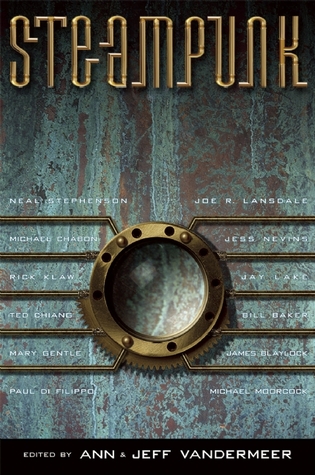
Following that train of thought, I recently got hold of the 2008 anthology Steampunk by Ann and Jeff Vandermeer. There are also a Steampunk II and a Steampunk III, hence the post title, but I haven’t seen them. Let me start by quoting from their preface:

In this anthology, we’ve tried to provide a blend of the traditional and idiosyncratic, the new and the old, while remaining true to the idea of steampunk as dark pseudo-Victorian fun. You’ll find stories about mechanistic golems, infernal machines, the characters of Jules Verne, and, of course, airships

The anthology Steampunk consist of thirteen excerpts and short stories, and three essays tackling history and definition of steampunk. I read only bits and pieces of the thirteen, and that needs explaining. I generally don’t like short fiction. I read tons of it when I was growing up and some of it was superb, but generally it is long on the clever and short on humanity.

Perhaps if someone had held my feet to the fire and required that I finish them, I would have found more to like in these short stories. Probably not. I skipped Moorcock because I had read the novel from which the excerpt was taken. I skipped Blaylock because I am reading one of his novels now. Both authors are excellent.

Many of the other stories left me cold. They were strings of events happening to people I could not care about. Also, the stories seemed universally dark. That is a valid anthologist’s choice, but I don’t care for horror and I outgrew dystopias thirty years ago. Life is a mixture of light and dark, and literature has to mirror that if it is going to hold my attention.

Mind you, most of what I sampled was reasonably well written. It didn’t fail for lack of skill, but there did seem to be a lot of throwing ideas around without linking them together. Short stories can sometimes get away with that. The steampunk novels I am presently reading all seem far better structured.

However, there was one shining light. Jess Nevins’ introduction: The 19th-Century Roots of Steampunk was a superb explanation of steampunk’s precursors. I learned a lot from Nevins.

413. Wherefore Art Thou Steampunk

As they teach us in high school, when Juliet says, “Wherefore art thou Romeo?”, she means why are you called Romeo, and then goes into a long bit about identity. This post will do the same thing.

I have been writing a steampunk novel since July, and it is going quite well. I am roughly half way through the first draft, and doing my world building as I write. I am also researching what it means to be steampunk.

My justification for writing in an unknown genre is that it really isn’t all that unknown. It is a first cousin to science fiction, to fantasy, to horror, to the novels of Verne, to alternate history when limited to the near-Victorian, to Edisonade (a new name to me for a sub-genre I’ve been reading all my life — think Tom Swift), and to the old west with neo-mechanical devices (a genre that existed long before the Wild Wild West). I’ve been reading all of these, all my life.

The name steampunk was proposed by K. W. Jeter in a letter to Locus. Jetter, James P. Blaylock, and Tim Powers are three big names in early steampunk, but the genre has come a long way since then.

You would be surprised how much research into obscure subjects lies untapped in college libraries in the form of Ph.D. dissertations. I have learned to use the internet to seek them out, since so many of the things I am interested in are quite obscure.

Mike Perschon’s 2012 dissertation The Steampunk Aesthetic can be accessed at https://era.library.ualberta.ca/files/m039k6078#.WbA9kcdllBw. On that page, click Download the full-sized PDF if you want to follow me down that rabbit hole. If not, you could just try Perschon’s website http://steampunkscholar.blogspot.com.

No? Neither? I don’t blame you. Not many people have that much itch, so hang on and I will quote a few of Perschon’s conclusions.

Accordingly, this is not a study of Victorians or Victorianism, but rather a study of steampunk’s hodge-podge appropriation of elements from the Victorian period.

Non-speculative neo-Victorian writing is characterized by an adherence to realism that steampunk rarely cleaves to.

Steampunk (is) not . . . historical fiction per se, but . . .  speculative fiction— science fiction, fantasy, and horror, all mixed into one—that uses history as its playground, not classroom.

The most useful thing Perschon said, from my perspective, is that steampunk is not a genre, but an aesthetic. I had largely come to the same conclusion. The question for me has become not, “is it steampunk,” but rather, “does it taste like steampunk”.

I found that the more carefully I researched the Victorian past, both historically and technologically, the more I was attempting to make my novel fit a set of limitations. I was approaching it the same way I approached Cyan, where I first created a world with certain characteristics, then worked my story around it.

Steampunk doesn’t seem to work that way. In steampunk, an author has an idea of what his world looks like, then comes up with some quasi-magical dingus to make it work. Do you want your airship to be able to lift more and go faster? Invent a gas that never existed. In science fiction terms, it’s more Star Wars than Heinlein. There is nothing wrong with that, but I’m having a hard time wrapping my head around it.

In addition to academia. I am also half-way through a half-dozen recent steampunk novels. I would be further along, but I’ve been a bit busy writing my own. I’ll clue you in on those novels as I finish them.

409. Man Stuff

I wrote this last Thursday. The post, not the quotation.

          Marquart and Dael took a bench in a completed corner. “Tell me how you have things arranged,” he said.
          “None of the wardens will leave their houses until late in the morning. The first will arrive here about midday. We will have roast krytes ready by then . . .” Marquart waved away her recitation. He didn’t care about preparations for food and drink; he was satisfied that there would be plenty of both.
          “Who will sleep where? Who will arrive first, who will stay latest, who will want to get me alone to talk to, who will get drunk quickest, who is likely to pick a fight, and with whom?”
          “Oh, man stuff.”
                                          from Valley of the Menhir

Today, I was writing chapter eleven of my latest steampunk novel. So far my hero (I don’t do wimpy protagonists) has served aboard four dirigibles and has risen in rank from Sub Lieutenant to Lieutenant Commander, brevet, in the British air service. These craft are the result of an unscrupulous Brit who, through theft, intimidation, and assassination has crippled the German airship effort and stolen all their ideas.

Earlier this morning (as I wrote) Lieutenant Commander David James and I settled thirty passengers into their berths on the Henry V, a dirigible of war acting as a passenger vessel carrying diplomats the the Grand Durbar in Delhi. If you don’t know what a durbar is, you’ll find out in coming months. David hated every minute of it.

Then we got a break of several hours as he got to go back to his real job as the lowest member of the group of senior officers, seeing to details as the dirigible, nicknamed Harry in reference to Shakespeare, leaves London for Paris. We have been following David’s career for eleven chapters now, and he has done a little bit of everything as he worked his way up. He will do even more in the future, and we will (metaphorically) stand at his shoulder and give him our moral support.

Man stuff.

The year is 1887, Victoria is on the throne, and our Britain is even stronger than the real one was since they just won the German War, largely through a squad of spies and assassins that remains Britain’s guilty secret. David is one of the few Brits who knows this.

Now its time for me to take David by the shoulders and march him down to the lounge to preside, as a stand-in for the massively scarred Commander VanHoek, over the first evening meal of the cruise. He hates the idea. Actually, so do I. In writing, as in life, sometimes if you want to go to a certain place, the path to get there passes through places you would rather avoid.

I’ve been researching Victorian aristocratic gossip in order to build a world like yet unlike our own. It’s not my cup of Earl Grey, but it is the job I’ve taken on, and I will do it well. Well enough, in fact, to move my readers through the event without arousing their distaste. That’s the writer’s equivalent of “never let them see you sweat”.

Still, I’ll be glad when the dinner is over so David and I can get back down to the engineroom where we can try to get another horsepower out of those damned, recalcitrant McFarland engines.

Man stuff.