Tag Archives: writing

Running From President 2

Billy Joe Barker, newsman, regular contributor to the Tulsa World was a long time Republican. He had a dalliance with liberalism during the sixties when he thought he was a hippie. He had the hair for it back then, and it’s the only part of that era he misses. By the mid-seventies he was back to a buzz cut and back to being a Republican.
Billy Joe hated Hillary, passionately. He was a Ted Cruz supporter, despite the hesitation Okies have for anything from Texas, but Cruz didn’t last. Billy Joe really tried to like Donald Trump, but he couldn’t. The last straw was watching Trump’s first interview with his new running mate Mike Pence. After that, Barker had a continuing  vision of Edgar Bergen with Charlie McCarthy on his knee. He gave up on Trump even before Cruz said, “Vote your conscience.”

Barker couldn’t begin to support Hillary, couldn’t stand the Libs and Greenies, and knew there was no hope for a third party. He was flummoxed. That’s when he decided to use the Tulsa World to push a pseudo-candidacy. He didn’t care who he ran, it was just a joke in a political season that had lost any taste of humor. He needed someone like Pat Paulsen, back when Billy Joe was briefly a hippie.

On the same day that he came to that conclusion, he read about Leap Alan Hed in Reader’s Digest. The article told about Leap celebrating birthdays only on years with a leap day, and about his claim to be 16 even though he was born in 1952. Billy Joe Barker had found his candidate.

First he had to locate him; that took two days. Leap had moved to Dannebrog, Nebraska, a bustling metropolis of 307 people. Wiki says 306, but that was before Leap moved in. Billy Joe called him long distance. That took a day of phone tag since Leap didn’t have a phone, and had to take the call at a neighbor’s house.

Billy Joe explained his proposition. Leap almost fell off his chair laughing. He said, “You’ve got to be out of your damned mind. The second worst part of what you want me to do is the campaigning. The worst part is, if I lie well enough, I might win. The answer is no!”

Billy wrote up his weekly column for the Tulsa World, telling the story of his aborted search for a candidate. At the end, he said, “If only crazy people run for the office of President, then Leap Alan Hed is the sanest person in America. He really doesn’t want the job.”

Beware of what you ask for. Or what you don’t ask for. more tomorrow

564. The Tale of Leap Alan Hed

In 2016, after a month and a half of extremely serious writing about race in America. I decided to celebrate with a bit of total nonsense. I chose to do it on Leap Day, because what better time for silliness than a day that only comes every fourth year.

I had intended it to be a one time bit of humor about an accidental President. It wasn’t anti-Trump, because at that time the idea that Donald Trump would become president was a million miles from anyone’s mind.

I went on with my life, getting ready for the release of Cyan and writing blogs on writing, science, and science fiction. I wasn’t worried about Trump. I was worried about Clinton. I eventually voted for her, while holding my nose, but my sympathies were with Bernie, or some other Democrat. Apparently a lot of people felt the same way.

I was aware of Trump, but I wasn’t thinking much about him. I just hoped the Republican candidate would be someone I could vote for if Clinton became the Democratic candidate.

By July, Trump was in the race and looking more and more ugly. But lest we forget, the prospects of Clinton as President didn’t look that good to a lot of us either. 2106 was beginning to stack up as a lose-lose situation. Reasonable candidates were failing fast in both parties.

I brought Leap Alan Hed, the nobody who won the Presidency by accident, back for a reprise and continued his story throughout the summer and fall. I bid him farewell the night before the election and faced reality with a post written in September but posted the day after the election.

In September I reprised the poem Hungry, about a border wall. That is another prophetic piece that I wish weren’t so accurate.

All the things I wrote fearfully about that summer have come true, along with more misery than I could have anticipated. Now I am bringing Leap back for a re-run, beginning today over in Serial. Everything has been tweaked to read smoothly, but ninety-nine percent remains unchanged.

Think of this as a presidential campaign in an alternate universe. And besides, politics aside, it’s just a good story about a nice guy who found himself in completely over his head. These posts have never been put in one place before, to simply be enjoyed as a story.

Running From President 1

In 2016, after a month and a half of extremely serious writing about race in America. I decided to celebrate with a bit of total nonsense. It didn’t work out the way I had anticipated. For a longer version of that story, look at today’s AWL post.

This is the story of Leap Alan Hed and his unintended write-in bid for the presidency. Think of this as a presidential campaign in an alternate universe.

======

Once upon a time – 1952, I think it was — there was a kid who was born on Leap Day.

His Dad was named Alan Hed, and he wanted to give his son the same name, but his wife had a quirky sense of humor. She told the nurse to call the boy Leap, as in Leap Alan Hed. When he was really young, his dad called him Alan and his mother called him Leap, but when he got old enough for school, his kindergarten teacher — who was a mean bastard, anyway  — called him Leap A. Hed. That brought about a sudden parent conference and after that the dad got his way, and the boy tried to forget that his first name was Leap.

People wouldn’t let him forget, and finally he gave in and refused to answer to a Alan any more. He went further. He decided that if he was going to be the boy with all those nicknames:

Leap Boy
Leap Frog
Leap for Cover
Leap Forward
Leap Back
.  .  .  and of course, still, interminably, Leap Ahead  .  .  .

.  .  .  if he was going to have to put up with all those stupid names, he was going to go all the way. I refused to celebrate his birthday on the twenty-eighth of February or the first of March. He only celebrated it on February twenty-ninth.

Worse, he counted his age by birthdays. When he was sixteen, he started putting his age down as four. He spent a lot of time talking to the principal about that, but they finally got tired of the whole business. You might say he out-stubborned them.

He couldn’t out-stubborn the draft board. When they said he was eighteen and he said he was four, they didn’t buy it. He claimed discrimination under the Civil Rights Act. He might have made it all the way to the Supreme Court, but when the 1969 draft lottery was held, February twenty-ninth drew number 285, so the draft board dropped the case.

After that his life calmed down. He never married (he claimed he was too young) and the IRS was indulgent. They figured he would regret his claims when he wasn’t eligible for Social Security until he was 260 years old.

Unfortunately for Leap – or Leap Boy, as the media eventually called him – some joker heard about his claims and put him up for President in 2016. This is the story of that event. more tomorrow

563. Another One Bites the Dust

I went to a local used bookstore today to find a copy of Heinlein’s The Rolling Stones. I can’t find a copy in my book room and none of my local libraries have it. That’s understandable; it came out in 1952 as a juvenile and it wasn’t his best work. I just wanted to see if my memory was correct after all these years as to his use of the barbecue roll, with paint. If that makes no sense, stick around. It will be in an upcoming Apollo post, as soon as I find a copy.

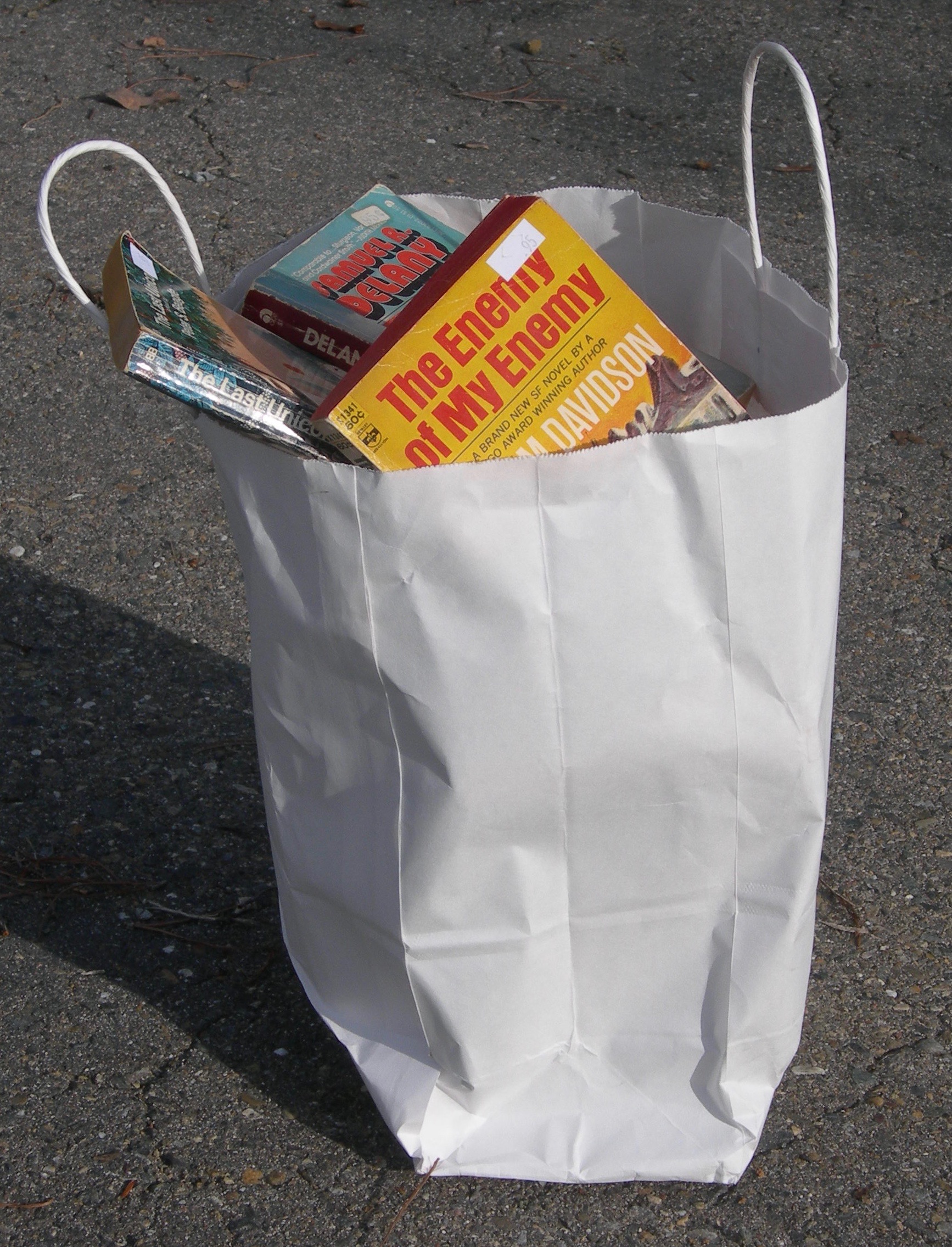
I walked into the bookstore. The proprietor said, “How are you?” and I replied, “Sad. You’re closing.” And she was. About a third of the shelves were empty and she was selling books by the bag, one to ten dollars, depending on the size of the bag.

I’ve completely lost count of how many used book stores have come and gone over the decades I have lived in this area. It always hurts to see one go, and every time a new one appears I know another book lover is buying themselves a heartache.

There are many things which are done for love instead of money. Blogging might be the new poster child for this way of life. Used bookstores are near the top, as well. Crafters fill the same niche.

If you go to a local boutique and buy some hand made jewelry, or any of a thousand other kinds of things you couldn’t buy at Wal Mart, you might be tempted to call them over priced. Maybe, from the consumer’s viewpoint, but I doubt if one in fifty crafters is making minimum wage. They always think they’ll make a little money when they start, but really . . .

A used bookstore as an investment? Hummm. I wouldn’t do it, although I’m glad there are people who do. Consider the mark-up (next to nothing) and consider how many customers come in each day. At least you have a lot of time to read.

I should talk. I do something even dumber than that. I write novels.

If you go to a used bookstore — in some town other than the one I’ve avoided mentioning, which no longer has a used bookstore — and look closely at the science fiction shelves you will find hundreds of writers you’ve never heard of. Some of them are pretty good and some aren’t. What they have in common, not counting Heinlein and a few like him, is that they probably never made a living by writing. A few achieved a bit of fame, but most of them didn’t. Many wrote only one or two books and gave up.

If you look at the names of the publishers, you won’t know it unless you’ve been following this for years, but many of them stayed in business by stiffing their authors. Others actually paid, but paid a pittance.

I don’t think there are too many of those completely dishonest publishers around any more. Times have changed. Now you can publish ebooks and stiff yourself.

Oh well, it’s a good life if you don’t weaken. And of course I don’t do it for the money — but I wouldn’t mind some.

562. Davy

This is one of my best stories series.

I re-read. It is my equivalent of brainless television. There are books that I frequently re-inhabit in order to once again enjoy the people, scenery, and action.

There are also books I read only once, and never need to read again. They become such a part of me that I still remember them decades later.

Edgar Pangborn provided two such books, Davy and The Trial of Calista Blake. I read each of them only once, between 1964 and 1967. I have never forgotten them, nor have I ever wanted to return to them. They were life changing, if read at the right age.

===========

I grew up in an era of fear. The bomb hung over us all, and fiction followed the trends of the day. Speaking from memory, not scholarship, it seems to me that it was the end of the exclusivity of science fiction. Events that would have once interested only the few and the faithful, were turning up on the best seller list. Books like Fail-Safe and On the Beach were called science fiction, and I suppose technically, they were. But they didn’t taste like science fiction because they were written by mainstream writers with different sensibilities. That may not be a legitimate complaint, but in truth they tasted like steak with no salt.

The flip side of the here-comes-the-bomb novels was an endless cavalcade of post-holocaust dystopias. The first book I read, the first day I discovered libraries, Star Man’s Son by Andre Norton, was one of those. There were dozens to follow; maybe hundreds. They mostly ran together in a mass of future sadness, but a few were memorable.

Davy stood out because it’s horny orphan protagonist got such joy out of life. He found a French horn in the rubble and taught himself to play it, which always made the book seem more like fantasy than science fiction. If you know French horns, you’ll understand.

We spend much of the book watching Davy go from ignorance to knowledge. The cover of the edition I read compares him to Tom Jones (the novel, not the singer) and that seems fair.

Davy’s world is the northeastern United States, a couple of centuries after the nukes fell. The names are scrambled but mostly decipherable. The state religion is the Holy Murican Church and belief is not optional. Davy falls in with anti-religious dissidents, which suits his doubter’s personality.

The novel is carried by Davy as a questioning, ebullient youth, but saved from silliness by a brooding feeling that all will not be roses. The story arc makes everything work. We see young Davy growing up as told by his older self, but we are spared the works of his maturity. There will be striving, battle, despair, and betrayal when the mature Davy attempts to mold the world to his liking, only to have it fall apart in his hands. That is the part of the story another novelist would have concentrated on, but we see it only in brief flashes. Then we are at the final chapter, a kind of coda in which Davy totals up his gains and losses and prepares for a final, hopeless journey.

What we have here is the joy of youth, overlain by the elegiac sadness of hopeless struggle against human inadequacy. Heinlein could have written it, but it would have had little heart because his protagonist would have stood above the fray, superior to the mass of humanity. Davy partook of the same human conditions that he fought against. Just like the rest of us. That made Davy stand out as something better that the rest of the dystopias. It made the novel a work of art to move the soul — at least if you read it at sixteen, while waiting for the bomb to fall.

561. Great (?) Books

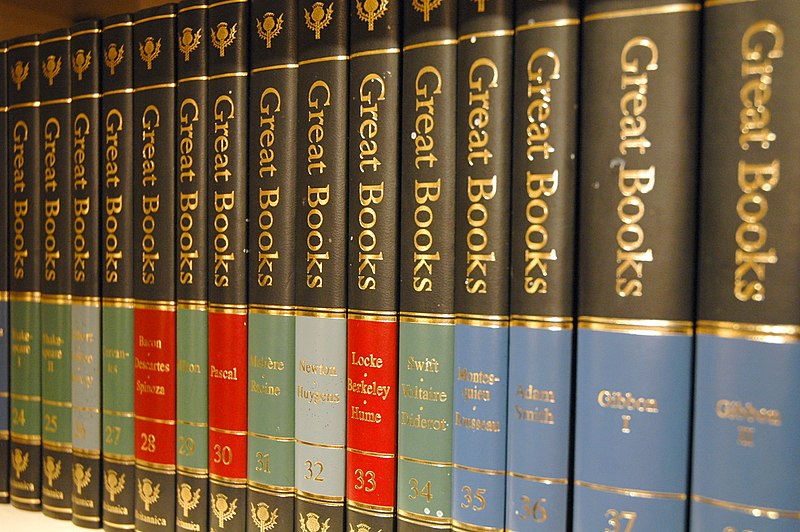
The Great Books of the Western World.
Taken 16 February 2005 by User:Rdsmith4

“Here are the most admirable and varied materials for the formation of a prig.”      James Payn, speaking of the Great Books of the Western World.

A prig (in case you didn’t know) is a self-righteously moralistic person who behaves as if superior to others.

=========

If Aristotle said it, it must be true, right? Maybe. Of course, Aristotle’s ideas about physical science held Europe back from progress for a couple of millennia, so maybe not.

According to Aristotle’s view of forced motion (as opposed to natural motion) a body would stop moving when applied forces was removed. This caused his followers much work trying to explain why an arrow didn’t stop moving as soon as it left the bow.

I think we can cut the old guy some slack. Pioneers never get things completely right. On the other hand, too much reverence for old things can really slow progress. Case in point: The Great Books.

When The Great American Read hit PBS, it sent me looking at some old lists of great books, although, to be fair, the GAR was not about great books, but popular books, which is a whole different perspective.

Among the books of lists I checked out was A Great Idea at the Time by Alex Beam, about Encyclopedia Britannica‘s Great Books of the Western World. That consisted of fifty-four volumes containing 443 works by seventy-four authors, all dead, white, and male. I recommend Beam’s humorous look at the intersection of prissy scholarship with American huxterism.

Meanwhile, let’s look at the same issue from a broader perspective. There is a prejudice among the educated that finds wisdom only in great or serious books. If Charles Dickens says it, it is wisdom. If Gordon Dickson says it, it is entertainment.

I don’t buy that. Never did. Don’t plan to in the future. I stand with Brian and Mike Hugg’s song You’re A Better Man Than I . . .

Could you tell a wise man
By the way he speaks or spell
Is this more important
Than the stories that he tells.

While I was researching all this, I ran across a Goodreads review of one of the books I had mentioned, The Novel 100, which included this sentence: “It contains a lot of my own personal favorites, while also including books that I should read.”

Should? Why should? Why read the Great Books, and for that matter, why capitalize them as if they were the Holy Bible?

Robert Hutchins, who was instrumental in producing the Great Books of the Western World (in part to make Great Profits), put it this way:

Until lately the West has regarded it as self-evident that the road to education lay through great books. No man was educated unless he was acquainted with the masterpieces of his tradition. There never was very much doubt in anybody’s mind about which the masterpieces were. They were the books that had endured and that the common voice of mankind called the finest creations, in writing, of the Western mind.

Yeah, right! If it was so “self evident” why was there such a giant fight to decide which books were great enough to go into the Great Books of the Western World?

In terms of ubiquity in the works of later writers, the greatest of the Great Books was the Bible. Adam, Eve, and the Garden — you might be Charles Darwin, and those names and their implications would still be understood. Only Shakespeare comes close to such instant recognition.

Today, it would be hard to find any author with recognition that is both widespread and lasting. Maybe Tolkien; maybe not. There are plenty of writers that everybody reads today, who will be forgotten in a decade. There are probably a few authors whose fame will never die with a small group of readers, but that would  be hard to nail down.

In the “good old days” there was a bit of unanimity on quality (less than Hutchins would have you think), but today’s society has opened outward to diversity in such a way that, while there will always be great books, there will probably never again be Great Books.

Greece and Rome may lie at the foundations of Western Civilization, but really, who has more to offer modern America, Marcus Aurelius or Maya Angelo.

560. We All Learn

Race has a persistent and powerful influence on America for something that really doesn’t exist.

Take the whitest non-albino in America and stand him on the western border of Kansas. Take the blackest black in America and stand him on the eastern border of Kansas. Now line up all the rest of us in a single line, whitest to blackest, in between those two. There would be no break in the continuum.

That should be no surprise to anyone. We have had black slaves (and their descendants) and white immigrants in America rubbing up against one another for four hundred years.

For four hundred years, white DNA patterns have been entering black America through force and black DNA patterns have been entering white America by passing. Lately, that DNA has been going both directions for kinder, gentler reasons.

It’s all been a giant blender — powered at first by hatred and eventually by love —- mixing up the vanilla with the chocolate. There is no use pretending that we are two races any more.

Right!

Try telling that to a white guy. Or try telling it to a black guy.

Clearly, there’s more to the story.

============

When I was growing up in rural Oklahoma in the fifties, the idea of two separate races seemed real and normal, but theoretical.

In my small town and the countryside around there were no black folks. Also no Jews. Nor Mexicans. No Italians either, come to think of it. There was one Catholic family who lived there briefly, but they didn’t last.

It was white, white, white, and Protestant, for as far as the eye could see, with one exception, —— Eddie. I’ll leave it to you to guess what word went into the blank; hint, it began with “N”.

The gentleman didn’t live in my community, but we saw him driving by in his pickup from time to time. He lived somewhere north; I never knew where. I never met him. I only knew him as a blurred, black face in a passing vehicle.

All the adults knew him and spoke well of him. He minded his own business; he took care of his family; he was a good farmer (wherever his farm was); he was quiet and he went his own way.

Now, if I weren’t talking about race, that would sound like a description of The Quiet Man. The archetype. The lone cowboy who rides into town, minds his own business and bothers no one. But don’t cross him because he takes no guff from anybody.

Nope, that’s not it at all. Not even close. But take away the last sentence — the one about “don’t cross him” — and change it to “gives no offense to anyone but quietly backs away”. Now you are closer to the truth. You have just defined the difference between The Quiet Man and Uncle Tom.

The Quiet Man knows his worth; Uncle Tom knows his place. Even growing up in whiteland, with no blacks around, I knew the difference.

============

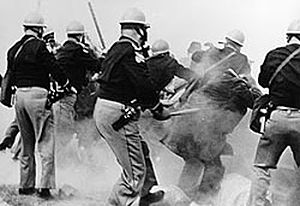
In my childhood, the only black folks I saw other than a blur on the highway, were on television. They were marching in Selma and across the South. And yes, now we are getting to why this post is coming on Martin Luther King Day.

My father called them troublemakers. He liked the phrase “outside agitators”, as well. I disagreed. I looked at the black people being washed down southern streets by fire hoses and said, “They’re right. We’re wrong.”

I didn’t say it out loud. I didn’t say much of anything out loud in those days except, “Yes, sir.” But a few years later when I escaped to college, I had decided for myself that black folks were as good as I was.

Now that may seem a rather obvious decision to you, but a lot of people from my generation and the one that followed never got the message. You see a lot of them now at rallies for a certain orange faced politician.

Martin Luther King and the tens of thousands he represented showed me an alternative to my father’s thinking. I thank them for giving me another option.

559. What Moved You?

The Great American Read is long over.

I enjoyed it, without becoming greatly involved. I’m not much of a joiner, and I have a taste in literature that veers off from that of most people, so I wasn’t too interested in what America decided. I did enjoy reacting to the list, but the whole project did not seem to hold much for me.

I was wrong.

I started my own best-of list and I’ve been slowly writing posts on its content, but most of the material provided by the Great American Read seemed simplistic, until I dug down to bedrock and found a section called Your Stories.

Note that I have linked it for you to visit. The introduction for the section reads:

Which novel has had the biggest impact on your life? Viewers of The Great American Read shared their stories with us by submitting text, photo, video or an audio file with a short story about how a novel impacted their life. Selected contributions are featured on this page.

These responses moved me. I didn’t agree with them all, but that didn’t matter. Some of the responders were championing books that I consider second rate, but that didn’t matter either. These people were talking about how books had impacted their lives, and that made their responses worth reading.

More than anything else, the responses reminded me that there is room for every kind of literature. There is probably no book — from porn to an exegesis of the scriptures — that doesn’t fill a need for someone. Sometimes books are a view of better things. Sometimes they are a lifeline in dark times. They always matter.

Hit the link and see for yourself what some of these people had to say. When you get to the bottom of the page, hit the Load More Contents button.

I don’t know how many responses are available. There were more than I had time to read, certainly, with more emotion than I could absorb in one setting. I intended to sample a few, and ended up staying for hours.

Check it out before the website goes away.

558. Serial Packaging

Publishing novels serially is a very old idea. Most of Charles Dickens work came out that way.

What I’ve done over the last few years in the blog Serial is a bit different. Dickens novels came out in pieces while he was writing them. Everything in my blog Serial was already finished, then had to be reverse engineered into serial form.

I actually made a brief attempt at writing on the go, although it appeared in A Writing Life while Serial was occupied by another story. It wasn’t for me. If you’re curious how things came out in the experiment, you can go to Mud Prolog, Mud 1, Mud 2,  and Mud 3 to see the results. I have a lot of emotional investment in the novel Mud and some day I will probably return to it, but not as a serial in progress.

When Dickens wrote his serialized novels, the size required for each chunk was known in advance and the chunks were big. David Copperfield, for example, was a novel of 358,551 words. I know this by downloading it from Project Gutenberg, transferring it to my word processor, and using the word count function. You might make note of that; it is a useful technique.

David Copperfield was published in twenty monthly installments. That makes each installment was about 18,000 words. In SFWA (Science Fiction Writers of America) terms, each installment was of novella length.

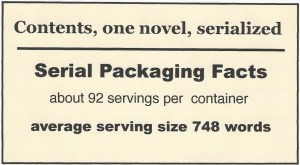
My typical serial post has been about 600 to 800 words.

Dickens serialized in order to sell to a market which could not afford books. At the same time, serializing boosted sales of this novels when they came out later in book form. Most successful nineteenth century authors followed the same pattern.

The big names in twentieth century science fiction also wrote serial novels, although they were shorter and presented in fewer but longer installments. In the golden age of SF, serial publication might be the only way to get a novel into print. A few years later, when the paperback revolution came about, those old magazines were mined for their novels.

In my case, nothing but Mud was in progress at the time it was posted. Some of the things presented had been published, some had not, one was presented as a excerpt from a completed novel, and one was a fragment from a novel I’ll probably never finish. Jandrax was annotated to such a degree that it almost forms a writing primer, and How to Build a Culture was entirely a how-to.

Everything I have presented in Serial has been to assure continued readership of the website. It’s a trick. Leave ‘em hanging, and they’ll come back. And the whole website was originally to assure a readership for my then upcoming novel Cyan, and for others that would follow.

That was the plan anyway, but the website quickly became something I valued for itself and man has it been fun.

I’ve enjoyed revisiting old friends. I’ve learned a lot from a close re-reading of old material, especially regarding pacing. Since I posted four days a week, each post had to be relatively short. That kept me from running out of material too soon, and kept each reading experience brief for the sake of the daily reader. I didn’t originally choose the 600 to 800 word length — it just evolved.

The actual process of taking a novel and breaking it into pieces has been a fascinating, frustrating, and rewarding experience. It typically begins with a completed novel, which may be decades old and which will already have been polished to a high shine. Nevertheless, I find a few errors.

The first step is to reduce the novel to individual pages. I use a stationary belt sander to remove the gummed spine. How’s that for getting down to how-to basics? These pages then have to be scanned one at a time with an OCR program (optical character recognition) to make them readable to the word processor. Then I have to find all the thousands of errors that crept in during OCR work. It takes a week, at least.

Now using a word processor version, I have to re-read the novel, looking for natural breaks in the action. I type a non-word at each break. I use breakbreak. Then I can use the find function to jump from break to break.

I then highlight what I have chosen, use the word count function, and type in the number of words. If it seems too short or too long, I adjust.

That takes care of post #1. Now to repeat.

Jandrax required 92 posts. Raven’s Run required 150. Some posts make sense on their own, but some require that I start with a sentence or two from the previous day’s post. I use bold-italic to denote this repeat.

All this takes place on a single word processor file. I then make individual files of each post-to-be. This is a backup to what will actually appear on the website. At this point, I run the spell checker one last time, even though by now I have read each section repeatedly with an eye out for errors.

The last step is copying from word processor file to the website.

Tedious? Yes. Fun? Absolutely. If you don’t enjoy re-reading your own work, why do you write?

If memory is nagging at you, then yes, a very different version of this appeared in a previous post a couple of years ago.