Tag Archives: writing

Raven’s Run 97

“A double barreled attack. Destroy any chance that Raven might have information, and discredit me at the same time, through her.”

“That’s why the luggage came on through. It’s probably loaded with drugs.”

“And it would look like Raven was smuggling.”

“And like I’m the world’s biggest hypocrite.”

*       *       *

When I asked the luggage question, I didn’t have a theory. I was just fishing for useful knowledge. The Senator’s reaction took me by surprise, and made no sense until I heard the story behind it.

Senator Daniel Cabral has a scar, low on his left side, just above his belt, the size of a dime, and a matching scar, slightly higher, that covers three square inches of his back just above his belt where partially successful plastic surgery left a white and lumpy mass. Entry wound and exit wound for a 38 caliber bullet. The other five bullets went through his partner.

He didn’t show me the scar, of course, but it was part of the story he and Ed Wilkes told me that night in Paris.

Dan Cabral was born in California of Mexican-American parents. His ancestors had been citizens for ten generations. He didn’t speak Spanish until he was ten years old and spent a summer with an uncle in Sinaloa. His parents were wealthy. His grandfather had bought farmland which had been in the path of growth. His father had sold it for development, reinvested, and repeated the process several more times. By the time Cabral was born, there were millions in the bank and in real estate.

Daniel had gone to college and, over his parents objections, had joined the FBI. He did well. The FBI needed Chicano agents to deal with Cuban refugee problems around Miami. Later, when Cabral became too well known there, they sent him to deal with drug smuggling across the Texas border. He spent two years, then transferred to Calexico to continue the same work.

Cabral had been with the FBI seven years when an arrest went bad on an empty road in the middle of the Mohave Desert. As he was falling, hit in the side, he shot the two smugglers who had killed his partner. One died there in the dirt beside his stalled truck. The other ran a hundred yards into the sage brush and bled to death. So did Cabral, nearly, before help came.

They gave him a commendation and four months leave to recuperate. He spent it thinking about all the things he had seen, and came to the conclusion that drug enforcement was causing the drug problem. 

I didn’t entirely buy his argument, but it went this way.

A drug user needs his drugs. If they are available at a reasonable price, he uses them. Sometimes he destroys himself, and sometimes he doesn’t. Lots of prominent citizens have gone through a successful lifetime on drugs without being found out. But if the drugs become too expensive, problems arise. To support his habit, the user might spend money that should have gone to his family, or rip off car stereos, or hold up a convenience store.

Or he might become a supplier. more tomorrow

302. The Drought Has Broken

dscn4470What is weather to a writer? If you live in the city, it might invoke a passing mood,. Beyond the city, where I live, it is everything.

I grew up on a farm, living in the glorious outdoors sixteen hours a day for half the year, and the other half freezing my #%*# off six hours a day milking cows. Weather was everything. Through the middle of my life, when I lived in cities, weather was mildly interesting. Now I live on three acres in the Sierra foothills, and weather is back with a vengeance.

I posted a picture at the top. This is an fold in the hills which is dry ninety percent of the year, and recently has been dry all year for half a decade. This is what it looks like now.

The drought has broken. Grass is green and knee deep in my yard. Yesterday was Valentines Day or, as my wife and I call it, the first day of spring.

That began as a joke. When we first came to where we live now, I bought her a tomato plant and we planted it together on Valentines Day, with high hopes and no expectations. A few months later we were eating tomatoes from it.

It doesn’t always work that way. In another year, a hard freeze on April 15th killed everything in the garden. Taxes and a hard freeze on the same day — it seemed appropriate. Life is like that in the real world. Sometimes you get the bear; sometimes the bear gets you.

If all this talk of green grass in February is making you jealous, take heart. By May, the rains will stop and they won’t return until winter. When you are having a picnic in June, on green grass under the trees, with cool breezes, here in the foothills it will be a hundred degrees with dry brown hills in every direction. The rattlesnakes will be carrying their canteens again.

But for now, the drought has broken. The grass is green, the weather is clement, and the lakes are full. And my novel Cyan is due out this summer, after the long dry spell since Jandrax and A Fond Farewell to Dying.

The drought has broken. Finally.

********

I have to offer a PS to my metaphorical connection of our breaking drought and the end of my publishing dry spell. Three days after I wrote this post for today’s release, the Oroville dam about two hundred miles north of here, hit the national news for excessive water and a failing spillway. Be careful what you ask for.

Raven’s Run 96

“Don’t mind me,” I said. “I find all this fascinating; even the seventy-five percent I don’t understand. But I do have one question. Where does Raven’s safety figure in all this double dealing?”

Daniel Cabral had a temper, no matter how much he had trained his face not to reveal it, and that made him mad. I didn’t care. I didn’t give a damn about the Senator’s political agenda. I just wanted Raven to be safe.

“My daughter’s safety comes before anything else,” Cabral said evenly. “However, at the moment there is nothing I can do for her. She will call home and find out everything that has happened, or one of your street musicians will find her and notify Hayden. Until that happens, there is nothing I can do for my daughter. All I can do is try to keep my career from going down the toilet because of her stupidity.”

“And if it came to choosing between your daughter’s safety and your career?”

“The safety of my family comes before anything else!”

No qualifications. No equivocation. I liked that. I also realized that Raven’s lifestyle had made him consider the possibility long ago.

I spread my hands in friendly surrender.

“Let’s get back to your story.” Wilkes said.

“Not yet,” I said. “There are some loose ends dangling. Senator, were you ever notified that Raven was missing? And what became of Raven’s luggage on the cruise ship?”

“I was not notified. When she didn’t show up at the airport as scheduled, I checked back and there was nothing the cruise line could tell me. I assumed that she had gone off somewhere without telling me. She does that. It is her way of declaring her independence.”

There was a great deal of impatience in Cabral’s voice, the legacy of years of dealing with his wayward daughter.

“And the luggage?”

“It was being held for her. She had not claimed it. I assumed she would, and gave it no more thought.”

“That doesn’t make any sense.”

“Why? How could it make any difference?”

“Why depends on a basic assumption – was Davis smart or stupid?”

“I vote for stupid,” Wilkes interjected.

“Maybe. But I was impressed by the way he handled the situation in Venice.”

“He died.”

“Luck. There was some skill on my part, but mostly it was luck. Let the same situation develop twenty times, and nineteen out of twenty I would be the one to die.” It was something I had been thinking about a lot.

“Look at what happened on the ship. If I hadn’t been there, how would it all have ended?”

Wilkes admitted, “He would have succeeded completely.”

“And would have escaped without a trace.”

“Yes.”

“So why leave the luggage aboard? Raven and I talked about this on the way to Europe, and we concluded that he would drop it overboard. That way, no one would suspect that Raven never made it back to New York. No one ever checks to see who gets off of a ship or plane. They just take names when you get on. They would look for clues to her disappearance everywhere else but on the cruise ship.”

“An oversight?”

“Possibly. Or perhaps he had a reason for the luggage to make it back to the states. But I have no idea what reason that could be.”

Cabral turned pale. He and Wilkes exchanged glances. Wilkes said, “Of course!” more tomorrow

301. Cyan in the Making (2)

This is a continuation of the Cover Design Questionnaire for Cyan.

Describe the main characters and their physical appearances.

Okay, I cheated a little on this one. When I first sat down to outline Cyan, I intended the crew to be truly multinational, and made sure that no two were from the same country. As I continued writing, it became clear that the Earth from which they came would not be that cooperative, so I transferred the crew to a single country, a successor of the US, and that’s how I described them here.

Also, when you see xxxxx xxxxx below, that is me restricting what you can read to avoid spoilers. 

All the ten original explorers are athletic, but normal looking. Like the original astronauts, they are of compact build; none are above 6 feet. They were chosen to be racially mixed, a goal made easy since their home nation is the USNA (formerly USA) after it has absorbed Canada, Mexico, and the Caribbean. The women of the group are independent souls. If an artist were to put one of them in a damsel-in-distress pose on the cover, she would hunt him down and beat the crap out of him.

Keir Delacroix, groundside crew leader, French ancestry, the most physically active crew member, survivalist, a generalist whose main job is keeping everyone else alive

Stephan Andrax, spaceside crew leader, Danish ancestry, more slender, he spends little time on Cyan

Tasmeen Rao, second in command in space and on the ground, Dravidian ancestry, from Trinidad, very dark smoky grey skin, darker than Leia, strong but so slender as to appear frail

Ramananda Rao, meteorologist, married to Tasmeen, similar in appearance, but without her seeming frailty

Leia Polanyi, paleontologist, African ancestry, of medium dark skin (think Uhura), small

Gus Leinhof, biologist, German ancestry, slightly older than the other crewmembers

Uke Tomiki, Japanese ancestry, powerful but slender body of a martial artist

Debra Brunner, biologist, mixed caucasian ancestry, movie star beautiful and hates it because it gets in the way of her work. No hipshot poses if she appears in illustration

Petra Crowley, geologist, xxxxx xxxxx xxxxx xxxxx xxxxx xxxxx

Viki Johanssen, anthropologist, Scandinavian ancestry, 6 feet tall, a powerful, lanky amazon, dirty blonde hair (really blonde, chopped short, and always dirty). xxxxx xxxxx xxxxx xxxxx xxxxx xxxxx xxxxx xxxxx xxxxx xxxxx xxxxx xxxxx xxxxx xxxxx xxxxx xxxxx xxxxx xxxxx

On Cyan, as explorers and later as colonists, they wore khaki and denim, with 12 mm automatic pistols in cross draw holsters on the left side – out of the way but easily accessible. If you need to draw Gus, he also carried a long barreled .22 revolver in an open holster low on his right. As the crew biologist, he used this to gather specimens without blowing them apart. Yes, it is a cowboy look, but it is how field biologists actually used to gather their specimens, before eco-consciousness and electro-miniaturized high tech equipment was available.

Who is your favorite/ Why? I like them all. Even the villain Curran has redeeming characteristics. Tasmeen is the one I would most like to meet, if she were a real person.

What sparked the book? Over the years, tales of exploration have always been my favorite kind of science fiction, but they are rare, and I couldnʼt think of one that took a planet all the way from initial exploration through colonization. It was the book I had always wanted to read, but I had to write it myself.

Raven’s Run 95

Chapter Twenty-seven

When I got back to the suite, Cabral had gone out. Wilkes had been waiting for my return, in case Joe Dias called early. After he left, I paced the room for a while, dispirited and irritable, then tried to catch up on some sleep. Uselessly. I alternated tracing cracks in the ceiling and staring at the phone.

I did have a life. Or at least, I used to have one. I had places to go and things to do. But I knew that I would make no move to leave. It wasn’t just Raven, either; there were too many unexplored possibilities in this new situation.

Wilkes and the Senator came in just as the phone rang. It was Joe. After I hung up, the Senator asked, “Well?”

“A week ago, someone torched Harvey Jacks’ office. Joe’s investigator talked to his wife. She didn’t know much, but she said Jacks had bragged about working for a big-wig in Sacramento. And Jacks had said she, not he, when referring to the big-wig. But he never named her. Seems he was very closed mouthed.”

“What was left of the office?”

“Not much. Joe’s willing to investigate further, but he did this much as a favor to me. I won’t ask him to do more without paying him. He has a living to make.”

“Call back and hire him in my name.”

I did, then covered the receiver and asked, “Anything else?”

Cabral looked at Wilkes, who shook his head. After I had hung up, Wilkes observed, “If Jacks was into blackmail, he would have had more than one copy of his evidence, and it wouldn’t have been in a file cabinet in his office.”

“Likely.”

“Let’s go back to the beginning,” the Senator said. “We’ll hear your story again, Ian, and look for anything we might have missed so far. I am not clear on timing and motivation, and I don’t understand how Davis and Alan found you so quickly in Marseille.”

I told the story again, sexually censored. I was talking to Raven’s father, after all. Wilkes sat at the table with a pad, taking notes. Cabral said nothing until I reached the fight on the Wahini in Marseille. Then he interrupted, “How much time was there between when Ramona called California and when the thugs jumped you?”

“Mid-morning of one day until the following evening. Maybe thirty hours.”

“Ed, make a note to check every airline with departing flights for Europe, particularly Paris, starting at the time of Ramona’s call and carrying forward twenty hours. Look for James Davis and anyone with a last name of Allen or a first name of Alan, under any variation of spelling. I’m particularly interested in how they paid for their trips.”

“Senator, you are asking a lot. The Bureau isn’t going to do that just as a favor. If you want to keep using them, you are going to have to make an official report on what happened to your daughter.”

Cabral said, “Shit.” It was the first coarse thing that had cracked his urbanity. Either he was beginning to accept my presence, or this was cutting close. Maybe both.

It helped bring some things into focus. Raven’s loose living would be an embarrassment to the Senator. What had happened to her since Bermuda would be a tabloid reporter’s dream come true. I could see the headlines in the Enquirer.

“Dammit, Ed, we need that information.”

Wilkes did not answer.

“You’re right, of course. It is asking too much. But we need to know. How else can we find out?”

“I could go ask,” Wilkes said.

“And flash your badge. That would be the end of you with the Bureau.”

Wilkes shrugged.

“No, Ed, I won’t let you. Besides, I need for you to stay inside.”

“I can find out without showing a badge or admitting my name. There are ways to finesse these things, but I would need to be on the spot.” Then he glanced sideways at me and raised a questioning eyebrow.

“Don’t mind me,” I said. “I find all this fascinating.” more tomorrow

300. Cyan in the Making (1)

Three hundred posts in A Writing Life. That’s a milestone, more so since there are more than three hundred additional posts over in the companion blog Serial.

This calls for a celebration and, since this blog was begun in support of my upcoming novel Cyan, it seems like a good time to announce the publication dates.

==The dates that were here were accurate==
==when I gave them, but have been changed.==
Click here to go to  post 316 for corrected dates.

I’ve seen the cover and I like it, but I’m not allowed to show it yet. Sorry.

Close to a year ago, my communication with EDGE became more intense. Cyan was scheduled for a near future release, which ended up being delayed, but the back and forth was useful and fascinating. I had no idea that they would ask for so much input. Certainly I had almost no input when Jandrax and A Fond Farewell to Dying were published, long ago. (see 133. and 134.).

One of the questionnaire’s I filled out was on cover design. I’m going to share part of it with you, because it is interesting, and because it is a good teaser for the upcoming novel.

Cover Design Questionnaire (in part)
this was for the editors and to be forwarded to the artist

Primary genre? science fiction

A potential subgenre? hard SF; near neighborhood, near future stelar exploration; SF realism —every company had it own definitions for subgenres. The guiding principle of Cyan was to tell a story about the kind of things that probably will happen in the next century or so.

List three comparative novels for cover suggestions–I went to B&N today to see what this monthʼs crop of covers look like. They are all beautifully done but essentially interchangeable. None of the covers gave much of a clue of what is going on inside the book, with the exception of Kim Stanley Robinson’s Red, Blue, and Green Mars.

My take on covers is that they should give the reader an idea of what he is buying. Cyan is a realistic, day-after-tomorrow story of colonization and exploration, with no battles and no fantasy elements. Most of the covers I saw today could as easily have been put on video games; that wonʼt work for Cyan. Cyanʼs cover should have no Terminator wannabes, no Conan clones, no Frazetta girls, and no Dystopian ruins.

Seven phrases for google searches:

science fiction
Procyon
space exploration, fiction
space colonization, fiction
first contact
recombinant DNA
overpopulation, fiction

Hypothetically, pick a scene for the cover — A lot of things happen in Cyan; there are many scenes that would look good on a cover, but the one that most clearly conveys the overall sense of the book is the first ten minutes the crew spends on the ground. I will enclose the text of the scene. (To the artist, I didn’t enclose it here.)

If you do that scene, here is some backstory on the landing craft. Starships are built in space with unstreamlined, open structures. The landing craft is a squat cone with added complexities. It is fusion powered, so its tanks are small, but it has some cargo space for specimens. The tug, during the colonization phase, is similar in appearance but much larger, with a large cargo hold. Both are VTOL craft, landing upright. This is because of the absence of landing fields, but such craft have also become popular on Earth. Given compact fusion reactors, their inherent inefficiencies are of no consequence.

If you prefer to include the non-human characters, I have included an excerpt of Cyl on the hunt. I have also enclosed further descriptions of the Cyl. (Again,to the artist, not here.

this questionnaire excerpt concludes tomorrow

Raven’s Run 94

I knew Cabral by contrast. He was as powerful as my own father had been weak. In his presence, I felt ten years old again. I wanted to please him. I wanted to be like him. All my orphan needs were exposed, when I was with him.

There were two dangers. I might let such a man become the lodestone of my life and live in his shadow as Ed Wilkes appeared to do. Or I might find myself opposing him even when I agreed with him, to keep my separateness alive. Like Raven did.

Already, I understood her better.

I closed my eyes and leaned back to absorb the dappled sunlight coming through the tree overhead. On April thirteenth, Raven had fallen into my life. Now it was two days until July.  For two and one half months, present or absent, she had been the focus of my life. The overpowering, erotic focus of my life. But she was not the entirety of my life. I had lived without her for two weeks now, and I was nearly my complete and normal self again.

My life was in need of review. At some deep level, I had been worrying at that, not for weeks, but for months.

The closest thing to a career I had had was when I worked for Joe Dias. There were things I had liked about the job – the excitement, the touch of danger, the intellectual challenge of finding clues to unravel a puzzle. I had not like the people I had to deal with. And finally, the day to day routine had been deadly dull.

I had liked college. The people you met were interesting; most were young and alive to possibilities. And they were, for the most part, not likely to shove a knife in your ribs when your back was turned. I had liked the work, the intellectual stimulation of chasing down clues in old record to see what had really happened, say, in the administration of Andrew Jackson. But the day to day routine meant long hours lethargically reading through dusty records. It, too, was deadly dull.

I had chosen the foreign service. To make a difference in the world. That’s what I told myself, but I was not so good at self deception. A semi-orphan from small town Wisconsin, deserted by an alcoholic father, a high school dropout who had clawed his way through college and graduate school – I knew what I was looking for. I was looking for respectability, and I was out to show the world that I was important.

I wanted to help Raven. I would help Raven. That was a given. 

But after that? Would the foreign service give me the chance I needed to prove myself, or would I become another petty bureaucrat. Or quit, because it was so deadly dull that I could not endure it. more tomorrow

299. I Survived Skylab

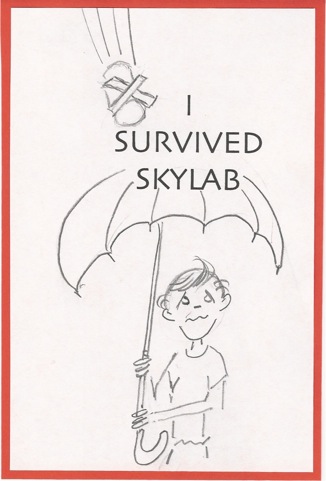
skylabAt the top of this post is a drawing, done with deliberate crudeness. I wish I could have used the original, but it existed before digital cameras and Pinterest. I have searched the internet without success for the image I remember. There are dozens of modern Skylab T-shirts. but none like what you see here.

In 1979, Skylab came crashing back to Earth. NASA knew it was going to happen, but could not prevent the event; it even predicted the date, July 11. The world partied in the face of danger – especially since the chances of being at ground zero were billions to one – and I Survived Skylab T-shirts were worn everywhere. The one I remember had a silly looking cartoon schmuck holding an umbrella over his head while Skylab was flashing down behind him.

If anyone still has a picture of one of those original T-shirts, post it on Pinterest and I’ll provide a link.

No one had intended Skylab to come to such an end. It was in reasonably high orbit, about 275 miles when he last crew came back to Earth. It still contained plenty of air and water, although the gyros were failing. It could have been remanned, and there were tentative plans to shift it to to a still higher orbit. No one took it too seriously, though; the vessel was old and battered, and NASA had turned its attention to the Space Shuttle.

In fact, most people at NASA thought the next Skylab crew would be ferried up by the Space Shuttle.

Nature had other plans.

By 1973, it was predicted that Skylab would deorbit years earlier than NASA was predicting, but NASA failed to listen. Increased solar activity had heated the atmosphere, causing it to expand. Low Earth orbits are still within the tenuous ranges of the outer atmosphere. Although the life of such orbits is measured in years, all things within a few hundred kilometers of Earth eventually come down. Now NASA was facing the fact that the Space Shuttle would not fly before Skylab’s orbit became critical. Not only could Skylab not be saved, it could no longer be equipped for a controlled deorbit.

A Russian Cosmos had crashed into northern Canada only a year before. The second stage of the Saturn which had launched Skylab had remained in orbit two years, then crashed into the North Atlantic in 1975. NASA was aware that the potential for disaster was great. It was predicted that up to 25 tons of debris might survive reentry, and there was no way to determine where it might land.

If Skylab had landed on Omaha – or Paris – we would be living in a very different world, with a very different attitude toward space exploration. In point of fact, Skylab struck the Earth in the desert of western Australia. No one was injured. Property damage was minimal.

The Shire of Esperance sent NASA a fine for littering.

*  *  *  *  *  *  *

Everybody has to carve out his own niche. In my science fiction, I concentrate on the next couple of centuries. In these posts I concentrate on the early space program. I have not yet written about the space shuttle, which always seemed to be like Grandpa’s pickup truck that he bought after he was no longer young and had sold his hot rod. Sorry, my prejudice, which I am sure I will someday reverse without apology.

I am even less interested in the ISS. I remember too well that, during its planning – before the feds told them to shut-their-mouths and not bite the hand that was feeding them – the scientific community complained loudly about all the research that would go unfunded to feed the ISS.

The ISS, symbol of American-Russian friendship, boldly going where everyone has already gone before. Sorry, my prejudice again.

If you are interested in the ISS, there is a plethora of available writing. If you want to know more about early space stations, try to find Living in Space by Giovanni Capara in your local library. Published in 1998, it is a detailed study of all the space stations before ISS.

Raven’s Run 93

“He was trying to shoot me, so I stomped his head into the pavement.”

“Very effectively, I’d say,” Wilkes added dryly.

It was an ugly picture. They had composed his features, and pushed his nose back more-or-less straight, but there was a curious flattening to his forehead that came through clearly in the grainy black and white.

“I don’t know him,” Cabral said calmly. After his early years with the FBI, the sight of death did not disturb him. “Do you?” Wilkes shook his head.

“Davis,” Cabral went on. “Why would he use his real name?”

“Assuming he did.”

“The coincidence with Alice Johnson’s maiden name is too great. I think we can assume as a near certainty that Davis is his name, that his first name probably is James, that he is related to Johnson-Fletcher, and that they are working together because they are related. So why would he use his real name?”

“Why not, Senator?” Wilkes said. “If he succeeded in killing your daughter on the cruise ship, it wouldn’t matter.”

Cabral drummed his fingers on the arm of his chair while he thought. I had a feeling that he was not so calm about all this as he tried to appear. Talking about an attempt on his daughter’s life had to make him angry. I thought I could see small indications of that anger, but his face was well schooled. Finally, he said, “No doubt that’s it. The simplest answer is often the best.”

I added, “Perhaps having used his real name, he was committed to finishing Raven in Marseille.”

“Or maybe it merely reinforced Johnson-Fletcher’s need. I am also assuming that she is the one Ramona had investigated, but we need to be sure.”

“I may be able to help there,” I said. “I need to make an overseas call.”

“Go ahead.”

I called Joe Dias. He was out, but Carmen said he had made an investigation. I gave her my number.

Wilkes said, “Joe Dias. The detective you worked for when you were going to college?”

“Damn, you are irritating. How much do you know about me?”

“When you applied for the foreign service, the CIA did a full background check. The Senator and I read it before we left California.”

That security check was the one thing that had made me hesitate about applying for the foreign service. It made me nervous. Especially about my time in Germany.

“Joe isn’t due back in his office for two hours. Meanwhile, I need some air. We can continue this later.”

“We will continue it now,” the Senator said.

“You daughter – Raven – has been on her own for two weeks. We have no reason to think she is in immediate danger. It will wait an hour while I collect myself.”

*       *       *

June was almost gone. In the two weeks since Raven and I had walked these same streets, the greens had deepened and a dusty pallor had come upon the sycamore leaves as the summer’s heat worked into them.

I found a bench overlooking a handful of grass trapped in a sea of sidewalks and streets. Things were moving too fast for me, and there were forces working at levels I could feel but could not touch. One thing I knew clearly, though. Daniel Cabral was a danger.

Ed Wilkes exuded a quiet competence and deadliness, but he was a pale candle in the sun of Daniel Cabral. Raven had spoken of competing with a powerful father, but that had been her wishful thinking. No child could have competed with him. Anything she might seem to have won over him, would have been a gift he had given without her knowing. more tomorrow

298. Skylab (2)

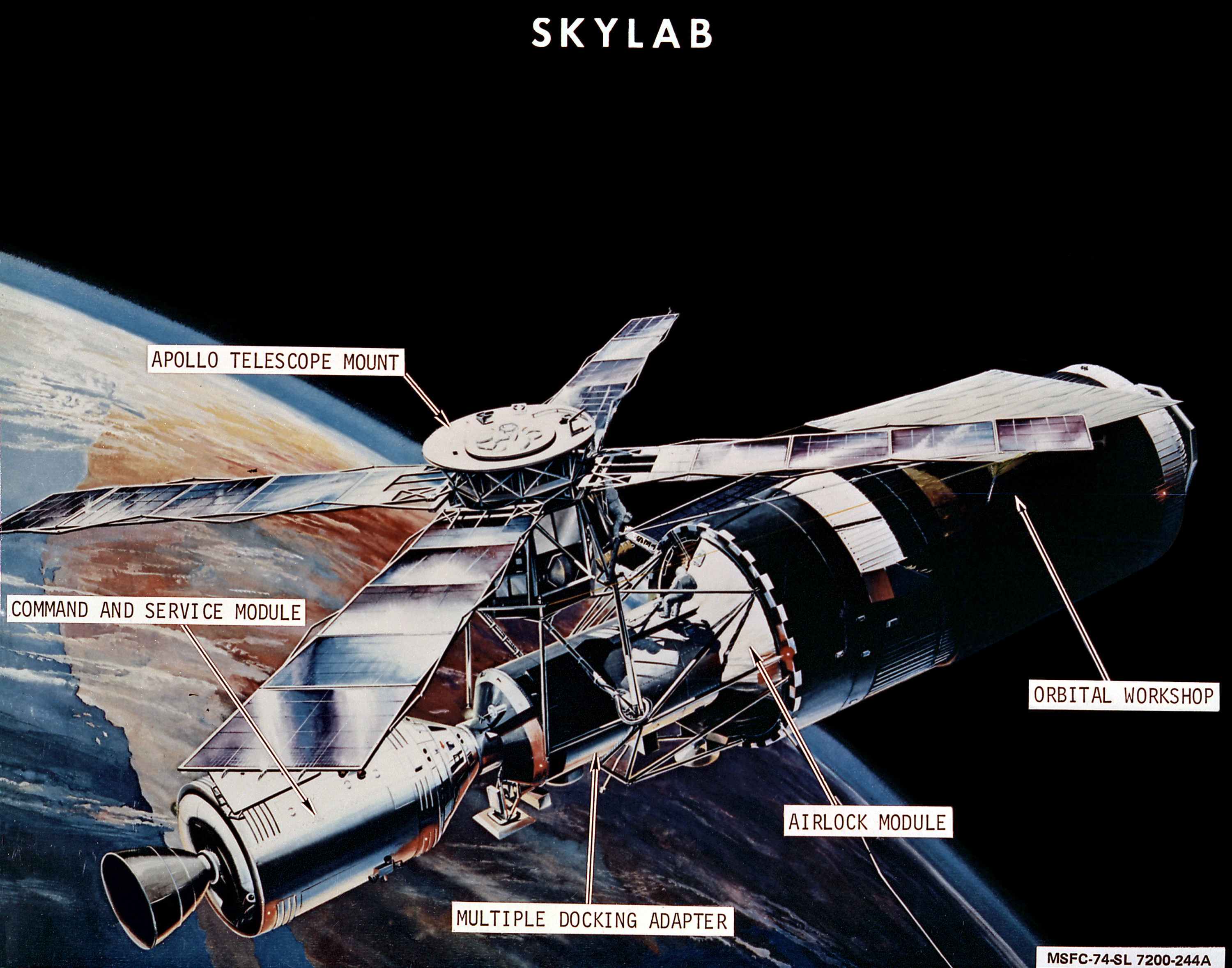
skylab_labeledTwo days after Armstrong and Aldrin stepped onto the moon, NASA announced that it would launch an orbital laboratory with space telescope, using a Saturn V rocket. Because of its great power, the Saturn V could place a large payload in low earth orbit, using only its first and second stages. The entire third stage was converted into the orbiting laboratory, and launched intact and ready for occupation. This was Skylab.

The astronauts who would man Skylab would arrive later in CSMs – NASA speak for Command Module and Service Module, considered as a package deal – launched on smaller Saturn I-B rockets.

This cylindrical third stage was divided by a floor grating into an upper work area and lower living quarters,with eating, sleeping, and bathroom areas. It was, of course, a weightless environment. At the end of the vehicle, an airlock and docking adapter allowed egress for extravehicular activities and connected Skylab to the CSM which brought the astronauts up, and remained docked to return them to Earth. A solar panel array provided power. In pictures of Skylab, this array is what looks like helicopter blades above the vehicle. The telescope mount is in the center of the solar power array.

Skylab was launched on May 14, 1973, with disastrous results. The meteorite shield, which was supposed to stay snugly against the outside of Skylab during the flight up, and deploy once in space, deployed prematurely. Once in orbit, only part of the solar panel array deployed. The rest had been trapped by the damaged meteorite shield. The result was too much heat and not enough power. Skylab was uninhabitable.

The astronaut launch was temporarily cancelled and NASA went into salvage mode. Within eleven days they had proposed, built, and tested a set of repairs, and the crew of Conrad, Kerwin, and Weitz launched on May 25th. It proved to be no easy task.

The first day, working from the hatch of the CSM, Weitz tried using a forked stick to remove some of the debris remaining from the meteorite shield in order to deploy the solar array. No luck. Then the astronauts tried to dock, only to find that part of their capsule was non-functional. They had to externally repair their docking probe before connecting with Skylab and finally getting to sleep, no closer to repair. The next day, they attacked repairs from inside Skylab. Weitz wore a gas mask as he tested the air inside the structure. Scientists had feared that the high temperature environment would release poisonous gasses from the insulation. It had not, but the temperature inside was 130 degrees. The astronauts then set up a parasol they had brought, inside the second airlock near the telescope, and slowly extended it outside Skylab. It opened successfully, providing relief from the sun. The temperature dropped, although only to 95 degrees. The second night, the astronauts slept in the docking adapter area where the temperature was reasonable.

Several days later, Conrad and Kerwin performed another EVA, used large scissors to cut away part of the meteorites shield, and finally freed the remaining solar array.

The work of the first Skylab crew not only saved the station for the work it was designed to do, but also proved the necessity of manned missions to rescue projects in danger. Twenty years later, when the Hubble needed repair to perform its functions, the precedent had long since been established.

The first Skylab crew stayed aboard a month, conducting astronomy and medical research. The second crew, Bean, Lousma, and Garriott, remained aboard for two months, continuing repairs and research.. The third crew, Carr, Pogue, and Gibson, remained in space 84 days, observed and photographed comet Kohoutek and continued other experiments.

By the time the third crew returned to Earth, Skylab was nearing the end of its service life. Beyond the damage done on launch day, many other systems were failing. There were plans to use it further, but nature had plans of her own. conclusion tomorrow