Category Archives: A Writing Life

302. The Drought Has Broken

dscn4470What is weather to a writer? If you live in the city, it might invoke a passing mood,. Beyond the city, where I live, it is everything.

I grew up on a farm, living in the glorious outdoors sixteen hours a day for half the year, and the other half freezing my #%*# off six hours a day milking cows. Weather was everything. Through the middle of my life, when I lived in cities, weather was mildly interesting. Now I live on three acres in the Sierra foothills, and weather is back with a vengeance.

I posted a picture at the top. This is an fold in the hills which is dry ninety percent of the year, and recently has been dry all year for half a decade. This is what it looks like now.

The drought has broken. Grass is green and knee deep in my yard. Yesterday was Valentines Day or, as my wife and I call it, the first day of spring.

That began as a joke. When we first came to where we live now, I bought her a tomato plant and we planted it together on Valentines Day, with high hopes and no expectations. A few months later we were eating tomatoes from it.

It doesn’t always work that way. In another year, a hard freeze on April 15th killed everything in the garden. Taxes and a hard freeze on the same day — it seemed appropriate. Life is like that in the real world. Sometimes you get the bear; sometimes the bear gets you.

If all this talk of green grass in February is making you jealous, take heart. By May, the rains will stop and they won’t return until winter. When you are having a picnic in June, on green grass under the trees, with cool breezes, here in the foothills it will be a hundred degrees with dry brown hills in every direction. The rattlesnakes will be carrying their canteens again.

But for now, the drought has broken. The grass is green, the weather is clement, and the lakes are full. And my novel Cyan is due out this summer, after the long dry spell since Jandrax and A Fond Farewell to Dying.

The drought has broken. Finally.

********

I have to offer a PS to my metaphorical connection of our breaking drought and the end of my publishing dry spell. Three days after I wrote this post for today’s release, the Oroville dam about two hundred miles north of here, hit the national news for excessive water and a failing spillway. Be careful what you ask for.

301. Cyan in the Making (2)

This is a continuation of the Cover Design Questionnaire for Cyan.

Describe the main characters and their physical appearances.

Okay, I cheated a little on this one. When I first sat down to outline Cyan, I intended the crew to be truly multinational, and made sure that no two were from the same country. As I continued writing, it became clear that the Earth from which they came would not be that cooperative, so I transferred the crew to a single country, a successor of the US, and that’s how I described them here.

Also, when you see xxxxx xxxxx below, that is me restricting what you can read to avoid spoilers. 

All the ten original explorers are athletic, but normal looking. Like the original astronauts, they are of compact build; none are above 6 feet. They were chosen to be racially mixed, a goal made easy since their home nation is the USNA (formerly USA) after it has absorbed Canada, Mexico, and the Caribbean. The women of the group are independent souls. If an artist were to put one of them in a damsel-in-distress pose on the cover, she would hunt him down and beat the crap out of him.

Keir Delacroix, groundside crew leader, French ancestry, the most physically active crew member, survivalist, a generalist whose main job is keeping everyone else alive

Stephan Andrax, spaceside crew leader, Danish ancestry, more slender, he spends little time on Cyan

Tasmeen Rao, second in command in space and on the ground, Dravidian ancestry, from Trinidad, very dark smoky grey skin, darker than Leia, strong but so slender as to appear frail

Ramananda Rao, meteorologist, married to Tasmeen, similar in appearance, but without her seeming frailty

Leia Polanyi, paleontologist, African ancestry, of medium dark skin (think Uhura), small

Gus Leinhof, biologist, German ancestry, slightly older than the other crewmembers

Uke Tomiki, Japanese ancestry, powerful but slender body of a martial artist

Debra Brunner, biologist, mixed caucasian ancestry, movie star beautiful and hates it because it gets in the way of her work. No hipshot poses if she appears in illustration

Petra Crowley, geologist, xxxxx xxxxx xxxxx xxxxx xxxxx xxxxx

Viki Johanssen, anthropologist, Scandinavian ancestry, 6 feet tall, a powerful, lanky amazon, dirty blonde hair (really blonde, chopped short, and always dirty). xxxxx xxxxx xxxxx xxxxx xxxxx xxxxx xxxxx xxxxx xxxxx xxxxx xxxxx xxxxx xxxxx xxxxx xxxxx xxxxx xxxxx xxxxx

On Cyan, as explorers and later as colonists, they wore khaki and denim, with 12 mm automatic pistols in cross draw holsters on the left side – out of the way but easily accessible. If you need to draw Gus, he also carried a long barreled .22 revolver in an open holster low on his right. As the crew biologist, he used this to gather specimens without blowing them apart. Yes, it is a cowboy look, but it is how field biologists actually used to gather their specimens, before eco-consciousness and electro-miniaturized high tech equipment was available.

Who is your favorite/ Why? I like them all. Even the villain Curran has redeeming characteristics. Tasmeen is the one I would most like to meet, if she were a real person.

What sparked the book? Over the years, tales of exploration have always been my favorite kind of science fiction, but they are rare, and I couldnʼt think of one that took a planet all the way from initial exploration through colonization. It was the book I had always wanted to read, but I had to write it myself.

300. Cyan in the Making (1)

Three hundred posts in A Writing Life. That’s a milestone, more so since there are more than three hundred additional posts over in the companion blog Serial.

This calls for a celebration and, since this blog was begun in support of my upcoming novel Cyan, it seems like a good time to announce the publication dates.

==The dates that were here were accurate==
==when I gave them, but have been changed.==
Click here to go to  post 316 for corrected dates.

I’ve seen the cover and I like it, but I’m not allowed to show it yet. Sorry.

Close to a year ago, my communication with EDGE became more intense. Cyan was scheduled for a near future release, which ended up being delayed, but the back and forth was useful and fascinating. I had no idea that they would ask for so much input. Certainly I had almost no input when Jandrax and A Fond Farewell to Dying were published, long ago. (see 133. and 134.).

One of the questionnaire’s I filled out was on cover design. I’m going to share part of it with you, because it is interesting, and because it is a good teaser for the upcoming novel.

Cover Design Questionnaire (in part)
this was for the editors and to be forwarded to the artist

Primary genre? science fiction

A potential subgenre? hard SF; near neighborhood, near future stelar exploration; SF realism —every company had it own definitions for subgenres. The guiding principle of Cyan was to tell a story about the kind of things that probably will happen in the next century or so.

List three comparative novels for cover suggestions–I went to B&N today to see what this monthʼs crop of covers look like. They are all beautifully done but essentially interchangeable. None of the covers gave much of a clue of what is going on inside the book, with the exception of Kim Stanley Robinson’s Red, Blue, and Green Mars.

My take on covers is that they should give the reader an idea of what he is buying. Cyan is a realistic, day-after-tomorrow story of colonization and exploration, with no battles and no fantasy elements. Most of the covers I saw today could as easily have been put on video games; that wonʼt work for Cyan. Cyanʼs cover should have no Terminator wannabes, no Conan clones, no Frazetta girls, and no Dystopian ruins.

Seven phrases for google searches:

science fiction
Procyon
space exploration, fiction
space colonization, fiction
first contact
recombinant DNA
overpopulation, fiction

Hypothetically, pick a scene for the cover — A lot of things happen in Cyan; there are many scenes that would look good on a cover, but the one that most clearly conveys the overall sense of the book is the first ten minutes the crew spends on the ground. I will enclose the text of the scene. (To the artist, I didn’t enclose it here.)

If you do that scene, here is some backstory on the landing craft. Starships are built in space with unstreamlined, open structures. The landing craft is a squat cone with added complexities. It is fusion powered, so its tanks are small, but it has some cargo space for specimens. The tug, during the colonization phase, is similar in appearance but much larger, with a large cargo hold. Both are VTOL craft, landing upright. This is because of the absence of landing fields, but such craft have also become popular on Earth. Given compact fusion reactors, their inherent inefficiencies are of no consequence.

If you prefer to include the non-human characters, I have included an excerpt of Cyl on the hunt. I have also enclosed further descriptions of the Cyl. (Again,to the artist, not here.

this questionnaire excerpt concludes tomorrow

299. I Survived Skylab

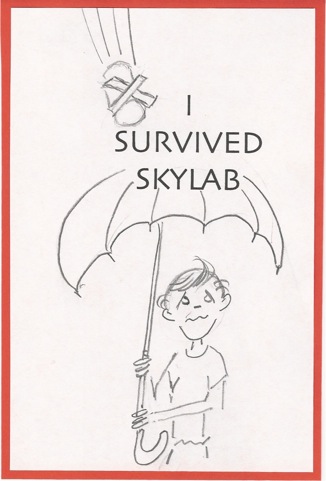
skylabAt the top of this post is a drawing, done with deliberate crudeness. I wish I could have used the original, but it existed before digital cameras and Pinterest. I have searched the internet without success for the image I remember. There are dozens of modern Skylab T-shirts. but none like what you see here.

In 1979, Skylab came crashing back to Earth. NASA knew it was going to happen, but could not prevent the event; it even predicted the date, July 11. The world partied in the face of danger – especially since the chances of being at ground zero were billions to one – and I Survived Skylab T-shirts were worn everywhere. The one I remember had a silly looking cartoon schmuck holding an umbrella over his head while Skylab was flashing down behind him.

If anyone still has a picture of one of those original T-shirts, post it on Pinterest and I’ll provide a link.

No one had intended Skylab to come to such an end. It was in reasonably high orbit, about 275 miles when he last crew came back to Earth. It still contained plenty of air and water, although the gyros were failing. It could have been remanned, and there were tentative plans to shift it to to a still higher orbit. No one took it too seriously, though; the vessel was old and battered, and NASA had turned its attention to the Space Shuttle.

In fact, most people at NASA thought the next Skylab crew would be ferried up by the Space Shuttle.

Nature had other plans.

By 1973, it was predicted that Skylab would deorbit years earlier than NASA was predicting, but NASA failed to listen. Increased solar activity had heated the atmosphere, causing it to expand. Low Earth orbits are still within the tenuous ranges of the outer atmosphere. Although the life of such orbits is measured in years, all things within a few hundred kilometers of Earth eventually come down. Now NASA was facing the fact that the Space Shuttle would not fly before Skylab’s orbit became critical. Not only could Skylab not be saved, it could no longer be equipped for a controlled deorbit.

A Russian Cosmos had crashed into northern Canada only a year before. The second stage of the Saturn which had launched Skylab had remained in orbit two years, then crashed into the North Atlantic in 1975. NASA was aware that the potential for disaster was great. It was predicted that up to 25 tons of debris might survive reentry, and there was no way to determine where it might land.

If Skylab had landed on Omaha – or Paris – we would be living in a very different world, with a very different attitude toward space exploration. In point of fact, Skylab struck the Earth in the desert of western Australia. No one was injured. Property damage was minimal.

The Shire of Esperance sent NASA a fine for littering.

*  *  *  *  *  *  *

Everybody has to carve out his own niche. In my science fiction, I concentrate on the next couple of centuries. In these posts I concentrate on the early space program. I have not yet written about the space shuttle, which always seemed to be like Grandpa’s pickup truck that he bought after he was no longer young and had sold his hot rod. Sorry, my prejudice, which I am sure I will someday reverse without apology.

I am even less interested in the ISS. I remember too well that, during its planning – before the feds told them to shut-their-mouths and not bite the hand that was feeding them – the scientific community complained loudly about all the research that would go unfunded to feed the ISS.

The ISS, symbol of American-Russian friendship, boldly going where everyone has already gone before. Sorry, my prejudice again.

If you are interested in the ISS, there is a plethora of available writing. If you want to know more about early space stations, try to find Living in Space by Giovanni Capara in your local library. Published in 1998, it is a detailed study of all the space stations before ISS.

298. Skylab (2)

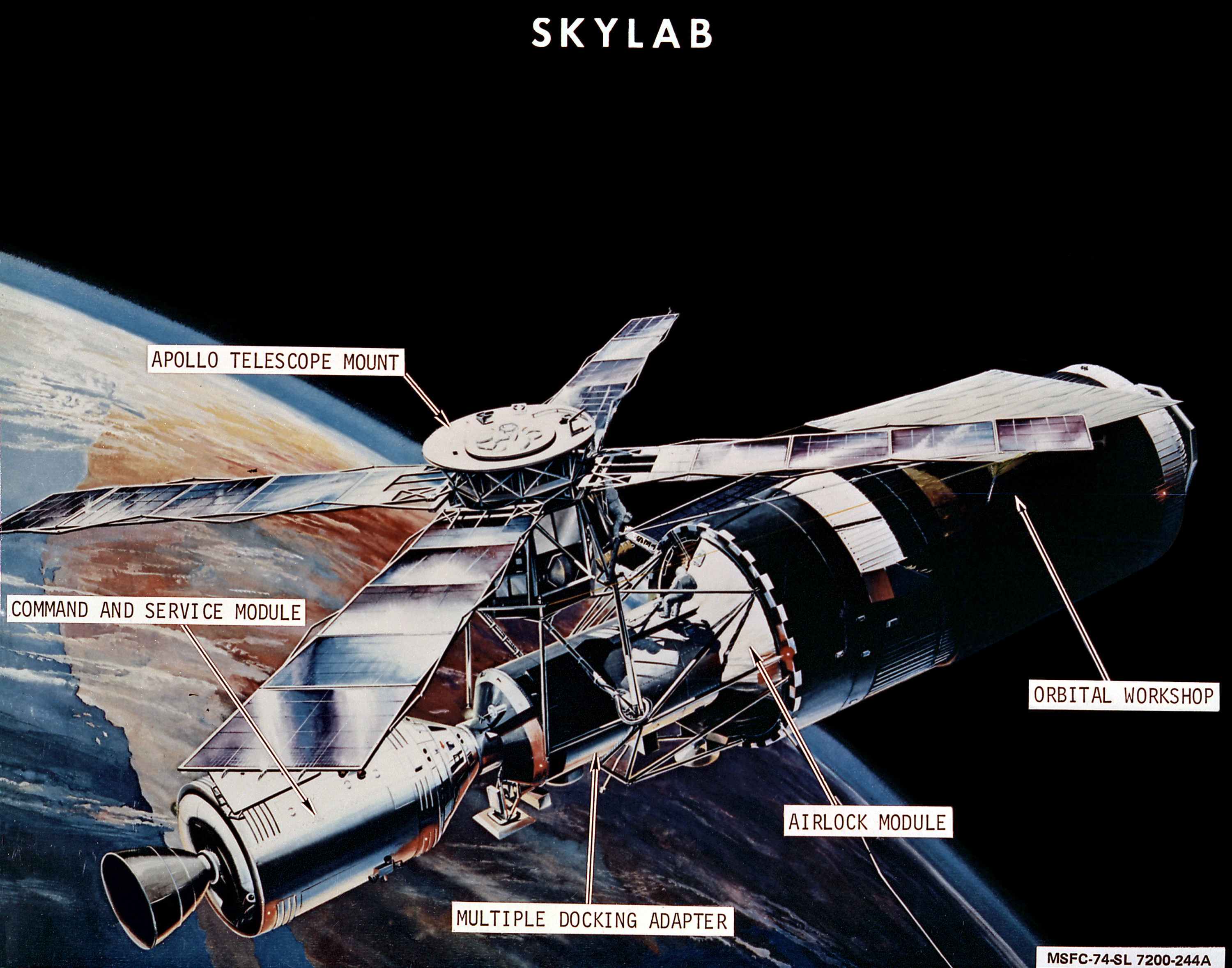
skylab_labeledTwo days after Armstrong and Aldrin stepped onto the moon, NASA announced that it would launch an orbital laboratory with space telescope, using a Saturn V rocket. Because of its great power, the Saturn V could place a large payload in low earth orbit, using only its first and second stages. The entire third stage was converted into the orbiting laboratory, and launched intact and ready for occupation. This was Skylab.

The astronauts who would man Skylab would arrive later in CSMs – NASA speak for Command Module and Service Module, considered as a package deal – launched on smaller Saturn I-B rockets.

This cylindrical third stage was divided by a floor grating into an upper work area and lower living quarters,with eating, sleeping, and bathroom areas. It was, of course, a weightless environment. At the end of the vehicle, an airlock and docking adapter allowed egress for extravehicular activities and connected Skylab to the CSM which brought the astronauts up, and remained docked to return them to Earth. A solar panel array provided power. In pictures of Skylab, this array is what looks like helicopter blades above the vehicle. The telescope mount is in the center of the solar power array.

Skylab was launched on May 14, 1973, with disastrous results. The meteorite shield, which was supposed to stay snugly against the outside of Skylab during the flight up, and deploy once in space, deployed prematurely. Once in orbit, only part of the solar panel array deployed. The rest had been trapped by the damaged meteorite shield. The result was too much heat and not enough power. Skylab was uninhabitable.

The astronaut launch was temporarily cancelled and NASA went into salvage mode. Within eleven days they had proposed, built, and tested a set of repairs, and the crew of Conrad, Kerwin, and Weitz launched on May 25th. It proved to be no easy task.

The first day, working from the hatch of the CSM, Weitz tried using a forked stick to remove some of the debris remaining from the meteorite shield in order to deploy the solar array. No luck. Then the astronauts tried to dock, only to find that part of their capsule was non-functional. They had to externally repair their docking probe before connecting with Skylab and finally getting to sleep, no closer to repair. The next day, they attacked repairs from inside Skylab. Weitz wore a gas mask as he tested the air inside the structure. Scientists had feared that the high temperature environment would release poisonous gasses from the insulation. It had not, but the temperature inside was 130 degrees. The astronauts then set up a parasol they had brought, inside the second airlock near the telescope, and slowly extended it outside Skylab. It opened successfully, providing relief from the sun. The temperature dropped, although only to 95 degrees. The second night, the astronauts slept in the docking adapter area where the temperature was reasonable.

Several days later, Conrad and Kerwin performed another EVA, used large scissors to cut away part of the meteorites shield, and finally freed the remaining solar array.

The work of the first Skylab crew not only saved the station for the work it was designed to do, but also proved the necessity of manned missions to rescue projects in danger. Twenty years later, when the Hubble needed repair to perform its functions, the precedent had long since been established.

The first Skylab crew stayed aboard a month, conducting astronomy and medical research. The second crew, Bean, Lousma, and Garriott, remained aboard for two months, continuing repairs and research.. The third crew, Carr, Pogue, and Gibson, remained in space 84 days, observed and photographed comet Kohoutek and continued other experiments.

By the time the third crew returned to Earth, Skylab was nearing the end of its service life. Beyond the damage done on launch day, many other systems were failing. There were plans to use it further, but nature had plans of her own. conclusion tomorrow

297. Skylab (1)

240px-skylab_sl-4

SKYLAB

The International Space Station has been continuously inhabited since November of 2000. if you are under twenty-five, you probably don’t remember a time when it didn’t exist. You also probably don’t know that scientists widely resisted it’s construction, feeling that far more could be learned by spending the equivalent amount in other ways. Whether or not they were right will probably never be known.

The space race that culminated in landing on the moon was fueled by the cold war. The construction of the International Space Station was fueled by the need to demonstrate that the cold war was over, and that Russia and America were now friends. How well that has turned out is also still in doubt.

There were space stations before the ISS, mostly Russian. Wikipedia has a nice list available. The US had an aborted space station project in the late sixties, the MOL (see 256. The Space Station That Never Was) and an actual one in the mid to late seventies. It came on the heels of the Apollo program and it was called Skylab.

Most Americans have forgotten it ever existed but for a few brief weeks in 1979, everyone in the world was looking at the sky and thinking about Skylab.

Gene Cernan and Harrison Schmitt were the last men on the moon in 1972 (see 293. Last Man on the Moon) because of funding cuts. Twenty Apollo missions had originally been envisioned. Apollo 20 was the first to be cancelled in January of 1970 to allow its booster to be used for Skylab. Later that year, Apollo 18 and 19 were cancelled.

If you think back only a few years, the last Space Shuttle flight brought rounds of congratulations for years of success, but at the same time the Cape, northeastern Florida, and NASA in general saw economic turmoil as thousands lost their jobs.

A similar thing happened at the height of the Apollo program. All the Saturn V boosters that were going to be built were in the pipeline, and the organization that produced them was in danger of disappearing. One of the schemes to keep the resource from disappearing was Skylab.

Space stations had always been envisioned. Early plans for reaching the moon called for building space station, then assembling the moon rockets there. It made good sense. Spacecraft have different design requirements from vehicles designed to cope with traveling through the atmosphere. Just look at the difference between the Lunar Lander and the Apollo Command Module. Now visualize a craft built in space for lunar or interplanetary travel; your vision will probably look a lot like the ISS looks today.

That plan to build a space station, then a moon rocket, made perfect sense, but it wasn’t going to happen fast enough to win a space race with the Russians. Hence the Apollo style moon missions, leading to victory in the space race, leading to an America that felt like a winner, but had no place to go next.

Enter, Skylab. more tomorrow

296. Space Walks (2)

gemini_spacecraftWe left Gene Cernan hanging onto to the side of Gemini 9, part way thorough a disastrous space walk. I’ve provided a drawing of the Gemini to orient you to what comes next.

Cernan left the hatch and began to move back to the base of the Gemini, utilizing undersized hand holds. He was weightless, which makes this sound easy, but remember that bending your arm is like “bending and inflated life raft”. As he worked his way back, he had to thread his umbilical through undersized stand-offs to keep it from tangling. When he reached the base of the Gemini, he found it surrounded by a ring of torn metal, like razor wire, that was the result of separation from the Titan rocket that had put him into orbit. Just the thing a space suit does not need to make contact with.

Once Cernan made it past the turn to the very base of the Gemini, he faced new problems. He was exhausted and overheated; the inside of his visor was so fogged that he was nearly blind. Making visibility even worse, the light NASA had provided over the MMU was a dim bulb, completely inadequate to his needs. He began to attempt to fire up the MMU, a procedure that required about thirty switches to be thrown in sequence, but he could hardly see the switches, and every time he tried to turn a dial, his untethered body spun the opposite way.

Once the MMU powered up, he had to release and position the arms and get it strapped on. By now he was far overbudget for time, and out of contact with Stafford in the Gemini. His heart was beating at three times its normal speed, he couldn’t see for sweat and fog, and the Gemini was twenty minutes away from orbital night when the impossible becomes the unthinkable. Stafford terminated the mission. The MMU was abandoned, untested. Cernan made his painful way forward and returned, not without a final struggle, to the safety of the Gemini.

Let’s let Cernan speak for himself.

Why is floating in space and turning a few dials so difficult? Let me give you a couple of tests. Connect two garden hoses and turn on the water. Now, using only one hand, try to unscrew them. Or, hold a bottle of soda or beer at arm’s length, and using a single hand, remove the twist off top. For extra reality, run a mile before you start so you’re nice and tired, do it while wearing two pairs of extra-thick gloves and close your eyes to simulate being unable to see. Stand on your head while doing some of these things to resemble tumbling in space. You get the idea. 

* * * * * *

There is one kind of space walk that always works, called a stand-up EVA. If an astronaut simply stands up on his seat, with the hatch open, he has none of the problems Cernan had.

Gemini 10 began with a stand-up EVA. Later Michael Collins performed an umbilical EVA, successfully although not easily, using a hand held maneuvering unit similar to the one used by Ed White.

In Gemini 11, Richard Gordon performed an umbilical EVA to attach a tether to an Agena target vehicle. Like Cernan, he overheated, lost vision to a fogged visor, and had his EVA cut short.

In Gemini 12, Buzz Aldrin performed two stand-up EVAs, sandwiched around an umbilical EVA. For the first time, everything went right. Aldrin had use of larger hand and foot holds, a reduced workload, and tools designed to overcome the problems of weightlessness. The lesson learned by White, Cernan, Collins, and Gordon had finally made spacewalks practical.

295. Space Walks (1)

260px-ed_white_first_american_spacewalker_-_gpn-2000-001180EVAs (extravehicular activities) or space walks are commonplace today. It wasn’t always that way. In the early days of space exploration, every space walk was a brush with death. The Russians denied that reality and the American’s downplayed it. But the fact was, in the words of Gene Cernan (see also 293. the Last Man on the Moon), “. . . we didn’t know diddly-squat about walking in space when I popped my hatch open on Gemini 9. . . It’s a sobering reflection when I think about it now, and I thank God that I lived through the experience.”

It was life threatening from the beginning. Alexey Leonov nearly died on man’s first spacewalk (see 116. Spacecraft Threatened by Bears). Three months later, Ed White’s space walk was exhilarating until it came time to reenter his Gemini craft. Then he found getting back in to be nearly impossible. Nothing is as easy as it looks in space.

There are basically three problems with spacewalks – vacuum, vacuum, and weightlessness. Vacuum outside and pressure inside makes space suits incredibly difficult to bend. Reaching over to flip a switch, which a bedfast child could do on Earth, takes great strength when suited up and in vacuum. Vacuum also provides insulation. When a spacewalking astronaut is working hard to bend in his pressure suit, the vacuum of space is keeping his body heat from dissipating. Finally, weightlessness makes it impossible to get purchase to exert one’s strength.

Both Leonov and White floated happily, but when it came time to reenter their vehicles, they found it hard to maneuver, hard to bend, and they both overheated.

Cernan’s spacewalk, the third ever attempted, was worse. He was given an impossible series of tasks to perform. Nevertheless, he was determined to perform them. People who fail, don’t remain in the astronaut corps, and trying to do the impossible nearly killed him.

First, the two astronauts fully suited up and opened the hatch. This meant that not only Cernan was suddenly encased in a “garment made of hardened plaster of paris”, but so was Stafford, reducing his ability to help. They released the “snake”, their term for the umbilical cord that carried electricity, oxygen, and communications. Ed White had also been on the end of an umbilical, but he had had a hand powered jet that he used for mobility. Cernan’s first experiment was to see if he could move around space, simply tugging on the umbilical.

He couldn’t.

The snake uncoiled and recoiled, subject to internal stresses. Any time Cernan tried to move by tugging on it, he ended up being spun out of control. This went on for half an hour until it was clear that no astronaut would ever be able to use his umbilical to maneuver.

Cernan clung to the hatch to catch his breath, then began the second experiment. The MMU was a backpack style manned maneuvering unit designed for an astronaut to fly freely at the end of  a safety line. It was a great idea, but there was no place in the Gemini to store it, so it had been fastened into a recess in the very base of the vehicle.

Now he just had to get there. concluded tomorrow

294. Let God Sort Them Out

Looks like Trump is at it again.

Half the country is protesting his latest executive order. The other half is sitting back and saying, “Keep it up! Don’t listen to those damned liberal punks!”

There is a larger issue in all this, no matter whether Trump’s latest move is brilliant or stupid. Arnaud Amalric said it best back in 1209:

Caedite eos. Novit enim Dominus qui sunt eius.

You’ve never heard that quote? Of course, you have – translated into English:

Kill them all and let God sort them out.

I first saw the quote on a T-shirt during the Viet Nam era. It was quite popular with a certain part of the population, especially in a war where the “enemy” and “the ones we went to save” were so inextricably intermixed. I later heard it attributed to Oliver Cromwell, and it did sound just like him. I finally tracked the first appearance to Amalric in 1209, but really, it is a universal sentiment.

You might even say that this is the real purpose of war. You can’t just shoot the German down the street, but call him a name, put him in a category, define him as the enemy, and you can shoot an anonymous Kraut.

If you are on the line, rifle in hand, facing a matching line of the enemy, how do you know which of those men deserve to die and which ones do not. You don’t. You can’t. And even if you could, you couldn’t do anything about it. 

If you were on a jury, deciding the guilt or innocence of a man accused of murder, careful judgment would be your primary duty. But in war, it’s a case of, “Kill them all and let God sort them out.” It doesn’t matter if you are a trained and committed Seal or a kid six weeks out of high school, barely trained, lost and confused, drafted, and praying to be anywhere else than in line of battle – the moment requires that you kill, and leave the question of justice in other hands.

Unfortunately, it doesn’t just work that way in war. It works that way in everyday life, as well. It certainly works that way in politics.

 When you see a real problem – a true evil – you want to root it out. It is a noble impulse. You want to stop evil before it can act. Of course, you do. We all do. But how?

Pass a law, make a rule, change a procedure. and apply it to the “bad guys”. But who are the bad guys? If they have committed a crime, there are plenty of laws already on the books to deal with them. But if you are trying to keep a crime from being committed . . .

To stop evil before it strikes, you have to act on the groups that harbor the bad guys. (And if you don’t hear the tongue-in-cheek in that sentence, you aren’t listening very hard.)

If you are afraid of Syrian terrorists, ban all Syrians. That’s the Trump version. If some innocent Syrians get hurt, it’s not our problem – he says. He doesn’t say, “Ban them all, let God sort them out.” But it comes to the same thing.

Liberals aren’t any better. They just apply Amalric’s rule to different problems. They say, “We must keep guns out of the hands of crazies.” Okay, who’s crazy? Who decides? Try to implement a preemptive law based on mental health as a criterion, and who would we ban? Psychotics? The delusional? Patients under treatment for depression? Adults from abusive childhoods, working through their issues? No problem, just disarm them all; let God sort them out. And keep them safe.

* * * * * *

Actually, it might just work, (he said, slipping his tongue back into his cheek.) Since every liberal knows that Donald Trump’s supporters are crazy, that would disarm half the population. Since ever Trump follower knows that you gotta be nuts to be a liberal, that would disarm the other half.

Problem solved. Just declare all of America crazy, and let God sort us out.

The rest of the world would not disagree.

* * * * * *

P.S., when Amalric made his famous statement, he was leading Catholic troops against Cathars, whose interpretation of Christianity differed from the Pope’s. Amalric wrote the Pope describing the subsequent battle, “Our men spared no one, irrespective of rank, sex or age, and put to the sword almost 20,000 people. After this great slaughter the whole city was despoiled and burnt.”

Unfortunately, that takes the humor out of their situation, and ours.

293. The Last Man on the Moon

600px-nasa_apollo_17_lunar_roving_vehicleOn one side is cynicism.

On the other, political correctness, a stiff upper lip, wearing your game face, or whatever is the most current version of refusing to acknowledge defeat or failure even while it is kicking your ass.

Somewhere in between is the truth.

I’ve been reading astronaut biographies for the last decade. You don’t really understand the American space program that made my youth so exciting until you have seen the same events through many different – sometimes sharply disagreeing – viewpoints. All of the biographies have been in that truthful middle ground, but some suffered from too much emotional distance and some from too much optimism. They all share bitterness at some contractors whose spacecraft were substandard, and ultimately deadly.

Of all these biographies, two stand out, Grissom’s Gemini (see 87. Gemini) and Cernan’s The Last Man on the Moon. I have long planned a post on Cernan’s book, but the timing of his death caught me tangled up in other matters and delayed it these last two weeks.

Cernan flew on Gemini 9, Apollo 10, and Apollo 17. He flew within 10 miles of the lunar surface, without landing on May 22, 1969. He landed the Apollo 17 craft three and a half years later, on December 11, 1972. When he stepped back aboard for the final time, he became the last man to walk on the moon, making the title of his memoir inevitable.

Unlike Glenn, Shepard, and Armstrong, Cernan didn’t become a household name, but he should have.

Cernan’s first flight was Gemini 9. Their first task was rendezvous and docking, which had been a pain in NASA’s side. Gemini 6 had been scrubbed when it docking target failed, and had flown later, using Gemini 7 as a rendezvous target, but without docking. Then Gemini 8 achieved rendezvous and docking with a subsequent Agena, only to be nearly torn apart by a thruster failure in the Gemini. Only Neil Armstrong’s skill saved the day.

When Cernan and Stafford on Gemini 9 rendezvoused with their Agena target vehicle they found that the shroud covering the docking target had only partially retracted. Docking was once again impossible. They succeeded in making three separate rendezvouses then set out to perform an ambitious EVA, or, as Cernan titled chapter 13 of his book, “The Spacewalk From Hell”.

I’ll save that story for later, when I give a full post of the trials of early spacewalks.

Three years later Stafford and Cernan were together again, along with John Young, on Apollo 10. When I taught the space program to eighth graders, I called this the most frustrating mission in the history of exploration. Leaving Young in the Command Module, Stafford and Cernan took their Lunar Lander down to about ten miles above the moon’s surface, did not land, and returned to lunar orbit to rendezvous with Young and return to Earth. Aside from de Sade level cruelty, it all seems so pointless from our perspective.

Of course, it was neither cruel nor pointless. It was necessary to calibrate the instruments which would calculate the vectors necessary to land accurately. It would be impossible to overemphasize how crude instruments were in 1969. Even with the help of Apollo 10, Apollo 11 did not land exactly where it was supposed to and nearly crashed in a rubble field.

By one number Stafford and Cernan missed being first on the moon. Stafford did not fly another mission until the Apollo-Soyusz mission of 1975. Cernan became commander of Apollo 17 which, because of funding cuts, became the last Apollo flight to land on the moon.

Back in Indiana, Purdue University holds bragging rights to having produced the first (Armstrong) and last (Cernan) astronauts to land on the moon.