Tag Archives: americana

560. We All Learn

Race has a persistent and powerful influence on America for something that really doesn’t exist.

Take the whitest non-albino in America and stand him on the western border of Kansas. Take the blackest black in America and stand him on the eastern border of Kansas. Now line up all the rest of us in a single line, whitest to blackest, in between those two. There would be no break in the continuum.

That should be no surprise to anyone. We have had black slaves (and their descendants) and white immigrants in America rubbing up against one another for four hundred years.

For four hundred years, white DNA patterns have been entering black America through force and black DNA patterns have been entering white America by passing. Lately, that DNA has been going both directions for kinder, gentler reasons.

It’s all been a giant blender — powered at first by hatred and eventually by love —- mixing up the vanilla with the chocolate. There is no use pretending that we are two races any more.

Right!

Try telling that to a white guy. Or try telling it to a black guy.

Clearly, there’s more to the story.

============

When I was growing up in rural Oklahoma in the fifties, the idea of two separate races seemed real and normal, but theoretical.

In my small town and the countryside around there were no black folks. Also no Jews. Nor Mexicans. No Italians either, come to think of it. There was one Catholic family who lived there briefly, but they didn’t last.

It was white, white, white, and Protestant, for as far as the eye could see, with one exception, —— Eddie. I’ll leave it to you to guess what word went into the blank; hint, it began with “N”.

The gentleman didn’t live in my community, but we saw him driving by in his pickup from time to time. He lived somewhere north; I never knew where. I never met him. I only knew him as a blurred, black face in a passing vehicle.

All the adults knew him and spoke well of him. He minded his own business; he took care of his family; he was a good farmer (wherever his farm was); he was quiet and he went his own way.

Now, if I weren’t talking about race, that would sound like a description of The Quiet Man. The archetype. The lone cowboy who rides into town, minds his own business and bothers no one. But don’t cross him because he takes no guff from anybody.

Nope, that’s not it at all. Not even close. But take away the last sentence — the one about “don’t cross him” — and change it to “gives no offense to anyone but quietly backs away”. Now you are closer to the truth. You have just defined the difference between The Quiet Man and Uncle Tom.

The Quiet Man knows his worth; Uncle Tom knows his place. Even growing up in whiteland, with no blacks around, I knew the difference.

============

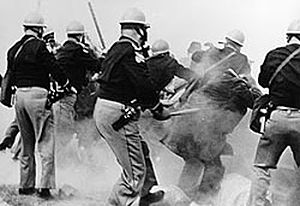
In my childhood, the only black folks I saw other than a blur on the highway, were on television. They were marching in Selma and across the South. And yes, now we are getting to why this post is coming on Martin Luther King Day.

My father called them troublemakers. He liked the phrase “outside agitators”, as well. I disagreed. I looked at the black people being washed down southern streets by fire hoses and said, “They’re right. We’re wrong.”

I didn’t say it out loud. I didn’t say much of anything out loud in those days except, “Yes, sir.” But a few years later when I escaped to college, I had decided for myself that black folks were as good as I was.

Now that may seem a rather obvious decision to you, but a lot of people from my generation and the one that followed never got the message. You see a lot of them now at rallies for a certain orange faced politician.

Martin Luther King and the tens of thousands he represented showed me an alternative to my father’s thinking. I thank them for giving me another option.

555. Calf Quilt

So what, you may ask, is a quilt doing in a writing post?

No writer just writes. My wife and I both discovered quilting in the mid-eighties. For me, it was an art form in which I could satisfy myself. My painting always lacked something, to my eye, but quilts are colorful geometric things with utility. I could make a quilt and not feel artistically inadequate.

For about a decade we have been deeply involved in putting together a quilt show for my wife’s guild every other year. In 2017 I took some time off from this blog, and I may have to do so again this year.

All this is simply to point out that if posts get scarce this month, nothing is wrong. I am just busy with a different piece of my life.

552. Links to Christmas

Tomorrow is the big day, when nobody should be on the internet, so I’ll have my say today. This is the fourth Christmas season since I began this website, and every year I say the same thing. I love Christmas.

I stand with Dickens, who called Christmas “a good time; a kind and forgiving, charitable, pleasant time; the only time I know of, in the long calendar of the year, when men and women seem by one consent to open their shut-up hearts freely.”

Over the years, I have posted many Christmas or Midwinter posts. If you are new to this site, here’s your chance to check some of them out.

My first year I posted a list of Christmas books, covering pretty much every aspect of the holiday. That same year, I talked about Dickens’s five Christmas novellas. Everybody knows A Christmas Carol; here is your chance to check out the rest.

When the ghost of Christmas Past appeared, Scrooge asked, “Long past?” and was told that she meant his past. My own early Christmases on the farm wouldn’t make a Christmas card, but I told about them in Twas the Season, posts 1 and also 2. I also talked about the Nostalgia for those days that never were .

Everyone talks about Mary and Jesus, but what about Jesus and Joseph?

Christmas itself has a history beyond the biblical story. It has always fascinated me, and I summarized what I have learned in three posts from 2016, Old European Christmas, Colonial Christmas, and Here Comes Santa Claus.

In 2016 and 2017, Christmas was overshadowed for my Latin friends by a grinch with an orange face and wild yellow hair. I wrote about Christmas for Lupe two years ago and about Jose, Maria, y Jesus in Trumpland last year. I didn’t have the heart to tackle the current occupant one more time this year. Maybe by next year I won’t need to.

Anyway, whether you check out any of these links or not, Merry Christmas.

549. The Saturn Rockets

Saturn V

This post is called The Saturn Rockets, plural, because there were two if you speak loosely, or three if you are picky. If we were looking at all of the rockets of the Apollo program, we would have to add Little Joe. Getting men to the moon was a complex operation.

The pre-Apollo manned missions used modified military missiles as launch vehicles. Atlas was designated for Mercury, but delays in achieving reliability caused the first two Mercury flights to be sub-orbital on Redstone missiles. Gemini used Titan II missiles throughout the program.

The Saturn rockets are often said to be designed from the start as space launch vehicles, not military missiles. That is a somewhat limited view. The program that eventually produced the Saturns began in 1956 and ran through an amazing number of paper iterations before anything ever left the ground. “Saturn” development was simultaneous with the developments of Atlas, Titan, and other military missiles, and kept changing as those other missiles refined rocket technology.

The same infighting family of scientists and engineers developed Saturn and all American military missiles, the same set of companies built them, and the same government paid for it all. Saturn was developed through NASA and was never planned to carry warheads, but the entire American manned space program was a child of the cold war. The civilian vs. military distinction is a bit of sleight of hand.

By 1959, the possible types of Saturn rockets had been reduced to eight configurations. Eventually three were built.

Saturn I was designed to put spacecraft into low Earth orbit. Saturn V was designed to put men on the moon, and later tasked with launching Skylab. See 297. Skylab 1 and 298. Skylab 2.

Remember Little Joe? That was an existing rocket that was used early to test out the Apollo capsule’s abort mechanism.

Ten Saturn I rockets flew;. Five were in Saturn development flights. Five others carried early, unmanned versions of Apollo spacecraft, as well as Pegasus micrometeorite satellites.

The Saturn I was replaced by the more powerful Saturn IB (shown at left) in 1966. Saturn IB became a workhorse for heavy, low Earth orbit launches.

The first Saturn IB topped by an unmanned CSM was launched in a mission then called Apollo 1. Later, after the deaths of three astronauts in the capsule fire, there was a mass renumbering of past flights in order to call their mission Apollo 1. It was an entirely understandable gesture, but it causes confusion to this day.

Two more Saturn IBs were launched in 1966, then the first Saturn V was launched. The next launch was to test an unmanned LEM in low Earth orbit. That flight fell to the Saturn IB which had been involved in the “Apollo One” disaster, since the capsule fire had not damaged the launch vehicle. Another Saturn V launch in 1968 completed the unmanned phase of Apollo.

On October 11, 1968, the first manned Apollo craft achieved orbit. Manned missions are what we all remember, but by that time there had been seven abort tests, sixteen launches of Saturn I, IB, and V vehicles, and twelve major ground simulation tests.

Apollo 7 was the only manned Apollo mission to use a Saturn IB. Apollo 9 was also a flight to low Earth orbit, but it used a Saturn V because it was  a full, close-in dress rehearsal and first launching of a manned LEM.

The other ten Apollo mission used the Saturn V, cementing a picture of that rocket into everyone’s mind.

After the end of Apollo, a Saturn V launched Skylab. Three subsequent launches of Saturn IBs took up the astronauts who manned it.

The last manned use of Saturn IB was to carry an Apollo CSM to rendezvous with a Soyuz vehicle in 1975.

546. Where Do You Get Your Ideas (1)

Everybody who doesn’t write, wants to know where writers get their ideas. Everybody who writes knows the answer is, “Everywhere,” and also knows that answer won’t satisfy anyone.

I think that those who ask really want to know is where we get the initial idea, the one that sets everything in motion. For instance, I have one like that which I haven’t used yet. It’s a winner for sure. It has hippies and drugs and the . . . nope! I might still write that one, so I’m keeping it to myself.

I’ve actually already told the origin stories of one novel, one series and one fragment. You can check them out if you want. I have one more answer that covers four stories, and that answer is Scrooge.

My fascination with Dickens’s classic began during the Christmas season of 1970. I was a new college graduate, married, waiting for my date to enter the Navy. My immediate future looked grim, and possibly short.

The musical Scrooge was released that year and it went straight to the heart when my wife and I saw it in the theatre. I immediately bought the videotape, even though I had no way to play it at the time. I knew I didn’t want to lose that powerful story of redemption.

In the  years that followed, I read the original story several times, along with the other four Christmas stories that Dickens followed up with in later years. I also made a collection of other Christmas Carol movies, some good, some dull, some awful. Every actor seemed to want to play Scrooge.

Five years after the release of Scrooge, I started writing novels. I concentrated on science fiction and fantasy, but deep down I wanted to write my own Christmas classic. And yes, I know, there are ten million other writers who have had the same idea.

I won’t go into detail, but over the years the idea grew from one story to three.

Nathaniel Gunn returns from a long voyage on a trading ship to Philadelphia in 1791 to find his wife dead from disease and his two children apparently dead as well. Throughout the following Christmas season he gives away his money to the needy around him, but it does his heart and soul no good until he has to give away the one thing that means the most to him.

The children, who are not really dead, make their painful way back from their uncle’s farm toward Philadelphia. Along the way they find themselves taking shelter with a family of Moravian’s, the Christian sect that was that era’s the strongest advocate of Christmas, long before it’s celebration became generally accepted.

These two stories are bracketed by a later story. Nathan, the son, finds himself in New York in 1823 where he befriends the despondent Clement Clarke Moore.

Those stories grew out of a desire to bring early Christmas to the new world, and tie the birth of Christ to the birth of the nation. (The first congress met in New York in 1789 and Philadelphia in 1791, before moving on to the newly built Washington City.)

It needs writing. Maybe someday if I can find the time . . .

Those were literary and historical ideas. Meanwhile, there was a purely visual idea that also came out of Scrooge. I’ll tell you about it in two days.

Continued Wednesday.

540. Where Are the Vets?

Here are some statistics, tailored for those who read this blog. I know most of you are young. I see your pictures on your likes, and I check out your websites.  I’m not young, so I see changes you may not be aware of.

Harry Truman, Dwight Eisenhower, John Kennedy, Lyndon Johnson, Richard Nixon, Gerald Ford, Jimmy Carter, Ronald Reagan, and both presidents Bush all served in the military in wartime. Regan and Bush Two served stateside in wartime; the others all saw combat.

Bill Clinton, Barack Obama, and Donald Trump did not serve.

In the current House of Representatives only 70 of 435 have served in the military. In the current Senate, only 13 of 100 have served. Those numbers will go up slightly with the incoming congress.

Veterans were not so under represented in previous congresses.

These figures relate the the reduced number of persons in the military. That is not quite the same as a smaller military, since the persons now serving tend to spend more years in service. Draftees from previous eras tended to go home as soon as they were allowed to do so.

I come from a long line of draftees. My father served in Europe in WW II, was wounded, and remained during the occupation of Germany. His younger brother was drafted, trained, and was on a ship “heading for Japan to die” (his words) when the US dropped the A bomb. He ended up in the occupation of Japan. I joined the Navy, Vietnam era, but not by choice. My draft number was 41, which meant my number was up (in both senses of the word) before I finished college. And no, I did not see combat.

I hated the draft and I still do, but it had one positive aspect. It leveled the playing field. More Americans had to step up, whether they wanted to or not, and that led to more protests. Without the draft, we would have been in Vietnam much longer.

Today is the hundredth anniversary of the end of WW I. All those veterans are gone. WW II ended in 1945. Very few of the vets from my father’s generation are still around.

America left Vietnam in 1973. Any vet who saw that day at age 18 would be 63 today. That was also the last  year American’s were drafted.

I’m not suggesting a return to the draft, God forbid. I have no particular agenda at all; I just want to give you this to think about.

A country which everyone has to defend, or at least has to stand in jeopardy of military service, is a very different thing from a country that depends on a volunteer military.

Better? Worse? That will be your decision going forward.

======

The numbers in this post come from PBS.

Trump World

I’ve been working on Like Clockwork, my latest steampunk novel. Today I was rereading a chapter from about the middle of the manuscript when this caught my attention. Let me share a few paragraphs.

“But lately it has all been falling apart.”

“You must expect that. Not everyone believed in the Founder’s ideas completely. One little girl didn’t believe at all. After He left, there was no one to answer prayers, and belief doesn’t last forever.”

“Are you saying that You — He — one or both of You  — answered prayers?”

“Of course not. But We did have the capacity to convince people that their prayers were being answered, even when they got the opposite of what they asked for. Any good religion can do that. You people are very easy to convince.”

Okay, I see the uncomfortable resemblance too, but I wasn’t thinking of Trump when I wrote this. Honest!

Then I read on and found another thought two pages later:

“So how do we get our world back to reality?”

“Reality? Never heard of it. You don’t get back to reality, you create reality. Didn’t you understand a word I said? If you want a different reality, tear this one down, and build a new one.”

Now that I can stand behind.

522. First Black Astronauts

Dr. Ronald McNair, Guion Bulford, Frederick Gregory

I recently saw Leland Melvin’s new book Chasing Space and got a chance to look it over. It’s a good book, although in full disclosure I won’t finish it. I read and write for a living. so my time is limited. Additionally, I have already read more than dozen astronaut bios, so this one lacks newness for me, even though it might be just what you are looking for.

It got me thinking about the first black astronaut, if there were such a thing. We all know who the first woman astronaut was — Sally Ride. That is, if we continue our cold war prejudice against the Russians and ignore Valentina Tereshkova.

It would be neat and tidy if there were a first black astronaut, but it isn’t that simple. If you type the question into Google, it will return Guion Bluford. We’ll talk about him in a second, but there were others that came before him.

Ed Dwight was chosen by John F. Kennedy to join the astronaut corps. He was an Air Force test pilot with a degree in aeronautical engineering. While in training, he was the target of racism. When Kennedy was assassinated, Dwight withdrew from the astronaut program. A few years later, continued harassment led him to retire from the Air Force altogether. He became a noted sculptor in a second career.

Robert Henry Lawrence Jr. was the next African-American astronaut. At Edwards Air Force Base, Lawrence investigated unpowered glide return characteristics using an F-104 Starfighter, contributing greatly to knowledge necessary to the Space Shuttle program. He was assigned to the Air Force’s Manned Orbiting Laboratory program, but before he flew in space, he was killed in a crash landing while acting as a pilot instructor to a trainee. When the MOL project was abandoned, many of it’s astronauts transferred to NASA, where they became the backbone of the early Space Shuttle missions. Lawrence would almost certainly have been among them.

The “first black astronaut” falls out this way.

Ed Dwight was the first black astronaut trainee.

Robert Lawrence Jr. was the first black working astronaut. Remember that most of any astronaut’s time is spent in training and on-the-ground research. Actual flight in space makes up a tiny fraction of an astronaut’s career. Lawrence was as much a real astronaut as Roger Chaffee who died in the Apollo One fire just before his first flight.

Guion Bluford was the first black astronaut to actually fly in space in 1983 aboard the Challenger. He participated in four shuttle flights.

We also have to add Ronald McNair to the list of firsts. He was the first black astronaut to die on a space mission, when Challenger exploded. It was his second space shuttle mission.

Before 1978, there had been fifty-some American Mercury, Gemini, and Apollo astronauts and an additional few dozen assigned to other missions. Of, these only Lawrence had been black and there had been no women.

An up-to-date list of black astronauts can be found here. There are fourteen: Guion Bluford, Ronald McNair, Frederick Gregory, Charles Bolden, Mae Jemison, Bernard Harris Jr., Winston Scott, Robert Curbeam, Michael Anderson, Stephanie Wilson, Joan Higginbotham, Alvin Drew, Leland Melvin (whose book started this post), and Robert Satcher.

There are an additional eight who, for various reasons, never flew is space. Lawrence and Dwight are on that list.

I, Too

Here is a poem for the day after the Fourth of July. Langston Hughes wrote this in 1926.

I, Too

I, too, sing America.

I am the darker brother.
They send me to eat in the kitchen
When company comes,
But I laugh,
And eat well,
And grow strong.

Tomorrow,
I’ll be at the table
When company comes.
Nobody’ll dare
Say to me,
“Eat in the kitchen,”
Then.

Besides,
They’ll see how beautiful I am
And be ashamed—

I, too, am America.

Apparently, it isn’t tomorrow yet. But tomorrow is coming, and it’s up to us to help it along.

poem for the fourth

Poem for the Fourth of July

I look out of the mesh
Out of the cage
and I do not see my mother
and I do not see my father.

We are so many here
So crowded
I smell the stench of fear
I hear the low hum of hopelessness

We came for refuge
.          Where is it?

I wrote this poem on June 18th and put it in line to appear on July 4th. When you read this, Zero Tolerance may have been reversed. If not, we all have work to do.

[It has, but only somewhat, and we still have work to do.]