Tag Archives: history

573: Apollo 9: Full and Complete

Apollo 9 was the first mission to fly full and complete: Saturn V booster, CSM, LM, and lunar rated spacesuits. They weren’t going to the moon, but they were checking out all the equipment that would take astronauts there.

Jim McDivitt was Commander, David Scott was the Command Module Pilot, and Rusty Schweickart was Lunar Module Pilot. Those designations are a bit misleading. Flying any part of a mission frequently took all hands. It took two people to land on the moon and the Commander was the lead pilot with the Lunar Module Pilot in something like a co-pilot’s role.

This was to be the first flight by a full fledged LM. (By this time NASA had dropped the acronym LEM because the word excursion seemed frivolous, but civilians and the media still called it the LEM.) A LEM mockup had flown unmanned, but the LM that flew on Apollo 9 had been much updated since then.

Apollo 9 lifted off on March 3, 1969 into low earth orbit. The Saturn third stage and attached CSM and LM were then moved into a slightly higher orbit, where the CSM separated, reversed and performed its first docking. The multipart cone which covered the LM was jettisoned at this time. (See 569, and animation in the film Apollo 13). The Saturn V third stage separated at this time and the combined CSM and LM moved away.

The Saturn V third stage had it’s own work to do. It’s engines were fired again to change the orbit’s apogee (high point). Once apogee was reached, the engines fired again to achieve a solar orbit. This firing did not achieve its proper objective, so a third firing took place later. Practically speaking, this merely got the third stage out of the way, but it also gave NASA a chance to once again check the flight characteristics of the Saturn stage which would, on subsequent missions, place the Apollo mission on orbit to the moon.

Aside: if you plan to read more on these subjects you will run into the terms S-IVB, which is the designation for a Saturn V third stage, and SPS, which is the designation for the rocket engine in the Service Module.

Now the CSM was flying backward in orbit attached to the LM, and the LM had opened its struts to a landing stance. The CSM fired it’s rocket for the first time (docking had been done on maneuvering thrusters), raising the orbit and providing the first test for the main engine.

Aside again: this mission should have happened before sending a crew around the moon. Although most of the events of Apollo 9 were firsts, a few things like firing the CSM’s main rocket had already been done on Apollo 8. However, the ability of the linked-up CSM and LM to fly under power had not been tested before.

The next day, the CSM/LM made three more burns, changing orbits and testing the integrity of the CSM/LM connection.

On the third flight day, McDivitt and Schweickart (with backpacks) transferred from the CM to the LM by way of the tunnel between hatches. The day was spent testing out the LM, including a six minute burn of the descent stage engine. McDivitt controlled the last minute manually, throttling up and down and shutting off the engine, just as astronauts would do on a actual moon landing. All this was performed while CSM and LM remained linked-up.

The fourth day of the flight, McDivitt and Schweickart returned to the LM. Schweickart spent thirty-eight minutes testing his spacesuit outside the vehicle. He had also been scheduled to crawl over to the CM to demonstrate how astronauts could be rescued after returning from a moon landing, should the two craft be able to rendezvous, but not dock. Space sickness made this maneuver impossible, but everything in the hardware itself checked out.

On the fifth day of the flight, McDivitt and Schweickart entered the LM for the third and last time, and separated from the CSM.

That is fifty years to the minute before this was supposed to be posted, assuming that my math and data from several different sources were all correct. Great plan, but my internet went down for three days. If fact, this post is coming out about three hours late, but at least I made it before Friday slipped away.

The major test of the LM descent stage engine had already taken place on day three. Now, it fired twice, first to raise the LM’s orbit and then to make it more circular. This was done to separate adequately from the CSM.

The descent stage of the LM was now jettisoned and the ascent stage engine was fired for the first time. This burn moved the LM ascent stage to 75 miles behind and 10 miles below the CSM. Over the next six hours, the LM ascent stage achieved rendezvous and docking. The astronauts moved back into the CSM, and the ascent stage was released. By remote control, it was ordered to fire its engines one last time and burned up in the atmosphere. The descent stage remained in orbit until 1981.

The remainder of the flight was uneventful. The CM splashed down north of Puerto Rico. The SM burned up on reentry, as would all subsequent SMs.

Almost no one remembers Apollo 9. It wasn’t the first Apollo into Earth orbit and it never went near the moon. It was a working astronaut’s flight, one more incremental testing of equipment. But when it was over, everything was ready for the moon landing.

Well, almost everything. There was still the matter of maneuvering the LM downward into a gravity well and out again, and the matter of getting good enough close-up views of the moon’s surface to be sure a landing could be done. Those would be the task of Apollo 10, in May.

One last aside: The April issue of the magazine Astronomy has interviews by the astronauts of Apollo 9. It just came out and I didn’t have time to read it before posting this.

572. Apollo 9: Spacesuits

Left photo, the first American spacewalk using an umbilicus. Middle photo, the inner layer of a moon rated suit. Right photo, same suit with outer layer, visor, and backpack.

If you have not been following these Apollo posts, here is a quick summary: when three astronauts died on the launch pad, their scheduled flight was renamed Apollo 1. The flight which completed their mission, after much delay, was called Apollo 7 following the original sequence. Apollo’s “2 through 6” never existed.

The next flight, originally Apollo 8, was to be a repeat of 7, but was changed to be the first launch of the complete Apollo package, Control Module, Support Module, and Lunar Module. However, delays in building the LM (or LEM as it was called in the early days) meant that flight could not happen by the scheduled date. The Apollo 8 which actually flew was a different Saturn, different CSM without an LM and different crew. They <flew around the moon>.

The first flight with all parts of the Apollo was pushed back, renumbered to Apollo 9, and flew fifty years ago yesterday, March 3, 1969. A full picture of the shuffling of missions and crews would take more words that even the geekiest reader could tolerate.

=========

Apollo 9 was the second manned flight atop a Saturn V, and the first to have both CSM and LM on board. Jim McDivitt was in command. David Scott was the CM pilot and Rusty Schweickart was the LM pilot. Don’t confuse him with Jack Swigert of Apollo 13.

There were two main objectives for the ten day mission. First was to test the ability of the astronauts to dock the CSM to the LM, to undock and fly the LM separately, both as a complete unit and the ascent stage alone, and to dock the ascent stage to the CSM once again. The second objective was to test out the first American space suit which was not tethered to its mother vehicle.

We will concentrate on the space suit today and look at the testing of the LM on Friday. That will be posted at 3 PM, PDT, fifty years to the minute from the first separation of the LM from its CSM.

=========

The space suits worn by both Americans and Russians had not allowed true freedom. Cooling, power, and life support gasses were never contained in the suits, but were sent to the suits by umbilical connections. As long as the crew was inside the vehicle, this posed no problem. The suits were deflated and for long periods of each mission, helmets and gloves were removed. During launch and return, the suits were again made air tight but were not inflated. There was no need. If the cabin had been breached during those maneuvers, the suits would have continued to provide life support.

I never seen it admitted, but clearly both NASA and the Russians were flirting with disaster through all those early flights. Let me explain.

When the first spacewalks (EVAs, extra vehicular activities) were made by Alexey Leonov and then Ed White, the space suits proved to massively restrict mobility. Leonov could barely get back into his vehicle because his suit had puffed up so much. Ed White only got back into Gemini IV with great difficulty and with the help of fellow astronaut Jim McDivitt.

You can imagine what would have happened on any early fight if there had been a hull breach during a reentry, and the pilot’s spacesuit had suddenly become stiff and unmanageable when every second was critical.

Small glitches kill pilots, as everyone in aeronautics knows.

Five missions after White’s EVA, Eugene Cernan nearly died during a spacewalk because his suit was so unmanageable. See  posts 295 and 296. It took three more EVAs on three missions by three additional astronauts until before spacewalks were brought under control.

All of these EVA’s, Russian and American, used umbilicals to provide life support and to tether astronauts to their vehicles. That was not going to work on the moon.

The development of a suit suitable for moonwalks took seven years. Pressurization, oxygen, and cooling were taken care of by an inner layer that rarely made it into photos. See the middle picture above. The outer layer was a laminate designed to resist abrasion, radiant heat, and micrometeorites. The backpack took the place of the umbilicus and provided power and oxygen.

Backpacks were first tested on Apollo 9 by McDivitt and Schweickart. David Scott performed a standup EVA — that is, he stood up in the open hatch of the CM — but he received life support through an umbilicus. This was the pattern for Apollos 9 through 17. The moon bound astronauts used backpacks, the CM pilot did not.

If the LM tested on Apollo 9 had worked, but the backpack hadn’t, Apollo 11 could still have landed on the moon, but Armstrong could not have left the Eagle to make “once small step . . .”

But it did work. The EVA was cut short by Schweickart’s space sickness, but the backpack worked fine.

more on Apollo 9 Friday

571. Nothing New Under the Sun

There is nothing new under the sun, but the old things keep coming back to poke you in the eye, and it all seems interconnected.

On MLK day I talked about growing up and shaking off racism. Then I talked about America’s love affair with great men who really aren’t all that great.

That led to a back and forth in the comments in which I talked about trying to teach truth in American schools, by using the space program as an example. Meanwhile, I’ve been trying to remind my younger readers of the incredible reality of what was happening fifty years ago in space exploration.

On President’s Day and we looked at the last half century’s sad and depressing crop of leaders.

Then it all came together in one coincidental discovery. I bought a copy of Apollo in Perspective by Jonathan Allday to fill in some gaps in my knowledge, and found this inserted as an epilog:

Men who have worked together to reach the stars are not likely to descend together into the depths of war and desolation. Lyndon B. Johnson, 1958

I need to insert three paragraphs of blank space here, to express my incredulity.

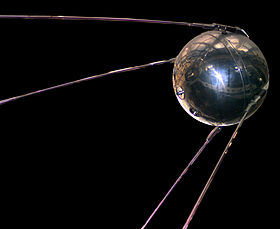
In 1958, Sputnik had just been launched. America was in a panic. The bureaucrats and the military were fighting (as usual) and the result was that American satellites were not being launched. The space program had begun in fear, riding on rockets which had been designed to carry nuclear warheads, and fueled by the terror those same warheads represented. Men were not working together to reach space; countries were working against each other for the best capacity to wage war.

Not only was every word in the quotation a lie, it was all a set of lies that no one could have believed, even then. Every word was the exact opposite of the truth, even as contemporary Americans understood the truth.

And all this from Lyndon Johnson, who would, a decade later, give us the Viet Nam war.

It seems that the greatest of our achievements and the most poignant of our failures remain inexorably intertwined. I guess that’s the human condition, but it’s hard to take sometimes.

570. Lunar Excursion Module

This is the Apollo 9 LEM, photographed after it separated from its CSM. Photographs of either CSMs or LEMs in space are typically nose on, since each could only be photographed from the other (there wasn’t anyone else around to do it), and they only separated in lunar orbit at the outset of a landing maneuver or at rendezvous. Apollo 9 separated in low earth orbit and performed various maneuvers there, making this side-on view, right above the Earth, a rare treat.

Apollo 9 launched fifty years ago March third. That’s a Sunday, and I don’t post on Sunday, but there will be plenty on that mission the following week.

Virtually all of the missions returning from space have returned by atmospheric braking and parachute, or atmospheric braking followed by a winged landing. In the early days of science fiction movies, landings were always tail first but that was not possible on Earth until Elon Musk and SpaceX finally managed it in 2015.

On the moon, there was no choice but to land tail first, slowed by rockets, and the LEM was built around that fact. Learning how to land tail first was also a major issue; see 185. The Flying Bedstead.

The LEM was a two stage rocket. The descent stage, dot-shaded gray in this NASA drawing, made up about two thirds of the mass of the LEM. It contained a frame, tanks with fuel and oxidizer, a rocket engine, and the landing gear. It also contained storage space, accessed from the outside, for the equipment that would be used once the astronauts were on the moon.

The landing gear served multiple functions. The pads at the end of each leg were designed to keep the LEM from sinking into the lunar soil. Their size was both a compromise and a guess. No one knew either how deep the lunar dust was, nor how much structural integrity it had. Worst case scenarios had the LEM sinking hopelessly into many feet of lunar dust, the accumulation of millions of years of micrometeorites pulverizing the lunar surface. In fact, the pads only sank slightly.

The number of unknowns that faced the engineers and mission planners was immense. It it hard for people born since the seventies to imagine the depth of our ignorance before Apollo 11 landed.

The struts were designed to absorb energy, because the LEM could not fire its engines all the way to the ground. The upwash of lunar dust and rocks would have blinded the pilot and possibly knocked holes in the LEM, so the engine was designed to be cut off at a certain height above the lunar surface, letting the LEM fall the last small distance. But how high? That was another calculated estimation (guess). And how much spring would the struts need? Too little and the LEM would crash to the ground. Too much, and it would rebound with possibly disastrous results. And if one leg landed on a boulder or in a hole, the whole LEM might tip over and be unable to return to orbit.

The ascent stage contained crew space, controls, computer, radar, guidance systems, oxygen for human use, and the crew in their space suits. It also contained fuel and oxidizer and its own rocket engine, all smaller than for the descent stage since the LEM ascent stage was one third the size and mass of the complete LEM. The descent stage formed a launching platform for the ascent stage.

When Apollo 17 launched from the moon, a camera was mounted on the rover which was left behind. You can see all 36 seconds of the last ascent stage liftoff from the moon at https://www.youtube.com/watch?v=9HQfauGJaTs.

Apollo 11 proved that all this would work. Apollo 10 was a dress rehearsal of everything but the final landing. But until Apollo 9, fifty years ago this weekend, no one knew if the LEM would work at all.

More next week.

569. Apollo: Profile of a Mission

This is the Apollo 9 LEM, photographed after it separated from its CSM. NASA photograph.

This was originally intended as a detailed picture of the Lunar Excursion Module, but it became clear while writing that before I could talk about the vehicle, I had to lay out it’s place in the scheme of things. This post then became a generic mission profile, and details of how the LEM worked will come in the next post.

If you Google lunar lander, you will find the LEM, but you will also find a lot of forgotten craft. Both the United States and the Russians had unmanned lunar landers and lunar crashers. That’s not a joke. Before soft landing was perfected, we learned a lot about the moon from probes which photographed all the way down to a crash landing. Those piles of rubble that dot the moon were the ancestors of Spirit and Opportunity.

That’s not good enough for a craft that was to be, in the vernacular of the day, man rated.

The LEM, or LM as it is often called today, was unlike any manned craft before or since. It has been called a “true” spacecraft, but in fact it only got half way toward that ideal. A “true” spacecraft, built in space and powered by a low force, long acting engine, would never have to endure the vicissitudes of atmospheric friction or high gravity.

The LEM did have to withstand multiple gravities during its launch from Earth, and again on landing and taking off from the moon. However, it never had to come in contact with atmospheric friction because it spent the launch hidden behind a streamlined clamshell shroud. It didn’t itself have to be streamlined, and its skin could be flimsy. The astronauts joked about being afraid of accidentally putting a boot through the side of the vessel. At least I think it was a joke.

The Saturn 5 is called a three stage rocket. It could as easily and accurately be called a six stage rocket. The first and second stages were designed to burn all their fuel and fall away. The third stage carried the rest of the vehicle into orbit and then shut down; at that point, it’s fuel was not exhausted.

If the mission was to lunar orbit or landing, the Apollo craft stayed in low earth orbit long enough to establish that all was well, then the third stage fired again to send the craft toward the moon.

On Apollo 8, there was no LEM, so in December I only described the Saturn and the CSM. Apollo 9, whose fiftieth anniversary comes in about ten days, had a LEM but never left near Earth orbit. Apollos 10 through 17 were lunar missions. They had similar flight plans and used all “six” stages.

When the Saturn third stage fired a second time, it put the entire remaining craft into a orbit toward the moon. The third stage would have gone right along with the rest to the craft, if it had been allowed to do so.

What happened next on each mission was well presented in the movie Apollo 13, but only if you already knew the what, the when, and the why. It was drama, not documentary, but with excellent animation. If you have a DVD of Apollo 13, take a look.

The LEM, and the CSM (command and service modules, treated as one) had initially been stacked vertically above the third stage, with the LEM protected by a shroud. The attached NASA drawing also shows the abort rocket above the command module, but that had already been discarded by the time the craft was actually on its way to the moon. All three astronauts were in the CM. The CSM, the LEM, the shroud, and the third stage are all still in one piece.

Now the CSM was released; it moved forward on maneuvering thrusters and turned a one-eighty. The LEM was still attached to the third stage. Now the clamshell opened up and the CSM moved carefully forward and docked with the LEM, front of CSM to top of LEM. The LEM was released from the third stage and towed away by the CSM. This position allowed the hatches on the CSM and LEM to mate so the astronauts could move freely between the two craft. The legs of the LEM, previously tucked under to fit within the shroud, now extended into lunar landing positions.

From this moment until lunar orbit was achieved and it was time for the LEM to move away from the CSM and land (or nearly land in the case of Apollo 10), the LEM/CSM were essentially one space craft. The Saturn third stage now made one last burn, changing to an orbit that would carry it out of the way.

For about two and one half days, the LEM/CSM drifted toward the moon. Upon leaving low Earth orbit, the craft had been traveling at close to 25,000 miles per hour. It should have reached the moon in ten hours, but the Earth’s gravity was pulling at it and slowing it down. Approximately six sevenths of the way to the moon, the craft was traveling at it’s slowest speed. At this point the Earth’s gravity and the moon’s gravity were in equipoise; thereafter the moon’s gravity accelerated the craft again.

At a point on the back side of the moon, the SM engine fired, slowing the combined craft enough to keep it from whipping around the moon and returning to Earth. It entered orbit of the moon. This burn, and the later one which put the CSM on its homeward trajectory, make the CSM essentially the fourth stage of the Apollo/Saturn mission.

Now it was time for the LEM to earn its keep.

What’s that you ask? Stages five and six? Where were they? The LEM itself was a two stage rocket. We’ll get details on that next post.

568. Presidents Day

I agonized over this post more than any in memory. I am not completely cynical, and the presidents I address, even the worst of them, also did things worthy of the office. I came back to this post a dozen times after I wrote it to ask myself, “Do I really want to say these things?” The answer is, “No.” But I will say them anyway, because the truth is the truth.

===========

Presidents Day. Humm.

We used to celebrate Lincoln’s birthday and Washington’s birthday, and ignored the rest of them. That wasn’t such a bad system. It allowed us to avoid linking Andrew Jackson with his betters.

How about our recent Presidents? Should we celebrate them?

John Kennedy. I have a friend who grew up in Boston and would punch out anyone who spoke against JFK, but let’s tally up what he really did. He lost the Bay of Pigs by abandoning the Cuban insurgents he had encouraged. He faced Khruschchev over the Cuban Missile crisis so let’s give credit for that, but he also sent Americans to Vietnam. Kennedy supporters claim he would have pulled out, if he had lived, but who knows. The jury will always be out of what might have happened.

Lyndon Johnson. He has massive accomplishments pushing through Kennedy’s programs and his own War on Poverty, but he also lied to the American people, lied to Congress, and conducted a secret war including massive bombings outside Vietnam. He, and Nixon after him, are responsible for over three million unnecessary  deaths. There is no responsible way to avoid calling him a war criminal.

Richard Nixon. Watergate, of course; it hardly needs repeating. He also opened up China and got us out of Vietnam by declaring that our defeat was a victory, and then running like hell. I really don’t know what else anyone could have done by that time, but why did he wait all those years and waste all those lives before telling the Big Lie? Maybe to win a second term?

Gerald Ford. They say his pardon saved the country from division and heartache. I say it only gave later Presidents bad ideas that should have been squelched fifty years ago by trying Nixon for his crimes.

Jimmy Carter. An attack on an embassy is an attack on American soil, but Carter sat impotent in the White House through the Iran hostage crisis.

Ronald Reagan. Tax cuts for the wealthy. Trickle down economics that never trickled down. Also the Iran-Contra affair in which Regan himself avoided punishment but fourteen members of his administration were indicted.

George H. W. Bush. “Read my lips.” Actually, going back on his promise regarding taxes was an act of courage that probably cost him a second term. That honorable act was sullied when he pardoned those convicted in Iran-Contra.

Bill Clinton. Plenty of good ideas, but we just remember him as the man who couldn’t keep his hands to himself.

George W. Bush. “Brownie, you’re doing a heck of a job”, and other stumble-statements too numerous to list and too painful to remember.

Barack Obama. I like the man, but I spend eight years cussing under my breath at some of the foolish things he did.

Donald Trump. I once said I didn’t consider Trump evil, just foolish. Subsequent events suggest that I was probably wrong. His fake declaration of emergency pretty much clinches matters.

Were these the best men in America?

Let’s celebrate President’s Day by taking a hard look at what’s coming our way in 2020. They don’t all look good. Let’s vow to make better choices for the future.

Lincoln and Washington, where are you?

565. Great (?) Men

This post was begun December 5, 2018, before the shutdown, right after watching President Bush’s funeral. Most of the posts from that time until now were already written to make time for some non-writing activities, so I watched the Federal shut-down from the sidelines. I will summarize my take in one sentence.

Another damn-fool stunt by the Damn-Fool-in-Chief.

Now back to December fifth.

=========

As I watched President Bush’s funeral this morning, I was once again struck by an understanding of how Trump became president. I am not going to offer similarities between the two men; I would be hard pressed to find any. I will suggest instead that the nation’s response to Bush One’s death tells us uncomfortable things about hero worship, individual liberty and responsibility, and America’s closet love affair with The Great Man.

America threw off a king in 1776, and has been in the habit of electing would-be kings to the presidency ever since.  They even asked George Washington to become king. He refused. If there has been a president since who didn’t want the powers of a king, I apologize for lumping him in with the rest. I don’t think I will have to apologize to many. Maybe none.

I get that. I also get that without a combination of arrogance and obstinance, and a massive need for power, no candidate would ever get through a campaign. Obama strikes me as a nice guy, someone I would like to know personally, but he had the need. Bush II was touted as the candidate you would most like to have a beer with — and I would, even though I never considered him competent. Vote for Bush II, hell no; share a laugh with him, of course. Bush II had the need. Bush I had the need. They all had the need for power.

You can be pretty sure that any humility shown by any president is feigned. Was Lincoln humble? He appeared humble, but I seriously doubt that he was. Overwhelmed and saddened by what fate had saddled him with, certainly, but a truly humble man would have withdrawn in favor of someone more qualified.

But Presidents don’t believe anyone else could be more qualified; if they did, they would never make it to the White House.

I understand the motivation of Great (?) Men; I don’t really understand why Americans, who otherwise cling to their liberties, continue electing them. Perhaps they are convinced that the alternative to the Great (?) Man is the wimp. Or maybe it’s just the John Wayne syndrome gone wrong.

Here’s what happens. There is trouble in the town. Every man knows what needs to be done. But only one man has the fastest gun and the toughest fists. So (the Lone Ranger) (John Wayne) (Chuck Norris) (millennials, fill in your own selection, I’m out of touch with current heroes) takes care of business because he is The Great Man.

That’s adequate for TV, but not for governing America. Presidential power has been growing at Congressional expense for several decades. Why? Maybe at the core it is because the President is one man and Congress is many. Is it just part of the American myth that the individual stands up to the mob?

Maybe.

I get it — but I don’t buy it.

561. Great (?) Books

The Great Books of the Western World.
Taken 16 February 2005 by User:Rdsmith4

“Here are the most admirable and varied materials for the formation of a prig.”      James Payn, speaking of the Great Books of the Western World.

A prig (in case you didn’t know) is a self-righteously moralistic person who behaves as if superior to others.

=========

If Aristotle said it, it must be true, right? Maybe. Of course, Aristotle’s ideas about physical science held Europe back from progress for a couple of millennia, so maybe not.

According to Aristotle’s view of forced motion (as opposed to natural motion) a body would stop moving when applied forces was removed. This caused his followers much work trying to explain why an arrow didn’t stop moving as soon as it left the bow.

I think we can cut the old guy some slack. Pioneers never get things completely right. On the other hand, too much reverence for old things can really slow progress. Case in point: The Great Books.

When The Great American Read hit PBS, it sent me looking at some old lists of great books, although, to be fair, the GAR was not about great books, but popular books, which is a whole different perspective.

Among the books of lists I checked out was A Great Idea at the Time by Alex Beam, about Encyclopedia Britannica‘s Great Books of the Western World. That consisted of fifty-four volumes containing 443 works by seventy-four authors, all dead, white, and male. I recommend Beam’s humorous look at the intersection of prissy scholarship with American huxterism.

Meanwhile, let’s look at the same issue from a broader perspective. There is a prejudice among the educated that finds wisdom only in great or serious books. If Charles Dickens says it, it is wisdom. If Gordon Dickson says it, it is entertainment.

I don’t buy that. Never did. Don’t plan to in the future. I stand with Brian and Mike Hugg’s song You’re A Better Man Than I . . .

Could you tell a wise man
By the way he speaks or spell
Is this more important
Than the stories that he tells.

While I was researching all this, I ran across a Goodreads review of one of the books I had mentioned, The Novel 100, which included this sentence: “It contains a lot of my own personal favorites, while also including books that I should read.”

Should? Why should? Why read the Great Books, and for that matter, why capitalize them as if they were the Holy Bible?

Robert Hutchins, who was instrumental in producing the Great Books of the Western World (in part to make Great Profits), put it this way:

Until lately the West has regarded it as self-evident that the road to education lay through great books. No man was educated unless he was acquainted with the masterpieces of his tradition. There never was very much doubt in anybody’s mind about which the masterpieces were. They were the books that had endured and that the common voice of mankind called the finest creations, in writing, of the Western mind.

Yeah, right! If it was so “self evident” why was there such a giant fight to decide which books were great enough to go into the Great Books of the Western World?

In terms of ubiquity in the works of later writers, the greatest of the Great Books was the Bible. Adam, Eve, and the Garden — you might be Charles Darwin, and those names and their implications would still be understood. Only Shakespeare comes close to such instant recognition.

Today, it would be hard to find any author with recognition that is both widespread and lasting. Maybe Tolkien; maybe not. There are plenty of writers that everybody reads today, who will be forgotten in a decade. There are probably a few authors whose fame will never die with a small group of readers, but that would  be hard to nail down.

In the “good old days” there was a bit of unanimity on quality (less than Hutchins would have you think), but today’s society has opened outward to diversity in such a way that, while there will always be great books, there will probably never again be Great Books.

Greece and Rome may lie at the foundations of Western Civilization, but really, who has more to offer modern America, Marcus Aurelius or Maya Angelo.

560. We All Learn

Race has a persistent and powerful influence on America for something that really doesn’t exist.

Take the whitest non-albino in America and stand him on the western border of Kansas. Take the blackest black in America and stand him on the eastern border of Kansas. Now line up all the rest of us in a single line, whitest to blackest, in between those two. There would be no break in the continuum.

That should be no surprise to anyone. We have had black slaves (and their descendants) and white immigrants in America rubbing up against one another for four hundred years.

For four hundred years, white DNA patterns have been entering black America through force and black DNA patterns have been entering white America by passing. Lately, that DNA has been going both directions for kinder, gentler reasons.

It’s all been a giant blender — powered at first by hatred and eventually by love —- mixing up the vanilla with the chocolate. There is no use pretending that we are two races any more.

Right!

Try telling that to a white guy. Or try telling it to a black guy.

Clearly, there’s more to the story.

============

When I was growing up in rural Oklahoma in the fifties, the idea of two separate races seemed real and normal, but theoretical.

In my small town and the countryside around there were no black folks. Also no Jews. Nor Mexicans. No Italians either, come to think of it. There was one Catholic family who lived there briefly, but they didn’t last.

It was white, white, white, and Protestant, for as far as the eye could see, with one exception, —— Eddie. I’ll leave it to you to guess what word went into the blank; hint, it began with “N”.

The gentleman didn’t live in my community, but we saw him driving by in his pickup from time to time. He lived somewhere north; I never knew where. I never met him. I only knew him as a blurred, black face in a passing vehicle.

All the adults knew him and spoke well of him. He minded his own business; he took care of his family; he was a good farmer (wherever his farm was); he was quiet and he went his own way.

Now, if I weren’t talking about race, that would sound like a description of The Quiet Man. The archetype. The lone cowboy who rides into town, minds his own business and bothers no one. But don’t cross him because he takes no guff from anybody.

Nope, that’s not it at all. Not even close. But take away the last sentence — the one about “don’t cross him” — and change it to “gives no offense to anyone but quietly backs away”. Now you are closer to the truth. You have just defined the difference between The Quiet Man and Uncle Tom.

The Quiet Man knows his worth; Uncle Tom knows his place. Even growing up in whiteland, with no blacks around, I knew the difference.

============

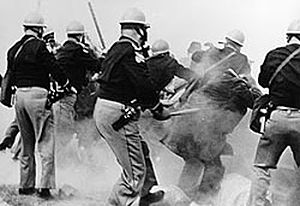
In my childhood, the only black folks I saw other than a blur on the highway, were on television. They were marching in Selma and across the South. And yes, now we are getting to why this post is coming on Martin Luther King Day.

My father called them troublemakers. He liked the phrase “outside agitators”, as well. I disagreed. I looked at the black people being washed down southern streets by fire hoses and said, “They’re right. We’re wrong.”

I didn’t say it out loud. I didn’t say much of anything out loud in those days except, “Yes, sir.” But a few years later when I escaped to college, I had decided for myself that black folks were as good as I was.

Now that may seem a rather obvious decision to you, but a lot of people from my generation and the one that followed never got the message. You see a lot of them now at rallies for a certain orange faced politician.

Martin Luther King and the tens of thousands he represented showed me an alternative to my father’s thinking. I thank them for giving me another option.

552. Links to Christmas

Tomorrow is the big day, when nobody should be on the internet, so I’ll have my say today. This is the fourth Christmas season since I began this website, and every year I say the same thing. I love Christmas.

I stand with Dickens, who called Christmas “a good time; a kind and forgiving, charitable, pleasant time; the only time I know of, in the long calendar of the year, when men and women seem by one consent to open their shut-up hearts freely.”

Over the years, I have posted many Christmas or Midwinter posts. If you are new to this site, here’s your chance to check some of them out.

My first year I posted a list of Christmas books, covering pretty much every aspect of the holiday. That same year, I talked about Dickens’s five Christmas novellas. Everybody knows A Christmas Carol; here is your chance to check out the rest.

When the ghost of Christmas Past appeared, Scrooge asked, “Long past?” and was told that she meant his past. My own early Christmases on the farm wouldn’t make a Christmas card, but I told about them in Twas the Season, posts 1 and also 2. I also talked about the Nostalgia for those days that never were .

Everyone talks about Mary and Jesus, but what about Jesus and Joseph?

Christmas itself has a history beyond the biblical story. It has always fascinated me, and I summarized what I have learned in three posts from 2016, Old European Christmas, Colonial Christmas, and Here Comes Santa Claus.

In 2016 and 2017, Christmas was overshadowed for my Latin friends by a grinch with an orange face and wild yellow hair. I wrote about Christmas for Lupe two years ago and about Jose, Maria, y Jesus in Trumpland last year. I didn’t have the heart to tackle the current occupant one more time this year. Maybe by next year I won’t need to.

Anyway, whether you check out any of these links or not, Merry Christmas.