Tag Archives: history

551. Apollo 8

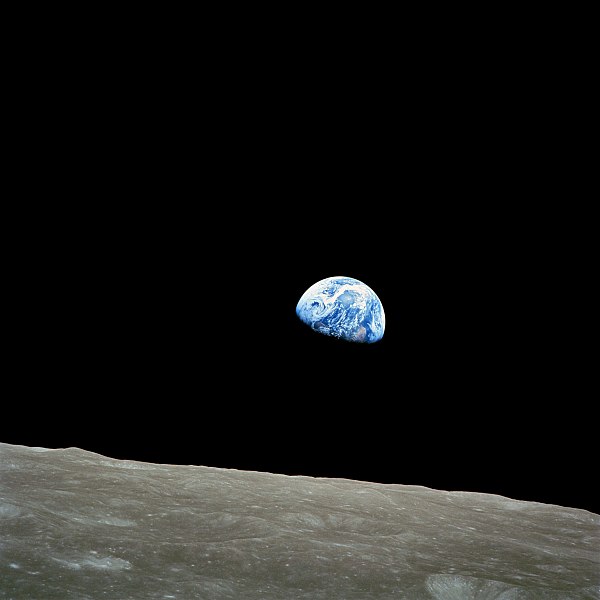
photo taken from Apollo 8

Things always look different in the rear view mirror.

If I were telling the story of Apollo 8 as it was understood when it was happening, it would be a different story than what it looks like today. We in the US knew what we were doing. We suspected what the Russians were doing, and our actions were based on those suspicions.

We were wrong. Here’s what was going on that we did not know then.

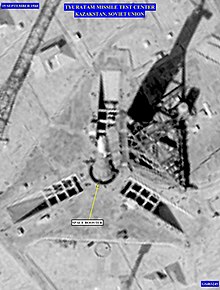
The Russians were developing a rocket, the N1, similar in size to the Saturn V. It was designed to carry two men into lunar orbit and allow one of them to land. America was aware of the existence of the N1, but not in any detail. It had been seen by reconnaissance satellite (shown here), but little else was known. Russia looked much closer to reaching the moon than the facts warranted.

In fact, the first N1 launch attempt came two months after Apollo 8, and was a disaster. There were four launch attempts in all, the last in November 1972, almost three years after Apollo 11. All ended in massive explosions and the N1 program was cancelled.

We didn’t know any of this until decades later. Based on our assessment, the Russians seemed to be on the verge of reaching the moon first, particularly after the delays that followed the Apollo One fire.

The LEM was not ready for use. The next mission was supposed to be in high Earth orbit, but NASA decided to go for broke instead. They changed the Apollo 8 mission, with only a few months to go, from an Earth orbit mission to a circumlunar mission.

On December 21, 1968 — fifty years ago this Friday — Frank Borman, James Lovell, and William Anders launched from Kennedy Space Center.

For anyone younger than sixty, it is impossible to recapture the feeling of the moment. We all know how the story came out, and that will be true over the next few years as a whole batch of fifth anniversaries come and go. At the time these spaceflights took place, no one knew if any of the astronauts would return to Earth alive.

The launch occurred at about eight AM, EST. The first and second stages burned their fuel and fell away. The third stage placed the craft in Earth orbit and remained attached.

The craft spent nearly three hours in near Earth orbit. This was standard; it allowed a full post-launch check before the craft’s irreversible journey to the moon began. Return to Earth from an aborted mission remained a possibility until the third stage fired again.

Once the third stage had fired, the CSM separated and rotated to have a view of the third stage and the retreating Earth. Having the spacecraft and the unmanned third stage on the same orbit was no part of the plan, so after five hours, the third stage vented its remaining fuel changing it to a different orbit that would not get in the way of the CSM.

The rocket in the Service Module was not used on the way to the moon. It could not be, for reasons that will be explained when we look at Apollo 9 in late February.

After nearly three days, Apollo 8 reached the vicinity of the moon. The Service Module engine fired for the first time, slowing the craft to place it in lunar orbit. The famous Earthrise photo at the top of this post was taken shortly thereafter. During the next twenty hours, Apollo 8 orbited the moon ten times. Then the Service Module engine fired again, sending them back to Earth to land in the Pacific on December 27th.

The lunar orbits took place on Christmas Eve and Christmas day. While in orbit, the astronauts read the first ten verses of the book of Genesis in a TV broadcast to Earth.

I have never been comfortable with that action. I recognize the need to comfort and unify the country at the end of a troubled year, and the need to set America apart from Russia. After all, Khrushchev had stated the Russian position when he said, “Gagarin flew into space, but didn’t see any god there.” And, despite those of us who disagree, America is demographically and historically a Christian country.

Nevertheless, why Genesis, the part of the scriptures most quoted by those who would hold back science? They would have been better to follow the lead of Linus van Pelt and quote Luke 2: 8-14. It was Christmas, after all.

The went, they orbited, and they returned. It doesn’t sound like much if you put it that way, but there was an additional factor. What if they didn’t make it back?

By the time of Apollo 8, eight astronauts had died in training or in on the launch pad. All those deaths were virtually instantaneous, but death in space could come another way. Astronauts could become stranded, unable to return.

That problem had been well understood from the first. During John Glenn’s first flight, my father, an Oklahoma farmer who considered the space program a complete waste of time and money, left his tractor in the field and went in to sit for hours in front of the television. He said later, “I just had to get that old boy back on the ground before I could go back to work.”

America had held its breath before, but going to the moon upped the ante. The possibility of three men being trapped in lunar orbit and unable to return was on everybody’s mind during Apollo 8. With subsequent moon landings, everybody worried about men being trapped on the moon, and unable to return.

It all turned out well; we know that now. But to have a sense of how it felt to those of us who watched it in real time, you have to factor in the fear of complete disaster.

549. The Saturn Rockets

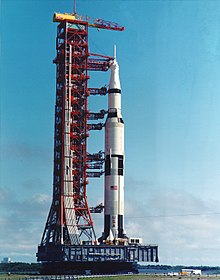
Saturn V

This post is called The Saturn Rockets, plural, because there were two if you speak loosely, or three if you are picky. If we were looking at all of the rockets of the Apollo program, we would have to add Little Joe. Getting men to the moon was a complex operation.

The pre-Apollo manned missions used modified military missiles as launch vehicles. Atlas was designated for Mercury, but delays in achieving reliability caused the first two Mercury flights to be sub-orbital on Redstone missiles. Gemini used Titan II missiles throughout the program.

The Saturn rockets are often said to be designed from the start as space launch vehicles, not military missiles. That is a somewhat limited view. The program that eventually produced the Saturns began in 1956 and ran through an amazing number of paper iterations before anything ever left the ground. “Saturn” development was simultaneous with the developments of Atlas, Titan, and other military missiles, and kept changing as those other missiles refined rocket technology.

The same infighting family of scientists and engineers developed Saturn and all American military missiles, the same set of companies built them, and the same government paid for it all. Saturn was developed through NASA and was never planned to carry warheads, but the entire American manned space program was a child of the cold war. The civilian vs. military distinction is a bit of sleight of hand.

By 1959, the possible types of Saturn rockets had been reduced to eight configurations. Eventually three were built.

Saturn I was designed to put spacecraft into low Earth orbit. Saturn V was designed to put men on the moon, and later tasked with launching Skylab. See 297. Skylab 1 and 298. Skylab 2.

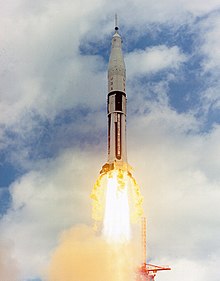
Remember Little Joe? That was an existing rocket that was used early to test out the Apollo capsule’s abort mechanism.

Ten Saturn I rockets flew;. Five were in Saturn development flights. Five others carried early, unmanned versions of Apollo spacecraft, as well as Pegasus micrometeorite satellites.

The Saturn I was replaced by the more powerful Saturn IB (shown at left) in 1966. Saturn IB became a workhorse for heavy, low Earth orbit launches.

The first Saturn IB topped by an unmanned CSM was launched in a mission then called Apollo 1. Later, after the deaths of three astronauts in the capsule fire, there was a mass renumbering of past flights in order to call their mission Apollo 1. It was an entirely understandable gesture, but it causes confusion to this day.

Two more Saturn IBs were launched in 1966, then the first Saturn V was launched. The next launch was to test an unmanned LEM in low Earth orbit. That flight fell to the Saturn IB which had been involved in the “Apollo One” disaster, since the capsule fire had not damaged the launch vehicle. Another Saturn V launch in 1968 completed the unmanned phase of Apollo.

On October 11, 1968, the first manned Apollo craft achieved orbit. Manned missions are what we all remember, but by that time there had been seven abort tests, sixteen launches of Saturn I, IB, and V vehicles, and twelve major ground simulation tests.

Apollo 7 was the only manned Apollo mission to use a Saturn IB. Apollo 9 was also a flight to low Earth orbit, but it used a Saturn V because it was  a full, close-in dress rehearsal and first launching of a manned LEM.

The other ten Apollo mission used the Saturn V, cementing a picture of that rocket into everyone’s mind.

After the end of Apollo, a Saturn V launched Skylab. Three subsequent launches of Saturn IBs took up the astronauts who manned it.

The last manned use of Saturn IB was to carry an Apollo CSM to rendezvous with a Soyuz vehicle in 1975.

548. Victorian Steampunk?


Please note that Serial is back temporarily, to present the short story by Dickens which was a predecessor to A Christmas Carol. It starts today. Check it out.


=======

The Victorian era — was there such a thing?

Victoria became Queen in 1837 and died in 1901, a reign of just short of sixty-four years. Everything in Britain changed in that time except the Queen, so does the phrase Victorian Era have any real meaning?

If you are going to write steampunk, that is a fair question. Of course steampunk usually takes place in an alternate Victorian era — sometimes extremely alternate — but you have to have at least a reasonable knowledge of the original if you are going to mimic it.

Most of us get our history everywhere but a history book, so let’s see what fiction we can use to subdivide the era. Jane Austen, the Brontes, and the Queen were born only a few years apart, so if you enjoy those authors, you are reading about the early Victorian period. Not my wheelhouse, but to each his own.

More to my taste, Charles Dickens’s first novel was published in 1837, the year Victoria became queen. His last novel (uncompleted) and his death took place in 1870. At that time Victoria still had three decades to live.

The Dickensian era is almost as widely known as the Victorian. In full disclosure, I have read all of Dickens’s Christmas novellas — A Christmas Carol several times — but his larger works tend to defeat me. I think I was inoculated against them by being force-fed Great Expectations at too young an age.

Not everyone reads Dickens by choice, but everyone knows what Dickensian means. Judith Flanders in The Victorian City, said:

Today “Dickensian” means squalor . . .(Dickens was) the greatest recorder the London streets has ever known — through whose eyes those streets have become Dickensian . . .

She got it right for her literary audience, but wrong for those who never read a Dickens novel that they weren’t forced to read. Dickensian, to the average Joe (or Joan) means carolers in fancy dress, Scrooge redeemed, Tiny Tim getting a second chance at life, and a village of quaint houses for the Christmas mantle. The actual harshness of Dickens’s other novels is excluded.

The squalor and the sweetness: that is the dual heritage that steampunk authors have to work with if they set their works in variations of the early Victorian period.

As I explained last Wednesday, Like Clockwork is derived from A Christmas Carol, although it morphed into something very different from a Christmas novel. I don’t think Dickens would recognize my London at all.

========

From 1870 when Dickens died, until 1901 when Queen Victoria died, the world became a very different place from the home of Scrooge, Tiny Tim, and Oliver Twist. The industrial revolution changed the world into something much closer to the present.

You might choose Jules Verne as the author that most represents this era, but not if you are concentrating on England. Verne would be the right literary reference for a steampunk novel set in the La Belle Époque, Paris. If you know of such a work, send me the author and title. I would love to read it.

My earlier steampunk novel, The Cost of Empire, travels across five continents by dirigible, but much of the action takes place in London. For that time period in London, there is only one literary creature who is in everyone’s DNA; not an author, but a character who is more real to most of us than the author who created him — Sherlock Holmes.

Holmes first case, A Study in Scarlet, was published in 1887, and there were flashbacks to earlier cases. His Last Bow was on the eve of World War I. This neatly fills in the rest of the Victorian era and spills over into the Edwardian.

Gender gets involved here. Dickens appeals, or doesn’t appeal, to men and women alike. The rest of British popular literature, contemporary to the era (not historical fiction) is largely gender biased, with Austen and the Brontes for the gals, Kipling, Buchan, and Conan Doyle for the guys.

In other words, if you are a guy (guilty as charged) and you consider Victorian characters, you are more likely to think first of Sherlock Holmes than of Elizabeth Bennet — or even Mr. Darcy.

When I first became involved in the Victorian era, after becoming interested in steampunk, my knowledge of everyday life in London came largely from multiple readings of the canon. That is what Holmes fans call the fifty-six stories and four novels written by ACD himself.  My internal vision of Victorian London was that which could be seen from 221b Baker Street, even though Sherlock himself never makes an appearance in my writings.

Yet.

========

If you want a reference book for each era, I recommend:

For the early Victorian period — The Victorian City by Judith Flanders. She gives a modern scholar’s look at the reality behind the world that Dickens wrote about.

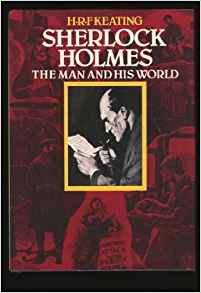
For the late Victorian period — Sherlock Holmes: the Man and his World by H. R. F. Keating. He provides commentary on Holmes’s world, with contemporary photographs of scenes from the canon.

Back for Now

On September fifth I temporarily closed out Serial. The reason was:

It has been three years, almost to the day, and I’m out of stuff.

I’m still out of stuff, since all my recent writings are looking for more traditional publishing opportunities, but I reserve the right to bring Serial back to life  long enough to bring in ringers like:

The Story of the Goblins Who Stole a Sexton
by Charles Dickens

This is the short story that later became A Christmas Carol. I will be presenting it in Serial in eight installments, starting Monday.

546. Where Do You Get Your Ideas (1)

Everybody who doesn’t write, wants to know where writers get their ideas. Everybody who writes knows the answer is, “Everywhere,” and also knows that answer won’t satisfy anyone.

I think that those who ask really want to know is where we get the initial idea, the one that sets everything in motion. For instance, I have one like that which I haven’t used yet. It’s a winner for sure. It has hippies and drugs and the . . . nope! I might still write that one, so I’m keeping it to myself.

I’ve actually already told the origin stories of one novel, one series and one fragment. You can check them out if you want. I have one more answer that covers four stories, and that answer is Scrooge.

My fascination with Dickens’s classic began during the Christmas season of 1970. I was a new college graduate, married, waiting for my date to enter the Navy. My immediate future looked grim, and possibly short.

The musical Scrooge was released that year and it went straight to the heart when my wife and I saw it in the theatre. I immediately bought the videotape, even though I had no way to play it at the time. I knew I didn’t want to lose that powerful story of redemption.

In the  years that followed, I read the original story several times, along with the other four Christmas stories that Dickens followed up with in later years. I also made a collection of other Christmas Carol movies, some good, some dull, some awful. Every actor seemed to want to play Scrooge.

Five years after the release of Scrooge, I started writing novels. I concentrated on science fiction and fantasy, but deep down I wanted to write my own Christmas classic. And yes, I know, there are ten million other writers who have had the same idea.

I won’t go into detail, but over the years the idea grew from one story to three.

Nathaniel Gunn returns from a long voyage on a trading ship to Philadelphia in 1791 to find his wife dead from disease and his two children apparently dead as well. Throughout the following Christmas season he gives away his money to the needy around him, but it does his heart and soul no good until he has to give away the one thing that means the most to him.

The children, who are not really dead, make their painful way back from their uncle’s farm toward Philadelphia. Along the way they find themselves taking shelter with a family of Moravian’s, the Christian sect that was that era’s the strongest advocate of Christmas, long before it’s celebration became generally accepted.

These two stories are bracketed by a later story. Nathan, the son, finds himself in New York in 1823 where he befriends the despondent Clement Clarke Moore.

Those stories grew out of a desire to bring early Christmas to the new world, and tie the birth of Christ to the birth of the nation. (The first congress met in New York in 1789 and Philadelphia in 1791, before moving on to the newly built Washington City.)

It needs writing. Maybe someday if I can find the time . . .

Those were literary and historical ideas. Meanwhile, there was a purely visual idea that also came out of Scrooge. I’ll tell you about it in two days.

Continued Wednesday.

545. Lottery Day at the Big Casino

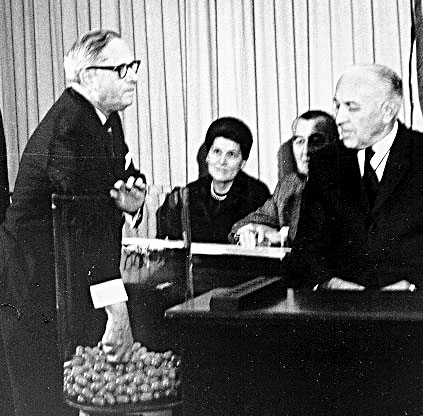
Rep. Pirnie draws the first number.

The place was a class at Michigan State University, just about this time fifty years ago. I wasn’t in the room, so I may be wrong on a few details, but the basic story spread quickly all over campus.

The professor was a young radical. There were a lot of those at MSU in the late 60s. Finals were near when he announced that grades would be given out a little differently this year. He opened a notebook and began to call roll. As he did, an assistant drew notes from a bowl. The professor read, “Adams.” The assistant took a folded paper from the bowl, opened it, and said C. The professor read, “Baker,” and the assistant said F.

As you may guess, it left the room in an uproar. I’m sure the actual grades were given in the normal manner, but the young professor had made his point.

About a week later, a similar lottery took place nationwide, televised, and determined life or death for thousands of young Americans. I was listening closely, because I was a contestant. It was the first draft lottery since World War II.

There were three of us paying attention, my two college roommates and I. One of them didn’t have to worry; he had blown his knee out as a high school wrestler and was 4-F. That’s a medical deferment. The other roommate and I were on student deferments, but we were both going to graduate in June. He drew a high number and never served. I wasn’t so lucky.

I have said often that the draft leveled the playing field. It was a favorite saying in that era that Viet Nam was a war where black people were sent to kill yellow people for the sake of white people. Without the draft, that would have been even closer to the truth.

I wasn’t feeling so charitable when that bastard got to my birthday and pulled a 41.

Ain’t it fun to gamble in the big casino?

544. Apollo 7

We are coming up on the fiftieth anniversary of the first moon landing.

Apollo One, the fire on the pad that caused the deaths of Grissom, White and Chaffee, took place February 21, 1967, causing a long delay. About a year and a half later things were just getting back up to speed. Apollo 7, the first successful manned flight took place on October 11, 1968.

The fiftieth anniversary of that flight was about a month ago, and I missed posting about it. That’s hard for me to believe, since I have been following the space program since 1957.

Purchased today, foot to butt kit, for self-application, apply immediately.

Apollo 7 is too important to simply mention, and too controversial for someone out of the loop to cover with authority. Nevertheless, here is a thumbnail.

Mission Commander Wally Schirra’s attitude toward NASA after the Apollo one disaster was — not positive. The space program had grown into a massive source of funds for companies. Engineers and the builders in the trenches were fully committed to excellence, however top brass decisions were sometimes questionable. The choice of North American Aviation to build the Command Module was controversial. McDonnell Aircraft had built the Mercury and Gemini craft, and many pointed out that the shift to North American Aviation wasted the talent and experience that had made the space program a success so far.

To put it bluntly, the Apollo Command Module NAA originally turned out was a lemon, and everybody knew it.

During the year and a half from the disaster to the launch of Apollo 7, Wally Schirra made it his personal mission to see to it that the craft he and his fellow astronauts were to ride in was of top quality. He was abrasive and relentless, and when Apollo 7 flew successfully, it was largely because of his persistence.

The flight, which he considered an engineering test mission, was cluttered up with scientific and PR projects. When they interfered with testing out the craft, he refused to do them. In space, where nobody could override his decisions. His acerbic interchanges with ground control would have banned him from future missions, but he had already announced that he would retire at the end of the flight. What could NASA do?

Apollo 7, the first manned Apollo mission, was an engineering success but a failure in personal politics. Eisele and Cunningham were never allowed to fly again, but the subsequent missions had a CSM that they could trust.

Wally Schirra became the only astronaut to fly on Mercury, Gemini, and Apollo missions.

======

I have recently worked out a series of posts covering events in the run-up to the moon landing. As I was doing so, I also became aware of another, less joyful anniversary. Since it took place on December first, which is a Saturday this year, I will skip Wednesday’s post and fill you in this Friday.

541. Who is Balfour?

If there is a single characteristic of Steampunk that stands out as nearly universal, it is the use of changed versions of real persons. For instance, in The Cost of Empire, I made some fundamental changes in the British royal family (Victorian era) to get the Prince of Wales I needed for the story.

In Like Clockwork, there are quite a few alternate real people who pop up at the very end, but the most important is Balfour who is one of the main characters. You met him just before and on Halloween. Today we find him ruminating on what he has learned.

#     #     #

What do you do the day after your alter ego calls you out? Balfour spent the day in bed.

First he replayed the moment Hyde — he still thought of him as a separate person — had said, “Why now? Why not now?” It was a valid observation, but it missed the point. For endless iterations of the year, Balfour had not remembered.

“Why now?” was a valid question, and Hyde had not answered it. Why not yesterday, or a year ago, or a hundred years ago? How could Balfour change in a changeless land? Or was the land itself finally beginning to change?

Balfour took The Strange Case of Dr. Jekyll and Mr. Hyde from the shelf where it had lain unread and unremembered. He spent some time with it. It now seemed cumbersome and circuitous, but the ghost of Hyde had understood it well. It was a piece of rebellion against his father’s religion and a piece of youthful arrogance, all jumbled together.

Balfour remembered other books he had written, or Stevenson had written, now that the dam against memory had partially broken. He remembered his youthful travelogues, and he remembered Treasure Island, the book that had made him rich. When he wrote Kidnapped he had finally given David Balfour one of his own names, and now he was using it again. He thought fondly of that character, and fondly of his young self, so far in the past that even the memories were ghostly.

He remembered Edinburgh and thought, “London is not my town. Give me Auld Reekie any time, with its narrow twisted streets stretching from Holyrood to the Castle.”

He remembered Fanny, his wife, and how hard it had been to win her. He remembered her children. He had written a book of poems for them, and for all the other children of the world.

He remembered a race of dark skinned people who had found him strange, but had made him one of their own. He also remembered a single poem written on a grave in that hot and humid land.

Under the wide and starry sky,
Dig the grave and let me lie.
Glad did I live and gladly die,
And I laid me down with a will.

It was a lie. He had not laid himself down with a will. He had laid down in exhaustion after a lifetime of fighting tuberculosis, happy to have the pain stop and happy not to face once more the terror of being unable to breathe; but not happy to let go of the life and the people he had loved.

Robert Louis Balfour Stevenson was born in 1850, and now he was living in an eternal 1850, not as an infant, but as a grown man with the accomplishments of a lifetime behind him.

A whole lifetime. A lifetime that tunneled all the way from that squalling infant in Scotland to a tombstone on a mountaintop in Samoa.

How could that be?

He had some of the memories of Stevenson, but the man himself had lived and died, and surely was no more. Hyde, who lived in his soul, had said to call himself Stevenson, but what was he really? Not the man himself; at best, a shade of the man. A memory, lying in bed, remembering.

He squirmed and groaned, and fought with those memories that were his, and yet were not his.

The first memory he could call his own, separate from Stevenson, was this room. He had no memory of choosing the Clock in the time Before. Whatever had brought him here, it was by a different path than any other citizen of this new London had taken.

Whatever else he was, he was Balfour, and he had been Balfour for endless iterations of the year. He had a face that looked like the face on the cover of Stevenson’s books. He had a lean body that served him well. Stevenson had been sickly, consumptive, and Balfour was not.

The man — or the shade of the man — who had passed from Edinburgh to Samoa, wracked with tuberculosis, fighting weakness all the way, through poverty to riches, from obscurity and parental disapproval to universal fame, was not content to leave things the way they were.

He was not truly Stevenson and this was not truly 1850 by a wide margin. He was Balfour, and he was ready to do battle once again to find out what it all meant.

Curious? Sure you are. Want more? It’s coming.

540. Where Are the Vets?

Here are some statistics, tailored for those who read this blog. I know most of you are young. I see your pictures on your likes, and I check out your websites.  I’m not young, so I see changes you may not be aware of.

Harry Truman, Dwight Eisenhower, John Kennedy, Lyndon Johnson, Richard Nixon, Gerald Ford, Jimmy Carter, Ronald Reagan, and both presidents Bush all served in the military in wartime. Regan and Bush Two served stateside in wartime; the others all saw combat.

Bill Clinton, Barack Obama, and Donald Trump did not serve.

In the current House of Representatives only 70 of 435 have served in the military. In the current Senate, only 13 of 100 have served. Those numbers will go up slightly with the incoming congress.

Veterans were not so under represented in previous congresses.

These figures relate the the reduced number of persons in the military. That is not quite the same as a smaller military, since the persons now serving tend to spend more years in service. Draftees from previous eras tended to go home as soon as they were allowed to do so.

I come from a long line of draftees. My father served in Europe in WW II, was wounded, and remained during the occupation of Germany. His younger brother was drafted, trained, and was on a ship “heading for Japan to die” (his words) when the US dropped the A bomb. He ended up in the occupation of Japan. I joined the Navy, Vietnam era, but not by choice. My draft number was 41, which meant my number was up (in both senses of the word) before I finished college. And no, I did not see combat.

I hated the draft and I still do, but it had one positive aspect. It leveled the playing field. More Americans had to step up, whether they wanted to or not, and that led to more protests. Without the draft, we would have been in Vietnam much longer.

Today is the hundredth anniversary of the end of WW I. All those veterans are gone. WW II ended in 1945. Very few of the vets from my father’s generation are still around.

America left Vietnam in 1973. Any vet who saw that day at age 18 would be 63 today. That was also the last  year American’s were drafted.

I’m not suggesting a return to the draft, God forbid. I have no particular agenda at all; I just want to give you this to think about.

A country which everyone has to defend, or at least has to stand in jeopardy of military service, is a very different thing from a country that depends on a volunteer military.

Better? Worse? That will be your decision going forward.

======

The numbers in this post come from PBS.

539. Alien Space Bats

If you have never heard the term Alien Space Bats, join the club. I found it while searching for an illustration for this post, originally titled deus ex machina. Alien Space Bats was a better title, so I changed it. ASB refers to impossible points of divergence in alternate history stories, as in, “It would take alien space bats intervening to make this story fly.” In short, it is a funnier way of saying deus ex machina.

Deus ex machina translates roughly as the God in the Machine, referring to an event in a Greek play wherein a God is literally lowered onto the stage to explain why everything happened as it did. It is all about plausibility and timing.

If, as a writer, you drag something into the story at the last minute to explain what has been going on, you are likely to be subject to ridicule, and deus ex machina is the phrase critics will use as a club to beat you with.

I ran into a variation of this back in the Precambrian, when I was in grad school. The class was on Indian history and culture. That is South Asian Indian, not Native American. We read a story in which the hero suffered terrible tribulations and at the very end it was revealed that he had done something bad in a previous life, and that was why all these things had happened to him.

My fellow students cried deus ex machina. I disagreed. If you were a Hindu, practicing or not, this story would have sounded reasonable. The bad things that happen to Hindus in this life are all explicable; they are all because they did something wrong in a past life and there is no point in moaning about it. As in life, so in literature.

It’s actually quite Christian, in a twisted sort of way. Fundamentalists don’t look to something individuals have personally done wrong, but to original sin to tell us why the bad things happen to good people.

Nowadays, New Age thinkers (?) have stood this on its head. You hear it everywhere, “Everything happens for a reason,” by which they mean that good will come from every apparent tragedy. It is undoubtedly the least intellectually valid cliché of the twenty-first century — but that’s a whole different sermon.

Now if you are or want to be a writer — and why would you be this far into this post if that weren’t true — you are the God and your computer is the machine. So ask yourself, why do bad things happen to your characters?

Metaphysically, you may be working out some personal trauma. Practically, you can’t have a plot without tension. But when it comes right down to it, neither of these is of any interest to your reader.

Your reader takes your story and temporarily treats it as real. When he reaches the point that he can’t do that any longer, he closes the book and you’re through.

So the question is, in your story, why do these things happen to your hero? In a thriller, it may be easy. His (or her) wife, husband, daughter, boss, company, governmental agency, or law firm has done something wrong and that is the reason your hero is on the run. Motivation is set from the get-go and the thriller formula becomes a matter of clever events to carry him/her through her/his tribulations.

If your hero has brought the troubles on himself, things get a little more interesting. If he/she has complicating factors and cross-motivations, even better, but you have to dribble all this out as you go along. You can’t do it as an info dump at the beginning and you can’t do it as a cheaters dump at the end. And in our world, a cheaters dump is a more honest word for deus ex machina.

You might get away with it in ancient Greece, but not in America today. Nor — recognizing that half the people reading this post are not from the USA and a fourth of them are from India — in any place where western style literature is the norm.

This is the game we have all agreed to play, so there is no point in whining about the rules.

If you have a reason for the things that happen in your story, but you don’t give hints along the way — if you save it all up for that dramatic reveal and dump it all on your reader at the very end, you’re on your own. I can’t help you.