Tag Archives: memoir

389. Pilgrim Son (1)

Pilgrim Son by John Masters is the third in a trio of memoirs. The first two are about his life in the British Indian army, the last is about becoming a writer.

As I said earlier, I first read Pilgrim Son in the late 70s, about the time I was writing Spirit Deer. I was impressed by Masters professionalism. I expected professionalism from the publishing industry —  the phrase publishing industry suggests that it is run in a businesslike manner. Within a few years, I decided that was a myth.

I recently went back to Pilgrim Son and reread it, looking for the point at which he rails against the industry for not recognizing that his first novel would be successful. I spent many hours and did not find the quotation, so I will tell you that he said something like this: If Nightrunners was good enough to be chosen for book clubs, then why did every editor who read it fail to know this? Quote, more or less.

Pilgrim Son is 383 dense pages, much of which is dedicated to Masters observations on becoming an American in the late 40s and early 50s, while living in a colony of bohemian artists and writers. That world no longer exists.

I can’t recommend the book to everyone. Nevertheless, if you are a serious would-be or beginning writer, you could do worse. For you, I will drop approximate page numbers from time to time in order to help you find the parts of the book which will be most useful to you.

The book Masters was writing at the beginning of Pilgrim Son was Bugles and a Tiger; its original title was Brutal and Licentious, part of a then well known quotation. I will call it Bugles  . . . or Brutal . . . as he does, according to which part of Pilgrim Son I am referring to at the moment. Sorry if that confuses you.

#                             #                            #

Around the beginning of 1948, John Masters had settled down to write. This included discussing his prospects with several editors of his acquaintance, and receiving their advice.

Beginning writers will now be reaching for their favorite means of suicide or homicide at the notion that Masters got to talk to and receive advice from editors before he had written anything. It does help to have friends in high places — or so I am given to understand. I never had any myself.

Those editors suggested that he begin with a memoir of his life in India, somewhat following the pattern of Lives of a Bengal Lancer. (page 106, but also check out pp. 104-5) Masters disliked that book, but took what he could from it in planning his own. Planning was second nature to him, learned as a British Army officer, so he soon knew what every chapter of Brutal . . . was going to contain. Then it was time to write.

Masters says: I pulled myself together. The first chapter was only going to be twenty-five pages and I could manage that. The the next . . . and the next . . . One chapter at a time, I could do it. The book as a whole and each chapter had been shaped by the master plan. Now I must concentrate on each page, each line.     page 112

Masters finished the first draft and read it through. He didn’t like it. Lots of beginning writers have reached that stage. Masters had learned that an excellent plan does not always result in excellent execution.

It’s what he did next that makes him interesting. In his own words, somewhat shortened:

A more experienced author might have been able to avoid these errors, but for me there was no way but to replan in the light of what was there on paper. …. Find out how it happened, first, and then remedy it.

I divided several sheets of paper into lines and columns and went carefully through the MS, grading each sequence in three ways: by length, by type, and by merit of its type. It soon developed that almost every sequence could be classified as Action, Explanation, Color, Characterization or Thought. When the job was done, and it took several day’s hard work, my new charts revealed a very lumpy texture in the book. Page followed page of action, with no explanation and little color. Color was not used as a background to action or as a perimeter to characterization, but haphazardly, as the pictures had come to me. Although I could grade some sequences A, too many were B’s and C’s: not good enough for a professional.

 . . . Using my charts to correct the early faults, I rewrote the first two chapters.  . . . .  

I’ve never been quite that organized myself, but I have gutted and rebuilt many hundreds  of pages. Pilgrim Son review continues tomorrow.
384. How to Sign an Ebook

I was involved in a book signing years ago, and had/will have two at Westercon. [Two weeks from now as I write this, one week ago as you read it.] Which begs the question — how do you sign an eBook? I’ll answer that below, but first . . .

Jandrax came out in 1978, and the Stacey’s book store in the local mall invited me to do a signing.

READERS PLEASE NOTE: THIS POST HAS BEEN HIJACKED BY REALITY.

After writing that last sentence, I did a quick internet search to see what happened to Stacey’s. I knew it disappeared later, but I couldn’t remember what year. I discovered that my Stacey’s was a spin-off of the well known San Francisco store and I had to work my way through obituaries to that great institution. I finally found someone who knew the fate of my local store. It closed in 1994. To quote my source

 . . . in 1994, Borders and Waldenbooks joined forces – and like a tidal wave of orcs, they swept across the land, mercilessly engulfing independent bookstores. Ashes to ashes, Stacey’s.  RIP, The Bookstore in Modesto.

Waldenbooks? I had completely forgotten them. They used to be at the other end of the mall, but they too are gone with the wind. I liked that store. I also liked both of the Borders stores that were within driving distance. Barnes and Nobel wiped them out years ago.

The upside is that Barnes and Nobel is also a fine bookstore with two local outlets. Today it is beleaguered by Amazon. If they go I’ll miss them, too.

I also miss The Bookstore, a true independent in another location across town. It was replaced by a Christian bookstore. The Christian bookstore went out of business later. Apparently, not even God can fight The Big Book Monopoly.

Because I like old books, and because I am usually short of cash, I shop at used bookstores. There are half a dozen in my five county area, but I also know of another ten, all of which have gone bankrupt in the last two decades. Ironically, when I want an old book that isn’t available locally, I buy from used bookstores on the internet — brokered by Amazon.

If you want to buy my latest novel, Cyan, you have to go to Amazon for now, where you can download it or order it in paperback. On July 17 it will become available everywhere. That is, everywhere on the internet.

The internet giveth, and the internet taketh away. That’s not a battle cry, just a recognition of the reality of change.

So back to what I was saying:  Jandrax came out in 1978, and the Stacey’s book store in the local mall invited me to do a signing. It was great fun, although most people stopped, smiled, looked, and left without buying a copy.

When things got slow, the manager explained some of the financial realities of his life. He said that when books came in, and didn’t sell, it would cost too much to send them back. They simply ripped the covers off and sent them back instead, for full credit against their account. Then they threw the coverless books into the dumpster.

He pulled a copy of Silmarillion, just published, off the shelf, tore off the cover, and gave it to me. He said he would return the cover and it wouldn’t cost him a dime.

I took it. I didn’t want to insult my host, but I felt guilty at the time, and I still do. It sits on a shelf in my library, an odd souvenir of my book signing. I still haven’t been able to force myself through it, so it remains unread. Tolkien without hobbits is a hard go.

I thought of that event three years later when A Fond Farewell to Dying came out with a cover that was — not beautiful. It didn’t sell. I had a vision of book store managers everywhere taking one look at the cover, deciding it wouldn’t sell, ripping it off for credit, and tossing FFTD into the dumpster, as unread as my copy of Silmarillion. Maybe that is just me making excuses.

Maybe not.

So here we are, back in the present. I have two book signings coming at Westercon, and Cyan is primarily an eBook. What to do? EDGE, my publisher, allows me to buy print-on-demand copies, so I ordered 50. I’ll keep some for myself and take the others along.

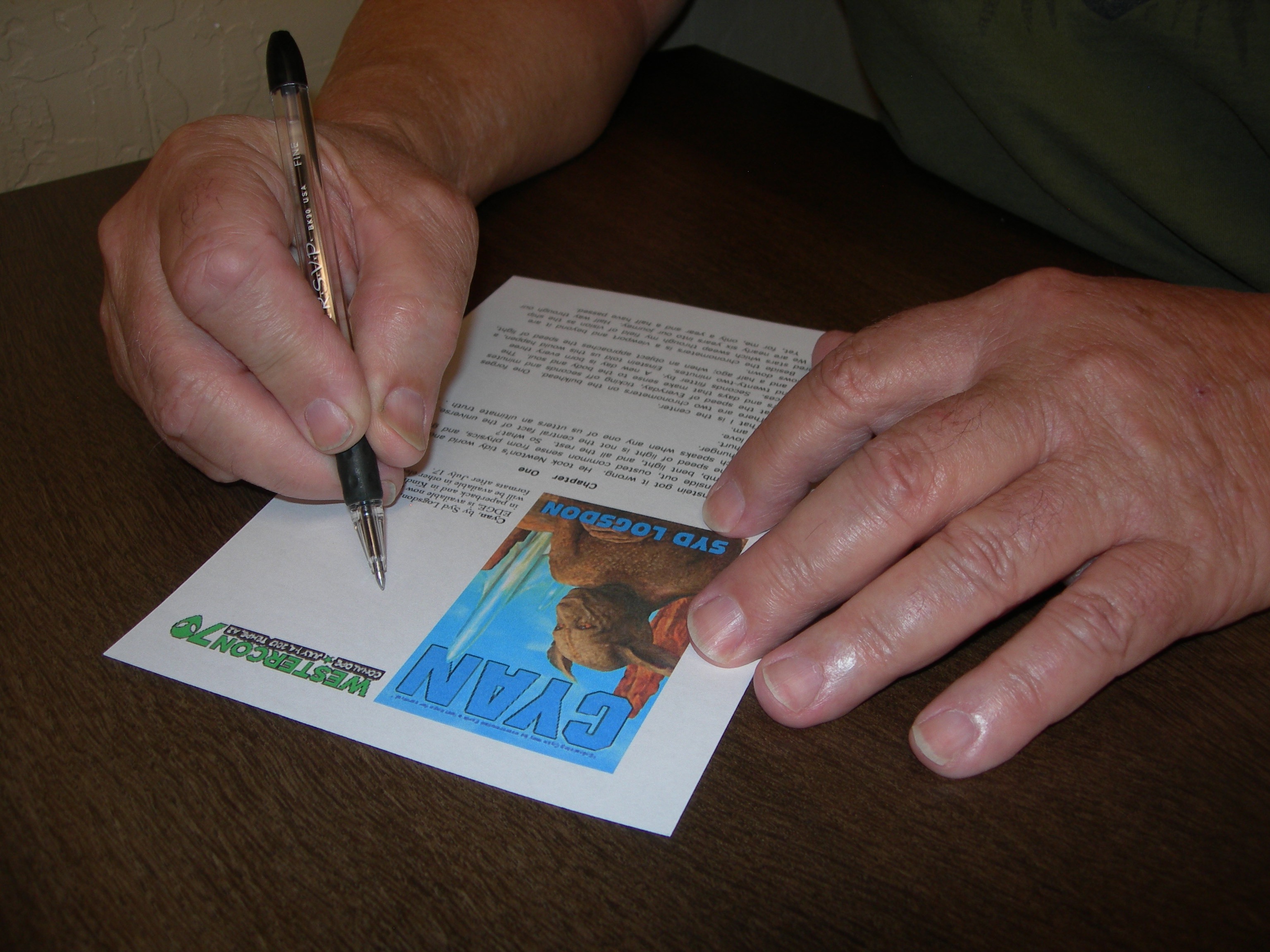
For the other thousand people at Westercon, I am making up a half-page, double-sided sheet with a thumbnail of Cyan’s cover, the Westercon logo, and a sample of text from chapter one. It amounts to a come-on for the eBook and a weird souvenir for those who attend Westercon. At least it gives me something to sign at the “book” signing.

Still, it was more fun signing a physical book.

379. Westercon

You know that I write these posts in advance, and it’s a good thing because today I am leaving for Tempe, Arizona and Westercon 70.

Westercon is a western US regional science fiction and fantasy convention. It has been around since 1948, when the Los Angeles Science Fantasy Society organized it for those who could not travel to the east coast where most Worldcons were held at that time.

This will be my third Westercon. I attended Westercon 33 in Los Angeles the year Zelazny was the guest of honor. I stepped out for air during the afternoon and a lovely young woman told me I looked lonely (I wasn’t), told me she was a wannabe actress – actually she said “I’m just an LA nobody” – and told me the story of her life. I know what you’re thinking. There is no romantic ending, no money changed hands, and she didn’t steal my wallet. I think she was just exactly what she said she was.

Later that night I was cornered at a party by a guy who wanted to tell me about his screenplay. He wouldn’t take the hint that I wasn’t interested, or that I was in no position to further his career. The screenplay turned out to be for a space opera about a ray gun shooting femme fatale. He whipped out a copy of Playboy and showed me a beautiful naked black girl on the centerfold. He said she was the one he had in mind to play the part.

I don’t remember his name (a high functioning forgettery is a very useful tool) but he is probably living in a big house in Hollywood today. The plot was just dumb enough to sell.

I don’t think most Westercons are that weird, costumes notwithstanding. I think it was just LA.

The next year Westercon 34 was in Sacramento. It was a bit more sedate and I gave the paper “How to Build a Culture”. There was a good turnout; as best I can remember a couple of hundred attendees in a small auditorium. I had prepared a piece of mat board with a hand-drawn circle, divided into four pie-slices with the words environment, technology, world view, and biological structure hand written in the quadrants. It was makeshift because my first computer was still five years in the future.

When I said, “Which brings me to my visual aid”, I stood it up and, to cover it’s crudity, added “We have spared no expense!”

The joke got the small chuckle it deserved, but the sound died instantly. A young man in the middle of the auditorium was saying, in a conversational voice, “He is showing a chart. It’s circular, divided into quadrants . . .” We all realized that he was describing the chart to a blind companion, and for the length of time it took him to give his description, you could have heard a feather drop in the room. The respectful silence from crowd made me proud to be a part of the moment.

Last year I wanted to go to Westercon 69 in Portland. I hadn’t gone during all the years of my dry spell; it just didn’t seem like it would be fun under the circumstances. Then Cyan’s release was delayed again, so I skipped Portland. Now that Cyan is out, I am off to Tempe.

It will be good to be back.

376. Live or Die

The core story of Spirit Deer is survival, and the corollary is a complete absence of help.

It doesn’t happen that way much today. If you get lost in the woods, they send helicopters to bring you home. Yachts carry emergency beacons to fetch the Coast Guard. If there is a smashing at your door, call 911. Then hide in a closet. Be very quiet. The police will come soon.

It wasn’t like that when I was Tim’s age. 911 hadn’t been invented anywhere. The police were thirty miles away, and we didn’t have a telephone until I was fifteen. Cell phone? Don’t be silly.

That was the situation I was trying to create in Spirit Deer, both in the original adult version and the stripped down core story that became a juvenile. It wasn’t that I was trying to go back to an earlier era. 1975, or even the late 1980s when adult-Tim became young-Tim, was already closer to the world of my childhood than today. No, I don’t mean arithmetic. I mean that in 2017, it is hard to even imagine being alone.

In a lesser sense, I spent half my childhood alone. I would drive a tractor for hours every morning, eat a brief lunch with my dad, then spent more hours alone until the sun went down. My dad was always there, of course, on his tractor five hundred yards away on the other side of the field. He waved occasionally. That isn’t the same as being absolutely alone, but you are alone-with-your-thoughts, and you don’t have to talk. I liked that.

Being all the way alone, in the woods, hunting, tracking, and surviving, was something every boy of my generation wanted to do. And there were a lot of books to fuel the fantasy.

Most of the early Andre Nortons followed a pattern that looked like this: The young hero is the lowest member of a group that mistreats him. He is separated from them by circumstances no one could have predicted. For a time, he is alone. Then he reintegrates, tentatively, with a new and previously alien group. He does not remain alone, but being alone frees him, and gives him the strength to reenter society.

It is a primeval story. The young hunter sets out on his spirit journey, alone, to fast and endure great hardships, to gain his spirit animal, and return to his people as a man.

Fors, in Star Man’s Son, the first Norton I read, leaves his people because he is cast out for being different, goes on a great quest, finds a prize (knowledge, in this case) despite great hardship, and returns to his people. Only, he gets to take a telepathic puma on the trip with him. That’s even better than being alone.

Proving your manhood, whether you set out to do it, or it simply happens to you, is a big part of these books. A scholar might call them rite-of-passage novels.

I remember one book which I no longer have. A boy was living in a cabin in the woods and he was temporarily alone. I don’t remember where his father had gone. He got up in the morning, fried eggs on the wood stove, slipped an extra two between slices of toast, and put them in his coat pocket, picked up his rifle, and set out into the snowy woods.

I don’t remember the rest of the novel, but he set out. That was enough to make it great. There was a lot of setting-out in those books.

The best of them all was Two Hands and a Knife, the original version. (see post 309) Our hero (aka, the reader in disguise) has to join his parents, who have settled in a hundred miles away across the Canadian wilderness. So naturally, he packs his gear and his dog and sets out by canoe. Alone. (Except for his dog. Every boy needs a dog like that, unless he can find a telepathic puma.) There is a storm; he loses his canoe with all his gear. With the help of his dog, he makes it to shore and all he has is his two hands and his knife. And his dog.

Does it get any better than that?

Lets swing this all back to Tim, hanging in the tree in today’s Serial post, knowing that he has to either summon the strength to make it up to where the pine cones are, or he will die a slow and painful death of starvation. No one will help him. No one even knows where he is.

If this situation scares hell out of you, you are reading the wrong book. Self-sufficiency is useful. Knowing you can be alone, takes the power away from those who would call you different, and demand conformity. It is no small thing.

374. Outdoor Education

In case you missed 364. The Core Story, let me remind you that Spirit Deer, now posting in Serial, began as a novel for adults, and only reached it’s present incarnation years later.

I wrote the original of Spirit Deer in 1975. By the mid eighties, finances led me back to college to add a teaching credential to my resume, and I began teaching middle school. I started  teaching sixth grade and worked my way up to eighth, over twenty-seven years.

One feature of sixth grade in central California schools was outdoor education week, during which the students lived in dorms at a foothills facility and went out twice a day for half-day hikes with naturalists. Teachers accompanied their students.

I had spent my childhood out of doors, and had added rock climbing, camping, and canoeing to my skill-set while in college. I still learned a lot preparing for outdoor ed, since my critter knowledge was based on Oklahoma and Michigan. That’s common. Any time a teacher has to brush up on a new subject, he learns a lot more than he will be able to teach his students.

I learned — then taught — all the common native trees and shrubs, the mammals and birds, a few of the reptiles and amphibians, and the manner in which the local Native Americans, the Miwuks, lived with nature. I took my students through a couple of weeks of intensive study before the week in the foothills, so they would be able to better appreciate their experience.

Even after I moved up to teaching seventh grade, I continued to go with the students on their outdoor ed week. When it came time to rewrite Spirit Deer, stripped to its core story, I called on that experience to tighten up my descriptions, calling trees out by their actual names this time.

One of the things that Tim-the-adult in 1975 did not have was the survival shelter that young-Tim builds in the present version. During the late 80s and early 90s, one of the hikes our outdoor ed students took was called the survival hike. They were taken to a place in the far end of the property and shown how to take a long piece of down wood, jam it into the crotch of a bush or tree, then stack shorter pieces of down wood against it. Next, they thatched the result with twigs, leaves, dirt, and moss, carpeted the floor with duff, then crawled inside their self-built shelter.

They were not taught how to make a fire. In the dry foothills of California, making a fire to  keep warm is a good way to burn down the forest. It happens every year.

They don’t do the survival hike any more. I can’t blame them. They trained hundreds of kids each week in what was a useful survival skill, but that also meant that hundreds of kids each week were ripping up the local environment. The area where the shelters were made eventually came to look like a bombed out battlefield.

Fortunately for young-Tim, he was one of those who learned how to make a survival shelter. It saved his life in the rewritten Spirit Deer.

#                 #                 #

There is another writer’s learning experience in this. When I was newly published, I met Chelsea Quinn Yarbro and started reading her St. Germain books. I was impressed, but also intimidated. Her descriptions of architecture, about which I knew little, and of the clothing worn by all classes of society, about which I couldn’t care less, made for a rich and dense reading experience. My own books were comparatively bare bones.

Then I read Path of the Eclipse, St. Germain book number four, which begins in China and ends in India, with an arduous journey through the lower Himalayas in between. About half way to India, I had an epiphany. In thousands of miles, Quinn had never called a tree by its name.

I had been holding myself to a false standard. She was writing the books that she wanted to write, and I was writing the books I wanted to write. Forget better or worse — they were supposed to look different.

366. Three comments on Spirit Deer

[1]  When I was a very young writer, I read everything in the library under Dewey Decimal 808. It’s called Rhetoric & collections of literature, but really, it’s where they stick all the how-to-write books. In one book of articles, there was a piece titled Multiply by Two. The author’s thesis was that it is always better when starting a book to have two people in front of the reader, to allow for conversation while setting the scene. That’s probably reasonable advice, but I disregarded it in Spirit Deer. Tim is completely alone by page six, and remains that way until the last page.

At the time I wrote Spirit Deer, it just seemed right for Tim to be alone. I had spent half my childhood alone, walking to round up cattle twice a day or on a tractor, endlessly circling innumerable fields. Nothing could seem more normal for Tim the adult, and that didn’t change when he became Tim the youngster. And it wasn’t just me. In the outdoor adventures I read as a child, boys were always out in the woods, and often alone.

I read those books in the fifties and I wrote Spirit Deer originally in the seventies. In 2017, I wonder if the cell phone generation has ever been alone, or ever will be again.

[2] Speaking of cell phones, the cell phone bit in Spirit Deer Post 2 was introduced because no modern kid would be without one. I didn’t want it in the story, so I used one sentence to both establish Tim as responsible and get rid of the damned thing. This scene also introduces a girl, who has no part in the story, but would be missed if absent in 2017. Her absence would have been taken for granted back in the seventies. Or the fifties. Or the thirties, or the nineteenth century. Actually, I see the automatic inclusion of females as progress, but I still wanted Tim to be alone in this story.

[3] Until Tim fires his rifle in Spirit Deer Post 3, he could always just go back to the campground and bike on the his grandfather’s place. There would have been no story. I wanted Tim to have some responsibility for getting himself into trouble. This book is about choices, so it would have been inappropriate for him to get dumped into the wilderness due to forces beyond his control.

This is very different from the original version of Spirit Deer where the hunt had been the legitimate act of an adult.

I also give Tim an out in Post 4 and he doesn’t take it. He could just walk away from his responsibility. But Tim is a moral being, as all my main characters tend to be. I like a stalwart hero. I don’t like the weaselly, vacillating type who finally talks himself into doing the right thing — in real life, or in the characters I write about.

365. You wanna write?

“You stupid-looking sons of bitches wanna write? Well, gwan home and write!”
Sinclair Lewis

This is the entire text of a lecture by Sinclair Lewis. It is quoted by John Masters, best selling author from the fifties and sixties, in his autobiography Pilgrim Son. Masters had just summed up his prospects as a beginning writer this way:

I could invest about two and a half years in making myself a self-supporting writer. I did not hesitate a moment in deciding it was a reasonable investment.

This was mid-1947. His evaluation was based on having severance pay after leaving the British Army in mid-career. Today’s equivalent would be a good day job.

In some ways, Masters is my touchstone for intelligent planning of a writing life. I read his autobiography early on, shortly after I had made a similar summing up, and had decided I could afford most of a year to see if I could write.

I’ve told my story before in the first three posts of this blog, and I repeated it a year later. I apologize to those few who were with me that early, but it needs telling yet again because it explains Spirit Deer, which is now appearing over in Serial. You will also hear more about Masters, both next week and later.

#                #                #

I started my college career at Michigan State in Biology, and later switched to Anthropology. The draft put me into the Navy, and then I returned to the University of Chicago for a masters degree. I intended to continue with my Ph.D., but didn’t work out that way.

I had lost my chops. Learning how to study, learning how to learn (not the same thing), and learning how to play the game (definitely not the same thing) are a college student’s chops. After four years in the Navy, it took me some time to get my chops back, and by then the next year’s quota for Ph.D. candidates had been filled. My would-be career was in hiatus.

However, all was not lost. When my major professor read my Master’s thesis, he told me to reapply the following year and they would find a place for me.

I had an unexpected year off. What to do? I knew I could write, but didn’t know if I could sit down day after day and write hundreds of pages. This was my chance to find out. The day after Labor Day, September 2, 1975, I sat down in front of my typewriter to find out.

Writing a science fiction novel or a fantasy novel would have called for a lot of time spent in world building. That wouldn’t tell me what I needed to know. A historical novel would have called for even more research, and a detective novel would have called for crafting a complex puzzle. I wasn’t worried about any of those skills. I just wanted to know — could I write word after word after word, day after day, week after week? And would it be fun?

I needed a minimal research story, so I decided to send my protagonist on a deer hunt, where he would get lost. I would set it in autumn, in a part of the Sierras I could drive to in a day if I needed to be on the scene. I would roll in a storm, with low hanging clouds so he couldn’t find north and couldn’t send up smoke. I intended to let him get out on his own. Over the weeks I piled misery after misery on the poor guy’s head.

Within two weeks, I was hooked. I was having a ball. Getting lost in the woods and finding my own way out was infinitely exciting, since every night I could go to my comfortable bed while poor Tim Carson (he had a last name then) tried to sleep on the frozen ground.

I never reapplied to Chicago, but I did go on to write many other novels.

364. The Core Story

photo by David Mayer

For the last month, these posts have been coming later in the day, in hopes of finding new readership in other time zones. I haven’t been happy with the results, so today I am reverting to the old posting schedule.

Over in Serial today, I begin presenting the novel Spirit Deer. I had some hesitation about this.

As it stands, Spirit Deer is a juvenile, not a YA. It would be suitable for most of the kids I taught in middle school, but too young for teenagers. It would stand with Island of the Blue Dolphins, not with Twilight.

It didn’t start out that way. When I originally wrote it, as an experiment to see if I could I write a complete novel, Spirit Deer was a book for adults. Tim had a last name, a wife, a job, a backstory, and other adult considerations. When he got lost in the woods and had to find his own way out, it was a catalyst for changing his life.

It was only 45,000 words however. That was too short for a western or a science fiction novel, even in the seventies, and way too short for a regular novel. And while the lost-and-found part of the story was fine, the relationships part wasn’t ready for prime time. It didn’t deserve to be published, and it wasn’t.

I moved on and my second novel,  Jandrax, and it was published. Fair trade; Spirit Deer had done its job by teaching me to write. It could be put away with no regrets.

But it wouldn’t die. The problem was, once you strip away the wife and the job and the friend and the adult concerns, the core story of how to keep alive when nature is trying to kill you was still powerful.

After a lot of years, and several other novels, I went back to Spirit Deer and stripped it down to it’s essence. At that level, Spirit Deer could have been about any male above the age of thirteen, all the way up to senility. To be fair, a woman could have endured what Tim endured, but I don’t think a woman would want to read a book about it. At least not in the eighties and nineties when the core story was tapping me on the shoulder and saying, “Don’t give up on me.”

Spirit Deer became a juvenile because of its length. When the wife and friend and backstory went away, there were only about 25,000 words left.

Consider this:

Man against nature, other men, or himself, is a story.
Man against nature, other men, or himself, plus gunfights, is a western.
Man against nature, other men, or himself, plus thugs, is a thriller.
Man against nature, other men, or himself, plus spies, is James Bond.
Man against nature, other men, or himself, plus sweet sex, is a romance.
Man against nature, other men, or himself, plus rough sex, is men’s action — a genre which has all but disappeared.
Man against nature, other men, or himself, plus sex, catching a big fish, and death on the last page, is Hemingway.

I didn’t want to add any of those plusses, and I didn’t want to make Spirit Deer artificially longer, so it became a juvenile. It’s still a good story, it taught me a lot, and it provides a lot for us to talk about as writers.

That is, I assume you are or want to be a writer, or I would have lost you in the second paragraph.

Spirit Deer will be presented in forty posts over in Serial, and there will be posts over here on A Writing Life expanding on the story, on being a beginning writer, and on how many ways a writer can present a core story.

363. Masters: Coming to America

What sort of country would (the United States) have now if the Indians had had an Immigration Service when the Pilgrims set out in 1620?
John Masters

When I first read John Masters, something he said stuck with me. Before going to Westercon this year, I wanted to run down that quotation, and in doing so I found much more worth sharing. What he said about writing will appear here later, but today I want to give his insights on immigration, or, as he called it, his Seven Year’s War with the U. S. Immigration authorities.

For reasons detailed in his book, John Masters decided that, though he was an Englishman, there was no life for him in England, and that America should become his home. He applied for an immigrant visa, knowing that the British yearly quota of 65,000 was never filled. His reactions to the questions asked on the application form were humorous, but too long to place here. Apparently the questions were as inane then as they are now. (see 329. Green Card Blues and 361. Take This Test)

A week or so later, he was told that he would have to wait about four and a half years. He had been placed on the Indian quota. He went back to inquire and was told that American law only recognized the place of his birth, not his actual citizenship. Never mind that he was born in a British military hospital. Never mind that he was born of a British mother and a British father, stationed in the British army in a British controlled area. Never mind that a child born of an American parent (and it only takes one) anywhere in the world is an American citizen. Never mind that he was born in 1914, and India didn’t become a country until 1947. He was born in India, so he was on the India quota.

It was a good thing he hadn’t been born while his father was stationed in Greece. The Greek quota was eighty-one years. (Yes, that is not a misprint. 81 years.)

Masters decided to withdraw his application for an Immigrant visa, get a visitor’s visa, and work things out later. That was not allowed. Since he had applied for an immigrant visa, he was no longer eligible for a visitor’s visa. Too many others when facing impossible waits had made that same move, then disappeared once they were in America.

As you might guess, as a British Army officer with plenty of friends, he was eventually allowed a visitor’s visa, came to America, and managed to stay permanently, although with many additional bureaucratic battles.

Good thing he wasn’t actually Indian.

More to the point in 2017, good thing he wasn’t Mexican, or poor, or not a native English speaker.

Master’s comments on writing will come in later posts.

362. Masters of India

     Wasn’t it barely a week since I had thrilled to learn what was inscribed on the base of the Statue of LIberty:
          Give me you tired, your poor,
          Your huddled masses yearning to breathe free . . .
     What generosity, I had thought, what a marvel of welcome!
                         John Masters

We’ll let that quotation hang there, and return to it later. This post, and several more, are connected to John Masters’ third installment of autobiography, Pilgrim Son.

I read the first installment of his autobiography, Bugles and a Tiger, during the 1970s. Normally a military biography would be the last thing to interest me. Furthermore, I was in the Navy against my will at the time, it that made it even more unlikely. However, Masters was a famous novelist specializing in India, so I read Bugles . . ., and I was impressed.

I had just finished four years studying South Asia and was about to return to another year of the same. My experience had shown me that there is wisdom (and stupidity) in writing on all sides of any issue. Wiser’s The Hindu Jajmani System (anthropologist), Nehru’s The Discovery of India (nationalist agitator, then national leader) and Masters’ various works (officer in the British Army in India) all showed accurate views from different perspectives.

I skipped Masters’ second autobiography, The Road Past Mandalay because I had no interest in sharing the horrors of WW II’s Burmese campaign, but Pilgrim Son was about the start of his life as a writer. I was beginning to write, so I ate it up.

That was nearly four decades ago. One particular story from that book stayed with me, and sent me back to seek it out again. I found that the whole book was a gem, far better than I remembered, and with more than one brief bit worth sharing.

For one thing, Masters had a lot to say about immigrants. That had not stuck in my memory because it was not an issue in the early eighties when I first read Pilgrim Son.

I have to set the stage by reminding American readers, whose world historical knowledge is typically shallow, that India is an ancient culture, but is new as a nation. Until mid-last century, it was controlled by Britain. In 1947, what was then India was partitioned into India and Pakistan, and each part became a self-governing nation. Decades later, Pakistan also split, into Pakistan and Bangladesh. What had once been a more-or-less uniform culture divided into hundreds of petty kingdoms, was first unified under British rule, then split into three modern nations.

After several hundred years, members of the British Army and of the British governing class, many of whom had lived in India for generations, had to take ship for England. John Masters was one of those Englishmen who was born in India, had lived his life there, and now found himself an immigrant to his other homeland. He soon found that there was nothing for him in England, and became an immigrant to America, where he began his writing career. more tomorrow