Hi, folks, I’m back. It’s five o’clock here on the west coast and I’m just getting home from helping a friend. I see that my power is restored. It went off 3:30 PM Wednesday and came back 1:30 PM Friday. That’s forty-six hours of no light, no computer, and spoiled food in the refrigerator, all of which was no fun. It was also forty-six hours without news of natural disasters or the liar-in-chief. My friends tell me it’s been a rough two days, so I have to go now and see how bad things got. Vacation is over.
Tag Archives: memoir
630. Sequel
I spent most of the summer trying out possibilities before settling on Dreamsinger as my next novel. One thing I considered was a sequel to A Fond Farewell to Dying. FFTD was set in a post nuclear war/post rising of the waters world. I wrote it before global warming became obvious, and my main character thought the flooding was due to the nukes that opened up the San Andreas fault. I don’t feel obligated to agree with him if I write another novel.
There would be several advantages in this sequel. I wasn’t done with my characters, even though FFTD had a proper closure. I had several bits and pieces of story that needed telling, but not enough to make a novel. I had a dandy idea for a third novel, if I could find a good second one to sew everything together.
In FFTD, the protagonist starts out in Ozarka, the island chain that lives in the middle of a much expanded Gulf of Mexico, but this is told as a flashback. The shattered, inundated remains of NorAm are not explored, and I felt there was a lot to see there. I wanted my old characters to fade into the background, letting me tell the next story through new eyes.
On a practical note, I’ve lived fifty years in California but only two of my novels are set there, and neither is science fiction. I know a lot of stuff that is going to waste.
So I decided to bring in a new character. He (I don’t know his name yet) is not so driven as David Singer was, but he is still a backwoods kid who has a lot to learn. That’s always useful; it lets us learn along with our character. I decided to let him grow up on an island off the coast of what is left of California, make his way across the now flooded Central Valley, spend some times in the former gold rush towns which will become seaports by his time, then head north walking along the crest of the Sierra/Cascade ranges. Up north he will come in contact with the characters from FFTD and his story will meld with theirs, but I don’t have that completely figured out yet.
I could tell you more, but at this point everything is still malleable. In fact, it is probably too soon to write this story; it needs to ferment a few more years.
Just to get a feel for this new novel, I wrote a few hundred opening words. You can have a peek at what may be coming, if you want.
==============
1.
The town I reached was a haphazard scattering of buildings up the dense green slopes of what was once the Coast Range, mostly built from sawn driftwood. At sea level were shacks and several small piers for fishermen, as well as a longer one for oceangoing vessels.
As for me, I was an invading army of one. Maybe I should say navy, since I was coming in from downcoast in the middle of a sealskin and driftwood kayak of my own making. I had left my birthtown two weeks ago, heading north to find a bigger life. Here and there I slept on islets, and cooked fish over driftwood fires, but mostly I just paddled all day with the sunrise on my right and the sunset on my left, and slept on the waters each night.
This place was not going to give me the life I wanted, but that long pier meant ships would come eventually. I beached the kayak on the open shore and dragged it into the brush, out of sight.
First things first. There were hundreds of streamlets coming down the steep, west facing slope. I picked one, walked up until I reached a waterfall, and let it sluice two weeks of grime and stench off my body. I swilled my fill of fresh water that had not spent days in a stoppered gourd. Then I walked on up the beach.
The first man I saw was a fisherman. So were the next dozen.
You could read the history and the future of the town in its architecture. There were a dozen huts on stilts paralleling the beach. The first actual houses were three hundred yards up a steep zigzag, and a hundred feet above the water.
Conclusion: from time to time a storm would wipe out everything below those houses. Prediction: someday, tomorrow maybe, or maybe ten years from now, a larger storm would wash the headland clean and this town would become a memory — if anyone survived to remember.
The first man I met looked me over and snarled, “Where did you come from?”
“Pirling. Two weeks south, out on one of the islands.”
“How’d you get here?”
“Kayak.”
His eyes ran down the beach behind me, looking, but he didn’t ask where I had hidden it. He said, “We all work here. No handouts. What can you do?”
“Anything you can do.”
# # #
For two weeks I worked, harder than anyone in the town. I wasn’t trying to impress anybody. It’s just that I had no friends or family, and nothing to keep me occupied but work. I slept on the beach. The sand was comfortable enough, and my boudoir was swept clean twice a day by the tide.
My body was comfortable, my belly was full, and the surly bastards I worked with never asked any questions. But my mind was trying to crawl out my ears to find something interesting to think about. Fat chance in that town.
Then a ship came. She was called Mariposa, Spanish for butterfly, a twenty-five meter schooner with a ferrocrete hull. I went aboard and looked for the skipper.
==============
His next stop will be the shattered remains of nuked San Francisco, with only Nob Hill still above the water. Maybe. Someday. If I get that far down the list of books-to-write.

627. Banned Book Week
If you google special weeks, you will find a week for everything. Some of them are worthy; most are just plain goofy.
There’s nothing goofy about Banned Book Week.
My first encounter with banned books was in high school, when I became aware that Oklahoma and almost no other state had banned The Grapes of Wrath because it supposedly portrayed Oklahomans in a bad light. They didn’t much like the term Okie either.
I’m an Okie and I like the term, but if I had been walking down the streets of Bakersfield in the thirties, and people had been calling me that while spitting on me, I would probably have a different viewpoint.
When I was a boy, more than half a century ago, I said n— all the time. I quit when I grew up and learned better. Of course Black people will never come to accept the word like I accept Okie, and they shouldn’t. Okie was only a cuss word in parts of California for a brief time, a long time ago. N— has a different history.
While we are banning books, let’s go ahead and ban the word nigger.
See, you can’t do it. I’ve managed to use the abbreviation n— up to now, but I couldn’t write that sentence without spelling it out.
We have made not saying the word the key to survival in modern politics, but does a clean mouth insure a clean conscience, or a clean personal history? If you think so, I have a swamp I’m willing to sell you.
Shall we ban the idea behind the word? Good luck trying.
All this brings us back to books. Books should not be banned, except for a few.
What?!?!?!?
That’s a lot like saying I’m for free speech, but not for hate speech. Okay, define hate speech. Not give examples, that’s too easy. Define it.
It can’t be done.
Now, back to books again. Personally, I hate the *** series. I wish those books had never been written, but I’m afraid to even mention their name in this post. They have all but disappeared on their own, but if I were to mount a campaign to ban them, they would be back on the shelves and on their way to the best-seller list before the month was out. There would be websites defending them and websites condemning them and hash-tags like — no, I’m not going to tell you what the hash-tags would say.
Banning books is not only wrong, it is also self-defeating. If something bothers you — books, words, concepts, actions — confront it. Banning it just drives it more deeply into the public consciousness.
If the media had not been so outraged in 2016 that they made ***** the main subject of every newscast, we would have a different president today.
If the Ayatollah had not condemned The Satanic Verses, it would have died the quiet death it deserved. I know. I fought my way half way through the thing out of moral obligation before I tossed it. If it hadn’t been condemned, I would have quit after page three.
End of sermon.
Now here is a tidbit that I am adding just because it amuses me. The Index Librorum Prohibitorum is the list of books banned by the Catholic Church, beginning about 1600, going through various versions, and being finally dropped in 1966. Johannes Kepler and Immanuel Kant along with some translations of the Bible have all had the dubious honor of inclusion over the years.
When I wrote A Fond Farewell to Dying, set on a post nuclear war Earth, the main character wrote a book called Inquiry into Artificially Induced Immortality. I needed to have it banned, so I had to let the New Vatican located on Lake Titicaca (Rome having been nuked) reinstitute the Index just so my hero’s book could be on it.
622. My Place or Yours?
If you didn’t read Monday’s post yet, go there first.
The most difficult problem I’ve had in getting under way with Dreamsinger is that I wouldn’t want to live as part of the culture of Home Station, the orbital habitat which most humans occupy. I need it as the flip side of the culture of the exiles on the surface, but I don’t like it.
Never fear, I’m a professional. I’ll get there, but there will be a lot of moaning, groaning, and cussing under my breath along the way.
One thing is in my favor — in world building, problems are answers. A perfect world might be pleasant to live in, but it would have no fodder for storytelling.
The situation in Cyan which led to the beltmen leaving Earth created a culture of enforced, extreme civility. That’s not natural for us hairless apes, so there has to be an enforcement arm with no sense of humor. That is the system of directed dreaming, explained Monday.
Directed dreaming is a system that needs overthrowing, and that will clearly be a major theme of the novel. But what else does it imply?
On Home Station, you don’t sleep. Therefore you don’t need a room. Your exercise/dreaming time is brief, so what do you do with yourself when you aren’t working? Where do you go? Once I had asked myself that question, I filled Home Station with lounges.
Also, if you don’t have a bed or a bedroom, where do you have sex? Let’s see what the rough draft says:
Antrim headed down to Heaviside Lounge for companionship and to purge his mind of the problems posed by Riff.
Beneath a flowering mimosa he saw a girl he knew. She had removed her shirt as a signal of readiness, but no one had yet joined her. Her name was — Broa. His mental hesitation triggered the Farleyfile which gave him a précis. Broa 14284. The number told him that she was one or two crèche releases older than he was. He had copped with her three times before, but he already remembered that. She was a tech working in hydroponics.
He stopped and smiled down at her. She said, “Want to cop?” and he said, “Sure.” He peeled off his shirt and she unfastened his pants. There was a snarl when they hit the floor and snagged on his shoes. Broa was already barefooted, and laughed at him as he extricated himself. He came down on her without bothering to remove her pants and met her mouth to mouth and tongue to tongue.
The pants came off soon after, and they put on a clinic of the four positions and the eight variations. Several of the other occupants of Heaviside Lounge wandered over to watch and admire.
Afterward, they talked for a while. Her eyes were on him, but her attention had wandered and so had his.
She levered herself up, pushed back her tangled hair, and said, “I have to shower before I go back to the hydros.” She kissed him again, lightly and briefly, picked up her clothes and walked away.
Antrim lay there admiring her back side. Nothing in the moment impelled him to run after her.
His mind was cleared, his body was spent, and the pleasure had been profound. But she was still, after four sexual meetings, so much a stranger that he had reflexively triggered the Farleyfile when he saw her. If he never saw her again, he would feel no loss.
It didn’t seem like enough.
Sex right out there in the open? Well, the future is supposed to be different and there are no secluded, grassy riverbanks on a space station. Actually, if you are living in society that controls your dreams, privacy is non-existent already. On Home Station, even the desire for privacy is considered a mental aberration.
In some ways, this culture is a bit of a feminist dream since everyone is completely equal and there is no power structure of dominance — except for the dream therapists, but that is a whole other level of this novel which we’ll get to eventually.
Everybody is comely. I don’t have space here to tell you where babies come from, but take my word for it, they all come out perfect. And it is considered impolite to refuse an offer to cop(ulate).
It sounds like a 14 year old boy’s idea of paradise, but it isn’t that either. Everybody on Home Station is so damned equal that nobody needs anybody. Want sex? Do it. Twenty minutes later you can each go your way without even exchanging names.
It’s very unromantic.
The culture of the exiles on Stormking, which we will see later, is based on survival. It is totally different, but also completely unromantic.
Antrim, our main character, has imbibed all kinds of romantic notions from reading the literature of Old Earth. He is seeking something neither culture stands ready to provide. He is going to have a rough time of it.
Corollaries, implications, and unexpected consequences of the structure of directed dreaming are falling out onto the page every day, often surprising the hell out of me. Weird things are happening and I haven’t even gotten to the culture of the dissidents who have been exiled to Stormking. Their lives are really different.
621. Dream Culture
For the last month or so I have been fleshing out one corner of a universe that I began writing about decades ago. My first SF novel was Jandrax, a lost colony story. Cyan came later, filling in the backstory of that same universe. Dreamsinger, which I am writing now, continues the process.
If you have read my novel Cyan, you will remember that when Keir visited the asteroid belt to view the B&A coreship, he discovered that the beltmen were secretly preparing an expedition of their own. They feared the impending destruction of Earth, but had no interest in colonizing a new planet. They had come to prefer life in space.
In the Cyan and Jandrax universe, the exploratory expedition to the Sirian system had found that the planet occupying the Goldilocks position — the distance from Sirius with the same level of radiation as Earth — was taken by a planet with a Uranian inclination. That is, it was tilted onto its back like a sad tortoise, with first one pole and then the other pointed toward it’s star as it moved through its orbit.
With no habitable planet, it was likely that Sirius would never again be visited by man. This made it an ideal destination for the beltmen who wanted to live in space without interference from planetbounds.
When the Procyon colonization expedition departed for Cyan, the beltmen were nearly ready to leave for Sirius. Keir’s last message was of farewell and good luck to them.
The beltmen had to build their craft in secret with minimal resources. It was a crowded, spinning torus which held 2000 refugees from impending disaster. Under-funded and under-powered, it would take an eighty-seven year journey to reach Sirius, and a generation would die in transit.
During that long, slow, crowded journey, civility became essential to survival. The refugees evolved a system called directed dreaming.
Once each day, each person entered into a dream like state during which her/his body (not under his/her conscious control) underwent rigorous exercise, followed by dreams tailored to keep them civil.
This is how it all sounds in the rough draft:
The dreamers were hanging, heads encased in sensory deprivation helmets, in ten rows of ten. They had already gone through their exercises, contortions that had stretched and strained every muscle and left them all soaked in sweat. Now they settled into a deep, quiescent, unmoving sleep
It looked like a grotesque mass hanging, but that was an illusion since their weight was just sufficient to keep them from bouncing off the ceiling. Being suspended by their necks at this level of gravity did not even cause discomfort.
Now, one by one, they began to move. An arm shot out here, fingers gripped nothing over there, arms crossed over chests to hold something in, legs shot out to kick some threat away. Each one was now in his own directed dream. Carefully tailored images were fed into their brains and they reacted. Uncivil inhibitions were destroyed; fears were dredged up and alleviated; prejudices were wallowed in until they seemed foolish. Angers were expressed in dreams, so they could be suppressed in waking life.
Dream therapy was every person’s right and obligation. Dream therapy was the key to civility. Dream therapy kept them all sane and happy.
It took less than an hour and a half, and afterward every person was ready to go back to his life. Each one was exercised, refreshed in mind and body, cleansed and cleared of all angers and resentment. There was no more need to waste a third of your life in sleep.
Sleep had never really knitted up the raveled sleeve of care anyway, but directed dreaming did.
You understand that I am setting this up as something that seems like a good idea, but isn’t.
Once the refugees arrived at Sirius, they immediately undertook the building of a larger station to be their new home. Directed dreaming continued to lubricate the wheels of progress, but not everyone agreed with this new way of life. Those who could not conform were exiled to Stormking, which was a place of Trenconian extremes, and a death sentence for most of those transported there.
I had already outlined all of this while I was still writing Cyan. For the last month or so, I have been fleshing it out. We’ll see some of the new thinking on Wednesday.
619. The Crash Heard Round the World
Two days ago on the news, a Tesla driver was caught on camera asleep at the wheel on a freeway. We all got to see him snooze, then eventually got to see him jerk awake. Chit-chat ensued. One talking head said, “Someday sleeping at the wheel will probably be legal and safe.” Another replied, “Not in my car!”
When I was ten years old, everybody knew that men would never walk on the moon. In the subsequent decades, the public’s default position on what science plans to do has switched from can’t to can. The public isn’t any smarter; they’ve just changed their prejudices.
Driverless cars have been around for a long time in science fiction. Here is page 2, paragraph 1 of Methuselah’s Children by Heinlein, first published in 1941.
Mary had no intention of letting anyone know where she was going. Outside her friend’s apartment she dropped down a bounce tube to the basement, claimed her car from the robopark, guided it up the ramp and set the controls for North Shore. The car waited for a break in the traffic, then dived into the high-speed stream and hurried north. Mary settled back for a nap.
Good fun in ’41, but no one would have expected to see it happen this soon. Even science fiction aficionados might have said 2119, or maybe 2219, yet here we are, on the brink.
In 1941, the world was very different. Heinlein might imagine driverless cars, but he never imagined something else that is now part of our world — computer hacking.
Hang on, folks, I’m going to make a prediction.
At a near future date every car on the highway will be driverless. The old curmudgeons like me who wouldn’t even trust cruise control will all be dead, mostly from auto crashes with drivers who did trust cruise control. The text-and-drive crew will have won the battle of the public consciousness. Science will have proved that humans are inferior to computers in driving, and science will be right because it will be comparing computers to the text-while-driving generation. Human drivers will be outlawed as unsafe — which they will be.
Driverless cars will talk to each other and to central control, adding another layer of safety to the whole enterprise. Central control will be heavily protected against hacking, for obvious reasons. Science will prove that central control is impenetrable.
Science always proves something like that, just before the cataclysm. See Three Mile Island and Chernobyl.
All that was just set-up for the prediction. Here is the prediction.
Sometime in August of 2035, a kid named Morrisey, who isn’t even born today, will hack the un-hackable central control. No one will notice. He will place a delayed command, and head for a hill overlooking an LA freeway.
On August 26th, 2035, at peak rush hour, central control will send out an order and every automobile in America will speed to 100 mph, then simultaneously make a ninety degree left turn.
Registering 4.6 on the Richter scale, it will be the Crash Heard Round the World.
St. Peter will have to put on extra staff.
617. Raiders Before the Ark
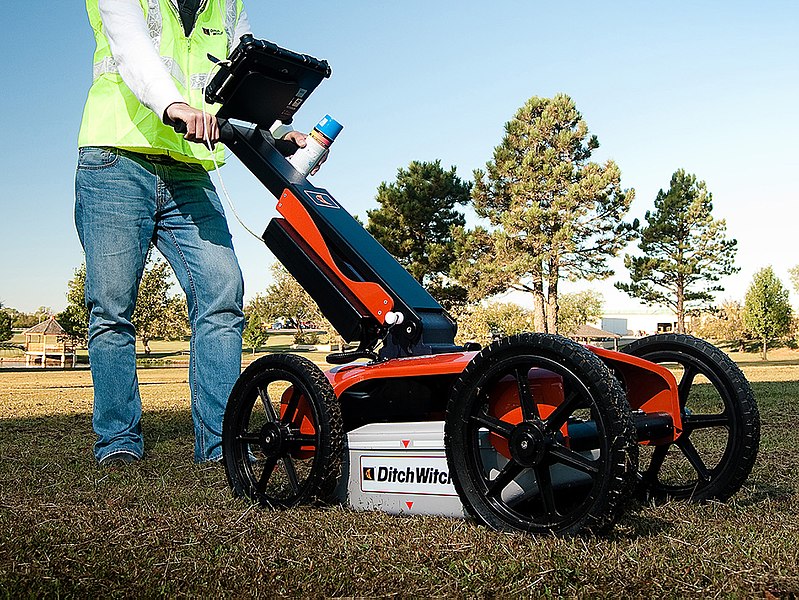
Ground penetrating radar used in survey archaeology.
I’m jealous; in 1967, we just walked and looked.
Anthropology has been a major part of my life. I spent five years in pursuit of it, and it forms the backbone of everything I think and write, even though my dislike of field work was pushing me away at the same time that writing was drawing me away.
When I discovered the field during the sixties, forensic anthropology was nearly unheard of and the tools of modern physical anthropology were just being assembled. Social anthropology, my specialty, and archaeology were the two choices for students then, and we all took classes in both.
My first class in archaeology was in spring quarter of 1967. The professor was a lean, fit man in his late thirties with thin blonde hair and a beard. He had great tales to tell. The class was taught in the MSU museum and there was a stuffed moose standing in the corner of the room. How cool can you get?
My roommate and I immediately started growing beards. I still have mine. In a miracle of convergence, I had a full beard about the time I saw them growing on faces all over campus. I had become a hippie, when all I wanted to do was look like Dr. Cleland.
It was an Indiana Jones moment, fourteen years before the movie came out.
I had escaped Oklahoma and had no intention of going back to spend my summers working on the farm. There are no summer jobs in social anthropology, but you an sign on to an archaeology crew, and I did for two summers.
1967 and 1968. Keep those numbers in mind. I was nineteen, then twenty. Keep those numbers in mind, too. Feminism was on the horizon, but I hadn’t heard of it yet. Political correctness, in those days, meant hating the Commies, supporting the Vietnam war, beating up hippies and draft dodgers, and voting Republican. I wasn’t politically correct.
The definition has changed since then, and I still am not.
Archaeology was an alpha male enterprise, in an alpha male era, and it was an alpha male time of my life. Sorry. Not bragging, not apologizing, just reporting.
Archaeology is hard, dirty work in the hot summer sun. It was much like what I left in Oklahoma, minus the manure but plus an intellectual content. I enjoyed it, but I didn’t fall in love with it. Like everything else in science, you spend a thousand hours of work for one tiny nugget of knowledge. The work didn’t bother me. Work is just work; I’ve always done it and I will as long as my body holds out. But there weren’t enough rewards.
My crew was doing survey archaeology all over northwestern lower Michigan. Our home base was Kalkaska just southwest of Traverse City. It’s a small town known for its giant fiberglass trout statue. The local young guys yelled insults at us when they saw us on the street. We were too cool (in our own minds) to be bothered. You know the drill. If there were any local young girls in town, they kept them well hidden.
We spent our days walking up and down the local rivers, looking for evidence of camp sites along the banks, or walking the shore of Lake Michigan for the same reason. Evidence of habitation meant chips of chert (the local low grade version of flint), pot sherds (broken pieces of pottery), or midden (trash heap) mounds. You had to learn to distinguish chips of worked stone from natural breakage while walking along at a normal pace.
If we found enough surface evidence, it was time to make a test pit. That meant a ten foot by ten foot square, taken down with flat bladed shovels in four inch lifts. All the dirt from each lift was tossed into a sieve — a wooden sided box with a 1/4 inch screen bottom. This was suspended from a sapling tripod and shaken. Dirt went through, chips, flakes, arrowheads, stone knives, or bits of pottery would be left behind.
Or, more often, nothing would be left behind and the test pit would be abandoned.
Sometimes we would be on public land, but most of the time we had to negotiate for permission to enter. The grad student who was leading our group spent more time making friends with local farmers — or trying to — than he did looking or digging.
So it went for most of two months and then everything changed for the better. It was about to get exciting. I’ll tell you about it Wednesday.
616. Anthropology
If you took my advice and watched Worlds of Ursula K. Le Guin, you know now that the K. stands for Kroeber, after her father A. L. Kroeber, who was one of the important early anthropologists, and that her work was influenced by growing up in the atmosphere of Berkeley. My work has also been influenced by my study of anthropology, as I was ready to share in this post. I wrote it a few weeks before I saw the American Masters presentation. I moved my post down to shoehorn in my recommendation that you watch the TV show while it is still around.
==========
I was seduced by novel writing in 1975 and that ended my five year study of anthropology, but there is more to it than that.
There were two things in anthropology that were driving me out before I wrote my first novel. One was cultural relativism, the philosophy that underlies the whole field. I didn’t buy it. I still don’t. You’ll hear more about that in a future post.
The other thing was field work. I did field work in archaeology for two summers, and that was fun, but my specialization was South Asian social anthropology. That meant sitting in some village in India for a year asking questions about local relationships, and there was no way to avoid it. It’s an absolutely required rite of passage and doing it once isn’t enough. You have to do it again and again. It is the way anthropologists do their research.
It offended my sense of privacy. If anyone were to ask me the kind of questions anthropologists ask their subjects, I would tell them to take a long walk off a short pier. Needless to say, being the person doing the asking wouldn’t make it feel any better.
There is also a deep triviality to field work. It resembles lab research in other sciences in that way. The end result of scientific research is not trivial, but the day to day weighing, titrating, or looking at slides from a telescope or an electron microscopes is exceedingly tedious.
That would also be true of asking questions about who is related to whom in the village, and making out kinship charts so you can tell who is a parallel-cousin and who is a cross-cousin. No, I’m not going to tell you what those two phrases mean; it’s better you don’t even have to think about it.
Encountering anthropology in college is like eating at a good German restaurant. It is laid out on your plate, already prepared, and delicious. It is still the same in grad school until the day you reach the field. Then you have to butcher the hog and make the sausage. It’s no fun any more.
I love ethnologies, treatises explaining in detail how other cultures work. The variety of ways in which mankind has organized his work, his time, and his beliefs is both staggering and fascinating. I would have enjoyed writing them, but the research needed to reach that stage would have been more than I could have borne.
I use what I learned in anthropology every time I write a novel. Sometimes it’s only a little; sometimes it forms the backbone of the whole enterprise.
I also wrote a long article on the subject called How to Build a Culture. I presented it at Westercon 34 in Sacramento, and later archived it on this website. It it’s present form, I have divided it into eleven virtual chapters to make navigation easier. The internal links to reach individual chapters are at the top of the file.
If you want to see it, click here. I think you’ll like it. It’s still anthropology, but you don’t have to do the fieldwork.
614. Wind and Air
Over in Serial, starting tomorrow, there will be a short story that is technically a prequel to Firedrake and Scourge of Heaven, two novels set in the fantasy World of the Menhir. This short story, The Gods of Wind and Air, offers no insights into the novels. Instead, it exists to tell the story of a serf whose character and philosophy interest me, and to give me a chance to experiment with connecting poetry to prose in a manner new to me.
Short stories come to me rarely. The only other short story from the world of the menhir is set some years after the main action, and can be found in Backstory.
One of the reasons I am offering The Gods of Wind and Air now is that my life is temporarily full of chores. A tree I planted forty years ago has grown into a giant, and now has to be trimmed back one limb at a time, plus lots of watering of other trees and bushes during the long California summer, plus the fact that I am now writing full speed on Dreamsinger. In the next few weeks I may not be able to provide two posts a week, so I am giving you something to tide you over.
Now, about the story itself . . .
When Marquart and his little band first entered the Valley of the Menhir, the unseen narrator (me) said:
. . . the Weathermistress was cooking up something unpleasant in her cauldron of clouds.
It is about the only reference to the elder gods in that novel. Unfortunately, that line ended up on the cutting room floor.
The World of the Menhir has always been lousy with god. Most of them are more like Greek demi-gods than like world creators. They live on the ground, brawl and love and hate, and are fairly human except for having Powers. I find them more interesting than omnipotent beings.
First to arrive were the gods of Comai, who entered from another world and dominated the native humans. They were eventually ejected in a string of events too long to even précis. Then came a thousand years without gods.
The events that make up my novels and short stories begin when a new set of gods from yet another world enter the land of the menhir and take up residence, beginning the century long battle between the Damesept and the Remsept. A chunk of that story is found in Banner of the Hawk 1.
Even before the Comanyi arrived, there were home-grown gods like the Weathermistress. The serfs and free foresters still worship them, as well as the Flower of the Waning Day, a trio of Comanyi who helped humans drive out their brother-gods.
Not Pellan, though. He is mad at all the gods, and that is where our story begins — tomorrow in Serial.
Incidentally, if the title sounds familiar, stories called The blank of blank and blank are everywhere. I think they all stem from the classic title The Queen of Air and Darkness which was first a novel by T. H. White, then a novella by Poul Anderson, and recently another novel by Cassandra Clare. It is a title rhythm that sticks in the mind.
Also incidentally, the logo presented at the top of all these posts is a runeboard, which is a means of divination used throughout the World of the Menhir. It doesn’t appear in this short story, but it was the only piece of world-of-the-menhir artwork I had available to me.
Enjoy.
611. Living Through History
I never worked for NASA. I have no actual connection with the space program, but I love it. These days, everybody is talking about the moon landing, but I’m not going to post about it directly. There is no need. I’m no expert, but every real expert left alive will be on your TV.
My connection is personal, and I first wrote about it when this website was new, in October of 2015. I don’t normally like to repeat old posts, but I can’t say it any better.
===========
It was pledge week at PBS. They ran the biography of Neil Armstrong for the upteenth time. My wife and I watched it for about the third time, and when it was over, she said, “That was my childhood.”
I knew exactly what she meant. She and I were soul mates long before we met. Pardon the corn, but it’s true. She grew up in Michigan and I grew up in Oklahoma; we met in college. But when we were children, we were both science nuts long before Sputnik. We both repeatedly checked out Vinson Brown’s How to Make a Home Nature Museum and followed the instructions. We both checked out books on how to grind the lens on your own reflecting telescope, but neither of us made one because we didn’t have the money to buy the glass blanks.
On October 4, 1957, Russia orbited their first satellite. I was in fifth grade when the teacher went up to the front of the room and wrote Sputnik on the board. She said it meant Earth-moon in Russian. It didn’t, but we knew almost nothing about the Russians then. A few days later, she wheeled a cart into the room. It had beakers beneath, a tiny sink, and a hand pump. Oklahoma schools had instituted science as a middle school and elementary subject for the first time.
I kept track of every satellite we launched and every rocket that blew up on the pad. There were a lot of them. When the Russians launched Muttnik (the nickname was American) I was fascinated to see a living creature in space. All my schoolmates said only the stinking Russians would send a dog up there to die.
I watched the Mercury astronauts first press conference and quickly got to know them all. I was thrilled when Yuri Gagarin orbited the Earth. Everybody wrung their hands because a Russians got there first, but I didn’t care. We were in space — and we meant people, not Americans.
I watched Shepard’s and Grissom’s launches, and cheered when Grissom didn’t go down with his capsule. In Michigan, my future wife was collecting every magazine that covered the Mercury program.
I was at school while John Glenn was in orbit, so I missed something monumental in our family history. My father, who thought the space program was a waste of money, got off his tractor and came in to watch the televised coverage. He later said, “I just couldn’t work until we got that old boy back safe.”
The rest of Mercury, Gemini, the beginnings of Apollo — I followed every mission.
I had discovered ecology, at a time when nobody knew what the word meant. I spent my junior year building an Ecosystem Operable in Weightlessness for the regional science fair. It was complicated, cutting edge, and more than I could actually complete by fair day. I won’t bore you with the details, but it helped get me a Fleming Fellowship the following summer. That gave me a chance to work with real scientists and to see some of the world beyond my tiny town. Those were the people who suggested I should apply to Michigan State.
At MSU the Biology department cared nothing about ecology. I was a few years too early; if you didn’t need an electron microscope to see something, it wasn’t interesting — to them. The closest thing to behavioral biology was Anthropology, and that is where I ended up. And where I found my wife.
We married in 1969 and took off for a long drive around the US, visiting relatives and national parks. We got back to to East Lansing in mid-July, following Apollo 11 on the car radio. On July 20 went went in to the student lounge of her old dorm and sat with dozens of college students watching a grainy black and white TV as Neil Armstrong set his foot on the moon.
You should have been there.