Tag Archives: science fiction

520. Beta Readers

This isn’t really a rant. Honest. If you had ever heard me rant, you would recognize the difference.

I find myself out of step with the modern world most of the time. I’m comfortable with that, but once in a while it catches me by surprise.

This comes of being an only child, raised on a farm, miles from the nearest small town. That is to say, alone. I also grew up in the era of the movie cowboy, the lone hero standing against the world. We’re talking John Wayne here; Clint Eastwood came much later.

In other words, I grew up in a place and time that preached individualism.

Today, we all cooperate.

That is, if we believe songs and movies and television and books, everything has changed. But has it really? I doubt it. We always cooperated on many things, and we still treasure the individual’s take on some things, although the balance between the two seems to be shifting. Even John Wayne always had some gang of scraggly misfits following along behind him.

I taught middle school as if cooperative learning hadn’t been invented yet. I could get away with that in the eighties and nineties, and a lot of other teachers had that same attitude. If I had to teach where “every child is equally and specially brilliant” — I’m quoting a TV ad for a private school — I’d rather drive a truck.

===============

So, what brought this to mind? Beta readers. The word is new, but the idea isn’t. Robert Louis Stevenson’s wife is rumored to have burned the first draft of Dr. Jekyll and Mr. Hyde, and didn’t like the rewrite all that much. We also hear that Mrs. Mark Twain often wasn’t too keen on what Sam Clements wrote.

Of course beta readers are more than censors. Ginny Heinlein always read RAH’s first drafts. She was agonizing about telling RAH that the first draft of Number of the Beast was not up to his standards, when an operation cured his mental fogginess and he saw it for himself. (It’s in the biography; I’m not claiming any special knowledge here.)

Since I always visit the websites of anyone who clicks a like button on one of my posts, I have been looking over the shoulders of a lot of young writers. I see people seeking beta readers and thanking their beta readers. They clearly think that beta readers strengthen the work.

Maybe. Even probably. Still . . .

It is certainly true that the editors who once filled that function are no longer as easy to reach. I also see the self-publishing advice that hiring an editor out of pocket before going to press is money well spent. Again, probably. It’s hard to spot your hundred and fifth grammatical error, after you have fixed a hundred and four.

Beta readers are all very twenty-first century, and I certainly have great respect for those writers who have the nerve to bypass traditional publishing. But for me . . .

Nobody reads a word I have written until it is checked and rechecked, read and reread, and then reread again a few dozen more times. By me, and only by me. It’s mine. I don’t share until I’m ready to publish. The first person to read my blog is you, and the first person to see one of my novels is an editor at some publishing house.

It’s all very much old school.

So beta readers need not apply to the old curmudgeon. But that’s just me. You’ll follow your own style. Writers always do.

519. The Lensmen (2)

Continued from Monday . . .

If you find the style of Galactic Patrol too old fashioned after two chapters, move on; you were born too late to enjoy it. But if you don’t stay, you will miss a menagerie of strange aliens, both sentient and otherwise.

No one has read all of science fiction, but I’ve read a lot. And in my slice of the SF universe, I have never found a writer who created more or weirder creatures than Doc Smith. I’ll describe just two; first Worsel:

. . . there was hurtling downward toward them a veritable dragon: a nightmare’s horror of hideously reptilian head, of leathern wings, of viciously fanged jaws, of frightfully taloned feet,  of multiple knotty arms, of long, sinuous heavily-scaled serpent’s body.

This is the creature who will become the second most formidable Lensman, and Kennison’s best friend. A third Lensman was Tregonsee:

This . . .apparition was at least erect, which was something. His body was the size and shape of an oil-drum. Beneath this massive cylinder of a body were four short, blocky legs upon which he waddled about with surprising speed. Midway up the body, above each leg, there sprouted out a ten-foot-long, writhing, boneless, tentacular arm, which toward the extremity branched out into dozens of lesser tentacles, ranging in size from hair-like tendrils up to mighty fingers two inches or more in diameter. Tregonsee’s head was merely a neckless, immobile, bulging dome in the center of the flat upper surface of his body — a dome bearing neither eyes nor ears, but only four equally-spaced toothless mouths and four single, flaring nostrils.

These are the minions of civilization; the baddies look worse.

Are these aliens too weird to be believable? Actually, the opposite is true. When we move beyond our solar system, if we don’t find aliens so outré that no science fiction writer could have predicted them, I’ll eat my keyboard.

Part of the power of these descriptions comes from E. E. Smith’s writing style. In flipping through the internet while writing this, I ran across a comment that if the Lensman series were to be offered for publication today, it would not be accepted. That is absolutely true, but it is also true that without the Lensman series, there would be no Star Wars, nor any other space opera. The Lensman series set the pattern that all others would follow, and nothing that came after was as good as the original.

Heinlein was Smith’s friend, and our best picture of him comes from RAH. He said that Smith was the original of the Gray Lensman, and that his wife was the original of Clarissa MacDougal, Kinnison’s sometime companion-in-adventure and wife-to-be.

Much of the charm of the series lies in Kennison’s Boy Scout incorruptibility. Those who say he has no personality are wrong. He simply has a personality that is out of the modern norm. Like Jesus. — which is exactly what he should be, as the end product of thousands of years of Arisan work in perfecting human DNA.

All this works, and the hundreds of weird aliens work, because E. E. Smith’s writing style is essentially naive. His rolling cascades of description could only come from someone who is incapable of embarrassment.

It’s been a long time since that kind of writer has been in vogue, and that day will probably never come again. But if you can achieve the right mind-set, you can still be amazed. The six paperback novels are available in any good used book store. Pass the clerk a ten-spot and the wonders of the universe will be yours.

518. The Lensmen (1)

This is one of the fifteen that hit the sweet spot.

Part of this appeared in Alien Autopsy (2), but this is an expanded version.

E. E. (Edward Elmer) Smith’s prose sings. I said that all my selections sing and I’m going to stick to that statement. I also said that that singing was a function of the story being told. Smith’s prose is like a heavy metal band in front of a driving beat, pumping their fists and screaming out in a harsh falsetto.

Doc Smith is the only writer I know above the age of twelve who uses capital letters for emphasis, as in —

All I can say in that you have the most important assignment in the Universe today, and repeat — that information MUST GET BACK TO BASE.     Galactic Patrol p. 23

Admittedly he only uses this sparingly, but if any modern writer were to use it at all, it would be tongue in cheek. Smith is completely serious. 

So why is he on my best list? Because no one is better than Doc Smith at what he does — pure evil, shining good, huge distances, dizzying speed, massive warfare, whole planets reduced to rubble, and a hero that is so perfect that Superman would retire if he ever met him. All this without a single blush; without even knowing that some of his fans might blush for him. That complete lack of a sense of the ridiculous is why the Lensman series works. Mankind is fighting for its life against an evil and overpowering enemy, every man must do his part, and there is no place for half measures.

Like Star Wars on steroids? No, that defames Smith and his work. Doc Smith invented space opera. Star Wars is the Lensman series diluted by a whole ocean.

[That, by the way, is me being over the top in homage to Smith, who lived over the top.]

Let’s take a moment to name the books in order.

                Triplanetary
                First Lensman
                Galactic Patrol
                Gray Lensman
                Second Stage Lensman
                Children of the Lens

Smith was not available in either of the two libraries that were the centers of my childhood universe, but when I got to college, one of my roommates was a fan. He wisely started me on Galactic Patrol, and I read through to the end of the series, then circled back. Take my word for it — keep the same order. If you start on the putative book one, Triplanetary, you’ll probably never make it past page five.

In fact, books four through six were written from 1937 through 1948, all appearing serialized in Astounding. Smith wrote Triplanetary in 1934, but it was a stand-alone. When he got a chance to get the complete series published in paperback, he rewrote Triplanetary to fit the others, wrote an entire new second book, First Lensman, and tweaked the rest. They fit together, and the first two have moments of excellence, but the last four are the essence of the tale. If you find the style too old fashioned after two chapters of Galactic Patrol, move on; you were born too late to enjoy it.

Continued on Wednesday.

517. The Three Stages of Heinlein

This is one of the fifteen that hit the sweet spot.

As I look back over my five hundred plus posts, I find Heinlein mentioned more than any other writer. I’m not going to repeat all that I have said, but I will provide links for you to see for yourselves.

You might think RAH is my favorite, but he isn’t. That would probably be Zelazny. When I was new to science fiction, in the fifties and sixties, it would have been Andre Norton. However, Heinlein is the one I most enjoy reading. His prose sings, but in an odd kind of way. He is like a weird uncle who sits by the fire telling lies and funny stories, occasionally laughing out loud at his own jokes, and getting serious just often enough to keep from looking like a clown.

But he does it so well.

Heinlein has been through three stages as an author. At first he was the master of compact, carefully plotted works, both short stories and novels. That was what publishers demanded at the time and he produced some masterpieces. I reviewed five of them in one post.

Then came Stranger in a Strange Land, his most popular book, and a dud, for my taste. That was the start of his inflated period, which continued until his death, as his books got longer and more discursive. He gets a lot of criticism for long windedness, and deserves all of it, but some of those works are my favorites.

Alongside his early work, Heinlein produced a number of juveniles (as they were called then) and some of them were of top quality. I reviewed several briefly, just this month. At the end of his list of juveniles is the book that Scribners rejected, Starship Troopers. It is another favorite of many, myself decidedly not included.

Heinlein had a thing for group sex and a short but pleasant relationship with the rock group Jefferson Starship.

Actually, I’ve talked about RAH more than I had realized. Maybe I need to give him a rest for a couple of years.

514. Space Force

As a die-hard space fan you might think I would like Trump’s Space Force idea, but I’m too much wedded to reality. This is just another publicity stunt, although there is a real history behind it.

The Russians had an independent Space Force from 1992 to 1997, and again from 2001 to 2011. Then they gave it up and made it a sub-set of the Russian air force. That’s not as sexy, but it makes more sense. It is also the way we have things organized here in the United States.

The poor Air Force! They have made a career out of trying to make space their domain, only to be slapped in the face by bureaucracy. Do you remember project MISS? No? Nobody else does either. MISS (Man In Space Soonest) was a plan to put a man in a capsule and shoot him into space on top of a converted ICBM. Now does it sound familiar? It was an Air Force project that was handed over to NASA and became Project Mercury.

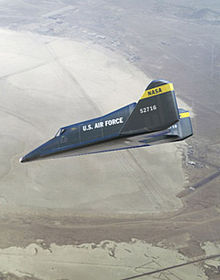
The Air Force followed up with project Dyna Soar, which would have put a winged vehicle on top of a rocket. It was cancelled because the money was needed for NASA. At the top of the post that is an artist’s impression of Dyna Soar landing at Edwards AFB after a mission.

Then the Air Force designed the Manned Orbital Laboratory, a black program which would have been America’s first space station. Cancelled; this time not by bureaucracy, but because of unexpected advances in unmanned satellites which made it obsolete before it flew.

The Air Force did provide input into the design of the Space Shuttle, and got to do some black missions. What were they? Beats me; they were secret.

The Air Force had a hand in several post-shuttle projects which never went to completion and finally got their own space ship in the X-37b. Sadly, it was unmanned.

As you can see, I’ve been writing a lot about all this. If you click on these four links, you will have a thumbnail history of NASA vs. the Air Force in a battle for space.

Now Trump wants to take space away from the Air Force altogether, but don’t blame him. He probably knows less about this than I do, and I am just an amateur enthusiast. Maybe he should click four times.

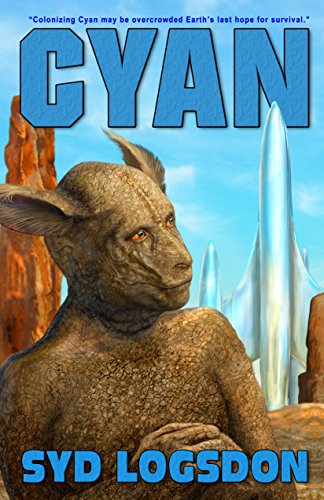
Enough of the latest publicity stunt. In Cyan, my explorers coming back from the Procyon system also faced a conflict that had been going on between NASA and a military space force while they were away. Here’s a quote:

All seemed well, on the surface, but something profound was happening to the people of Earth. They were waking up to reality. When interstellar exploration had begun, few had taken it seriously. Now the process was flushed with success, and that success carried the seeds of its own downfall.

Suddenly, all over Earth, people who had been indifferent to space travel, except to mutter about a waste of resources, became truly aware of what was happening. And they didn’t like it. In the vague common mind of the beast, numbers began to move in slow, painful calculations.

A few thousand colonists; billions of the rest of us.

They — the rich, the powerful, the smart, the educated, the lucky — they will go to the stars and walk the green valleys of paradise. We — the downtrodden, the ordinary, the workers, the plodders, the ones who really make things happen, the ones who always get screwed — in short, you and me. We will stay behind.

In the general elections of 2103, and in a hundred scattered elections and revolutions in 2104, the people of Earth turned on their leaders and said with a loud voice that the spacers who brought in the ore from the belt, and the workers of L-5, and especially those who were finding new worlds, were no longer heroic friends but dangerous enemies. They would no longer be given freedom to do as they pleased, but would be harnessed to the common good.

This was the Earth Darwin returned to in 2105. When Tasmeen signaled Ganymede Station, she received a taped reply.

“Welcome home, Darwin. You will find the language of this year somewhat different from when you left. When the Dog Star returned in 2088, we found that it would be best to train comtechs in the jargon of your departure year, and that is the reason for this tape.

“The biggest change you will have to be ready for is that NASA no longer exists … because after the general elections of 2103 the people of North America decided to combine all space efforts into one military organization. You are all now members of the Federated Space Service.”

Tasmeen said, “I have a bad feeling about this.”

Yeah, Tasmeen. Me, too.

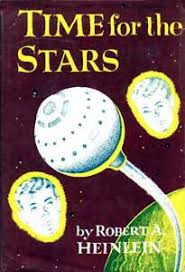
513. Heinlein’s Time for the Stars

Yesterday (June 25) I had a request from a reader for advice on which Heinleins to read after Stranger and Starship Troopers. I replied that my favorites were Door into Summer for the old compact Heinleins, Time Enough for Love for the later, long-winded ones, and Time for the Stars among the juveniles.

The exchange reminded me of a post I had written but not published, because I had an excess of Heinlein related posts going at the time. Here it is, slightly updated and finally published.

===============

Time for the Stars is one of my favorite Heinlein juveniles. I am using it here as a foil to Spirit Deer, in talking about core stories.

Spirit Deer was my first novel, written for adults but very short. I later stripped it of wife and adult friends, and turned into a juvenile. It appeared in Serial between June 5th and August 10th of last year. See 364. The Core Story and 398. Summing up Spirit Deer.

If you strip Time for the Stars and Spirit Deer both down to the core, and they are quest stories. The explorers on the torch ship Lewis and Clark are ostensibly seeking knowledge, but for the young communication techs (i.e. telepaths) that quest in inextricably bound up with a search for maturity. Tim, in Spirit Deer, is seeking survival, and a return to normalcy, but he cannot achieve that without finding maturity.

If you haven’t read Time for the Stars (and why haven’t you?), here is a brief summary.

Tom and Pat Bartlett are twin brothers who are part of an experiment to see if telepathy exists. They go along as a joke, and find that it is not a joke. The “secret language” they have used all their lives turns out to actually be telepathy. What they think other people can’t understand, they in fact cannot hear.

The discovery that makes this more than a parlor trick is that true telepaths can communicate long distances — proven as far as Pluto — and their contact does not show a speed of light time lag. Now relativistic starships can go out from star to star without having to return home to bring back their data.

Tom goes to space and Pat, the dominating twin, stays behind. Tom learns to assert his independence, especially as his stay-behind twin ages much more rapidly. The trip is grueling, the exploration dangerous, and eventually Tom returns home, still young while his twin has grown old.

That is all the summary I can give without spoilers, but how much do you need?

The voyage of the Lewis and Clark is a long trip away and a quick return. Tim, in Spirit Deer, has a quick plunge into the wild and a long return. They differ in detail, but the arc is home — away — home again.

There aren’t more than a billion stories with that arc, significantly including the Heinlein juveniles Starman Jones, Tunnel in the Sky, and Have Spacesuit — Will Travel, all of which are excellent. Upon returning home, these story’s characters characters are changed by their experiences. Jones’ life is most changed, with some losses and great gains. Rod Walker of Tunnel finds a career. Kip Russell of Spacesuit gets on with plans for his life, but his options are immensely augmented.

All four are Heinlein at his best.

512. Time Jacks

Beginning last July I wrote a steampunk novel called Cost of Empire. It is presently seeking a home. I am now working on a second but very different steampunk novel called Like Clockwork. Besides being weird, it also insists on being about 65,000 words long. I really don’t know what I’m going to do about that; that would be a happy length for a 70s or 80s novel, but today’s market demands 100,000 words. Writing is easy compared to meeting the artificial needs of publishing, but short or long, LC is nearing completion.

(Of course, the post last Wednesday makes some of this obsolete. That is the problem with writing ahead.)

It is time to start thinking about a new novel. I have a time travel trilogy I began outlining about two years ago, just before Empire demanded to be written. I’ve been looking over my notes from then, to get my head in order before plunging in. At that time, I wrote a short first chapter, just to test things out.

Would you like to see it? I thought so. The novel will be called Time Jacks.

=========================

In the middle of the continent is a state called Kansas, and in the middle of Kansas is a medium sized town devoted to Time.

Near the middle of the town is a university devoted to the study of time, its mathematical nature, manipulation, inviolability (or lack thereof), and philosophical implications. Bleekman University is the most theoretical of all theoretical institutions, where the finest mathematicians and the finest of philosophers meet and attempt to understand each other, while both are trying to understand Bleekman’s legacy.

On a lintel stone over the entrance to the campus is an engraving of Bleekman’s Theorem. It takes one hundred seventeen symbols, some of which are seen nowhere else in the history of human thought, and some of which are still disputed by those mathematicians and philosophers.

There are three other institutions in Bleekman — surely you guessed that would be the name of the town. Near the university on the north is the Institute of Applications, where the knowledge brought back from alterlines is studied before it is released to the world at large. Scholars at the Institute ask, ”How does it work?” and “What use can we make of it?”

Scholars at Bleekman University do not care for such questions. They spend their time — that statement is almost a pun in itself — poking about on the edges of the Universal Why, knowing that they will never penetrate to its core.

Scholars from the Institute and from the University rarely talk to each other. That may be fortunate for mankind. Opinions differ on this matter.

South of both is “The Academy”. It has a longer name, but no one uses it. Here the brightest and best from all over the Earth come to become Time Agents. Ten thousand are admitted each autumn, having been previously winnowed by harsh competitive examinations. After three years, a few hundred become technicians and a few dozen become agents.

As you might expect, the graduates are a cocky lot.

[I left space here for several paragraphs I wasn’t yet ready to write.]

Oh, you noticed? Not surprising, really. I mentioned the University and three other institutions, then only told you about two.

In the center of Bleekman is a dome, a hundred meters high and a thousand meters across. You can see it from space, but I can’t tell you much more than that. Agents go in through the dome’s only entrance and a year or so later they come out, changed forever. Within the dome are the mechanisms of transference, which anyone is welcome to understand. Just study Bleekman’s Theorem, and good luck to you.

There are many other exits from the dome, but they are all in other timelines; alterlines, most people call them. This Bleekman, this Kansas, this Earth, and this universe constitute the homeline.

Time agents go through the dome to various elsewheres and bring back treasure. They go with the courage of a lion and the stealth of a mouse, changing nothing, and stealing nothing but knowledge.

That is all I can tell you. No one knows more, except for the few who have passed the entrance exams and the three years of winnowing that produces time agents.

=========================

Okay, it’s clearly a rough draft, but I like where it is going. This will be fun.

511. Novel or Novella

If you don’t know about <tor.com>, it is a high quality on-line magazine of science fiction. For years they were one of the few places which would take unagented submissions for short stories, although they have recently changed that policy. They have been mostly closed to novellas as well, but they still have occasional open periods, and one has just begun.

Since most submissions end in, “Try again elsewhere,” I have not previously mentioned any of my own submissions in this blog. However this opening for novellas has brought up some things I want to talk about. Again (see also 146. Novella 1).

Before we begin, here is a piece of information. SFWA (Science Fiction Writers of America), the professional organization which awards the Nebulas, breaks stories into these categories:

short story    under 7,500 words
novelette       7,500 – 17,500 words
novella         17,500 – 40,000 words
novel            40,000 words and up

In the last few years, most people would add very short, or flash fiction, to this list.

I have been working since January on a novel called Like Clockwork, but it has been fighting back. It wants to be 65,000 words long. That would be just right for a submission in the 1970s or ’80s, but is too short to sell in today’s market, unless you are self-publishing.

I’m not. I have considered it seriously, but it calls for a skill set that I don’t have, and don’t want. So I continued soldiering on, hoping for inspiration. Then I became aware of the novella opening at Tor (dot) com, which left me with a choice — try to make Like Clockwork longer than it wanted to be, self-publish it at its natural length, or cut it drastically to create a novella.

My own first publication was a novella, To Go Not Gently in Galaxy in 1978. It was roughly the first third of the novel A Fond Farewell to Dying which I was then in the process of writing.

Cutting TGNG out of FFTD was easy. There was a natural break in the action that allowed me to end the story without leaving the reader feeling cheated.

Cutting Like Clockwork down to size would be another matter; I would have to remove about a third of the book. That would be painful, but would not be a new situation. The floor under my computer is already metaphorically knee deep with good writing that didn’t fit into various novels.

First I had to cut out a long section that took place before the main story. That was easy enough, except that it meant dribbling the necessary backstory into the rest of the book a sentence here and a paragraph there. Smoothly, you understand, and without letting the seams show.

There were four main characters and four lesser characters in Like Clockwork, all paired off. One pair had to be dropped. Some of the things that they did for the plot had to be shoehorned into the lives of the remaining pairs. Smoothly; without letting the seams show.

Much was lost. The Great Babbage, companion to the Great Clock, simply went away. It was reduced to a couple of off-hand references, and that really hurt.  Altogether, it took me a month to chew 65,000 words down to 39,000 words. I submitted it earlier this week, retitled The Clock That Ate Time.

Will you be reading it soon? The writer’s psychotic optimism says yes, but I didn’t destroy any of the files that I cut, and everything that was removed can always be restored if necessary.

That’s my recent history, but it is only worth telling because it points out a larger problem.

Only certain lengths of story can find a market in today’s world. There are homes for flash fiction and for short stories, and novellas can occasionally find their place, but the lengths between 40,000 words and about 90,000 words reside in a wasteland. That is really unfortunate, since most of the best novels in the history of science fiction were in that range.

It’s all a matter of fashion. The best of today’s science fiction would have been rejected unread as too long to publish just a few decades ago.

To put it bluntly, then and now both stink if you have a good story that is the wrong length.

All this is somewhat malleable but there are stories that need to be a certain length. If you are a young writer, this profiling by story length is one more reason self publishing may be your future.

506. The Great American Read

The Great American Read or
What is that book doing on the list,
and where is my favorite?

If you want to start a fight, make a list of great books, then step back while every reader on Earth disagrees with you.

When the Great American Read was announced, I couldn’t wait to see the list. I love lists of great books. It turned out, however, that these weren’t great books, but favorite books. That is a major distinction. Great books or influential books would include the Koran, The Wealth of Nations, Das Kapital, and a raft of works everybody has heard of, but few have read. That list would not include Fifty Shades of Grey or The Martian.

It reminded me of a collection called Best Remembered Poems which included a selection of Purple Cow poems but did not contain Andrew Marvell’s To His Coy Mistress. Popularity and quality are different categories.

As I worked my way deeper into the GAR, I found that the original list of 100 came from a group of readers carefully selected for diversity. That’s all very twenty-first century, but it is likely to find oddball books as well as good ones.

Not that I am complaining. If I made a list of my 100 favorite books, no one would else like all of them either. That’s just the nature of the game.

The GAR people ask, “Which book is your favorite?” I read the list and didn’t find my favorites. A Wizard of Earthsea wasn’t there, which was criminal, but not surprising. Kidnapped wasn’t there, nor was anything else by Robert Louis Stevenson. That was surprising. What about Treasure Island and The Strange Case of Dr. Jekyll and Mr. Hyde?

As a side note, in 2014 The Guardian did a list of the 100 best novels and Kidnapped came in number 24.

So I looked at the list and started to make notes.

There were 8 books I had read and liked — Tom Sawyer, The Call of the Wild, The Count of Monte Cristo, Dune, The Hunt for Red October, The Lord of the Rings, Siddhartha, and The Sun Also Rises. None of these were my favorites, and only Tom Sawyer and Siddhartha would be runners-up for that title.

I won’t identify those I didn’t read or didn’t like, but . . .

There were 4 I read but didn’t like.
There were 4 I read part way through and tossed.
There were 3 I knew enough about to avoid.
There were 2 I read, but found them to be nothing special.
There were 8 I had not read, but I had read other books by the same author. This included authors I had liked and ones I had disliked.
There were 3 which were on my to-read list. I subsequently read one of these and demoted it to nothing special.

There was also one book — Moby Dick — that I read as a child in an abridged version, and plan to read in its entirety when I have a spare decade.

Looking at my tally, you might think I’m picky. That’s probably true, but there are a thousand books in my read-and-liked category that weren’t on this list. I just don’t seem to read what everybody else reads.

How about you? There is a reply button at the top of the post.

———:::———

The original question was, what is your favorite. For me, out of this list, it would be The Adventures of Tom SawyerThe Lord of the Rings beats it for scope, The Sun Also Rises beats it for gravitas, but it seems to me the only way to choose from such a varied list is to judge a book on how well it does what it sets out to do. For that, TS beats them all.

If I didn’t have to choose from their hundred, I think I would choose The Old Man and the Sea.

505. Heinlein and the Hippies

I have come to realize the value of a post title in finding readers, but I try to avoid bait and switch. To provide a balancing bit of honesty, this isn’t about the effect Stranger in a Strange Land had on the Free Love generation, but on the relationship between Heinlein and one particular group of hippies, the Jefferson Airplane, aka the Jefferson Starship.

For the relationship of hippies to Stranger, see 160. Stranger in a Strange Land. That way I don’t have to tell you again that I read it early and found it to be a dud.

As for me, I was a half-way hippie. I opposed the war, grew a beard, let my hair go long, and dressed in rumpled casual. The wild, multi-colored garb of TV hippies was largely a media invention. Real hippies wore Army surplus because it was cheap, which was also one of my sartorial motivations.

However, I didn’t do drugs and I was in the wrong place in the wrong time. My college roommate spent the Summer of Love in California; I spent it looking for archaeological sites in the backwoods of Michigan. He told me all about it when he came back in the fall; I had been out of touch and didn’t even know it had happened.

The only thing I understood as it happened in 1967 was the music, blaring out of the car radio as our survey crew drove around looking for archeology sites. I particularly liked that new group the Jefferson Airplane.

Which brings me to the heart of the post. In 1969, Paul Kantner wrote Heinlein a letter asking permission to quote from his work. I knew this, after a fashion, from contemporary gossip, and it was evident in the lyrics soon after, but I didn’t get confirmation until the second volume of Heinlein’s biography came out (see below). I’ll quote some of Heinlein’s reply:

I am pleased by your courtesy . . . Bits and pieces from my stories have been used by many people . . . and it is rare indeed for anyone to bother to ask my permission.

Heinlein gave permission and went on to ask for some autographed albums in return, since he was a fan of their work. Who knew?

The album Blows Against the Empire came out about a year later, by Paul Kantner and the Jefferson Starship. Despite the title. it was actually a compendium band filling in the time between the breakup of Jefferson Airplane and its later rebirth as Jefferson Starship.

It would be impossible to overstate how much music from this era was fueled by LSD. If you seek out the full lyrics, you’ll see how many drug references I have left out of what follows:

from the cut Hijack

You know – a starship circling in the sky – it ought to be ready by 1990
They’ll be building it up in the air ever since 1980
People with a clever plan can assume the role of the mighty
And hijack the starship
Carry 7000 people past the sun
And our babes’ll wander naked thru the cities of the universe

7000 Gypsies swirling together
Offering to the sun in the name of the weather
Gonna hijack – hijack the starship

from the cut Starship

Out – the one remaining way to go
Free – the only way to fall
The light in the night is the sun
And it can carry you around the planetary ground
And the planetary whip of the sun

Mankind gone from the cage
All the years gone from your age

If you are at all familiar with Heinlein, you will recognize that this imagery is from the novel Methuselah’s Children, originally serialized in 1941, which was also the first appearance of Lazarus Long. Of course Kantner reworked it. The hijackers are not Howards fleeing for their lives, but drug-fired hippies whose faith in everything turning out well is a bit laughable in hindsight.

Like all the first half dozen Jefferson Airplane or Starship albums, I loved it. If you are younger than old, there is an excellent change that you’ve never heard music that shows the spirit of innovation and experimentation that was the hallmark of the 60’s. The music that appears on TV flashback programming is fine stuff, but it is also the tame stuff. The raw stuff doesn’t get replayed.

If you are curious, give this album an online listen, although you may not care for it.

==========

Robert A. Heinlein, vol. 2, The Man Who Learned Better by William H. Patterson, Jr, p. 312. FYI, the subtitle does not refer to a change of heart by Heinlein, but is RAH’s idea of one of the three or four basic plots in fiction, and one he often used.