Tag Archives: science fiction

426. The Five Plots of Time

It is a dubious tradition to produce articles like The Three Basic Plots of Fiction, or The Four Kinds of Traditional Hero. I’ll add my bit, even though I’m dubious myself.

The Five Master Plots of Time Travel Stories

This grouping came out as I was thinking about The Map of Time. Time travel has a long and tortured history as a set of concepts hung uncomfortably between science fiction and fantasy. None of it makes much scientific sense, although I do read a lot of actual (?) scientific theory which demonstrates that even scientists can waste their lives reading too much SF. It would make more sense to simply call all time travel stories fantasy, but they always require a time machine, so they must be science fiction — more or less.

Then again, Einstein would hate FTL stories. They violate relativity, but that doesn’t keep me from reading and writing them.

Let’s just tackle this mess in the spirit of fun.

Master plot #1.     A man tries to change history and fails. He is doomed to failure, no matter what, because the past can’t be changed. The entertainment in this kind of story is in making the reader think the hero will succeed, and fouling him up at the last minute in some clever way.

Master plot #2.     A man tries to change the past in some logically forbidden way. The classic form would be that our hero goes back to kill his father before our hero is born. The stars go out; the universe ends.

I am not fond of this form. It’s too much too simple. Perhaps a good writer could make it work if we know that the victim-to-be is the hero’s father, but the hero does not. (Shades of Oedipus!) Then we would anticipate that this is a type one story, and be taken by surprise when the hero succeeds and the stars go out. That might work, but I doubt it.

Master plot #3.     This is a variation on 1 and 2. A man tries to fix a tragedy by going back in time, but instead makes things worse. This is just a variation on the notion that, “You can’t make the world better, and you shouldn’t try. Just accept your fate.” Literature is filled with this Christianity based defeatism, epitomized by The Monkey’s Fist.

The Greeks called it hubris. I don’t buy it. For me, a man without hubris isn’t much of a man.

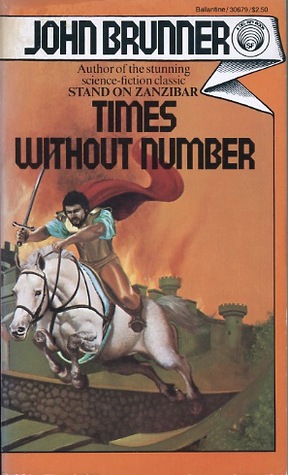
Master plot #4.     A man is in a world different from ours. He tries to change the past, succeeds, and his world morphs into the “real” world, i. e. ours. If the reader accepts that he is reading an alternate timeline story, and is taken by surprise by the ending, it can work. Brunner used this bit in Times Without Number, but that novel had enough quality to succeed even with a different ending. Zelazny did a beautiful variation in the short story The Game of Blood and Dust.

Master plot #5.     A man tries to change history, but instead creates a new timeline, or crosses over into an existing alternate timeline. This isn’t a trope; it’s a genre. Alternate timelines can be wonderful, but they are often cheap knock-offs, based on the notion that you don’t have to create anything, you just rearrange what already exists.

They aren’t even time travel stories, unless someone moves from one timeline to another. Pavane is an alternate timeline novel, but not a time travel story, since every actor in the novel remains tied to his own timeline throughout, and is never even aware of the existence of any other.

Okay, I will admit that any bright twelve year old could invent more plots, or could knock holes in these. I present them merely as a mental exercise — a fourth dimensional Rubik’s cube — for your amusement.

Have fun arguing.

425. Goodreads as Textbook

I bought The Key of Time several years ago from E. R. Hamilton’s, my favorite purveyor of remaindered books. It looked and sounded good, but so did the half dozen others that came in the same order. I put Key aside and it stayed in my to-read pile until I became immersed in Steampunk. It seemed to ooze Steampunk, so I dove in.

I planned to review it in this blog. You saw the results on Monday in post 423. 85 Pages: a review, so named because I couldn’t get past page 85.

That got me thinking about Goodreads. I’ve only been involved with Goodreads for about a year and a half, but I am impressed by the intelligence of most of the reviews. Since I discovered it, I have treated Goodreads almost like a textbook on what intelligent readers want.

Here are Goodreads’ stats on The Key of Time by Felix J. Palma, translated by Nick Caisto:

10289 ratings                2127 reviews                rating 3.37 out of  5

That’s a lot of ratings and reviews. Many Goodreads books have almost none. The 3.37 rating is fairly normal. It’s hard to find a book on Goodreads that doesn’t garner mixed reactions.

I decided to pick a few Goodreads reviewers who agreed and disagreed with my take. Here are some examples — or rather excerpts, for the sake of space and so I don’t step on anybody’s copyright.

Traci said, It was amazing.

. . . Do you enjoy magic tricks even though it’s all sleight of hand? . . . I loved every moment I spent with this new and talented author.  . . . one of my favorites, of the year. Beautifully written.

Did Palma get his act together after page 86? Were the last 524 pages better than what I read?Did I miss something?

Frances seemed to think so, with some reservations.

Frances said, (I) really liked it.

. . . I was beginning to wonder if I wanted to continue. At times I groaned (but it). . . . soon became compelling enough to finish. When I finally read the last page . . . I (was) . . .  pleased to have read such a creative and unique book.

I have to admit that I also felt compelled to continue as well, despite the insipid “hero” and glacial pace. It reminded me of all the times I’ve tried to read Dickens’ longer books. But this isn’t Dickens. It’s more like pretend-Dickens. For me it was finally more irritating than intriguing.

Velma said, (I) did not like it. and recommended the book for “someone willing to edit it, heavily.”

Time travel! Jack the Ripper! Automatons! What’s not to love?!? Well, as it turns out, almost everything. . . . it took every ounce of stick-to-it-iveness I could muster to get through this convoluted, interminable literary maze. WHERE, I ask you, was the EDITOR in this hot mess? . . . (Palma is) a decent, if grandiose, storyteller and he mimics to perfection the florid style of the period he set this novel in . . . But come on, Félix, enough with the meandering, the inconsistencies, the convenient last-minute reprieves . . . I was all set to love this book, what with it being about the re-writing of the history of the earliest science fiction and all, but it wasn’t to be . . .

Velma pretty much sums up my reaction. If you look at her whole review on Goodreads, she is even angrier than this excerpt shows.

What is the takeaway? About Goodreads, that is. I’ve had my say on Palma.

Goodreads won’t tell you if a book is good. It will tell you all the different things readers think about it. And that is its value — many looks from many directions. I will continue to check it out, after I read something. Whether I love a book or hate it, I always learn something from Goodreads reviews, even it is is just public taste.

424. Arthur C. Clarke and Russia

(Written last Thursday) This morning’s news brings new revelations about what Russia is doing to America through the internet. Or are they new? Didn’t Arthur C. Clarke warn us all that this was coming back in 1960 in his short story I Remember Babylon? Of course he did; Arthur has always been ahead of the curve.

I Remember Babylon? is actually dated and struck me as a bit naive when I first read it, but you might want to check out Arthur’s prescience as he gives you today’s headlines 57 years before they happened. After its original appearance in Playboy, the story was reprinted in Tales of Ten Worlds, available in your local used bookstore or on Amazon.

423. 85 Pages: a review

This was supposed to be a review of The Map of Time, by Felix J.  Palma, a book of 609 pages. Instead, it is a review of the first 85 pages because I am going to bail, give up, leave; because life is short and Time is precious.

Mind you, there is some quality in this book. If it were irremediably terrible, I wouldn’t waste a post on it.

Heinlein did time travel, often and occasionally well. Let me retrodict (retrodict: neologism, the opposite of predict) how Heinlein would have written the first 85 pages of this story in, say, 1955.

A___ stood over the torn body of his lover, heartbroken, feeling that his life was over. Then C___, his cousin said, “You can fix this. Just go back in time and kill her killer before he can kill her.

That, folks, is the entire thrust of the fist 85 pages of The Map of Time.

And that’s not all. We already knew exactly what was going to happen by the second or third page. How? Because Palma spends most of his pages foreshadowing events. And, since he calls in every cliché known to Victorian England — Jack the Ripper, ruthless rich father, cowardly wimp of an heir, H. G . Wells and his Time Machine, a hero who thinks he is sensitive but is actually just a clod chasing whores in Whitechapel — we know from the start where this story is going.

The only surprise along the way is that there wasn’t one single surprise along the way.

The writing style is Victorian appropriate. The “hero” never becomes quite so bad that we don’t think he might be salvaged. The “Dear Reader” asides are cleverly handled. The description of London carries the story well. These are all the reasons I stayed around as long as I did. I thought it might get better. I thought something would eventually reward me for my perseverance.

No luck. I’m out of here.

Did I leave just before the story got good? I’ll never know.

If you stuck with The Map of Time all the way through, and you think I’m wrong, tell me. But, spoiler alert, I’ll be hard to convince.

419. Airship Flamel

As I mentioned previously, I found To Rule the Skies: An Airship Flamel Adventure when its author, Michael Tierney, liked one of my posts and I went to visit his website. I bought it as an eBook, which is an adventure in itself. I read eBooks on my desktop Mac. Things that come through iBooks work fine, but the Kindle download is a piece of crap. As you read, it jumps to a new page every few seconds without any input from the user. The only way to successfully read is with your finger lightly on the mouse, and that only works part of the time. This is particularly irritating since the old Kindle download worked fine.

Let me say at the outset that I loved this book. It was a hoot. However, I’m not sure how many of you will feel the same. It probably depends on your vision of what steampunk should be.

To Rule the Skies reminded me of the books I read when I was a kid back in the fifties. Then books were straightforward, violence was muted, and nobody had any literary pretensions. Irony was unknown.

You couldn’t write a book like that if it were set in today’s world, or in the past as seen from today. You can do it in steampunk. As Perschon said of Oppel’s Airborne, it was a time “before the cynicism and doubt the Great War produced. This is the Gilded Age; this is the time of Victorian Optimism.”

That attitude may not be realistic, but it is a breath of fresh air.

The plot resembled an episode of The Wild Wild West, but the crew of the airship Flamel was pure Victorian British. Stiff, long winded, formal, but that was its charm. The tone was somewhere between innocent naiveté and tongue in cheek.

After all, True Grit isn’t Louis L’Amour, and that is its charm. The same thing works here.

I think its time for an example.

Sparks flew at every connection and disconnection. Montgomery was worried that the chamber was imbalanced and he made ready to pull the switch that would break the connection to the umbilical.  “She canna take it any more!” he cried, and just as he did, the shaking stopped suddenly, and the plasma inside the chamber settled down to a slowly pulsing orange glow.  He spun in his chair and checked the gauges.  “All normal, Mr. MacIver!  The luminous matter reaction has started!”  Montgomery slumped in his chair relieved.

MacIver? Say that one out loud. And engineer Montgomery shouting, “She canna take it any more!” as he performs a miraculous repair on a dying piece of high tech machinery. The pop culture references come thick and fast.

I hope Michael Tierney isn’t insulted if I say it isn’t literature, but, man, is it fun.

418. India by Dirigible

Today the British dirigible Henry V, nicknamed Harry, reached western India, then traveled south from Goa — still in Portuguese hands in 1887 in our world and theirs — to Mangalore (now called Mangaluru) where they will follow the Netravathi River in their crossing of the Western Ghats.

God, I love writing novels

This morning, so far (I’m writing this on Sept. 29), I have four views of various posts. Three are from the USA and one is from India. That is no surprise. As I reported in a previous post, India is the third most common country of origin for those who view my blog, after the USA and Canada. I don’t understand why, but I like it a lot. I have had a strong connection with India since 1967.

(This is in textual parentheses because it is a parenthetical event. I took a brief break to watch Well Read on my local PBS and found a rerun of an interview by Indian author Anuradha Roy. It was both another connection, and a caution that what I know about India is small compared to a writer who is a native.)

During my first year in college, I switched to Anthropology because Biology was going through a phase where, if a study didn’t require an electron microscope, it wasn’t worth doing. I was there to study ecology, and couldn’t see spending my life wearing a white coat in an air conditioned lab. Anthropology seemed a better bet, and I soon became enthralled with India. I even ended up taking a year of Hindi, but a language you don’t speak, goes away. I could still tell you how to get to the Ajmiri hotel, and that’s about it.

When I  was about to graduate from college, my wife and I volunteered for the Peace Corps and were assigned to a project in Mysore, the Indian state which is now called Karnataka. Between my draft number and Nixon’s cancellation of the Peace Corps deferment, we never got to go. Instead, I spent the next four years in the Navy, and then returned to college for an MA where my thesis was on Indian village economics.

Then I became a writer, and I never got to India.

India, however, always remained a part of my writing. In A Fond Farewell to Dying, a young scientist from post-apocalyptic America goes to India which, two hundred years from now, is the only refuge of civilization. In the steamunk novel I am now writing (still in search of a good title) Lieutenant Commander James of the dirigible Henry V is caught up in a conflict between Britain at her peak and her Indian possessions which are beginning their long fight for freedom.

Incidentally, at the other end of the Netravathi River which was mentioned in the first paragraph, is Mysore, the region I was assigned to almost fifty years ago. I never made it in the flesh, but I’m looking forward to going there by dirigible.

God, I love writing novels

417. Sturgeon and Steampunk

If I’ve learned anything in my ongoing study of steampunk, it is that Sturgeon’s Law does not apply. [Sturgeon’s Law: Ninety percent of everything is shit.]

Sturgeon’s rule applies to science fiction, fantasy, literature approved for the college curriculum, and the work of prominent philosophers. It applies to fields where there is some objective means of determining quality.

Steampunk, on the other hand, is so wide ranging that it would be hard to find any two fans who agree on precisely what it is, far less what constitutes good steampunk.

After I read and reviewed Steampunk by the Vandermeers (see 411. Steampunk I II III), I checked out how it fared in Goodreads. The reviews were all over the map. More notably, when reviewers told what stories they liked or hated, no one liked or hated the same stories.

So if Sturgeon is not useful, let’s try this: [Logsdon’s addendum: I don’t like ninety percent of what I try to read.] That is why I’ve read so many first-twenty-pages-of-novels, without finishing them. I’m referring to all novels, not just steampunk.

The Addendum is not just a matter of putting my name beside Sturgeon’s. You could call it Wilkes Addendum, if your name were Wilkes, or Jones Addendum if your name were Jones. I suspect it would still hold. Quality and liking are not the same thing. I frequently read works that are marvelously written, but I simply can’t find any interest in them. That often happens when I dip into the Classics. It happened in some of the stories in the Vandermeer anthology.

On the flip side, some stories are pure fun, even though I can’t claim that they are intrinsically good.

This like/dislike issue comes up all the time when people “like” one of my posts. I always visit their websites. A lot of them are very young or deeply wounded, and are baring their souls. Occasionally I say hello, but mostly I withdraw silently, just happy that the internet is there for them.

Frequently I find a writer who is displaying his work. I always read, but rarely comment, because, “Who am I to judge?” It was under those circumstances that I recently read the first chapter of Echo by Kent Wayne (very much not steampunk). It is a fine piece of fiction, powerfully written, and it will clearly have much to say in coming chapters. It is also quite violent, and the character at the center is not someone I could like — yet, although there are hints of coming change. I short, I rank it high for quality, but I won’t read it further because it takes me places I don’t want to go. My shortest honest response would be, fine work, but not for me.

On the other hand, I also found Michael Tierney through a “like”, bought his purely steampunk ebook To Rule the Skies, and am presently 77% of the way through it. That’s an ebook workaround for the lack of pagination. The novel reads like Tom Swift, the Steampunk Professor and I love it for that very reason. I’ll devote a post to it shortly.

Another thing I have tentatively concluded is that lots of steampunk fans must also love Downton Abbey and Fear of Flying. I’ve lost track of how many heroes and heroines are members of the Victorian upper crust, the heroines also being spunky and liberated.

Oh well, it’s a big tent, with room for everybody. Most of the people inside seem to be wearing top hats with gears on them, but it isn’t required.

416. Steampunk I II III

If you go to Amazon, select books, and type in Steampunk, you will get a supposed 100 pages of 16 entries each. No, I didn’t tap through all of them.

In the novel I am presently working on, I had cause to quote Samuel Johnson’s A man who is tired of London, is tired of life. I think I could paraphrase that as a man who is tired of steampunk is tired of reading. Steampunk seems to encompass everything, which makes it a little hard to throw a rope around.

I have been reading proto-steampunk all my life, but the genre (if it is a genre) has only been identified as such since about 1980. What is it, other than everything? I feel a little like a wild kid in a permissive household; how can I be a rebel if I can’t find any boundaries?

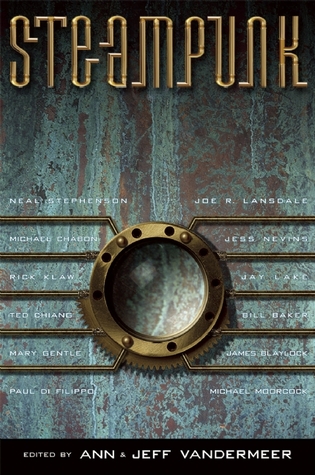
Following that train of thought, I recently got hold of the 2008 anthology Steampunk by Ann and Jeff Vandermeer. There are also a Steampunk II and a Steampunk III, hence the post title, but I haven’t seen them. Let me start by quoting from their preface:

In this anthology, we’ve tried to provide a blend of the traditional and idiosyncratic, the new and the old, while remaining true to the idea of steampunk as dark pseudo-Victorian fun. You’ll find stories about mechanistic golems, infernal machines, the characters of Jules Verne, and, of course, airships

The anthology Steampunk consist of thirteen excerpts and short stories, and three essays tackling history and definition of steampunk. I read only bits and pieces of the thirteen, and that needs explaining. I generally don’t like short fiction. I read tons of it when I was growing up and some of it was superb, but generally it is long on the clever and short on humanity.

Perhaps if someone had held my feet to the fire and required that I finish them, I would have found more to like in these short stories. Probably not. I skipped Moorcock because I had read the novel from which the excerpt was taken. I skipped Blaylock because I am reading one of his novels now. Both authors are excellent.

Many of the other stories left me cold. They were strings of events happening to people I could not care about. Also, the stories seemed universally dark. That is a valid anthologist’s choice, but I don’t care for horror and I outgrew dystopias thirty years ago. Life is a mixture of light and dark, and literature has to mirror that if it is going to hold my attention.

Mind you, most of what I sampled was reasonably well written. It didn’t fail for lack of skill, but there did seem to be a lot of throwing ideas around without linking them together. Short stories can sometimes get away with that. The steampunk novels I am presently reading all seem far better structured.

However, there was one shining light. Jess Nevins’ introduction: The 19th-Century Roots of Steampunk was a superb explanation of steampunk’s precursors. I learned a lot from Nevins.

415. Life-long Day Job

After twenty some years of teaching
science, I finally got a lab.  SL

Continuing from Monday’s post — Jandrax came out and I went back to writing full time. Those were the years of A Fond Farewell to Dying, Todesgesanga (FFTD translated to German) Valley of the Menhir, Scourge of Heaven, Who Once Were Kin, and the first iteration of Cyan. I know you’ve never seen half of those books, but you will. I promise.

There is no better feeing than sitting down every day and writing, when the results are good. And they were. However, there are few more frustrating feelings than writing good books that don’t sell. After most of a decade of full time writing, it was clear that I couldn’t go on that way, and equally clear that I couldn’t quit. I needed a day job that would leave me some time for writing.

My wife suggested that I substitute teach. The pay was good (compared to minimum wage) and I didn’t have to look for jobs. I signed up, and the jobs came to me. It worked as a stopgap.

I couldn’t do it again, after being an actual teacher. Substitute teaching is to teaching, as going to the dentist is to being a dentist. The best one word description is probably painful.

However, I didn’t feel that way at the time. Yes, the job was boring, and yes, it was glorified babysitting, but I had made a shocking discovery.

I liked the kids. A lot.

You have to understand, I was an only child, raised on a farm, having little contact with other kids. I never had children of my own — by choice. To me, babies are just pre-humans. Kids under ten bore the hell out of me. But these kids were interesting and fun to be around.

I had discovered that middle school kids are more fun than a bucket of puppies. I realize that I am a minority in that opinion, and I also realize that part of my feeling comes from not having to take them home with me, but there it is.

Most teachers want to teach high school or fourth grade. Not me. My days as a substitute teacher in high school were dismal. My days teaching kindergarten were horrific. But middle school was my Goldilocks age — not too young, not too old.

By that time I had two masters degrees, so it didn’t take long to tack on a teaching credential. I took a job in one of the schools where I had substituted and I was still there twenty-seven years later.

In my mind, it was a day job. I continued writing. I continued working on the novels which weren’t quite right, and I wrote Raven’s Run. Years went by. I wrote a novel about teaching, Symphony in a Minor Key, which is running over in Serial right now.

I could tell you all about my first years, describe my first room, and give you insights into the joys and pains of teaching — except that I already have, in Symphony.

After about ten years, it was obvious that I wan’t going to get back to full time writing any time soon. After another decade, I admitted to myself that I wasn’t just a writer who was teaching. I was a teacher. It took me that long to be able to say it without having it sound like a defeat. I never stopped being a writer. I just became a teacher as well. I had two careers, parallel and simultaneous, and there was nothing wrong with that.

I was a writer, and a good one. I was a teacher, and a good one. Nothing wrong with that. After about twenty five years, I could even call myself a teacher out loud.

Now I am a retired teacher, and a full time writer again, with a new book out and another working its way through the computer. But I wouldn’t trade those years of teaching for anything.

414. Day Jobs

I  have had a lot of jobs in my life. The shortest lasted one day. I took a job as a rough carpenter, and spent a day putting blocking between rafters. I had a rough time of it. I had just spent four years indoors working in a naval hospital followed by a year in grad school, and I was out of shape by the standards of the farm boy I had once been. It was a hot summer day in California and I probably wasn’t worth my wages that day, but I would have gotten better. I had the skills for the job, but it was a physical challenge and I was up for it. Unfortunately, at the end of the day, the boss said that tomorrow I was to go to a site in Sonora to work. That was a town fifty miles away, not the state in Mexico. I realized that if I had to drive my dying car that far every day to get to work, it would cost me more in gasoline and repairs than I would make at minimum wage.

If you end the day with less money than you started, that isn’t a day job. That’s a mistake. However, when you write your first about the author for your first book or for your website, having worked at a lot of day jobs is an asset. It makes you look worldly and interesting.

Farm worker. That’s a job I didn’t get paid for at all. I started at age eleven and continued until I escaped to college.

Trim carpenter. That sounds skilled, and I am that skilled now. I wasn’t when I did the job, one summer between college terms. I was hired because the wages were so low that people who had the skills wouldn’t apply. I took the job because I was newly married and needed money to carry me through my last year of college.

Horticultural agent, peace corps. That’s a job I applied for, was accepted to, and really wanted, until Nixon did away with the deferment and I had to face my low draft number. I can’t count that one, since I never made it to India, to my eternal disappointment.

Cabinet maker. Another minimum wage job in a local shop to keep body and soul together while waiting for the Navy.

Surgical technician. Yes, really. I spent my naval career in the dental service of a naval hospital, stateside during the Viet Nam war, and happy not to be shot at. Since I was the only enlisted man with a college degree (the recruiter said, “College man? We’ll make you an officer.” Riiiiight!), I became head surgical tech. That meant standing across from the oral surgeon during about 2000 extractions of wisdom teeth.

Surgical nurse. I never count that one, because no one would believe me. The person who stands next to the doctor and hands him his instruments during an operation in the main OR is written down on the report as surgical nurse, whether they are a nurse or just have OJT. I did that maybe two hundred times while I was in the navy, usually on broken jaws, but occasionally on some pretty sophisticated maxillofacial reconstructions. Fascinating, but it didn’t make me a real nurse.

Writer. Nope, not a day job. A lifetime job, but you don’t make minimum wage.

County Red Cross Director. I earned that job. I had become a full time unpublished writer when I started as a Red Cross volunteer. I became a first aid and CPR instructor and taught hundreds of students, then became a member of the board of directors, and finally went full time for fifteen months. There weren’t a lot of applicants, since the job didn’t pay much above minimum wage. Non-profits are like that; they have to get money from donors, and it goes mostly to providing services, not cushy salaries — and that’s as it should be.

I was proud to work for the Red Cross and considered making it a career, but the bureaucracy is brutal. Besides, my first novel came out from Ballantine and I thought I was going to make a living at writing.

Stop laughing. It seemed possible in 1978. more on Wednesday