Tag Archives: science fiction

582. Newtonian Nukes

Everybody who read the last generation of science fiction juveniles before Apollo knew Newton’s third law:

For every action, there is an equal and opposite reaction.

The demonstrations in popular science books of that same era usually went something like this: imagine a person on a frozen pond wearing ice skates, throwing bricks. Every brick he throws will move him backward. If we could ignore the friction of skates on ice, it would be proportional. That is, if a hundred pound man  . . .

Okay, side issue. Most Americans back then, and even today, don’t think in kilograms or kilometers, nor distinguish mass from weight in everyday thought, so . . .

If a hundred pound man throws a one pound brick at ten miles per hour, it will propel him backward at one tenth of a mile per hour. 1 times 10 = 0.1 times 100. We are ignoring friction from the ice, the atmosphere, and probably a bunch of other things.

So, if you want to go faster, throw more bricks, right? If you throw a thousand bricks, you should be able to go pretty fast, right? Wrong, because the first brick your throw in the new scenario will have to move not only the hundred pound man, but also the other 999 pounds of bricks.

Increasing the amount of fuel carried quickly brings about diminishing returns. More fuel alone is not the answer.

In a Newtonian scenario, the faster the propellant leaves the rocket engine, and the more propellant you use, the faster you can go. LOX and LH are probably near the practical  maximum for propellant speed by chemical reaction. The logical next step would be to use a non-chemical energy source to activate our propellants, such as a nuclear powered rocket. Even that won’t get us to the stars, but it makes sense for travel inside the solar system.

Before Apollo, everyone who read science fiction knew that, which is why the Scorpius and her sisters in the Rip Foster book are nuclear powered. So were the ships in Bullard of the Space Patrol, a marvelous fix-up novel by Malcolm Jameson that no one remembers today. So were the ships in the Dig Allen series (1959 – 1962), six great but forgotten novels, and the ships of the Tom Corbett books, which were not so great and are not completely forgotten.

Star Trek put all these early concepts out of business. Warp speed was a necessity for roaming the galaxy, but it made nuclear rockets look old fashioned. I think that’s too bad. There is still room for them in science fiction, and certainly in real life.

I haven’t mentioned Heinlein yet. The Rolling Stone was nuclear, but he quickly moved on to torch ships, which had the capacity of total annihilation of matter. He never explained how that could be done, but the result would be “propellant” moving at essentially lightspeed. You can’t get faster than that without warp drive. His torch ships roamed the solar system and went on to explore nearby stars.

I stole that schtick for my coreships in Cyan, with a twist. See 23. Star Drives.

In a rational world — which we will probably never inhabit, but we can still write stories about — you would use chemical rockets to get to LEO (low Earth orbit), nuclear powered rockets to zip around the solar system (fission powered if you were writing in the sixties, fusion powered if you were writing today), and “torch ships” to reach nearby stars. Beyond that, you would need FTL (faster than light) vehicles which, by our present understanding of the universe, are impossible.

Too bad about FTL, but why are we still using chemical propellants in the real world fifty years after Apollo? Fear of nukes, of course. There will be more to say about that on Wednesday.

581. The Traveler in Black

(The traveler in black) has many names, but one nature, and this unique nature made him subject to certain laws not binding on ordinary persons. In a compensatory fashion, he was also free from certain other laws more commonly in force.

John Brunner was a successful and popular author of science fiction and fantasy, but he is rarely mentioned in the same breath with Clarke or Asimov. He has fifty-nine books listed inside the cover of my copy of Traveler, and he won a Hugo for Stand on Zanzibar, but he never quite made it to the top rung of the ladder. I have a theory about that.

The blurb-quoted reviews on the back cover of my Traveler praise Brunner for his competence. Competence may get you to the party, but it doesn’t make the fans gather ’round you once you are there; and that isn’t completely fair either, since he once wrote a book that was as good as any in science fiction or fantasy. The Traveler in Black was his Old Man and the Sea.

My theory is that, like Clarke, Brunner was an idea man. His characters have just enough blood in their veins to carry the ideas, and not one drop more. Zanzibar is a prime example; all the characters in that novel were cyphers. It was a big book about big ideas, populated by little tiny people.

Traveler avoids the curse of dull character by the oddest of twists; the traveler has no character at all. His character is to not have character. And it works.

The traveler moves through a world of chaos, having no will and no agenda, and changes everything. He is cursed-blessed-given-created to answer wishes in the exact words they were asked.

It’s like a wishing well with a mean streak, but there is no mean streak in the traveler. He sadly shakes his head and does what he was created to do — gives people exactly what they ask for. And since people aren’t too bright, they don’t see the consequences that will attend their wishes. They almost always get what they really didn’t want. Many do not survive their wish fulfillment, and no one survives unscathed.

As you may guess, this uses up a lot of lesser characters. These are précis people; sketched out in a few words and gobbled up by the march of change. Only the traveler survives.

This sounds a bit like a Mad magazine view of history, but Brunner pulls it off through the non-personality of the traveler. He has no backstory. He has no motivations, only the geas to grant wishes. He is slowly carving reason out of chaos by letting chaos devour itself. There is a tremendous cost in human suffering, and the traveler witnesses it all, unable to warn or advise, compelled to grant whatever wish he encounters, whatever the cost to the wisher.

We don’t hear him think about this. He does not converse, although he is often the object of conversations. We only know his inner feeling by a shake of the head, a hesitation to speak, and the slow pace of his progress through the world. That this is one sad and weary entity is only acknowledged in passing. It is all a game of subtlety, conveyed by the stately beauty of the language in which it is written.

Traveler is a fix up novel of individual stories previously published in SF magazines, and stitched together by the traveler himself. It comes in two versions. The one I read first, many years ago, was called The Traveler in Black. Its cover is pictured here. The cover pictured at the top of the post is a later version with one more story called, of course, The Compleat Traveler in Black.

The odd spelling is a literary reference. I won’t elucidate. I’ll just let you feel superior if you recognize it.

580. Pavane

During the Golden Age, most science fiction was in the form of short stories, published in science fiction magazines. When paperbacks became popular, there was a need for novels, mostly short by modern standards. Authors and editors mined the SF magazines for interrelated short stories that could be linked together and somewhat rewritten to appear as if they were novels. They became known as fix-up novels. The next three on my best list are all fix-up novels: Pavane today, The Road to Corlay (set for April 17, but these things sometimes change), and The Traveler in Black this Wednesday.

Pavane by Keith Roberts (publication date 1968) is not to everybody’s taste, but is one of my all time favorites. It is an alternate universe novel, set in the twentieth century in a world where the Catholic Church has maintained its power. The universe-changing event was the assassination of Queen Elizabeth the First, shortly before the arrival of the Spanish Armada.

Of course, the people of Pavane don’t know that they are an alternate. Their world is simply the world. Other than a brief introduction, the novel is written from that perspective. Things are explained, as they must be in any novel, but only enough that someone in the world of Pavane would understand.

(If I wrote a story about a blacksmith, I would explain enough that a college student could understand, not enough for an alien from Alpha Centauri to understand.)

This makes Pavane a bit challenging, but Roberts does his job well. The challenge is slight, and the reward is an abundance of ambiance.

Pavane takes place in a cold, hard world, and the characters fit their situations. Jesse Strange, in the first story The Lady Margaret is so dedicated to the family business (haulage by steam road waggons) that he passes up love and ignores friendship. Rafe, the student signaler, is engaging, but doomed. The story of the artist Brother John is positively grim.

All this sounds like I’m saying, “Don’t read this book,” but in fact I give it my highest recommendation. You will be forced to confront this alternate culture by digging deep into what makes it work, and any time one has to learn another way of thinking from the inside, the mind and the heart are enriched.

The ending called Coda is a disappointment. Roberts gets up on his soap box for a brief but embarrassing moment to try to justify his culture. Cultures don’t need justification; they just are. And every one of them, including yours and mine, is a mixture of joy and horror.

Probably the most notable part of the novel is the sheer beauty of the writing. At least, that is my take. I have found beauty of writing to be extremely subjective, but Pavane hits the sweet spot for me. I invite you to see if it hits yours.

One thing for sure. Thirty pages in, you will already know if you love it or hate it.

Pavane is available used or e-book from Amazon, or if you are lucky at your local used book store.

579. Guilt

How many times have you seen it: the massive city, the grinding machinery of the state, the downtrodden under the wheels of the machine — it’s a classic dystopia. One man (or, rarely, woman) fights back, foments a rebellion, and it all comes crashing down, ushering in a new day.

End of movie or novel.

Well, maybe . . .

It seems to me that this trope has been overused. I have no real argument with all those stories that end with the destruction of a dystopia, but I was looking for something a bit more subtle in Like Clockwork. There is something resembling a downfall (you’ll get no spoilers here) but it doesn’t come at the end, and those who bring it about have to face the reality of what they have done. Here’s a taste.

(Hemmings) laid his head on his crossed arms. His heart hurt.

Life may be nasty, brutish, and short. Life may be eternal in the lap of Jesus. Or life maybe a recurring year, extended far too long, but it is still life. And Hemmings had taken the lives of men who had done him no wrong.

He had not known the others who had died, but he clearly remembered the guard at the waggon door. He grieved for him.

I know exactly where this scene originated.

I was a young teen. I had recently discovered the local public library and my hundredth-or-so book was Underwater Adventure by Willard Price. Overall, it was a good book, although no better or worse that the average I was reading at the time. However, one scene knocked me out.

The villain, posing as a friend, went for a dive with the mentor. The two brothers who were the heroes of the book were elsewhere. The villain contrived to have the mentor trapped underwater, and left him there to drown.

Two things about this affected me. First, the mentor did not make a brilliant and heroic escape. He actually did drown. Second, the villain — who was pretty scummy and eventually came to a well deserved bad end — came up out of the water full of remorse. Not enough remorse to go back and save the mentor, but enough to be shaken.

The scene was told from the villain’s perspective. In that moment, I identified with him far more than I had identified with the cardboard heroes. Through him, I came to an understanding of how it would feel to take the life of a good man. It was something worth knowing, and something a bit more real than most of what I was reading at the time.

So here I am, decades later. I have a debt to Willard Price for that moment of clarity, and I’m paying it forward.

575. Textbook: The Rolling Stones

This is a continuation of the post Learning Spaceflight.

For someone reading this post today, it will require a bit of imagination to recreate the head space I’m talking about. Think 1952. Sub-divisions and interstate highways were brand new. NASA was still three years in the future. Heinlein wrote a science fiction juvenile called The Rolling Stones in the year Mick Jagger was still twelve years old.

In the interests of full disclosure, I was five years old that year, so I must have read it six or seven years after publication.

In those days, those of us who were in love with the idea of spaceflight were getting our fix from science fiction, and mostly from juveniles. PBS was seventeen years in the future, and NOVA was twenty-two years in the future.

I recently re-read The Rolling Stones. It was never my favorite novel. I would give it one star for plot and no stars for its obnoxious characters.

The Stone family lived on the moon. The slightly underaged twins wanted to buy a spaceship and flit around the system on their own, using money they had made from an invention. Dad said, “No,” but never fear. He bought a larger ship and took his whole family along, first to Mars, then to the asteroid belt.

If my tone sounds facetious, chalk it up to how irritating all the characters were, but as a textbook on how to fly in space, The Rolling Stones was top notch.

Here is an example. Leaving Luna for Mars, the Stones opt for the most economic orbit. This puts them in a long line of craft who have made the same decision. They fuel up on Luna then drop down to pass close to the Earth because . . .

A gravity-well maneuver involves what appears to be a contradiction in the law of conservation of energy. A ship leaving the Moon or a space station for some distant planet can go faster on less fuel by dropping first toward Earth, then performing her principal acceleration while as close to Earth as possible. To be sure, a ship gains kinetic energy (speed) in falling towards Earth, but one would expect that she would lose exactly the same amount of kinetic energy as she coasted away from Earth . . .

The mass of fuel adds to the energy as they drop deeper into the Earth’s gravity well, but the fuel is expended at perigee so it does not subtract from the energy as they move away. I’m interrupting RAH and explaining it myself because he took too many paragraphs, but that’s where I learned about gravity well maneuvers. By the time I got to college my main interest was ecology and then anthropology, so I never studied engineering or orbital mechanics. I still wish I could have done both but, in truth, most of my knowledge of space travel came from Heinlein, Clarke, Ley, and Goodwin, with lesser lessons from Gamow, Coombs, Hoyle and dozens whose names I no longer remember.

Later on, the Stones headed out for the asteroid belt. They . . .

shaped orbit from Phobos outward bound for the Asteroids six weeks later. This was no easy lift like the one from Luna to Mars; in choosing to take a ‘cometary’ or fast orbit . . . the Stones had perforce to accept an expensive change-of-motion of twelve and a half miles per second for the departure maneuver. A fast orbit differs from a maximum-economy orbit in that it cuts the orbit being abandoned at an angle instead of being smoothly tangent to it… much more expensive in reaction mass.

Of course. That makes perfect sense.

I watched the first part of a NOVA program the other day called The Rise of the Rockets. I turned it off about ten minutes in muttering kinderspiel. At least that’s the word I’m choosing to use in this family site. That happens a lot. NOVA covers fascinating subjects, but they tend to dumb them down. The old dudes did it better, even in their fiction.

However, they didn’t always get it right. Regarding the asteroid belt, RAH said . . .

But it was not until the first men in the early days of the exploration of space actually went out to the lonely reaches between the orbits of Mars and Jupiter and looked that we learned for certain that the Asteroids were indeed fragments of a greater planet — destroyed Lucifer, long dead brother of Earth.

Back in the fifties when The Rolling Stones was written astronomers had not yet decided if the asteroids were an exploded planet or an unformed one, caught in the tidal stresses of Jupiter’s gravity. RAH chose the more exciting option. Today we know better. Too bad. I always wanted to write a novel called The Last Days of Lucifer. I guess I still could, as steampunk.

In the fifties, we knew little about the universe and not all that much about the solar system. A lot of what RAH and others wrote has been killed by current knowledge. He had a non-human civilization with canals on Mars and intelligent talking dragons in the swamps of Venus. But he knew his math, and his rockets always got where they were going by following the rules of physics that NASA uses today.

570. Lunar Excursion Module

This is the Apollo 9 LEM, photographed after it separated from its CSM. Photographs of either CSMs or LEMs in space are typically nose on, since each could only be photographed from the other (there wasn’t anyone else around to do it), and they only separated in lunar orbit at the outset of a landing maneuver or at rendezvous. Apollo 9 separated in low earth orbit and performed various maneuvers there, making this side-on view, right above the Earth, a rare treat.

Apollo 9 launched fifty years ago March third. That’s a Sunday, and I don’t post on Sunday, but there will be plenty on that mission the following week.

Virtually all of the missions returning from space have returned by atmospheric braking and parachute, or atmospheric braking followed by a winged landing. In the early days of science fiction movies, landings were always tail first but that was not possible on Earth until Elon Musk and SpaceX finally managed it in 2015.

On the moon, there was no choice but to land tail first, slowed by rockets, and the LEM was built around that fact. Learning how to land tail first was also a major issue; see 185. The Flying Bedstead.

The LEM was a two stage rocket. The descent stage, dot-shaded gray in this NASA drawing, made up about two thirds of the mass of the LEM. It contained a frame, tanks with fuel and oxidizer, a rocket engine, and the landing gear. It also contained storage space, accessed from the outside, for the equipment that would be used once the astronauts were on the moon.

The landing gear served multiple functions. The pads at the end of each leg were designed to keep the LEM from sinking into the lunar soil. Their size was both a compromise and a guess. No one knew either how deep the lunar dust was, nor how much structural integrity it had. Worst case scenarios had the LEM sinking hopelessly into many feet of lunar dust, the accumulation of millions of years of micrometeorites pulverizing the lunar surface. In fact, the pads only sank slightly.

The number of unknowns that faced the engineers and mission planners was immense. It it hard for people born since the seventies to imagine the depth of our ignorance before Apollo 11 landed.

The struts were designed to absorb energy, because the LEM could not fire its engines all the way to the ground. The upwash of lunar dust and rocks would have blinded the pilot and possibly knocked holes in the LEM, so the engine was designed to be cut off at a certain height above the lunar surface, letting the LEM fall the last small distance. But how high? That was another calculated estimation (guess). And how much spring would the struts need? Too little and the LEM would crash to the ground. Too much, and it would rebound with possibly disastrous results. And if one leg landed on a boulder or in a hole, the whole LEM might tip over and be unable to return to orbit.

The ascent stage contained crew space, controls, computer, radar, guidance systems, oxygen for human use, and the crew in their space suits. It also contained fuel and oxidizer and its own rocket engine, all smaller than for the descent stage since the LEM ascent stage was one third the size and mass of the complete LEM. The descent stage formed a launching platform for the ascent stage.

When Apollo 17 launched from the moon, a camera was mounted on the rover which was left behind. You can see all 36 seconds of the last ascent stage liftoff from the moon at https://www.youtube.com/watch?v=9HQfauGJaTs.

Apollo 11 proved that all this would work. Apollo 10 was a dress rehearsal of everything but the final landing. But until Apollo 9, fifty years ago this weekend, no one knew if the LEM would work at all.

More next week.

569. Apollo: Profile of a Mission

This is the Apollo 9 LEM, photographed after it separated from its CSM. NASA photograph.

This was originally intended as a detailed picture of the Lunar Excursion Module, but it became clear while writing that before I could talk about the vehicle, I had to lay out it’s place in the scheme of things. This post then became a generic mission profile, and details of how the LEM worked will come in the next post.

If you Google lunar lander, you will find the LEM, but you will also find a lot of forgotten craft. Both the United States and the Russians had unmanned lunar landers and lunar crashers. That’s not a joke. Before soft landing was perfected, we learned a lot about the moon from probes which photographed all the way down to a crash landing. Those piles of rubble that dot the moon were the ancestors of Spirit and Opportunity.

That’s not good enough for a craft that was to be, in the vernacular of the day, man rated.

The LEM, or LM as it is often called today, was unlike any manned craft before or since. It has been called a “true” spacecraft, but in fact it only got half way toward that ideal. A “true” spacecraft, built in space and powered by a low force, long acting engine, would never have to endure the vicissitudes of atmospheric friction or high gravity.

The LEM did have to withstand multiple gravities during its launch from Earth, and again on landing and taking off from the moon. However, it never had to come in contact with atmospheric friction because it spent the launch hidden behind a streamlined clamshell shroud. It didn’t itself have to be streamlined, and its skin could be flimsy. The astronauts joked about being afraid of accidentally putting a boot through the side of the vessel. At least I think it was a joke.

The Saturn 5 is called a three stage rocket. It could as easily and accurately be called a six stage rocket. The first and second stages were designed to burn all their fuel and fall away. The third stage carried the rest of the vehicle into orbit and then shut down; at that point, it’s fuel was not exhausted.

If the mission was to lunar orbit or landing, the Apollo craft stayed in low earth orbit long enough to establish that all was well, then the third stage fired again to send the craft toward the moon.

On Apollo 8, there was no LEM, so in December I only described the Saturn and the CSM. Apollo 9, whose fiftieth anniversary comes in about ten days, had a LEM but never left near Earth orbit. Apollos 10 through 17 were lunar missions. They had similar flight plans and used all “six” stages.

When the Saturn third stage fired a second time, it put the entire remaining craft into a orbit toward the moon. The third stage would have gone right along with the rest to the craft, if it had been allowed to do so.

What happened next on each mission was well presented in the movie Apollo 13, but only if you already knew the what, the when, and the why. It was drama, not documentary, but with excellent animation. If you have a DVD of Apollo 13, take a look.

The LEM, and the CSM (command and service modules, treated as one) had initially been stacked vertically above the third stage, with the LEM protected by a shroud. The attached NASA drawing also shows the abort rocket above the command module, but that had already been discarded by the time the craft was actually on its way to the moon. All three astronauts were in the CM. The CSM, the LEM, the shroud, and the third stage are all still in one piece.

Now the CSM was released; it moved forward on maneuvering thrusters and turned a one-eighty. The LEM was still attached to the third stage. Now the clamshell opened up and the CSM moved carefully forward and docked with the LEM, front of CSM to top of LEM. The LEM was released from the third stage and towed away by the CSM. This position allowed the hatches on the CSM and LEM to mate so the astronauts could move freely between the two craft. The legs of the LEM, previously tucked under to fit within the shroud, now extended into lunar landing positions.

From this moment until lunar orbit was achieved and it was time for the LEM to move away from the CSM and land (or nearly land in the case of Apollo 10), the LEM/CSM were essentially one space craft. The Saturn third stage now made one last burn, changing to an orbit that would carry it out of the way.

For about two and one half days, the LEM/CSM drifted toward the moon. Upon leaving low Earth orbit, the craft had been traveling at close to 25,000 miles per hour. It should have reached the moon in ten hours, but the Earth’s gravity was pulling at it and slowing it down. Approximately six sevenths of the way to the moon, the craft was traveling at it’s slowest speed. At this point the Earth’s gravity and the moon’s gravity were in equipoise; thereafter the moon’s gravity accelerated the craft again.

At a point on the back side of the moon, the SM engine fired, slowing the combined craft enough to keep it from whipping around the moon and returning to Earth. It entered orbit of the moon. This burn, and the later one which put the CSM on its homeward trajectory, make the CSM essentially the fourth stage of the Apollo/Saturn mission.

Now it was time for the LEM to earn its keep.

What’s that you ask? Stages five and six? Where were they? The LEM itself was a two stage rocket. We’ll get details on that next post.

563. Another One Bites the Dust

I went to a local used bookstore today to find a copy of Heinlein’s The Rolling Stones. I can’t find a copy in my book room and none of my local libraries have it. That’s understandable; it came out in 1952 as a juvenile and it wasn’t his best work. I just wanted to see if my memory was correct after all these years as to his use of the barbecue roll, with paint. If that makes no sense, stick around. It will be in an upcoming Apollo post, as soon as I find a copy.

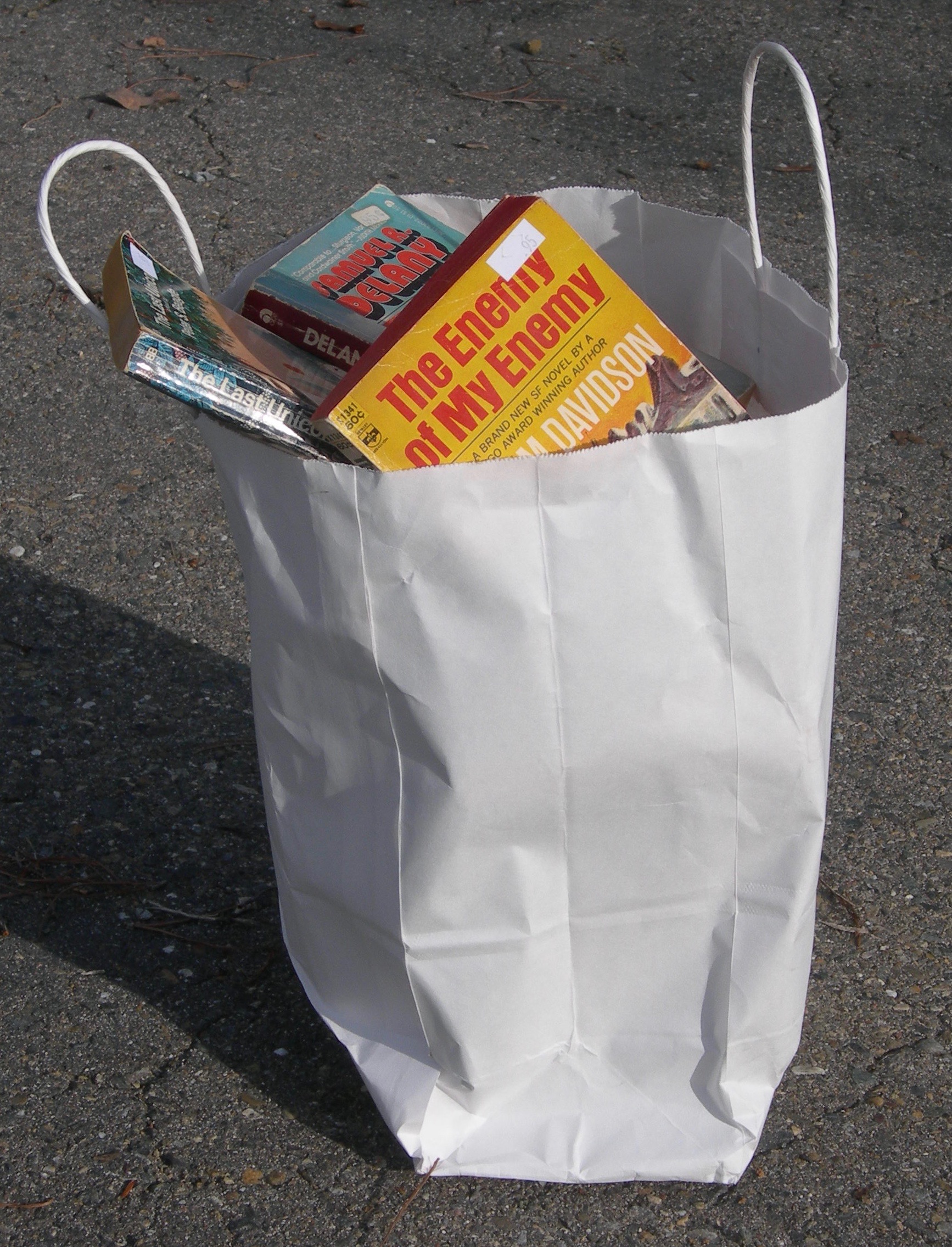
I walked into the bookstore. The proprietor said, “How are you?” and I replied, “Sad. You’re closing.” And she was. About a third of the shelves were empty and she was selling books by the bag, one to ten dollars, depending on the size of the bag.

I’ve completely lost count of how many used book stores have come and gone over the decades I have lived in this area. It always hurts to see one go, and every time a new one appears I know another book lover is buying themselves a heartache.

There are many things which are done for love instead of money. Blogging might be the new poster child for this way of life. Used bookstores are near the top, as well. Crafters fill the same niche.

If you go to a local boutique and buy some hand made jewelry, or any of a thousand other kinds of things you couldn’t buy at Wal Mart, you might be tempted to call them over priced. Maybe, from the consumer’s viewpoint, but I doubt if one in fifty crafters is making minimum wage. They always think they’ll make a little money when they start, but really . . .

A used bookstore as an investment? Hummm. I wouldn’t do it, although I’m glad there are people who do. Consider the mark-up (next to nothing) and consider how many customers come in each day. At least you have a lot of time to read.

I should talk. I do something even dumber than that. I write novels.

If you go to a used bookstore — in some town other than the one I’ve avoided mentioning, which no longer has a used bookstore — and look closely at the science fiction shelves you will find hundreds of writers you’ve never heard of. Some of them are pretty good and some aren’t. What they have in common, not counting Heinlein and a few like him, is that they probably never made a living by writing. A few achieved a bit of fame, but most of them didn’t. Many wrote only one or two books and gave up.

If you look at the names of the publishers, you won’t know it unless you’ve been following this for years, but many of them stayed in business by stiffing their authors. Others actually paid, but paid a pittance.

I don’t think there are too many of those completely dishonest publishers around any more. Times have changed. Now you can publish ebooks and stiff yourself.

Oh well, it’s a good life if you don’t weaken. And of course I don’t do it for the money — but I wouldn’t mind some.

562. Davy

This is one of my best stories series.

I re-read. It is my equivalent of brainless television. There are books that I frequently re-inhabit in order to once again enjoy the people, scenery, and action.

There are also books I read only once, and never need to read again. They become such a part of me that I still remember them decades later.

Edgar Pangborn provided two such books, Davy and The Trial of Calista Blake. I read each of them only once, between 1964 and 1967. I have never forgotten them, nor have I ever wanted to return to them. They were life changing, if read at the right age.

===========

I grew up in an era of fear. The bomb hung over us all, and fiction followed the trends of the day. Speaking from memory, not scholarship, it seems to me that it was the end of the exclusivity of science fiction. Events that would have once interested only the few and the faithful, were turning up on the best seller list. Books like Fail-Safe and On the Beach were called science fiction, and I suppose technically, they were. But they didn’t taste like science fiction because they were written by mainstream writers with different sensibilities. That may not be a legitimate complaint, but in truth they tasted like steak with no salt.

The flip side of the here-comes-the-bomb novels was an endless cavalcade of post-holocaust dystopias. The first book I read, the first day I discovered libraries, Star Man’s Son by Andre Norton, was one of those. There were dozens to follow; maybe hundreds. They mostly ran together in a mass of future sadness, but a few were memorable.

Davy stood out because it’s horny orphan protagonist got such joy out of life. He found a French horn in the rubble and taught himself to play it, which always made the book seem more like fantasy than science fiction. If you know French horns, you’ll understand.

We spend much of the book watching Davy go from ignorance to knowledge. The cover of the edition I read compares him to Tom Jones (the novel, not the singer) and that seems fair.

Davy’s world is the northeastern United States, a couple of centuries after the nukes fell. The names are scrambled but mostly decipherable. The state religion is the Holy Murican Church and belief is not optional. Davy falls in with anti-religious dissidents, which suits his doubter’s personality.

The novel is carried by Davy as a questioning, ebullient youth, but saved from silliness by a brooding feeling that all will not be roses. The story arc makes everything work. We see young Davy growing up as told by his older self, but we are spared the works of his maturity. There will be striving, battle, despair, and betrayal when the mature Davy attempts to mold the world to his liking, only to have it fall apart in his hands. That is the part of the story another novelist would have concentrated on, but we see it only in brief flashes. Then we are at the final chapter, a kind of coda in which Davy totals up his gains and losses and prepares for a final, hopeless journey.

What we have here is the joy of youth, overlain by the elegiac sadness of hopeless struggle against human inadequacy. Heinlein could have written it, but it would have had little heart because his protagonist would have stood above the fray, superior to the mass of humanity. Davy partook of the same human conditions that he fought against. Just like the rest of us. That made Davy stand out as something better that the rest of the dystopias. It made the novel a work of art to move the soul — at least if you read it at sixteen, while waiting for the bomb to fall.