Tag Archives: blogging

556. How it All Began

Let me offer a slightly belated Happy New Year. My first post of the year was tied in to the last/first/only year of the novel Like Clockwork, and my second was an apology for any posts that might be missing this month. I still may miss some, but I am trying to avoid that.

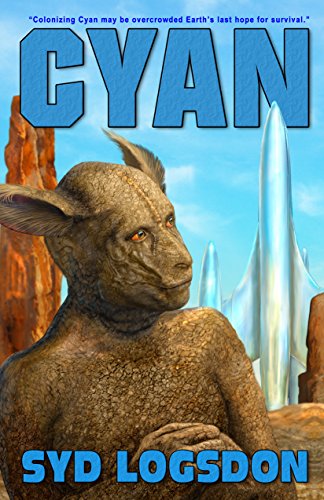
Since we are in the month of beginnings, I thought I would remind my newer followers how this enterprise started. In 2015, EDGE publisher bought my SF novel Cyan, to be released as an e-book in their new EDGE lite (dumb name) line. In honor of that — which is a sneaky way of saying to drum up business for that — I began a blog.

By the way, if you haven’t bought Cyan yet (and why haven’t you?), you can pick it up from Amazon as an ebook or paperback.

Actually, I began a website containing two blogs. The website was to be called A Writing Life and the two blogs were to be called A Writing Life and Serial. It was a glaringly bad decision to call the site and one of the blogs by the same name, but I’m stuck with it now.

Cyan was due out at the beginning of 2016 and actually came out nearly a year and a half late. I had the embarrassing task of explaining every delay in the blog.

Posts were short at first. Here is the first one:

========

1. Welcome to my World

Hi, I’m Syd Logsdon. I have been writing novels for four decades, but I’m a new blogger.

When I began, writers wrote, publishers published, and readers bought their books in bookstores – or at least at bookstands which might pop up anywhere. E-books, nooks and kindles, and the internet have changed all that. Now e-books outsell hardbacks and writers have to adapt.

Actually, this is an opportunity for me. Over the years I have accumulated a mass of knowledge, ideas, complaints, irritations, joys, disappointments, and backstage savvy that didn’t fit into any format available to me. Now I have a place to share these things.

What prompted me to start blogging at this time was the release of my e-book Cyan from EDGE, due in January of 2016. If you don’t know them, EDGE is the premier science fiction publisher of Canada.

Cyan is the story of the discovery, exploration, and colonization of a nearby habitable planet, set against the backdrop of cataclysmic overpopulation on Earth, and carried out by a fascinating and varied group of characters.

Old fashioned? No; just temporarily out of fashion.

Recent science fiction has often lost sight of the next century. This is too bad, since we are the last generation which can write what we want about nearby stars before astronomers map the actual planets which exist there.

You can expect daily posts here at A Writing Life. It is set up like a blog, but it isn’t a chronicle of daily activities. Each post is a mini-essay on some subject, current, historical, or timeless.  Most of the time, these posts will come four days a week.

At Serial, in the menu, you will find serialized fiction. Pop over there for details.

Drop in often; you will always find something new.

========

A few things changed over the years. It quickly became obvious that running A Writing Life (the blog) four days a week and Serial five days a week was an unnecessary complication. I dropped Serial to four days a week early on.

After nearly four hundred posts of the A Writing Life blog, the four day a week schedule became unsupportable and I dropped to two days a week. Serial changed as well, but I’ll talk about that on Wednesday.

555. Calf Quilt

So what, you may ask, is a quilt doing in a writing post?

No writer just writes. My wife and I both discovered quilting in the mid-eighties. For me, it was an art form in which I could satisfy myself. My painting always lacked something, to my eye, but quilts are colorful geometric things with utility. I could make a quilt and not feel artistically inadequate.

For about a decade we have been deeply involved in putting together a quilt show for my wife’s guild every other year. In 2017 I took some time off from this blog, and I may have to do so again this year.

All this is simply to point out that if posts get scarce this month, nothing is wrong. I am just busy with a different piece of my life.

552. Links to Christmas

Tomorrow is the big day, when nobody should be on the internet, so I’ll have my say today. This is the fourth Christmas season since I began this website, and every year I say the same thing. I love Christmas.

I stand with Dickens, who called Christmas “a good time; a kind and forgiving, charitable, pleasant time; the only time I know of, in the long calendar of the year, when men and women seem by one consent to open their shut-up hearts freely.”

Over the years, I have posted many Christmas or Midwinter posts. If you are new to this site, here’s your chance to check some of them out.

My first year I posted a list of Christmas books, covering pretty much every aspect of the holiday. That same year, I talked about Dickens’s five Christmas novellas. Everybody knows A Christmas Carol; here is your chance to check out the rest.

When the ghost of Christmas Past appeared, Scrooge asked, “Long past?” and was told that she meant his past. My own early Christmases on the farm wouldn’t make a Christmas card, but I told about them in Twas the Season, posts 1 and also 2. I also talked about the Nostalgia for those days that never were .

Everyone talks about Mary and Jesus, but what about Jesus and Joseph?

Christmas itself has a history beyond the biblical story. It has always fascinated me, and I summarized what I have learned in three posts from 2016, Old European Christmas, Colonial Christmas, and Here Comes Santa Claus.

In 2016 and 2017, Christmas was overshadowed for my Latin friends by a grinch with an orange face and wild yellow hair. I wrote about Christmas for Lupe two years ago and about Jose, Maria, y Jesus in Trumpland last year. I didn’t have the heart to tackle the current occupant one more time this year. Maybe by next year I won’t need to.

Anyway, whether you check out any of these links or not, Merry Christmas.

Hiatus Again

So, once again Serial crawls back into its bed for a long winter nap. I plan to keep the blog alive on life support until I need it again. No, make that in suspended animation; after all this is primarily a science fiction site.

Meanwhile, over in A Writing Life there is a post called Links to Christmas which you can use to see past posts about the season.

Merry Christmas

(Or whatever holiday you celebrate.)

520. Beta Readers

This isn’t really a rant. Honest. If you had ever heard me rant, you would recognize the difference.

I find myself out of step with the modern world most of the time. I’m comfortable with that, but once in a while it catches me by surprise.

This comes of being an only child, raised on a farm, miles from the nearest small town. That is to say, alone. I also grew up in the era of the movie cowboy, the lone hero standing against the world. We’re talking John Wayne here; Clint Eastwood came much later.

In other words, I grew up in a place and time that preached individualism.

Today, we all cooperate.

That is, if we believe songs and movies and television and books, everything has changed. But has it really? I doubt it. We always cooperated on many things, and we still treasure the individual’s take on some things, although the balance between the two seems to be shifting. Even John Wayne always had some gang of scraggly misfits following along behind him.

I taught middle school as if cooperative learning hadn’t been invented yet. I could get away with that in the eighties and nineties, and a lot of other teachers had that same attitude. If I had to teach where “every child is equally and specially brilliant” — I’m quoting a TV ad for a private school — I’d rather drive a truck.

===============

So, what brought this to mind? Beta readers. The word is new, but the idea isn’t. Robert Louis Stevenson’s wife is rumored to have burned the first draft of Dr. Jekyll and Mr. Hyde, and didn’t like the rewrite all that much. We also hear that Mrs. Mark Twain often wasn’t too keen on what Sam Clements wrote.

Of course beta readers are more than censors. Ginny Heinlein always read RAH’s first drafts. She was agonizing about telling RAH that the first draft of Number of the Beast was not up to his standards, when an operation cured his mental fogginess and he saw it for himself. (It’s in the biography; I’m not claiming any special knowledge here.)

Since I always visit the websites of anyone who clicks a like button on one of my posts, I have been looking over the shoulders of a lot of young writers. I see people seeking beta readers and thanking their beta readers. They clearly think that beta readers strengthen the work.

Maybe. Even probably. Still . . .

It is certainly true that the editors who once filled that function are no longer as easy to reach. I also see the self-publishing advice that hiring an editor out of pocket before going to press is money well spent. Again, probably. It’s hard to spot your hundred and fifth grammatical error, after you have fixed a hundred and four.

Beta readers are all very twenty-first century, and I certainly have great respect for those writers who have the nerve to bypass traditional publishing. But for me . . .

Nobody reads a word I have written until it is checked and rechecked, read and reread, and then reread again a few dozen more times. By me, and only by me. It’s mine. I don’t share until I’m ready to publish. The first person to read my blog is you, and the first person to see one of my novels is an editor at some publishing house.

It’s all very much old school.

So beta readers need not apply to the old curmudgeon. But that’s just me. You’ll follow your own style. Writers always do.

517. The Three Stages of Heinlein

This is one of the fifteen that hit the sweet spot.

As I look back over my five hundred plus posts, I find Heinlein mentioned more than any other writer. I’m not going to repeat all that I have said, but I will provide links for you to see for yourselves.

You might think RAH is my favorite, but he isn’t. That would probably be Zelazny. When I was new to science fiction, in the fifties and sixties, it would have been Andre Norton. However, Heinlein is the one I most enjoy reading. His prose sings, but in an odd kind of way. He is like a weird uncle who sits by the fire telling lies and funny stories, occasionally laughing out loud at his own jokes, and getting serious just often enough to keep from looking like a clown.

But he does it so well.

Heinlein has been through three stages as an author. At first he was the master of compact, carefully plotted works, both short stories and novels. That was what publishers demanded at the time and he produced some masterpieces. I reviewed five of them in one post.

Then came Stranger in a Strange Land, his most popular book, and a dud, for my taste. That was the start of his inflated period, which continued until his death, as his books got longer and more discursive. He gets a lot of criticism for long windedness, and deserves all of it, but some of those works are my favorites.

Alongside his early work, Heinlein produced a number of juveniles (as they were called then) and some of them were of top quality. I reviewed several briefly, just this month. At the end of his list of juveniles is the book that Scribners rejected, Starship Troopers. It is another favorite of many, myself decidedly not included.

Heinlein had a thing for group sex and a short but pleasant relationship with the rock group Jefferson Starship.

Actually, I’ve talked about RAH more than I had realized. Maybe I need to give him a rest for a couple of years.

501. Preface to Robert Louis Stevenson

As anyone who has read even a few posts here knows, I started AWL to find readers for my novels, specifically for Cyan which had just been accepted by EDGE. I had no idea how many interesting people I would meet along the way. Some of them were fellow writers of science fiction, fantasy, and steampunk, some were fellow bloggers who wanted to be writers (this post is for you, as you’ll see at the end), and some of the ones I met indirectly had been dead for many years.

Of course, I had been discoursing with dead people all my life. Imaginary people, as well, starting with Victor Appleton II, “author” of books I was reading before I got my first library card. If you don’t recognize “him”, “he” was a house pseudonym belonging to the Stratemeyer group. “He” wrote the Tom Swift, Junior books which were my idea of science fiction when I was ten.

Come to think of it, many of the people in the Bible that my parents introduced me to were imaginary as well as dead, but a wise man doesn’t talk about to that in public.

One of my favorite friends-I-never-met is Robert Louis Stevenson. He has been a part of my life for decades, and I recently had cause to dig deeper into his personal story while putting together an upcoming series of posts.

Very early in his career (1878), long before anyone had heard of him, Stevenson wrote a travel book about his voyage by canoe on some European rivers, called Inland Voyage. I’m not recommending it to you, but it went into my massive pile of turn of the century — that’s nineteenth century — marine and canoe travel books, after I had skimmed it and found this in his preface:

To say truth, I had no sooner finished reading this little book in proof, than I was seized upon by a distressing apprehension.  It occurred to me that I might not only be the first to read these pages, but the last as well; that I might have pioneered this very smiling tract of country all in vain, and find not a soul to follow in my steps.  The more I thought, the more I disliked the notion; until the distaste grew into a sort of panic terror, and I rushed into this Preface, which is no more than an advertisement for readers.

A preface is only an advertisement for readers? Imagine that! If Stevenson had been writing 140 years later, he would have had a blog, and wouldn’t I love to read that. Also, consider the notion that one of the world’s most successful writers started out thinking that no one would ever read what he was writing.

Of course, there were thousands of other writers in 1878 who thought no one would ever read their writing, and no one ever did. We never knows in advance what will happen. We just have to keep putting one foot in front of the other, and hope.

499. Triple Tease

Thomas Anderson of Schlock Value has an ongoing love/hate (largely hate) relationship with blurbs. I mostly share his view, but things have changed since the era, mostly the 70s, which he reviews. When Cyan came out, I had the chance to write the blurbs myself. In fact, I was asked to write three blurbs of 10, 25, and 75 words, from which the publisher would choose.

Squeezing a whole novel into twenty-five-words-or-less is an interesting exercise. I decided to try it again on the novel I’m presently writing, Like Clockwork, but with a variation. 10, 25, and 75 is really hard. I’ll wait until the book is finished for that, but I did write short, shorter, and really short candidates.

Here are the results.

=========

The year is 1850. The year is always 1850. Now it is November and a year’s worth of progress toward understanding is in jeopardy. In a few weeks will come Midwinter Midnight, when the Clock that Ate Time will reset, it will be January first once again, and all that has been gained will be lost from memory.

Snap, who helped to build the Clock and regrets his actions; Balfour who was another man in another life; and Hemmings, formerly a computer, who now figures differently — these three, with Pilar, Eve, Lithbeth, Pakrat, and old man Crump are determined to set Time free again. And if they fail . . .

The year will be 1850. The year will be 1850 forever.

119 words

=========

The year is 1850 — again. A year’s worth of progress toward understanding is in jeopardy. In a few weeks it will be Midwinter Midnight, when the Clock that Ate Time will reset, it will be January first once again, and all that has been gained will be lost from memory.

50 words

=========

The year is 1850 in a this alternate London, where time has no hold. There are only a few weeks left to restart the future.

25 words

=========

How’s that for a tease?

498. Living in the Promiseland

There is a winding road across the shifting sand
And room for everyone living in the promiseland
Willie Nelson

I began this website in the fall of 2015. It was to be about writing, particularly about writing science fiction, and I had no intention of responding to political events.

Fat chance of that happening, given what has happened in America since.

In fact, I had written about twenty numbered posts when events in the world forced me to stick some personal political comments in between posts 10 and 11. It was called Walls Against the World. It wouldn’t be the last time I had to interrupt my regular programming to speak out.

That was the day after Hungary closed it’s borders to Syrian refugees. It reminded me too forcibly of the Russians closing Hungary’s borders in 1956, to keep Hungarian refugees from reaching the west and freedom.

East Germany had built a wall across Berlin in 1961, and then-candidate Trump was running on the promise to build a wall across the border with Mexico. I didn’t buy in. At the time I said, “Hitler would be proud. East Germany would understand. Russia is laughing.”

Was that only thirty-three months ago? Time flies when you are running from a forest fire.

I opened that post with these words:

          Have you ever asked yourself, “How could Germany have been fooled into following Adolph Hitler?” The answer is on your television this morning, and it is Donald Trump.
          I’m not saying that Trump is a Nazi. I don’t see him as evil, merely foolish. But the techniques that have brought him to prominence are the same techniques that Hitler used.

Then Trump won and here we are. I have tried since then to be fair and at least somewhat balanced. After all, he was elected by the American people (aided by Putin and Comey) and the Democrats hadn’t given Americans much of an alternative.

I have resisted calling Trump evil, and I have resisted refusing to see why many Americans chose to vote for him. I understand them; I just don’t understand him. I have not called him by the H****r word, even as Trump has become increasingly dictatorial. I have tried to avoid pointing out that Hitler was initially elected to office, before he took over everything.

All that was before Trump opened concentration camps on the Mexican border in the name of Zero Tolerance. We haven’t seen this in America since 1942.

Maybe I’ll send the White House a copy of Willie Nelson’s Living in the Promiseland. At least I would if I thought it would do any good.

Give us your tired and weak and we will make them strong
Bring us your foreign songs and we will sing along
.               from Living in the Promiseland

496. Bob Dylan, Nobel Laureate

There is something about blogging that I didn’t expect when I started. Since these posts are opinionated, but not totally opinion, I find myself doing research from time to time to keep my facts straight. That means I occasionally learn things I would never otherwise have known.

It’s a major bonus.

I was aware of Bob Dylan’s selection by the Nobel committee, and his reticence regarding the event, but I didn’t know the full outcome. I wanted to make an off-hand comment about it in another post, but didn’t want to make a fool of myself, so I checked out the facts.

The Nobel committee awarded Dylan the prize for literature last October “for having created new poetic expressions within the great American song tradition.”

Can a song be true literature? I would say yes, although rarely; about as often as a poem is or a novel is. Does Dylan’s work rise to that level of gravitas. Again, my answer is yes; the only other songwriter who comes to mind who worked at that level was Leonard Cohen. Paul Simon just misses the cut.

Dylan took a very long time replying to the committee, fueling speculation that he would refuse the honor, but he finally complied, and eventually provided his Nobel lecture, which is the only requirement attached to the prize.

His lecture was also my prize for checking out the facts. It is superb. I’ve provided a link below.

The lecture, actually more of a biographical essay, is written in the same intelligent but not over-educated voice that we hear in his songs. This is entirely appropriate; it is pure Dylan. He tells of the early impact of Buddy Holly, and then of American folk, then shifts to a personal analysis of three classic books, Moby Dick, All Quiet on the Western Front, and the Odyssey. He presents their complexity, their unflinching view of the rough truths of life, and the manner in which each makes statements which require the readers engagement. Much in these books is not spelled out and nailed down, just as much in his songs is not. These three books are offered for their influence on Dylan’s work.

I found the essay intelligent and moving, and instead of providing a blow by blow, I recommend that you use the link below to read it for yourselves.

I will only quote one short passage, from near the end:

Our songs are alive in the land of the living. But songs are unlike literature. They’re meant to be sung, not read. The words in Shakespeare’s plays were meant to be acted on the stage. Just as lyrics in songs are meant to be sung, not read on a page. And I hope some of you get the chance to listen to these lyrics the way they were intended to be heard.

I hope you will take the time to read the whole essay. Meanwhile, I think I’ll go dig up some of those old LPs I bought while I was in college during the sixties. He has a rough voice and I don’t like his harmonica playing, but oh, those words!