Tag Archives: fantasy fiction

Prince of Exile, 2

1.

In a far country, the King lay dying.

News had spread throughout the region. For a long time he had grown steadily weaker. Even the peasants in the fields and shopkeepers in the town below Castle Hill knew that the end was near.

As the King lingered on the edge of death, the courtiers, servants, nieces and nephews who normally surrounded him were all shut out by Croayl, the priest.  Croayl and the King had spent their lives together, yet no two men were more different. The King was a man of passions, fiercely held and freely stated. Croayl was all inward. Throughout his lifetime, the King’s court had been open; now at the end of his life, Croayl closed off access to him. It was an ill omen.

2.

We came down out of the hills in the afternoon. The promise of rain had not been fulfilled and a west wind was driving the clouds away before it. Boiling over our heads, they changed from gray to white as the sunlight increased. The hills around us were covered with low, brown grasses. Higher up, hidden by the convolutions of the foothills, snow had begun falling on the steeper slopes, sifting down among the pines, gentle, quiet, and deadly.

I gave thanks to be out of it. The passes we had crossed would be closed for days, and that too was a comfort, for we had been pursued.

It was often that way in the service of the Prince of Exile.

We were weary of riding, all but the Prince, as we made our way downslope in a silent file. There were seven of us in all. People are always joining the Prince’s retinue, following a while for reasons of their own, then wandering off to find their own destiny. But it seemed to me that in the last few years, more had come than had left, and I was uncomfortable traveling with so many.

Now we were making our way down out of the mountains toward the warmth of the valley and, hopefully, toward the comforts of an inn I knew. I could have asked the Prince if this was indeed Gleian Ellerick, but he has a disconcerting way of turning even a simple question into an exercise in metaphysics. It did not matter to me what its ontological status was, as long as my bed was warm.

The Prince was willing to let me remain incurious as long as I did not ask questions that he could misconstrue as philosophical. It was one of the reasons I still followed him after all these years.

How many years? Sorry, that’s one of those questions. You’ll understand what I mean as we move along. more tomorrow

Prince of Exile, 1, introduction

Welcome back to Serial in its normal form. I did not want my fantasy short story Prince of Exile broken up by a change of year. Beginning tomorrow, it will appear in eleven additional posts, with this post as an introduction.

I have been writing fantasy of one kind or another since the beginning. In 1972 I wrote the opening lines of Valley of the Menhir, (post 39) three years before I decided to try my hand at novels. Most of the fantasy I’ve written has been in that universe; the Land of the Menhir has become almost a second home to me.

This story stands separate and a lot further along the continuum from medieval to mythical. It takes place adjacent to a land of Kings and barmaids, and in that land at the same time – sort of. The Prince is more than a little hard to pin down.

The initial rush of emotion that told me I had a story crying to be written came when I first heard the Doors’ performance of Celebration of the Lizard on their 1970 album Absolutely Live. When I heard . . .

Brothers and sisters of the pale forest
Children of the night
—–
Tomorrow we enter the town of my birth
I want to be ready.

. . . I knew I had to take those words, absorb them, transmute them, and bring them back again. The story that emerged did not contain the words of the poem; nevertheless, they are its genesis and essence.

(Pardon the brevity of the quotation; I am punctilious about not stealing other artist’s words.)

Two other fragments were necessary to this story; I am a fan of Michael Moorcock and of Elric, but Stormbringer always repelled me. In part 2, I decided to offer my anti-Stormbringer in rebuke.

The second fragment comes from childhood, from a book called Wild Animals I have Known by Ernest Thompson Seton, which I bought when I was about twelve. In one of his stories, all based on real events, Seton says, “Every true story ends in death.” Or so my mind constructed his meaning; I still have the book, but I have never since been able to find the passage that affected me so deeply. Most likely, I had rebuilt his actual words, “The life of a wild animal always has a tragic end,” which is a subtly but critically different observation.

Over the years, while recognizing the reality of Seton’s statement, whatever words he actually used to convey it, I have also come to realize that the opposite is equally true. No action, for good or ill, ends with the actor’s life. All the things we do have reverberations that long outlive us. In other words, “No true story ever ends.”

In Prince of Exile, I finally found the right place to use that conundrum.

You might guess from the length of this introduction that Prince of Exile is something special to me. I may be my favorite among all the things I’ve written. Although it would be hard to rank Prince above something I’ve spent years polishing, at least pound for pound it ranks first.

There is one flaw in the story, which I have no intention of fixing. If you were to read it cold, you would  expect to find that the prince is the king’s son. No. The King is a king; the Prince is the prince. Not related the way you would think at all. Logically, I should change one or the other, but I can no more do that than Ursula LeGuin could change Ged’s name because someone might think she meant God. Anyway, structural flaws don’t mean so much in a story that comes from this deep.   Prince of Exile begins tomorrow.

56. Cinn Sings a Folksong

Sometimes I write poetry as poetry. Sometimes I write it to fill story needs. This folksong was written for Valley of the Menhir to give Tidac and Cinnabar a romantic moment early in their courtship.

She showed him how to hold the thyril and how to strike the bass strings with his thumb while his fingers touched the trebles. His left hand stopped the trebles; the bass strings rang free. He tried manfully – which is to say, clumsily – to coordinate his two hands and was becoming frustrated when she stopped him with a giggle.

“You try too hard,” she said. “You aren’t trying to overcome an armed opponent; you are trying to coax the music out.”

Next he tried to pick out the simple lullaby which she sang over and over for him. He had not heard her sing before; her voice was small but sweet. After a time the tune came, and still later it came freely. Cinnabar kissed him noisily and congratulated him.

Then Cinnabar picked up the thyril and began to play. The melody was sad, but it brightened slowly. She raised his eyes to his and they were full of promise. She began to croon very softly:

*****

I reach for her, lying in her linen bed;

My fingers draw her forth into my arms.

Her rounded hip against my belly —

Her slender neck is in my hand.

My fingers touch and stroke her strings

     evoking music

          the thrumming that fills my loins

               the dry treble that excites the night.

Sometimes she is cold within my arms

And I must coax her voice to life.

Tonight she is fire,

Yielding to the motion of my hands.

My fingers touch and stroke her strings

     evoking magic

          the crying bittersweetness of the night

               wraps its hands around my heart.

*****

An ambiguous song, equally applicable to the thyril or the woman who held it. Whatever I am, or have been, or wish to be, Tidac thought, is now wound up with her.

Cinnabar smiled up at him and laid aside the thyril.

*****

I wrote that scene about 1978, and it remained in every revision until about 2010 when it was cut as a part of a major push to tighten up the pacing of the early part of the story. Too bad; I always liked it.

Filler

No post today, as usual, but . . .
Most of my writing life has been spent telling tales of the World of the Menhir. Today a dragon that escaped the fall of Whitethorn returns, a generation later, in the short story The Best of Lies, over in Serials. Drop in and enjoy.

40. Names From the Past

Original_ouija_board

The boy in the tower, remember? From the last two posts? His name? I’ll take you there by way of a side trip.

In 1965 I was a Fleming Fellow. I can be reasonably sure you’ve never heard of that, but it is a wonderful program. Every year from four to seven juniors from Oklahoma high schools are chosen to spend the summer teamed up with doctors from the Oklahoma Medical Research Foundation, essentially as research interns.

We were housed boarding house style with a local family, where one of my young colleagues promptly found a girlfriend, Dixie Margaret Peacock-Van Tyle. I wouldn’t share her name after all these years, but it’s just too good to resist. She was pretty, vivacious, and a lot more worldly than we nerds were.

One night as we were all sitting around the living room, she brought out a ouija board and we had a seance. All our hands were on the planchette, but Dixie was the one who interpreted the results. The board told us of past lives, and when it came to my past, the board spelled out TIDAC. Tidac, Dixie said, was a fourteenth century prince of Normandy. Then it spelled out JAVERNAN. Javernan was a sixteenth century French sorcerer.

I was a kid from nowhere. At home, I had to keep my opinions ruthlessly suppressed. I worked constantly, on the farm and on science projects. I had no real interests except for getting-the-hell-out, and getting on with my life. I had no girlfriend, not because girls didn’t like me, but because I refused to let any entanglement interfere with my escape.

Considering my real life, being a prince and a sorcerer in previous lives was a big deal. I went to bed that night with a smile on my face that has really never faded.

Thank you, Dixie, wherever you are. You brought some romance and whimsy into my life.

The boy in the tower became Tidac, and when he grew to be a man, the first friend he made was named Javernan.

39. Into the Valley

220px-Langaa_egeskov_rimfrostIn 1972, I was working as head surgical technician in the dental service of a naval hospital. We did quite a bit of exciting work, but the day to day routine consisted of assisting in the extraction of impacted wisdom teeth.

The next day after the vision of the young boy in the tower (yesterday’s post), some unfilled appointments left me with a couple of hours to kill. I sat down and wrote the first chapter of what would become a fantasy series.

I typed the last period on the last polishing of that story in June of 2013.

Mark Twain said of a writer starting a novel, “. . . in the beginning he is only proposing to tell a little tale; a very little tale; a six-page tale.”

In 1972 I had no intention of writing a novel, much less becoming a novelist, but the boy’s story already had me by the throat.

In that first chapter, which I wrote there in the dental office, Marquart, the boy’s father, comes in on horseback (kakais came later), in midwinter, to take up his new lands in the Valley of the Menhir. His new wife is with him, pregnant with the boy. They are seen by Harthka, wife of a free forester and, as they pass on, we follow her to her crude, hidden dwelling. She is followed by a ‘shifter (only a simple werewolf in this first iteration) who attacks her. She is saved by her husband Amon (later Amyn, to avoid confusion with Amon Ra).

A simple story, and very medieval at first. Everything would grow, deepen, and morph as the fantasy elements crystalized, but I did not know that in 1972. I did realize, as I wrote that first chapter, that when Marquart was killed, the boy would flee to the hills, would be found and raised by the forester Amyn, and that those years would be the making of him.

I also knew the boy’s name, which I will share next post.

A young marine knocked on the door. I put the papers aside, called the oral surgeon, and went back to work. That night I took the chapter home and filed it away, where it would lie fallow for the next five years, then re-emerge to blow a hole in my career.

More next post.

38. Sidetracked by Mark Twain

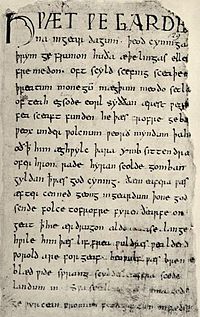
200px-Beowulf.firstpageMark Twain said:     (see posts 18, 19, and 20)     “(In the beginning a writer) has no clear idea of his story; in fact he has no story. He . . . can only find out what it is by listening as it goes along telling itself . . .”      

Been there; done that. Spirit Deer and Jandrax presented themselves to my typewriter with reasonable speed and ease. My third work, Valley of the Menhir, was a kakai of a different color.

          (Kakai – the native riding beast of the World of the Menhir.)

VOTM actually came to me about three years before I had any idea of becoming a novelist. I was stationed at a California naval base and my wife was with me. She was working at the base library and taking a reference librarian class at a local junior college. I took it with her, for company. One night in the college library, waiting for her to finish her work, bored, I took down a copy of Beowulf. I opened the book and the words “all that lonely winter . . .” jumped out at me.

I slammed the book shut and put it away. I didn’t know what part of the story I was in, or what the actual context was, and I didn’t care.

I had had a vision of a young boy in the open window of a stone tower, looking out across a leafless, snow bound landscape. He was newly an orphan. The master of the tower had saved him, but in doing so, the boy had become captive to his world’s expectations. He would now have to spend his childhood in preparation for gaining revenge on the slayer of his father. But he wanted no revenge. His only feelings for his cold and distant father was a vague fear, even now that he was dead.

I wasn’t a novelist yet, but I knew a story when I saw one. I didn’t know I would still be haunted by it forty-some years later.

More next post.

37. Fantasy, Whatever That Is

220px-Mårten_Eskil_Winge_-_Tor's_Fight_with_the_Giants_-_Google_Art_ProjectIt has been a grand ride.

Since I started reading science fiction in the late fifties, I have seen the rise of Amber, Witch World, the Dorsai, the Lensmen, LeGuin, Zelazny, Ellison, Varley, Ballard, and hundred of others. I was there for the Tolkien revival and the revival of other fantasy writers under Ballantine.

Through the years, avid readers waged war on one another over the most trivial of notions, just like any other family. If you called science fiction “sci fi” (never mind SyFy) you were beyond the pale. You had to call the genre science fiction, or maybe SF; but then you had to argue whether that stood for science fiction of speculative fiction or . . . I’ve forgotten what the lesser contenders were.

Mimeograph and USPS were the internet of the early sixties. Whole forests went to the pulp mills to make paper to support arguments about what was or was not science fiction, whether fantasy was worth considering, and where one ended and the other began. Then Heinlein published Glory Road and sent shock waves through the SF community by landing with one foot squarely in each camp.

I mention all this because, although my publications so far have been science fiction, I have spent more time and taken more satisfaction writing fantasy. I’ll spell that out in the next few posts. Most of those works remain unpublished, but you can see some short stories in Serials.

Today, everything goes, but you still have to declare your allegiance. I recently dealt with a publisher who required that you shoehorn your submission into one of about forty SF/fantasy sub-categories.

All of this is probably subsumed under Clarke’s Third Law, “any sufficiently advanced technology is indistinguishable from magic.” Put another way, the Creation as given in Genesis is fact, allegory, or fantasy depending on whether you are a fundamentalist, a religious liberal, or an atheist.

Put still another way, if it tastes like fantasy, it is (for you) and if it tastes like science fiction, it is (for you).