
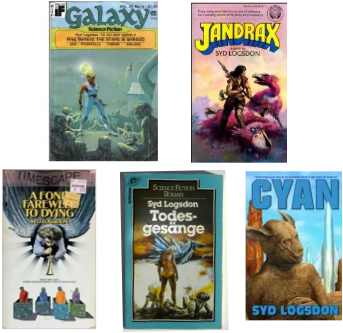
Again, the five covers at the top of this post represent my five published works, in chronological order. Let’s continue from the bottom left.
It is hard to tell from these thumbnails, but the quality of the “angel” is excellent. The four “zombies in electronic boxes” are not so easy on the eyes, but I presume that was a deliberate choice by the artist, Kevin Eugene Johnson. I don’t criticize Johnson’s skill as an artist, and I don’t know who chose to use a symbolic representation of the novel, but the result was a killer.
A Fond Farewell to Dying was my second published novel. I was in a good place. After Jandrax sold, I was advised to get an agent and I found Virginia Kidd. You probably haven’t heard of her. Fame is fleeting for agents, but she was top of the line for the eighties. She pitched FFTD to David Hartman and he bought it.
Hartman was at Pocket Books and he was about to launch a new line called Timescape. FFTD was among the first group of books released, but when I saw the cover, my heart sank.
At the top is a banner proclaiming the new imprint. That was a good idea, since everyone was waiting for Timescape to arrive. But the image — it had nothing to do with the story. That’s not unusual, but in this case, it was almost certain to scare off anyone who would have enjoyed the actual story within.
This is about cover art, not blurbs, but I have to tell you what those tiny words just under the trumpet say, because they are a key to the thinking of whoever designed this mess:
WHAT PRICE LIFE?
SURRENDER YOUR BODY! GIVE UP YOUR SOUL!
Nope. Not even close to what the novel contained.
FFTD was a straight science fiction novel about artificial immortality through cloning and memory taping. One of my intentions was to treat the matter accurately. There was no end of cloning stories around in the early eighties, but most of them were, scientifically, pure BS. I wanted to do it better.
There were no zombies. There were no electronic boxes. There was no angel, particularly not an angel with a trumpet sounding out the Last Days.
I did use the interplay between Dave, a lapsed fundamentalist Christian, and Shashi, his lover who was Hindu and a believer in reincarnation. Their arguments allowed me a deep look into the morality of artificial immortality, but it had nothing to do with zombies and angels of the last trump.
In the weeks after publication, I found a copy of FFTD in a local grocery store, in a dump full of religious books. Based on the cover, somebody had placed it beside The Bible Story Books and The Jesus Generation.
A Fond Farewell to Dying never found its audience. Big surprise.
Things get tangled in the world of publishing. In researching this post, I found out that the same image was used as the cover of Gute Nachrichten aus dem Vatikan und andere »Nebula«-Preis-Stories, which is the name under which the German translation of Nebula Award Stories Seven appeared.
Cover images are frequently recycled. Johnson’s image was a virtual parody of FFTD, but it had nothing at all to do with the Nebula winners. Oh, well. That’s business in the publishing industry.
More irony — FFTD itself sold to Goldman Verlag, another German publisher, in 1984. They changed the title to Todesgesange (Death Song) and chose a cover that looks like tormented creatures in a Hellscape. Take a look at the middle image in the bottom row.
Is that creature in the middle supposed to be a demonic angel? I never could tell.
Arrrrrrr! You can translate that into your favorite cuss words. I don’t like to use profanity in A Writing Life.
A lot of things changed between FFTD and Cyan, the last thumbnail above. I had a lot of input into the details of publication, including an early look at the cover. I wasn’t always listened to, but that is to be expected. I was pleased with the artwork.
The creature on the cover looks a little too much like an actor in a skin suit, but it is actually a key creature from the story, a para-Cyl. The original Cyl were bipedal, tailless hoppers, sub-human but of relatively high intelligence. Because of (DELETED), one of the crew felt obligated to (DELETED) by means of recombinant DNA. Then she (DELETED) which caused no end of problems.
Cyan is still available from Amazon. When you read it, you will thank me for the deletions.
And when you visualize the Cyl, fold their legs, make their upper bodies smaller, their butts bigger, and their ears longer. But don’t make them look like kangaroos. Cyl don’t have tails, and that changes their whole anatomy.
 A Writing Life