Tag Archives: fantasy fiction

603. Small Gods, Big Result

Small Gods, Big Result
also known as
Full-Fledged Characters, Where Are You?

I have a colleague, JM Williams, who is a great fan of Terry Pratchett. On his suggestion, I checked one of his novels out of the library, read five pages, and tossed it.  Yech.

A month or so later I mentioned the fact to him. He suggested that I might prefer to start on a different novel, and suggested Small Gods.

I was hooked by page two. The scene, or was it an allegory, of the eagle and the tortoise was wonderful, and I was ready to believe that Terry Pratchett might be all JM said he was.

By page 38, I wasn’t so sure again, and I found myself trying to analyze exactly what was missing — for me — in the novel. I do that a lot. If you write, I’m sure you know what I mean.

Roughly by page 200, I was back on board again.

I had came to a conclusion, and since it bears on writing in general, I’m going to expound. As with the responses I got from 601. Home Court Advantage, feel free to disagree.

At page 38 of Small Gods, there was no character I liked well enough to care if he lived or died. Still, interesting  things were happening and I wanted to know how they were going to come out. That is a positive mark for a writer who knows what he is doing, but it isn’t really enough.

By about page 200, I wanted Om to make it and I really wanted Brutha to make it. From that time on, I had a vested interest that kept me going with enthusiasm. If I read another Pratchett (and I probably will) that enthusiasm will be there from the start, now that I trust the author.

I had needed characters I could care about.

This is not the same as full-fledged characters. There is no such thing. Robert Caro just wrote a four volume biography of Lyndon Johnson, and I’m sure he didn’t tell everything there was to tell. I read both parts of Patterson‘s bio of Heinlein and I still have questions.

If biographers who spend massive chunks of years don’t get it all, how can a fiction writer expect to have a “full-fledged” character. What does the phrase mean, anyway?

Om, Brutha, Vorbis, Simony, Urn, and Didactylos are all characters in Small Gods who are well thought out, powerful, and exactly sufficient to the task at hand. Not one of them is a “full-fledged” character, but they are each fledged exactly enough.

If you want to write full-fledged characters, maybe you should give up novels and write LITERATURE instead. (If WordPress allowed multiple fonts in one post, I would put LITERATURE in all curlicues.) Then you can out-Joyce Joyce if you want to, and still have readers.

They will have to read. There is a paper due next week, called for by the professor at the front of the room. He wants company in the misery of having been forced to read LITERATURE in order to get his degree.

In point of fact, there are powerful characters in literature and in genre fiction as well. The difference is in the expectations and tolerance of the reader. Powerful does not mean turning a microscope on his backstory and telling every detail.

Ursula LeGuin told us that science fiction is too small for Mrs. Brown, meaning there weren’t enough full-fledged characters. I listened. I respect LeGuin too much to ignore her, but after decades of considering her argument, it’s just smoke and mirrors.

I could (over)state in response, science fiction isn’t too small for Mrs. Brown; Mrs. Brown is too dull for science fiction.

Fiction, however humble or pretentious, is too small to contain any actual living human being. That isn’t what fiction is all about. Writers of fiction give a précis, a starting point, a few brief actions and emotions, and the reader fills in the rest. The reader draws on a full life of looking at other people, and at him or herself.

The real issue between literature and genre fiction is how many (and how dull) are the details the reader will tolerate.

Take Spenser (the detective, not the poet) for example. He has been around for almost fifty novels and, like Bond, has outlived his creator. After all this time we know a bit about him — actually, we may know all there is to know about him, and it isn’t much. Except for the interminable descriptions of food, all the details provided about him also move each story forward.

Recently I have worn out Spenser, Nero Wolfe and Archie, Judge Dee, Bony, Travis McGee and a dozen others, and have started Anne Cleves’s Shetland series. In my first attempt, I am having to get used to masses of detail about the lives of very ordinary people. I like it, but it is hard sledding; if I hadn’t visited Shetland and enjoyed the place, it would be even harder.

Cleves is a fine writer. My problem is a matter of expectations. Any detective writer in the list above would have finished Cleves’s novel in half as many pages, and the details left out would be the dull ones.

I like what I’m reading, really I do, but anything with this much detail about ordinary life has to be LITERATURE.

There will be more to say about all this on Monday.

HOLD IT – – – STOP THE PRESSES.

Something just came up as I was putting this to bed to wait for the 19th of June. It’s peripheral, but it struck me funny enough to put in a mini-post tomorrow. I will still say more about the main subject on Monday.
588. How Quickly Do You Write?

How long does it take to write a novel, a short story, or a poem?

Those who visit this site and register a like usually have websites of their own which I visit, so I know that many of you write. Many more of you would like to, or are just starting to. “How long does it take?” may not mean much to a poet, but anyone writing a novel has to wonder if she/he has a reasonable prospect of completing it.

I had that question myself when I started. I wondered if I could sit down and write every day until I had produced a novel. It seemed more likely that the well would run dry and I would end up going on to something else, but there was no way to know except by trying.

I began the day after Labor Day, 1975, and wrote five days a week. By Christmas, I had a novel. It was short, simple, and unsalable, but it was finished. I loved the process and I was hooked.

I started my second novel, Jandrax, the first of the next year, and had it finished by summer. That needs a little explanation. It was in the mid-seventies and the typical paperback novel ran about 50,000 words. Today a typical novel is, at minimum, twice that.

Novels in the seventies were often extremely fast paced. These days they are (to my taste) glacial. Comparing Gordon Dickson’s early novel Dorsai! to his late novel The Final Encyclopedia will show you what I mean.

Jandrax could have used more smooth transitions between scenes and less twitching speed. About another seven thousand words and another two or three weeks of attention would have helped. Still, it fit into its era and was published by Del Rey, but I would slow the pace if I were writing it today. A bit. Not much.

During 2017 I wrote a novel of about 90,000 words called The Cost of Empire. The rough draft took about four months and it went out looking for a home at the end of six. That is about twice the pace of my first published novel, which makes sense after all these years of experience.

Next I wrote Like Clockwork, a much more complicated novel. I worked from January to July of 2018; then I broke off and rewrote what I had as a novella for a sales opportunity that had come up. That didn’t pan out, so I went back to the original concept in October. I lost most of December and January to another project, then finished the novel at the end of February. Call it ten months of writing, spread out over fourteen months altogether.

Ten months vs. six seems about right for a complex vs. a straightforward novel at this stage of my life. The longest I ever took from concept to publication was just short of forty years, but that was a special case.

I write, rewrite, and polish — then polish again. Most authors with a long list of novels don’t do that. Louis L’amour clearly did little if any revising. His books are full of inconsistencies that he or an editor should have caught, but that didn’t keep him from being spectacularly successful. He wrote 89 novels in 38 years.

During World War II, Robert Sidney Bowen wrote about twenty air war novels for boys in five years. He said he could complete a novel in ten days and he never revised. No problem — considering their style and quality, revision probably would not have helped.

Lester Dent reportedly once wrote an entire Doc Savage novel over a weekend, although that amounted to taking two shorter works he had already written and blending them together.

I think we all want to write a bestseller in record time in a frenzy of inspiration. That dream probably won’t come true for any of us, but I know of at least once that it happened.

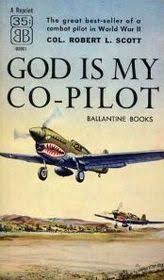
Colonel Robert Scott, WW II war hero, was recalled by the Pentagon for a tour America to stir up feelings of patriotism with his personal story of shooting down flocks of Japanese planes.

Near the end of that tour, Colonel Scott was asked by the Scribner (sic) publishing house to relate his experiences in a book. But he had only three days to do so before he had to report to Luke Field in Arizona as its new commander, so he simply spoke his recollections — 90,000 words — onto wax cylinder recording devices.*

Three days! God Is My Co-pilot became a best seller.

*The quotation is from his obituary in the New York Times.

587. Back to the Garden

Since summer, I have been working on reviewing the fifteen novels I chose as my favorites, and one thing has emerged. They nearly all have a rural or wild setting.

The exceptions are Heinlein and the Lensman series, both of which take place in completely civilized futures, and Dickens’s Christmas Carol, with its pre-modern urban setting.

The other twelve, whether past, contemporary, or future, are rigidly non-urban. Two take place at sea, three take place in variant, rural Englands, three take place in purely fantasy worlds, either wild or bucolic.

Davy Balfour spent his adventure crossing wild Scotland, and Roy Craig fought a wilderness so fierce that it threw off human domination.

Highland Laddie Gone takes place in modern America, but in a rural setting where the protagonists are pretending to recreate ancient Scotland. Part of A Prince of the Captivity takes place in an urban setting, but its soul and much of its action take place on an icecap, in the Alps, in the wasteland of war, and in wild places that exist only in Adam Melfort’s imagination.

If this were just my weird preference in books, it wouldn’t be worth a post, but it is much more than that. It is a reflection of recent history.

===============

Americans went to war in the forties. Those who came back changed the world. While England languished, half crippled as a result of the war, America exploded into the future. Freeways, cars that looked like jet planes, and housing tracts all emerged. Stamped tin toys were out; plastic was in.

The past (westerns were everywhere) and the present (endless spy stories) fought for dominance as the paperback revolution swept the nation.

While America was rushing forward technologically and outgrowing its landmass, some of the former generation were looking backward. A lot of young writers were looking to the future and seeing a post-nuclear age of Armageddon that was a replay of bad times past.

Some turned to fantasy. Ballantine gave us masses of books dug up from the actual past of literature, portraying pasts that never were, but which we all thought should have been. Tolkien became the king of backward looking nostalgia.

Two-thirds of my fifteen favorites were drawn from this anti-urban movement.

===============

I grew up on a farm, but most of my generation was urban. And rich, in comparison to any previous generation of youth. And they had the pill — which changed life a lot more than computers ever will. Sex, drugs and rock and roll. I missed all that, back in my Baptist-farmer world.

Then I got to college. I went from being marginal to my home town to being a marginal hippie. I agreed with most of their ideas, but I had no confidence that they would pull them off. And they didn’t. They stopped the war, but it wasn’t a clean victory. Nixon kept Viet Nam on life support long enough to win a second term.

By that time a new craze had hit; everybody wanted to go back to the land. I had waded through too much cow manure to buy into that.

I eventually went back to the land in a different way. I retired from teaching and bought a house on three acres in the Sierra foothills. Here I can see turkeys, deer, coyotes and an occasional bobcat walk past the picture window of the air conditioned shed where I write. I don’t raise crops, just novels.

A decade after the back-to-the-land crew had moved back to the cities, I wrote a novel, Raven’s Run, and put my opinions into the mouth of one of my characters, Rusty Dixon. For the record, he cusses more than I do.

Then along came the sixties. Some of us went off to Viet Nam and landed in pot heaven. Other kids my age went down to the cities and became hippies. When all that peace and love shit started to fall apart, a big bunch of hippies, lots of them from San Francisco and L.A., decided the new big thing was to go ‘back to the land’. ‘Course most of them had never been on the land, so they weren’t really going back to it. If they had, they’d have known better. I mean, I never saw any kid raised on a farm that went in for that shit.

It doesn’t take much insight to realize that the back-to-the-land movement, as well as Tolkien and his imitators, were moved my the same impulse. The modern eco-generation is singing the same tune, whether they understand it or not. It is a universal human hymn. For all of them, the future looks bleak and the past looks better than it really was.

Personally, I still have more faith in the future than in the past, but that twenty year spree of fine anti-urban and fantasy novels that came after World War II is still a pleasure to read.

585. A Life of Reading

Trying to write a post on The Road to Corlay has turned out to be tough. I remember the book clearly, and I didn’t remember it at all. That is, I remember how I felt when I read it. I remember the feel of its countryside, and the slow grace of its human interactions, but I can’t remember one name, and can hardly remember one scene. I would drop the whole thing, but I “made my brag” by posting the list early. I need to read Corlay again, but that poses a problem. I don’t have the time.

It was scheduled for today, but I’m going to have to postpone it for now.

I retired from teaching about seven years ago and went back to writing full time. I had written quite a few books in the seventies and eighties, before hunger sent me to get a day job, and a few more while I was teaching, but that wasn’t nearly enough to satisfy me. Don’t get me wrong; this isn’t about mortality. I plan to live to be a hundred because I’m just too damned busy to die.

The fact is, reading a book is ten times better than watching a movie, but writing a book is fifty times better than reading one. And takes fifty times as long.

Besides the hundred thousand words a modern novel demands, there are the other hundreds of thousands of words you have to go through while getting to the right ones. And there are all those books you have to burrow through looking for just the right bit of information or inspiration to help you understand how that next chapter is supposed to come out.

Just reading a book for fun gets lost somewhere. I read the things I need to read, and late in the evening I read comfort books, like the thirtieth Nero Wolfe, which isn’t that different from the other twenty-nine.

It wasn’t always that way.

I was an only child on a farm in the fifties. We had one black and white TV that got two channels, which my parents watched while I read. Of course I became a reader; what else was there to do. From the time I discovered the county library, there was no time I didn’t have a stack of books awaiting my attention.

But I didn’t talk about it. My mother read occasional romance novels but she didn’t talk about it. My dad read the Bible, but he didn’t talk about it. The habit started early.

I read books about hunting and outdoor life. I lived outdoors, but on a tractor. I never hunted, barely fished, and I had never seen a tent. The real outdoors wasn’t for play, it was for work, and that didn’t satisfy me.

Looking back, I know that the place I lived as a boy was rather lovely, in a muted sort of way. It was farm country, lightly populated by humans, but with plenty of birds, and occasional coyotes and possums. Nevertheless, every patch of ground was either under the plow or turned into grazing land. There was nothing truly wild. I wanted forests and streams, fish and game, and snow, along with the freedom to wander through them.

It was all available in books, along with a thousand other adventures all over the globe.

My school mates read because they had to read — but nobody talked about it. Nobody read science fiction. Nobody wanted to know any more about science than they were required to. I was reading and studying continuously, preparing to head for college to be a scientist — but I didn’t talk about it, because no one else really wanted to know.

When I got to college, one of my roommates was a science fiction fan. We talked about it, but only a little. By then, my habit of silence was pretty well set.

A lifetime later I started this blog. It’s the first time I’ver really talked about the books I love and why I love them, right here, talking to you —

Hi. You see, there was this book called The Road to Corlay . . . but I guess we’ll just have to chat about that later.

581. The Traveler in Black

(The traveler in black) has many names, but one nature, and this unique nature made him subject to certain laws not binding on ordinary persons. In a compensatory fashion, he was also free from certain other laws more commonly in force.

John Brunner was a successful and popular author of science fiction and fantasy, but he is rarely mentioned in the same breath with Clarke or Asimov. He has fifty-nine books listed inside the cover of my copy of Traveler, and he won a Hugo for Stand on Zanzibar, but he never quite made it to the top rung of the ladder. I have a theory about that.

The blurb-quoted reviews on the back cover of my Traveler praise Brunner for his competence. Competence may get you to the party, but it doesn’t make the fans gather ’round you once you are there; and that isn’t completely fair either, since he once wrote a book that was as good as any in science fiction or fantasy. The Traveler in Black was his Old Man and the Sea.

My theory is that, like Clarke, Brunner was an idea man. His characters have just enough blood in their veins to carry the ideas, and not one drop more. Zanzibar is a prime example; all the characters in that novel were cyphers. It was a big book about big ideas, populated by little tiny people.

Traveler avoids the curse of dull character by the oddest of twists; the traveler has no character at all. His character is to not have character. And it works.

The traveler moves through a world of chaos, having no will and no agenda, and changes everything. He is cursed-blessed-given-created to answer wishes in the exact words they were asked.

It’s like a wishing well with a mean streak, but there is no mean streak in the traveler. He sadly shakes his head and does what he was created to do — gives people exactly what they ask for. And since people aren’t too bright, they don’t see the consequences that will attend their wishes. They almost always get what they really didn’t want. Many do not survive their wish fulfillment, and no one survives unscathed.

As you may guess, this uses up a lot of lesser characters. These are précis people; sketched out in a few words and gobbled up by the march of change. Only the traveler survives.

This sounds a bit like a Mad magazine view of history, but Brunner pulls it off through the non-personality of the traveler. He has no backstory. He has no motivations, only the geas to grant wishes. He is slowly carving reason out of chaos by letting chaos devour itself. There is a tremendous cost in human suffering, and the traveler witnesses it all, unable to warn or advise, compelled to grant whatever wish he encounters, whatever the cost to the wisher.

We don’t hear him think about this. He does not converse, although he is often the object of conversations. We only know his inner feeling by a shake of the head, a hesitation to speak, and the slow pace of his progress through the world. That this is one sad and weary entity is only acknowledged in passing. It is all a game of subtlety, conveyed by the stately beauty of the language in which it is written.

Traveler is a fix up novel of individual stories previously published in SF magazines, and stitched together by the traveler himself. It comes in two versions. The one I read first, many years ago, was called The Traveler in Black. Its cover is pictured here. The cover pictured at the top of the post is a later version with one more story called, of course, The Compleat Traveler in Black.

The odd spelling is a literary reference. I won’t elucidate. I’ll just let you feel superior if you recognize it.

580. Pavane

During the Golden Age, most science fiction was in the form of short stories, published in science fiction magazines. When paperbacks became popular, there was a need for novels, mostly short by modern standards. Authors and editors mined the SF magazines for interrelated short stories that could be linked together and somewhat rewritten to appear as if they were novels. They became known as fix-up novels. The next three on my best list are all fix-up novels: Pavane today, The Road to Corlay (set for April 17, but these things sometimes change), and The Traveler in Black this Wednesday.

Pavane by Keith Roberts (publication date 1968) is not to everybody’s taste, but is one of my all time favorites. It is an alternate universe novel, set in the twentieth century in a world where the Catholic Church has maintained its power. The universe-changing event was the assassination of Queen Elizabeth the First, shortly before the arrival of the Spanish Armada.

Of course, the people of Pavane don’t know that they are an alternate. Their world is simply the world. Other than a brief introduction, the novel is written from that perspective. Things are explained, as they must be in any novel, but only enough that someone in the world of Pavane would understand.

(If I wrote a story about a blacksmith, I would explain enough that a college student could understand, not enough for an alien from Alpha Centauri to understand.)

This makes Pavane a bit challenging, but Roberts does his job well. The challenge is slight, and the reward is an abundance of ambiance.

Pavane takes place in a cold, hard world, and the characters fit their situations. Jesse Strange, in the first story The Lady Margaret is so dedicated to the family business (haulage by steam road waggons) that he passes up love and ignores friendship. Rafe, the student signaler, is engaging, but doomed. The story of the artist Brother John is positively grim.

All this sounds like I’m saying, “Don’t read this book,” but in fact I give it my highest recommendation. You will be forced to confront this alternate culture by digging deep into what makes it work, and any time one has to learn another way of thinking from the inside, the mind and the heart are enriched.

The ending called Coda is a disappointment. Roberts gets up on his soap box for a brief but embarrassing moment to try to justify his culture. Cultures don’t need justification; they just are. And every one of them, including yours and mine, is a mixture of joy and horror.

Probably the most notable part of the novel is the sheer beauty of the writing. At least, that is my take. I have found beauty of writing to be extremely subjective, but Pavane hits the sweet spot for me. I invite you to see if it hits yours.

One thing for sure. Thirty pages in, you will already know if you love it or hate it.

Pavane is available used or e-book from Amazon, or if you are lucky at your local used book store.

567. Bridges of Longing

Every time I print some poetry, my own or favorites from other writers, my readership spikes. It’s got to be the tag POETRY that does it.

The problem is that I don’t like 99.9 percent of the poetry I read today. My rule is: if you can rewrite a poem without line breaks, and that turns it into the first couple of sentences in an unfinished short story, then it isn’t a poem. Almost everything I read nowadays fails that test.

I’m not talking about rhyme. Check out Spoon River Anthology or anything by Yeats or Frost to see the flip side of what I’m complaining about.

When I do find exciting work by a contemporary author, it knocks me out. Example: Marsheila Rockwell.

I met Marsheila at Westercon in 2017 at a reading. She and another author, a couple of author’s friends, and I sat down in a conference room that would have held fifty. I was the only stranger in the room.

Westercon 70 was odd that way. It was very much a home town version of a regional conference. The Cosplay and Filk venues were packed, but the book signings and author’s readings were almost (sometimes completely) empty.

Her stories were fine and her poetry was excellent. I bought her collection Bridges of Longing and there wasn’t a poem in it that wasn’t wonderful. There were some I didn’t like, primarily in the section Those Who Wait, but it was only because they were harsh to the point of hopelessness. It wasn’t because they weren’t true. The same was true of some of her stories. They were superb, whether they matched my taste or not.

You see, Marsheila and her sig-other and writing partner primarily operate in the fields of horror, dark fantasy, and D & D, all places I have no interest in going. I would certainly never have found her except that fate steered me into that reading.

Her poetry, on the other hand, is humane and feminist, and always with a hard edge. It sounds like real life, even when it is supposedly about goddesses and harshly treated mermaids. She is the best new poet I have encountered in many years, even if her novels aren’t in my wheelhouse.

I would say, buy Bridges of Longing. The poems alone are worth the cost many times over, and if you have any liking for fantasy, you will enjoy the stories as well.

You might also check out her website http://marsheilarockwell.com/ .

563. Another One Bites the Dust

I went to a local used bookstore today to find a copy of Heinlein’s The Rolling Stones. I can’t find a copy in my book room and none of my local libraries have it. That’s understandable; it came out in 1952 as a juvenile and it wasn’t his best work. I just wanted to see if my memory was correct after all these years as to his use of the barbecue roll, with paint. If that makes no sense, stick around. It will be in an upcoming Apollo post, as soon as I find a copy.

I walked into the bookstore. The proprietor said, “How are you?” and I replied, “Sad. You’re closing.” And she was. About a third of the shelves were empty and she was selling books by the bag, one to ten dollars, depending on the size of the bag.

I’ve completely lost count of how many used book stores have come and gone over the decades I have lived in this area. It always hurts to see one go, and every time a new one appears I know another book lover is buying themselves a heartache.

There are many things which are done for love instead of money. Blogging might be the new poster child for this way of life. Used bookstores are near the top, as well. Crafters fill the same niche.

If you go to a local boutique and buy some hand made jewelry, or any of a thousand other kinds of things you couldn’t buy at Wal Mart, you might be tempted to call them over priced. Maybe, from the consumer’s viewpoint, but I doubt if one in fifty crafters is making minimum wage. They always think they’ll make a little money when they start, but really . . .

A used bookstore as an investment? Hummm. I wouldn’t do it, although I’m glad there are people who do. Consider the mark-up (next to nothing) and consider how many customers come in each day. At least you have a lot of time to read.

I should talk. I do something even dumber than that. I write novels.

If you go to a used bookstore — in some town other than the one I’ve avoided mentioning, which no longer has a used bookstore — and look closely at the science fiction shelves you will find hundreds of writers you’ve never heard of. Some of them are pretty good and some aren’t. What they have in common, not counting Heinlein and a few like him, is that they probably never made a living by writing. A few achieved a bit of fame, but most of them didn’t. Many wrote only one or two books and gave up.

If you look at the names of the publishers, you won’t know it unless you’ve been following this for years, but many of them stayed in business by stiffing their authors. Others actually paid, but paid a pittance.

I don’t think there are too many of those completely dishonest publishers around any more. Times have changed. Now you can publish ebooks and stiff yourself.

Oh well, it’s a good life if you don’t weaken. And of course I don’t do it for the money — but I wouldn’t mind some.

562. Davy

This is one of my best stories series.

I re-read. It is my equivalent of brainless television. There are books that I frequently re-inhabit in order to once again enjoy the people, scenery, and action.

There are also books I read only once, and never need to read again. They become such a part of me that I still remember them decades later.

Edgar Pangborn provided two such books, Davy and The Trial of Calista Blake. I read each of them only once, between 1964 and 1967. I have never forgotten them, nor have I ever wanted to return to them. They were life changing, if read at the right age.

===========

I grew up in an era of fear. The bomb hung over us all, and fiction followed the trends of the day. Speaking from memory, not scholarship, it seems to me that it was the end of the exclusivity of science fiction. Events that would have once interested only the few and the faithful, were turning up on the best seller list. Books like Fail-Safe and On the Beach were called science fiction, and I suppose technically, they were. But they didn’t taste like science fiction because they were written by mainstream writers with different sensibilities. That may not be a legitimate complaint, but in truth they tasted like steak with no salt.

The flip side of the here-comes-the-bomb novels was an endless cavalcade of post-holocaust dystopias. The first book I read, the first day I discovered libraries, Star Man’s Son by Andre Norton, was one of those. There were dozens to follow; maybe hundreds. They mostly ran together in a mass of future sadness, but a few were memorable.

Davy stood out because it’s horny orphan protagonist got such joy out of life. He found a French horn in the rubble and taught himself to play it, which always made the book seem more like fantasy than science fiction. If you know French horns, you’ll understand.

We spend much of the book watching Davy go from ignorance to knowledge. The cover of the edition I read compares him to Tom Jones (the novel, not the singer) and that seems fair.

Davy’s world is the northeastern United States, a couple of centuries after the nukes fell. The names are scrambled but mostly decipherable. The state religion is the Holy Murican Church and belief is not optional. Davy falls in with anti-religious dissidents, which suits his doubter’s personality.

The novel is carried by Davy as a questioning, ebullient youth, but saved from silliness by a brooding feeling that all will not be roses. The story arc makes everything work. We see young Davy growing up as told by his older self, but we are spared the works of his maturity. There will be striving, battle, despair, and betrayal when the mature Davy attempts to mold the world to his liking, only to have it fall apart in his hands. That is the part of the story another novelist would have concentrated on, but we see it only in brief flashes. Then we are at the final chapter, a kind of coda in which Davy totals up his gains and losses and prepares for a final, hopeless journey.

What we have here is the joy of youth, overlain by the elegiac sadness of hopeless struggle against human inadequacy. Heinlein could have written it, but it would have had little heart because his protagonist would have stood above the fray, superior to the mass of humanity. Davy partook of the same human conditions that he fought against. Just like the rest of us. That made Davy stand out as something better that the rest of the dystopias. It made the novel a work of art to move the soul — at least if you read it at sixteen, while waiting for the bomb to fall.