Tag Archives: review

575. Textbook: The Rolling Stones

This is a continuation of the post Learning Spaceflight.

For someone reading this post today, it will require a bit of imagination to recreate the head space I’m talking about. Think 1952. Sub-divisions and interstate highways were brand new. NASA was still three years in the future. Heinlein wrote a science fiction juvenile called The Rolling Stones in the year Mick Jagger was still twelve years old.

In the interests of full disclosure, I was five years old that year, so I must have read it six or seven years after publication.

In those days, those of us who were in love with the idea of spaceflight were getting our fix from science fiction, and mostly from juveniles. PBS was seventeen years in the future, and NOVA was twenty-two years in the future.

I recently re-read The Rolling Stones. It was never my favorite novel. I would give it one star for plot and no stars for its obnoxious characters.

The Stone family lived on the moon. The slightly underaged twins wanted to buy a spaceship and flit around the system on their own, using money they had made from an invention. Dad said, “No,” but never fear. He bought a larger ship and took his whole family along, first to Mars, then to the asteroid belt.

If my tone sounds facetious, chalk it up to how irritating all the characters were, but as a textbook on how to fly in space, The Rolling Stones was top notch.

Here is an example. Leaving Luna for Mars, the Stones opt for the most economic orbit. This puts them in a long line of craft who have made the same decision. They fuel up on Luna then drop down to pass close to the Earth because . . .

A gravity-well maneuver involves what appears to be a contradiction in the law of conservation of energy. A ship leaving the Moon or a space station for some distant planet can go faster on less fuel by dropping first toward Earth, then performing her principal acceleration while as close to Earth as possible. To be sure, a ship gains kinetic energy (speed) in falling towards Earth, but one would expect that she would lose exactly the same amount of kinetic energy as she coasted away from Earth . . .

The mass of fuel adds to the energy as they drop deeper into the Earth’s gravity well, but the fuel is expended at perigee so it does not subtract from the energy as they move away. I’m interrupting RAH and explaining it myself because he took too many paragraphs, but that’s where I learned about gravity well maneuvers. By the time I got to college my main interest was ecology and then anthropology, so I never studied engineering or orbital mechanics. I still wish I could have done both but, in truth, most of my knowledge of space travel came from Heinlein, Clarke, Ley, and Goodwin, with lesser lessons from Gamow, Coombs, Hoyle and dozens whose names I no longer remember.

Later on, the Stones headed out for the asteroid belt. They . . .

shaped orbit from Phobos outward bound for the Asteroids six weeks later. This was no easy lift like the one from Luna to Mars; in choosing to take a ‘cometary’ or fast orbit . . . the Stones had perforce to accept an expensive change-of-motion of twelve and a half miles per second for the departure maneuver. A fast orbit differs from a maximum-economy orbit in that it cuts the orbit being abandoned at an angle instead of being smoothly tangent to it… much more expensive in reaction mass.

Of course. That makes perfect sense.

I watched the first part of a NOVA program the other day called The Rise of the Rockets. I turned it off about ten minutes in muttering kinderspiel. At least that’s the word I’m choosing to use in this family site. That happens a lot. NOVA covers fascinating subjects, but they tend to dumb them down. The old dudes did it better, even in their fiction.

However, they didn’t always get it right. Regarding the asteroid belt, RAH said . . .

But it was not until the first men in the early days of the exploration of space actually went out to the lonely reaches between the orbits of Mars and Jupiter and looked that we learned for certain that the Asteroids were indeed fragments of a greater planet — destroyed Lucifer, long dead brother of Earth.

Back in the fifties when The Rolling Stones was written astronomers had not yet decided if the asteroids were an exploded planet or an unformed one, caught in the tidal stresses of Jupiter’s gravity. RAH chose the more exciting option. Today we know better. Too bad. I always wanted to write a novel called The Last Days of Lucifer. I guess I still could, as steampunk.

In the fifties, we knew little about the universe and not all that much about the solar system. A lot of what RAH and others wrote has been killed by current knowledge. He had a non-human civilization with canals on Mars and intelligent talking dragons in the swamps of Venus. But he knew his math, and his rockets always got where they were going by following the rules of physics that NASA uses today.
567. Bridges of Longing

Every time I print some poetry, my own or favorites from other writers, my readership spikes. It’s got to be the tag POETRY that does it.

The problem is that I don’t like 99.9 percent of the poetry I read today. My rule is: if you can rewrite a poem without line breaks, and that turns it into the first couple of sentences in an unfinished short story, then it isn’t a poem. Almost everything I read nowadays fails that test.

I’m not talking about rhyme. Check out Spoon River Anthology or anything by Yeats or Frost to see the flip side of what I’m complaining about.

When I do find exciting work by a contemporary author, it knocks me out. Example: Marsheila Rockwell.

I met Marsheila at Westercon in 2017 at a reading. She and another author, a couple of author’s friends, and I sat down in a conference room that would have held fifty. I was the only stranger in the room.

Westercon 70 was odd that way. It was very much a home town version of a regional conference. The Cosplay and Filk venues were packed, but the book signings and author’s readings were almost (sometimes completely) empty.

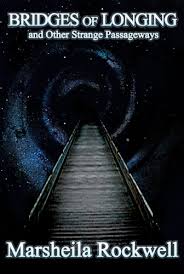
Her stories were fine and her poetry was excellent. I bought her collection Bridges of Longing and there wasn’t a poem in it that wasn’t wonderful. There were some I didn’t like, primarily in the section Those Who Wait, but it was only because they were harsh to the point of hopelessness. It wasn’t because they weren’t true. The same was true of some of her stories. They were superb, whether they matched my taste or not.

You see, Marsheila and her sig-other and writing partner primarily operate in the fields of horror, dark fantasy, and D & D, all places I have no interest in going. I would certainly never have found her except that fate steered me into that reading.

Her poetry, on the other hand, is humane and feminist, and always with a hard edge. It sounds like real life, even when it is supposedly about goddesses and harshly treated mermaids. She is the best new poet I have encountered in many years, even if her novels aren’t in my wheelhouse.

I would say, buy Bridges of Longing. The poems alone are worth the cost many times over, and if you have any liking for fantasy, you will enjoy the stories as well.

You might also check out her website http://marsheilarockwell.com/ .

562. Davy

This is one of my best stories series.

I re-read. It is my equivalent of brainless television. There are books that I frequently re-inhabit in order to once again enjoy the people, scenery, and action.

There are also books I read only once, and never need to read again. They become such a part of me that I still remember them decades later.

Edgar Pangborn provided two such books, Davy and The Trial of Calista Blake. I read each of them only once, between 1964 and 1967. I have never forgotten them, nor have I ever wanted to return to them. They were life changing, if read at the right age.

===========

I grew up in an era of fear. The bomb hung over us all, and fiction followed the trends of the day. Speaking from memory, not scholarship, it seems to me that it was the end of the exclusivity of science fiction. Events that would have once interested only the few and the faithful, were turning up on the best seller list. Books like Fail-Safe and On the Beach were called science fiction, and I suppose technically, they were. But they didn’t taste like science fiction because they were written by mainstream writers with different sensibilities. That may not be a legitimate complaint, but in truth they tasted like steak with no salt.

The flip side of the here-comes-the-bomb novels was an endless cavalcade of post-holocaust dystopias. The first book I read, the first day I discovered libraries, Star Man’s Son by Andre Norton, was one of those. There were dozens to follow; maybe hundreds. They mostly ran together in a mass of future sadness, but a few were memorable.

Davy stood out because it’s horny orphan protagonist got such joy out of life. He found a French horn in the rubble and taught himself to play it, which always made the book seem more like fantasy than science fiction. If you know French horns, you’ll understand.

We spend much of the book watching Davy go from ignorance to knowledge. The cover of the edition I read compares him to Tom Jones (the novel, not the singer) and that seems fair.

Davy’s world is the northeastern United States, a couple of centuries after the nukes fell. The names are scrambled but mostly decipherable. The state religion is the Holy Murican Church and belief is not optional. Davy falls in with anti-religious dissidents, which suits his doubter’s personality.

The novel is carried by Davy as a questioning, ebullient youth, but saved from silliness by a brooding feeling that all will not be roses. The story arc makes everything work. We see young Davy growing up as told by his older self, but we are spared the works of his maturity. There will be striving, battle, despair, and betrayal when the mature Davy attempts to mold the world to his liking, only to have it fall apart in his hands. That is the part of the story another novelist would have concentrated on, but we see it only in brief flashes. Then we are at the final chapter, a kind of coda in which Davy totals up his gains and losses and prepares for a final, hopeless journey.

What we have here is the joy of youth, overlain by the elegiac sadness of hopeless struggle against human inadequacy. Heinlein could have written it, but it would have had little heart because his protagonist would have stood above the fray, superior to the mass of humanity. Davy partook of the same human conditions that he fought against. Just like the rest of us. That made Davy stand out as something better that the rest of the dystopias. It made the novel a work of art to move the soul — at least if you read it at sixteen, while waiting for the bomb to fall.

561. Great (?) Books

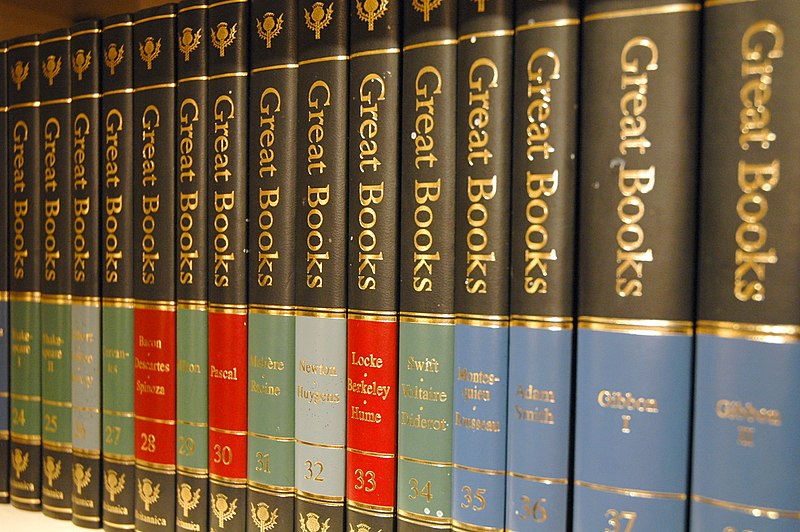
The Great Books of the Western World.
Taken 16 February 2005 by User:Rdsmith4

“Here are the most admirable and varied materials for the formation of a prig.”      James Payn, speaking of the Great Books of the Western World.

A prig (in case you didn’t know) is a self-righteously moralistic person who behaves as if superior to others.

=========

If Aristotle said it, it must be true, right? Maybe. Of course, Aristotle’s ideas about physical science held Europe back from progress for a couple of millennia, so maybe not.

According to Aristotle’s view of forced motion (as opposed to natural motion) a body would stop moving when applied forces was removed. This caused his followers much work trying to explain why an arrow didn’t stop moving as soon as it left the bow.

I think we can cut the old guy some slack. Pioneers never get things completely right. On the other hand, too much reverence for old things can really slow progress. Case in point: The Great Books.

When The Great American Read hit PBS, it sent me looking at some old lists of great books, although, to be fair, the GAR was not about great books, but popular books, which is a whole different perspective.

Among the books of lists I checked out was A Great Idea at the Time by Alex Beam, about Encyclopedia Britannica‘s Great Books of the Western World. That consisted of fifty-four volumes containing 443 works by seventy-four authors, all dead, white, and male. I recommend Beam’s humorous look at the intersection of prissy scholarship with American huxterism.

Meanwhile, let’s look at the same issue from a broader perspective. There is a prejudice among the educated that finds wisdom only in great or serious books. If Charles Dickens says it, it is wisdom. If Gordon Dickson says it, it is entertainment.

I don’t buy that. Never did. Don’t plan to in the future. I stand with Brian and Mike Hugg’s song You’re A Better Man Than I . . .

Could you tell a wise man
By the way he speaks or spell
Is this more important
Than the stories that he tells.

While I was researching all this, I ran across a Goodreads review of one of the books I had mentioned, The Novel 100, which included this sentence: “It contains a lot of my own personal favorites, while also including books that I should read.”

Should? Why should? Why read the Great Books, and for that matter, why capitalize them as if they were the Holy Bible?

Robert Hutchins, who was instrumental in producing the Great Books of the Western World (in part to make Great Profits), put it this way:

Until lately the West has regarded it as self-evident that the road to education lay through great books. No man was educated unless he was acquainted with the masterpieces of his tradition. There never was very much doubt in anybody’s mind about which the masterpieces were. They were the books that had endured and that the common voice of mankind called the finest creations, in writing, of the Western mind.

Yeah, right! If it was so “self evident” why was there such a giant fight to decide which books were great enough to go into the Great Books of the Western World?

In terms of ubiquity in the works of later writers, the greatest of the Great Books was the Bible. Adam, Eve, and the Garden — you might be Charles Darwin, and those names and their implications would still be understood. Only Shakespeare comes close to such instant recognition.

Today, it would be hard to find any author with recognition that is both widespread and lasting. Maybe Tolkien; maybe not. There are plenty of writers that everybody reads today, who will be forgotten in a decade. There are probably a few authors whose fame will never die with a small group of readers, but that would  be hard to nail down.

In the “good old days” there was a bit of unanimity on quality (less than Hutchins would have you think), but today’s society has opened outward to diversity in such a way that, while there will always be great books, there will probably never again be Great Books.

Greece and Rome may lie at the foundations of Western Civilization, but really, who has more to offer modern America, Marcus Aurelius or Maya Angelo.

530. In the Valley of Magic

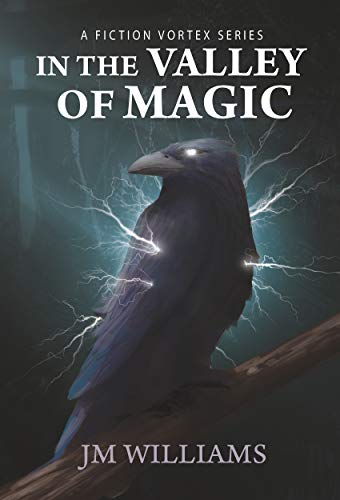
I recently finished JM Williams’s novel In the Valley of Magic, and I’m here to tell you about it.

Over the three years of this blog, I have been liked by quite a few people and most of them are bloggers. I always drop in to see their sites, with mixed results. If they are also writers, I try to sample what they have written. Usually the results belongs in a blog, not a bookstore. That’s not criticism; everybody has to start somewhere. Once in a while they are good, but not my type, so I have to give them a pass. One author wrote an amusing and entertaining first novel, which I reviewed positively, and a second novel I couldn’t get through.

JM Williams is the positive exception. I have read three of his works now, and they have all been excellent. Be careful if you go looking for him, though. An Amazon search will offer more than one JM Williams, and you won’t know which is which. You might try his website to keep things straight.

If you have read Iric, you have already been introduced to Marudal, the scene of the action. Iric’s appearance in the new novel is sadly brief.

JM Williams calls this a short-story-novel. There is no single, main hero. For most of the book, each chapter introduces a new viewpoint character. That may sound challenging, but the characters are cunningly drawn and are mostly people you will want to spend time with. It all works well, although I don’t care for his term short-story-novel. That suggests a fix-up novel, which this definitely is not.

If you don’t know the term, a fix-up novel is a novel made up of often tenuously linked short stories. They were popular in the early days of paperbacks, when writers would mine their short stories from SF magazines and shoehorn them together to make novels. Sometimes it worked; sometimes it didn’t.

In the Valley of Magic is nothing like that. It is a single, unified novel, very tightly organized and plot driven. It just has lots of characters, and each one has a piece of the story to tell. By the end of the book, those characters begin to reappear and to interact in ways that bring the whole to a satisfying conclusion.

The characters were varied and interesting, and the ones who should have been appealing, were. Many were flawed, sometimes deeply, and in need of a little redemption. There were plenty of villains, too, but most were self-serving or driven by ignorance and indifference. Some were simply on the wrong side of a developing war.

The plot was complex, and made to seem even more so by the way it was presented by one character at a time. It wasn’t a whodunnit, but more of a a what-the-hell-did-they-just-do? Since we couldn’t ask ourselves, “What will happen next to our hero?” given that our “hero” changed with every chapter, we were left asking, “What was that all about, and what is it going to lead to next?” The plot propelled the story forward and the payoff was well worth the read.

JM Williams also recently published a retelling of a Hans Christian Andersen tale titled The Nightingale. It has a few characters always on stage and the rest in the background, so we see the action through just a few viewpoints. That’s normal, and I wouldn’t mention it except to point out that Williams also excels in traditional storytelling.

528. Repeat, with Variations

You hear it said — author Joe Doakes has written the same book thirty times. The phrase is sometimes supercilious and often has more than a touch of envy hidden in it. The implication is, “Hell, I could do that.”

True confession: I couldn’t. Sometimes I feel good about that, and sometimes I wish I could do that, because repetition is one of the main paths to $ucce$$. I keep telling myself it is not the only path.

If you are, or want to be, a writer, you should examine this notion from the viewpoint of a reader, standing in front of a shelf of books, with only enough money and time to buy and read one of them.

The one with the naked woman catches your eye (male viewpoint assumed; for alternate gender, insert your own preference) but you’ve been burned by that advertising gimmick before. One looks likely, but you’ve never read anything by that author before, so you hesitate. If you could find a book by a favorite author, you would be reassured. If you could find a book by your favorite author, featuring a favorite character, your satisfaction would be almost certain.

It’s that simple. In addition, the author has the advantage of not having to invent a new main character for each book. It might be that finding something new for an old character to do would become tedious, but I can’t report on that from personal experience. No wonder publishers want books that can become the first of a new series.

We are talking about comfort food books here; true escapist reading for the times when you want to think, but only just a little. Television substitutes. Something for the long-haul trucker to read at night to take his mind off the fact that his wife is two thousand miles away, and what he would really like to be doing is . . .; you get the picture.

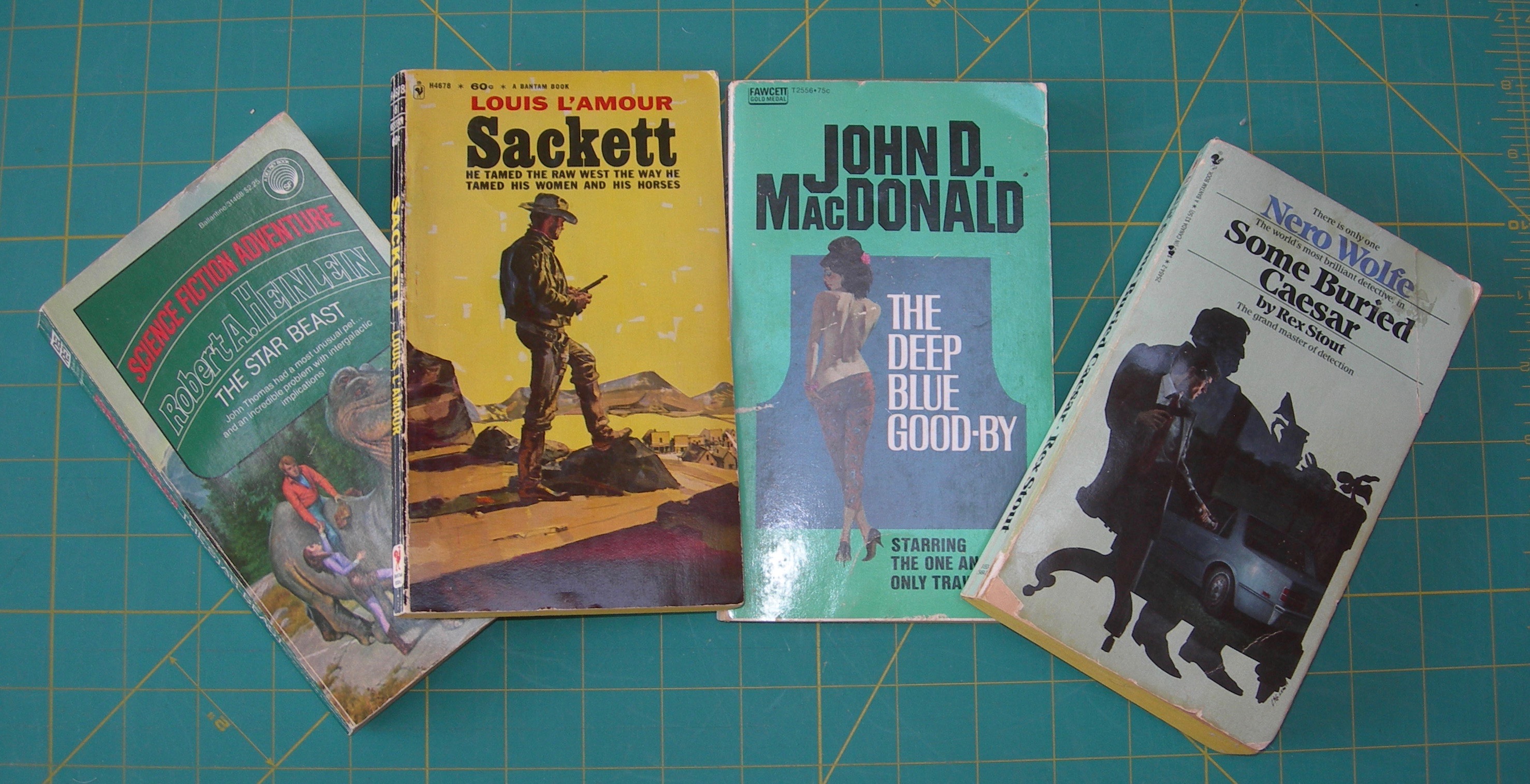
For me, during my first twenty years of writing, my go-to escape was Louis L’amour. I was writing science fiction and fantasy; he was writing westerns. He didn’t exactly write the same book fifty times. If he had, I couldn’t tell his good ones from his bad ones, and he had both. (Read Flint or Conagher, but avoid The Haunted Mesa.)

After beating my head against the typewriter (this was pre-computer) for a few hours, I would pick up a Louis L’amour western and ride off across the plains. Thoughts of interstellar travel were banished until the imagination well refilled itself. It was good stuff, but I don’t read him much any more. I have them all memorized.

I also have Heinlein in the photo at the top, which is a little unfair. He was not guilty of writing the same novel over and over (people who have only read from the second half of his career may disagree), but he only had one character. Male, female, both alternating, old, young — it didn’t matter. Every one was the Heinlein character, so if you liked one of his books, you were likely to like the rest. And if not, not.

The Travis McGee books are a clinic in how to do a series character who can continue to repeat with variations. No one ever did branding as well as John D. MacDonald. Every book contained a color in the title. He wrote The Deep Blue Good-by, Nightmare in Pink, A Purple Place for Dying, the Quick Red Fox, and seventeen more shades. You could recognize a McGee book from across the bookstore. MacDonald’s biography was titled The Red Hot Typewriter. In it, he explained that before he committed to the series, he wrote the first two novels to see if he could stand to be married to McGee for decades. For more, see 49. The Green Ripper.

The Spencer novels belong here as well. I read with pleasure through the first ten or so; each one was reasonably unique and expanded his character. The next thirty were increasingly dreary repetitions; they provided a quick escape and as quickly faded from memory. I still occasionally re-read one of the early novels, but the rest were all one-and-done.

Today, when the writing stalls, I rinse my mind out with Nero Wolfe and Archie Goodwin. I can’t say I really like them, but I always know what to expect.

527. Jack of Shadows

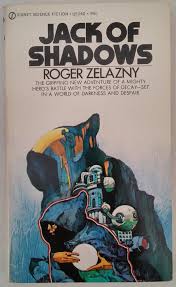
This is one of the fifteen that hit the sweet spot. Actually, almost anything by Zelazny belongs on somebody’s best-of list.

If you haven’t read Roger Zelazny, it’s time to start. The border between science fiction and fantasy is his domain, and nobody explores in better than he does.

Zelazny’s magnum opus is the Amber series, ten books detailing the story of Prince Corwin and his family and enemies — frequently the same people. You might start with Nine Princes in Amber, but then you will find yourself hooked, with nine more books to read before you can rest.

He also has a number of stand-alone novels, any one of which would be a proper place to begin to experience Zelazny. To name a few, in publication order:

This Immortal
The Dream Master
Isle of the Dead
Jack of Shadows
To Die in Italbar
Doorways in the Sand
Bridge of Ashes
Eye of Cat

There are also a half dozen between Bridge of Ashes and Eye of Cat which, in my opinion, don’t stack up to the rest. I’ve read and reread all of the above and a few more, along with numerous of his short stories. They always seem to be lurking in the Best Of . . . anthologies.

Isle of the Dead is probably my favorite among the stand-alones, followed closely by Eye of Cat, but as a recommendation for a Zelazny newbie I give you Jack of Shadows. It is close on the heels of the previous two in quality, and it is a more typical Zelazny. If you like Jack of Shadows as well as I do, you’re probably ready to take the big leap into the seemingly endless Amber books. Just make sure you don’t start out of order or it will drive you nuts. Check out the bottom of this post for details.

Jack, our (anti) hero begins his tale at his execution.

His planet is tidally locked with it’s sun like scientists used to think Mercury was. One side is constantly in day and the other constantly in night. Ah, you say, science fiction. Don’t jump to any conclusions. The daysiders are quite scientific, but the nightsiders are denizens of magic. Jack derives his power from shadow, so he is a creature of both and of neither, which is a very Zelaznyesque thing to be.

Nightsiders are immortal, but can be killed. Upon death, they are reborn in the Dung Pits of Glyve, which is at the middle of the nightside of the planet. That is where Jack finds himself shortly after the story begins, and the novel is basically the tale if Jack working his way back past innumerable enemies, to freedom, revenge, questionable redemption, and a cliffhanger ending.

Almost every review, and there are many of them, tells the whole story in brief. But why would you want to know if you plan to read it yourself? I won’t be party to cheating you like that.

If you decide to take the big leap into the Amber series, here is a list to keep you in proper order. There are two sets of five novels, the first being the story of Corwin:

Nine Princes in Amber
The Guns of Avalon
Sign of the Unicorn
The Hand of Oberon
The Courts of Chaos

The second set is the story of his son Merlin.

Trumps of Doom
Blood of Amber
Sign of Chaos
Knight of Shadows
Prince of Chaos

Neither set of novels comes to a proper conclusion. Zelazny was still writing them when he passed. We can imagine that he is somewhere in a luxurious room in Castle Amber, close enough to hear Random’s drumming, writing the ninety-second installment for the amusement of the immortals.

Aside for those old enough to have read Amber when it was being written: Did anybody else out there think the title of book one was a mashup of Nine Princes Waiting and Forever Amber and the second book title a spin on The Guns of Navarone, three best sellers of that era? Considering Zelazny’s sense of humor, it could be.

526. The Read Me Function

Never judge a book by its cover.

Sage advice, but largely meaningless. Covers sell books. A friend of a friend who writes romance eBooks advised me, if I ever published that way, to make sure that the cover looked like all the other covers for the same kind of book. She wasn’t talking about how good the cover looked. She was talking about branding. Did the cover scream at the top of its voice Romance, or Science Fiction, or Zombie Book.

I understood exactly what she meant, from sad experience. The cover for A Fond Farewell to Dying has an angel with a trumpet calling what appear to be dead folks out of some boxes. It fit the story only by a massive stretch of imagination, but it did look like one of those End of the World books that used to be popular. I found it once on a spinner rack of Christian books. Somebody got a surprise when they got home that night.

At least it used to be that you could pick up a paperback and read the blurb, but that is usually wildly inaccurate. The only hope you had, in the days when people went to bookstores and actually handled the books they were about to buy, was to read.

Imagine that.

Usually, the first few pages would tell you if you wanted to continue. That is why every how-to-write book you’ve ever read stresses making the first page great. That also works for selling manuscripts. If the first page is terrible, no reader or editor will ever read page two. Of course, there are fifty other hoops to jump through between a good first page and a sale.

At least a good first page might sell a book once it’s published and on the newsstand. The reader won’t come to hate you until he has slid into bed, with the light burning, and then finds out that everything goes south after page fourteen. All tucked in and nothing to read; and out a few dollars besides. Grrrrr.

So what do you do if you buy on line? You use the Read Me function, of course.

Technology giveth and technology taketh away, and the Read Me function is a pure gift. It’s like thumbing through the first pages of a novel by a new author in the newsstand to see if you like him (or her), but without the clerk giving you the stink eye. And you can do it in the comfort of your own home. It’s heaven.

It’s amazing how many books I haven’t bought, because of the Read Me function.

519. The Lensmen (2)

Continued from Monday . . .

If you find the style of Galactic Patrol too old fashioned after two chapters, move on; you were born too late to enjoy it. But if you don’t stay, you will miss a menagerie of strange aliens, both sentient and otherwise.

No one has read all of science fiction, but I’ve read a lot. And in my slice of the SF universe, I have never found a writer who created more or weirder creatures than Doc Smith. I’ll describe just two; first Worsel:

. . . there was hurtling downward toward them a veritable dragon: a nightmare’s horror of hideously reptilian head, of leathern wings, of viciously fanged jaws, of frightfully taloned feet,  of multiple knotty arms, of long, sinuous heavily-scaled serpent’s body.

This is the creature who will become the second most formidable Lensman, and Kennison’s best friend. A third Lensman was Tregonsee:

This . . .apparition was at least erect, which was something. His body was the size and shape of an oil-drum. Beneath this massive cylinder of a body were four short, blocky legs upon which he waddled about with surprising speed. Midway up the body, above each leg, there sprouted out a ten-foot-long, writhing, boneless, tentacular arm, which toward the extremity branched out into dozens of lesser tentacles, ranging in size from hair-like tendrils up to mighty fingers two inches or more in diameter. Tregonsee’s head was merely a neckless, immobile, bulging dome in the center of the flat upper surface of his body — a dome bearing neither eyes nor ears, but only four equally-spaced toothless mouths and four single, flaring nostrils.

These are the minions of civilization; the baddies look worse.

Are these aliens too weird to be believable? Actually, the opposite is true. When we move beyond our solar system, if we don’t find aliens so outré that no science fiction writer could have predicted them, I’ll eat my keyboard.

Part of the power of these descriptions comes from E. E. Smith’s writing style. In flipping through the internet while writing this, I ran across a comment that if the Lensman series were to be offered for publication today, it would not be accepted. That is absolutely true, but it is also true that without the Lensman series, there would be no Star Wars, nor any other space opera. The Lensman series set the pattern that all others would follow, and nothing that came after was as good as the original.

Heinlein was Smith’s friend, and our best picture of him comes from RAH. He said that Smith was the original of the Gray Lensman, and that his wife was the original of Clarissa MacDougal, Kinnison’s sometime companion-in-adventure and wife-to-be.

Much of the charm of the series lies in Kennison’s Boy Scout incorruptibility. Those who say he has no personality are wrong. He simply has a personality that is out of the modern norm. Like Jesus. — which is exactly what he should be, as the end product of thousands of years of Arisan work in perfecting human DNA.

All this works, and the hundreds of weird aliens work, because E. E. Smith’s writing style is essentially naive. His rolling cascades of description could only come from someone who is incapable of embarrassment.

It’s been a long time since that kind of writer has been in vogue, and that day will probably never come again. But if you can achieve the right mind-set, you can still be amazed. The six paperback novels are available in any good used book store. Pass the clerk a ten-spot and the wonders of the universe will be yours.

518. The Lensmen (1)

This is one of the fifteen that hit the sweet spot.

Part of this appeared in Alien Autopsy (2), but this is an expanded version.

E. E. (Edward Elmer) Smith’s prose sings. I said that all my selections sing and I’m going to stick to that statement. I also said that that singing was a function of the story being told. Smith’s prose is like a heavy metal band in front of a driving beat, pumping their fists and screaming out in a harsh falsetto.

Doc Smith is the only writer I know above the age of twelve who uses capital letters for emphasis, as in —

All I can say in that you have the most important assignment in the Universe today, and repeat — that information MUST GET BACK TO BASE.     Galactic Patrol p. 23

Admittedly he only uses this sparingly, but if any modern writer were to use it at all, it would be tongue in cheek. Smith is completely serious. 

So why is he on my best list? Because no one is better than Doc Smith at what he does — pure evil, shining good, huge distances, dizzying speed, massive warfare, whole planets reduced to rubble, and a hero that is so perfect that Superman would retire if he ever met him. All this without a single blush; without even knowing that some of his fans might blush for him. That complete lack of a sense of the ridiculous is why the Lensman series works. Mankind is fighting for its life against an evil and overpowering enemy, every man must do his part, and there is no place for half measures.

Like Star Wars on steroids? No, that defames Smith and his work. Doc Smith invented space opera. Star Wars is the Lensman series diluted by a whole ocean.

[That, by the way, is me being over the top in homage to Smith, who lived over the top.]

Let’s take a moment to name the books in order.

                Triplanetary
                First Lensman
                Galactic Patrol
                Gray Lensman
                Second Stage Lensman
                Children of the Lens

Smith was not available in either of the two libraries that were the centers of my childhood universe, but when I got to college, one of my roommates was a fan. He wisely started me on Galactic Patrol, and I read through to the end of the series, then circled back. Take my word for it — keep the same order. If you start on the putative book one, Triplanetary, you’ll probably never make it past page five.

In fact, books four through six were written from 1937 through 1948, all appearing serialized in Astounding. Smith wrote Triplanetary in 1934, but it was a stand-alone. When he got a chance to get the complete series published in paperback, he rewrote Triplanetary to fit the others, wrote an entire new second book, First Lensman, and tweaked the rest. They fit together, and the first two have moments of excellence, but the last four are the essence of the tale. If you find the style too old fashioned after two chapters of Galactic Patrol, move on; you were born too late to enjoy it.

Continued on Wednesday.