Tag Archives: space travel

575. Textbook: The Rolling Stones

This is a continuation of the post Learning Spaceflight.

For someone reading this post today, it will require a bit of imagination to recreate the head space I’m talking about. Think 1952. Sub-divisions and interstate highways were brand new. NASA was still three years in the future. Heinlein wrote a science fiction juvenile called The Rolling Stones in the year Mick Jagger was still twelve years old.

In the interests of full disclosure, I was five years old that year, so I must have read it six or seven years after publication.

In those days, those of us who were in love with the idea of spaceflight were getting our fix from science fiction, and mostly from juveniles. PBS was seventeen years in the future, and NOVA was twenty-two years in the future.

I recently re-read The Rolling Stones. It was never my favorite novel. I would give it one star for plot and no stars for its obnoxious characters.

The Stone family lived on the moon. The slightly underaged twins wanted to buy a spaceship and flit around the system on their own, using money they had made from an invention. Dad said, “No,” but never fear. He bought a larger ship and took his whole family along, first to Mars, then to the asteroid belt.

If my tone sounds facetious, chalk it up to how irritating all the characters were, but as a textbook on how to fly in space, The Rolling Stones was top notch.

Here is an example. Leaving Luna for Mars, the Stones opt for the most economic orbit. This puts them in a long line of craft who have made the same decision. They fuel up on Luna then drop down to pass close to the Earth because . . .

A gravity-well maneuver involves what appears to be a contradiction in the law of conservation of energy. A ship leaving the Moon or a space station for some distant planet can go faster on less fuel by dropping first toward Earth, then performing her principal acceleration while as close to Earth as possible. To be sure, a ship gains kinetic energy (speed) in falling towards Earth, but one would expect that she would lose exactly the same amount of kinetic energy as she coasted away from Earth . . .

The mass of fuel adds to the energy as they drop deeper into the Earth’s gravity well, but the fuel is expended at perigee so it does not subtract from the energy as they move away. I’m interrupting RAH and explaining it myself because he took too many paragraphs, but that’s where I learned about gravity well maneuvers. By the time I got to college my main interest was ecology and then anthropology, so I never studied engineering or orbital mechanics. I still wish I could have done both but, in truth, most of my knowledge of space travel came from Heinlein, Clarke, Ley, and Goodwin, with lesser lessons from Gamow, Coombs, Hoyle and dozens whose names I no longer remember.

Later on, the Stones headed out for the asteroid belt. They . . .

shaped orbit from Phobos outward bound for the Asteroids six weeks later. This was no easy lift like the one from Luna to Mars; in choosing to take a ‘cometary’ or fast orbit . . . the Stones had perforce to accept an expensive change-of-motion of twelve and a half miles per second for the departure maneuver. A fast orbit differs from a maximum-economy orbit in that it cuts the orbit being abandoned at an angle instead of being smoothly tangent to it… much more expensive in reaction mass.

Of course. That makes perfect sense.

I watched the first part of a NOVA program the other day called The Rise of the Rockets. I turned it off about ten minutes in muttering kinderspiel. At least that’s the word I’m choosing to use in this family site. That happens a lot. NOVA covers fascinating subjects, but they tend to dumb them down. The old dudes did it better, even in their fiction.

However, they didn’t always get it right. Regarding the asteroid belt, RAH said . . .

But it was not until the first men in the early days of the exploration of space actually went out to the lonely reaches between the orbits of Mars and Jupiter and looked that we learned for certain that the Asteroids were indeed fragments of a greater planet — destroyed Lucifer, long dead brother of Earth.

Back in the fifties when The Rolling Stones was written astronomers had not yet decided if the asteroids were an exploded planet or an unformed one, caught in the tidal stresses of Jupiter’s gravity. RAH chose the more exciting option. Today we know better. Too bad. I always wanted to write a novel called The Last Days of Lucifer. I guess I still could, as steampunk.

In the fifties, we knew little about the universe and not all that much about the solar system. A lot of what RAH and others wrote has been killed by current knowledge. He had a non-human civilization with canals on Mars and intelligent talking dragons in the swamps of Venus. But he knew his math, and his rockets always got where they were going by following the rules of physics that NASA uses today.

574. Learning Spaceflight

I learned how to fly in space before spaceflight existed, from science fiction writers who, in turn, learned it from pioneers like Robert Goddard, Willy Ley, Herman Oberth, and Wernher von Braun. Or Tsiolkovsky in Russia. The pioneers’ tool was mathematics. They speculated, then looked at those speculations through the unblinking eye of calculations. They taught everyone how to fly in space long before NASA existed. Later some of them worked for NASA.

When I was researching for a post on Apollo Eight, I encountered reference to the barbecue roll. I had known about that maneuver from science fiction, long before Apollo Eight.

The barbecue roll is needed because vehicle in deep space is surrounded by vacuum with sunlight impinging on one side and sub-polar cold on the other. In low Earth orbit, that condition only lasts 45 minutes of every 90 minute orbit followed by pure cold in the Earth’s shadow. Apollo Eight was the first manned vehicle to endure that temperature imbalance on a long term basis — roughly five days. That’s a lot of stress.

The solution, used on Apollo Eight, then Apollo’s Ten through Seventeen, was to spin the craft about it’s long axis. It was called the barbecue roll, as in a rotisserie. You can hear that phrase used in the movie Apollo 13, and it will probably appear on the movie First Man when it comes out in October.

Anyone who had read any science fiction knows about spinning ships to provide artificial gravity. That’s not what we are talking about. The barbecue roll was quite slow, the distance from center of craft to skin was small, and any pseudo-gravity produced was probably imperceptible. The entire purpose of the roll was to equalize heat distribution by exposing all parts of the skin to heat, then cold, in sequence.

Long before there were real spacecraft, I had read about this maneuver in early science fiction, probably multiple times. It made me want to know who thought it up, which scientist first wrote about it, and how many decades before it was needed was it speculated into existence.

It struck me as a prime example of the kind of thing the pioneers did while they were writing the rules of the game, long before the game was ever played.

I looked for answers and struck out. I spent far too many hours reading the same few references on the internet, usually repeated without credit, or reading technical articles. The papers scientists and engineers write are long on facts, but short on history.

Somewhere, somewhen, somebody was dreaming about his imagined spacecraft out in a long orbit between the planets, and figured out how to equalize temperature. It might have happened several times independently. I would love to have been there, in the dormitory lounge of some engineering department, or in a meeting of enthusiasts at some model rocket club, or in the bedroom of some kid like Asimov in America or Clarke in Great Britain or some kid whose name I can’t even guess in Russia. What fun to be there when some nerd (before the word existed) slapped his head and said, “Hey, listen to this!”

Of course that moment in inaccessible, but somewhere, sometime, somebody wrote down his speculations in a paper that only enthusiasts would ever read. That is what I could have reasonably hoped to find. If you have any clues where I could continue the search, please reply to this post.

What I finally did find was one partial reference in Heinlein’s The Rolling Stones, quoted here:

The weather outside the orbit of Mars is a steady ‘clear but cold’; no longer would they need reflecting foil against the Sun’s rays. Instead one side of the ship was painted with carbon black and the capacity of the air-heating system was increased by two coils.

I clearly remember, from several sources, the notion of painting part of a vehicle black to better absorb solar energy as ships moved out further from the sun. One nagging memory has a ship painted with white and black stripes and spun. Heinlein did not spin his ship; he distributed heat to the cold side via refrigerant coils. In that particular novel, Heinlein had to maintain a non-spinning ship for plot reasons. In science fiction, physics start the ball rolling but plot determines where that ball ends up.

We’ll look closer at The Rolling Stones as a textbook for spaceflight within the solar system on Monday.

573: Apollo 9: Full and Complete

Apollo 9 was the first mission to fly full and complete: Saturn V booster, CSM, LM, and lunar rated spacesuits. They weren’t going to the moon, but they were checking out all the equipment that would take astronauts there.

Jim McDivitt was Commander, David Scott was the Command Module Pilot, and Rusty Schweickart was Lunar Module Pilot. Those designations are a bit misleading. Flying any part of a mission frequently took all hands. It took two people to land on the moon and the Commander was the lead pilot with the Lunar Module Pilot in something like a co-pilot’s role.

This was to be the first flight by a full fledged LM. (By this time NASA had dropped the acronym LEM because the word excursion seemed frivolous, but civilians and the media still called it the LEM.) A LEM mockup had flown unmanned, but the LM that flew on Apollo 9 had been much updated since then.

Apollo 9 lifted off on March 3, 1969 into low earth orbit. The Saturn third stage and attached CSM and LM were then moved into a slightly higher orbit, where the CSM separated, reversed and performed its first docking. The multipart cone which covered the LM was jettisoned at this time. (See 569, and animation in the film Apollo 13). The Saturn V third stage separated at this time and the combined CSM and LM moved away.

The Saturn V third stage had it’s own work to do. It’s engines were fired again to change the orbit’s apogee (high point). Once apogee was reached, the engines fired again to achieve a solar orbit. This firing did not achieve its proper objective, so a third firing took place later. Practically speaking, this merely got the third stage out of the way, but it also gave NASA a chance to once again check the flight characteristics of the Saturn stage which would, on subsequent missions, place the Apollo mission on orbit to the moon.

Aside: if you plan to read more on these subjects you will run into the terms S-IVB, which is the designation for a Saturn V third stage, and SPS, which is the designation for the rocket engine in the Service Module.

Now the CSM was flying backward in orbit attached to the LM, and the LM had opened its struts to a landing stance. The CSM fired it’s rocket for the first time (docking had been done on maneuvering thrusters), raising the orbit and providing the first test for the main engine.

Aside again: this mission should have happened before sending a crew around the moon. Although most of the events of Apollo 9 were firsts, a few things like firing the CSM’s main rocket had already been done on Apollo 8. However, the ability of the linked-up CSM and LM to fly under power had not been tested before.

The next day, the CSM/LM made three more burns, changing orbits and testing the integrity of the CSM/LM connection.

On the third flight day, McDivitt and Schweickart (with backpacks) transferred from the CM to the LM by way of the tunnel between hatches. The day was spent testing out the LM, including a six minute burn of the descent stage engine. McDivitt controlled the last minute manually, throttling up and down and shutting off the engine, just as astronauts would do on a actual moon landing. All this was performed while CSM and LM remained linked-up.

The fourth day of the flight, McDivitt and Schweickart returned to the LM. Schweickart spent thirty-eight minutes testing his spacesuit outside the vehicle. He had also been scheduled to crawl over to the CM to demonstrate how astronauts could be rescued after returning from a moon landing, should the two craft be able to rendezvous, but not dock. Space sickness made this maneuver impossible, but everything in the hardware itself checked out.

On the fifth day of the flight, McDivitt and Schweickart entered the LM for the third and last time, and separated from the CSM.

That is fifty years to the minute before this was supposed to be posted, assuming that my math and data from several different sources were all correct. Great plan, but my internet went down for three days. If fact, this post is coming out about three hours late, but at least I made it before Friday slipped away.

The major test of the LM descent stage engine had already taken place on day three. Now, it fired twice, first to raise the LM’s orbit and then to make it more circular. This was done to separate adequately from the CSM.

The descent stage of the LM was now jettisoned and the ascent stage engine was fired for the first time. This burn moved the LM ascent stage to 75 miles behind and 10 miles below the CSM. Over the next six hours, the LM ascent stage achieved rendezvous and docking. The astronauts moved back into the CSM, and the ascent stage was released. By remote control, it was ordered to fire its engines one last time and burned up in the atmosphere. The descent stage remained in orbit until 1981.

The remainder of the flight was uneventful. The CM splashed down north of Puerto Rico. The SM burned up on reentry, as would all subsequent SMs.

Almost no one remembers Apollo 9. It wasn’t the first Apollo into Earth orbit and it never went near the moon. It was a working astronaut’s flight, one more incremental testing of equipment. But when it was over, everything was ready for the moon landing.

Well, almost everything. There was still the matter of maneuvering the LM downward into a gravity well and out again, and the matter of getting good enough close-up views of the moon’s surface to be sure a landing could be done. Those would be the task of Apollo 10, in May.

One last aside: The April issue of the magazine Astronomy has interviews by the astronauts of Apollo 9. It just came out and I didn’t have time to read it before posting this.

572. Apollo 9: Spacesuits

Left photo, the first American spacewalk using an umbilicus. Middle photo, the inner layer of a moon rated suit. Right photo, same suit with outer layer, visor, and backpack.

If you have not been following these Apollo posts, here is a quick summary: when three astronauts died on the launch pad, their scheduled flight was renamed Apollo 1. The flight which completed their mission, after much delay, was called Apollo 7 following the original sequence. Apollo’s “2 through 6” never existed.

The next flight, originally Apollo 8, was to be a repeat of 7, but was changed to be the first launch of the complete Apollo package, Control Module, Support Module, and Lunar Module. However, delays in building the LM (or LEM as it was called in the early days) meant that flight could not happen by the scheduled date. The Apollo 8 which actually flew was a different Saturn, different CSM without an LM and different crew. They <flew around the moon>.

The first flight with all parts of the Apollo was pushed back, renumbered to Apollo 9, and flew fifty years ago yesterday, March 3, 1969. A full picture of the shuffling of missions and crews would take more words that even the geekiest reader could tolerate.

=========

Apollo 9 was the second manned flight atop a Saturn V, and the first to have both CSM and LM on board. Jim McDivitt was in command. David Scott was the CM pilot and Rusty Schweickart was the LM pilot. Don’t confuse him with Jack Swigert of Apollo 13.

There were two main objectives for the ten day mission. First was to test the ability of the astronauts to dock the CSM to the LM, to undock and fly the LM separately, both as a complete unit and the ascent stage alone, and to dock the ascent stage to the CSM once again. The second objective was to test out the first American space suit which was not tethered to its mother vehicle.

We will concentrate on the space suit today and look at the testing of the LM on Friday. That will be posted at 3 PM, PDT, fifty years to the minute from the first separation of the LM from its CSM.

=========

The space suits worn by both Americans and Russians had not allowed true freedom. Cooling, power, and life support gasses were never contained in the suits, but were sent to the suits by umbilical connections. As long as the crew was inside the vehicle, this posed no problem. The suits were deflated and for long periods of each mission, helmets and gloves were removed. During launch and return, the suits were again made air tight but were not inflated. There was no need. If the cabin had been breached during those maneuvers, the suits would have continued to provide life support.

I never seen it admitted, but clearly both NASA and the Russians were flirting with disaster through all those early flights. Let me explain.

When the first spacewalks (EVAs, extra vehicular activities) were made by Alexey Leonov and then Ed White, the space suits proved to massively restrict mobility. Leonov could barely get back into his vehicle because his suit had puffed up so much. Ed White only got back into Gemini IV with great difficulty and with the help of fellow astronaut Jim McDivitt.

You can imagine what would have happened on any early fight if there had been a hull breach during a reentry, and the pilot’s spacesuit had suddenly become stiff and unmanageable when every second was critical.

Small glitches kill pilots, as everyone in aeronautics knows.

Five missions after White’s EVA, Eugene Cernan nearly died during a spacewalk because his suit was so unmanageable. See  posts 295 and 296. It took three more EVAs on three missions by three additional astronauts until before spacewalks were brought under control.

All of these EVA’s, Russian and American, used umbilicals to provide life support and to tether astronauts to their vehicles. That was not going to work on the moon.

The development of a suit suitable for moonwalks took seven years. Pressurization, oxygen, and cooling were taken care of by an inner layer that rarely made it into photos. See the middle picture above. The outer layer was a laminate designed to resist abrasion, radiant heat, and micrometeorites. The backpack took the place of the umbilicus and provided power and oxygen.

Backpacks were first tested on Apollo 9 by McDivitt and Schweickart. David Scott performed a standup EVA — that is, he stood up in the open hatch of the CM — but he received life support through an umbilicus. This was the pattern for Apollos 9 through 17. The moon bound astronauts used backpacks, the CM pilot did not.

If the LM tested on Apollo 9 had worked, but the backpack hadn’t, Apollo 11 could still have landed on the moon, but Armstrong could not have left the Eagle to make “once small step . . .”

But it did work. The EVA was cut short by Schweickart’s space sickness, but the backpack worked fine.

more on Apollo 9 Friday

570. Lunar Excursion Module

This is the Apollo 9 LEM, photographed after it separated from its CSM. Photographs of either CSMs or LEMs in space are typically nose on, since each could only be photographed from the other (there wasn’t anyone else around to do it), and they only separated in lunar orbit at the outset of a landing maneuver or at rendezvous. Apollo 9 separated in low earth orbit and performed various maneuvers there, making this side-on view, right above the Earth, a rare treat.

Apollo 9 launched fifty years ago March third. That’s a Sunday, and I don’t post on Sunday, but there will be plenty on that mission the following week.

Virtually all of the missions returning from space have returned by atmospheric braking and parachute, or atmospheric braking followed by a winged landing. In the early days of science fiction movies, landings were always tail first but that was not possible on Earth until Elon Musk and SpaceX finally managed it in 2015.

On the moon, there was no choice but to land tail first, slowed by rockets, and the LEM was built around that fact. Learning how to land tail first was also a major issue; see 185. The Flying Bedstead.

The LEM was a two stage rocket. The descent stage, dot-shaded gray in this NASA drawing, made up about two thirds of the mass of the LEM. It contained a frame, tanks with fuel and oxidizer, a rocket engine, and the landing gear. It also contained storage space, accessed from the outside, for the equipment that would be used once the astronauts were on the moon.

The landing gear served multiple functions. The pads at the end of each leg were designed to keep the LEM from sinking into the lunar soil. Their size was both a compromise and a guess. No one knew either how deep the lunar dust was, nor how much structural integrity it had. Worst case scenarios had the LEM sinking hopelessly into many feet of lunar dust, the accumulation of millions of years of micrometeorites pulverizing the lunar surface. In fact, the pads only sank slightly.

The number of unknowns that faced the engineers and mission planners was immense. It it hard for people born since the seventies to imagine the depth of our ignorance before Apollo 11 landed.

The struts were designed to absorb energy, because the LEM could not fire its engines all the way to the ground. The upwash of lunar dust and rocks would have blinded the pilot and possibly knocked holes in the LEM, so the engine was designed to be cut off at a certain height above the lunar surface, letting the LEM fall the last small distance. But how high? That was another calculated estimation (guess). And how much spring would the struts need? Too little and the LEM would crash to the ground. Too much, and it would rebound with possibly disastrous results. And if one leg landed on a boulder or in a hole, the whole LEM might tip over and be unable to return to orbit.

The ascent stage contained crew space, controls, computer, radar, guidance systems, oxygen for human use, and the crew in their space suits. It also contained fuel and oxidizer and its own rocket engine, all smaller than for the descent stage since the LEM ascent stage was one third the size and mass of the complete LEM. The descent stage formed a launching platform for the ascent stage.

When Apollo 17 launched from the moon, a camera was mounted on the rover which was left behind. You can see all 36 seconds of the last ascent stage liftoff from the moon at https://www.youtube.com/watch?v=9HQfauGJaTs.

Apollo 11 proved that all this would work. Apollo 10 was a dress rehearsal of everything but the final landing. But until Apollo 9, fifty years ago this weekend, no one knew if the LEM would work at all.

More next week.

569. Apollo: Profile of a Mission

This is the Apollo 9 LEM, photographed after it separated from its CSM. NASA photograph.

This was originally intended as a detailed picture of the Lunar Excursion Module, but it became clear while writing that before I could talk about the vehicle, I had to lay out it’s place in the scheme of things. This post then became a generic mission profile, and details of how the LEM worked will come in the next post.

If you Google lunar lander, you will find the LEM, but you will also find a lot of forgotten craft. Both the United States and the Russians had unmanned lunar landers and lunar crashers. That’s not a joke. Before soft landing was perfected, we learned a lot about the moon from probes which photographed all the way down to a crash landing. Those piles of rubble that dot the moon were the ancestors of Spirit and Opportunity.

That’s not good enough for a craft that was to be, in the vernacular of the day, man rated.

The LEM, or LM as it is often called today, was unlike any manned craft before or since. It has been called a “true” spacecraft, but in fact it only got half way toward that ideal. A “true” spacecraft, built in space and powered by a low force, long acting engine, would never have to endure the vicissitudes of atmospheric friction or high gravity.

The LEM did have to withstand multiple gravities during its launch from Earth, and again on landing and taking off from the moon. However, it never had to come in contact with atmospheric friction because it spent the launch hidden behind a streamlined clamshell shroud. It didn’t itself have to be streamlined, and its skin could be flimsy. The astronauts joked about being afraid of accidentally putting a boot through the side of the vessel. At least I think it was a joke.

The Saturn 5 is called a three stage rocket. It could as easily and accurately be called a six stage rocket. The first and second stages were designed to burn all their fuel and fall away. The third stage carried the rest of the vehicle into orbit and then shut down; at that point, it’s fuel was not exhausted.

If the mission was to lunar orbit or landing, the Apollo craft stayed in low earth orbit long enough to establish that all was well, then the third stage fired again to send the craft toward the moon.

On Apollo 8, there was no LEM, so in December I only described the Saturn and the CSM. Apollo 9, whose fiftieth anniversary comes in about ten days, had a LEM but never left near Earth orbit. Apollos 10 through 17 were lunar missions. They had similar flight plans and used all “six” stages.

When the Saturn third stage fired a second time, it put the entire remaining craft into a orbit toward the moon. The third stage would have gone right along with the rest to the craft, if it had been allowed to do so.

What happened next on each mission was well presented in the movie Apollo 13, but only if you already knew the what, the when, and the why. It was drama, not documentary, but with excellent animation. If you have a DVD of Apollo 13, take a look.

The LEM, and the CSM (command and service modules, treated as one) had initially been stacked vertically above the third stage, with the LEM protected by a shroud. The attached NASA drawing also shows the abort rocket above the command module, but that had already been discarded by the time the craft was actually on its way to the moon. All three astronauts were in the CM. The CSM, the LEM, the shroud, and the third stage are all still in one piece.

Now the CSM was released; it moved forward on maneuvering thrusters and turned a one-eighty. The LEM was still attached to the third stage. Now the clamshell opened up and the CSM moved carefully forward and docked with the LEM, front of CSM to top of LEM. The LEM was released from the third stage and towed away by the CSM. This position allowed the hatches on the CSM and LEM to mate so the astronauts could move freely between the two craft. The legs of the LEM, previously tucked under to fit within the shroud, now extended into lunar landing positions.

From this moment until lunar orbit was achieved and it was time for the LEM to move away from the CSM and land (or nearly land in the case of Apollo 10), the LEM/CSM were essentially one space craft. The Saturn third stage now made one last burn, changing to an orbit that would carry it out of the way.

For about two and one half days, the LEM/CSM drifted toward the moon. Upon leaving low Earth orbit, the craft had been traveling at close to 25,000 miles per hour. It should have reached the moon in ten hours, but the Earth’s gravity was pulling at it and slowing it down. Approximately six sevenths of the way to the moon, the craft was traveling at it’s slowest speed. At this point the Earth’s gravity and the moon’s gravity were in equipoise; thereafter the moon’s gravity accelerated the craft again.

At a point on the back side of the moon, the SM engine fired, slowing the combined craft enough to keep it from whipping around the moon and returning to Earth. It entered orbit of the moon. This burn, and the later one which put the CSM on its homeward trajectory, make the CSM essentially the fourth stage of the Apollo/Saturn mission.

Now it was time for the LEM to earn its keep.

What’s that you ask? Stages five and six? Where were they? The LEM itself was a two stage rocket. We’ll get details on that next post.

550. CSM and Friends

The moon bound Apollo missions sent three things along, a LEM, a Command Module, and a Support Module. Apollo 8 was the only moon bound launch that didn’t carry a LEM, so we will save it for later. CSM was the common abbreviation for the linked Command Module and Support Module. The photo at the top of this post is a CSM.

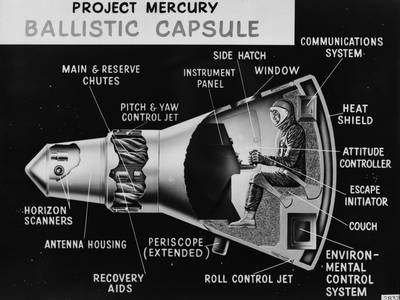
In the original Mercury spacecraft, (shown here) the single occupant was in a closed space with all his supplies of air and, on longer flights, water and food. Flights were short and maneuverability was minimal. There was no need to store large quantities of fuel or oxygen. The retrorockets which burned to return the craft to earth were outside the vehicle and behind the heat shield; this was also true on the Gemini craft.

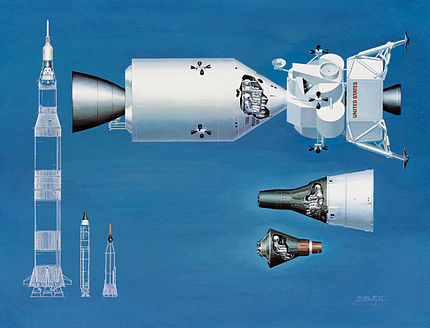
On Gemini flights, the ability to maneuver was critical. Gemini was the program in which astronauts learned how to rendezvous and dock and how to perform space walks. (EVAs; extra-vehicular activities) Gemini was also designed to test the effects of long term weightlessness. There was a need to store large quantities of fuel and oxygen, so a section was added between the crew cabin and the heat shield. It was not accessible from the crew space. You can see it in the silhouette of the Gemini spacecraft shown here.

Gemini could not contain both enough oxygen for very long missions and enough fuel for major maneuvering. Long missions were loaded up with oxygen, but little fuel. Rendezvous and docking missions were shorter and loaded up with fuel.

The trip to the moon would take plenty of breathing oxygen and maneuvering fuel, and a lot more besides. All this, and fuel cells for electricity, were crammed into the Support Module. It also had to act as another stage in the Saturn rocket. It had to have a large engine and fuel supply to use while entering lunar orbit, and when exiting lunar orbit to return to Earth. A comparison of the three photos will show that Mercury and Gemini had only retrorockets for return, strapped outside the heat shield, along with maneuvering thrusters you can’t see in the pictures. The bell of the CSM’s large rocket is clearly visible.

With Apollo, the heat shield was moved back to the base of the crew space. The Command and Support Modules were designed to be separated just before reentry. The Support Module burned up in the atmosphere while the Command Module was slowed by its heat shield before landing by parachutes.

This poster from NASA shows all three spacecraft side by side, at scale, with the LEM thrown in as a bonus.

We’ll look at the Apollo 8 mission itself on Wednesday.

544. Apollo 7

We are coming up on the fiftieth anniversary of the first moon landing.

Apollo One, the fire on the pad that caused the deaths of Grissom, White and Chaffee, took place February 21, 1967, causing a long delay. About a year and a half later things were just getting back up to speed. Apollo 7, the first successful manned flight took place on October 11, 1968.

The fiftieth anniversary of that flight was about a month ago, and I missed posting about it. That’s hard for me to believe, since I have been following the space program since 1957.

Purchased today, foot to butt kit, for self-application, apply immediately.

Apollo 7 is too important to simply mention, and too controversial for someone out of the loop to cover with authority. Nevertheless, here is a thumbnail.

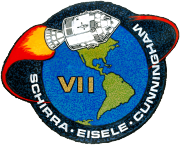
Mission Commander Wally Schirra’s attitude toward NASA after the Apollo one disaster was — not positive. The space program had grown into a massive source of funds for companies. Engineers and the builders in the trenches were fully committed to excellence, however top brass decisions were sometimes questionable. The choice of North American Aviation to build the Command Module was controversial. McDonnell Aircraft had built the Mercury and Gemini craft, and many pointed out that the shift to North American Aviation wasted the talent and experience that had made the space program a success so far.

To put it bluntly, the Apollo Command Module NAA originally turned out was a lemon, and everybody knew it.

During the year and a half from the disaster to the launch of Apollo 7, Wally Schirra made it his personal mission to see to it that the craft he and his fellow astronauts were to ride in was of top quality. He was abrasive and relentless, and when Apollo 7 flew successfully, it was largely because of his persistence.

The flight, which he considered an engineering test mission, was cluttered up with scientific and PR projects. When they interfered with testing out the craft, he refused to do them. In space, where nobody could override his decisions. His acerbic interchanges with ground control would have banned him from future missions, but he had already announced that he would retire at the end of the flight. What could NASA do?

Apollo 7, the first manned Apollo mission, was an engineering success but a failure in personal politics. Eisele and Cunningham were never allowed to fly again, but the subsequent missions had a CSM that they could trust.

Wally Schirra became the only astronaut to fly on Mercury, Gemini, and Apollo missions.

======

I have recently worked out a series of posts covering events in the run-up to the moon landing. As I was doing so, I also became aware of another, less joyful anniversary. Since it took place on December first, which is a Saturday this year, I will skip Wednesday’s post and fill you in this Friday.

513. Heinlein’s Time for the Stars

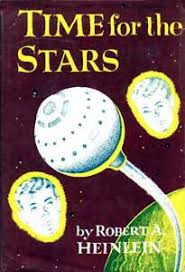
Yesterday (June 25) I had a request from a reader for advice on which Heinleins to read after Stranger and Starship Troopers. I replied that my favorites were Door into Summer for the old compact Heinleins, Time Enough for Love for the later, long-winded ones, and Time for the Stars among the juveniles.

The exchange reminded me of a post I had written but not published, because I had an excess of Heinlein related posts going at the time. Here it is, slightly updated and finally published.

===============

Time for the Stars is one of my favorite Heinlein juveniles. I am using it here as a foil to Spirit Deer, in talking about core stories.

Spirit Deer was my first novel, written for adults but very short. I later stripped it of wife and adult friends, and turned into a juvenile. It appeared in Serial between June 5th and August 10th of last year. See 364. The Core Story and 398. Summing up Spirit Deer.

If you strip Time for the Stars and Spirit Deer both down to the core, and they are quest stories. The explorers on the torch ship Lewis and Clark are ostensibly seeking knowledge, but for the young communication techs (i.e. telepaths) that quest in inextricably bound up with a search for maturity. Tim, in Spirit Deer, is seeking survival, and a return to normalcy, but he cannot achieve that without finding maturity.

If you haven’t read Time for the Stars (and why haven’t you?), here is a brief summary.

Tom and Pat Bartlett are twin brothers who are part of an experiment to see if telepathy exists. They go along as a joke, and find that it is not a joke. The “secret language” they have used all their lives turns out to actually be telepathy. What they think other people can’t understand, they in fact cannot hear.

The discovery that makes this more than a parlor trick is that true telepaths can communicate long distances — proven as far as Pluto — and their contact does not show a speed of light time lag. Now relativistic starships can go out from star to star without having to return home to bring back their data.

Tom goes to space and Pat, the dominating twin, stays behind. Tom learns to assert his independence, especially as his stay-behind twin ages much more rapidly. The trip is grueling, the exploration dangerous, and eventually Tom returns home, still young while his twin has grown old.

That is all the summary I can give without spoilers, but how much do you need?

The voyage of the Lewis and Clark is a long trip away and a quick return. Tim, in Spirit Deer, has a quick plunge into the wild and a long return. They differ in detail, but the arc is home — away — home again.

There aren’t more than a billion stories with that arc, significantly including the Heinlein juveniles Starman Jones, Tunnel in the Sky, and Have Spacesuit — Will Travel, all of which are excellent. Upon returning home, these story’s characters characters are changed by their experiences. Jones’ life is most changed, with some losses and great gains. Rod Walker of Tunnel finds a career. Kip Russell of Spacesuit gets on with plans for his life, but his options are immensely augmented.

All four are Heinlein at his best.

500. Heinlein’s Harems

Heinlein did not invent group sex, but he tried to take out a patent on it.

               (Disclaimer: I made that up about the patent. It’s called hyperbole, the use of exaggerations and untrue statements for effect. The difference between hyperbole and lying is that in hyperbole, you don’t expect anyone to believe you.
               If you offer exaggerated or untrue statements with the style, cadence, and straight face of hyperbole, but you expect to be believed, that’s lying disguised as hyperbole. You may have seen this happen recently. At least one of our leaders makes it public policy.)

The world first became aware of Heinlein’s preoccupation with group sex in 1961 with his novel Stranger in a Strange Land. I didn’t buy in; I couldn’t accept the underlying idea. A successful family of multiple males and females didn’t seem likely. Most 1+1 marriages fail, and a lot of the ones which don’t fail, should fail. The idea of a whole passel of people living together in one big happy sexual family without exploding from the stresses generated strained my willing suspension of disbelief.

Hippies tried it a few years later. It was a lot of fun for the alpha personalities, but not so much for the shy ones who just went along with the idea. Communes tended to fall apart quickly.

Kings often have multiple women. In the orient, they called them harems. In the west, they called them mistresses. But any family of the 1+n style can’t be very successful. It will always result in one tired guy and a lot of women feeling blue and lonely.

Heinlein multiplied his multi-person families throughout the rest of his career, and to be fair, he did once portray such a family falling apart in the novel Friday.

Let me paint you a picture.  Start with a bunch of naked people. The men are okay looking and the women are beautiful. No exceptions on that issue. They are all young; that part is easy enough since they are all Howards and therefore semi-immortal. Put them in a luxurious lounge, with self-aware computers attending to their every whim. Now let the sex begin — but it doesn’t. Instead, we get endless, interminable, unquenchable talking about sex.

I read Stranger in high school. Three years later, in college, The Harrad Experiment was all the rage. It was about a school which encouraged its students to experiment with free love (as it was called in that era). My roommate read it and complained, “They don’t do it; they just talk about it.” I can’t verify that statement. It sounded so much like Stranger that I gave it a miss.

               (Disclaimer: Heinlein is one of my favorite authors. I re-read him more often than anyone but Zelazny. On the subject of sex, however, he sees the smiles and ignores the strains. For him, the cup is neither half-full nor half-empty. It is overflowing. It’s a nice idea, but it strains my credulity.)

When I wrote Cyan, two kinds of multi-person families showed up. Saloman Curran was the product of a ring family. That appears first in Chapter Six, Stranded on Earth [3] in the odd way that book is laid out. Ring families were a disaster for adults and children alike, and their structure goes a long way toward explaining why our villain was so villainous.

The ten explorers who set out on their multi-year journey to Procyon were a family of another kind, and one that worked out fairly well. They were young, healthy men and women, cut off from contact with any other humans, and stimulated by the excitement and danger of exploration. Sex was sure to happen anyway, so NASA made sure they were compatible during training. Read between the lines of that statement. I didn’t set the situation up for titillation; I was working out what I thought might actually happen. Once the explorers returned to Earth, the ten-some did not last. It had existed due to a particular situation, which was not likely to be repeated.

               (Disclaimer: Yes, I know this was supposed to be the future, yet the explorers are all apparently hetero. I started Cyan in the early eighties for that audience. If I were writing it today, I would have to change some things, but it’s really too late now.)

Heinlein was trying to shake up a moribund society, and make it look at what might happen. I was trying, a generation later, to figure out what probably would happen.

=======

Briefly, back to hyperbole as humor. Once in a meeting, I said with a straight face that, “Only stupid people exaggerate. Smart people use hyperbole.” Most of my friends just looked at me (that happened a lot). The one friend who got it, roared.

Yes, I know. It isn’t funny in cold print. It’s all a matter of timing.