Author Archives: sydlogsdon

443. Booklist Reboot

On December 15, 2015 I posted this list of Christmas books. 

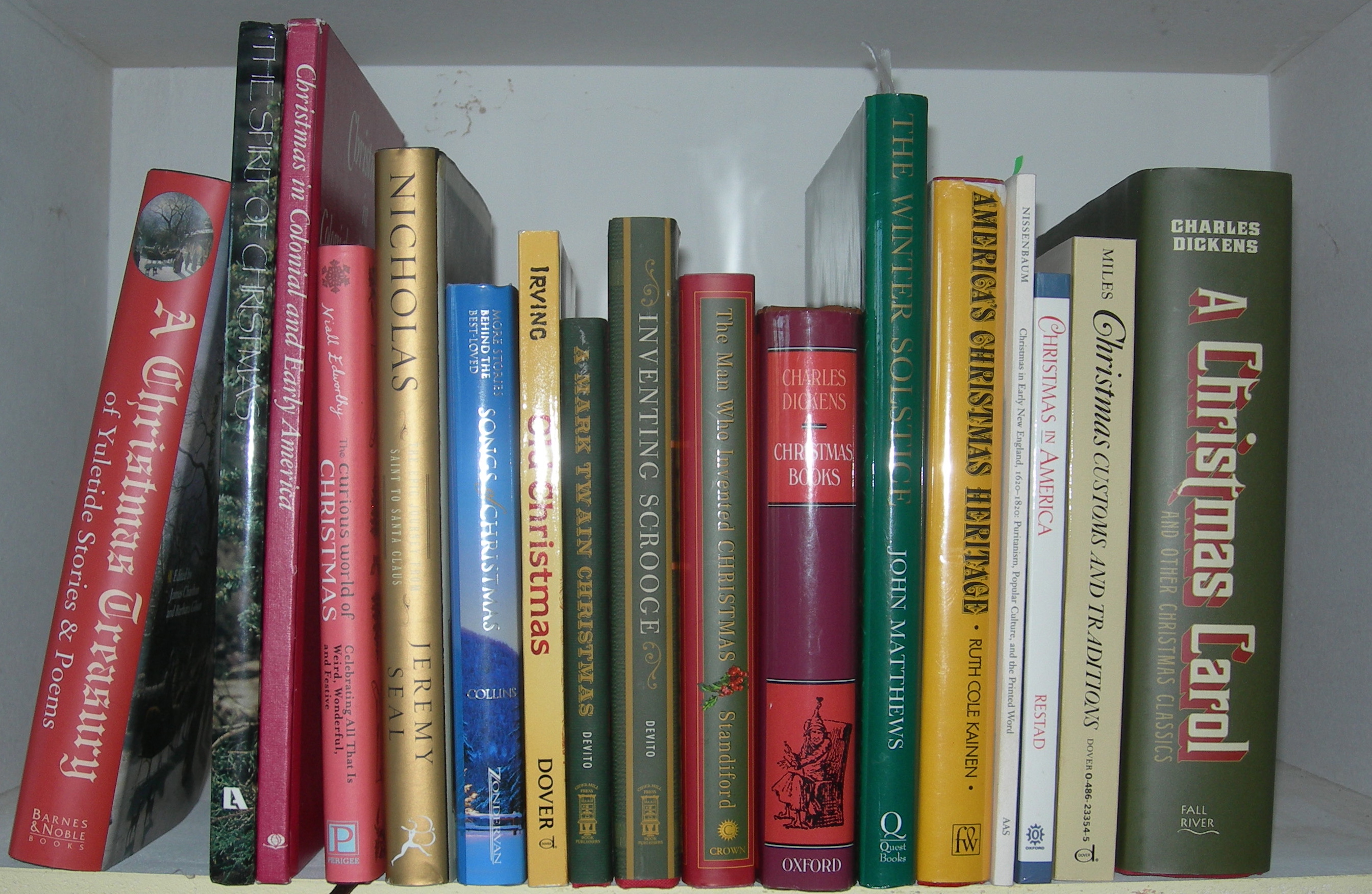
Here is the annotated booklist I promised you yesterday. You could also Google Christmas or old Christmas, or search either of those subjects on Amazon. I suggest you do. This is not a best list because there are too many books on Christmas for anyone to have read them all. This is simply a list of what I’ve discovered over the years, minus the clinkers. Some of these are easy to find, others will lead you through the back stacks of used bookstores, but there’s no harm in that.

A Christmas Carol by Dickens has to head any list. He also wrote many other Christmas works and gets his own post next Wednesday, the 23rd.

Washington Irving had a powerful influence on Christmas, which is largely forgotten today. Among his followers was Clement Moore of Night Before Christmas fame. They also get their own post, on Christmas Eve.

The rest of this list is in order from decorator froth to historical complexity.

Go to any bookstore and you will find dozens of Christmas cookbooks and books on Christmas decor, sometimes with historical tidbits. You’re on you own here, with one exception. The Spirit of Christmas series by Leisure Arts is classy, has been around since about 1990, and fills up ten pages of Amazon with choices.

Christmas in Colonial and Early America, 1975, by World Book, is an early, sepia toned version of this kind of book with a little more meat in it’s history.

For almost two decades, Ace Collins has been writing books titled Stories Behind . . . , beginning with Stories Behind the Best-loved Songs of Christmas. The title tells the tale; the individual stories are interesting and heart felt.

The Curious World of Christmas is lightweight and breezy, a book of short entries which can be digested one little bite at a time.

The only recent Christmas book I can’t recommend is Nicholas, by Jeremy Seal. I found it dark and tedious, and couldn’t get past page 42, but if you want a detailed look at how St. Nicholas became Santa, it’s the only work I know completely devoted to that subject.

The Man Who Invented Christmas by Les Standiford and Inventing Scrooge by Carlo De Vito each tell the story of the genesis of Charles Dickens’ most famous story. As a writer and a lover of Christmas, I couldn’t choose between them. Read the one that is easier for you to find. Then read the other one next Christmas.

A Mark Twain Christmas has been sitting on my next shelf for a couple of weeks. I will give it a tentative approval based on a thumb-through, and the fact that it is also by Carlo De Vito.

A Christmas Treasury of Yuletide Stories and Poems by Charlton and Gilson has works by every famous author you’ve ever heard of, from St. Matthew through The Adventure of the Blue Carbuncle.

Ruth Kainen’s America’s Christmas Heritage contains well written regional histories of Christmas at a level of detail that is satisfying without being overwhelming.

John Matthews’ The Winter Solstice has a look similar to the decorator/cookbook works above, but with a unique twist. It concentrates on the Roman, Celtic, and Germanic contribution to Christmas. It feels like the Middle Ages, without falling into the trap of New Age Gaia worship.

Christmas Customs and Traditions by Clement Miles is a Dover reprint of a 1912 work. It is an old fashioned history of the evolution of Christmas from Roman times to what was then the present.

Christmas in America by Penne Restad is a scholarly telling of the history of American Christmas. 172 pages of text, 36 pages of notes. You get the picture; a book for the overeducated Christmas nerd, but it is still a good read.

The remaining “recommendations” are probably over the top.

I have in front of me Christmas in Early New England, 1620-1820: Puritanism, Popular Culture, and the Printed Word by Stephen Nissenbaum, published by the American Antiquarian Society. I have already confessed to having two masters degrees, one in Social Science and one in History. This is the kind of thing I used to read for a living. I still read them, but only if they are on a subject that really interests me. Nissenbaum taught at Amhurst; you will find his original research referenced in many of the less scholarly books above. His book The Battle for Christmas was a Pulitzer Prize finalist, but a scholarly work of 400 pages is not something to take on casually. I confess to not owning it; I read it on interlibrary loan years ago. If, however, you are a Christmas nerd and a history buff, it is available in paperback. Go for it; what have you got to lose?

===================

BY THE FOLLOWING YEAR I had purchased and re-read Nissenbaum, and wrote three posts summarizing The Battle for Christmas. If, like me, you are a complete Christmas nerd, click here to read them.

Symphony 53

They parked at an underground garage at the hotel where the conference was being held.

Since Carmen had shown him only coldness from the first, Neil had tried to avoid thinking about her. He hadn’t had much success. She figured prominently in his erotic fantasies, and in spite of himself he always noticed what she was wearing and how she was wearing her hair. Now he studied her covertly while she took time to fluff up her shoulder length curls. Her eyes were deep brown in a cafe-au-lait face. Her nose was thin, her features were finely modeled, and her skin was smooth.

In the elevator, her perfume surrounded him. He felt sixteen years old. He felt foolish and elated at the same time.

The elevator door opened and Carmen stepped out. Neil came a bit behind, enjoying her trim figure. She wore a short, close fitting black skirt and a patterned silk blouse of many blues, with her hair loose on her shoulders and a yellow scarf at her throat. The high heels she wore exaggerated the motion of her hips. She had the look of a hot, chic, young Chicana on the prowl; and the fact that she seemed unaware of the effect she was having on Neil — and all of the other men she passed — only made her more desirable.

It was going to be hard to keep his mind on business.

# # #

The conference was titled Literature Based Learning: a New Approach to the Teaching of Reading. The hotel had set aside a long conference room with a speaker’s table at one end and rows of tables facing the front of the room. They had shoehorned nearly a hundred teachers into a space that would have comfortably held half that number. Neil and Carmen appropriated a spot near the front, then Carmen left to run some errands of her own. Neil stayed behind to listen in on the conversations around the room.

Neil liked to circulate before things started and get a feel for the crowd. That way he could pick out the dull and the pompous, and zero in on the interesting ones who remained in case he had to get into a group.

The conference was advertised for grades K through eight. All the conferences Neil had attended before had been only for high school teachers. The difference between this conference and those was striking. Those conferences had been seventy-five percent male; this one was ninety percent female. As Neil circulated, he found that most of the conversations were about other people. He heard, “He said . . .”, and “She did . . .”,  and “They went . . .”.  At the high school conferences he had mostly heard, “I said . . .”, and “I did . . .”, and “I went . . .”.

Carmen returned and they took their seats. The superintendent of a local district spoke briefly and then introduced the main speaker, Anne Marie Chang. Carmen whispered, “That is the woman who gave us a bad rating last year. Whatever you do, don’t tell her you’ve grouped your kids!”

The speaker did not look that formidable, but when she began talking it was clear that she had an axe to grind, and that she had had a lot of practice in grinding it. After a brief introduction to the new language arts framework, and a hint that she had had more than a small role in shaping it, Ms. Chang passed out xeroxed copies of something she wanted the participants to read. Once they were distributed, face down, she told everyone that they had two minutes to read the passage and then they should be prepared to discuss it. Neil and Carmen turned theirs over, and Neil chuckled. Carmen said, “What is this?” She sounded irritated. “Can you read this?” more tomorrow

442. Life is a Tunnel

Every once in a while, a phrase appears, demanding to be used. Sometimes it fits into whatever is being written at the time. Sometimes it hangs around for years before it fits. Sometimes, it just hangs around.

The phrase at the top came to me when I was considering a sequel to Raven’s Run. There were several stories on audition, and none were chosen. I don’t even remember which sequel this was supposed to go with. I do remember the scene it was to be part of.

Iain Gunn was looking out a second story window at an urban street. South San Francisco, I think. It was just beginning to rain. A girl with long black hair had just gotten out of a car. She was wearing a tight, short dress, and she was, of course, lovely. Gunn was waiting for someone to come along who was connected with the business he was just getting involved in, and this girl certainly was not that person, but she caught his attention.

She hunched her shoulders when the rain first hit her, but then she straightened her back and looked up. She raised her hands to the rain and smiled. No dancing around — she was a serious and sophisticated person — but she accepted the rain and appreciated the moment. She stood for a few more moments, facing Gunn but unaware of his presence. Her hair began to flatten against her head and Gunn could see beads of moisture trickling down her face. Then she turned and walked purposefully away. For her the moment was over, but it would remain with Gunn.

Life is a tunnel, three feet wide and seventy years long. The phrase hits Gunn (as it had hit me). She is just another of the million people he will nearly meet, nearly have some kind of relation with, one whom he could perhaps come to hate, or perhaps fall in love with. But he will never know.

If this were cliche #472 in the detective story handbook, he would meet her again and this would just be a foreshadowing of things to come. Meeting her again would be expected by the reader.

It is not meeting her that will make the incident meaningful. She will now become a symbol for all the things we miss as we live our random lives.

It’s not a new idea, and not the first time I’ve used it. These words in the opening paragraphs of Valley of the Menhir set the stage for what is to come:

Out there in the night that stretches away from us all — there where consciousness ends; where experience missed sets an iron boundary on our lives — there is a land of red sky and green sea, Poinaith, and another land where the gray sky leans down to lock hands with the sliver elfin forest.

Experience missed sets an iron boundary on our lives. Another phrase that jumped into my head, but in this case, just as I needed it.

We all live lives of found and missed opportunities. Our lives are a path from birth to death, as wide as our shoulders and as long as we last. We see so much, but if we were to turn three feet to either side, there are a thousand other lives we could live instead.

I’m satisfied with my life so far and I’m glad I was wrong about its length. I have more things to do, and more books to write. These last seventy years have been great, but I‘m not done.

Symphony 52

They rolled past Tracy and onto highway 580. For as far as the eye could see in every direction were windmills. Most of them were tall, slender, high-tech monstrosities. Seen in isolation, they might have a functional beauty, but here on these hills they were starkly out of place. Neil said, “I had read about these windmills, but I never guessed they could be so ugly.  How could they do this to the landscape?”

“I know,” Carmen replied bitterly, “and notice how few are turning.”

“Almost none of them.”

“Right. I’ve been watching this take place for a couple of years now. Every time I come through here there are more windmills, but I never see them turning. If we need wind energy so badly, why aren’t they making electricity instead of just standing there? If they don’t work, why are they building more of them? It makes you wonder if someone lining his pockets on government money?” see below

For a few minutes, the conversation lagged; then she said, “How do you like teaching sixth graders?” It was almost the same question she had asked thirty miles before, but this time it sounded real. Neil answered, telling her some of the feelings he had for his students, and explaining how different they were from high school students. Carmen warmed to him as he spoke. He could feel her relaxing.

Then he told her of his conversation with Pearl, and how he had grouped his readers. Carmen laughed and said, “Don’t let Bill Campbell hear about that.”

“Why?”

“Last year he caught hell during our Program Quality Review. They said we were tracking. We weren’t really, but one of the inspectors had an attitude problem. She was one of the new guard, and gung ho for literature based reading. Her report was so unfavorable that Bill had to do away with leveling even before we had anything to take its place.”

“I had wondered about that. You seemed to be out of synch with yourselves. You’re all set up for literature based reading, but the books aren’t literature — they’re horrible.”

“Yes, they are. We have some new materials ordered, but they haven’t come in yet.”

“Good.”

“No, I’m sorry. I didn’t mean to get your hopes up. Bill only had so much money, so he only ordered for Pearl and me. He said he would order literature for sixth grade next year when Gina was ready to come back.”

After a long silence, Neil asked, “Did he come to that decision before or after he knew who was going to replace her for the year?”

“Before,” Carmen said, but he was not sure he believed her.

Paranoid! Don’t let them make you paranoid, he told himself sternly. Then he had to laugh. Don’t let them make you paranoid? Them?

“What are you laughing at,” Carmen asked, but he couldn’t answer and she looked miffed. He thought, “Serves you right.”

The rest of the trip was friendly. Neil traded stories with Carmen, telling of his boyhood and youth in Oregon, and finding out more about what it was like to grow up as the daughter of a field worker. They dealt with surfaces and first insights, speaking as if their lives had been without pain. It was not intimacy, but it was a beginning.

It had been several years since Neil had been to the Bay Area, and he was shocked at its growth. It had spilled over the first range of the foothills to fill up the Livermore Valley. All the lovely hills and pasture lands were giving way to stucco and concrete. “People are even moving as far as Modesto to find affordable homes, and commuting to the Bay Area,” Carmen said. Neil could not imagine a seventy mile commute.

==================

Out of fairness, I have to add that the windmills did look like a big government hoax in 1988 when this was written, but today they provide much of the state’s energy. more tomorrow

441. The Last Apollo

“We leave as we came, and, God willing, we shall return, with peace and hope for all mankind.”        Cernan’s closing words on leaving the moon at the end of Apollo 17

Forty-five years ago, at 12:33 AM Eastern Time, the last manned moon flight took off from Cape Canaveral.

It was a stunt from the get-go. Kennedy’s speech, setting a goal of landing a man on the moon and returning him safely to the Earth, was a Trump-worthy brag. If we had failed, it would be laughed at today as just another empty promise made by a politician.

One man laid down the challenge and thousands of men and women carried out the promise.

But it was still a stunt. When Kennedy made his speech on May 25, 1961, Russian had put a man into orbit. We had not, although we had managed a sub-orbital flight. Atlas boosters were still blowing up on launch, so a smaller Redstone was used for Alan Shepard’s flight on May fifth.

NASA had only been in existence for three years. By any real or imagined yardstick, the Russians were far ahead in space.

By herculean efforts, NASA forged ahead through Mercury and Gemini. The fire aboard “Apollo One” set American efforts back significantly, and when launches began again, it looked like the Russians were going to land on the moon first.

There were Soviet problems however, particularly the repeated failure of their N-1 rocket. These doomed their attempt to reach the moon first, but NASA was not aware at the time.

NASA had problems of its own. The lunar lander was not ready when Apollo 7, the first actual manned Apollo flight, left for low Earth orbit in October of 1968. Only a year remained on Kennedy’s timeline, and the Soviets — we thought — were poised to land on the moon ahead of us. Something had to be done.

That something was the Apollo 8 journey to and around the moon, without a lander, for the Christmas season of 1968. We had been to the moon first (by an ad-man’s stretch of the truth), even if the Soviets became the first to land.

Apollo 9 tested the lunar lander in low Earth orbit. Apollo 10 (the most frustrating almost in human history) returned to the moon, deployed the lunar lander, and flew it to within wishing distance of the moon without landing.

Apollo 11 landed a man safely on the moon, and returned him safely to the Earth.

Now what?

For the Soviets, the answer was to turn away from the moon. Their N-1 mega-rocket had failed, and their manned modules and lander were stored away. The Soviets began a series of long flights and space stations, studying space from low Earth orbit.

For NASA there were nine more Saturn V rockets waiting to launch Apollo 12 through 20. It didn’t turn out that way. Apollo 12 landed in a different part of the moon, Apollo 13 suffered and explosion, didn’t land, and barely made it home.

Even before Apollo 13, Apollo 20 was cancelled so its Saturn V could be used to launch Skylab. Even before Apollo 14 landed, Apollo 18 and 19 were cancelled. Why? Because it was a stunt from the get-go. Apollo 11 met the deadline. To coin-counting bureaucrats, that was enough.

For those of us who see space exploration as the future of humanity, Apollo 11 was only the  beginning. Lunar exploration, a moon base, Mars. Venus — there should have been no end.

Bureaucrats did not agree. On Thursday, 1972, at 12:33 AM Eastern Time, the last manned moon flight took off from Cape Canaveral.

more next Thursday, the anniversary of the last liftoff from the Moon

Symphony 51

He shouldn’t have run. Until then, he had been clean in conscience and in action. Running had weakened his position; worse, it had shown a weakness within him that he had not known was there. In the six months since the incident, he had faced that weakness, and had grown because of it.

Still . . .  If he had stayed, he would never have met these children. They were so fresh, so new, so open and unafraid of the world around them. They were like Neil had been before Alice Hamilton. Their Alice Hamiltons were all still ahead of them.

He loved them. There was no lesser word to describe the warmth he felt whenever they flowed into his room like a river of life. It didn’t matter that some of them were rowdy, that some of them were incorrigible, that some of them were — be honest; use the right word — stupid. None of that could stand up for a moment against the sheer elemental liveliness of them. Little Randi Nguyen, face shining, skinny legs sticking down from her shorts, standing her ground to correct him when he made a misstatement. Oscar, so cool, so self-contained, but containing what? What mysteries made him turn against his intellect and act out a dumb-Mexican stereotype? All of them, even Tony Caraveli and Jesse Herrera, were precious to him, each in his or her own way.

Carmen broke his reverie with an unpleasant, “Ugh!”, and he smelled the sugar processing plant at Manteca. It fouled the air for miles around. And with that honest stench in his nostrils he admitted that, for all his other feelings, he could kill Jesse Herrera sometimes.

Apparently the silence had become uncomfortable for Carmen. She said, “How are things going for you after two months?”

Her question fell false on his ear. He said, “Fine,” and let the silence put its pressure on Carmen again. Whatever was wrong between them, was her problem. He could do nothing about it until she gave him some clue what it was all about.

Two miles slid away beneath them. She was concentrating on her driving now as the oncoming cars had the rising sun full in their faces, and were two-thirds blinded. Finally, the road widened to four lanes again, and she visibly relaxed.

“Tough driving,” he commiserated.

“I hate it. I would rather drive through the heart of L.A. than through that stretch of highway.”

She was quite a good driver, but he couldn’t say so. The compliment would sound false. Neil looked out the window to hide his irritation. It looked like it would be a long day.

The coast range rose up before them, low, golden-brown, and rounded like breasts in repose. Now, in late October, the grass was grazed to the ground and they were empty of animal life. Someone — Tom Wright — had told him that they were as green as the hills of Ireland in the springtime, and that for a few months they were covered with fattening cattle. It was hard to believe.

“I’ll have to come this way in the spring.” Neil said. “Tom said these hills are beautiful then.”

“They are,” Carmen responded. “If you really want to see something beautiful, though, go eastward into the foothills. They are similar to these, but with scattered live oaks, and they are covered with California poppies in the spring. These hills are pretty enough, but they are so overgrazed that the wildflowers really don’t have a chance.”

That, Neil thought, is what I’ve been wanting. An ordinary conversation without all those overtones of hostility. more Monday

440. Pearl Harbor Day is Tomorrow

Pearl Harbor Day is tomorrow and for the third time, I am not going to write about it directly.

In 2015, I used Pearl Harbor Day as a jumping off place to discuss the decision to go to war in Iraq.

In 2016, I used Pearl Harbor Day as a jumping off place to discuss Japanese Internment.

In 2017, I am even less able to salute and shout hallelujah than I was on the last two times Pearl Harbor Day rolled around. Things are even worse than they were then.

Do I think we were shouldn’t have retaliated to the Pearl Harbor attack? Don’t be absurd.

Do I support disarmament? I wish I could, but it would be national suicide.

Am I a veteran? Yes; and I would love to be the last veteran.

Am I a pacifist? Don’t I wish. I would love to live long enough to be able to say yes to that, but I won’t. Neither will you, and you are younger than I am.

There are times when we have to fight and Pearl Harbor signaled one of those times, but our national default setting should not be attack. We should fight rarely, and only when necessary. For many years now, we have been doing a terrible job of deciding when to fight, so I find it hard to wave the flag. Someone might think that means I’m ready to start shooting.

Tomorrow is Pearl Harbor Day. It is also the forty-fifth anniversary of the last manned moon launch. I think I’ll write about that.

Symphony 50

“For now, Carlos, you will read with the group in the fifth grade book. Later, we’ll see. Give me that detention slip.”

Carlos fished it out, looking puzzled, and handed it over.

Neil took it and said, “Now you have a decision to make. Have you learned that I won’t put up with rebellion in my classroom, or would you rather take this home for your mother to sign and have her see that you were defiant?”

Carlos brightened when he saw that he was going to have a reprieve. He said, as if by rote, “I understand that you won’t put up with no defiance.” There was so much relief in his voice that it left no room for sarcasm.

Neil crumpled the form and tossed it into the trash. Then he motioned with his hand and said, “Go play.”

Carlos disappeared, as if by magic.

# # #

Grouping his readers was no panacea. It cost Neil time he would have like to use for language, because he had to teach reading three times a day instead of once, and it threw the students who were not reading onto their own resources. That worked well enough for the high readers. When he was working with the low readers, the high readers were quite capable of doing independent work in language. For the low readers it was a problem. If they could not read, they certainly were not self-sufficient in their language studies. Within a week, Neil was feeling ragged from shuttling between groups, and the misbehavior was way up. Students who are left alone to work by themselves at materials which are essentially above their grasp, will find other ways to amuse themselves.

But . . . the children could read.

# # #

At the end of that first week of leveled reading, Neil got a day off from teaching. On that Friday, he and Carmen went to Oakland to a conference.

Conferences and in-service training are a blessing and a curse: a blessing in that they allow teachers to stay up on the latest thinking in their field, and to see different way of approaching old problems; a curse in that they are usually bad and frequently very bad. Neil knew this already from the high school conferences he had attended, but he was not prepared for how abysmal elementary conferences could be.

During the second week of school Bill Campbell had called him in to say, “I want you to know what is in the wind. There have been so many changes coming out of Sacramento during the last year that I can’t keep up with them myself. Since you and Carmen are at the heart of it, I am sending you.” So Neil found himself paired off for the day with the one teacher at Kiernan who apparently couldn’t stand him.

He met Carmen at the school parking lot when the sun was just beginning to stain the sky with dawn. They had agreed to take her car because his was so old and decrepit. She pulled out expertly and headed for the freeway. As they passed through the same flat, oleander lined corridor he had traversed six months earlier on his first trip to Modesto, he reflected on the changes that had taken place in him since that time. The problems he had faced in Oregon had faded in his mind, but the bitterness remained.

If he had it to do over . . .  If he had it to do over, he would have stayed to fight it out. It was a mark of his callowness that he had chosen to run. He had never really been hurt before. He had never had a friend, lover, or institution turn upon him and damn him for no reason. more tomorrow

Symphony 49

Neil was rapidly losing patience. “Carlos,” he said, “I will always try to have good materials to teach you with, and I will never intentionally embarrass you. You’ve been with me long enough to know that. But this is the best book I could find for you right now. Maybe it won’t work and I will get rid of it, but I will make that decision, and you will read what I give you to read. Do you understand?”

Carlos did not reply and did not open his book.

“Carlos, this is the only warning you will get. Open your book and participate.”

Carlos looked out the window.

Neil got up, went to his desk, and returned silently with a detention form. He filled out Carlos’ name and in the line marked offence, he wrote, “Defiance. Refused to open his textbook.” The room had become completely quiet. He pushed the slip in front of Carlos and said, “Sign it.”

Carlos jerked the form angrily to him and read it. His face went pale at the word defiance. For a moment Neil thought he would start to cry, but even at eleven years old he was too macho for that. He scrawled his name angrily across the paper and spun it back across the table. Neil tore the top sheet off and handed it back and put the second copy into his shirt pocket.

“Now, everybody open to page eleven.”

This time Carlos opened his book.

It was easier when the children read at something closer to their own level, but the stories were even more insipid. Worse, they revolved around the interests of fourth graders, making it clear in subtle ways that these children were reading below their level. Even at that, Brandy and Pedro were unable to read.

After half an hour, Neil sent them back to their regular seats and called his poor readers together. He also called Carlos and Dixie back. This time there was no rebellion, even though most of these children had already read the fifth grade book. Tony Caraveli said, “Mr. McCrae, we read this book last year.”

“I know.”

“Do we have to read it again?”

“Maybe. Maybe not. We’ll see. Let’s just read today and we’ll see how it goes.”

After Carlos’ rebellion had been summarily smashed, no one else gave him any trouble. Neil felt badly about riding roughshod over their very sensible objections, but he had to see for himself and decide for himself. They might be unhappy with his methods, but they were getting nowhere with the present system. Something had to change and that change was sure to make somebody unhappy.

Dixie and Carlos had been the best readers in his other group. He had not explained why he was having them read again, but they could guess, and they did their best. Even though he stumbled, Carlos put more effort into his reading than he ever had before. He would do anything rather than endure the shame of reading out of a fourth grade book.

When the bell rang, Neil motioned for Carlos to remain behind. He said, “Carlos, I am the teacher and I won’t ever let a student tell me how to run my class. But I understand why you didn’t want to read out of the fourth grade book.”

Carlos looked fierce and said nothing. Neil had no intention of trying to break down his machiso. He doubted that he could anyway. “You worked pretty hard today when you read out of that fifth grade book. Do you think you could keep up that kind of effort?”

“Yes.” Carlos was the picture of an eleven year old Chicano boy in trouble, with a stiff, solemn face trying to protect his image, but close to tears. more tomorrow

439. Jose, Maria, y Jesus in Trumpland

[Don’t expect even handedness here.]

In English we call him Joseph, in Italian he is Giuseppe, in Basque he is Joseba, in Spanish he is just plain Jose.

In English we call her Mary, in Hebrew she is Miryam, in German she is Maria, and also in Spanish.

In English he is Jesus, in Cornish he is Jesu, in Italian he is Gesu, and in Spanish he is Jesus again, but pronounced Hey-sous.

We are going to walk with these three in this sermon for the Christmas season.

And it came to pass in those days, that there went out a decree from Caesar Augustus, that all the world should be taxed. And all went, every on into his own city. And Jose also went up from Galilee, out of the city of Nazareth, into Judaea, unto the city of David, which is called Bethlehem, to be taxed with Maria his espoused wife, being great with child.

Of course that could be written as Joseph and Mary, but surely they are the same couple, in any language. Jose was a carpenter. He built things out of wood to feed his family, and he paid his taxes like everybody else. All the world was to be taxed, and he had to go back to the place from which his people came.

Where would that be? Perhaps a land with cities named Sacramento for the Holy Sacrament, or maybe Atascadero, Alameda, Camarillo, El Segundo, or Escondido. Perhaps cities like Fresno, La Mesa, Madera, or Mariposa show where his people once lived. Certainly they must have lived in cities like Los Angeles, Merced, Paso Robles, Salinas, or San Francisco. Even if his people no longer own the land, certainly the city named after him, San Jose, must once have belonged to his people.

And so it was, that, while they were there, the days were accomplished that she should be delivered. And she brought forth her firstborn son, and wrapped him in swaddling clothes, and laid him in a manger, because there was no room for them in the inn.

I think Luke shortened this a bit. Was there only one inn in Bethlehem? We can see the young couple, going from place to place, Jose leading, Maria on a burro since she cannot walk so late in her pregnancy. Everywhere they are turned away. Are all the sleeping places truly full? It may be. Or perhaps something about the two of them, perhaps the color of their skin, makes the innkeepers turn them away. Luke does not tell us.

I see migrant housing everywhere I go in California and I think, perhaps, a manger was preferable.

Now they are in a place where their people once lived, but to which they are no longer welcome. And here, their son is born.

Donald Trump would call Him an anchor baby. I wonder what He will call Trump, when they finally meet.

And there were in the same country shepherds abiding in the field, keeping watch over their flock by night. And, lo, the angel of the Lord came upon them, and the glory of the Lord shone round about them: and they were sore afraid. And the angel said unto them, Fear not: for, behold, I bring you good tidings of great joy, which shall be to all people.

To all people. ALL people. Imagine that!

=============

Luke’s story is complete, but ours is not. It is up to every one of us to see that it turns out right.