Author Archives: sydlogsdon

259. Turkeys Under the Oak Tree


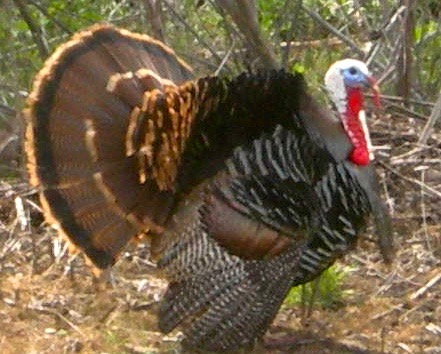
dscn0719dscn0693These birds were photographed on a spring drive through the foothills, about twenty miles from my house. The puffed up, greeting card version is what the males look like in season, when they are strutting their stuff and looking for love. The other bird is what most turkeys look like, most of the time.

You are reading this on Thanksgiving, but I am writing on September 27, about something that happened yesterday. My wife came to the door of the little building out back where I work and said, “Come here. Quietly.” There were ten wild turkeys eating bugs and acorns along the east side of the house.

We don’t get turkeys very often right up to the house, although seeing them in the neighborhood is a common occurrence. We stood for twenty minutes watching in the hundred degree heat of the tag end of summer before they casually wandered off.

Turkeys are the symbol of Thanksgiving, but I was thankful to see them because wild things fill my life with joy.

I grew up on a farm in Oklahoma in another century. I worked long hours when I was growing up, but I worked outdoors, so it might have well have been play. The music that filled my life was the churr of cicadas on summer evenings and the howl of coyotes echoing through the frosty night air in winter.

I left the farm for college, then spent my adult life in a small city, and moved to the foothills when I retired. Now my human neighbors are near enough for help in emergencies, but far enough away that I don’t hear them when they fight. I don’t even know if they fight.

Several times I have seen packs of coyotes running through my yard. Once a mother duck with nine ducklings following single file paraded through. Deer come in from time to time. They mostly prefer the low ground, and we live on a hill, but they come for water as the long days of summer dry out the last of their water holes. I keep water in bird baths for the birds, and water basins on the ground for everybody else.

The deer also have an uncanny knack of knowing when the tomatoes are ripe. Oh, well.

I see a bobcat about once a year, somewhere nearby. Twice they have come into our yard. Once I looked out the window to see a bobcat in the fenced back yard where stray cats stay out of reach of coyotes. My wife and I watched out the window as he sauntered along, unaware of us, then casually jumped the six foot fence without touching it.

We were even visited one holiday by the Christmas Pig. It was a three hundred pound porker who had obviously escaped from some farmer. I saw him several times after, so I’m maintaining hope that he was never found, and escaped becoming bacon and sausage.

So, happy Thanksgiving to you. And also to the turkeys and ducks and bobcats and raccoons and possums and the one lone pig.

In my house, Thanksgiving means turkey (from the supermarket, of course), stuffing, cranberries and pumpkin pie. Being thankful means looking out my window and never knowing what kind of critter might be looking back.

Raven’s Run 49

We moved on past paintings of lesser quality, among the frolicking marble nudes that the pompiers did so well. We passed into a room devoted to Gustav-Adolf Mossa and stopped at the doorway. It was overpowering. The colors were vibrant, almost harsh after the gentle treatment of the pompiers, and the subject matter was grotesque. The paintings were hard edged super-realism, all portraits of women, or rather of one single woman in a dozen horrifying guises. Her face looked like a Mucha face that had taken up devil worship. The size of the eyes was exaggerated; the mouth was tiny and perfect, smiling just a little and self-satisfied. In one painting she sat, quite nude, with her legs together and her upper body turned toward the viewer. Her breasts were enormous. As she leaned forward, with her weight on her hands and her elbows together, her breasts jutted, round, rich and full, with huge aureoles that faded imperceptibly into the white flesh beyond. Her only adornment appeared to be a Victorian hat and she sat on a pile of hay, or perhaps seaweed.

As we approached, the hat resolved itself into two ravens perched on either side of her coiffure, and within the nest of hair on top of her head were three tiny human skulls, resting like raptor’s eggs.

The painting was masterfully constructed. The eye was caught by the painter’s skill, and carried through the picture on a cunningly conceived path. From the shock of the hair nest, one’s eyes could only return to the ample breasts, down the arrow formed by her arms, past the darkness that lay at the base of her belly, to her thighs where they rested on the sea wrack.  They were splattered with tiny drops of bright red blood. And then the sea wrack resolved itself into what it really had always been:  hundreds, thousands, of bloody, broken, twisted human bodies.

Repelled by the pile of bodies, the eye darted back to the breasts and face, but there was no relief. Instead, the serene, enigmatic look had lost it’s mystery. Now one knew exactly why she looked so self-satisfied.

All of the bodies were male. This was no allegory of war. This was the all-devouring female.

Raven’s fingers dug into my arm as we stood before the picture and she whispered, “Horrible.” But neither of us could look away.

The picture next to it was stranger still, subtler, and therefore more terrifying. more tomorrow

258. George Mackay Brown’s Seven Poets

Most of the people who read this blog are writers, or want to be writers. I know from visiting your websites that you range from beginner to professional, and many of your writings have impressed me.

Friends, I have something for you. I’ll give you details below, after the set-up.

I discovered George Mackay Brown in 1987 when my wife and I went to Europe for the first time. We started in England, then went to Scotland to see the land of my wife’s ancestors. Along the way, I visited bookstores to pick up reading material that I wouldn’t find at home and discovered Neil Gunn and George Mackay Brown, two Scottish authors who deeply enriched my life. Both write elegantly about their own experiences in Scotland and the Orkneys (technically part of Scotland but very different). I’m sure I’ll talk about them both from time to time in this blog, but today I just want to shill for one short piece by George Mackay Brown.

I recently had reason to flip through my George Mackay Brown collection, looking for a story I read years ago, and stumbled onto The Seven Poets, the final story in his collection The Sun’s Net. It is a post-apocalyptic story, but it is a fable, not science fiction.

    *     *

The world has reverted. After machines and cities swallowed up the earth, there was a revolution. Machines were banished. Cities were destroyed. Now there is a world wide agreement that no settlement can have more than 250 members. When a village grows beyond that, some are chosen to leave and form a new village.

(Now don’t tell me this wouldn’t work. I know it and GMB knew it. It’s a fable; a set-up to make a point about writing.)

The world is calm, serene, and boring; some men can’t abide that. They become wanderers, without a village, without a community, welcome everywhere for a brief stay, but welcome nowhere as permanent residents. Our narrator is such a man. He has wandered the whole world, through a long lifetime, staying with men of every occupation, but most usually, staying with poets.

Every village has a poet, who spends his year writing a masque for the midwinter festival. In Spain, such a poet told our narrator, “The world was created by one Word. Every poet makes, in his lifetime, a tiny fraction of one letter of that Word.” Another poet’s voice had deserted him. Another was a heretic to the new order who wrote of machines, but when his villagers performed his masque, their mocking turned the performance into a parody of his thoughts. In Siberia, a poet wrote in the inhuman language of roots and salmon and blizzards . . .

    *     *

I can’t begin to convey the depth of sensible weirdness of The Seven Poets. That would require exactly a many words as GMB took, exactly the same words, and in the same order. Prose written by poets can do that to people who try to paraphrase it. I can only say that his fable has captured beautifully the strangeness of trying to nail life to the page with words.

There doesn’t seem to be an online source for The Seven Poets, but it’s probably only fair that you’ll have to seek it out in print. I guarantee you a singular experience if you do.

Raven’s Run 48

We rinsed off under the open fresh water showers, then walked down the beach carrying our outer clothing until the sun had dried us. Raven pointed up to the top of the concrete wall that lined the beach. American tourists with long lensed cameras were recording the scene below. I wondered if any of them saw the beauty, even vaguely, or felt a deep ache in their belly from knowing that they could have come down those narrow stairs and joined the dance, instead of watching and sniggering from above.

Life is not a spectator sport.

We left the beach and hid from the sun among the tree shaded streets. Raven mailed her letter, and we talked. She wanted to know more about the rest of Europe, so we could plan the weeks ahead. She only knew the Europe of tours and hotels, not the Europe of streetwandering.

We found ourselves climbing a narrow street in the south end of Nice, where the sun beat down directly out of a pale blue sky. We hid from the heat in the Musee des Beaux Arts, and wandered around the vast converted mansion admiring the delicate marble statues and sumptuous paintings. 

At the turn of the century in France, impressionism swept the art world and changed the face of painting forever. The victory was so complete that those they ousted from prominence, the pompiers, were all but forgotten. It was too bad. The pompiers had their faults; their subjects were antique, their treatment was too romantic and studied. Yet they produced a body of beautiful work, far more to my taste than the impressionists.

There was a Clement, Egyptian orange merchants, depicting two women, dark skinned and richly robed with a spill of oranges that glowed against the darkness of their clothing. The Nile behind them was shadowy, faded tan, almost like a mirage.

Down the wall was Thamar by Cabanel. It showed a powerful, robed, dark skinned man with a half nude white woman collapsed in his lap. She appeared to be sleeping, or lost in grief, but she might have been dead. The pompiers had a romantic view of death.

“I wonder if Thamar is French for Othello?”

“I don’t know, but I don’t like it,” Raven said.

“The colors are warm and rich. His face and outstretched arm are powerful statements.”

“Yes, but the girl is a half-fat, pasty wimp. I can’t get past her to enjoy the rest of the painting.”

“How about the next one?” That was Thaïs by Tanoux.

Raven laughed. “Come on, Ian. Great fruit, great cloth, great leopard skin on the bed, great background. And she’s not fat, but why is she naked while he is fully clothed? And what has he just asked her to do that she should look so shocked?”

“I can imagine.”

“Me, too. But if I were her, I wouldn’t listen to a word he said until he stripped down and joined me on the bed. Two people clothed is ordinary; two people nude is erotic; but a naked woman with a clothed man standing over her whispering shocking suggestions is pornography. It reminds me of an off-color Victorian novel.”

I smiled. “Feminism has just ruined a whole school of art for me.”

“I’ll bet.  You’d love to be him.”

“Do you really think so?”

Raven gave me her full attention. “You probably don’t want to think so, but in your heart, you would.” more tomorrow

257. Who Knows?

Who knows? Probably the internet.

The internet is science fiction at its best. Back in 1986, when I bought my first Mac, it came with a program called HyperCard. It was a crude, early version of what has now grown to be the internet. It allowed you to create mini-documents called cards and connect them via buttons so you could jump freely from one to another. I dreamed of creating a database of everything I wanted to keep at my fingertips. Then Newton came out – Newton was a proto-tablet that didn’t work very well – and I saw the pair of them as my own personal Tricorder.

Just dreams. Both hardware and software were too crude to be more than a tease, and even a tiny database takes a vast amount of time to create.

Today, the internet does what I dreamed of doing in the days of HyperCard and Newton. I use it to do research for this website. Sometimes I’m looking for things I don’t know, and it works fine for that. Primarily, however, I use it to check details on things I already know.

Here is an example. Years ago I wanted to look again at the Sherlock Holmes quote about furnishing your brain. If you don’t know what I’m talking about, here it is:

“You see,” (Holmes) explained, “I consider that a man’s brain originally is like a little empty attic, and you have to stock it with such furniture as you choose. A fool takes in all the lumber of every sort that he comes across, so that the knowledge which might be useful to him gets crowded out, or at best is jumbled up with a lot of other things, so that he has difficulty laying his hands upon it. Now the skillful workman is very careful indeed as to what he takes into his brain-attic. He will have nothing but the tools which may help him in doing his work, but of these he has a large assortment, and all in the most perfect order. It is a mistake to think that that little room has elastic walls and can distend to any extent. Depend upon it there comes a time when for every addition of knowledge you forget something that you knew before. It is of the highest importance, therefore, not to have useless facts elbowing out the useful ones.”

I thought this was in one of his middle stories. It wasn’t; it was in the first, A Study in Scarlet. To find it, I pulled down my complete Holmes in two volumes and spent an hour looking, but I couldn’t find it. I stumbled across it by accident months later.

So today I did an experiment. I went to my search engine and typed in “brain attic”. It returned a page with ten responses. Six of them referred to the Holmes quote. I opened one, copied and pasted into this post, and you just read it.

Here is another example of finding things I already knew. In my post on The Monkey’s Paw, I wanted to use a quatrain from the Rubaiyat. I knew it well, but not well enough to quote for publication. I didn’t want to spend time getting out my copy and reading through its pages, so I typed a fragment – “dId the hand of the potter shake” – into the search engine and up popped:

After a momentary silence spake
Some Vessel of a more ungainly Make;
“They sneer at me for leaning all awry:
What! did the Hand then of the Potter shake?

Notice that I scored a hit even though I had left out “then”.

Earlier today, I was writing about the Lord Darcy stories. I didn’t want to misspell Randall Garrett’s name (How many Ls, how many Rs, how many Ts?) so I typed it into the search engine and got my correct spelling along with a great deal of additional material that I didn’t need.

That I didn’t need at the moment, that is, but information that will be there when I do need it. Like I said at the top, the internet is science fiction at its best.

Raven’s Run 47

Chapter Thirteen

Nice is an exchange point where trains from France and Italy meet. When we got off at six in the morning, it was busy. Three hours later, it would be jammed.

When I had been released from the Army, the first place I visited was the Riveira. Palm trees, secluded beaches, beautiful women, bright air and warm water in an ambiance of riches – everything a kid fresh out of Wisconsin could dream of. I had spent a week in and around Nice, so there was a certain feeling of homecoming when we stepped off the train.

We stowed our packs in a locker, ate breakfast at the Freetime – France’s equivalent of McDonalds – and headed down Avenue Jean Medecin. Nice is a major city, with all the virtues and vices that implies. The storefronts displayed the latest haute coture but the gutters were filled with garbage. We shared the street with high fashion ladies and kids in ripped denim.

A lot had happened to us in twenty four hours, and a few hours sleep on the train was not enough to wipe it away. I felt gritty and irritable and Raven was keeping long silences. My mind was like a VCR stuck on replay; the events we had experienced kept repeating themselves in my mind as we walked. Raven on the beach, the night attack, the sight of tendons moving at the bottom of my wound, the night ride with Will, and the man with the newspaper. Had he only been an innocent traveler?

Probably, but I wished I had been awake when we passed back through Marseille.

Most of all, I remembered Raven’s statement that I didn’t know myself – implying that I was still trying to win a contest of wills with her. We had been happy on the Wahini, during the crossing, when I had known everything and she had known nothing. Once we were on land, it all started to fall apart.

Enough! Too little sleep and too much philosophizing are a bad combination. Mind, I said, shut up!

I began to just enjoy the day. Nice was never intended for deep thought, but for grasshopper enjoyment of the sun, the sea, women, and the day at hand. Perhaps Raven was made the same way, and I was trying too hard to understand what we had.

Raven bought a change of clothing while I waited on the street, people watching, and we went on down past the Place Massena. For several hours we alternated walking the beach and wandering through the streets near the Promenade des Anglais. We ate fruit and bread from an outdoor market, then went down to the beach and lay in the sun for an hour. I slept while Raven wrote her father a full account of all that had happened to her.

Peace, time, and the sun warmed some of the irritation out of us. Raven woke me from my nap with a gentle kiss on the forehead. When I opened my eyes, her lips moved on down to mine and we lay for a long time just holding each other.

She had gone topless again, but this time as a French woman would, quietly, naturally, and without the bravado that reveals uncertainty. As she sat up from our embrace, I saw her against the sea and sky, full breasted, smiling quietly, serene and at peace with herself. I took her hand. It would have been gauche to touch her intimately in so public a place. It embarrassed me to remember what we had done only yesterday. Like dogs rutting; not like love at all.

A little girl of six or seven was playing nude in the sand at the water’s edge. A boy of like age was chasing seagulls, his tiny penis bouncing as he ran. Old men and young men were lying in the sun; young women had wound down the tops of their one-piece bathing suits and sat by twos and threes with their boyfriends, talking and laughing. Bare breasted grandmothers followed their naked grandchildren from place to place. It was not a scene of Playboy titillation, but of serene beauty. more tomorrow

256. The Space Station That Never Was

 275px-mol_usafI love conspiracy theories. I don’t believe them, but they’re fun.

We do know that much is hidden from us. The SR-71 Blackbird was a myth, sworn not to exist, for most of it’s operational life, so why not believe in the Aurora, or at least wish it were real and dream up stories that use it.

The problem with actually believing in conspiracies is that most conspirators are too dumb to pull them off. Still, occasionally . . .

In 2005 two spacesuits of unknown origin were found in a locked room in a NASA museum. They were not connected with any known program, and presented a mystery to be solved. The story of chasing that mystery was well told by NOVA in its 2008 episode Astrospies. A decade after the discovery, and seven years after the NOVA program, files and photos were declassified and the secrets of the Manned Orbiting Laboratory were fully revealed.

The Air Force has long had a hand in spaceflight. As early as 1957, it funded development of a spaceplane, the X-20 Dyna-Soar. Ultimately that project was scrapped because of the success of the Mercury and Gemini programs, but USAF shifted goals to the Manned Orbiting Laboratory and continued.

The existence Manned Orbiting Laboratory project was not secret. It was announced in 1963 but most of what went on was not revealed to the public. Essentially, it was an orbiting spy station designed to take pictures of military interest. MOL was a single use vehicle. It was designed to be launched, used for a forty day mission, then abandoned. At that time the crew would return via a Gemini B capsule which was launched with the MOL.

MOL was designed for a stacked launch. The launch vehicle was to carry the MOL with the manned Gemini B in place at the top. Once in polar orbit, the Gemini B would be powered down and the two astronauts would move into the MOL where they would spend their mission taking pictures of the Earth through advanced camera system called KH-10. At the end of the mission, the astronauts would reactivate the Gemini B and return to Earth in it, abandoning the MOL.220px-titan-3c_mol-gemini-b-test_3

The Gemini B was virtually identical to the Gemini used by NASA, except for a hatch through the heat shield that allowed astronauts to move between it and the MOL.

The initial launch took place on Nov. 3, 1966 from Cape Canaveral. The MOL launched was a boilerplate mockup made from a Titan propellant tank, and the Gemini B was the prototype, and unmanned. The capsule returned to Earth safely, proving the modified heat shield, and is on display today at the Air Force Space and Missile Museum.

In June 1969, the project was cancelled. No manned and functioning flight was made. By the time of its cancellation, progress had outrun the program, and unmanned reconnaissance satellites had proved that they could do the job more cheaply than the MOL.

In all seventeen astronauts trained to fly MOL missions. One was Robert Lawrence, the first black astronaut, who died in training in 1967. (see 167. On the Brink of Glory) When the program was cancelled, all the astronauts who were under 35 years old were offered jobs at NASA. The seven who were eligible all accepted and became NASA Astronaut Group 7. All flew on the space shuttle.

Raven’s Run 46

“There is a whole universe of things about you I don’t know, but that in itself tells me volumes.

“In ordinary life, you are friendly; in bed, you are a fireball; but in anything that touches any deep part of you, you are an ice maiden. Sexually liberated, but emotionally frigid.”

She stared out the window with such intensity that I thought the glass might melt. I shut up. You can only go so far with a monolog.

After some miles she said, “You aren’t blind.”

“I’m a lot like that, myself.”

“I know, Ian. I’m not blind, either. But we get into habits, and act out parts we have become comfortable in.” She was speaking with metronymic precision. When she joked around, her Hispanic accent sometimes became thick. When she was thoughtful, it almost disappeared. Clarity of speech was an index of her mood.

“I tend to dominate situations,” I said.

“You are a master of understatement.”

“And you don’t like being dominated.”

“Not at all.”

“So you decided to show me who was boss.”

She nodded.

“You knew I was hooked on you. So you used Will for leverage, to put me in my place. To demonstrate the precise length of my leash.”

“It wasn’t like that. It wasn’t calculated. It was an impulse.”

“So it wasn’t planned – it comes to the same thing.”

After a moment, she shrugged half agreement.

“But it didn’t work out. I wasn’t the only one who was hooked.”

Raven laughed harshly. “That is one way of looking at it.”

“How else could you look at it?”

“I could say that you answered my challenge in a way I could not resist.”

“Oh, come on!”

Raven looked puzzled. Our conversation was losing its central thread. Somehow, we had stopped talking in a shared language, and I did not know when it had happened. She said, “I can’t believe you underestimate yourself.” She stared out the window again, her face lovely and opaque. Speaking into the glass, she said, “What do you think we are?”

“I think we are two domineering people trying to fall in love, and trying at the same time to see who will end up as boss.”

That amused her. Her view was obviously different. She said, “Who is going to win?”

“I hope it will end in a draw. An equal partnership.”

“You know me a little,” she admitted, “but you don’t know yourself at all. Why do you stay with me?”

“I like you.”

Her eyes flew wide. “Like me!” she cried out. “Just like me?”

I laughed out loud. She could no more have helped that reaction, than a wet cat could keep from spitting. more tomorrow

255. Fire

dscn2539For writers – or anyone who is leading a thoughtful life – every day brings experiences that add to our understanding of the world around us. For the last half decade, my tutor has been fire.

I took the photo at the top of this post a few years ago, while standing in my front yard. The smoke was only about three miles away and my first thought was, this is finally it. Fortunately, it was on the other side of a lake that lies in the valley between my house and its location. We drove to a vantage point and spent an hour watching a scoop-equipped helicopter dropping down to the lake for loads of water, and dropping them on the fire. It took several days to put it out, so for a week we could not open any windows because of the smell of burning.

There have been weeks in late summer almost every year recently, when the smell of burning kept us indoors. You could blame our long-running drought, but that isn’t it. When there is little winter rain, things become unnaturally dry, and there is fire. When there is abundant winter rain, the grass and weeds grow tall and lush, and there is more fuel for the fires that still come.

Arthur Clarke wrote a story called Report on Planet Three, in which Martians, observing Earth through telescopes, concluded that life could not survive here because the atmosphere was so rich in oxygen that Earth might have open fires as a natural phenomenon! When I first read the story as a youth in Oklahoma, I found it humorous. Now that I live in the foothills of California, I say, “Yep, Arthur, you got another one dead right.”

A few years ago, a target shooter started a fire that burned into Yosemite. Three years ago, north of here, an illegal campfire was the spark. Two years ago, east of a foothill town I visit frequently, it was untrimmed trees rubbing against a power line. This year, someone pulled off the road into dry grass and his hot muffler started a thousand acre burn just a few miles from my home. That was the fire that caused me to write this post.

dscn4753Here is one of my favorite places. It is a vernal pond; man made, but fleeting. Right now it is probably filling with water, as it does every fall. It will look this beautiful until spring – maybe.

In the coverage of the fire this year, a newscast showed a reporter standing on a black top road. One side was untouched; the other was fire blackened. It was the point at which the fire had started, and I recognized it as the place I park when I go to the pond. I couldn’t tell whether the reporter was facing north or south, so I don’t know if my favorite place was saved, or destroyed. I haven’t yet had the heart to drive up and find out.

In my writing, I have brought nuclear war to Earth in two different fictional universes. It’s easy. I don’t see many movies, but everyone sees their trailers on TV. Massive, ubiquitous destruction prevails. A kid with his own camera and computer could illegally produce his own apocalyptic vision, using FX stolen from Blue-ray. Washington and New York have each gone up a dozen times in the last few years. He would have an abundance of destruction to call upon.

Bringing massive destruction over there is easy and cathartic. Dealing with even small destructions right here is another matter. I had no problem blowing up the Earth, twice, but I dread driving up to see if my favorite pond is still there.

Raven’s Run 45

According to the train schedule, we passed back through Marseille at 4:58 AM. I had planned to watch for any passengers who got on, but I didn’t wake up until a middle-aged Italian woman with her two grandchildren invaded our compartment at St.-Raphael. She told us in bad French that she was returning to Milan from visiting her daughter, and that her daughter would be coming along in two weeks to pick up the children. She scolded the children in a strident voice, threw open the train window and leaned out to shout across the platform to her family, then offered Raven and me cookies when she gave them to her grandchildren. I took one. It had been a long time since the picnic on the beach.

Raven spoke no French. She looked puzzled at first, trying to follow a clumsy conversation in a third language, engaged in by two people who both spoke it badly. Eventually she gave up and stared out the window.

I slipped my bare foot up beside her on the seat and nuzzled it against her hip. She looked irritated at first, but she finally put her hand on my ankle. I blew her a kiss, a brief pursing of the lips that brought an equally brief smile. She said, “Sorry, Ian. I’m not at my best when I’m short on sleep.”

“Me either. We can talk if we remain circumspect.” Raven looked sideways at our compartment mates; the woman had settled back to knit in silence and the children were mercifully asleep. I went on, “She doesn’t speak English. It is always the first question I ask, bad as my French is. But she would probably know a few words, so talk around things.”

“Where are we going?”

“Nice. It is close to Marseille in case we have to go back quickly, and it is the gateway to the Riveira. Big yachts, blue waters, topless beaches.”

She shot me fiery look. Raven did not like being teased.

I settled in against the window, with one eye on Raven and the other on the russet semi-desert outside. Past St.-Raphael the train hugs the coast and the Mediterranean is in view most of the time. I said, “I’ve been thinking a lot about yesterday. I’m not too happy with either of us.”

Raven nodded toward the grandmother and asked, “Is this the time to discuss it?”

“Why not? We’ve been more intimate in a public setting.”

She actually blushed. I said, “When you apologized to Will, you said you had been jealous. I think that was only the least part of what was going on in your mind.”

“How the hell do you know what was going on in my mind!”

“I don’t, of course, but I know what was going on in mine. Now I do, that is. Then I was just reacting. I think you were just reacting, too.”

I paused for comment, but she just shrugged. I went on, “I think you were jealous, but at the bottom of it all, I think what happened was a challenge to me.”

“That’s clear enough, Sigmund.”

“Not a sexual challenge, Raven. A much deeper challenge hidden within a sexual challenge.”

Our compartment mate’s eyes dodged furtively sideways and her whole shapeless body seemed to come alive with listening. She might not understand much English, but she knew “sexual challenge”.

“You don’t know anything about me,” Raven said. “How can you guess what I think.”

“After two months of enforced intimacy? Come on, Raven. I know a bare minimum about your family, less about your past, and you won’t even commit yourself about what kind of art and music you like. There is a whole universe of things about you I don’t know, but that in itself tells me volumes. more tomorrow