Category Archives: A Writing Life

207. I Have a Dream

I’ve told my personal story regarding justice for black citizens several times, and I fleshed it out over a month and a half in February and March of this year. Here is a brief reprise for those who weren’t following yet.

I was born and raised in a small Oklahoma town with no blacks in sight. My father was a Baptist deacon and lay minister, and a dominating man. I never disagreed with him – out loud. He did not hate blacks – really, he didn’t. He expected to see many of them in heaven. He did think they had their place, ordained by God, and they would be happy if they only kept to it. He considered Martin Luther King an agitator and an evil man.

I agreed with his views of God and man when I was very young, but by my teen years I was beginning to question both. Silently question, that is. There was no discussion in our house, only my father’s statements ex cathedra and our silent nods. My final conversion away from his thinking on race came when black marchers were washed down the street by fire hoses in Selma and elsewhere.

This Sunday is the anniversary of the March on Washington, and Martin Luther King’s I Have a Dream speech. When it happened, it passed me by. At the time, I was wrestling with my father’s views on God. My change of view on race was a couple of years in my future.

In our house, it was just another speech by that self-serving agitator King.

When I was doing research for posts earlier this year, I became aware of Philip Randolph, who orchestrated the March on Washington. Shamefully, I had never heard of him. At that time I said that I would find out more about him, and I did. His story is worth telling, but it isn’t mine to tell. I had planned a post detailing the March, but that isn’t my story, either. I’ve decided to leave both to those who fought the battles while I was still coming to realize that there was a war.

The story of the March on Washington isn’t mine to tell, but it changed my life, as it changed all of our lives, even if I didn’t know it at the time.
206. Coxey’s Army

“Congress takes two years to vote on anything. Twenty-millions of people are hungry and cannot wait two years to eat.”        Joseph Coxey

This weekend marks the anniversary of the 1963 March on Washington. It wasn’t the first march.

When I was a kid, my father would occasionally say something like, “That kid eats enough to feed Cox’s army!” We’d all laugh. It was just a saying. I was an adult before I realized where the phrase came from, or that “Cox” was actually Joseph Coxey.

Long before our present financial difficulties, even long before the Great Depression, the American economy has had a history of booms and busts. The origins of the Panic of 1893 are complex, but the result was clear. Unemployment rose dramatically – to 25% in Pennsylvania and 43% in Michigan.

There were few resources for the unemployed and hunger spread. Everybody had a theory as to the cause of the problem. Everybody had a different solution. Does this sound familiar?

Among those who spoke out was businessman Joseph Coxey. He called for government expenditures, not for handouts, but for a massive program of public improvements. He was branded as a crank for his position. Thirty years later it became the New Deal.

In order to push his agenda, Coxey organized a march on Washington. Leaving Massillon, Ohio in March of 1894, he and his followers marched approximately fifteen miles a day along the National Road.

The National Road was the first major highway built in the US by the federal government. It represented the kind of public improvement Coxey was calling for. Ironically, construction on the road had been stopped in 1837 by an earlier financial panic.

The press dubbed the group Coxey’s Army, and spread the word. It would be easy to forget, in our cell-phone world, that instantaneous communication is not new. It began in the mid nineteenth century when the telegraph advanced along with the railroads. The railroads had to have the telegraph to coordinate their trains; the newspapers co-opted it to carry local news throughout the nation.

Newspaper reporters followed along, reporting the progress of the march. Local people gave the marchers places to camp and donated food to sustain them. The local unemployed would join the march for a day or so, although few stayed for the whole journey.

A second march, called Kelly’s Army left San Francisco, also heading toward Washington. A few made it all the way by July. Fry’s Army from Los Angeles used a stolen train for part of their attempt to reach Washington.

About 400 of Coxey’s Army reached the Capitol on May first, but were stopped by police. Coxey and a few others climbed a fence and were arrested for trespassing on the Capitol grounds.

Coxey achieved nothing immediate, but began a long tradition of marching on the seat of government. Wikipedia lists well over a hundred marches, calling for everything from jobs, to peace, to abortion rights, to an end to abortion, to labeling on genetically engineered foods.

The most important of these was the 1963 march where Martin Luther King gave his “I have a dream” speech.

205. Detroit Riots

This won’t take long.

People thirty to forty years younger than I am may see the Civil Rights movement as history – possibly even ancient history. Unless you are black, or very liberal, chances are you really only know one civil right leader – Martin Luther King.

Martin Luther King was an advocate of non-violence and his commitment to that position helped keep the civil rights movement from becoming bloodier than it was. Nevertheless, he was not loved in my home when I was growing up. My father didn’t hate him – as a Christian, he wasn’t allowed to hate anybody – but his eyes narrowed and his face grew grim whenever he read in the Tulsa World about whatever latest thing Martin Luther King had done.

Martin Luther King was the white man’s friend, but my father couldn’t see that.

When the Detroit Riots occurred 1967, I was a thousand mile away from Oklahoma, spending my college sophomore summer working as an archaeologist in Bay City, Michigan. We were about a hundred miles away from Detroit, and saw nothing of the riots except what was on television, but we were scared. I was pro-Black, pro-Civil Rights, pro-Martin Luther King, and I was scared.

Martin Luther King surely hated the violence that summer, but it was a wake-up call to complacent white America. I’m glad I wasn’t home to see my father’s reaction to the event. Both men hated the violence, but from polar opposite perspectives.

And yet . . .

Recently, I saw a bumper sticker or a passing car. I can’t  quote it, but here is what I remember:

Violence never solved anything – except for ending slavery, ending Fascism, saving the remaining Jews, and keeping America safe at home.

Hmmm?

Now blacks are being killed with depressing frequency by police (Or were they always being killed, and we are just now becoming properly aware of it?), and police are being gunned down in turn. Do I approve? Of course not, not in either case. But I am not surprised.

Do I want to see black violence against whites? Good God, no. Violence brings reprisals, which hurts everybody. Besides, to be personal and selfish, I would be a big white target.

Still, I remember Detroit, and I remember my father’s willingness to turn his back on events and let them pass him by, as long as they didn’t disturb his little world.

I hate that this is true, but fear motivates.

204. Running From President

If you missed how this all started, Leap Alan Hed was tagged, against his will, as a write-in candidate for President. He fled in the middle of the night from the media circus that ensued. See 178. Leap Boy, back in the news, 192. Billy Joe Takes a Leap, 200. The Last Sane Man and 203. Leap on the Bandwagon.

Leap was born in 1952, on Leap Day, which was the start of all his troubles. He made his run from the media in his 64th year. That isn’t an age to start running.

Leap didn’t drink much, had never smoked, and had never had a wife, so he wasn’t too broken down. Still, 64 is 64.

Leap followed the genetic pattern of the American species. He headed west. That wasn’t hard in Nebraska where all county roads are routed by compass. He was in the middle of nowhere, half way to Rockville, when a pickup ground to a stop beside him and the driver motioned him to get in. The manure crusted on the wheels and fenders was reassuring; this was not a TV person. Besides, the sun was coming up, Leap was tired, and an old man walking down an empty road would be easy to spot from the air. Paranoia, or whatever you call it when they are really after you, had set in, and Leap had no problem imagining a horde of drones fanning out across the landscape, looking for him.

True to form, all Leap got from the driver was a nod and a grunt until they were back up to speed and a mile had passed under the tires. Then he said, “You’re Hed.” Leap admitted that he was. “Saw your picture in the newspaper. Heard about the ruckus in Dannebrog.” Then he called the newsmen a word that two men in a truck might use, but would never like to see written down. Leap agreed with him.

Another mile passed. The driver said, “How did you get into this mess, anyhow?”

“How does a guy get struck by lightning? Bad luck. Real bad luck.”

“How come you’re running for President?”

“I’m not! Some (and he used that word again) from Tulsa called me up and tried to get me to run as a joke. I said no, and he didn’t take no for an answer. Now the whole country wants me to run, or pretend to run, and I don’t know what I’m going to do.”

At Rockville, the driver turned left, crossed the Platte River and followed highway 68 toward Ravenna. He said, “You got any money? If you’re gonna run, you’ll need money.”

“Some. I took the rainy day money out of the sock drawer before I left.”

“I could loan you forty.”

“No, you keep it. But thanks.”

They drove on in silence. Fifteen miles later, as they were coming into Grand Island, the driver said, “I’ll drop you at the bus station.” Leap nodded. He didn’t ask the driver’s name. It didn’t matter, really. In the short time he had lived in Dannebrog, Leap had met a dozen men and women who would have helped him out just as automatically, with no hesitation and no thought of reward. In fact, Leap would have done the same himself.

At the bus station, he walked around the pickup and reached up to shake the hand of his new, anonymous friend.  For the first time he saw him full face, not profile. He was tanned and whiskered, lean, maybe forty years old, with a ball cap and a khaki shirt. He grinned at Leap and said, “Running from president. God almighty. Only in America.”

Leap said, “What would you do if they tried to stick you with the job?”

“Run like a deer, leap like an antelope, burrow like a prairie dog. Anything it took to get away.  Good luck. I hope they don’t catch you.”

**        **       **        **

For those of you who don’t live in Nebraska but still recognized the name Dannebrog in the last two posts, yes, you’re right, this is an homage to Roger Welsch, who would also run from President.

203. Leap on the Bandwagon

This series starts with 178. Leap Boy, back in the news and continues in 192. Billy Joe Takes a Leap and then in 200. The Last Sane Man.

It’s hard to say who made the first mistake. Certainly Leap’s mother should never have named him Leap, even if he was born on Leap Day. Some temptations just have to be resisted. Worse, she should have spoken his name out loud when she named him. Leap Alan Hed, for heaven’s sake. How could she have missed that Alan would become A., and no one could ever meet her son without saying Leap A. Hed.

Leap wasn’t blameless himself. By fighting back to the point of absurdity, he made himself famous enough to come to public attention. Counting his age by leap-day-birthdays and calling himself 16 when he was in his sixties — that’s just asking to be noticed.

Of course Billy Joe Barker was to blame for touting him as a write-in candidate for President. Then when he said that Leap was sane because he really didn’t want to be President, it was the last nail in Leap’s coffin.

People never give you what you want, but they always give you what you don’t want. Didn’t anybody know that?

Shelia Barnstaple of Wilmington, Ohio started a blog called I Want Leap for President. Wilton Damonson of Ash Fork, Arizona started a competing blog called Leap on the Bandwagon, also using the hashtag #LeaponforLeap. You would not believe how many people have 140 characters worth of something to say.

Throughout August, as Donald sank in the polls, people first sighed with relief, then suddenly realized that Hillary would probably win. Someone published a poem anonymously that read:

When Donald came I feared the worst,
If he won it just might kill me.
He surely was the worst of worst,
But second worst was Hillary.

Within days the doggerel was re-posted four million times, and a hundred and ninety-two people were claiming authorship.

Meanwhile, Shelia Barnstaple and Wilton Damonson combined forces and the draft Leap movement really took off. Leap found his house in Dannebrog surrounded by reporters. It looked like Marilyn Lovell’s lawn in Apollo 13. Leap came out with a shotgun to run them off, but they only clicked their cameras faster. He retreated. The shotgun was never loaded, since Leap was basically a peaceful fellow, but the hashtag #Leapforlawandorder raced around the globe at the speed of light.

Leap drew the shades and locked his doors, turned out all the lights but one, and settled in to wait out the silliness with his paperback collection of Nero Wolfe novels. After an hour, the reporters started pounding on his door, then on his windows, and finally on the walls of his house. He couldn’t call for help since he didn’t have a phone, but his neighbors took pity and brought in the county sheriff. He drove the mob back into the street.

That night, Barnstaple and Damonson posted a call to join Leap in his Silent Vigil for America. Three hundred thousand people promised that they would.

Sometime during the night, a darkly clothed figure joined the reporters breifly, then quietly faded away. Once it was light the next morning, Armin Arkin of WFUD noticed that the back door was ajar and announced that he was going in. Within minutes, the street was empty and the house was jammed with anchors and their cameramen elbowing for room to broadcast, but Leap had disappeared.

202. Planetary Scale

     Everything in a writer’s life is grist for the mill. For a science fiction writer that includes science itself and, in my case, the teaching of science.
     Here is some more teacher geek. In a book on teaching middle school astronomy, this would be an appendix.

When I was in my early teens and discovered the local library, it not only gave me science fiction, but science as well. I remember the dozen or so books on popular astronomy. I particularly remember How to Build a Telescope, which aroused my lust then dumped me when I found out I didn’t have enough money to but the mirror blanks.

The single issue that most challenged the writers of those books was how to convey the scale of things. Now, if you are under forty, you will have to project your mind back to the days when print technology did not include glossy paper and color photography. Visualize a few grainy black and white photos, a few drawings, and lots and lots of words. Like, “If the distance from the Sun to the Earth were equal to the thickness of a sheet of paper, then the distance to Alpha Centauri . . . “

I grew up figuring out that kind of analogy, but if I gave such a book to one of my modern students, their eyes would glaze over and the wheels would stop turning. The children of Sesame Street have to be shown.

Would you like a simple example? Did you know that a softball is moon-size in comparison to a 12 inch classroom globe of the Earth? And if you hold the softball 30 feet away from the globe, it will be proportional in distance as well as size.

For the rest of the solar system, you can’t show both proportional size and proportional distance in a classroom. You can buy a poster with the proportional sizes, but the planets are all on top of each other. If you make a chart of proportional distances, the individual planets will be too small to see.

You can do both, however, if you are willing to take the exercise outside.

We are about to make a model of the solar system. If you want to get out your calculator, be my guest, but I’ve already done the math and I’m willing to share. The scale I used was one to one billion. It would be easier in metrics, but we will eventually be using a local road map for this, so the good ole American system will have to do.

The chart below is in miles and double-steps. That’s because we want your students to get into the act and count the distance to the planets. A double step is normal walking, counting every time your left foot hits the ground, one-and-two-and-three-and . . .

Your sun will be about five feet in diameter. I looked for years for a balloon that size and never found one, so each year I made a new five foot diameter circle of paper and taped it to the outside wall of my classroom. The distances you need are:

Mercury        38 double steps
Venus            71 double steps
Earth             99 double steps
Mars            150 double steps
Jupiter         513 double steps or 0.5 miles
Saturn                                           0.9 miles
Uranus                                         1.7 miles
Neptune                                       2.7 miles
Pluto                                            3.5 miles

You can skip Pluto if you want, but when I first started doing this, it was still a planet.

Give some of your students models of the planets (we’ll talk about sizes below) and take off with the whole class, counting double steps. At 38, leave the student with the Mercury model and continue with the rest of the class. Et cetera.

My double steps go through Jupiter because our playground allowed us to get almost that far. When we reached the boundary fence, I would tell them, “Jupiter is just beyond that house.” Then I would reel off where Saturn through Pluto would be found. My recital would mean nothing to you; you need to make up your own. Find a large scale local map, measure out distances from your classroom, and memorize them. (For us, Pluto was in the next village.)

None of this would be worthwhile without models to show how small our planets are in comparison to the space they inhabit. I made Mercury, Venus, Earth, Mars, and Pluto out of  beads or glass headed pins, stuck into dowels. Be sure to paint the dowels orange for when Johnny loses one in the long grass. The rest of the planets were made of rubber balls found after multiple trips to toy stores, and painted with artists’ acrylics.

You need these sizes, and this time I’m going metric because it’s way easier.

Mercury       5 mm
Venus        12 mm
Earth         13 mm
Mars           7 mm
Jupiter     143 mm
Saturn     121 mm
Uranus      52 mm
Neptune    50 mm
Pluto            3 mm

Feel free to pass this on to anyone who might want to make this model.

201. Teaching by Feel

I taught science for 27 years in a small school in California. At first it was science and everything else, but each year I had more science classes until I retired teaching science full time. A few years before that, while I was teaching five science classes and one class of perspective drawing, our shop teacher left. I volunteered to keep his class open, so for two semesters, I taught shop. That is when I instituted Pounding Day.

Pounding Day came from my firm belief that kids learn best with their minds when they are also learning with their bodies. This is not the same thing as “hands on”, which is a good idea that too often deteriorates into doing arts and crafts instead of science.

Pounding Day is practice. If you want to learn to add, you practice your addition tables. If you want to be LeBron James, you practice basketball. Driving nails is no different. It makes no sense to drive your first nail into a project you have just spent a week measuring and cutting. Your first nail should be into something disposable, because is it will kink and flatten.

During the first week of class, I gave each student a hammer, two dozen 16 penny nails, and a chunk of 2 x 4. After minimal instruction, I turned them loose.

You’ve never heard such noise. OSHA would not have approved. My friend Adrianna did, however. Every Pounding Day she waved encouragement as she drove her herd from the exercise yard to the playing fields. Adrianna taught PE; she understood kinesthetic learning.

Kinesthetic learning also works for science.

Old science texts used to have kids making up pulleys from sewing thread spools. Modern technique uses prepackaged kits with flimsy plastic pulleys and underweight weights. You tell a kid that he has doubled his mechanical advantage, but he can’t tell because the whole setup is so lightweight he could easily pick it up and hurl it at his buddy in the next row.

Not good enough. Not at all good enough. When I was a new teacher, I built 2 x 4 frames, bought sash weigh pulleys and down-rigger cannonballs. Cannonballs are two and a half pound lead weights used for summer deep lake fishing. When one of my students doubled his mechanical advantage, he could feel the difference.

(Yes, I painted the cannonballs so my students would not be handling lead.)

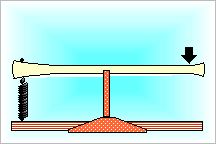
I also built a leverage demonstrator, consisting of a 2 x 4 base with a moveable fulcrum, heavy spring load, and a mattock handle lever. I only built one because there was a dangerous amount of force involved, so I never let students use it unless it was braced by my adult strength.

fulcrum demo

With the fulcrum in the middle of the handle, the downward force is equal to the force of the spring. With the fulcrum near the end of the handle, I couldn’t budge the thing myself. With the fulcrum near the spring, the smallest girl in the class could move the handle with one finger.

If you have earned your students’ trust, and if you are careful not to bruise fragile egos, you can have a lot of fun pitting big boys against little girls in contests of strength rigged to let the little girls win.

[Safety notes: If the fulcrum is next to the spring and a student pushes down, then lets go, the handle will fly 180 degrees to the left and conk whoever is sitting there. Beware. If the fulcrum is far from the spring and your heaviest student jumps up and throws himself on the end of the handle – and they will – you had better be strong enough to keep the whole mechanism from tipping sideways and crunching you both. If you aren’t strong enough, don’t let them do it.]

Our final pulley experiment moved outdoors where I had suspended a bosun’s chair from a basketball goal. Students sat in the chair with the arrangement of pulleys over their heads and lifted their own weight off the ground.

When we did inclined planes, I brought a wheelbarrow, 2 x 12, and concrete blocks from home for the day. I let a student sit in the wheelbarrow while another ran him up increasingly steep ramps. Change students and repeat.

If the subject is force, middle schoolers need to feel that force in their hands and arms, not just calculate forces and imagine how they would feel.

200. The Last Sane Man

It was a bad week in mid-August.

Donald was imploding and Hillary should have been, but Donald kept grabbing the microphone. Nobody was thinking about e-mails because Donald kept spinning out one-liners. The Democrats were simultaneously frightened that he might win, and exulting in the poll numbers that said he wouldn’t. The Republicans were furious at lost opportunities, and tearing their hair out over the poll numbers.

On Sunday, August 14th, Billy Joe Barker sat down in front of his computer to compose his weekly commentary for the Tulsa World. The column was called Thank God Its Monday, but this night he simply couldn’t find anything to be thankful for. He had had such high hopes for Trump, but that was only a bitter memory now.

Then inspiration took him by the throat. His fingers flew across the keyboard and he hummed happily as he typed out the doom of a poor schmuck who had never done him any harm.

Please Mr. Custer

If you are old enough, you may remember a novelty song from 1960 called Please Mr. Custer. A trooper was complaining to commanding officer, who happened to be George Armstrong Custer, that he really didn’t want to go with him on his ride out to see what the Indians at the Little Big Horn were up to.

I don’t blame him. Nobody blamed him. It was a good laugh and nobody thought the trooper was unpatriotic for yelling, “I don’t want to go.”

I thought of that trooper today as I remembered my column of August first. It was about Leap Alan Hed, the boy who was born on leap day. Kids teased him so much when he was young about his name, Leap A. Hed, that he got back by counting his age by leap-year birthdays. He told me himself, when I interviewed him over the phone, that it was a piece of silliness he regrets to this day.

I invited him to run for President as a humor candidate, and offered to carry his campaign in this column. He turned me down flat, and I called him the sanest man in America because he really doesn’t want to be President. He didn’t even want to pretend he wanted to be President.

The trooper in the old song said, “I don’t want to go,” and Leap said, “I don’t want to be President.” Fifty-six years apart – the last two sane men in America.

I wanted to vote for Trump, I really did, but I can’t. Hillary – never mind. And the outliers, not them either.

On November 8, I am going to write in Leap Alan Hed, the last sane man in America. If you find Donald and Hillary as unpalatable as I do, I invite you to join me.

The piece was picked up by AP and UPI. All across the nation, every anchor with two minutes to spare read part of it on his broadcast. It became a phenomenon.

The reason was clear to those who paid attention. For a year, Donald Trump had given the talking heads something to cover. He was fun; he was colorful. He was safe. Nobody in his or her right mind thought he would ever win anything, and the rest of the Republican candidates were a dreary lot.

Then he won the nomination. The talking heads felt panic, and a massive sense of guilt at the idea of “What have we done?”

By the time relief arrived through Donald’s spiraling self-destruction, they were really tired of him. And they had always been tired of Hillary. Leap was a breath of fresh air. Leap was something different they could talk about, and he was safe. No one could ever take seriously the candidacy of a man who refused to run.

It seemed as safe as betting against Donald had seemed.

How quickly we forget.

199. Lost in Juarez

This is a continuation of yesterday’s post. You really should read it first.

Chapter 1

I spent my first week drunk in Juarez. Or rather, drinking steadily; a controlled drip of Corona that kept me looking and smelling intoxicated while I watched the other Gringos and learned their ways with the natives. Then I moved north to El Paso and spent a few days learning how men treated American barmaids in 1944. I moved on to Austin where I learned how to talk to waitresses and librarians and store clerks. 

Sure, America was my native country, but my year of birth was still in the future. I remembered how Dad and my uncles had acted when I was young, but they were always on their best behavior – married church-going Christians in front of the kid. How they had talked and acted when I was not around, or when they were younger, was another matter. There are subtleties, and the subtleties will trip you up.

By comparison, my stop off in San Francisco in ’67 has been a cakewalk. Everyone was crazy, or expected craziness. The weirder you were, the more you fit in. Not so this era.

I wasn’t the only spy in America in 1944. Posters said it in four words:  Loose lips sink ships. The stock answer to excessive curiosity was, “Whadda you need to know that for, Buddy?” That didn’t cause me problems because I wasn’t gathering military information. I already knew how the war was going to turn out. I was just learning how to pass as a native of the era.

In Tulsa I pissed in Whites Only toilets and drank from Whites Only water fountains. It gave me chills. Linda had been black; cafe au lait, actually. Marrying her in this era would have landed me in jail – or worse.

I had acquired a limp and a scar that all but closed one eye, and a feigned irritability that kept people at a distance. The shirt I wore was khaki with stitching scars where the sergeant’s stripes had been. I was a wounded veteran who just didn’t want to talk about it. I didn’t claim that identity; I wore it like a second skin and no one questioned me.

All in all, I used a dozen disposable identities during those days while I learned who I had to be for my mission. I made my mistakes under those other names.

How far can you joke with a waitress? About what subjects? What will be taken as humor, and what will get your face slapped, or win you a night in jail? What will a cop wink at, and what will get you a nightstick upside the head? I had to know because, ultimately, I had to become invisible.

I wandered west to the Rockies, then east to New York, and finally back southward toward Georgia.

It was odd to find out what felt the most strange. Segregation and Jim Crow depressed me, but did not surprise me. The absence of computers and instantaneous communication I took for granted. It was the heat that came as a sheer physical shock.

I used to think that Thomas Edison was the greatest benefactor of mankind, bringing light to dispel the darkness. After a summer in Texas, I changed my allegiance to Willis Carrier and his air conditioner.

By February of 1945, I was settled into Warm Springs, Georgia, under the relatively stable identity of Bill Taylor, electrician. I shaved my hair back at the hairline, gave it a hint of gray, let my stubble grow, and tinted it gray as well. I gained twenty pounds, walked with rounded shoulders and a forward slump, and wore clothes two sizes too big. That added twenty years to my age, and I no longer looked out of place in a country where all the young men had gone to war.

Now it was time to manufacture an electrical problem at the Little White House at Warm Springs, so I could plant the mechanism under the floor that would reach the dying Roosevelt and give him an extra decade of life.

Will you ever read the rest of this story. Maybe. I like where it’s going, but there are these dozens of other ideas vying for my time. We’ll see.

198. Waking up Dead

I often get a story notion and pop out a couple of opening chapters before I have clear idea where things are going to go. Then I leave things alone, there in the dark in the back of my mind, and visit them from time to time to see what kind of a mushroom crop I’m growing.

For this particular idea, spelled out in yesterday’s post, I wrote two different quickie openings. One was presented Monday, the second is presented today and tomorrow. Enjoy.

Prolog

“Yes, I hear you!”

Aroused now from sleep, Fletcher tried to open his eyes but felt no response from his eyelids. Yet he could see, somewhat, mostly vague shapes and a bilious yellow color.  And movement – some kind of moving shapes beyond the yellow fog.

“Where am I?”

“What is your name?”

“Jim Fletcher.”

“What do you remember?”

That was also vague, and he wrestled with it for a while. There had been a wedding – his? No, he only remembered preparations for the wedding. There was to be a party the night before, but he could not remember attending it. He said so.

“I have no way of knowing anything about your life,” the voice in his head responded, “except that at some point you opted for cryogenic suspension.”

“Then I am dead?”

“Yes.”

Fletcher thought about that for a while. It did not seem wrong. It was as if some hidden part of him had been aware of duration – great duration – since his last conscious thought.

He said, “Then you are about to revive me?”

“Hell, no.”

“But . . .”

“I can’t understand the arrogance of you people. Wherever did you get the idea that we would want more people, or that someone from your era would have anything to contribute to our world.”

“It was Linda’s idea. She said we could be together forever.”

“Crap.”

“If the woman you are about to marry wants to love you forever, you don’t argue. I signed the paper.”

“And here you are.”

“Where?”

“That, I will not tell you. In fact, it is imperative that you never learn anything about here/now. All that remains of you is a head, badly decayed outside the skull, with one eye, virtually no skin, and a brain that is basically intact. We bought you as biological waste, at the same price per kilo as manure, and revived you to this point. There were about four hundred of you in the lot, and only three came back to consciousness.”

“Why did you do it . . . if we are so useless?”

“I am going to make you an offer. You will think yes or no. If no, you’ll be fertilizing a vegetable garden tomorrow. If yes, you will be fully revived and given a chance to live again.”

“Yes.”

“Wait for the rest. Either way you choose, you will never know what year this is, nor anything about our civilization. For you to learn those things would make you less useful for our purposes.”

“And your purposes are?”

“You will be trained and sent back to an era near in time to the one in which you lived. This is why we are willing to revive you. You have knowledge and instincts which will let you survive where none of us could. An explosive device will be implanted in your skull to insure compliance. You will go where you are sent and do what you are told.”

“I would be a slave.”

“You would be alive. Now decide.” continued tomorrow