Tag Archives: americana

440. Pearl Harbor Day is Tomorrow

Pearl Harbor Day is tomorrow and for the third time, I am not going to write about it directly.

In 2015, I used Pearl Harbor Day as a jumping off place to discuss the decision to go to war in Iraq.

In 2016, I used Pearl Harbor Day as a jumping off place to discuss Japanese Internment.

In 2017, I am even less able to salute and shout hallelujah than I was on the last two times Pearl Harbor Day rolled around. Things are even worse than they were then.

Do I think we were shouldn’t have retaliated to the Pearl Harbor attack? Don’t be absurd.

Do I support disarmament? I wish I could, but it would be national suicide.

Am I a veteran? Yes; and I would love to be the last veteran.

Am I a pacifist? Don’t I wish. I would love to live long enough to be able to say yes to that, but I won’t. Neither will you, and you are younger than I am.

There are times when we have to fight and Pearl Harbor signaled one of those times, but our national default setting should not be attack. We should fight rarely, and only when necessary. For many years now, we have been doing a terrible job of deciding when to fight, so I find it hard to wave the flag. Someone might think that means I’m ready to start shooting.

Tomorrow is Pearl Harbor Day. It is also the forty-fifth anniversary of the last manned moon launch. I think I’ll write about that.

429. Scales, digital and ridiculous

Ah, the good old days. They really sucked.

Even the phrase sucked falls into that category. I know that most of those who read this will not remember, but there was a time when nobody said sucked. It ranked up there with the “F” word. I remember when it arrived on the scene in my middle school students’ vocabularies, how it was an issue for a short time, and how two years later teachers were saying it. That’s what happens when a perfectly good forbidden word becomes common; it loses its flavor.

============

I have a great respect for Science Olympiad, but I never liked coaching, so I always volunteered to judge events instead. I enjoyed taking on new events that needed to be shepherded through their first year of implementation, and that led me to build a lot of gadgets to use in judging the contestants’ gadgets.

The people who think up new events in Science Olympiad often show an Olympian detachment (pun intended) from reality. Case in point — and forgive me if my numbers are off, I’m writing from memory — in two events students had to build light structures and test them to destruction. First it was a bridge, and a few years later, a tower. The lightest bridge or tower that held the most weight before failing won the event. There was a formula for weight vs. load, and specifications for what constituted failure.

The students applied the weight by pouring sand into a suspended bucket and there was a set maximum. If the structure held the maximum, the lightest structure won. If the structure failed, the weight vs. load formula was invoked. All in all, it was a well thought out event.

Except for one thing. The load was in pounds — up to ten, as I remember — and the weight of the structure was in grams. Let’s do the conversion.

1 pound equals 16 ounces
1 ounce equals 28.35 grams
Therefore, 10 pounds equals 4536 grams
And 9 pounds equals 4082.4 grams
That is a difference of 453.6 grams

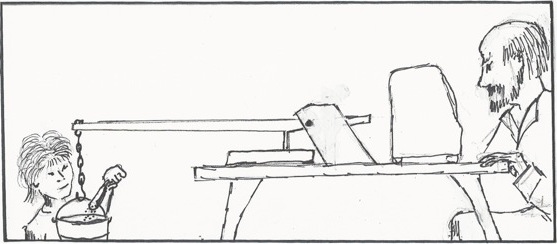
Did I lose you? Just look at the cartoon at the top for a moment, regain your equilibrium, and come back to me. There is no final exam on this. This is just memoir about how much fun teaching science can be on a small budget.

To measure mass in grams, you could use a triple beam balance available in any science class. To measure ten pounds, you have your bathroom scale. But wait a minute, that ten pound maximum-weight bucket of sand has to be measured in grams! How do you do that?

You do it with levers, using the gizmo pictured at the top of the page. I actually built it, and used it all the years I was associated with that event. The lever makes the scale read about 160 pounds when there are 10 pounds in the bucket. That spreads out the difference between two similar weights. The box the adult is staring at is my old Mac SE, with a preprogrammed formula in a database. The formula is:

Scale reading in pounds after the sand has been added (times) conversion factor to grams (minus) weight of bucket in grams ——- all this fed into the formula for comparing load in grams to weight of the bridge or tower in grams, a formula provided by Science Olympiad.

At the event, all I had to do was watch the contestant, and stop her/him at the moment the structure failed. He/she was only given ten pounds of sand to work with, so overfilling could not happen. I typed in the reading from the bathroom scale and the computer gave me the score — after I had built and tested the device, programmed the database, and provided ten pounds of sand, calculated to the nearest gram on the same device.

Fun? Of course it was fun. I volunteered to do this, remember?

Was it accurate? No and yes. No, there was too much friction for the gram readings to be accurate, but the friction was the same for every trial, so yes, the ranking of the contestants was completely reliable.

About three years after Science Olympiad retired the event, digital scales which would measure that much sand to the nearest gram became available for under five bucks at every-guy’s-public-man-cave, Harbor Freight. Thank goodness it didn’t come earlier and ruin my fun.

427. A Grave Story

The paragraph below comes from Symphony in a Minor Key. Neil McCrae has read a ghost story at Halloween, timing it to end just as the bell rings in his sixth grade class.

Half the students leaped to their feet screaming, then broke into laughter, and went out for their break repeating juicy bits of the story to one another. Neil sat back with a feeling of satisfaction, mixed with amusement at his own self-indulgence.  There was a lot of theater in Neil McCrae, but he kept it on a tight leash. Once in a while, though! Just once in a while it felt good to cut loose.

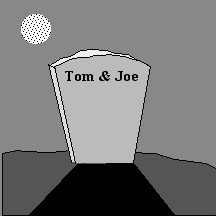
Since the novel is based on my teaching career, it will surprise no one that Neil and I share a few characteristics. Keeping theatricality on a tight leash is one of them. Telling ghost stories on Halloween is another. This is one of those stories, based loosely on a joke I read in Boy’s Life back in the fifties.

Of course it’s a true story. I wouldn’t lie to you.

=======================

I had two brothers as students. I had one in my class one year, and his younger brother the next. They were always hanging out together. Some brothers get along; come don’t. These two were great friends.

They were outdoors types. The liked to fish and hunt. Their dad would take them canoeing, and sometimes the three of them would camp out together.

The year I’m thinking about, the last year I knew them, their dad had been really busy all fall, so they were on their own. They decided to go off together in the canoe, and go camping along the river.

I didn’t mention, did I, that the Tuolumne River runs along about a mile from the school where I taught? Or that the regional cemetery is right along the river? Of course, the students I told this story to, already knew that.

Since it’s a true story, I have to keep the details straight.

This particular fall had been rainy, and both brothers were involved in soccer, so they kept putting off their canoeing and camping trip. September came and went, and then October, and by the time November was just around the corner, they were getting pretty desperate to go. That’s probably why they decided to go on the last Friday night in October.

I probably wouldn’t have gone, myself, because it was Halloween, but these two had a habit of daring each other, and that often got them into trouble. So they went. They put in the river at Fox Grove and intended to sleep somewhere about five miles west, then paddle on down to Legion Park the next morning. Their mom was going to pick them up there. Too bad she never got the chance.

Everything went along fine for the first hour. They got a late start, but that didn’t matter since they could camp anywhere. It’s pretty wild down along the river. They got past the rapids under the bridge. They were pretty tame rapids. Things went well for the first few miles, but then fog began to form. That was fun at first.

Did I mention it was Halloween?

The fog hung in the old trees along the river bank, but they could still slip along below it. At first. Then it got dark, all the sooner because the fog was cutting off the moonlight.

Did I mention there was a full moon? That was part of the reason they went that night, because they thought they would be able to see by it’s light. They hadn’t figured on the fog. Pretty soon they couldn’t see anything. They got on down the river for a while by instinct. If you’ve been on the water enough, you get a feel for currents, and anyway, you can’t get lost on a river. It only goes one direction.

Still, it started to get dangerous, not to mention creepy, so they pulled up on a mud bank to think things over. They also had been drinking two liter Pepsi’s, if you know what I mean. They had to take care of that little chore, and they did, but while they were looking for a bush apiece, they got separated. They could hear each other clearly, but the river banks threw back such echoes that they couldn’t find each other. And then they couldn’t find the canoe. Finally, Joe – that was the younger brother – found a path up and shouted to Tom – that was the older brother – that they should climb out of the river bottom and meet on the flat land up topside. Tom shouted back to go ahead, so Joe went up.

That might not have been the best idea they ever had. They had made it further down the river than either one realized, and when Joe got to the top, he found himself in the cemetery.

Now Joe wasn’t particularly spooky. Camp fire stories of ghosts just bored him. But this was a real cemetery, and the fog in the trees looked like Spanish moss hanging down – you know, like in the stories of the bayous. He didn’t like it. He hollered for Tom, but got no answer. Then the fog thickened and the moon, which had been mostly obscured, disappeared completely. He found that he couldn’t see anything, so he put his hands out to feel, and found himself moving along, guiding himself by the tops of tombstones. He didn’t like that much either, but what are you going to do?

Tom, meanwhile, thought he had found a trail up, but it only led him into a bramble of raspberry bushes. It took him ten minutes to work his way through them and by the time he made it up to the top, his clothes were in tatters and he had blood all over his hands from fighting the thorns. He staggered out on top, panting with the effort, and found himself in the cemetery, too.

I know all this because I was one of the ones who went looking for them then next day, after someone had found their abandoned canoe. It was easy enough to track them, first by river mud footprints, then prints in the soft soil. We knew which was which because Tom’s shoes were much bigger, and besides, there were all those drops of blood.

What neither boy knew was that there was a funeral scheduled for that Saturday. The groundskeepers had dug the grave, and it was standing open. Tom found it first.

Of course, it was pitch dark, so he found it by falling in. The groundskeepers had done a good job. It was seven feet deep, with straight-up sides, three feet wide and seven feet long and completely impossible for Tom to get out of. And did he try! He leaped. He scrambled. You could see the next day where he had dug his fingers into the sides of the grave, with no success. I’m sure he shouted, but no one could hear him. I wouldn’t be surprised if he cussed a little.

Eventually, he exhausted himself and sank to the ground, curled up in a ball, and decided to wait for morning. He was half asleep when Joe found the grave the same way Tom had.

Joe fell in, and the sound of a body falling into the grave with him sent Tom to his feet. He slammed himself back against the side of the grave, wanting to scream, but no sound came out. It never occurred to him that it might be Joe, but every other monster from every movie he had ever watched went running through his head. He squeezed back into a corner of the grave in abject fear, while Joe picked himself up, turned, and began leaping and scrabbling at the wall of the grave.

About that time, just enough moonlight came down into the grave that Tom could recognize his brother. Joe slid back to the bottom of the grave for the third or fourth time as Tom reached out his bloody hand, with tattered sleeves hanging down, and touched his brother’s shoulder. His voice was hoarse from fright as he said, “You’ll never make it out of this grave.”

But Joe did. He screamed and gave such a leap that he outdid himself, caught his fingertips on the lip of the grave, scrambled like a madman, and was gone.

Tom was still there when we found him the next morning. I won’t say he was all right. I don’t think he was ever all right again. But he was there.

Joe was never found. They dragged the river. Friends, neighbors, and strangers turned out in the search, but it was useless.

Tom and his family moved away soon after, but I get Christmas cards from his mother every year. She tells me what Tom has been doing, but she never mentions Joe.

Me either. Except every year about this time I feel the need to tell his story. Just a cautionary tale, you understand. Nothing to do with me, whatsoever.

I wouldn’t lie to you.

398. Summing Up Spirit Deer

Today Spirit Deer ends with a short post. Tim is home and all is well.

Here’s a short summing up for those who missed the start. Spirit Deer has appeared in two major forms. It was first a book for adults, with a thirty-something Tim Carson, who had a wife, a job, friends, and included various events which have since been excised. It was a carefully chosen story that offered me no research difficulties. The entire purpose of the original Spirit Deer was to see if I could write day after day until a novel length manuscript emerged. I could. It did. And I never stopped writing.

Years later I pared it back to its core story and recast it as a juvenile, which is what I have presented here.

Writing Spirit Deer was so enjoyable that I did not reapply for a Ph.D. program in Anthropology, as I had intended. Also, in full disclosure, I had come to the realization that, although Anthropology as an intellectual endeavor fascinated me, the idea of sitting in an Indian (South Asian, not Native American) village and taking down daily gossip as field work did not appeal. Not even a little bit.

So I kept writing, had some success, had a long dry spell for sales during which I still kept on writing, and now my new book Cyan is available. On the basis of that publication, I just came back from Westercon where I served on panels, met a batch of young authors, and was struck by the kernel of a new steampunk novel that I am working on as you read this. My second published novel was set in India, and made use of all those years studying Anthropology. My next one is built around an obscure event in the history of British India, turned inside out and backwards in an alternate steampunk universe.

Its been a good ride, and a rough ride, but I wouldn’t have had it it any other way.

Spirit Deer 40

Chapter 15

Well fed now, with his ankle all but healed, Tim snowshoed down the mountainside to the Tate, and upstream to the highway bridge. It took most of two days, but he had learned to build shelters quickly. With meat and a fire, and wrapped in a half cured bearskin, it did not take much to make Tim comfortable enough to sleep at night.

When Tim reached the road, it was still choked with snow, so he walked the last few miles into the village. It was afternoon of the fourteenth day of his absence when he headed down his own street looking like something out of another age. He wore ragged jeans and an enormous, shaggy bear skin, and moved confidently on snowshoes, dragging a rough toboggan of saplings piled high with greasy, frozen bear meat.

His father’s rig was sitting in the front yard. A feeling of guilt for the trouble he had caused took the edge off his homecoming, but only for a moment. He left his toboggan in the yard and stepped up onto the porch. He knocked.

His mother looked smaller, older, and more precious when she opened the door. She stood for a moment, frozen by the shock of his reappearance. Then she gathered Tim into his arms. Over her shoulder, he saw his father coming into the living room. The smile that split his father’s face was worth the whole ordeal Tim had gone through. In three strides his father crossed the floor and caught them both up in his embrace, and Tim was truly home at last. finis

Spirit Deer 39

With a growl that shook the forest, the black bear wheeled; the spear shaft quivered in his side. He charged. Tim cast his second spear at the bear’s open mouth, but missed. The obsidian point flew high and cleaved a gash through the animal’s already mutilated nose and up between his eyes, glancing off his heavy skull. The bear screamed and reared up, pawing at his face. Tim lunged forward, grabbed the shaft of the first spear, and plunged it deeper. A mighty paw caught him and tossed him aside.

Tim staggered to his feet. Blood rushed into his eyes, but he wiped it away. The bear, too, was blinded by blood. Moving unsteadily, Tim recovered his second spear. He circled the thrashing bear, found his atlatl, and took a stand near the club. The bear was dying, but he was still deadly. Blinded by blood, he turned his shaggy head from side to side to listen.

“Here, Bear,” Tim whispered. The bear jerked his head toward the sound, then rose on his hind legs, turning his head to catch the slightest noise.

“Here!” Tim screamed and hurled his spear. It pierced the bear’s belly once again. Dropping to all fours, the bear charged. The spear shafts burrowed twin furrows in the snow. It was a blind charge, and Tim stepped to one side bringing up his club. He swung it as he would have swung an axe in his father’s woodpile, overhead and down with all the power of his chest and arms, directly onto the bear’s skull. The bear dropped, plowing up the snow as it skidded to a halt, twitched, and lay still.

* * *

The crippled deer stood proud and defiant on his island of traction. Tim faced him with a spear in his hand. The deer’s hard brown eyes never wavered and his antlered head was lowered to fight to the last. But it would be no contest, for Tim could kill from where he stood.

Tim had followed his deer a long way. Both of them had been cripples, and now both were nearly well. Tim had been alone and helpless. Slowly, bit by painful bit, he had gained the tools of survival. Now he stood with the deer’s life in his hands.

And now he no longer needed to kill it.

The deer’s flinty eyes never changed as Tim laid aside his spears and removed his snowshoes. Moving carefully with his club raised, Tim fenced with the deer until he had tangled the club in its antlers. When the deer threw up his head to rip the club from Tim’s hand, Tim did not resist. Instead he lunged forward and threw his shoulder against the deer’s side, reaching under its belly to grasp his opposite foreleg, and tossed him into the snow. Tim rolled on over the deer’s back to avoid his flashing rear hooves and caught him by the antlers.

Throwing his weight backward, he dragged the struggling deer off the mud bar onto the smooth ice, then dragged him to shore. Tim stepped back as the deer plunged to his feet and bounded away. When the deer reached the edge of the timber, he turned for a moment and looked back.

Tim raised his hand to the deer. “Good luck,” he said.

The deer disappeared into the forest, and Tim turned back to the carcass of the bear. last post tomorrow

Spirit Deer 38

Tim’s snowshoes lent speed to his footsteps. When he caught up to the bear, it had its nose close to the snow, doglike, as it lumbered through the drifts with careless strength. Tim remained at a distance. He kept the animal in sight, but made no move to overtake it. The wind lay at Tim’s back, but for some reason the bear did not scent him. Once the bear stopped and tested the air as Tim crouched in the cover of a hemlock, but he seemed unable to get the information he needed from the wind. Tim could see his massive head; the swelling was gone from his cheek. Tim’s blow had done the bear some good by allowing the wound to drain. Now the bear looked less anguished, but just as deadly.

The bear topped a rise and disappeared. Tim followed, taking care in case the bear had stopped just out of sight. He crossed the ridge a hundred yards to the left of the bear’s tracks.

Tim’s deer had been feeding just under the crest of the hill. Now he was floundering in flight from the bear.

The crippled deer tried to cut to the right, but the bear was faster in the deep snow. He closed the gap quickly, and the deer turned away to the left, heading out across a barren stretch of snow.

The deer should have known better. The “clearing” extended tabletop flat for two hundred yards in every direction – it could have been nothing but a frozen, snow covered lake. In his frenzy to escape, the deer hit the smooth snow, floundered, and fell sliding on the ice. The bear galloped after him. The deer regained his feet, only to fall again, then lunged forward and spun around. He had found a mud bar, no more than six feet by four, that rose inches above the ice and provided a tiny island of traction.

Yet, he was trapped. He could stand; he could wheel to face his attacker, but he could not retreat over the slick ice.

He was doomed.

Tim could not allow it.

He moved down the slope at a shuffle with his snowshoes shushing along the snow’s surface. The crippled deer stood with his head down and his antlers poised; he made a splendid figure of defiance. The bear circled just out of range of his lunges. The slickness of the ice did not seem to bother the bear at all. The advantages were all his.

Tim came to the edge of the ice and paused. The bear had not seen him, but when he did his life would be in deadly danger. Yet he could not leave. He had uncompleted business here. The bear circled close and the crippled deer lunged, catching the bear’s nose with his antlers. The bear sat back and turned his head.

He saw Tim.

Startled, the bear spun and lost his footing on the ice. The deer lunged forward and speared his flank. The bear leaped back, then turned toward Tim. Tim stood like a statue, with his spear poised to cast. He had taken his crutch-club and had stuck it into a snowdrift close at hand.

The bear looked at Tim, then at the deer. He turned to rush the deer and Tim cast his spear.

It flew forward in a clean arc, propelled by the extra snap of his wrist, and arrowed toward the target Tim had selected. Just forward of the bear’s hind leg, back from the heavy bones of his rib cage, it penetrated the bear’s belly.

With a growl that shook the forest, the black bear wheeled; the spear shaft quivered in his side. He charged. more tomorrow

Spirit Deer 37

Using the light limbs of a young fir, he bent a pair of frameworks and laid other straight, small limbs across them, weaving them together and tying their ends with the deerskin strings.

He struggled back to the hollow where he had collapsed and spent a freezing half hour searching for his bow. When he had found it, he removed the bootlace bowstring and used it to make snowshoe bindings. The bow had been pretty useless anyway, and his arrows were lost.

* * *

The storm lasted through a long afternoon and night. By the morning after Tim’s kill, it had spent its fury. The clouds had lifted and blue sky was even showing through here and there. The mountains were covered with more than a foot of new snow.

Tim set out, walking easily on his new snowshoes, strengthened by the venison, and with a new confidence. He carried his spears and his atlatl in his hand and the crutch-club was strapped across his back as a weapon of last resort.

He had eaten all the deer meat, but now he felt confident that he could get more. He had run his prey down on clumsy bough snowshoes, so surely he could do the same with these better ones, especially since the snow had drifted even deeper. He moved with a shuffling step, sliding each snowshoe forward with a minimum of lifting, for they were heavy once they became caked with snow.

The deer were leaving the high country. Although he did not see them, he saw new trails all about him in the fresh snow. Too much of their food had been buried, so the muleys would stay no longer. Like Tim, they were heading for the valley.

* * *

Tim knelt in the snow to examine one set of tracks more closely. In the deep snow where the deers’ bellies dragged it had been hard to tell much. Here where the snow cover was thinner, the message was clear. Tim’s spirit deer was heading down the mountain, and having a hard time with his injured foreleg.

Tim started along after the deer. The snow had stopped about four in the morning, and now it was about ten. The tracks could be six hours old, although Tim doubted it. It was foolish to follow them. It would be far better to sight a deer first, then follow him.

It did not matter. Logic was not the issue. There was a bond between Tim and that particular deer. It was not hatred and it was not love. It was no emotion that Tim could have put a name to, but he needed that particular deer like he needed food and shelter. It was as if that deer had taken away a part of him when he shot it and Tim had to follow it – forever? – across this frozen waste.

It was a thing beyond food and shelter. It was a thing beyond manhood, as civilized man understands the term. It was a matter of selfhood. Like two stars locked in each other’s gravities, Tim and the deer were inseparably linked.

He was not the only one following the deer. Tim came upon bear tracks. There was nothing in them to tell Tim for certain that this was the same bear which had driven him from his other kill, but he somehow he knew that it was.

This bear stood like a demon between him and his prey, just as he had stood yesterday between him and his kill. Spirit deer and demon bear. 

To stalk old tracks was foolish; to stalk a stalking bear was suicide. Still, Tim went on. more tomorrow

Spirit Deer 36

The bear made no move to charge, but growled deep in his throat. Tim moved toward the deer, going slowly and searching through the snow. He found his other spear and his atlatl. He thrust one spear into his quiver, hooked the other into his atlatl and balanced them over his right shoulder while he held the torch in his left hand.

The wind tore at the torch, laying the flames out horizontally. The numbing cold cut deep.

When Tim had come to within thirty feet of the kill, the bear made a move to charge, then retreated from the torch. He snorted and shook his head. Slowly, Tim advanced, but the bear stood his ground.

Tim needed three hands: one for the torch, one for the spear, and one to cut out a portion of the desperately needed meat. He advanced another step. He had to drive the bear off, but the bear showed no sign of fear.

Tim’s torch was burning down, and as it died the bear was gaining confidence.

The bear charged. Tim cast the spear, and missed. It cut the air where the bear had been one second before.

The bear’s roar shook the mountainside and his jaws plunged toward Tim’s face. With one last desperate burst of strength as he fell back, Tim brought his atlatl down like a club on the bear’s swollen cheek. The festering wound burst open in a shower of pus and the bear leaped stark upright. His scream split the air. He towered above the spot where Tim had been knocked down, waving his paws in agony, then turned and plunged into the storm.

Suddenly, Tim was alone in a swirling white world of snow. He drew a broken breath and for the moment he could not move. Then he rolled to his knees and pulled out his knife. He cut out a massive chunk of meat and hacked off a section of hide, working quickly, for the bear would surely return.

He recovered his spears and atlatl, estimated his position, and headed back toward the shelter he had left hours earlier. The wind and snow were so fierce that he didn’t think he would be able to build a new shelter in time to keep from freezing. And he wanted distance between himself and the bear.

Fortunately, though the deer had run far, he had been circling back when Tim caught him. In the howling storm Tim could not be sure of his directions. Juices from the meat froze on the back of his hand. He blundered on.

It was the hollow where the deer had nuzzled him that he recognized first. After that he found his way without difficulty, but he was chilled through by the time he had kindled a new fire in his shelter.

For all his efforts, he had gained only a piece of venison weighing a few pounds and one lacerated section of hide. But when he remembered the bear, he was content just to be alive.

Chapter 14

Throughout the storm, Tim kept his fire high to keep the cold away, even though it meant frequent trips out to find wood. He was stronger now for the meat he had eaten.

Yesterday he had done without his crutch, and he would have to do without it in the future. As the snow level rose, he would have to have better snowshoes, and the piece of deerskin was the way to obtain them. There was not enough to use as webbing, but he cut what there was into strings. These he soaked in hot water in a bark basket made from his now useless quiver. more next week

Spirit Deer 35

He looked up into the eyes of an enormous black bear.

Fear took hold of him. The entire right side of the bear’s face was swollen to the size of an orange and his cheek was smeared with yellow pus. His nose was partially torn away. For a moment that seemed to last forever they faced each other; then the bear lumbered forward, growling deep in his chest.

Tim hooked spear to atlatl and stood his ground, poised over his kill like some prehistoric man.

The bear charged.

Tim hurled his spear, but it glanced off the bear’s heavily furred shoulder. Then Tim leaped sideways and the bear knocked him down as he charged by. His sweeping forepaw missed Tim by inches. Tim scrambled up instantly and ran. He heard the roar behind him and leaped into the lower branches of a small fir. Scrambling upward and tearing off his rough snowshoes as he climbed, he quickly reached a place where further climbing was impossible. The bear stood on his hind legs and stretched his mighty paws upward. The scars he left on the tree trunk were just below Tim’s feet.

The bear circled the tree several times, then went to the deer. Settling down where he could watch Tim, he began to feed.

Tim cursed the bear, but the bear did not listen. As his fear began to drain away, Tim pounded the tree trunk in frustration. To finally make a kill after all this time, only to have it snatched away! He needed that meat, but the humiliation was almost worse.

The bear continued to eat, keeping his one good eye on the tree where Tim seethed.

Across the mountain, a wall of white bore in, ripping the needles about him and tearing at the warmth of his body. In an instant, Tim could barely see the deer and bear. He had sweated during the chase; now he felt that moisture chilling his body. The wind carried snow in stinging, hail like particles that peppered his face and arms. His world was suddenly restricted to the few branches around him. He could see nothing and feel nothing but the cruel, cruel wind.

He had to have shelter, food, and fire. The bear stood between him and all three. He had lost his weapons, but he did not intend to freeze to death cowering in a tree.

There were some dead branches nearby that had partially dried since the last snow, and a squirrel’s nest that was dry on its underside  He had been carrying the remaining rifle cartridges since he was lost. Now he pulled the bullet out of one with his teeth and spread the gunpowder across the squirrel’s nest he had torn to pieces. With knife and firestone, he kindled a flame.

And the wind blew it out.

This was no time for further hoarding. He emptied the remaining cartridges across the nest, working the powder into the tangle so that some of it at least would be protected from the wind. Again he struck sparks and once again the nest took fire. This time it flamed up and scorched his eyebrows. He twisted the flaming nest into the tangle of dead branches and the wind fanned their flame higher until he held a formidable torch.

Tim slid to the ground and sidled toward the spear that lay closest to him. The bear made no move to charge, but growled deep in his throat. more tomorrow