Tag Archives: history

592. Armed Forces Week 2019

Armed Forces Week comes in May. It runs from the second to the third Saturday. The third Saturday is also Armed Forces Day.

As holidays go, Armed Forces Week isn’t particularly notable. Mother’s Day also gets caught up in the mix as the only Sunday in the week. For “right thinking people”, that probably seems appropriate. For those of us whose thinking is always a bit off center, it is ironic.

It all depends on your view of the question of the legitimacy of military force. To a very few (not including me) it is always wrong. To the average American, a simple statement that, “We support our servicemen,” ends the discussion.

It really doesn’t end anything.

We all know, whether we want to admit it or not, that every military organization in history has committed atrocities. If your answer to, “Do you support [fill in the military action of your choice?]”, is “I support our troops.”, you are just avoiding the question.

I have problems with all this. I’m no pacifist, and I believe in defending my country. Still, I see example after example of our government screwing things up and getting our servicemen and women maimed and killed for unsupportable reasons. Viet Nam comes to mind, but the problem didn’t stop when that quasi-war was over.

It hits close to home for me in a rather odd way. My wife and I make quilts, and are members of a local quilt guild. There are several organizations like Quilts of Valor which coordinate the making of quilts to be given to veterans. It would be hard to find any organization which seems more useful and harmless, but I don’t participate. Most people see these organizations’ efforts as support for troops and veterans. I respect that position and I never argue with them, but, for me, it feels too much like validating the jackass generals in all the stupid and useless things they do.

It is the same with  Armed Forces week. Most people see it as an appreciation of our soldiers and sailors, but it looks to me like a smoke screen. It tends to make legitimate questions about American military actions look like a lack of patriotism.

I came to this opinion when I was in the service. To clarify that, it was in the Viet Nam era, but I was not deployed to Viet Nam itself.

And it all starts with boot camp. I wrote a post about that experience for Armed Forces Week of 2016, That was three years ago when the blog was new and not many people were reading. I repeated it two years ago, so I won’t print it again, but if you want to know what I think of that institution,  go to 432. The Making of a Navyman.

589.5 Tequila and Lederhosen

Cinco de Mayo caught me by surprise this year. It is an important holiday in California, and was particularly important to about half the kids I taught before I retired.

You will note that I did not say Mexican-American kids. Even before the advent of Trump, a surprisingly large number of (whatever) students didn’t like that name. Some wore a T-shirt that said:

Not Mexican-American
Not Hispanic
Not Chicano
MEXICAN!

I’ve already had my say on the subject of Cinco de Mayo. I invite you to check out these two older posts to see what that was.

One post had the full title: Juan Angus Georg Angelo O’Malley celebrates St. Patrick’s Day by drinking tequila and while wearing lederhosen under his kilt.

The other was titled: Who said you were Mexican?

589. A Son of the Sooner State

I was born in Oklahoma, a land on the edge of the South and also on the edge of the West. It was the land of the Indians, but you wouldn’t know it from the power structure. Its flag honors 60 tribes, but the whole place is pretty damned white. During my childhood, it wasn’t a great place to be a Black, a Jew, or an Indian.

Some say Oklahoma fought on the side of the South, but that isn’t accurate. Some Indian tribes living there fought against the Federal government, and they had reason, but the white folks who came in, took over, and dominated the new state of Oklahoma came from both north and south, long after the Civil War was over.

Kansas did fight for the North, and soon after the Civil War it had become culturally eastern. It was a place where the eastern cattle buyers bought the herds driven up from Texas, and where the immigrant sodbusters set up their farms. Dodge City, Abilene, Wyatt Earp, you know the story.

Texas fought for the South and right after the Civil War it began sending herds of cattle north to the newly built Kansas railroads. They left Texas scrawny and arrived at the railhead fat, working their way slowly northward while eating free grass.

Did I say free? Well . . .

Bear in mind what lay between Texas and Kansas — Indian Territory which would later become Oklahoma. I.T. was the dumping ground for disenfranchised Native Americans (see 247. The People’s President), and it was their grass that fed the cattle, which made the cattle owners rich, made the railroad owners rich, and fed the people in eastern cities.

Pretty soon railroads like the KATY were cutting across Indian Territory itself. That was the nickname of the MKT, the Missouri, Kansas and Texas. It started in Missouri (barely) but primarily it linked Kansas with Texas. The land between was still called Indian Territory, but more and more whites were moving in, often to railroad towns, and the tribes were rapidly losing what hold they had over their new homeland.

My paternal grandparents were both young when they separately moved into Oklahoma, while it was still Indian Territory. My grandmother liked to tell tales about getting her mail addressed to K2C, IT. In modern English, that’s Catoosa, Indian Territory. Even though this was long after the great cattle drives, my grandfather still herded cattle on horseback. Someone in the family still has a photo of him in wooly chaps, hat, boots, and six-shooter, looking like Sam Elliott. My maternal great-grandfather was a locomotive engineer on the railroads that opened up the territory.

Piece by piece, the Native Americans lost the land they had been granted when they were forced out of the Eastern United States. Whites moved in and Oklahoma was born in 1907. I came along forty years later, a year after my father returned from WW II.

When I was young, we had our own version of rich and poor, but it was a mild form of The Great American Malady. Ranchers wore Stetsons and cowboy boots, had horses and drove Cadillacs. Farmers wore ball caps and laced up work shoes, did not have horses and drove pickups, usually old and rusty ones. We were farmers, although my Dad finally treated himself to a Stetson when he was well into middle age and wore it to church every Sunday after that.

By the time of his death, and even more rapidly a few years later, the land and culture of my youth and his adulthood disappeared. Our farm no longer produced grain and milk, but was subdivided into toy farms for people who worked in Tulsa, but wanted to breathe clean air on the weekends.

By that time I was gone. I left Oklahoma in 1966 and rarely returned, but everything I have written since is filtered through memories of that place. I suspect every other writer could tell a similar story.

587. Back to the Garden

Since summer, I have been working on reviewing the fifteen novels I chose as my favorites, and one thing has emerged. They nearly all have a rural or wild setting.

The exceptions are Heinlein and the Lensman series, both of which take place in completely civilized futures, and Dickens’s Christmas Carol, with its pre-modern urban setting.

The other twelve, whether past, contemporary, or future, are rigidly non-urban. Two take place at sea, three take place in variant, rural Englands, three take place in purely fantasy worlds, either wild or bucolic.

Davy Balfour spent his adventure crossing wild Scotland, and Roy Craig fought a wilderness so fierce that it threw off human domination.

Highland Laddie Gone takes place in modern America, but in a rural setting where the protagonists are pretending to recreate ancient Scotland. Part of A Prince of the Captivity takes place in an urban setting, but its soul and much of its action take place on an icecap, in the Alps, in the wasteland of war, and in wild places that exist only in Adam Melfort’s imagination.

If this were just my weird preference in books, it wouldn’t be worth a post, but it is much more than that. It is a reflection of recent history.

===============

Americans went to war in the forties. Those who came back changed the world. While England languished, half crippled as a result of the war, America exploded into the future. Freeways, cars that looked like jet planes, and housing tracts all emerged. Stamped tin toys were out; plastic was in.

The past (westerns were everywhere) and the present (endless spy stories) fought for dominance as the paperback revolution swept the nation.

While America was rushing forward technologically and outgrowing its landmass, some of the former generation were looking backward. A lot of young writers were looking to the future and seeing a post-nuclear age of Armageddon that was a replay of bad times past.

Some turned to fantasy. Ballantine gave us masses of books dug up from the actual past of literature, portraying pasts that never were, but which we all thought should have been. Tolkien became the king of backward looking nostalgia.

Two-thirds of my fifteen favorites were drawn from this anti-urban movement.

===============

I grew up on a farm, but most of my generation was urban. And rich, in comparison to any previous generation of youth. And they had the pill — which changed life a lot more than computers ever will. Sex, drugs and rock and roll. I missed all that, back in my Baptist-farmer world.

Then I got to college. I went from being marginal to my home town to being a marginal hippie. I agreed with most of their ideas, but I had no confidence that they would pull them off. And they didn’t. They stopped the war, but it wasn’t a clean victory. Nixon kept Viet Nam on life support long enough to win a second term.

By that time a new craze had hit; everybody wanted to go back to the land. I had waded through too much cow manure to buy into that.

I eventually went back to the land in a different way. I retired from teaching and bought a house on three acres in the Sierra foothills. Here I can see turkeys, deer, coyotes and an occasional bobcat walk past the picture window of the air conditioned shed where I write. I don’t raise crops, just novels.

A decade after the back-to-the-land crew had moved back to the cities, I wrote a novel, Raven’s Run, and put my opinions into the mouth of one of my characters, Rusty Dixon. For the record, he cusses more than I do.

Then along came the sixties. Some of us went off to Viet Nam and landed in pot heaven. Other kids my age went down to the cities and became hippies. When all that peace and love shit started to fall apart, a big bunch of hippies, lots of them from San Francisco and L.A., decided the new big thing was to go ‘back to the land’. ‘Course most of them had never been on the land, so they weren’t really going back to it. If they had, they’d have known better. I mean, I never saw any kid raised on a farm that went in for that shit.

It doesn’t take much insight to realize that the back-to-the-land movement, as well as Tolkien and his imitators, were moved my the same impulse. The modern eco-generation is singing the same tune, whether they understand it or not. It is a universal human hymn. For all of them, the future looks bleak and the past looks better than it really was.

Personally, I still have more faith in the future than in the past, but that twenty year spree of fine anti-urban and fantasy novels that came after World War II is still a pleasure to read.

586. Slogging Toward Space

One of the things I have to offer is a viewpoint that reaches back half way through the twentieth century. That can be a problem, actually. I don’t want to talk about the good old days. Fortunately, I never thought the good old days were all that good. They were, however, both exciting and hard.

It has become almost cliché to point out how little computing power the Apollo 11 computer had, but there are a thousand other instruments which we take for granted now, which were also not available during the early space program. I used a few of them myself, early on.

Some of these instruments became fossilized into early science fiction, as in Slip-stick Libby, one of Heinlein’s regular characters. Slip-stick was a slang term for a slide rule, an instrument of sliding scales which was used in computation. It was only good for estimating to about three significant figures. I learned to use one in high school in 1966. Early Texas Instrument portable calculators made them obsolete a few years later, although you will still see them in use at Mission Control when things began to go bad in the movie Apollo 13.

Another nearly obsolete instrument from the Apollo era is the theodolite. I learned to use one in the same class. We took it out to the back lot of the school for some practical examples of the uses of trigonometry. We didn’t call it a theodolite, however. We called it a transit, which is somewhat less accurate. Real surveyors called it a gun.

A transit measures elevations and angles. You level the instrument on its tripod and align it to true north, then you look through a telescopic sight, with crosshairs, at a distant target, usually a rod with red and white inch markings.

(We’re talking sixties here — everything in America was in inches, feet, and miles.)

This instrument was used in surveying everything from house foundations to radar installations before lasers replaced them. It gave you direction. It didn’t give you distance. For that you walked, dragging a measuring device called a chain.

The dictionary will tell you that a chain is a unit of length equal to 66 feet, subdivided into 100 links. It may not tell you that a chain (of length) was represented by a heavy, physical, steel chain that the rod man dragged behind him — for thousands of miles during a career.

Today, laser radar does it all.

An alidade or plane table worked like a transit except that it was attached to a narrow steel plate which moved freely on a plywood table. It was used for mapping. You would slide the alidade around on the table, over a sheet of paper, take your sightings, and use the edge of its base as a ruler. It allowed you to  draw a map as you went. I used one of them two years after high school at an archaeological site in Bay City, Michigan.

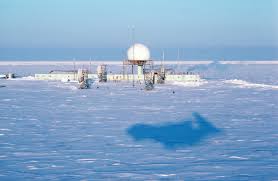
To fully understand what a tremendous undertaking the space program was, you should remember that a line of radio/radar stations was built all around the world to track spacecraft in orbit. At the same time, the same Russian missiles which scared American into the space race had to be watched for. A line of radar installations (the DEW — distant early warning — line) was built across Canada for that purpose.

The building of these two sets of installations was an immense undertaking. Even before the first foundation was laid, the positioning of these instruments had to be determined to the highest possible tolerances. This was done by survey engineers working with transits and doing their calculations by hand, with rod men dragging chains. A slide rule might provide estimates, but after that it was paper, pencil, and mathematical tables — which had themselves been calculated by hand.

The word calculator first meant a person who calculated such tables. By hand.

These engineers didn’t all come from Harvard, or other prestige colleges. There were thousands of them, possibly tens of thousands, and they came from every college in America. Bear that in mind as we contemplate the present college entry cheating scandals.

Speaking of which — prestige colleges my &#^$%!  Math is math, whether you learn it at USC or Palomar Junior College.

===============

I want to introduce you to a survey engineer you have never heard of. He is a distant in-law, a fine man I only met once. I ran across a decades old newspaper clipping of his obituary the other day, and it triggered this post.

I’m appending a copy of that clipping, minus family matters, to give you an idea of how the space race, and the missile defense of America, looked from the mud below. The gentleman’s name was William Mussetter.

===============

Mr. Mussetter graduated from Willmington College in 1917 and also attended Haverford College in Haverford, Pa. He retired after working 40 years in government service as an astronomical geodetic engineer. He served with the US Coast and Geodetic Survey, Army Map Services, InterAmerican Geodetic Survey United States Department of Foreign Services where he worked in many different countries.

Mr. Mussetter was a veteran of World War I, serving as a second lieutenant. In World War II he served as a captain and taught artillery.

At the end of the World War II, Mussetter received a call from Washington, D. C. He was assigned to head a survey group to be based in Panama and to work in south America, principally on the west coast of Chile, Peru, Ecuador, Columbia to Venezuela. This project lasted four years.

The Mussetters came home to Wilmington and he worked with the Ohio State University doing contract research for the U.S. Air Force. There was a need to connect the continents of the world, locating them with respect to each other, then to lay out guided missile courses from Cape Canaveral to the Bahamas. [This means during the early testing of IRBMs and ICBMs, before they began to be used to launch space vehicles. The same tracks were used through Mercury, Gemini, and Apollo. See 578. That Odd Spiral.]

In 1953, he transferred to the U.S. Army Corps of Engineers to define the Earth’s parameters, its diameters, flatness at the Poles and other data. [We are talking about building the DEW line here.]

He worked with a survey team measuring the arc of the Meridian at 30 degrees East Longitude from the Mediterranean Sea at Egypt to South Africa, down through Egypt, the Sudan, Uganda, Belgian Congo, Tanganyika, and into North Rhodesia; 4800 miles. [Many of these names no longer exist.] He also did some survey work for the Aswan Dam on the Nile River.

In 1964 he was sent to Antarctica, to Byrd Station, and the South Pole.

He had retired in 1964, but during the last four months of 1964, he worked in Peru, S. A. on a contract for a hydro-electric project; and in 1966 he was sent back to Afghanistan for three months, to inspect the work that was begun in 1961, and complete the Tri-lateration of Afghanistan.

===============

All this without a computer. Imagine that.

582. Newtonian Nukes

Everybody who read the last generation of science fiction juveniles before Apollo knew Newton’s third law:

For every action, there is an equal and opposite reaction.

The demonstrations in popular science books of that same era usually went something like this: imagine a person on a frozen pond wearing ice skates, throwing bricks. Every brick he throws will move him backward. If we could ignore the friction of skates on ice, it would be proportional. That is, if a hundred pound man  . . .

Okay, side issue. Most Americans back then, and even today, don’t think in kilograms or kilometers, nor distinguish mass from weight in everyday thought, so . . .

If a hundred pound man throws a one pound brick at ten miles per hour, it will propel him backward at one tenth of a mile per hour. 1 times 10 = 0.1 times 100. We are ignoring friction from the ice, the atmosphere, and probably a bunch of other things.

So, if you want to go faster, throw more bricks, right? If you throw a thousand bricks, you should be able to go pretty fast, right? Wrong, because the first brick your throw in the new scenario will have to move not only the hundred pound man, but also the other 999 pounds of bricks.

Increasing the amount of fuel carried quickly brings about diminishing returns. More fuel alone is not the answer.

In a Newtonian scenario, the faster the propellant leaves the rocket engine, and the more propellant you use, the faster you can go. LOX and LH are probably near the practical  maximum for propellant speed by chemical reaction. The logical next step would be to use a non-chemical energy source to activate our propellants, such as a nuclear powered rocket. Even that won’t get us to the stars, but it makes sense for travel inside the solar system.

Before Apollo, everyone who read science fiction knew that, which is why the Scorpius and her sisters in the Rip Foster book are nuclear powered. So were the ships in Bullard of the Space Patrol, a marvelous fix-up novel by Malcolm Jameson that no one remembers today. So were the ships in the Dig Allen series (1959 – 1962), six great but forgotten novels, and the ships of the Tom Corbett books, which were not so great and are not completely forgotten.

Star Trek put all these early concepts out of business. Warp speed was a necessity for roaming the galaxy, but it made nuclear rockets look old fashioned. I think that’s too bad. There is still room for them in science fiction, and certainly in real life.

I haven’t mentioned Heinlein yet. The Rolling Stone was nuclear, but he quickly moved on to torch ships, which had the capacity of total annihilation of matter. He never explained how that could be done, but the result would be “propellant” moving at essentially lightspeed. You can’t get faster than that without warp drive. His torch ships roamed the solar system and went on to explore nearby stars.

I stole that schtick for my coreships in Cyan, with a twist. See 23. Star Drives.

In a rational world — which we will probably never inhabit, but we can still write stories about — you would use chemical rockets to get to LEO (low Earth orbit), nuclear powered rockets to zip around the solar system (fission powered if you were writing in the sixties, fusion powered if you were writing today), and “torch ships” to reach nearby stars. Beyond that, you would need FTL (faster than light) vehicles which, by our present understanding of the universe, are impossible.

Too bad about FTL, but why are we still using chemical propellants in the real world fifty years after Apollo? Fear of nukes, of course. There will be more to say about that on Wednesday.

578. That Odd Spiral

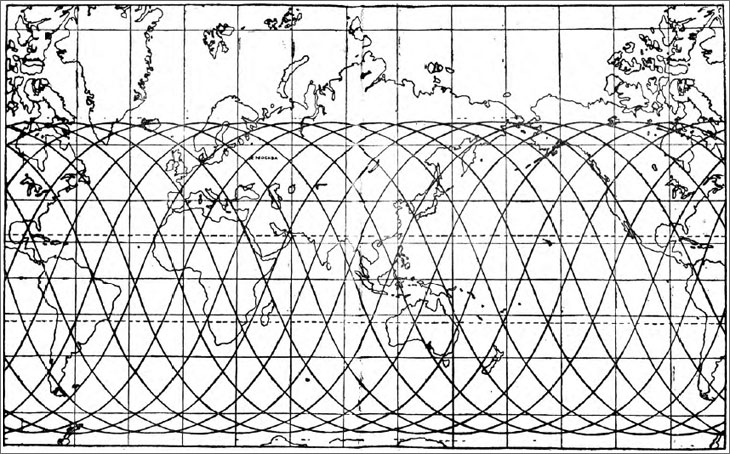
This is the track of Sputnik, the first satellite launched from Baikonur Cosmodrome at latitude 46 degrees north. Launches from Cape Canaveral followed paths that were more flattened out because they were launched from 28 degrees north.

The orbital path shown above was to be found in thousands of publications at the dawn of the space age. Everyone carried the image in their heads, but today I had a hard time finding it on the web. My how times change.

Every space geek in 1960 would have known everything in this post, but then Star Trek came along. Kirk and Spock, and especially Uhura, went at warp speed and walked around on the floor like it was a sound stage in Hollywood. No weightlessness there. Then Star Wars came along and all veracity went out the viewplate.

There were a lot of very basic principles of physics that governed the space program, which Hollywood had to ignore.

Let’s begin on the ground. The Earth rotates eastward at a certain number of miles per hour. (We are channeling 1960 here. None of the published reports on space used the metric system back then.) Any geek with a pencil could figure out rotational speed by dividing equatorial circumference (25,000 miles to any 1960’s space fan, forget the decimals.) by the length of the day. !042 miles per hour eastward at the equator.

A spacecraft in low Earth orbit flies at 17,500 miles per hour. Actually that varies, but that was the figure in all the space enthusiasts books at the time. If you launched a rocket eastward, you started with about 1000 mph of free speed. If you launched westward, it would cost you 2000 mph of extra speed. You wouldn’t gain the natural advantage, and the rocket would be going 1000 mph the wrong way as it sat on the ground.

Everyone launched eastward.

There was actually another reasonable option, launch north or south. We’ll look at that choice at the bottom of the post.

Actually you don’t get all of that speed advantage. The circumference of the Earth is less as you move northward, lowering the eastward speed. If a United World wanted to choose the most advantageous place for a spaceport, it would be at high altitude somewhere on the equator. That happened frequently in science fiction.

Neither America nor Russia had a far southern point suitable for a space port. America’s best choices were Texas and Florida — the same two states Jules Verne pointed out in From the Earth to the Moon. Florida had the added advantage of having the Atlantic ocean to eastward, which provided a place to drop first stages and failed rockets, without landing on anybody’s house.

Russia built in the desert at the same latitude as Portland, Oregon, but they always chose secrecy over other factors.

Launching eastward is an exaggeration, of course. Straight east from either site won’t work; launches had to be aimed south of east to bring the center of the orbit into line with the center of the Earth’s gravity.

You might think that a launch from Canaveral would return to Canaveral after one orbit, but that isn’t true. The Earth is rotating eastward, so a spacecraft launched from Canaveral will pass over a spot about a thousand miles west of Canaveral on its first return. And so forth. Which is why the cosmonauts were a thousand miles off target after one extra orbit in yesterday’s post.

All this gives us that odd spiral at the top of the post.

In fact, you could launch a spacecraft into orbit from any point on Earth as long as its orbital path circled around the Earth’s center of gravity. Further south is simply more efficient.

You could even launch satellites due north, and we do, from Vandenberg Air Force Base on the west coast of California. Such satellites also spiral around the Earth, but they cover every part of the Earth eventually. Weather and spy satellites use this orbit.

Southeastward launches from Canaveral and Baikonur don’t cross over the far north or the far south.

What about a satellite exactly circling the equator? In low Earth orbit, it would circle the Earth about every 90 minutes. The moon, a quarter of a million miles further out, circles the Earth in 29 1/2 days. Clearly, even for math challenged enthusiasts, the further out the satellite, the slower it travels in orbit. At some distance from the center of the Earth, it would take a satellite one day to circle the Earth. Seen from Earth, it would appear to hang in one spot above the equator.

Everybody should know that, because that is how communication satellites work. The first person to recognize the fact and calculate the distance was Arthur C. Clarke, known even to non-SF readers from 2001, a Space Odyssey. The connection between science and science fiction has always been close.

577. The First Space Walk (2)

The space suit worn by Alexei Leonov on the first human space walk. On display at the Smithsonian National Air and Space Museum. Author: Nijuuf

This is the rest of Tuesday’s post. If you haven’t read it yet, take the time to do so, or this won’t make much sense.

Alexey Leonov had extreme difficulty reentering the airlock. His space suit had over inflated; the boots and gloves had slipped beyond his toes and fingertips, and his suit had increased in girth. He had to vent part of his rapidly depleting oxygen in order to bring his suit down in size, and even then he entered the airlock head first, instead of feet first as planned. Once inside the airlock, he had extreme difficulty contorting his body to close the outer door. All this time, his body was heating up dangerously; surrounded by vacuum, there was nothing to carry away the heat his body was generating.

Once air pressure had been restored in the airlock, Belyayev opened the inner door and Leonov was safe. For the moment. As he said in an article for Smithsonian’s Air and Space magazine in 2005, “the difficulties I experienced reentering the spacecraft were just the start of a series of dire emergencies that almost cost us our lives.”

The mission had achieved it’s goal and it was time to return, but just before the scheduled time for firing retro rockets the cosmonauts discovered that their automatic guidance system was malfunctioning. It took time to prepare for manual entry, so they had to wait one orbit, which would make them miss their return point by a thousand miles. (To find out why it would be a thousand miles, see the post coming on March 25.) Most of that orbit they were out of radio communications. (The Americans had built a string of radio relay stations around the world to maintain constant communication with their astronauts, but the Soviets had not.)

When communications were restored, ground control asked them where they had landed.

Their orbital path was set; the moment of firing their retro rockets would determine where on that orbit they would land. They chose a target just past the Urals. Using the clumsy and difficult manual backup equipment, they achieved the correct attitude and fired the retro rockets in the conical rear portion of the craft called the orbital module. The orbital and landing modules were supposed to separate ten seconds after retrofire. They didn’t.

The two cosmonauts knew immediately that something was terribly wrong. Instead of the steady press of force against their backs as they decelerated, they found themselves whipped about by confused forces that exceeded ten gravities. A communication cable between the two modules had failed to release, and now both modules were whipping about each other, tethered by the cable.

Finally, about 60 miles up, the cable burned through and the cosmonauts were freed. The drogue chute deployed, and then the main. All was peaceful and in order – briefly. Then it became dark as they dropped below cloud cover, the final rocket fired to slow them to landing speed, and they touched down in six feet of snow.

They were 1200 miles beyond their intended landing point.

They blew the explosive bolts to release the hatch. It didn’t open. They had landed in the middle of a forest and the hatch was held shut by a tree. By yanking violently they dislodged it and it fell away, lost in the snow.

They made their way out of the spacecraft and waded through snow to a small clearing. Those back at headquarters had not heard their landing signal, but a passing cargo plane had. It circled, and was soon joined by other planes and helicopters, but none of them could land in the rough taiga. Pilots threw a bottle of cognac; it broke. They threw warm clothing which got caught in the trees, but at least two pairs of wolfskin boots made it to the ground.

The light was failing. The cosmonauts returned to their craft for shelter. Leonov was walking in calf deep sweat still trapped in his space suit from his space walk. Both cosmonauts stripped, removed the liners from their space suits and wrung them dry, then put the on again along with the wolf skin boots. They abandoned the useless space suits and crawled into the landing module for the night, well aware that the taiga was filled with bears and wolves, and that this was mating season, when they were most aggressive.

The hatch was out of reach. The lights failed, but the circulation fan ran all night, adding to their misery. The temperature dropped to 22 below zero.

A rescue party arrived on skis the next morning; they chopped trees to build a small log cabin and a big fire. The cosmonauts spent a second night, then skied out to where a second, larger party had chopped down enough trees for a helicopter to land.

I guess they made ‘em tough in those days. I suspect they still do.

576. The First Space Walk (1)

I posted this in 2016, under the title Spacecraft Threatened by Bears. The title was snarky but accurate. Back then I had few followers, so it seems time to post the amazing story again.

My admiration for the people of the early American space program is boundless, but the Russians were no slouches either. They were the first to perform many feats, including the first space walk, during the flight of Voskhod 2 on March 18-19, fifty-four years ago.

I had the great good fortune of living through the early days of manned space flight. I was nine years old when the Russians orbited the first satellite, and the early manned flights came when I was in high school. I watched every American launch with fascination and envy, but the Russian launches were shrouded in secrecy. I knew only the bare minimum that all Americans knew. I’m not sure the president knew much more.

During those early days, nothing was routine. Every mission was dangerous. They still are, of course, but not so much as then. American failures were there for all the world to see, while the Soviets kept their’s secret.

After the breakup of the Soviet Union, information about the early Russian space program became generally available, but by then few people cared. I did, and I sought out the stories.

=============

Oceans are big targets and landing in water cushions the fall. That is why Americans always splashed down. The Soviets were unwilling to land their craft anywhere outside of the USSR for reasons of security. Their hard landings had an effect of the design of their spacecraft.

The first six manned Soviet spaceflights were aboard Vostok craft, which came down on land — hard. Vostok astronauts wore space suits throughout their flights and landed by personal parachute separate from the capsule. Before the second generation Soyuz spacecraft came on line, the Soviets launched two additional manned missions on modified Vostoks called Voskhod.

On Voskhod, an additional rocket was added to the spherical descent module to fire at the last minute. This softened the landing enough so the cosmonauts could remain within the descent module all the way to the ground. Since ejection seats were no longer used, the weight saving allowed Voskhod 1 to carry three astronauts.

Voskhod 1 cosmonauts flew without space suits, as did early Soyuz missions. Voskhod 2 cosmonauts Belyayev and Leonov wore space suits because they were scheduled for the first space walk.

American space walks first took place during the Gemini program (see post 87). That craft had two hatches but no airlock; both astronauts were in vacuum during the entire spacewalk.

To exit his Voskhod in space, Leonov used an inflatable airlock (see drawing above), leaving Belyayev in the craft and unable to aid him. I had known this for several years but just in the last few days found out why. Russian electronics within Vostok and Voskhod were air cooled. American electronics were not. This meant that if a Voskhod were opened to space, the electronics would overheat.

On Voskhod 2, Leonov crawled into the airlock, sealed the inner door and opened the outer one. Belyayev remained in the pressurized descent module.

For ten minutes, Leonov remained within the airlock but exposed to the vacuum of space, then he slipped free and floated on a tether for another ten minutes. He was called back in to terminate his space walk, and his difficulties began.

(Or perhaps they had already begun. Some sources state that he “experienced a disorienting euphoria” during the space walk and other sources state that he suffered bends like symptoms after the space walk was over; I haven’t been able to confirm these statements.)

This post concludes on Thursday.

574. Learning Spaceflight

I learned how to fly in space before spaceflight existed, from science fiction writers who, in turn, learned it from pioneers like Robert Goddard, Willy Ley, Herman Oberth, and Wernher von Braun. Or Tsiolkovsky in Russia. The pioneers’ tool was mathematics. They speculated, then looked at those speculations through the unblinking eye of calculations. They taught everyone how to fly in space long before NASA existed. Later some of them worked for NASA.

When I was researching for a post on Apollo Eight, I encountered reference to the barbecue roll. I had known about that maneuver from science fiction, long before Apollo Eight.

The barbecue roll is needed because vehicle in deep space is surrounded by vacuum with sunlight impinging on one side and sub-polar cold on the other. In low Earth orbit, that condition only lasts 45 minutes of every 90 minute orbit followed by pure cold in the Earth’s shadow. Apollo Eight was the first manned vehicle to endure that temperature imbalance on a long term basis — roughly five days. That’s a lot of stress.

The solution, used on Apollo Eight, then Apollo’s Ten through Seventeen, was to spin the craft about it’s long axis. It was called the barbecue roll, as in a rotisserie. You can hear that phrase used in the movie Apollo 13, and it will probably appear on the movie First Man when it comes out in October.

Anyone who had read any science fiction knows about spinning ships to provide artificial gravity. That’s not what we are talking about. The barbecue roll was quite slow, the distance from center of craft to skin was small, and any pseudo-gravity produced was probably imperceptible. The entire purpose of the roll was to equalize heat distribution by exposing all parts of the skin to heat, then cold, in sequence.

Long before there were real spacecraft, I had read about this maneuver in early science fiction, probably multiple times. It made me want to know who thought it up, which scientist first wrote about it, and how many decades before it was needed was it speculated into existence.

It struck me as a prime example of the kind of thing the pioneers did while they were writing the rules of the game, long before the game was ever played.

I looked for answers and struck out. I spent far too many hours reading the same few references on the internet, usually repeated without credit, or reading technical articles. The papers scientists and engineers write are long on facts, but short on history.

Somewhere, somewhen, somebody was dreaming about his imagined spacecraft out in a long orbit between the planets, and figured out how to equalize temperature. It might have happened several times independently. I would love to have been there, in the dormitory lounge of some engineering department, or in a meeting of enthusiasts at some model rocket club, or in the bedroom of some kid like Asimov in America or Clarke in Great Britain or some kid whose name I can’t even guess in Russia. What fun to be there when some nerd (before the word existed) slapped his head and said, “Hey, listen to this!”

Of course that moment in inaccessible, but somewhere, sometime, somebody wrote down his speculations in a paper that only enthusiasts would ever read. That is what I could have reasonably hoped to find. If you have any clues where I could continue the search, please reply to this post.

What I finally did find was one partial reference in Heinlein’s The Rolling Stones, quoted here:

The weather outside the orbit of Mars is a steady ‘clear but cold’; no longer would they need reflecting foil against the Sun’s rays. Instead one side of the ship was painted with carbon black and the capacity of the air-heating system was increased by two coils.

I clearly remember, from several sources, the notion of painting part of a vehicle black to better absorb solar energy as ships moved out further from the sun. One nagging memory has a ship painted with white and black stripes and spun. Heinlein did not spin his ship; he distributed heat to the cold side via refrigerant coils. In that particular novel, Heinlein had to maintain a non-spinning ship for plot reasons. In science fiction, physics start the ball rolling but plot determines where that ball ends up.

We’ll look closer at The Rolling Stones as a textbook for spaceflight within the solar system on Monday.