Tag Archives: memoir

Symphony 18

Day One

School began on Friday the second of September. All of the other teachers complained about having the students for only one day and then losing them for the Labor Day weekend. They said it was like having to do the first day of school twice. For Neil, it was a Godsend. It allowed him three days grace to rethink his ideas after having a day with his students.

Even the weather relented and gave him a day that did not reach above ninety.

When Neil arrived, there was a short line of students with their parents in front of the secretary’s desk. Half a dozen early arriving students had begun a baseball game out back, and there were half a dozen more hanging around the doors of some of the classrooms.

Neil unlocked his door and propped it open with a chair. He had arranged the student desks in straight rows, and had put a student name tag on each desk. Neil’s mother would not have approved, but she had been teaching elementary for thirty years and could handle less restrictive seating arrangements. Neil intended to have everything orderly, at least at first. He had even seated the students in alphabetical order to make it easier to learn their names.

Neil was in his room by eight o’clock in case any parents came to meet him. Only four showed up and two of them dropped their children off at the door without coming in. Mr. Kruger brought Kenneth in and introduced himself briefly. Then Mrs. Whitlock brought in her son Larry and stood by while he introduced himself, squirming with embarrassment, and stayed to chat for a few minutes. Neil found out that Larry always did well in school, that he always liked his teachers, but that he sometimes forgot to do his homework, and that Neil was to call her immediately if anything went wrong. Neil said that he was happy that she cared enough to come in. He meant what he said, but privately he reserved judgment. She was a little too good to be true. He wondered if Larry loved school as much as she thought he did, or if she was reading her own enthusiasm into him.

By the time Mrs. Whitlock left, the room had begun to fill up with children. Some stood in small knots, talking and trying not to be seen looking at Neil. Others ignored him quite completely and wandered around the room without self-consciousness. One skinny blonde girl went up to look at the books that Gina had left, and began telling a dark haired friend which ones she had read. Three boys looked at a display of National Geographic maps Neil had put up.

Larry Whitlock had joined a trio of other boys in the back of the room and already two of them were beginning to scuffle. Neil raised his voice until his baritone filled the room. “Gentlemen,” he said calmly but sternly, “people don’t wrestle in my classroom, even between classes.”

The room was instantly silent, and all eyes were on him. He turned to look at the papers on his desk — papers he had no need to look at — and seemed to ignore the boys. They eased out the door and began wrestling again under his window. He continued to ignore them, so they went out onto the playground. more tomorrow

418. India by Dirigible

Today the British dirigible Henry V, nicknamed Harry, reached western India, then traveled south from Goa — still in Portuguese hands in 1887 in our world and theirs — to Mangalore (now called Mangaluru) where they will follow the Netravathi River in their crossing of the Western Ghats.

God, I love writing novels

This morning, so far (I’m writing this on Sept. 29), I have four views of various posts. Three are from the USA and one is from India. That is no surprise. As I reported in a previous post, India is the third most common country of origin for those who view my blog, after the USA and Canada. I don’t understand why, but I like it a lot. I have had a strong connection with India since 1967.

(This is in textual parentheses because it is a parenthetical event. I took a brief break to watch Well Read on my local PBS and found a rerun of an interview by Indian author Anuradha Roy. It was both another connection, and a caution that what I know about India is small compared to a writer who is a native.)

During my first year in college, I switched to Anthropology because Biology was going through a phase where, if a study didn’t require an electron microscope, it wasn’t worth doing. I was there to study ecology, and couldn’t see spending my life wearing a white coat in an air conditioned lab. Anthropology seemed a better bet, and I soon became enthralled with India. I even ended up taking a year of Hindi, but a language you don’t speak, goes away. I could still tell you how to get to the Ajmiri hotel, and that’s about it.

When I  was about to graduate from college, my wife and I volunteered for the Peace Corps and were assigned to a project in Mysore, the Indian state which is now called Karnataka. Between my draft number and Nixon’s cancellation of the Peace Corps deferment, we never got to go. Instead, I spent the next four years in the Navy, and then returned to college for an MA where my thesis was on Indian village economics.

Then I became a writer, and I never got to India.

India, however, always remained a part of my writing. In A Fond Farewell to Dying, a young scientist from post-apocalyptic America goes to India which, two hundred years from now, is the only refuge of civilization. In the steamunk novel I am now writing (still in search of a good title) Lieutenant Commander James of the dirigible Henry V is caught up in a conflict between Britain at her peak and her Indian possessions which are beginning their long fight for freedom.

Incidentally, at the other end of the Netravathi River which was mentioned in the first paragraph, is Mysore, the region I was assigned to almost fifty years ago. I never made it in the flesh, but I’m looking forward to going there by dirigible.

God, I love writing novels

Symphony 17

After his conversation with Carmen, Neil changed his plans. Instead of spending his pre-school days in academic preparation, he worked at getting to know his children. The cumulative folders were a gold mine. He found out who had been suspended during previous years. He found out which students needed the most academic help. He could see which students had a pattern of mid-winter absences to Mexico.

One boy had been registered originally as Dean Mason. Then his name had been changed to Dean Solstenes, back to Dean Mason, and finally to Dean Smallwood, all within three years. It was easy enough to read an unstable family situation from those changes.

On Dierdre Galloway’s folder he found a note that said, “Needs glasses and won’t wear them. Must sit up front or she won’t be able to read the chalkboard.”

Before he met them, he knew that:

Brandy Runyon had repeated kindergarten, and then had repeated third grade. She should have repeated fifth, but at fourteen, she was far too physically developed. She was marking time while waiting for the paperwork to be completed to transfer her to a school where her learning disability could be dealt with.

Oscar Teixeira had been making outstanding scores on his yearly tests every year since kindergarten, then in fifth grade he had scored almost zero. In the last two years, he had been suspended five times, always for insolence or insubordination. Every parent letter made reference to Oscar as being bored with school. He had failed last year’s test deliberately, and had been suspended for it.

Not every folder contained a problem. Some told stories of unbelievable progress. Tasmeen and Rabindranath Kumar had first enrolled four years ago, in first grade. They had come from Madras, in India, and spoke no English. Their first year scores were nearly zero, but by the second year they were only a little below grade level. At the end of the third grade they were both skipped ahead to bring their grade level more into line with their ages. Despite this, their fifth grade scores showed them to be well above their classmates.

Their fifth grade teacher had wanted to advance Tasmeen another grade. She was a year older than her brother, scored consistently higher, and the teacher felt that he was holding her back. The parents would not agree. They said that they both could be advanced, or Rabindranath alone could be advanced, but Tasmeen was not to be placed above her brother.

With sixty-seven children to remember, Neil fell back on a system that had worked for him in college. On five by eight cards he placed name, age, test scores and a four or five word physical description of each child. For most of the children, he could do no more until he met them. For students like Tasmeen, Oscar, and Brandy, his notes filled the card.

# # #

The night before school was to start, Neil sat in his apartment considering the string of students that had passed through his classes during his years in Oregon. The number was staggering. He had been seeing 170 to 180 students each day for four years. Seven to eight hundred students, and he could only remember about two dozen of their faces.

He had a feeling that he would remember these sixth graders long after he had forgotten every high school student he had ever taught.

Symphony 16

Carmen tapped the folder and said, “This is a typical pattern for a Mexican child who has been in this country for two or three years and is doing well. If she is nurtured, she will probably make it. Her language could improve very quickly if she gets the kind of stern but understanding attention she needs.”

Carmen looked at Neil as she said, “Please don’t think I’m lecturing you, but this is critical. Rosa — all the Rosa’s out there — will not sound intelligent. She won’t be able to think clearly because she won’t have the internal language skills necessary for clear thought. But she is potentially intelligent.

“If you lose her this year, you will have lost her forever. Right now, she could catch up if you push her hard without breaking her spirit. But if she slides through this year it will probably be too late.”

Carmen thumbed through the file and withdrew another folder. This student’s picture showed a skinny blonde with a cocky grin. “This is Rosa’s competition,” Carmen said. “This is the kind of student that will take all your time if you let yourself be seduced by success.”

“Please understand, I don’t know these children. I have met Rosa through her older brothers and sisters, but I don’t know her personally and I don’t know Stephanie at all. I’m just trying to show you the general patterns to look for while you are really getting to know them.

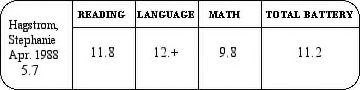
“Stephanie is a top student. That 12.+ means that she got every question right on that particular test. The point is, Stephanie will sound smart because she had mastered her language far beyond what we expect of an eleven year old. Rosa will sound stupid,” Carmen made a face as if the word were distasteful, “because she has not mastered English. The Stephanies of the world always get more than their fair share of attention.”

Neil glanced quickly at Carmen, and caught her face in such an intensity of expression that he could almost see back into her own childhood to the time when she had learned how the “Stephanies” stole attention away from the dark, quiet ones.

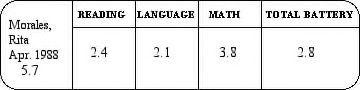
Carmen returned to the file and pulled out a third folder. The girl’s name was Rita. She was skinny and smiling from behind a huge pair of glasses.

Neil looked at her test scores and just shook his head. “Why is she in sixth grade?” he asked. “She can’t do the work if she is scoring at a second grade level. Why wasn’t she retained?”

“I know this one,” Carmen replied. “I had her when I taught third grade. She is almost fourteen. Her family moves back and forth from Mexico even more than most. She went to first grade here. Then she disappeared for a couple of years, and came back for third grade, but she only stayed until Christmas and then we didn’t see her until the middle of fourth grade. She went to three other American schools during that time, for a few months here and a few months there. Who knows what she did in Mexico. Even when she was enrolled in school here, she seldom came. She has seven younger brothers and sisters, and her mother keeps her home to baby sit.

“She hardly speaks English at all. I’ve tried talking to her in Spanish, and her Spanish is terrible, too. Just when I thought I was going to get close to her and make a difference in her life, she went back to Mexico again.” more tomorrow

Symphony 15

“Two years ago a team from the state told us we had to go to a middle school arrangement. It’s the latest thing, putting sixth grade up with seventh and eighth. Never mind how poorly it works! That’s when we put in the portables and built a fence between the two halves of the campus. That’s when we worked out this schedule.”

Neil was surprised at the bitterness in her voice. He guessed that she had fought against the change. The schedule looked beautifully logical and balanced, but he had an idea that it would not work out in practice as well as it did on paper.

He remembered the three brown faces in the road ditch. “What about those students who don’t speak English?” he asked.

“Hopefully, there will only be a few, but some of your students may not read or write.”

“You mean they may not read and write well.”

“I mean they may not read or write at all. In English or in Spanish. That happens when they shuttle back and forth to Mexico every year.”

Neil caught Carmen studying him with a look of puzzled curiosity that she tried to hide. “Have you studied your cumulative folders yet?” she asked quickly.

“I don’t know what they are.”

She led him to the teacher’s lounge and showed him the file cabinet where the folders were kept. The folders for each group of students filled a fat cardboard box. They took the two sixth grade boxes back to Carmen’s room where she took a folder and laid it in front of Neil. It was for Rosa Alvarez. Along the top edge of the folder was a row of six small photographs — Rosa’s pictures in every grade from kindergarten to fifth. She was dark haired and brown eyed with a round face and a solemn expression.

Covering the front outside of the folder were strips of computer printed labels with esoteric columns of numbers. Like the pictures, there was one label for each grade. Carmen tapped the labels with her forefinger and said, “These are test results. You will find them most useful for getting to know your kids quickly. Every year all of our students are given a comprehensive battery of standardized tests. They can be very useful, but you should remember that they aren’t always accurate.”

Carmen smiled for the first time. “You can also use them if you have a weakness for soulful brown eyes. I sometimes develop such an affection for my students that I stop pushing as hard as I should. Lately I’ve made it a practice to come back to these test scores at least once a quarter to remind myself of where each child really is.”

Neil studied her. She was beautifully proportioned. Her hair and coloring were pure Chicano. Her facial features were quite small. She kept her feelings hidden behind the smooth perfection of her face. Neil wondered how much Bill Campbell had told her.

The computer label was covered with data. Carmen said, “Look under the name. You see the 5.7? That is the base of comparison for the other scores. It means fifth grade, seventh month. That is when they took the test. A student who was exactly dead average would score a 5.7 across the board. Now look at Rosa.”

“Rosa’s reading scores show her reading almost a year below grade level. That isn’t as bad as it seems. That kind of variation is still fairly close to the norm. Her language score, though, is nearly two years below grade level — she scored at a high third grade level when she took this test. Her math score is above grade level, which puts her total somewhere near normal.” more Monday

Symphony 14

He opened all the windows and propped the door open with a chair but it didn’t help much. Then he surveyed the room. He opened the doors under the counter that ran the length of the window wall and found it mostly filled with sealed cardboard boxes belonging to Gina Wyatt. It was just as well; he had nothing to store. All of the paraphernalia he had accumulated during his years of teaching were stored in his mother’s garage in Oregon. They would be of no use to him at this grade level.

The west wall of the room had a generous blackboard. There was a battered metal teacher’s desk jammed against the wall, a row of coat hooks at the back of the room, and some empty bulletin boards on the walls. The walls were of faded blue plaster. The acoustic tile ceiling was discolored where the roof had leaked.

Jammed into one corner, beneath the blackboard and against the counter, was a battered bookcase. Neil sat cross legged to examine it. It contained a dozen dictionaries, an ancient set of encylopedias, and about fifty books. They were a mixture of rescued cast-offs and modern but much worn children’s paperbacks. There was a note taped to the shelf that said, “Don’t let the kids steal too many of these. Good luck, Gina.”

Neil smiled. The note made him feel less alone.

That note was the only piece of paper in the room, so Neil went to the office and filled out a requisition form. An hour later the janitor delivered a cart load of materials: reams of newsprint, binder paper, drawing paper, construction paper in assorted colors, crayons, tape, paper clips, and staples. But there was much missing. There were no colored markers, no stapler, no pencils, no pens, no binders, and no spiral notebooks.

At the bottom of the requisition form was a note saying, “The school doesn’t supply everything you asked for.” Then it went on in parentheses: (Sorry. Low budget. You’ll get used to it. Ask Pearl for help — she’s our best scrounger. Evelyn.)

Neil didn’t know whether to laugh or cry.

Enough. He was spinning his wheels here. He still didn’t have a clear picture of what he was supposed to teach, so he crossed to Carmen de la Vega’s room.

The air conditioning wrapped him up in a rush of cool air. Carmen looked up with a distant, measuring coolness of her own. He reminded her that she was supposed to show him the ropes.

She began by sketching a grid on paper. “The students have seven periods of classes. We teach six and have one period off for preparation. You’ll need that to grade papers. In order to make it all work, our preps are staggered. Yours is fourth period, mine is seventh, Pearl’s is first, and so on. 

“We have about sixty-five students in the sixth grade.  They will be divided into two groups, and they will stay in those groups all day, moving from teacher to teacher as a unit. They will have one period each of math, history, science, and P.E., except that Tom teaches P.E. four days a week and art one day a week. The rest of the day they will spend with you.”

Carmen had sketched in the schedule as she explained, and it was clear enough. She said, “That means that you will actually teach only two classes a day, but each class will be three periods long.”

“Isn’t this a bit of a strange schedule?” Neil asked. more tomorrow

Symphony 13

When he got back to his apartment, Neil dug around in his still packed boxes to find the few books he had kept as personal treasures from his childhood. The formula books had not worn well; they held little that the adult Neil McCrae could find worthwhile. But there were others that had kept their value, and he spent the next four hours accompanying the young Hunt brothers as they continued the expedition their father had had to abandon, collecting zoo animals while floating downriver on their Amazon Adventure.

# # #

On Monday morning, Neil arrived at work five minutes late in order to avoid meeting his colleagues before Campbell had a chance to introduce him. They were laughing and joking as old friends will when they have not seen each other for months. Neil was the only newcomer; their responses to him were quick and friendly.

Pearl Richardson was broad and heavy, with short white hair and a mouth full of laughter. Fiona Kelly sat beside her, sharing a joke, with a dry chuckle to Pearl’s hearty guffaw. Fiona was slender and pale with hair that might have been red even before her hairdresser got hold of it, and was absolutely red now.

Donna Clementi was petite and quiet. Neil thought it would take a long time to get to know her. Delores Zavala sat a little removed from the rest of the group as if she were not quite sure of her place there.

Tom Wright was well formed but slender. He had straw colored hair and a runner’s body; sitting there in gym shorts and a tee shirt he looked precisely like a P.E. teacher. Glen Ulrich looked old, tired, and ill. His eyes had the look of repressed physical pain.

“Finally,” Campbell said, completing the introductions, “is Carmen de la Vega. Her room is just across from yours, and she is teaching core to seventh graders. She will be the one to go to when you don’t understand something.”

Neil felt something like a shock run through him. It was not recognition — he did not know her and she did not remind him of anyone he knew — but it was a spark. A recognition of possibilities. It took him completely by surprise. It went straight through his smiling, guarded mask and gripped his heart in with both hands. 

But when she raised her eyes to his, there was no answering spark in them. They were cool and hooded. She smiled and said hello, but it was a distant, formal smile that brought no feeling to her eyes.

# # #

The morning was devoted to discussion of the changes in the language and social science frameworks. Neil was barely aware that such things existed and had never read one. He followed the discussion as best he could and offered no comments.

After lunch, they were free to work, so Neil went to his room. The walls were bare. It would remain a place without personality until he put his stamp on it. The student desks were a mixture of styles and colors. Some were new, but most were battle scarred veterans made of dark, much carved wood. He compared their number to the list of students he had been given and made a note to ask for two more.

It was one o’clock and the temperature outside was in the high nineties. In only a few days, Neil had come to know Modesto’s end-of-summer weather pattern. It would continue to grow hotter until four or five, and hold that heat until after sundown. The room was an oven. more tomorrow

Symphony 12

Neil woke up stiff and disoriented. The breeze from the air conditioner had finally conquered the heat of the apartment and had gone on to chill him while he slept. He was sticky and clammy with half-dried sweat.

For a minute, he did not know where he was. He was caught up in the tag end of a dream. It had not been pleasant, but he could not remember enough details to understand his discomfort, and so he couldn’t let it go. Finally he shook his head and staggered up, forcing the remnants of sleep away by action. He turned on the lights in the kitchenette, drank deeply from the tap, and looked at the clock. He had slept six hours, and he knew the rest of his night would be sleepless.

He showered, ate, and watched the ten o’clock news. It had been 106 degrees. He rubbed his gritty eyes and thought longingly of the coastal fogs of his native Oregon.

He picked up the reading textbook again, then surprised himself by throwing it against the wall in disgust. It was trash — unfit to inflict on children — and it would get no better if he read it from cover to cover. He kicked on his shoes and went out.

The night was a pleasant shock. The heat of the day had miraculously disappeared and the evening breeze was deliciously cool as it coiled about him. He crossed the parking lot, then changed his mind, and pocketed the car keys he had been carrying. The only places that would be open at this time of night were bars, and alcohol would have no part in solving any of his problems. He walked down Sylvan and turned off onto the first residential street he crossed.

The night air was perfect, and the moon was almost full. Even between the widely spaced street lights, the lawns were well visible. It was a middle class neighborhood of twenty year old houses, neatly kept. Each lawn was well clipped, the sidewalk edges were meticulously neat, and the street trees were beginning to come into maturity. There was an air of respectability and prosperity about the place; not the snobbery of the wealthy houses in his home town, nor the poverty of the barrio apartments, but a California style embodiment of the American dream. They reminded him of the neighborhood where he had grown up, and he let the half dark houses around him fade into memories of the houses and people he had known.

Even in the midst of nostalgia, Neil was trying to solve the problems that would face him in the weeks to come. He tried to remember how he had learned to read, and found that he could not remember a single textbook. Had they been as insipid as the ones he had been given today? It was hard to believe that he would not remember such books — with loathing.

All he could remember were the books he had owned and loved, read and re-read. Many of them were trash, too, but of a different kind. They were written to a formula by anonymous authors and published under a company owned pseudonym. He had not know that at the time, of course. He had even written the “author” a fan letter, and had received a form thank-you in reply. But whatever they lacked in style, skill, and grace, they had had a plot. Someone young whom Neil had liked had gone somewhere interesting and had done something exciting while overcoming dangers without the help of an adult. That was more than he could say about the stories in the reading text. more tomorrow

Symphony 11

Near the tracks, where the dirt road left the tarmac, there was a cluster of tiny houses. Once they had been painted white, but they were repaired with raw wood, some new, some old, giving them a patchwork appearance of gray, tan, and dirty white. Some of the roofs were of corrugated iron, others were of tattered shingles. The few trees that sheltered the little houses from the August sun were unwatered and sparsely leafed. Over everything there was a patina of dust.

Neil slowed down and turned back east once more. Those little houses were typical of the kind of housing provided by farmers for their migrant help, but Gina had said that these had been bought up by a Modesto attorney and were being rented out. They had no formal name, but everyone called them the Johnson Road apartments because the farm had once been owned by the Johnson family.

As Neil cruised by one last time, three small brown children popped up out of the weeds in the road ditch and stared impassively at him as he passed. He waved, but got no response.

He had considered driving up the tarmac road past the small houses, but it had seemed too condescending; too much like slumming. Now he was glad that he had not.  In about a week some of those faces he had seen in the road ditch would be in his classroom, and he didn’t want to start his work here by offending anyone.

# # #

Back in his own apartment, Neil turned the air conditioner up, stripped to his shorts, and sat directly in front of the thin stream of cool air. His drapes were pulled against the afternoon sunlight, so that the room was a cool refuge against the heat. He turned on one small lamp and looked again at the textbooks. Despite the poverty of the barrio apartments, he had been rejuvenated by the sight of the three children. If they were his to teach, then he had to take a closer look at the tools he had been given to teach with.

They were awful. The grammar book was so confused and overdone that he could hardly read it. Every page was overprinted with colorful drawings and pictures. When it was new, that had probably caught some administrator’s eye. It was hard to imagine a working teacher being impressed.

In New York, Neil had learned how to lead a reader’s eye across a page by the manner in which the text was laid out. It could be done subtly by column spacing, choice of typefaces, and the judicious use of headings and simple drawings.

There was nothing subtle in this textbook. Everything was in glaring reds and blues, and the eye paths spiraled and folded back on themselves in total confusion. It was like listening to rock music written by an untalented garage band. It was visual noise.

The spelling workbook was merely dull. There were twenty words per lesson to be memorized, and four or five pages of insipid fill-in-the-blank exercises.

The reading textbook was the worst. It looked good; the pictures were varied, colorful, skillful, and the page layout did not distract the eye. But the stories were so dull and pointless that it would be a wonder if any child could bring himself to read them.

Neil read the first story and shook his head. The second left him feeling hopeless all over again. The third story put him to sleep. more Monday

Symphony 10

“They can’t expect me to teach anything to kids who don’t speak English. There has to be a better way.”

“There are better ways, for districts who can afford the specialized personnel,” Gina snapped. “This district can’t. When you’ve been around a while, you will see for yourself.”

Gina’s news was most unwelcome, and left Neil feeling sorry for himself again. For most of the summer, he had managed to keep the past out of mind by a complete change of scene. He had approached this new school with a grim determination not to let self-pity get the better of him, but that resolution hadn’t lasted out the first day.

“Look, I’m sorry,” Gina said, sensing his mood. “I didn’t mean to be critical, but things are different here than you are used to. I don’t know why Bill didn’t tell you what you were getting yourself into. It’s not like him.”

Neil wanted to change that subject. He said, “Don’t blame Bill. I walked into this with both eyes open. If I didn’t ask enough questions, it’s my fault, not his.”

“Still . . .”

“You were going to show me what books you use and what you do,” Neil suggested, and they spent some time doing that. Then Gina took her leave, waddling uncertainly out to her car.

When she had gone, he sat in stricken silence for half an hour, idly fingering the textbooks without really seeing them. First Alice Hamilton’s false accusation, and then a class full of students with needs he seemed unlikely to be able to meet. That would have been enough for depression. But the textbooks Gina had given him were awful.

Neil was in love with the English language, and with its expression in literature. That was what had taken him to New York, and it was the perversion of literature in the marketplace that had driven him back to college, and then into teaching. Now he would be teaching children who could not even read, and the materials he had been given were so trivial, so insipid, that his mind couldn’t deal with them.

All else he had born with at least an outward calm. But the descent from Shakespeare to Dick and Jane pushed him to the edge of despair.

Despair, however, was something Neil had no intention of giving in to.

# # #

Neil left a short time later, and drove eastward toward McHenry Avenue. Within a couple of miles, he approached the Western Pacific railroad tracks, and slowed down. According to Gina, most of the Chicanos who attended Kiernan School lived in a barrio-like cluster of houses and apartments on either side of the tracks. He rode slowly by, trying to gauge the depth of their poverty but it was impossible from the main road. He turned around and drove by a second time, more slowly.

On the east side of the tracks was a small, run-down apartment complex. It was called the Oaks; or miscalled, because the two huge trees shading it were sycamores. Two scruffy, unbarbered palms flanked a broken concrete fountain at the east entrance. The grass around the buildings was cut and green, but the dusty field beyond was full of abandoned cars. A few children were clustered around a swing set.

On the other side of the railroad, a pot-holed tarmac road led north parallel to the tracks. Two hundred yards from Kiernan, a dirt road led to a huge and ancient barn, a cluster of ragged trees and the burned out shell of what had been a two story farm house. Near the tracks, where the dirt road left the tarmac, there was a cluster of tiny houses. more tomorrow