Tag Archives: writing

593. Flying the Good War


A note before we begin. The fiftieth anniversary of the Apollo 10 liftoff is Saturday, but my post on that event will wait for the anniversary of the descent, next Wednesday.

For Americans, WWII was The Good War. For many of us, it was the last war we could be proud of. It is also the last war we won. There has to be a connection in that somewhere.

My father came home from the war, found a wife and had a son, all in a year. I grew up in the shadow of the war he had just fought. The idea of being a pacifist, or even questioning going into the military never came up for me until much later when America found itself in Viet Nam.

In 1956, when the Soviets invaded Hungary, my cousin and I played refugees escaping to America. In 1962, when the first theatrical movie played on TV, it was The Enemy Below. Our whole family watched together as an American destroyer played a game of wits with a German U-boat. After that, I wanted to join the Navy.

(I did, eventually, but that was an entirely different set of circumstances, and a whole different story.)

That’s how it starts for a boy, and reading can be a big part of the story. A lot of space adventure juveniles are really stories about space navy or space marines. The Bullard and Rip Foster books mentioned about a month ago (post 582) are examples, but they are much toned down compared to the juveniles about WW II, written while we were actually fighting.

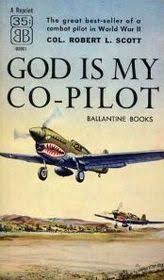
God is my Co-pilot wasn’t a juvenile, but it is still that kind of book. During the days just before America entered WWII, Robert Scott was a volunteer pilot fighting the Japanese on behalf of the Chinese. Millennials will have to do a mental reset on that issue; Japan was an industrial powerhouse then, China was a backward country of peasants, and the Japanese attacks were brutal. America’s sentiments were with the Chinese.

Robert Scott wrote his memoir in 1943 and thousands of American kids read it from that time forward. I was one of them. When he shot Japanese planes out of the sky, I cheered him on. But he also strafed soldiers on the ground. That was a little tougher to read about, but they were the enemy, after all. He nicknamed his plane “Old Exterminator” . It was quite a bit different from fifties TV where the cowboy always shot the gun out of the bad guy’s hand.

Even though Scott’s tone was dispassionate, hating the enemy came through clearly. That was also true of R. Sidney Bowen, who wrote the Dave Dawson series, but there was nothing dispassionate about his way of putting things. For example:

The dark of night had come again to war besieged England, and from the northern most tip of Scotland clear south to the Isle of Wight British eyes and ears were on the alert for any and all surprise moves by Hitler’s devilish hordes on the other side of the English Channel and the North Sea. . . . At Lands End Base, however, there were two who were not waiting for “Satan,” with his trick mustache and ever drooping lock of greasy hair, to make the next move.

The Nazi was almost screaming by the time he finally came to a pause. Dave, looking at his flushed face, spittle drooling mouth, and popping eyes, knew that he was not looking at just one man but at a living symbol of the whole rotten to the core Nazi breed. Just as Air Marshal Manners had said, “Clever, cunning, and a genius at his work, but a black hearted, ruthless murderer.”                         both quotations from Dave Dawson on Convoy Patrol

Like Scott, Bowen had been a military pilot. He started out driving an ambulance during WW I. He later lost that job because he was underaged, returned to the US, and when he turned seventeen, volunteered for the Royal Flying Corps. He saw limited service as WW I wound down. He then joined the US Army Air Service.

He became a journalist, and later became editor-in-chief of Aviation Magazine. When WW II broke out in Europe, he began the Dave Dawson War Adventure series which produced fifteen volumes during the war. They were still available in one local library when I discovered them fifteen years later.

They weren’t literature. They were really pretty awful. They did have something going for them besides slam-bang action and hyper-patriotism, and that was all the airplanes. Dave and his buddy Freddy were constantly flying different Allied planes, forever getting shot down or parachuting behind enemy lines for reasons of espionage, and always escaping in a captured Nazi or Japanese plane. Over the course of fifteen volumes, they must have flown sixty types of planes.

Whatever Bowen lacked, he knew his planes.

Dave Dawson began as an American volunteer in the RAF, just as Bowen had done one war earlier. When America entered the war, Dave and Freddy bounced back and forth between flying for Britain and flying for America. Eventually, they fought in every theatre, taking young Allied readers with them.

They hated Nazis and they hated Japs (Bowen’s word), but they were never cruel. They would never have strafed troops on the ground, as the real Robert Scott did regularly. In Dave Dawson with the Pacific Fleet, two spies were escaping from the boys’ aircraft carrier, carrying vital information to the Japanese. Dave and Freddy shot down their plane, but the spies parachuted. Dave and Freddy agonized about the situation; the information the spies were carrying could cost American ships and lives, but in the end they could not bring themselves to machine gun the spies as they floated down.

Robert Scott would not have hesitated a heartbeat.

Dave and Freddy couldn’t keep the spies from reaching a pair of Japanese cruisers, but they did manage to singlehandedly sink both ships, killing thousands of Japanese with a clear conscience. (If you think you detect my tongue jammed securely into the corner of my cheek, you are quite right.)

I admit to liking the excitement, the danger, and the mystery of those books, but for me it was mostly about the planes. Before the space race started with Sputnik, I was already in love with hot planes, and there are no hotter planes than military ones. I put those sentiments into the mouth of Snap in Like Clockwork, when he said to Pakrat:

“Weapons of war are the most beautiful machines men build. I don’t know why it is so, but it is.”

The Dave Dawson books are available in an e-book megapack, which I bought while doing this post. I don’t recommend them, but one reviewer said, “I appreciate that they are clean books, but with enough adventure for a boy.”

Okay, maybe. If John Wayne shooting a few hundred Indians to save the fort was good clean fun, so was Dave Dawson.

When I was a kid, I used to watch those cowboys-and-Indians shoot-em-ups, but I can’t do that any more. I can still ignore the Dave Dawson book’s failings under the excuse of nostalgia, and read one once in a while when it’s late at night and I’m too tired to think. I’m sure it’s the planes that make the difference.

I don’t see books like these any more, but today’s youth don’t need them to get a military fix. They have video games. (There’s that tongue in cheek again.)

592. Armed Forces Week 2019

Armed Forces Week comes in May. It runs from the second to the third Saturday. The third Saturday is also Armed Forces Day.

As holidays go, Armed Forces Week isn’t particularly notable. Mother’s Day also gets caught up in the mix as the only Sunday in the week. For “right thinking people”, that probably seems appropriate. For those of us whose thinking is always a bit off center, it is ironic.

It all depends on your view of the question of the legitimacy of military force. To a very few (not including me) it is always wrong. To the average American, a simple statement that, “We support our servicemen,” ends the discussion.

It really doesn’t end anything.

We all know, whether we want to admit it or not, that every military organization in history has committed atrocities. If your answer to, “Do you support [fill in the military action of your choice?]”, is “I support our troops.”, you are just avoiding the question.

I have problems with all this. I’m no pacifist, and I believe in defending my country. Still, I see example after example of our government screwing things up and getting our servicemen and women maimed and killed for unsupportable reasons. Viet Nam comes to mind, but the problem didn’t stop when that quasi-war was over.

It hits close to home for me in a rather odd way. My wife and I make quilts, and are members of a local quilt guild. There are several organizations like Quilts of Valor which coordinate the making of quilts to be given to veterans. It would be hard to find any organization which seems more useful and harmless, but I don’t participate. Most people see these organizations’ efforts as support for troops and veterans. I respect that position and I never argue with them, but, for me, it feels too much like validating the jackass generals in all the stupid and useless things they do.

It is the same with  Armed Forces week. Most people see it as an appreciation of our soldiers and sailors, but it looks to me like a smoke screen. It tends to make legitimate questions about American military actions look like a lack of patriotism.

I came to this opinion when I was in the service. To clarify that, it was in the Viet Nam era, but I was not deployed to Viet Nam itself.

And it all starts with boot camp. I wrote a post about that experience for Armed Forces Week of 2016, That was three years ago when the blog was new and not many people were reading. I repeated it two years ago, so I won’t print it again, but if you want to know what I think of that institution,  go to 432. The Making of a Navyman.

591. The Flower and the Seed

This is the picture of a place near my home. For eight months of the year it is a dry wash, surrounded by vegetation burned brown by the summer sun. It only looks like this during the brief rainy season.

Every year the water off the surrounding hills reconfigures the falls and pools, so every spring the place shows a different face.

Two years ago here, I saw a sprig of grass growing at the edge of a rushing torrent, ready to be torn off and swept away. This poem occurred to me:

Though the bee did not come,
And the fruit did not form,
            It does not follow
That the blossom lived in vain.

Of course it isn’t about bees, flowers, and seeds — or springs of grass — but about songs unsung and books unread.

I am short of time today, after Monday’s massive post, so I thought I would share this brief poem again.

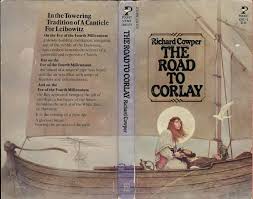
590. The Road to Corlay

Cold curtains of November rain came drifting slowly up the valley like an endless procession of phantom mourners following an invisible hearse. From beneath an overhang of limestone a boy and an old man squatted side by side and gazed disconsolately out across the river to the dripping forest on the far bank. Suddenly a salmon leaped — a flicker of silver in the gloom and a splash like a falling log. The boy’s eyes gleamed. “Ah,” he breathed. “Did you see him?”

That’s a lot of description for an opening paragraph. Hemingway would have hated it, but it works perfectly to present the quasi-medieval setting and elegiac mood of The Road to Corlay.

The novel came out in paperback from Pocket Books in 1979. I read it some time that year and it made a permanent impression, so much so that I named it as one of my fifteen favorite books earlier this year. The impression, however, was of its quality and was not accompanied by anything like a scene by scene recollection.

I had to read it again, and I am glad that I did.

What appears between the covers of the Pocket Books version is a novella called The Piper at the Gates of Dawn (Hugo and Nebula nominee for 1977) and a short novel called The Road to Corlay. Together they tell one seamless story, but it will be easier here to talk about them separately.

Beware — I normally avoid spoilers but I can’t do it in this case.

The Piper at the Gates of Dawn is allegorical, but don’t let that put you off. Allegory is often just a lazy author’s attempt to achieve false profundity, but Cowper does it right. My personal test for allegory is, “Does the writing stand by itself? Would I like it as well if I didn’t know the story it mimics?” The Piper at the Gates of Dawn passes this test easily.

 It takes place on the eve of the new millennium, 2999 AD, in a post-flood England. The waters began rising in the 1980s due to global warming. (Yes, I said global warming, even though this story was begun in the 1970s.) By the time Piper opens, technological society is a thing of the past and the Church Militant rules the land.

Here is the only real weakness in the underlying story. Why revive Catholicism as villain? In the 70s its power was essentially dead in Britain, and its resurgence is merely assumed, never explained. I can only chalk it up to the extreme Englishness of the novel. Brits have been seeing the Catholic Church as bogeyman since Bloody Mary’s reign of terror in the 1550s. If this novel had been written by an American (like Davy was), we would probably have seen cold, heartless Puritans hanging witches instead.

Logical or not, the Church Militant makes a good foil, and offers a medieval tone without needing a lot of backstory.

The story itself — that is, the plot — can be summarized quickly. Tom, a boy of about thirteen and Old Peter, a storyteller, are walking toward York where Tom is supposed to enter a Church school. Tom has the ability, taught to him by a wizard, to play his pipes so that he can control animals and make people see visions. He also knows a lot more about unfolding events than a boy should know. His playing amplifies Old Peter’s storytelling so that by the time they reach York, they are raking in money and followers.

Tom is a very docile and agreeable lad, but every time he gives in to Peter’s schemes, it moves him closer to his own destiny. Peter seems to have no clue that this is happening. We are not told that Tom is manipulating, but he never seems surprised when things go his way.

The world is in turmoil with prophesies of the coming of the White Bird of Kinship at the turn of the millennium. Once in York, at the end of the year, Tom slips away to play his pipes for the gathered crowd. The White Bird descends upon the land, but just at the climax of the event Tom is killed by the bolt from a crossbow.

Piper is allegorical, certainly, but not a true allegory. It is a retelling of the Christ story, but with more differences than similarities.

We have the self-sacrificed innocent, but he has preached no sermons and promulgated no gospel. We have Gyre, who fires the bolt but has no memory of the deed or the reason for it. There is a touch of Judas here, but only a touch, and that lies primarily in his regret.

We have the White Bird, which even a character within the story recognizes as being like the Holy Spirit, but the death of Tom does not bring about any redemption. It only causes the Bird’s descent to misfire.

We have Old Peter who takes Gyre with him to spread the word of what has happened, like two apostles after the resurrection. But there was no resurrection and the Bird has flown away. Peter and Gyre are not actually spreading the word of what has happened, but of what is still to come, and here we find a trace of John the Baptist.

It isn’t a Christ story, but a slightly Christlike story. And it is not an ending, but a beginning. The Piper at the Gates of Dawn is the most emotionally unified and satisfying part of the overall story, but it demands the follow-up provided by The Road to Corlay

=============

I sometimes hear reviewers say that, while they are ready to meet the characters in the opening chapter of a novel they don’t want to have to do it all over again on page fifty. My novel Jandrax caused great irritation to one reviewer for that very reason, but sometimes a complicated story requires a rotating cast of characters.

The Road to Corlay is that kind of work. It begins eighteen years after the boy Tom’s death. Old Peter and Gyre have been spreading the gospel of the White Bird of Kinship, but they remain mostly off stage. All the characters are new, and many of them won’t live to see the end of the book.

The Church Militant has tried to absorb the new religion into itself, but now its leaders change tactics. An proscription for heresy is released, and all the people we will come to care about become the hunted.

In researching for this post, I ran across a review of another Cowper novel which contained the lines, “This novel has real people in it that you can care about . . . just don’t expect too many laughs.” He could have been talking about The Road to Corlay.

The novel begins with two fishermen dragging in body bound to a spar. It is Thomas of Norwich, the second of three Thomases in the book. That is a little confusing, but a necessary part of the story. He is alive, but he shouldn’t be after all his days in the water. It will take the rest of the novel to answer why this is and what it means. He comes into the hands of Jane, who is gifted with huesh, which is something like ESP crossed with foreseeing. She enters his mind, but finds two men there, one being Thomas himself, the other a stranger she can barely touch.

It is in chapter two that the disaffection starts for most reviewers, including Joachim Boaz and Thomas Anderson, two reviewers I enjoy and respect.

In this new chapter the scene changes to 1986, a decade in the future from Cowper’s perspective. It is a familiar world of cars and hospitals, and of scientists working at the edge of current knowledge. A scientist name Carver is having a chemically induced OBBE (out of body experience) and his colleagues can’t wake him up. No one is worried at first, but then he sinks fast and the chapter ends with him in danger. We know from what Jane said in the last chapter that Carver is the other man in Thomas of Norwich’s head.

And it is raining — has been raining for months. Without ever saying so, Cowper has let us know that the rising of the waters has begun.

Let’s dispose of this 1986 intrusion, if it is an intrusion, before we get back to 3018. Everybody seems to hate it, but I didn’t mind it at all. On a visceral level, it was a relief every three chapters to spend a few pages somewhere that my new friends weren’t being hunted down.

More importantly, 1986 is a counterpoise to the future. It isn’t there to give backstory; that could have been done in a few carefully chosen sentences of authorial omniscience. It shows that the past and the future are the same. The scientists with their machinery basically don’t know what the hell is going on. The people like Jane who use and are used by huesh, don’t know where it comes from or why it works. The central purveyors of the new religion basically don’t know how any of it works, or what is going to happen next. Confusion is the human norm in all eras, which perfectly agrees with my prejudices.

Meanwhile, back in 3018: Thomas of Norwich takes refuge with Jane’s family. Only a small portion of the population has embraced Kinship, but those who have take care of each other. Jane is troubled, not only by the other man inside Thomas, but because she hueshed Thomas washed up on the beach, drowned. In her experience, huesh foreseeings never fail, and she has become fond of Thomas.

(Speaking of things to hate, I hate this kind of foreshadowing, but once again, Cowper made it work.)

Thomas has a mission, to find Gyre, who killed the boy Tom and became his greatest advocate, and to carry the boy’s pipes and written testament to safety in France. Jane takes him part way on that journey by boat, and is later attacked, then rescued. She learns that her family has been killed and she is herself now a refugee. She and Thomas come together again and he comforts her in her grief. In their days together, fondness has already turned to love, and now that leads to a night of lovemaking. Shortly after, they are captured together, and held for those who are hunting them.

Meanwhile, in a separate strand of the story, Brother Francis is sent by Cardinal Constant, head of the English Church Militant and prime mover against the Kinsmen, in search of knowledge about the boy who died. Francis travels from place to place, tracing the boy’s history, and hearing from those he has touched. He is slowly converted to Kinship, so as he nears the end of his journey, he changes sides. When he finds Gyre, he does not turn him over to the Church, but chooses to help him.

Gyre offers to play on the boy’s pipes, so Francis can hear an echo of an echo of the melody that is converting the world.

Raising his head abruptly the dying Kinsman gazed up at the vaulted ceiling and cried with a voice so strong it seemed almost as if it must be coming from some other throat than his: “Boy, show now at the end that I am forgiven! You know that I shot in ignorance of what I did! Speak you now through my darkness that his darkness may become light!”

He drew a deep, panting breath, raised the twin mouthpieces to his lips, and fixing the Advocate Sceptic with an unwavering gaze he began to play.

The Road to Corlay is a long and complicated story, but none of it would mean anything if it weren’t so beautifully written.

Gyre passes the pipes and testament to Francis and dies. Francis goes on, now looking for Thomas of Norwich to deliver them to him, but he finds him captive of the Church. Using his standing as a priest, since no one knows of his apostasy, he effects a rescue, but Thomas is killed.

Jane, with her unborn son, the pipes and the testament, escapes to France where her coming son Tom will fulfill his destiny.

=============

Tom the boy who died by crossbow, Thomas of Norwich who inherited his pipes and testament, Tom the unborn son in Jane’s womb at book’s end (who I’m told is the primary figure in the two sequels) — clearly we have a reincarnation sub-text going on here unexplained.

We also have a sub-text of repetitions. The birth of Christianity, medieval days, the rise of technological hubris smashed back by a flood (again, just like Noah), the rebirth of a quasi-medieval society and a new Church Militant, followed by the birth of Kinship (the primitive, original Christianity?). From what little I know of the two sequels, Kinship wins out, becomes the great power, and is itself corrupted.

To my eye, this all looks very Hindu, with age after age, and avatar after avatar of basically the same Gods, repeating variations of the same myths. I’ll say more on that in a month or so when I deal with the Earthsea books.

=============

Now I’m going to take you down the rabbit hole of my Southern Baptist childhood by way of this quotation:

. . . midway out in the Somersea a three masted barque, its white sails drooping like tired petals, floated becalmed above it’s own reflection. High above it a solitary star twinkled, a silver drop suspended from an invisible thread.

There are white boats in the offing in several places in this novel — white like the White Bird. In this case with “white sails drooping like a tired” (bird?). A three masted barque — where else have we seen something that looks like three upright wooden masts crossed by yards? Oh, yes, on the hill at Calvary? And where but above the manger did a solitary star twinkle?

You doubt me? I don’t blame you, but this is the world of types and symbols scattered through a sea of parables that I grew up in. This book speaks to me the same way, with little hints and teases that float untethered through the text. No? Then tell me, if that barque is not symbolic — even if my reading of it was not precise — why was it there? It had no place in the plot.

These are the little touches — images and turns of phrase — scattered throughout The Road to Corlay which make it read like a new scripture to those of us who spent our childhoods reading the original Christian scripture.

=============

I don’t understand all of The Road to Corlay; I’m not supposed to. If all its meaning could be reduced to reason, Cowper could have nailed it to some college door like the ninety-five theses, and it would have been mummified in a philosophy text.

Instead, he gave us a fable. I understand that impulse. In 1975, fresh out of graduate school, I wrote my first novel, and was seduced. I could say things in fiction that I could never say any other way.

Thomas of Norwich, trying to explain how it felt to play the song of the White Bird, said:

“I knew the supreme joy of possessing something that can only exist in the giving.”

I get it. That’s how it feels every time I write, but it seems too arrogant to admit, so let’s just keep it between ourselves.

589.5 Tequila and Lederhosen

Cinco de Mayo caught me by surprise this year. It is an important holiday in California, and was particularly important to about half the kids I taught before I retired.

You will note that I did not say Mexican-American kids. Even before the advent of Trump, a surprisingly large number of (whatever) students didn’t like that name. Some wore a T-shirt that said:

Not Mexican-American
Not Hispanic
Not Chicano
MEXICAN!

I’ve already had my say on the subject of Cinco de Mayo. I invite you to check out these two older posts to see what that was.

One post had the full title: Juan Angus Georg Angelo O’Malley celebrates St. Patrick’s Day by drinking tequila and while wearing lederhosen under his kilt.

The other was titled: Who said you were Mexican?

589. A Son of the Sooner State

I was born in Oklahoma, a land on the edge of the South and also on the edge of the West. It was the land of the Indians, but you wouldn’t know it from the power structure. Its flag honors 60 tribes, but the whole place is pretty damned white. During my childhood, it wasn’t a great place to be a Black, a Jew, or an Indian.

Some say Oklahoma fought on the side of the South, but that isn’t accurate. Some Indian tribes living there fought against the Federal government, and they had reason, but the white folks who came in, took over, and dominated the new state of Oklahoma came from both north and south, long after the Civil War was over.

Kansas did fight for the North, and soon after the Civil War it had become culturally eastern. It was a place where the eastern cattle buyers bought the herds driven up from Texas, and where the immigrant sodbusters set up their farms. Dodge City, Abilene, Wyatt Earp, you know the story.

Texas fought for the South and right after the Civil War it began sending herds of cattle north to the newly built Kansas railroads. They left Texas scrawny and arrived at the railhead fat, working their way slowly northward while eating free grass.

Did I say free? Well . . .

Bear in mind what lay between Texas and Kansas — Indian Territory which would later become Oklahoma. I.T. was the dumping ground for disenfranchised Native Americans (see 247. The People’s President), and it was their grass that fed the cattle, which made the cattle owners rich, made the railroad owners rich, and fed the people in eastern cities.

Pretty soon railroads like the KATY were cutting across Indian Territory itself. That was the nickname of the MKT, the Missouri, Kansas and Texas. It started in Missouri (barely) but primarily it linked Kansas with Texas. The land between was still called Indian Territory, but more and more whites were moving in, often to railroad towns, and the tribes were rapidly losing what hold they had over their new homeland.

My paternal grandparents were both young when they separately moved into Oklahoma, while it was still Indian Territory. My grandmother liked to tell tales about getting her mail addressed to K2C, IT. In modern English, that’s Catoosa, Indian Territory. Even though this was long after the great cattle drives, my grandfather still herded cattle on horseback. Someone in the family still has a photo of him in wooly chaps, hat, boots, and six-shooter, looking like Sam Elliott. My maternal great-grandfather was a locomotive engineer on the railroads that opened up the territory.

Piece by piece, the Native Americans lost the land they had been granted when they were forced out of the Eastern United States. Whites moved in and Oklahoma was born in 1907. I came along forty years later, a year after my father returned from WW II.

When I was young, we had our own version of rich and poor, but it was a mild form of The Great American Malady. Ranchers wore Stetsons and cowboy boots, had horses and drove Cadillacs. Farmers wore ball caps and laced up work shoes, did not have horses and drove pickups, usually old and rusty ones. We were farmers, although my Dad finally treated himself to a Stetson when he was well into middle age and wore it to church every Sunday after that.

By the time of his death, and even more rapidly a few years later, the land and culture of my youth and his adulthood disappeared. Our farm no longer produced grain and milk, but was subdivided into toy farms for people who worked in Tulsa, but wanted to breathe clean air on the weekends.

By that time I was gone. I left Oklahoma in 1966 and rarely returned, but everything I have written since is filtered through memories of that place. I suspect every other writer could tell a similar story.

588. How Quickly Do You Write?

How long does it take to write a novel, a short story, or a poem?

Those who visit this site and register a like usually have websites of their own which I visit, so I know that many of you write. Many more of you would like to, or are just starting to. “How long does it take?” may not mean much to a poet, but anyone writing a novel has to wonder if she/he has a reasonable prospect of completing it.

I had that question myself when I started. I wondered if I could sit down and write every day until I had produced a novel. It seemed more likely that the well would run dry and I would end up going on to something else, but there was no way to know except by trying.

I began the day after Labor Day, 1975, and wrote five days a week. By Christmas, I had a novel. It was short, simple, and unsalable, but it was finished. I loved the process and I was hooked.

I started my second novel, Jandrax, the first of the next year, and had it finished by summer. That needs a little explanation. It was in the mid-seventies and the typical paperback novel ran about 50,000 words. Today a typical novel is, at minimum, twice that.

Novels in the seventies were often extremely fast paced. These days they are (to my taste) glacial. Comparing Gordon Dickson’s early novel Dorsai! to his late novel The Final Encyclopedia will show you what I mean.

Jandrax could have used more smooth transitions between scenes and less twitching speed. About another seven thousand words and another two or three weeks of attention would have helped. Still, it fit into its era and was published by Del Rey, but I would slow the pace if I were writing it today. A bit. Not much.

During 2017 I wrote a novel of about 90,000 words called The Cost of Empire. The rough draft took about four months and it went out looking for a home at the end of six. That is about twice the pace of my first published novel, which makes sense after all these years of experience.

Next I wrote Like Clockwork, a much more complicated novel. I worked from January to July of 2018; then I broke off and rewrote what I had as a novella for a sales opportunity that had come up. That didn’t pan out, so I went back to the original concept in October. I lost most of December and January to another project, then finished the novel at the end of February. Call it ten months of writing, spread out over fourteen months altogether.

Ten months vs. six seems about right for a complex vs. a straightforward novel at this stage of my life. The longest I ever took from concept to publication was just short of forty years, but that was a special case.

I write, rewrite, and polish — then polish again. Most authors with a long list of novels don’t do that. Louis L’amour clearly did little if any revising. His books are full of inconsistencies that he or an editor should have caught, but that didn’t keep him from being spectacularly successful. He wrote 89 novels in 38 years.

During World War II, Robert Sidney Bowen wrote about twenty air war novels for boys in five years. He said he could complete a novel in ten days and he never revised. No problem — considering their style and quality, revision probably would not have helped.

Lester Dent reportedly once wrote an entire Doc Savage novel over a weekend, although that amounted to taking two shorter works he had already written and blending them together.

I think we all want to write a bestseller in record time in a frenzy of inspiration. That dream probably won’t come true for any of us, but I know of at least once that it happened.

Colonel Robert Scott, WW II war hero, was recalled by the Pentagon for a tour America to stir up feelings of patriotism with his personal story of shooting down flocks of Japanese planes.

Near the end of that tour, Colonel Scott was asked by the Scribner (sic) publishing house to relate his experiences in a book. But he had only three days to do so before he had to report to Luke Field in Arizona as its new commander, so he simply spoke his recollections — 90,000 words — onto wax cylinder recording devices.*

Three days! God Is My Co-pilot became a best seller.

*The quotation is from his obituary in the New York Times.

587. Back to the Garden

Since summer, I have been working on reviewing the fifteen novels I chose as my favorites, and one thing has emerged. They nearly all have a rural or wild setting.

The exceptions are Heinlein and the Lensman series, both of which take place in completely civilized futures, and Dickens’s Christmas Carol, with its pre-modern urban setting.

The other twelve, whether past, contemporary, or future, are rigidly non-urban. Two take place at sea, three take place in variant, rural Englands, three take place in purely fantasy worlds, either wild or bucolic.

Davy Balfour spent his adventure crossing wild Scotland, and Roy Craig fought a wilderness so fierce that it threw off human domination.

Highland Laddie Gone takes place in modern America, but in a rural setting where the protagonists are pretending to recreate ancient Scotland. Part of A Prince of the Captivity takes place in an urban setting, but its soul and much of its action take place on an icecap, in the Alps, in the wasteland of war, and in wild places that exist only in Adam Melfort’s imagination.

If this were just my weird preference in books, it wouldn’t be worth a post, but it is much more than that. It is a reflection of recent history.

===============

Americans went to war in the forties. Those who came back changed the world. While England languished, half crippled as a result of the war, America exploded into the future. Freeways, cars that looked like jet planes, and housing tracts all emerged. Stamped tin toys were out; plastic was in.

The past (westerns were everywhere) and the present (endless spy stories) fought for dominance as the paperback revolution swept the nation.

While America was rushing forward technologically and outgrowing its landmass, some of the former generation were looking backward. A lot of young writers were looking to the future and seeing a post-nuclear age of Armageddon that was a replay of bad times past.

Some turned to fantasy. Ballantine gave us masses of books dug up from the actual past of literature, portraying pasts that never were, but which we all thought should have been. Tolkien became the king of backward looking nostalgia.

Two-thirds of my fifteen favorites were drawn from this anti-urban movement.

===============

I grew up on a farm, but most of my generation was urban. And rich, in comparison to any previous generation of youth. And they had the pill — which changed life a lot more than computers ever will. Sex, drugs and rock and roll. I missed all that, back in my Baptist-farmer world.

Then I got to college. I went from being marginal to my home town to being a marginal hippie. I agreed with most of their ideas, but I had no confidence that they would pull them off. And they didn’t. They stopped the war, but it wasn’t a clean victory. Nixon kept Viet Nam on life support long enough to win a second term.

By that time a new craze had hit; everybody wanted to go back to the land. I had waded through too much cow manure to buy into that.

I eventually went back to the land in a different way. I retired from teaching and bought a house on three acres in the Sierra foothills. Here I can see turkeys, deer, coyotes and an occasional bobcat walk past the picture window of the air conditioned shed where I write. I don’t raise crops, just novels.

A decade after the back-to-the-land crew had moved back to the cities, I wrote a novel, Raven’s Run, and put my opinions into the mouth of one of my characters, Rusty Dixon. For the record, he cusses more than I do.

Then along came the sixties. Some of us went off to Viet Nam and landed in pot heaven. Other kids my age went down to the cities and became hippies. When all that peace and love shit started to fall apart, a big bunch of hippies, lots of them from San Francisco and L.A., decided the new big thing was to go ‘back to the land’. ‘Course most of them had never been on the land, so they weren’t really going back to it. If they had, they’d have known better. I mean, I never saw any kid raised on a farm that went in for that shit.

It doesn’t take much insight to realize that the back-to-the-land movement, as well as Tolkien and his imitators, were moved my the same impulse. The modern eco-generation is singing the same tune, whether they understand it or not. It is a universal human hymn. For all of them, the future looks bleak and the past looks better than it really was.

Personally, I still have more faith in the future than in the past, but that twenty year spree of fine anti-urban and fantasy novels that came after World War II is still a pleasure to read.

586. Slogging Toward Space

One of the things I have to offer is a viewpoint that reaches back half way through the twentieth century. That can be a problem, actually. I don’t want to talk about the good old days. Fortunately, I never thought the good old days were all that good. They were, however, both exciting and hard.

It has become almost cliché to point out how little computing power the Apollo 11 computer had, but there are a thousand other instruments which we take for granted now, which were also not available during the early space program. I used a few of them myself, early on.

Some of these instruments became fossilized into early science fiction, as in Slip-stick Libby, one of Heinlein’s regular characters. Slip-stick was a slang term for a slide rule, an instrument of sliding scales which was used in computation. It was only good for estimating to about three significant figures. I learned to use one in high school in 1966. Early Texas Instrument portable calculators made them obsolete a few years later, although you will still see them in use at Mission Control when things began to go bad in the movie Apollo 13.

Another nearly obsolete instrument from the Apollo era is the theodolite. I learned to use one in the same class. We took it out to the back lot of the school for some practical examples of the uses of trigonometry. We didn’t call it a theodolite, however. We called it a transit, which is somewhat less accurate. Real surveyors called it a gun.

A transit measures elevations and angles. You level the instrument on its tripod and align it to true north, then you look through a telescopic sight, with crosshairs, at a distant target, usually a rod with red and white inch markings.

(We’re talking sixties here — everything in America was in inches, feet, and miles.)

This instrument was used in surveying everything from house foundations to radar installations before lasers replaced them. It gave you direction. It didn’t give you distance. For that you walked, dragging a measuring device called a chain.

The dictionary will tell you that a chain is a unit of length equal to 66 feet, subdivided into 100 links. It may not tell you that a chain (of length) was represented by a heavy, physical, steel chain that the rod man dragged behind him — for thousands of miles during a career.

Today, laser radar does it all.

An alidade or plane table worked like a transit except that it was attached to a narrow steel plate which moved freely on a plywood table. It was used for mapping. You would slide the alidade around on the table, over a sheet of paper, take your sightings, and use the edge of its base as a ruler. It allowed you to  draw a map as you went. I used one of them two years after high school at an archaeological site in Bay City, Michigan.

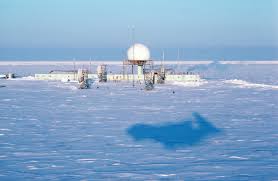
To fully understand what a tremendous undertaking the space program was, you should remember that a line of radio/radar stations was built all around the world to track spacecraft in orbit. At the same time, the same Russian missiles which scared American into the space race had to be watched for. A line of radar installations (the DEW — distant early warning — line) was built across Canada for that purpose.

The building of these two sets of installations was an immense undertaking. Even before the first foundation was laid, the positioning of these instruments had to be determined to the highest possible tolerances. This was done by survey engineers working with transits and doing their calculations by hand, with rod men dragging chains. A slide rule might provide estimates, but after that it was paper, pencil, and mathematical tables — which had themselves been calculated by hand.

The word calculator first meant a person who calculated such tables. By hand.

These engineers didn’t all come from Harvard, or other prestige colleges. There were thousands of them, possibly tens of thousands, and they came from every college in America. Bear that in mind as we contemplate the present college entry cheating scandals.

Speaking of which — prestige colleges my &#^$%!  Math is math, whether you learn it at USC or Palomar Junior College.

===============

I want to introduce you to a survey engineer you have never heard of. He is a distant in-law, a fine man I only met once. I ran across a decades old newspaper clipping of his obituary the other day, and it triggered this post.

I’m appending a copy of that clipping, minus family matters, to give you an idea of how the space race, and the missile defense of America, looked from the mud below. The gentleman’s name was William Mussetter.

===============

Mr. Mussetter graduated from Willmington College in 1917 and also attended Haverford College in Haverford, Pa. He retired after working 40 years in government service as an astronomical geodetic engineer. He served with the US Coast and Geodetic Survey, Army Map Services, InterAmerican Geodetic Survey United States Department of Foreign Services where he worked in many different countries.

Mr. Mussetter was a veteran of World War I, serving as a second lieutenant. In World War II he served as a captain and taught artillery.

At the end of the World War II, Mussetter received a call from Washington, D. C. He was assigned to head a survey group to be based in Panama and to work in south America, principally on the west coast of Chile, Peru, Ecuador, Columbia to Venezuela. This project lasted four years.

The Mussetters came home to Wilmington and he worked with the Ohio State University doing contract research for the U.S. Air Force. There was a need to connect the continents of the world, locating them with respect to each other, then to lay out guided missile courses from Cape Canaveral to the Bahamas. [This means during the early testing of IRBMs and ICBMs, before they began to be used to launch space vehicles. The same tracks were used through Mercury, Gemini, and Apollo. See 578. That Odd Spiral.]

In 1953, he transferred to the U.S. Army Corps of Engineers to define the Earth’s parameters, its diameters, flatness at the Poles and other data. [We are talking about building the DEW line here.]

He worked with a survey team measuring the arc of the Meridian at 30 degrees East Longitude from the Mediterranean Sea at Egypt to South Africa, down through Egypt, the Sudan, Uganda, Belgian Congo, Tanganyika, and into North Rhodesia; 4800 miles. [Many of these names no longer exist.] He also did some survey work for the Aswan Dam on the Nile River.

In 1964 he was sent to Antarctica, to Byrd Station, and the South Pole.

He had retired in 1964, but during the last four months of 1964, he worked in Peru, S. A. on a contract for a hydro-electric project; and in 1966 he was sent back to Afghanistan for three months, to inspect the work that was begun in 1961, and complete the Tri-lateration of Afghanistan.

===============

All this without a computer. Imagine that.

585. A Life of Reading

Trying to write a post on The Road to Corlay has turned out to be tough. I remember the book clearly, and I didn’t remember it at all. That is, I remember how I felt when I read it. I remember the feel of its countryside, and the slow grace of its human interactions, but I can’t remember one name, and can hardly remember one scene. I would drop the whole thing, but I “made my brag” by posting the list early. I need to read Corlay again, but that poses a problem. I don’t have the time.

It was scheduled for today, but I’m going to have to postpone it for now.

I retired from teaching about seven years ago and went back to writing full time. I had written quite a few books in the seventies and eighties, before hunger sent me to get a day job, and a few more while I was teaching, but that wasn’t nearly enough to satisfy me. Don’t get me wrong; this isn’t about mortality. I plan to live to be a hundred because I’m just too damned busy to die.

The fact is, reading a book is ten times better than watching a movie, but writing a book is fifty times better than reading one. And takes fifty times as long.

Besides the hundred thousand words a modern novel demands, there are the other hundreds of thousands of words you have to go through while getting to the right ones. And there are all those books you have to burrow through looking for just the right bit of information or inspiration to help you understand how that next chapter is supposed to come out.

Just reading a book for fun gets lost somewhere. I read the things I need to read, and late in the evening I read comfort books, like the thirtieth Nero Wolfe, which isn’t that different from the other twenty-nine.

It wasn’t always that way.

I was an only child on a farm in the fifties. We had one black and white TV that got two channels, which my parents watched while I read. Of course I became a reader; what else was there to do. From the time I discovered the county library, there was no time I didn’t have a stack of books awaiting my attention.

But I didn’t talk about it. My mother read occasional romance novels but she didn’t talk about it. My dad read the Bible, but he didn’t talk about it. The habit started early.

I read books about hunting and outdoor life. I lived outdoors, but on a tractor. I never hunted, barely fished, and I had never seen a tent. The real outdoors wasn’t for play, it was for work, and that didn’t satisfy me.

Looking back, I know that the place I lived as a boy was rather lovely, in a muted sort of way. It was farm country, lightly populated by humans, but with plenty of birds, and occasional coyotes and possums. Nevertheless, every patch of ground was either under the plow or turned into grazing land. There was nothing truly wild. I wanted forests and streams, fish and game, and snow, along with the freedom to wander through them.

It was all available in books, along with a thousand other adventures all over the globe.

My school mates read because they had to read — but nobody talked about it. Nobody read science fiction. Nobody wanted to know any more about science than they were required to. I was reading and studying continuously, preparing to head for college to be a scientist — but I didn’t talk about it, because no one else really wanted to know.

When I got to college, one of my roommates was a science fiction fan. We talked about it, but only a little. By then, my habit of silence was pretty well set.

A lifetime later I started this blog. It’s the first time I’ver really talked about the books I love and why I love them, right here, talking to you —

Hi. You see, there was this book called The Road to Corlay . . . but I guess we’ll just have to chat about that later.