Category Archives: A Writing Life

570. Lunar Excursion Module

This is the Apollo 9 LEM, photographed after it separated from its CSM. Photographs of either CSMs or LEMs in space are typically nose on, since each could only be photographed from the other (there wasn’t anyone else around to do it), and they only separated in lunar orbit at the outset of a landing maneuver or at rendezvous. Apollo 9 separated in low earth orbit and performed various maneuvers there, making this side-on view, right above the Earth, a rare treat.

Apollo 9 launched fifty years ago March third. That’s a Sunday, and I don’t post on Sunday, but there will be plenty on that mission the following week.

Virtually all of the missions returning from space have returned by atmospheric braking and parachute, or atmospheric braking followed by a winged landing. In the early days of science fiction movies, landings were always tail first but that was not possible on Earth until Elon Musk and SpaceX finally managed it in 2015.

On the moon, there was no choice but to land tail first, slowed by rockets, and the LEM was built around that fact. Learning how to land tail first was also a major issue; see 185. The Flying Bedstead.

The LEM was a two stage rocket. The descent stage, dot-shaded gray in this NASA drawing, made up about two thirds of the mass of the LEM. It contained a frame, tanks with fuel and oxidizer, a rocket engine, and the landing gear. It also contained storage space, accessed from the outside, for the equipment that would be used once the astronauts were on the moon.

The landing gear served multiple functions. The pads at the end of each leg were designed to keep the LEM from sinking into the lunar soil. Their size was both a compromise and a guess. No one knew either how deep the lunar dust was, nor how much structural integrity it had. Worst case scenarios had the LEM sinking hopelessly into many feet of lunar dust, the accumulation of millions of years of micrometeorites pulverizing the lunar surface. In fact, the pads only sank slightly.

The number of unknowns that faced the engineers and mission planners was immense. It it hard for people born since the seventies to imagine the depth of our ignorance before Apollo 11 landed.

The struts were designed to absorb energy, because the LEM could not fire its engines all the way to the ground. The upwash of lunar dust and rocks would have blinded the pilot and possibly knocked holes in the LEM, so the engine was designed to be cut off at a certain height above the lunar surface, letting the LEM fall the last small distance. But how high? That was another calculated estimation (guess). And how much spring would the struts need? Too little and the LEM would crash to the ground. Too much, and it would rebound with possibly disastrous results. And if one leg landed on a boulder or in a hole, the whole LEM might tip over and be unable to return to orbit.

The ascent stage contained crew space, controls, computer, radar, guidance systems, oxygen for human use, and the crew in their space suits. It also contained fuel and oxidizer and its own rocket engine, all smaller than for the descent stage since the LEM ascent stage was one third the size and mass of the complete LEM. The descent stage formed a launching platform for the ascent stage.

When Apollo 17 launched from the moon, a camera was mounted on the rover which was left behind. You can see all 36 seconds of the last ascent stage liftoff from the moon at https://www.youtube.com/watch?v=9HQfauGJaTs.

Apollo 11 proved that all this would work. Apollo 10 was a dress rehearsal of everything but the final landing. But until Apollo 9, fifty years ago this weekend, no one knew if the LEM would work at all.

More next week.

569. Apollo: Profile of a Mission

This is the Apollo 9 LEM, photographed after it separated from its CSM. NASA photograph.

This was originally intended as a detailed picture of the Lunar Excursion Module, but it became clear while writing that before I could talk about the vehicle, I had to lay out it’s place in the scheme of things. This post then became a generic mission profile, and details of how the LEM worked will come in the next post.

If you Google lunar lander, you will find the LEM, but you will also find a lot of forgotten craft. Both the United States and the Russians had unmanned lunar landers and lunar crashers. That’s not a joke. Before soft landing was perfected, we learned a lot about the moon from probes which photographed all the way down to a crash landing. Those piles of rubble that dot the moon were the ancestors of Spirit and Opportunity.

That’s not good enough for a craft that was to be, in the vernacular of the day, man rated.

The LEM, or LM as it is often called today, was unlike any manned craft before or since. It has been called a “true” spacecraft, but in fact it only got half way toward that ideal. A “true” spacecraft, built in space and powered by a low force, long acting engine, would never have to endure the vicissitudes of atmospheric friction or high gravity.

The LEM did have to withstand multiple gravities during its launch from Earth, and again on landing and taking off from the moon. However, it never had to come in contact with atmospheric friction because it spent the launch hidden behind a streamlined clamshell shroud. It didn’t itself have to be streamlined, and its skin could be flimsy. The astronauts joked about being afraid of accidentally putting a boot through the side of the vessel. At least I think it was a joke.

The Saturn 5 is called a three stage rocket. It could as easily and accurately be called a six stage rocket. The first and second stages were designed to burn all their fuel and fall away. The third stage carried the rest of the vehicle into orbit and then shut down; at that point, it’s fuel was not exhausted.

If the mission was to lunar orbit or landing, the Apollo craft stayed in low earth orbit long enough to establish that all was well, then the third stage fired again to send the craft toward the moon.

On Apollo 8, there was no LEM, so in December I only described the Saturn and the CSM. Apollo 9, whose fiftieth anniversary comes in about ten days, had a LEM but never left near Earth orbit. Apollos 10 through 17 were lunar missions. They had similar flight plans and used all “six” stages.

When the Saturn third stage fired a second time, it put the entire remaining craft into a orbit toward the moon. The third stage would have gone right along with the rest to the craft, if it had been allowed to do so.

What happened next on each mission was well presented in the movie Apollo 13, but only if you already knew the what, the when, and the why. It was drama, not documentary, but with excellent animation. If you have a DVD of Apollo 13, take a look.

The LEM, and the CSM (command and service modules, treated as one) had initially been stacked vertically above the third stage, with the LEM protected by a shroud. The attached NASA drawing also shows the abort rocket above the command module, but that had already been discarded by the time the craft was actually on its way to the moon. All three astronauts were in the CM. The CSM, the LEM, the shroud, and the third stage are all still in one piece.

Now the CSM was released; it moved forward on maneuvering thrusters and turned a one-eighty. The LEM was still attached to the third stage. Now the clamshell opened up and the CSM moved carefully forward and docked with the LEM, front of CSM to top of LEM. The LEM was released from the third stage and towed away by the CSM. This position allowed the hatches on the CSM and LEM to mate so the astronauts could move freely between the two craft. The legs of the LEM, previously tucked under to fit within the shroud, now extended into lunar landing positions.

From this moment until lunar orbit was achieved and it was time for the LEM to move away from the CSM and land (or nearly land in the case of Apollo 10), the LEM/CSM were essentially one space craft. The Saturn third stage now made one last burn, changing to an orbit that would carry it out of the way.

For about two and one half days, the LEM/CSM drifted toward the moon. Upon leaving low Earth orbit, the craft had been traveling at close to 25,000 miles per hour. It should have reached the moon in ten hours, but the Earth’s gravity was pulling at it and slowing it down. Approximately six sevenths of the way to the moon, the craft was traveling at it’s slowest speed. At this point the Earth’s gravity and the moon’s gravity were in equipoise; thereafter the moon’s gravity accelerated the craft again.

At a point on the back side of the moon, the SM engine fired, slowing the combined craft enough to keep it from whipping around the moon and returning to Earth. It entered orbit of the moon. This burn, and the later one which put the CSM on its homeward trajectory, make the CSM essentially the fourth stage of the Apollo/Saturn mission.

Now it was time for the LEM to earn its keep.

What’s that you ask? Stages five and six? Where were they? The LEM itself was a two stage rocket. We’ll get details on that next post.

568. Presidents Day

I agonized over this post more than any in memory. I am not completely cynical, and the presidents I address, even the worst of them, also did things worthy of the office. I came back to this post a dozen times after I wrote it to ask myself, “Do I really want to say these things?” The answer is, “No.” But I will say them anyway, because the truth is the truth.

===========

Presidents Day. Humm.

We used to celebrate Lincoln’s birthday and Washington’s birthday, and ignored the rest of them. That wasn’t such a bad system. It allowed us to avoid linking Andrew Jackson with his betters.

How about our recent Presidents? Should we celebrate them?

John Kennedy. I have a friend who grew up in Boston and would punch out anyone who spoke against JFK, but let’s tally up what he really did. He lost the Bay of Pigs by abandoning the Cuban insurgents he had encouraged. He faced Khruschchev over the Cuban Missile crisis so let’s give credit for that, but he also sent Americans to Vietnam. Kennedy supporters claim he would have pulled out, if he had lived, but who knows. The jury will always be out of what might have happened.

Lyndon Johnson. He has massive accomplishments pushing through Kennedy’s programs and his own War on Poverty, but he also lied to the American people, lied to Congress, and conducted a secret war including massive bombings outside Vietnam. He, and Nixon after him, are responsible for over three million unnecessary  deaths. There is no responsible way to avoid calling him a war criminal.

Richard Nixon. Watergate, of course; it hardly needs repeating. He also opened up China and got us out of Vietnam by declaring that our defeat was a victory, and then running like hell. I really don’t know what else anyone could have done by that time, but why did he wait all those years and waste all those lives before telling the Big Lie? Maybe to win a second term?

Gerald Ford. They say his pardon saved the country from division and heartache. I say it only gave later Presidents bad ideas that should have been squelched fifty years ago by trying Nixon for his crimes.

Jimmy Carter. An attack on an embassy is an attack on American soil, but Carter sat impotent in the White House through the Iran hostage crisis.

Ronald Reagan. Tax cuts for the wealthy. Trickle down economics that never trickled down. Also the Iran-Contra affair in which Regan himself avoided punishment but fourteen members of his administration were indicted.

George H. W. Bush. “Read my lips.” Actually, going back on his promise regarding taxes was an act of courage that probably cost him a second term. That honorable act was sullied when he pardoned those convicted in Iran-Contra.

Bill Clinton. Plenty of good ideas, but we just remember him as the man who couldn’t keep his hands to himself.

George W. Bush. “Brownie, you’re doing a heck of a job”, and other stumble-statements too numerous to list and too painful to remember.

Barack Obama. I like the man, but I spend eight years cussing under my breath at some of the foolish things he did.

Donald Trump. I once said I didn’t consider Trump evil, just foolish. Subsequent events suggest that I was probably wrong. His fake declaration of emergency pretty much clinches matters.

Were these the best men in America?

Let’s celebrate President’s Day by taking a hard look at what’s coming our way in 2020. They don’t all look good. Let’s vow to make better choices for the future.

Lincoln and Washington, where are you?

567. Bridges of Longing

Every time I print some poetry, my own or favorites from other writers, my readership spikes. It’s got to be the tag POETRY that does it.

The problem is that I don’t like 99.9 percent of the poetry I read today. My rule is: if you can rewrite a poem without line breaks, and that turns it into the first couple of sentences in an unfinished short story, then it isn’t a poem. Almost everything I read nowadays fails that test.

I’m not talking about rhyme. Check out Spoon River Anthology or anything by Yeats or Frost to see the flip side of what I’m complaining about.

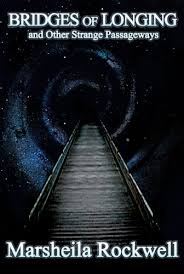
When I do find exciting work by a contemporary author, it knocks me out. Example: Marsheila Rockwell.

I met Marsheila at Westercon in 2017 at a reading. She and another author, a couple of author’s friends, and I sat down in a conference room that would have held fifty. I was the only stranger in the room.

Westercon 70 was odd that way. It was very much a home town version of a regional conference. The Cosplay and Filk venues were packed, but the book signings and author’s readings were almost (sometimes completely) empty.

Her stories were fine and her poetry was excellent. I bought her collection Bridges of Longing and there wasn’t a poem in it that wasn’t wonderful. There were some I didn’t like, primarily in the section Those Who Wait, but it was only because they were harsh to the point of hopelessness. It wasn’t because they weren’t true. The same was true of some of her stories. They were superb, whether they matched my taste or not.

You see, Marsheila and her sig-other and writing partner primarily operate in the fields of horror, dark fantasy, and D & D, all places I have no interest in going. I would certainly never have found her except that fate steered me into that reading.

Her poetry, on the other hand, is humane and feminist, and always with a hard edge. It sounds like real life, even when it is supposedly about goddesses and harshly treated mermaids. She is the best new poet I have encountered in many years, even if her novels aren’t in my wheelhouse.

I would say, buy Bridges of Longing. The poems alone are worth the cost many times over, and if you have any liking for fantasy, you will enjoy the stories as well.

You might also check out her website http://marsheilarockwell.com/ .

566. The Negro Speaks of Rivers

The Negro Speaks of Rivers
by Langston Hughes

I’ve known rivers:
I’ve known rivers ancient as the world and older than the
     flow of human blood in human veins.

My soul has grown deep like the rivers.

I bathed in the Euphrates when dawns were young.
I built my hut near the Congo and it lulled me to sleep.
I looked upon the Nile and raised the pyramids above it.
I heard the singing of the Mississippi when Abe Lincoln
     went down to New Orleans, and I’ve seen its muddy
     bosom turn all golden in the sunset.

I’ve known rivers:
Ancient, dusky rivers.

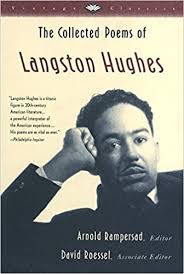
I am a great fan of Langston Hughes. I keep his complete works in my library, and I had hoped to dip into it to publish one of his less well known poems here during Black History Month. I couldn’t.

I try to stay on the sunny side of copyright law out of respect for authors and to keep out of jail. However, I am no lawyer, and copyright law in America is an incredible snarl, so I depend on others for my information. I went to Project Gutenberg, an organization dedicated to placing old literature in ebook format. They are well organized and quite careful about only using material in public domain. They have almost nothing by Hughes, so I googled, which only muddied the picture further.

I like to place pictures as teasers above each post. Other than the ones I have created myself, I get most of them from Wikipedia since they specify (if you click a couple of times on the picture) their copyright standing. I went there following this copyright question and found in Wikisource that:

This work (The Negro Speaks of Rivers) is in the public domain in the United States because it was published before January 1, 1924.

Most of Hughes work was published after that date.

It may seem odd to worry about the copyright status works by a man who died 52 years ago, but theft is theft, even if you are stealing from a dead man. I try not to steal, although sometimes I goof. I posted Hughes’s poem I, Too last Independence Day, not realizing that it was not in public domain. Of course, you can get a view of many copyrighted works on the Internet. I, Too appears in dozens of places.

I have a solution to this conundrum. Go out and buy a book of poems by Langston Hughes. Buy it for Black History Month if you care. Buy it for the beautiful poetry if you don’t care.

You can even go to a used book store to buy it. Resale of books never puts a penny in any author’s pocket, but it keeps their works alive.

Running From President 4

It’s hard to say who made the first mistake. Certainly Leap’s mother should never have named him Leap, even if he was born on Leap Day. Some temptations just have to be resisted. Worse, she should have spoken his name out loud when she named him. Leap Alan Hed, for heaven’s sake. How could she have missed that Alan would become A., and no one could ever meet her son without saying Leap A. Hed.

Leap wasn’t blameless himself. By fighting back to the point of absurdity, he made himself famous enough to come to the public’s attention. Counting his age by leap-day-birthdays and calling himself 16 when he was in his sixties — that’s just asking to be noticed.

Of course Billy Joe Barker was to blame for touting him as a write-in candidate for President. Then when he said that Leap was sane because he really didn’t want to be President, it was the last nail in Leap’s coffin.

People never give you what you want, but they always give you what you don’t want. Didn’t anybody know that?

Shelia Barnstaple of Wilmington, Ohio started a blog called I Want Leap for President. Wilton Damonson of Ash Fork, Arizona started a competing blog called Leap on the Bandwagon, also using the hashtag #LeaponforLeap. You would not believe how many people have 140 characters worth of something to say.

Throughout August, as Donald sank in the polls, people first sighed with relief, then suddenly realized that Hillary would probably win. Someone published a poem anonymously that read:

When Donald came I feared the worst,
If he won it just might kill me.
He surely was the worst of worst,
But second worst was Hillary.

Within days the doggerel was re-posted four million times, and a hundred and ninety-two people were claiming authorship.

Meanwhile, Shelia Barnstaple and Wilton Damonson combined forces and the draft Leap movement really took off. Leap found his house in Dannebrog surrounded by reporters. It looked like Marilyn Lovell’s lawn in Apollo 13. Leap came out with a shotgun to run them off, but they only clicked their cameras faster. He retreated. The shotgun was never loaded, since Leap was basically a peaceful fellow, but the hashtag #Leapforlawandorder raced around the globe at the speed of light.

Leap drew the shades and locked his doors, turned out all the lights but one, and settled in to wait out the silliness with his paperback collection of Nero Wolfe novels. After an hour, the reporters started pounding on his door, then on his windows, and finally on the walls of his house. He couldn’t call for help since he didn’t have a phone, but his neighbors took pity and brought in the county sheriff. He drove the mob back into the street.

That night, Barnstaple and Damonson posted a call to join Leap in his Silent Vigil for America. Three hundred thousand people promised that they would.

Sometime during the night, a darkly clothed figure joined the reporters briefly, then quietly faded away. Once it was light the next morning, Armin Arkin of WFUD noticed that the back door was ajar and announced that he was going in. Within minutes, the street was empty and the house was jammed with anchors and their cameramen elbowing for room to broadcast.

Leap had disappeared. more tomorrow

565. Great (?) Men

This post was begun December 5, 2018, before the shutdown, right after watching President Bush’s funeral. Most of the posts from that time until now were already written to make time for some non-writing activities, so I watched the Federal shut-down from the sidelines. I will summarize my take in one sentence.

Another damn-fool stunt by the Damn-Fool-in-Chief.

Now back to December fifth.

=========

As I watched President Bush’s funeral this morning, I was once again struck by an understanding of how Trump became president. I am not going to offer similarities between the two men; I would be hard pressed to find any. I will suggest instead that the nation’s response to Bush One’s death tells us uncomfortable things about hero worship, individual liberty and responsibility, and America’s closet love affair with The Great Man.

America threw off a king in 1776, and has been in the habit of electing would-be kings to the presidency ever since.  They even asked George Washington to become king. He refused. If there has been a president since who didn’t want the powers of a king, I apologize for lumping him in with the rest. I don’t think I will have to apologize to many. Maybe none.

I get that. I also get that without a combination of arrogance and obstinance, and a massive need for power, no candidate would ever get through a campaign. Obama strikes me as a nice guy, someone I would like to know personally, but he had the need. Bush II was touted as the candidate you would most like to have a beer with — and I would, even though I never considered him competent. Vote for Bush II, hell no; share a laugh with him, of course. Bush II had the need. Bush I had the need. They all had the need for power.

You can be pretty sure that any humility shown by any president is feigned. Was Lincoln humble? He appeared humble, but I seriously doubt that he was. Overwhelmed and saddened by what fate had saddled him with, certainly, but a truly humble man would have withdrawn in favor of someone more qualified.

But Presidents don’t believe anyone else could be more qualified; if they did, they would never make it to the White House.

I understand the motivation of Great (?) Men; I don’t really understand why Americans, who otherwise cling to their liberties, continue electing them. Perhaps they are convinced that the alternative to the Great (?) Man is the wimp. Or maybe it’s just the John Wayne syndrome gone wrong.

Here’s what happens. There is trouble in the town. Every man knows what needs to be done. But only one man has the fastest gun and the toughest fists. So (the Lone Ranger) (John Wayne) (Chuck Norris) (millennials, fill in your own selection, I’m out of touch with current heroes) takes care of business because he is The Great Man.

That’s adequate for TV, but not for governing America. Presidential power has been growing at Congressional expense for several decades. Why? Maybe at the core it is because the President is one man and Congress is many. Is it just part of the American myth that the individual stands up to the mob?

Maybe.

I get it — but I don’t buy it.

564. The Tale of Leap Alan Hed

In 2016, after a month and a half of extremely serious writing about race in America. I decided to celebrate with a bit of total nonsense. I chose to do it on Leap Day, because what better time for silliness than a day that only comes every fourth year.

I had intended it to be a one time bit of humor about an accidental President. It wasn’t anti-Trump, because at that time the idea that Donald Trump would become president was a million miles from anyone’s mind.

I went on with my life, getting ready for the release of Cyan and writing blogs on writing, science, and science fiction. I wasn’t worried about Trump. I was worried about Clinton. I eventually voted for her, while holding my nose, but my sympathies were with Bernie, or some other Democrat. Apparently a lot of people felt the same way.

I was aware of Trump, but I wasn’t thinking much about him. I just hoped the Republican candidate would be someone I could vote for if Clinton became the Democratic candidate.

By July, Trump was in the race and looking more and more ugly. But lest we forget, the prospects of Clinton as President didn’t look that good to a lot of us either. 2106 was beginning to stack up as a lose-lose situation. Reasonable candidates were failing fast in both parties.

I brought Leap Alan Hed, the nobody who won the Presidency by accident, back for a reprise and continued his story throughout the summer and fall. I bid him farewell the night before the election and faced reality with a post written in September but posted the day after the election.

In September I reprised the poem Hungry, about a border wall. That is another prophetic piece that I wish weren’t so accurate.

All the things I wrote fearfully about that summer have come true, along with more misery than I could have anticipated. Now I am bringing Leap back for a re-run, beginning today over in Serial. Everything has been tweaked to read smoothly, but ninety-nine percent remains unchanged.

Think of this as a presidential campaign in an alternate universe. And besides, politics aside, it’s just a good story about a nice guy who found himself in completely over his head. These posts have never been put in one place before, to simply be enjoyed as a story.

563. Another One Bites the Dust

I went to a local used bookstore today to find a copy of Heinlein’s The Rolling Stones. I can’t find a copy in my book room and none of my local libraries have it. That’s understandable; it came out in 1952 as a juvenile and it wasn’t his best work. I just wanted to see if my memory was correct after all these years as to his use of the barbecue roll, with paint. If that makes no sense, stick around. It will be in an upcoming Apollo post, as soon as I find a copy.

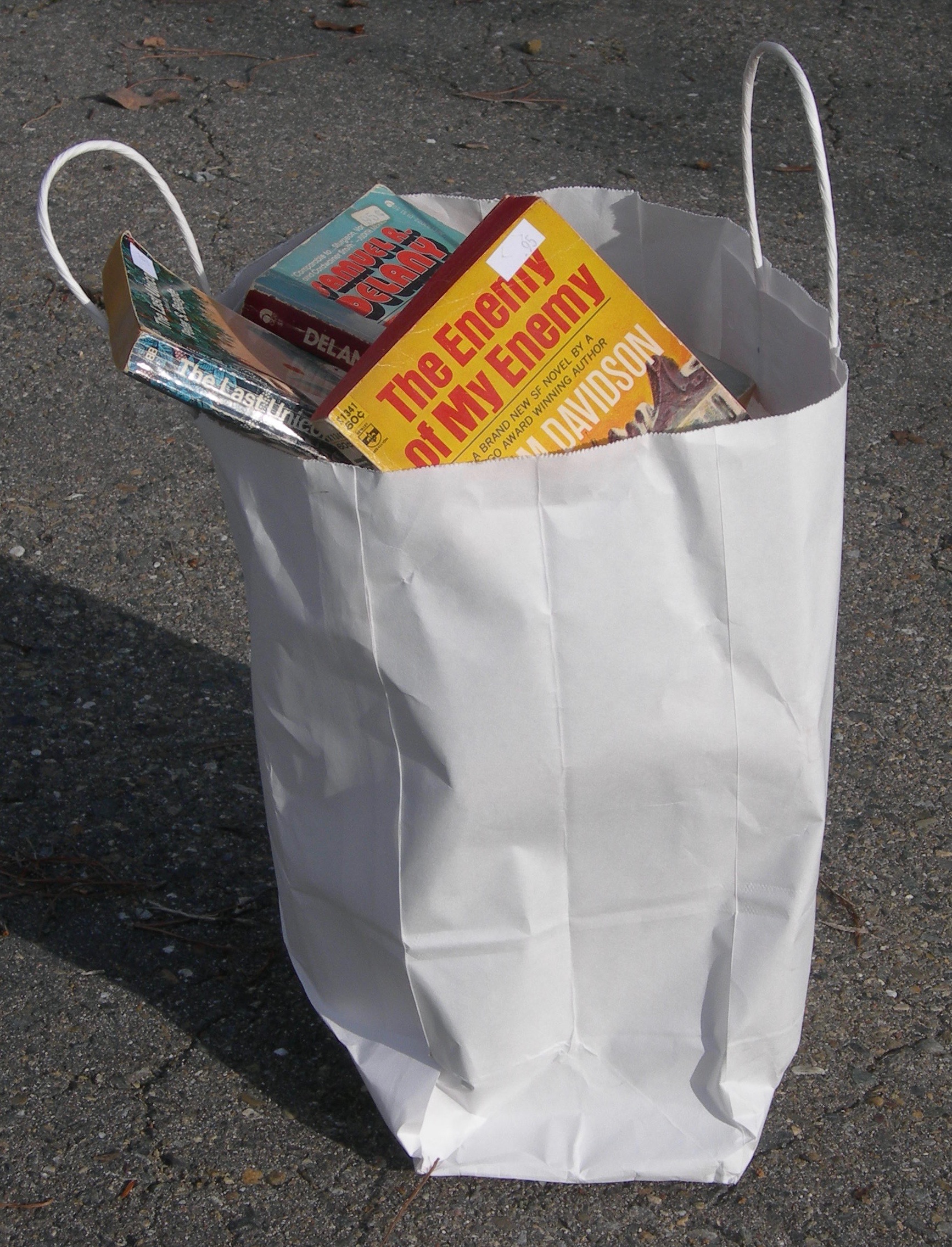
I walked into the bookstore. The proprietor said, “How are you?” and I replied, “Sad. You’re closing.” And she was. About a third of the shelves were empty and she was selling books by the bag, one to ten dollars, depending on the size of the bag.

I’ve completely lost count of how many used book stores have come and gone over the decades I have lived in this area. It always hurts to see one go, and every time a new one appears I know another book lover is buying themselves a heartache.

There are many things which are done for love instead of money. Blogging might be the new poster child for this way of life. Used bookstores are near the top, as well. Crafters fill the same niche.

If you go to a local boutique and buy some hand made jewelry, or any of a thousand other kinds of things you couldn’t buy at Wal Mart, you might be tempted to call them over priced. Maybe, from the consumer’s viewpoint, but I doubt if one in fifty crafters is making minimum wage. They always think they’ll make a little money when they start, but really . . .

A used bookstore as an investment? Hummm. I wouldn’t do it, although I’m glad there are people who do. Consider the mark-up (next to nothing) and consider how many customers come in each day. At least you have a lot of time to read.

I should talk. I do something even dumber than that. I write novels.

If you go to a used bookstore — in some town other than the one I’ve avoided mentioning, which no longer has a used bookstore — and look closely at the science fiction shelves you will find hundreds of writers you’ve never heard of. Some of them are pretty good and some aren’t. What they have in common, not counting Heinlein and a few like him, is that they probably never made a living by writing. A few achieved a bit of fame, but most of them didn’t. Many wrote only one or two books and gave up.

If you look at the names of the publishers, you won’t know it unless you’ve been following this for years, but many of them stayed in business by stiffing their authors. Others actually paid, but paid a pittance.

I don’t think there are too many of those completely dishonest publishers around any more. Times have changed. Now you can publish ebooks and stiff yourself.

Oh well, it’s a good life if you don’t weaken. And of course I don’t do it for the money — but I wouldn’t mind some.

562. Davy

This is one of my best stories series.

I re-read. It is my equivalent of brainless television. There are books that I frequently re-inhabit in order to once again enjoy the people, scenery, and action.

There are also books I read only once, and never need to read again. They become such a part of me that I still remember them decades later.

Edgar Pangborn provided two such books, Davy and The Trial of Calista Blake. I read each of them only once, between 1964 and 1967. I have never forgotten them, nor have I ever wanted to return to them. They were life changing, if read at the right age.

===========

I grew up in an era of fear. The bomb hung over us all, and fiction followed the trends of the day. Speaking from memory, not scholarship, it seems to me that it was the end of the exclusivity of science fiction. Events that would have once interested only the few and the faithful, were turning up on the best seller list. Books like Fail-Safe and On the Beach were called science fiction, and I suppose technically, they were. But they didn’t taste like science fiction because they were written by mainstream writers with different sensibilities. That may not be a legitimate complaint, but in truth they tasted like steak with no salt.

The flip side of the here-comes-the-bomb novels was an endless cavalcade of post-holocaust dystopias. The first book I read, the first day I discovered libraries, Star Man’s Son by Andre Norton, was one of those. There were dozens to follow; maybe hundreds. They mostly ran together in a mass of future sadness, but a few were memorable.

Davy stood out because it’s horny orphan protagonist got such joy out of life. He found a French horn in the rubble and taught himself to play it, which always made the book seem more like fantasy than science fiction. If you know French horns, you’ll understand.

We spend much of the book watching Davy go from ignorance to knowledge. The cover of the edition I read compares him to Tom Jones (the novel, not the singer) and that seems fair.

Davy’s world is the northeastern United States, a couple of centuries after the nukes fell. The names are scrambled but mostly decipherable. The state religion is the Holy Murican Church and belief is not optional. Davy falls in with anti-religious dissidents, which suits his doubter’s personality.

The novel is carried by Davy as a questioning, ebullient youth, but saved from silliness by a brooding feeling that all will not be roses. The story arc makes everything work. We see young Davy growing up as told by his older self, but we are spared the works of his maturity. There will be striving, battle, despair, and betrayal when the mature Davy attempts to mold the world to his liking, only to have it fall apart in his hands. That is the part of the story another novelist would have concentrated on, but we see it only in brief flashes. Then we are at the final chapter, a kind of coda in which Davy totals up his gains and losses and prepares for a final, hopeless journey.

What we have here is the joy of youth, overlain by the elegiac sadness of hopeless struggle against human inadequacy. Heinlein could have written it, but it would have had little heart because his protagonist would have stood above the fray, superior to the mass of humanity. Davy partook of the same human conditions that he fought against. Just like the rest of us. That made Davy stand out as something better that the rest of the dystopias. It made the novel a work of art to move the soul — at least if you read it at sixteen, while waiting for the bomb to fall.