
Tag Archives: memoir

482. Where’d Ya Get That Name?

I was writing a short story yesterday, called The Gods of Wind and Air. I knew the main character well enough, had an idea of who he was and what motivated him, and had a fair idea of what he was about to do. I had written the first paragraph and the last paragraph, so I knew where he and I were going together, but I didn’t know his name.

It needed to be reasonably short — five or six letter would be ideal. He was a peasant, with only one name and it didn’t need to be fancy, but it also didn’t need to look like he was an American. No Bill nor Tom nor even Andre need apply.

Usually by this stage in something I’m writing, I know all the main characters’ names, and minor characters are forgettable enough that their names don’t count. I didn’t want to stop the flow of things, so I went postal on the keyboard, firing off a hundred finger strokes at random while moving my hands in twin circles around the keyboard. Three seconds, four at the outside, and I had produced:

;dknclm,v mqrt09gyoweuhb sd; vkjqroifgowduh jnsdp;ogui48o uyecxvKsmvkrpifgvdwslhj merpiogiyfvcoldsjkjvm qp9fgvweujk mpf9gewqsiojksvbpo9irhgbcv anop;s’dkv90q8reudvbq][giu193reuojvbn fe][guy38ewyiush sjnf][5206yu08tr peldgjshdkv[w40efuy 2ieuochn we[]pgf0uhisdujvnmaw]p-0uyhgfovl;d klfop3yion[pqofgijeqhj

Somewhere in that mess would be letter clusters that would fire a spark in the old brain. Sure enough, there was a pel and an an which gave me Pellan, and my troubled peasant had a name.

If you plan to write a normal novel, you will need from dozens to hundreds of names. Sometimes that is easy. When I wrote Jandrax, the stranded colonists were French, three colonies removed from Earth, but still with French names. I went to Homo Hierarchicus, by Louis Dumont. It is a study of Indian caste by a French anthropologist which I had from my college days. Half of the scientists in the bibliography are French. I copied a long list of first names, a long list of last names, and chose at random from each. Then I cross-checked to see that I had not accidentally recreated some famous name — say, Marcel Proust. I did have a Marcel, but I made sure he had a different last name.

When I wrote Symphony in a Minor Key I needed a lot of Anglo and Mexican names. Where I live, that is no problem. I just went to the phone book to get twin, paired lists of first and last names.

Sometimes a reader has no trouble guessing where a writer got a name. In the western novel Flint, the villain is Porter Baldwin. Since Porter and Baldwin were two of the major locomotive manufacturers in that era, and the action revolves around frontier railroads, we have no problem figuring out where Louis L’Amour got PB’s name.

It’s not that easy when you are writing fantasy. I’ve never met anyone named Pellan, for instance. When I wrote my first fantasy novel, I needed names for five sub-lords (as I called them then). I happened to be listening to an early record (stereo, LP, 12 inch vinyl — it was a long time ago) by Ravi Shankar. In the liner notes, he explained the five parts of a raga, giving the Indian names for the movements.

Yes, you guessed it. I later modified them so that it was not so obvious. Just a piece of advice; if you are writing a fantasy about a pair of twins, and you happen to be listening to classical music — don’t name your twins Allegro and Adagio. Someone will notice.

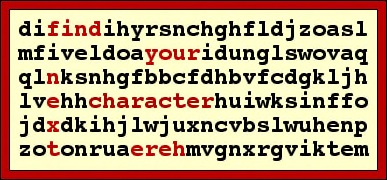
Eventually, I needed so many odd ball names that I had a brainstorm. I bought a Find-a-word. They aren’t so popular anymore, so I will describe — a Find-a-word is a book of full page puzzles where each page is filled with letters in a grid. Your job is to find the words that are listed at the bottom of the page.

I used the Find-a-word to look for letter groupings that weren’t words, but could be in my fantasy world. Brilliant, I thought. In reality, I never found anything useful. Maybe you will have more luck. I offer the notion to you free of charge.

It’s no secret that most of the people who read A Writing Life are, or want to be, writers. If you will please look up and to the left, you will find a button that says Leave a reply.

I know you guys (and gals — and whatever) are out there. I can hear your breathing in the dark. Take five minutes and tell me what you do to find character names. I’m honestly curious.


Symphony 128

They sat quietly discussing options. The clock ticked and the phone remained silent. Bill decided to call the sheriff, but as he was reaching for the phone, they heard the sound of tires on asphalt, and the squeal of brakes. Neil cursed, and Bill snapped, “Listen, you damned hothead, let me do the talking. Don’t screw this up for us.”

Bill sat back at his desk. His face seemed placid, even serene. For the first time in months, Neil really looked at Bill Campbell, and realized that he was an old man. This was not his first crisis; it was not his fiftieth crisis. That experience gave him confidence.

It did not give Neil confidence. A man can get too used to doing only what seems possible, and letting the rest go. He can forget that sometimes it is necessary to reach beyond yourself, to put yourself at risk.

There was a knock at the door and a man put his head around the corner, calling, “Hello. Is anybody here?”

“Come on in,” Bill invited.

Neil got his first look at the boyfriend, and let out a slow breath. The man had once been small; possibly spindly. You could still tell it. He wasn’t more than five feet eight, but every inch of him had been made over by countless hours at the weight machine. His short blond hair was in deliberate boyish disarray and he had a ready grin. Likeable and domineering at the same time. He made you want to stay out of his way, or make friends fast. Neil was only an inch short of six feet himself and of athletic build, but he felt the daunted by such a powerful body.

Bill said, “May I help you?”

“I’ve come to pick up Lisa Cobb.”

“I’m afraid I can’t just let her go off with someone I don’t know. You are . . . ?”

“Of course. I’m Jim Pollard, Lisa’s mother’s fiancee.”

“I see. Well Mr. Pollard, I’m afraid that doesn’t help much, because I don’t know you personally. Please don’t misunderstand. I am only trying to take care of the children I’m responsible for, but I can’t let her go with you on just your say so.”

Pollard’s face grew dark, but he controlled himself and said, “Lisa’s mother is in the car. You know her don’t you?”

He slammed the door behind him without waiting for a reply.

Neil looked at Bill and asked with bitter humor, “Do you have a baseball bat?” Bill waved him to silence. He was dialing the sheriff.

There was a coil of barbed wire in Neil’s stomach as he waited for their return.

The door did not exactly slam open. It was under complete control, and Pollard never let it hit the wall, but he shoved it open with such force that the effect was the same.

Judith Cobb was as tall as Pollard, yet she looked dwarfed beside him. She smiled at Bill and Neil; then the smile became a twitch and disappeared. She could not hold it for more than a few seconds. Pollard had her by the arm. He looked as if he were giving her support; she looked as if she would fall if he let go.

Judith Cobb said, “Jim said that you wouldn’t let Lisa go with him because you didn’t know him. Where is she?”

Bill had made his decision. He motioned them to seats, then said, “She is with one of our other teachers, and I don’t intend to let her go until someone gets here from Child Protective Services. She tells us that Pollard tried to rape her.”

For a moment, Jim Pollard looked as if he would leap to his feet and strike Bill Campbell. Then he did something even more dangerous. He held his temper. He turned to Judith Cobb and said, “See, Judy. Now she is lying to these people. I told you she needed counseling.” more tomorrow

Symphony 127

Bill said, “It could happen that way. We aren’t the police.  We aren’t God. All we can do is what the law lets us do.”

“These kids are our responsibility!”

“Only in a limited sense. When they leave the playground, when they reach their homes, they aren’t ours any more.”

Neil thought, “Like Hell!” He had told Lisa he would make it right. He could not betray her. He could not let her go back into that house. She had been reaching out to him all year with her stories. He had coaxed her on, had led her to trust him, promising to make things right. He could not step back now, no matter what the law had to say.

We teach them love, and trust, and caring, and fair play. We are giving them poor armor for the real world of pain and rejection and betrayal.

The phone rang.

Bill reached for it, hesitated, then picked it up. He listened, winced, and said, “Yes, Mrs. Cobb. She is here. She missed the bus. I didn’t call you because I just found out.”

There was a pause, then he continued, “You don’t need to come in. I’m heading home in a few minutes. I will be glad to drop her off.” A longer pause. “No, it’s no problem. It’s not out of the way.” 

It was a wasted effort. Bill finally said, “All right, Mrs. Cobb. She will be here.” He hung up and told Neil, “She didn’t buy it. I wouldn’t have answered the phone, but it might have been Child Protective Services.”

“Now what?” 

“Now we hope they call before Mrs. Cobb gets here. Let’s go see what Carmen found out.”

In the outer office, Evelyn was putting on her coat.  Bill told her he needed her to stay on to wait for a call. They walked to the quad, knocked on Carmen’s door, and waited. Eventually, she came to open it. Lisa sat slumped in a chair with her back to the door. Carmen whispered, “Can you come back later?”

In a few words, Bill outlined the situation and asked, “Do you have enough to tell us what to do next?”

“Yes. Shoot the bastard if you have to, but don’t let Lisa go back to him.”

“Did he rape her?”

“Not yet, but if she goes home tonight, he probably will. He has been coaxing her for a month, first behind her mothers back and then openly. The mother won’t do anything. According to Lisa, he beats her mother, so maybe she is scared of him. Or maybe she is scared of losing him. I don’t know. Last night, the boyfriend waited until the mother was asleep on some sleeping pills he gave her, and then dragged Lisa into her own bedroom. She waited until he pulled his pants down and then ran while he was too tangled up to chase her. She spent the night at a friend’s house.”

“Whose?”

“She didn’t tell me, and I don’t intend to ask.”

Carmen shut the door and went back to Lisa. Neil and Bill walked back to the office, and Bill sent Evelyn home. No call had come in yet from Child Protective Services. Neil cursed them. Bill pointed out that they had a limited staff. It was just bad luck that they had needed someone five minutes after work on a Friday night. As they were arguing, the phone rang. Bill scooped it up eagerly, listened, scowled, said, “Thank you,” and hung up. He said, “The duty worker is on her way. That was the switchboard with the message. I wish she had called directly so I could have talked to her!” more Monday

481. Asimov’s Good Life

I couldn’t sleep last night so I lay awake thinking of an article to write and I’d think and think and cry at the sad parts. I had a wonderful night.
                         Asimov, from It’s Been a Good Life, p. 157

When I was new to reading science fiction in the early sixties, Clarke, Heinlein, and Asimov were everybody’s big three. Bradbury was in the next rank, but not for me. I found him unreadable. Andre Norton was still out in the cold for most people, but she, Clarke, and Heinlein were my personal big three. Asimov didn’t make the cut. I read a few of his novels, didn’t like them, and moved on.

Recently I ran across his summary autobiography, It’s Been a Good Life, edited by Janet Jeppson Asimov. It reminded me that I knew very little about the man, so I took it home.

Asimov has three full autobiographies, and a list of publications that goes on for eighteen closely packed pages. After his death, Janet Asimov published autobigaphical excerpts under the title It’s Been a Good Life. At 238 sprightly pages, 98 percent by Asimov himself, it was just right for someone who wanted to be fair to an author who is an acknowledged master.

Searching my memory and his bibliography, I found that I had read four of his novels: Lucky Starr and the Moons of Jupiter, The Stars Like Dust, and a couple of his early robot novels, each only a few years after they were published. I thought the first two were just adequate and the robot novels were dull. By the time I got to Foundation, I decided to skip it, along with anything else he might write. My local county library was full of science fiction I enjoyed, so why bother with Asimov.

It occurs to me now that might have been an error.

Asimov says (p. 143) The 1950’s [were] the decade of my greatest science-fiction triumphs, [but as] the 1950’s ended, I [ended] most of my involvement with the field. (see below)

From 1960 onward, Asimov wrote everything on every subject. It seemed to me that he had written every third book in the library. I dived into one or another from time to time doing research for my own writing. They were accurate, easy to read, and cursory, which is exactly what they were supposed to be.

When the novel The Gods Themselves came out in 1972 it was his first SF novel in fourteen years. (Not counting one novelization of a movie.) He had gone from SF novels, to non-fiction, then back to SF novels as a more mature writer. That was a biographical arc I couldn’t appreciate when I was first reading him as a teenager, for the simple reason that it had not happened yet. When it did, I had already lost interest. Not trying his new works, given his reputation, was certainly my mistake

By the eighties he was writing SF novels and winning awards once again. In 1989, he wrote Nemesis. He said this about it, “My protagonist was a teenaged girl and I also had two strong adult women characters. I placed considerably more emotion in the novel than was customary for me.” That sounds more my style, since lack of emotion was my complaint about his early work. I think I’ll check it out.

One last note for writers and would-be writers: This book is a treasure trove. I agree with pretty much everything he says about writing, but go read it from a man with far more credentials than I have.

=======

The brackets in the quotation are from Janet Asimov. She uses them to give context and continuity to excerpts which would otherwise be unintelligible. It is competently and smoothly done.

=======

Full disclosure time: After completing this post, I obtained a copy and read the first few pages of Nemesis. Sorry, I still don’t like Asimov’s writing style, but that’s all right. Not everybody likes Shakespeare, either.

Symphony 126

Confrontation

Neil had a sudden vision of Jesse Herrera. He thought, “While I was wasting time on that worthless little son-of-a-bitch, this was happening.” But that was not fair. He had done all he could for Lisa. He had heard her cry for help and had made himself available to her. There was nothing else he could have done until she told her story.

He put Jesse and his anger out of his mind. This was not the time for self-indulgence. Neither anger, nor disgust, nor embarrassment, nor worry for his future had any place in this moment. Now, he could think of no one but Lisa.

First, touch her. Tell her in body language that she has not become strange and foul and soiled by what someone else has done to her. He took both her hands in his and murmured, “Honey, I’m so sorry you had to go through that. We’ll make it right, I promise.”

How? How will I make it right? 

He needed help. If ever there was a time in his life not to be stubborn about getting help, it was now. He pushed back the curtains that he had drawn to give privacy to his room during the sex education session, and looked across to the quad. Carmen was still moving about in her room. He said to Lisa, “Do you think you could talk to Ms. de la Vega as well as to me, since Ms. Kelly isn’t here?”

She could. Neil put his hand around her shoulder. She was trembling. He led her out the door and across into Carmen’s room. Carmen looked up, saw the distress in Lisa’s face, and opened her arms. Lisa pushed off of Neil and ran to her. Carmen went to her knees to hold her closer and looked questioningly over Lisa’s shoulder at Neil. He explained the situation.

Carmen put her face beside Lisa’s streaming face and rocked her gently. Without looking up, she whispered, “Get out. Go to Bill. Tell him what happened and leave this to me.”

Neil stopped only long enough to lock the door on his way out. He found Bill Campbell putting computer readouts into a briefcase in preparation for going home. He explained everything he knew.

Bill sat drumming his fingers on the desk top like a man who wanted to say, “Are you sure?” But he didn’t. He dialed a number and waited, then spoke into the receiver, “Child Protrective Services, please.” There was a long pause while he listened, then he snapped, “Well someone had better be on duty!”  After another pause, he said, “Take this message. We have a female child who is apparently in grave danger of a step-father rape. The step-father is still in the family. We just found out about it. We haven’t contacted the mother and we haven’t been able to verify the incident. We need the duty worker as soon as she gets home.” Then he gave his name and phone number and hung up.

“Switchboard,” Bill said. “The duty person is in transit. We just missed her by five minutes. When she gets home, she will call in and the switchboard will relay the message. But she may stop for groceries and who knows what. It might be an hour or more.”

“What do we do now?”

“That is a good question. The bus should be home by now, so we can expect a call from the mother. I don’t want to talk to Mrs. Cobb until the case worker is here, but I can’t lie to her to stall her off.”

“What can CPS do?”

“That all depends on whether or not they believe Lisa.”

“What do you mean?”

“Children do lie, and they have to consider that”

“Do you mean that we might not be able to help her? After she came to us — trusted us!” more tomorrow

Symphony 125

Neil gathered up the papers with questions that lay scattered around the floor. He sighed as he tossed the terse, misspelled queries into the wastebasket.

There was a soft knock at his door. He looked up to see Lisa Cobb standing with one hand on the doorframe and a face full of worry. He forced a smile and said, “Did you miss the bus?”

She nodded and said, “Can I come in?”

“Of course.”

“I wouldn’t want to get you in trouble.”

“I don’t understand.”

She came in and stood before him, holding her underlip between her teeth to keep from crying. As soon as Neil recognized the depths of her distress, he seated her and sat beside her. Her hands twitched on the desk top and he reached out to take them in his. A single tear streaked her face.

Lisa said, “When you were in trouble last month and had to go to the school board, Mama told me it was because you stayed after school with some girl, and she said you did things to her. I don’t want you to get in trouble because of me.”

Neil considered the depths of experience that must be behind her to think such thoughts at her age. He said, “Let me worry about that. What is on your mind? It’s more than missing the bus.”

She sobbed, “I missed the bus deliberately to talk to you. I mean, to talk to somebody. I was going to talk to Ms. Kelly, but she left. I ran after her, but she didn’t hear me and she just drove away.” 

Lisa was shaking like a leaf. Neil reached out to her, then drew back his hand. She saw the aborted motion and turned her head away. She started to get up to go.

Silently, he cursed himself. Let them fire me, dammit, he thought. What good am I to myself or these children if I am afraid to reach out to them.

He caught Lisa as she rose to go and pulled her back into the seat beside him. All the dams burst and she sobbed herself out against his chest. The minutes crept by. Despite his best intentions, Neil’s eyes roved around the room as he prayed that no one would come in until she was calm enough to sit up. He hated the thoughts, but he had learned self-preservation the hard way.

Finally the sobs died away. Lisa pushed off from him, went to the sink, and washed her face. He left her alone until she had finished, then said, “Come over here and tell me about it.”

She crossed to the chair near him and collapsed in exhaustion. Her tears and his comforting had forged a new bond between them. Now she could speak. “You and Ms. Kelly said that if anyone ever tried to touch us anywhere or any way we didn’t like, that we didn’t have to let them?”

“That’s right. You have a right to privacy with your own body.” There was a cold knot in his stomach as he thought, Here it comes. All of her hints have been leading to this.

“And you said that if that ever happened, we should let somebody we trusted know about it?”

Neil asked gently, “Who is it and what is he doing?”

Sobs wracked her again. It was all she could do to get it out a sound. She stammered, “My mother’s boyfriend is trying to make me go to bed with him.” more tomorrow

Symphony 124

Ninety percent of the girls had watched the film calmly for knowledge, but only ten percent of the boys did. They had all come in to prove how much they knew already. As a consequence, they learned very little.

Their questions were different. They did not care about babies except to ask about defects and oddities. Their concern was the sexual act itself. If the questions had not been anonymous, probably none of them would have been able to ask anything. Preserving their image would have killed the whole experience.

They wanted to know:

“What is a hard-on?”

“What is masturbation?”

“Does it make you go blind?”

“Does it feel good?”

“Do girls masturbate?”

“What is a wet dream?”

“Does everybody have them?”

“What is a dick?”

“What is a cock?”

“What is a peter?”

“What is a boner?”‘

“What is an erection?”

“How can you keep from having them in public?”

Neil did his best to answer each question as simply and calmly as he could. Half of the questions were simply an attempt to bring their slang language into line with the new information the film had presented.

“How big is a penis?” Neil held his hands about six inches apart.

“Is everybody’s the same size?” 

“It depends on the situation. It varies a lot even for one person, from one erection to the next.”

“Do women like big ones better?”

Neil thought, How the hell should I know? and passed the question to Fiona. She fielded it gracefully and turned it around, pointing out that women weren’t as much interested in size as they were in tenderness and love. 

The boys didn’t even bother to listen to that answer.

By the time the boys left, running out into the playground to find some sixth grade girl to embarrass, Neil was exhausted and depressed. He and Fiona looked at each other and she said, “What a disaster.”

“Is it always like that?”

“It has never been like that before. The girls, yes; they were just the same as always, but the boys were terrible. You must be a bad influence.”

Neil invoked a four letter word he seldom used, and added, “Don’t even joke about that.”

“You know what I think? I think they have probably been like this every year and I just never got the chance to see how they acted because Tom or Glen always took this section alone.”

“It wasn’t that they were interested in intercourse,” Neil said, thinking aloud while he tried to make sense of it. “They weren’t; not really. I’ll bet you every one of them is a virgin.”

“You would have a hard time convincing me of that any more, even at their age.”

“It was all posture; all gesture; all trying to keep their places in the pecking order.”

“Pecker order, you mean!”

“That’s too close to reality to even make a good pun.” Neil gave up trying to put his feelings into words. He could only ask himself if he had been like that at eleven years old; he must have been.

Once again he faced the cruelty, the vanity, and the ignorance of the macho image. How did a boy go from that to become a real man, and why did so many veer aside from the harder path to become predatory womanizers, wife beaters, rapists, and child molesters? And what could he do to help them along the right path?

Fiona bid him good-bye and left. He gathered up the papers that lay scattered around the floor. It would not do for their questions to be found and circulated around the playground as a source of dirty fun. more tomorrow

Symphony 123

When it was over, Fiona said, “I will take any questions, or you can direct your questions to Mr. McCrae. Also, just in case anyone is too shy to ask their questions out loud, you can write your questions on these pieces of paper and hand them in anonymously.”

It got very quiet in the room. For the first time since the film began, the girls began looking sideways at Neil. He would have given a hundred dollars to be someplace else, but if he let himself look embarrassed, the girls would surely be, so he kept his face expressionless. It was a major struggle.

No girl spoke, but several were writing questions on paper. Before the matter had gone past bearing, the first written questions began to come in. As soon as Fiona began answering them, the tension eased.

The questions were mostly about menstruation and period hygiene. Fiona answered fully and without hesitation. That put them at ease, and other questions began to flow in. Soon they were coming faster than she could answer them. Most were written, but a few were beginning to ask questions out loud. They wanted to know where twins came from. Fiona tossed that one to Neil to bring him into the conversation, then took the next one on nursing babies.

They were a little interested in menstruation, and very interested in babies — particularly in twins and birth defects and whether brothers and sisters would have two headed babies if they got married — but they had few questions about the sexual act itself. That was the present level of their maturity.

One girl asked a question about getting pregnant, and Fiona used it as a springboard. It was apparent to Neil that she had been waiting for that particular question to surface. Fiona explained clearly that if a girl had had her first period, and she had sex with a boy, she could get pregnant.

“Even if you just do it once?”

Lisa Cobb asked the question, but you could see from the incredulity in their eyes that they were all thinking the same thing. Yes, Fiona assured them, one time was all it took. Neil chimed in to reinforce her statement.

“But that’s not fair!” Tanya Michelson said.

Fiona went with that sentiment, emphasizing the need for caution because life wasn’t fair.

There weren’t many questions directed toward Neil, although Fiona handed him enough of the general ones to make it look like he was participating fully. It really did not matter. When the girls went home, they would have have seen a man and woman working together and discussing sexual matters freely and without embarrassment. If that was all they got out of his presence, it was worthwhile.

Fiona got another question she had been waiting for. Lupe Ochoa asked what contraception was and Fiona answered in detail, telling what worked and what didn’t — emphasizing that the rhythm method didn’t — and how it was used. If Fiona had taught those things directly, she might have been in trouble, but since she was only answering a question . . .

Eventually they ran out of time. The girls had already run out of questions and were asking the same ones over and over. Fiona took the girls out into the playground while Neil rounded up the boys and herded them into the room. 

# # #

When Fiona returned, they started the video again. The boys reacted differently to everything. Their stance as they entered the room, and as they watched the film was different. Where ninety percent of the girls had watched calmly for knowledge, only ten percent of the boys did. more Monday

Symphony 122

The sex ed. class was scheduled for April twenty-first, a Friday. The whole day was skewed by the class; other subjects were shortened and shifted to leave the last two hours of the day free.

The girls went first, while Tom Wright took the boys out for an extended P.E. period. The boys class was scheduled to last right up until the busses left, so they would have no time to stand around and paw the ground while comparing notes, nor to search out the girls and harass them with their new knowledge.

The girls entered the room in a state of high nervous tension. Neil had the same feeling. He sat at one side of the room where he could be seen and ignored. For the most part, the girls chose to pretend he wasn’t there.

Fiona laid down the ground rules. “Today we are all going to see a film about growing up, and the changes your bodies go through when you do. Mr. McCrae will be here for the film and for the question period afterward so that he can give us a man’s perspective. If you have any questions you want to ask him, feel free. The same goes with me. Today, you may ask any question at all. There are no stupid questions and no embarrassing questions. We want you to know the facts. If you wait to ask your friends these questions, chances are they won’t know any more than you do. Now is the time to ask.”

Fiona turned on the video. It was quite good for that age group. Parts of it were outdated; the black teenagers still wore Afro hairdos and the clothing was out of style. It used young actors telling each other their problems in a story setting to cover acne, the awkwardness of a first date, growth spurts, and all of the other “safe” aspects of the children’s budding sexuality.

The more “hard-core” sexual topics were sandwiched between the less threatening ones. Accurate but faceless and impressionistic drawings showed external sexual characteristics, and showed a comparison of the growth cycles of two girls, one maturing early, the other maturing late. Menstruation was explained, and the narrator gave the girls advice on how to treat their periods. The internal sexual organs, sperm and eggs, and the cycle of reproduction were also shown by drawings. The male sexual organs were shown in an unshaded line drawing as they went from rest to erection and then to orgasm. However, as the penis became erect, its tip ended up off camera so the spurting of semen was not seen.

In all, it was accurate but bland, slightly boring, and quite non-threatening.

After the first three minutes, the girls forgot Neil was there and he could observe them at his leisure. They had come a long way this year, but some of them still had a long way to go. Rita Morales had had her fourteenth birthday in February. She was tall, slender, and her breasts were fully formed. If she did not begin to control herself, she would probably be pregnant within the year. Rosa Alvarez took in the film the way she did her math, as something she needed to know and intended to remember. There was no evidence on her face that it meant anything personal to her. Stephanie Hagstrom looked on with the intentness of someone who already knew the outline and was filling in the blank spaces. Skinny, tiny, undeveloped Randi Nguyen sat fidgeting and looking around for something more interesting. Her hormones had not yet kicked in, and this video was a matter of complete indifference to her. more tomorrow

Symphony 121

“If Oscar doesn’t stop acting stupid now, stupidity is going to become a reality for him in a few years.”

“So tell him.”

“I have, repeatedly. It doesn’t do any good, because he wants to be stupid.”

Teixeira slammed his chair back as he got up. “That is the most preposterous thing I have ever heard. I think I know what will cure Oscar. I’ll pull him out of this ridiculous little school and transfer him to some place that can handle him.”

“John.”

“What!”

“If a witness on the stand were to suddenly start to sweat and become defensive, what would you think?”

John Teixeira paused with his hand on the door. He didn’t answer. He didn’t have to. Neil could see the point go home. He looked back at Neil, puzzled by his own over-reaction.

“John,” Neil continued in a mild voice, “Oscar isn’t just playing dumb. He’s playing dumb Mexican.”

Teixeira’s voice was ominous as he said, “Exactly what does that mean?”

“I’ve worked with Oscar for eight months now, but I’ve only met you a few times. I can’t say I know you well, but this is the impression I get. You are Chicano. Your skin says it, your name says it, the shape of your face says it — but absolutely nothing else about you says it. You dress white, talk white, shake hands white, live white, walk white. You probably pee white, if you’ve been able to find any difference. In everything you say and do, you are telling your son that to be successful, to be intelligent, he has to be Anglo. He can’t be both Chicano and bright. I think you have forced him to make a choice between those two, when no choice was necessary. And I think he has chosen to be Chicano.

“John, I don’t think I can help him. I don’t think anyone can but you. You have to teach him he can be both Chicano and bright, both Chicano and successful. And you can’t just tell him. I think you are going to have to stop being afraid to be a Chicano yourself, before you can reach out to your son.”

Teixeira slammed the door behind him on the way out.

Neil sat back, discouraged and angry with himself. He should have sugar coated his words so that Teixeira would listen to them. By throwing them out like an accusation, he had probably destroyed any chance of helping Oscar.

# # #

Neil continued to watch Oscar’s lack of progress, and to search for a solution that did not require a change of heart on John Teixeira’s part. Then, a week later, Oscar came to Neil and said, “What are we going to do for Cinco de Mayo this year?”

“I don’t know. I never thought about it. Do you normally do something to celebrate it?”

“Of course!”

“What?”

Oscar described some of the things that had been done in previous years. It was all Neil could do to keep the triumph out of his face, but he managed to look disinterested as he said, “That sounds pretty lame.”

“Lame! Cinco de Mayo is as important to us Chicano’s as the Fourth of July is to you Anglos.”

“Tell me why.”

Oscar tried to explain, but he was intelligent enough to realize that his arguments were based on emotion and empty of fact. When he had ground to a halt, Neil smiled and reached out to squeeze his shoulder. “Oscar, I said the celebrations you used to do sounded lame. I did not make fun of Cinco de Mayo itself. I just think it needs to be presented better. Now, here is what I want you to do . . .” more tomorrow