
Monthly Archives: November 2026

744. Adverbially Farewell, Once More

I am running short on hours to provide a quality post every week because I have been busy preparing for self-publication, so I have decided to republish a few oldies. Enjoy — especially if you are a word nerd.

From post 77: January 11, 2016

Adverbially Farewell

I am here to present a eulogy to an old and treasured friend, the suffix -ly.

I am also here to point out that my version of English comes from mid-last century, that your version is probably up-to-date, and that the English your grandchildren will speak will be incomprehensible to both of us.

As adversity separates the men from the boys, so the suffix -ly separates the adverbs from the adjectives. At least, it used to.

As a matter of full disclosure, I am not a linguist. I am fascinated by languages, but I haven’t taken the time to learn them. I once spoke two semesters worth of Hindi and I can still embarrass myself in German, but my studies have mostly been as an onlooker. I have read several dozen books purporting to explain linguistics, but books by real linguists make tensor calculus look easy.

Still, I can expound on the really low level stuff.

Two factors are at work in language, position and inflection. Latin was inflectional, not positional. Veni, vidi, vici (I came, I saw, I conquered) could be stated in any word order without losing meaning because the form of each word defines its function.

English is often positional. If we say the boy ate the dog, we assume it was a hot dog because word order tells us who was the eater and who was the eaten. If we said the flic ate the flak, we don’t need a dictionary to know who did the eating. Word position tells us.

But I also said eater and eaten. Here the word itself changes depending on how it functions. In English, that change usually comes as a word ending.

The terms for these concepts are positional grammar and inflectional grammar. English swings both ways. If I say the eater ate the eaten, we all say, “So what?” But if I say the eaten ate the eater, I am speaking nonsense, because inflection is fighting against word order.

It can be complicated, but there is a rule in English that keeps it simple. Adverbs typically end in -ly; adjectives don’t. (Ugly is the exception).

Here are three quick nonsense examples, quickly presented. (Okay, four.)

  • “The rapid river flowed rapidly through the canyon.”
  • “The beautiful sunset reflected beautifully off the cathedral.”
  • “The angry citizen spoke angrily to his Congressman.”

Were these examples too silly? Let me dive deeper (pun intended) into the first example.

The rapid river — rapid is an adjective because it modifies river. It describes an attribute of the river, its speed.

Flowed rapidly — rapidly is an adverb because it modifies flowed. It describes the manner in which the river flowed, and we recognize it instantly by its ending.

Once upon a time and place, say my home state of Oklahoma in 1962, teachers taught this distinction and expected student to know it. Even then, however, only word nerds like me continued to make the distinction after the ink had dried on the final exam.

Apparently anchormen never got the word. Ad men say whatever they want, truth and grammar notwithstanding, so they don’t count.

In 2016 (when I first posted this, and still in 2026), if I hear someone making the -ly distinction between adjective and adverb, my ears perk up because it has become so rare.

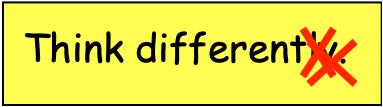
I think it is fair to say that Steve Jobs drove the final nail in -ly’s coffin. When he urged us all to “Think different”, he made it official that even smart guys don’t need grammar. Now anyone who puts up a sign reading “Shop local” (instead of “Shop locally”) can say, “If it is good enough for Steve Jobs . . .“

This isn’t actually the rant it appears to be. I will personally continue to fight the battle of the -ly ending, but the war is over, and I know it.

Actually, it probably doesn’t matter. I know what Jobs means from context and word order. Losing the -ly ending probably won’t make any difference in the English language. It is just one of the natural ongoing changes that occur in all languages.

I once said that users of the English language who face change have only one obligation. If the change is stupid, don’t use it. The loss of -ly isn’t stupid . . .

. . . but it still hurts my ears.

743. AI and File 770

There is a website called FIle 770 which I have been following since they asked to quote from one of my posts. I hadn’t heard of them until then because I’m not a scence fiction “fan”.

I have been writing science fiction for 50 years, and reading it extensivley for 65, but I don’t discuss it with friends and I don’t join fan clubs. I even wrote a post about that once, so I never ran across File 770 until they ran across me.

File 770 covers everything in science fiction, fantasy, and horror, including books, television, and movies, with a big et cetera following that list. I have learned a lot from them. You might check them out.

The October 29th post quoted an excerpt from SF Concatenation, which quoted from an article in Nature titled Can scientists reliably tell if a novel is written using AI.

That got my attention.

Being a scholar (snoop, busy body, sceptic) I tracked the quotation backward and sideways. I need to tell you where I went so you can check things out for yourself, but that will be tedious, so I will place the URLs at the bottom of the post.

The Nature article was a bit of a mess. I can partly put this down to being an interview rather than a closely written scientific report, but the categories given in the description of the study are a hopeless jumble. Think apples and oranges, with a few peach pits thrown in. The original scientific paper was more reasonable, but the categories raised questions from the outset.

The main example of AI generated text was much more troubling. AI (typically the program Pangram) searching for AI generated material seems to boil down to looking for identical phrases which are “too long and specific to occur in exactly the same way by coincidence”. The example given was “They collapsed together, a tangle of sweat-slicked limbs and racing hearts.”

What!  You’ve got to be kidding me.

Writing about sex in romantic novels calls for indirection mixed with enthusiasm. You can’t name body parts and describe what they are doing, but you must be able to bring your reader to a state of sexual excitement. That isn’t easy, and the turgid text which often results sounds exactly like the example provided. The author of the study is surprised to find this identical sequence is two separate books. I would be surprised if you didn’t find that sequence a dozen times, given a large number of romance novels to study.

But that isn’t the main problem with equating long identical word sequences with AI. If such identical sequences are found, what does it really mean?

1.  It might mean that two different authors had independently created the sequences, no matter how unlikely.

2.  It might mean that it was out and out plagarism.

3.  I might mean that the sequence was unconsciously remembered and reused.

4.  It might be deliberate, unreferenced quotation, perhaps an homage, perhaps a quotation thought too insignificant to note.

5. Or, it might be AI.

Simply assuming that it is AI is indefensible.

If a dozen or more such sequences were found in a single book, it still would not indicate AI. It would more likely be a dishonest human writer.

I will suggest an experiment that would deal with the question of AI hunting down AI. Take a few thousand novels from the twentieth century (or the nineteenth) and subject them to Pangram. See how many pop up as AI generated. I’m taking bets that it would “find” hundreds, a hundred years before AI was invented.

For even more negatives on Pangram, check out the Atlantic article below.

* * * * *

The original File 770 can be found at (https://file770.com/pixel-scroll-10-28-26-i-find-your-lack-of-pixels-disturbing/). No, you aren’t reading that wrong, Mike Glyer likes goofy titles.

From File 770, I went to the Nature article, available at (https://www.nature.com/articles/d41586-026-03394-4)

The Nature article carried me back to a précis of the original scientific study at (https://arxiv.org/abs/2607.20349). Once there, I clicked View PDF and got the whole thing.

Along the way I also found an even more interesting article in the Atlantic at (https://www.theatlantic.com/technology/2026/05/pangram-ai-detection-accuracy/687381/)

742. Post election Post

“I will go tomorrow,” said the king.

“You will wait for me,” said the wind.

     Gaelic proverb from the days of sail.

===========

“I am the king, bow down,” said Trump.

“Not so fast,” said the People.

     Election results, 2026.

===========

I am celebrating yesterday’s results, but I also offer a caution.

In 2024, Republicans took both houses of congress. That was unfortunate, although under any other president, it would not have been so great a disaster.

In 2026, Democrats took back both houses of congress. It was necessary and proper, but it is not sustainable.

America works best when all voices are heard.

Democrats, you are  now responsible for the country’s immediate future.

Republicans, you are now responsible for taking your party back from a corrupt and incompetent administration.

Independents — like me — will be watching both of you.