Tag Archives: memoir

259. Turkeys Under the Oak Tree


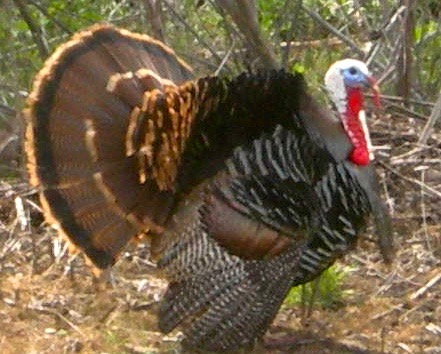
dscn0719dscn0693These birds were photographed on a spring drive through the foothills, about twenty miles from my house. The puffed up, greeting card version is what the males look like in season, when they are strutting their stuff and looking for love. The other bird is what most turkeys look like, most of the time.

You are reading this on Thanksgiving, but I am writing on September 27, about something that happened yesterday. My wife came to the door of the little building out back where I work and said, “Come here. Quietly.” There were ten wild turkeys eating bugs and acorns along the east side of the house.

We don’t get turkeys very often right up to the house, although seeing them in the neighborhood is a common occurrence. We stood for twenty minutes watching in the hundred degree heat of the tag end of summer before they casually wandered off.

Turkeys are the symbol of Thanksgiving, but I was thankful to see them because wild things fill my life with joy.

I grew up on a farm in Oklahoma in another century. I worked long hours when I was growing up, but I worked outdoors, so it might have well have been play. The music that filled my life was the churr of cicadas on summer evenings and the howl of coyotes echoing through the frosty night air in winter.

I left the farm for college, then spent my adult life in a small city, and moved to the foothills when I retired. Now my human neighbors are near enough for help in emergencies, but far enough away that I don’t hear them when they fight. I don’t even know if they fight.

Several times I have seen packs of coyotes running through my yard. Once a mother duck with nine ducklings following single file paraded through. Deer come in from time to time. They mostly prefer the low ground, and we live on a hill, but they come for water as the long days of summer dry out the last of their water holes. I keep water in bird baths for the birds, and water basins on the ground for everybody else.

The deer also have an uncanny knack of knowing when the tomatoes are ripe. Oh, well.

I see a bobcat about once a year, somewhere nearby. Twice they have come into our yard. Once I looked out the window to see a bobcat in the fenced back yard where stray cats stay out of reach of coyotes. My wife and I watched out the window as he sauntered along, unaware of us, then casually jumped the six foot fence without touching it.

We were even visited one holiday by the Christmas Pig. It was a three hundred pound porker who had obviously escaped from some farmer. I saw him several times after, so I’m maintaining hope that he was never found, and escaped becoming bacon and sausage.

So, happy Thanksgiving to you. And also to the turkeys and ducks and bobcats and raccoons and possums and the one lone pig.

In my house, Thanksgiving means turkey (from the supermarket, of course), stuffing, cranberries and pumpkin pie. Being thankful means looking out my window and never knowing what kind of critter might be looking back.

258. George Mackay Brown’s Seven Poets

Most of the people who read this blog are writers, or want to be writers. I know from visiting your websites that you range from beginner to professional, and many of your writings have impressed me.

Friends, I have something for you. I’ll give you details below, after the set-up.

I discovered George Mackay Brown in 1987 when my wife and I went to Europe for the first time. We started in England, then went to Scotland to see the land of my wife’s ancestors. Along the way, I visited bookstores to pick up reading material that I wouldn’t find at home and discovered Neil Gunn and George Mackay Brown, two Scottish authors who deeply enriched my life. Both write elegantly about their own experiences in Scotland and the Orkneys (technically part of Scotland but very different). I’m sure I’ll talk about them both from time to time in this blog, but today I just want to shill for one short piece by George Mackay Brown.

I recently had reason to flip through my George Mackay Brown collection, looking for a story I read years ago, and stumbled onto The Seven Poets, the final story in his collection The Sun’s Net. It is a post-apocalyptic story, but it is a fable, not science fiction.

    *     *

The world has reverted. After machines and cities swallowed up the earth, there was a revolution. Machines were banished. Cities were destroyed. Now there is a world wide agreement that no settlement can have more than 250 members. When a village grows beyond that, some are chosen to leave and form a new village.

(Now don’t tell me this wouldn’t work. I know it and GMB knew it. It’s a fable; a set-up to make a point about writing.)

The world is calm, serene, and boring; some men can’t abide that. They become wanderers, without a village, without a community, welcome everywhere for a brief stay, but welcome nowhere as permanent residents. Our narrator is such a man. He has wandered the whole world, through a long lifetime, staying with men of every occupation, but most usually, staying with poets.

Every village has a poet, who spends his year writing a masque for the midwinter festival. In Spain, such a poet told our narrator, “The world was created by one Word. Every poet makes, in his lifetime, a tiny fraction of one letter of that Word.” Another poet’s voice had deserted him. Another was a heretic to the new order who wrote of machines, but when his villagers performed his masque, their mocking turned the performance into a parody of his thoughts. In Siberia, a poet wrote in the inhuman language of roots and salmon and blizzards . . .

    *     *

I can’t begin to convey the depth of sensible weirdness of The Seven Poets. That would require exactly a many words as GMB took, exactly the same words, and in the same order. Prose written by poets can do that to people who try to paraphrase it. I can only say that his fable has captured beautifully the strangeness of trying to nail life to the page with words.

There doesn’t seem to be an online source for The Seven Poets, but it’s probably only fair that you’ll have to seek it out in print. I guarantee you a singular experience if you do.

257. Who Knows?

Who knows? Probably the internet.

The internet is science fiction at its best. Back in 1986, when I bought my first Mac, it came with a program called HyperCard. It was a crude, early version of what has now grown to be the internet. It allowed you to create mini-documents called cards and connect them via buttons so you could jump freely from one to another. I dreamed of creating a database of everything I wanted to keep at my fingertips. Then Newton came out – Newton was a proto-tablet that didn’t work very well – and I saw the pair of them as my own personal Tricorder.

Just dreams. Both hardware and software were too crude to be more than a tease, and even a tiny database takes a vast amount of time to create.

Today, the internet does what I dreamed of doing in the days of HyperCard and Newton. I use it to do research for this website. Sometimes I’m looking for things I don’t know, and it works fine for that. Primarily, however, I use it to check details on things I already know.

Here is an example. Years ago I wanted to look again at the Sherlock Holmes quote about furnishing your brain. If you don’t know what I’m talking about, here it is:

“You see,” (Holmes) explained, “I consider that a man’s brain originally is like a little empty attic, and you have to stock it with such furniture as you choose. A fool takes in all the lumber of every sort that he comes across, so that the knowledge which might be useful to him gets crowded out, or at best is jumbled up with a lot of other things, so that he has difficulty laying his hands upon it. Now the skillful workman is very careful indeed as to what he takes into his brain-attic. He will have nothing but the tools which may help him in doing his work, but of these he has a large assortment, and all in the most perfect order. It is a mistake to think that that little room has elastic walls and can distend to any extent. Depend upon it there comes a time when for every addition of knowledge you forget something that you knew before. It is of the highest importance, therefore, not to have useless facts elbowing out the useful ones.”

I thought this was in one of his middle stories. It wasn’t; it was in the first, A Study in Scarlet. To find it, I pulled down my complete Holmes in two volumes and spent an hour looking, but I couldn’t find it. I stumbled across it by accident months later.

So today I did an experiment. I went to my search engine and typed in “brain attic”. It returned a page with ten responses. Six of them referred to the Holmes quote. I opened one, copied and pasted into this post, and you just read it.

Here is another example of finding things I already knew. In my post on The Monkey’s Paw, I wanted to use a quatrain from the Rubaiyat. I knew it well, but not well enough to quote for publication. I didn’t want to spend time getting out my copy and reading through its pages, so I typed a fragment – “dId the hand of the potter shake” – into the search engine and up popped:

After a momentary silence spake
Some Vessel of a more ungainly Make;
“They sneer at me for leaning all awry:
What! did the Hand then of the Potter shake?

Notice that I scored a hit even though I had left out “then”.

Earlier today, I was writing about the Lord Darcy stories. I didn’t want to misspell Randall Garrett’s name (How many Ls, how many Rs, how many Ts?) so I typed it into the search engine and got my correct spelling along with a great deal of additional material that I didn’t need.

That I didn’t need at the moment, that is, but information that will be there when I do need it. Like I said at the top, the internet is science fiction at its best.

255. Fire

dscn2539For writers – or anyone who is leading a thoughtful life – every day brings experiences that add to our understanding of the world around us. For the last half decade, my tutor has been fire.

I took the photo at the top of this post a few years ago, while standing in my front yard. The smoke was only about three miles away and my first thought was, this is finally it. Fortunately, it was on the other side of a lake that lies in the valley between my house and its location. We drove to a vantage point and spent an hour watching a scoop-equipped helicopter dropping down to the lake for loads of water, and dropping them on the fire. It took several days to put it out, so for a week we could not open any windows because of the smell of burning.

There have been weeks in late summer almost every year recently, when the smell of burning kept us indoors. You could blame our long-running drought, but that isn’t it. When there is little winter rain, things become unnaturally dry, and there is fire. When there is abundant winter rain, the grass and weeds grow tall and lush, and there is more fuel for the fires that still come.

Arthur Clarke wrote a story called Report on Planet Three, in which Martians, observing Earth through telescopes, concluded that life could not survive here because the atmosphere was so rich in oxygen that Earth might have open fires as a natural phenomenon! When I first read the story as a youth in Oklahoma, I found it humorous. Now that I live in the foothills of California, I say, “Yep, Arthur, you got another one dead right.”

A few years ago, a target shooter started a fire that burned into Yosemite. Three years ago, north of here, an illegal campfire was the spark. Two years ago, east of a foothill town I visit frequently, it was untrimmed trees rubbing against a power line. This year, someone pulled off the road into dry grass and his hot muffler started a thousand acre burn just a few miles from my home. That was the fire that caused me to write this post.

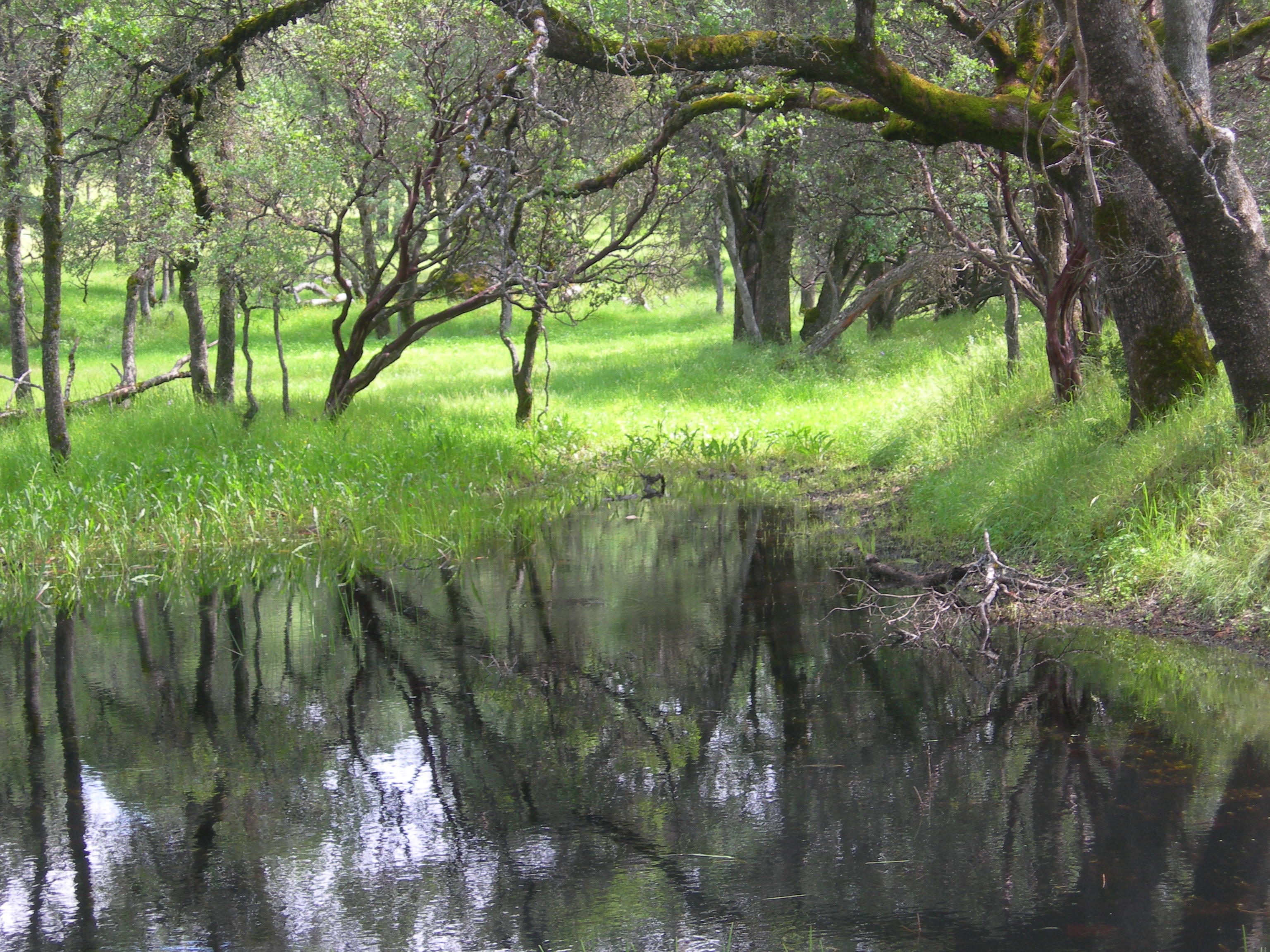
dscn4753Here is one of my favorite places. It is a vernal pond; man made, but fleeting. Right now it is probably filling with water, as it does every fall. It will look this beautiful until spring – maybe.

In the coverage of the fire this year, a newscast showed a reporter standing on a black top road. One side was untouched; the other was fire blackened. It was the point at which the fire had started, and I recognized it as the place I park when I go to the pond. I couldn’t tell whether the reporter was facing north or south, so I don’t know if my favorite place was saved, or destroyed. I haven’t yet had the heart to drive up and find out.

In my writing, I have brought nuclear war to Earth in two different fictional universes. It’s easy. I don’t see many movies, but everyone sees their trailers on TV. Massive, ubiquitous destruction prevails. A kid with his own camera and computer could illegally produce his own apocalyptic vision, using FX stolen from Blue-ray. Washington and New York have each gone up a dozen times in the last few years. He would have an abundance of destruction to call upon.

Bringing massive destruction over there is easy and cathartic. Dealing with even small destructions right here is another matter. I had no problem blowing up the Earth, twice, but I dread driving up to see if my favorite pond is still there.

254. Legal at Last

Roughly a week ago, California legalized recreational marijuana, having legalized medical marijuana twenty years previously.

It was so much of a no brainer, that (time-travel-spoiler-alert) I am writing this post a week before it happens, with reasonable certainty that I would-will-did not have to eat my words before post date.

So why even bother to talk about it? For one thing, it is a tie in with Raven’s Run, now being presented over in Serial. In my fictional 1989, California State Senator Cabral has been trying for years to bring about legalization because he thinks prosecution itself is what has made marijuana profitable. Oddly enough, that is also my opinion; I came to that belief back in the sixties.

Ah, the sixties. There is a smoky haze of nostalgia about the era, and the smoke smells like pot. I remember it well, and one reason I remember so well is that I wasn’t partaking. It wasn’t a moral stance. I was going to college on a scholarship, and I was determined that nothing was going to stand between me and graduation. Most of the people I knew were smoking weed and popping various multicolored pills which promised multicolored results. Those were the early days when the law hadn’t caught up to the pharmacopeia. In Michigan, where I was going to school, possession of marijuana was a felony, but possession of LSD was still a misdemeanor.

My friends were reading Castaneda’s The Teachings of Don Juan as enlightenment and popping peyote. I read Don Juan as fantasy – second rate fantasy, by the way – and skipped the medicine.

They were also taking LSD. At least their supplier said it was LSD, but on the black market, who knows. I wasn’t interested. I already knew about LSD from my time as a Fleming Fellow, during high school. One of the doctors I encountered at the OMRF that summer had used LSD in an attempt to induce musth (a frenzied sexual state – think pon farr) in an elephant. It didn’t go well for the elephant, and I was in no mood to engage in unsupervised medical research in a college apartment.

I came away from the sixties disliking the idea of mind altering substances. Then someone very close to me, with a debilitating ailment, became hooked on prescription pain killers. That reinforced my feelings. Now I try to hold my intake to coffee and aspirin.

This does not give me reason to tell anyone else what to do, and the idea of a whiskey fueled police force jailing ragged people for smoking pot is beyond my comprehension. I have voted for legalization every chance I’ve had, even though I wouldn’t touch the stuff myself. It has taken the rest of society fifty years to catch up to that position.

To be fair, a lot of people have been part way there for some time. As one of my kindest, gentlest, most Christian and conservative friends said two decades ago, when the question of medical marijuana was on the ballot, “Doctors can prescribe codeine, cocaine, and heroin, but not marijuana. That’s just dumb.” I would have said it more forcefully, but I couldn’t have said it more accurately.

So, when it came time to write Raven’s Run, I made the mastermind in the background (not yet revealed in Serial, so you’ll just have to keep reading) a purveyor of pot with interests in keeping up the anti-pot laws that make his enterprise profitable. And waiting in the wings, also related to Raven’s Run, is another novel, not yet written, about the sixties drug culture and the role played by the CIA in making LSD America’s favorite abbreviation.

252. Leonard Cohen, an appreciation

A day or so ago, Leonard Cohen’s death was announced on a trailer at the bottom of a newscast about Trump. It was not much notice for one of the finest artists of the last century.

I went online to find a few articles, New York Times and Rolling Stone mostly, but they didn’t tell me much that I didn’t know. I’m not going to add anything to his bio in this post. If you want to know about Leonard Cohen, listen to his songs.

To sum up, briefly and without equivocation, Leonard Cohen meant more to my moral and ethical life, more to my writing, and expressed my personal feelings better than any writer of fiction ever did.

I don’t mean that I learned about life from him. I learned about life from life, and a harsh one at that. I was fully formed when I discovered him, but he spoke to me. Leonard Cohen had the ability to say in music what I was trying to say in text. In almost every song, there was someplace where, the first time I heard it, I shouted, “Yes, dammit. Yes!”

I discovered Cohen when I was in college, in the sixties. Then I graduated, got drafted, spent four years working in a military hospital, went back for an MA, and in 1975, settled down to write novels. I wrote more or less full time for most of the following decade.

My wife would leave for work, and I would sit down at the typewriter with music on the stereo. At that time, I needed emotionally charged music to set the mood and drown out other sounds – today I could write through a hurricane. I wore the grooves deeper in a lot of LPs, and nothing played as often as Leonard Cohen.

HIs music was like a drug, compounded of depression and hope. It was rich, complex, filled with both thought and emotion, but it was an acquired taste. Except for Susanne and Hallelujah, not many people took to him. He doesn’t come easily; you have to listen with both ears and your whole heart.

Leonard Cohen’s music suffuses everything I have written. I never met him, outside of his records, but I count him as a mentor.

If you want to go beyond Hallelujah, I have a suggestion. Find a copy of Alexandra Leaving ( from Ten New Songs) and listen to it repeatedly, asking yourself, “Who is speaking? Who is this man, and what is the woman to him?” Make it your personal koan.

If, after repeatedly listenings, you decide Leonard Cohen isn’t for you, fair enough. You will have saved yourself a lot of heart ache.

And missed a lot of joy.

251. Night at the Movies

Over in Raven’s Run in Serial today, Ian Gunn is reminiscing about:

The feeling in a night drive —- the humming of tires; the warm heaviness of the air, the darkness beyond the car —- when you were a child in the back seat —- and the thick air slid in and out of your throat like oil.

That description is pure memory.

Oklahoma is the edge of the South, with thunderstorms, tornadoes, and hot, humid summers. Air conditioner country – but I lived there before people has air conditioners. Days over a hundred were common, and the nights brought thick, moist, warm air. There were scraggly trees in the creek beds and flattish land between that was half native grass pastures and half grain fields.

Was. Now it grows houses, and people live indoors with the AC running, but in the fifties people were sparse on the ground and they spent most of their time outdoors.

I spent my summer days driving a tractor. There were no air conditioned cabs – no cabs at all, actually – but it wasn’t bad. There was an umbrella clamped to the seat, and as long as I was moving, which was at least ten hours a day, there was a breeze.

Nevertheless, nights were a pleasure by contrast. After the cows were milked, we sat in the living room with the west windows open to the wind. My parents watched TV (black and white, two channels). I joined them, or read a book. Once or twice a year, we would all go see a movie.

Those same years, my wife-to-be lived in Saginaw, Michigan. She used to walk to Saturday matinees. It’s a common reminiscence, but my nearest theatre was twenty miles away, so going to a movie was a family expedition.

After the day’s work, and milking the cows, and supper, and cleaning up, we would drive to Collinsville as the sun was going down. When we arrived, we went right in. There was only one theatre with one screen, and it changed movies every three days, so you went on the day your movie of choice was there. It didn’t matter what time the movie started; we went in, sat down, and started watching. Then we watched the coming attractions and the cartoon, and pretty soon the next showing started. We watched until my dad said, “Okay, this is where we came in.” Then we left, with no wasted time, because four AM was coming all too soon, and the cows weren’t going to milk themselves.

What I remember best about movie nights, is the ride home – especially when I was ten or so. Twenty miles on a two lane blacktop, lying stretched out on the back seat, reliving the movie, and the coming attractions which were pretty exciting for a ten year old in the fifties. Imitation of Life previews were disturbing, largely because I didn’t understand the premise of the picture (see 95. Literature of Passing). Then there was a scene of a girl wearing only a towel in a cowboy movie preview that revisited my libido for months. Mostly though, I remember a science fiction movie – something I would never have seen outside of previews – with animated pterosaurs and dinosaurs chasing people as they fled in their cars. Tame stuff for the Jurassic Park generation, but scary to me.

Outside the car, the night dampness amplified the smell of grass and weeds. The soundtrack of the night was the humming of tires and the unending churr of cicadas. The air swirling in through the open windows was syrup thick, damp and cool. The vibrations from the road, softened by the seat and transmitted through to my spine, was electric, and the little shocks from potholes were like tiny bursts of pleasure.

All this comfort was balanced by the emotional rush of hearing those imaginary dinosaurs in pursuit, along with the scree of giant pterosaurs flashing overhead.

I’ve forgotten most of the movies we saw, but I will never forget what the night felt like.

245. Serializing

I’ve been doing a lot of serializing lately. In fact, I’ve been at it for over a year, but lately it has become intense.

Publishing novels serially in periodicals is a very old idea. Most of Charles Dickens work came out that way. What I’m doing is a bit different though, because Dickens wrote his novels to be serialized. The size of each chunk was known to him when he wrote. And the chunks were bigger.

David Copperfield was a novel of 358,551 words. I know this by downloading it from Project Gutenberg, transferring it to my word processor, and using the word count function. You might make note of that; it is a useful technique. David Copperfield was published in twenty monthly installments. That makes each installment was about 18,000 words. In SFWA (Science Fiction Writers of America) terms, each installment was of novella length.

My typical serial post is about 600 words.

Dickens serialized in order to sell to those who could not afford his books, and at the same time, to boost sales of those books when they came out after they appeared in periodicals. Most successful nineteenth century authors followed the same pattern. So did the big names in twentieth century science fiction, although they wrote smaller novels and presented them in fewer, but longer installments. Often they didn’t sell their books for serialization until they were already completed.

That is also my situation. Nothing I have presented in Serial was in progress at the time it was serialized. I’m too slow and picky a writer for that. Some of the things presented had been published, some had not, one was presented as a excerpt from a completed novel, and one was a fragment from a novel I’ll probably never finish. Jandrax was annotated to such a degree that it almost forms a writing primer, and How to Build a Culture was entirely a how-to.

Everything I have presented in Serial has been to assure continued readership of the website. It’s a trick. Leave ‘em hanging, and they’ll come back. And the whole website is to assure a readership for my upcoming novel Cyan, and for others that will follow.

But man, it has been fun.

I’ve enjoyed revisiting old friends. I’ve learned a lot from a close re-reading of old material, especially regarding pacing. Since I post four days a week, each post has to be relatively short, both to keep from running out of material too soon and to keep each reading experience brief for the sake of the daily reader. I didn’t originally choose 600 words; that just evolved.

The actual process of taking a novel and breaking it into pieces has been fascinating, frustrating, and a rewarding learning experience. It begins with a completed novel, which may be decades old, and which will already have been polished to a high shine. Still, I find errors from time to time.

First, using a word processor version, I have to re-read the novel, looking for natural breaks in the action every two and a half to three manuscript pages. I type a nonsense word at each break. I use breakbreak, as one word, which has meaning to me but would never appear in the actual text. This will allow me to use the find function to jump from break to break if I should need to. After typing breakbreak, I highlight what I have chosen, use the word count function, then type in the number of words. If it seems too short or too long, I adjust.

That takes care of post #1. Now to repeat. Jandrax required 92 posts. Raven’s Run will require 150. Some posts make sense on their own, but some require that I start with a sentence or two from the previous day’s post. I use bold-italic to denote this repeat.

All this takes place on a single word processor document. I then make individual documents of each post-to-be. This is a backup to what will actually appear on the website. At this point, I run the spell checker one last time and face the two-space conundrum.

I learned touch typing in high school in the mid-sixties on a mechanical (not even electric) typewriter. This was overseen by Mrs. Worden (AKA the warden) who pounded (pun intended) the rules into our heads. One rule was that you put two spaces between sentences.

Over the years I went from mechanical typewriters, to electric typewriters, to computers, but the rule stuck with me – even after everyone else had stopped using it. Raven’s Run was written before I kicked the two space habit, so now I have to go through each document removing the second space.

The last step is copying from word processor file to website.

Tedious? Yes. Fun? Absolutely. If you write, and you don’t enjoy reading your own work, why bother?

244. Walking by Night

outhouseHere in California, Halloween doesn’t look like itself any more. I suspect the same metamorphosis is taking place across the country. Images from the Mexican Day of the Dead are everywhere, competing with Anglo witches, ghosts, goblins, and jack-o-lanterns.

It’s no surprise, really, since Halloween has become a $econd Chri$tmas, in terms of commerce. I have no trouble understanding why retailers are producing big-eyed, flower painted skulls for sale. I have some trouble understanding why anyone is buying them.

As a matter of full disclosure, I don’t care for Halloween, and at both ends of my life I have had little to do with it. In the middle, when I lived in cities, I hosted the trick-or-treaters who came to my door, just like everyone else. I admit the mid-level kids were fun and putting up with a little pleasant extortion was just being a good grown-up. I wasn’t much impressed by the adults with infants in arms, or the overaged teenagers who grunted and threatened like gang bangers. But many Americans have no sense of age appropriateness, so they were no surprise.

Anyway, I would be a hypocrite if I hated trick-or-treaters after all my praise of Christmas last year. After all, trick-or-treat and wassailing are the same ritual.

I haven’t had a trick-or-treater at my door since I retired to the foothills, and that brings me full circle. When I was young – during the fifties in very rural Oklahoma –  we didn’t trick-or-treat. We were simply too spread out. It would have been impossible to walk to anyone’s house, and in those days parents weren’t about to drive their children all over the county just for their amusement.

Instead, the local tradition was ritualized vandalism by teenagers. That was the night outhouses got turned over – and yes, people still used them. Windows got egged, toilet paper got tossed, there was even some graffiti. In Oologah, the next town south, I saw a business sign which had been tagged with Oologah hoars. Vandals couldn’t spell back then either.

As October rolled around, all the adults started telling outhouse stories from their misspent youths, and current youths started planning. I took no part in any of it, but I heard it all, and one story in particular caught my fancy. I think it was true; at least I knew the old lady in question.

She lived in a little house in town, with no plumbing and an outhouse out back. Every year somebody turned it over on Halloween, and she was tired of it. This year, she went out when it was still light and settled in to wait with a shotgun across her knees. Eventually it got dark, and eventually she heard whispers and the first creak as the local teenagers got a grip the outhouse. She threw the door open, leaped out and gave a mighty scream, and fired both barrels into the air. When the echoes cleared, there was no sound but retreating footsteps.

The old woman went to bed with a smile on her face. The would-be vandals, once they recovered from their fright, had the memory of a priceless adrenaline rush and a story to tell for the rest of their lives.

I love it when everybody wins.

237. Rain

dscn4753This is a vernal pond, a few miles from my home. It will fill with water by Christmas and be dry again by Easter.

Let’s take a break from the world of politics and check into the latest meteorological phenomenon.

It rained last night.

That may not be a big deal to you, but here in the foothills of the Sierras it represents the change from one season to another in a climate that only has two seasons – dry and wet.

Our last rain came in mid-April. Six months without a drop. You may have heard that we are in a drought, but this is a different phenomenon. It is normal here for the last rain to come in mid-April, and normal for the first rain of the rainy (if that is the word) season to come in mid-October. Our drought is because we haven’t been getting enough rain between October and April.

So what does that have to do with my world of writing science fiction? Everything, really.

When I was young, my three favorite SF authors were Clarke, Heinlein, and Norton. Clarke’s stories always took place in artificial environments. Heinlein’s characters inhabited space ships, orbiting habitats, or frontier worlds; it didn’t matter, as long as they could talk incessantly, they were happy. Andre Norton characters, whether they were explorers, soldiers, spies, or interstellar traders, always spent their time outdoors, in wilderness or something like wilderness. The only cities you were likely to see in a Norton novel were in ruins, or the slums of the Dipple which any one of several young men were quick to flee from, usually into more trouble than they could imagine.

That suited me just fine. Her worlds were my world. In rural Oklahoma, I spent from May to September every year outside, usually driving a tractor, through rain, wind, dust, and heat. There were years when I watched the crops dry up and die under the relentless sun – and watched my Dad see six months work disappear before his eyes. There were other years when the rains came on time, the crops were good, and the pastures grew up heavy with grass; when the nights were a symphony of insect whirrings and the days were filled with bird songs and butterflies. Cliché? Paradise always sounds like a cliché.

It was the only life I knew, and I loved it, good years and bad, but I had to leave it, first for college, then to make a living. When I wrote my first book, I sent my protagonist into the mountains and lost him there, then let him find his way out. For my second book, Jandrax, I marooned a shipload of colonists on a barren, unexplored world, and watched them find a way to survive. In Cyan, coming out in a few months, I send a crew of ten to explore a rich new planet, then send them back to colonize.

I lived in a small city for most of my life. I could write about cities, but I don’t want to. My world is the world of nature –  even if it is nature on another planet.

So— it rained last night. About an inch, which isn’t much, even by Oklahoma standards, but the foothills only get thirteen inches in an average year. All the creekbeds remain empty and the hills remain covered with tall, dead grass in shades of brown, but within the soil, the change has begun. Seeds that have lain dormant since spring will be sprouting now, out of sight, and within a week there will be a faint haze of green, invisible beneath the long grass, but showing in the road ditches. This year’s grass will begin to flex its vegetive muscles, forcing its way upward through last year’s dead roots. Unnoticed, those roots will begin to loosen and be shoved aside until one day, a month from now, seemingly all at once, the old year’s grasses will tilt and fall, to disappear beneath the new green.

Suddenly all the brown will be gone and the new year’s grass will clothe every hillside. While the snows of winter cover the midwest, these Sierra foothills will be spring green, and the wildflowers will return.