Tag Archives: memoir

171. Solstice Measured

so me

This is a follow on to Monday’s post. If you haven’t read it, you might want to give it a glance.

I’m going to show you how to construct a simple instrument to measure sun angles. It works especially well at the solstice, but a few days late won’t hurt if you are only out to amuse yourself and maybe learn something. I first used this when I was considering where to place windows in a building to get north light without afternoon glare. You could use it to pick out the optimum placement for solar panels, or decide how deep to make a south-facing porch.

FYI to my followers in Brazil, New Zealand, and Australia. I am going to write as if everybody lived in the north latitudes; I’m sure you are used to modifying that kind of writing to meet your own needs. Sorry, but it’s just too clumsy to qualify every statement.

All you need to measure sun angles is a board with a vertical dowel or wire set into it near the center. You could use a carpenter’s square for that. You will need a spirit level to level the board, and it wouldn’t hurt to then use the level to see if the dowel is still vertical (what carpenters call plumb). You will mark the shadows as they fall directly on the board.

This is what I used the second year. The first year i drove a rusty used pipe into the ground and drove stakes into the shadows. Same principle, but far too clumsy.

Next, you need your local sun time. Subtract daylight savings time, but that isn’t enough. Noon, by the sun, is when the sun is directly south of you. Clearly that is an hour earlier on the east side of your time zone than it it on the west side, so you need your longitude and some simple arithmetic.

There are twenty four time zones, each 15 degrees wide. The first time zone is at zero longitude in Greenwich, England but, again, it’s not that simple. Time zones center on their base longitude. The first zone lies from seven and a half degrees east longitude to seven and a half degrees west longitude, and the other zones follow suit. Then all is adjusted to match up with political boundaries, but we can ignore that.

Let’s choose Oklahoma City as a neutral site, so I can give  a shout out to their wonderful Fleming Fellowship, celebrating its sixtieth anniversary this month. OKC is at 97.5 west longitude. If you ignore political gerrymandering, OKC’s time zone centers on 90 degrees longitude, so OKC is on the western boundary of the theoretical time zone; the political time zone ends on the western border of the state. The sun is south of OKC when your watch says 1:30 PM, if your watch is accurate and you have it set for daylight savings time.

To find solar noon for the longitude where you live, add or subtract 3 minutes for every degree you are west or east of the theoretical center of you time zone.

I like to set my board up the day before and rotate it so that the (solar) noon shadow lies parallel to this sides of the board. That isn’t necessary, but it makes for a neater project. Then I’m ready to record the shadow that falls at sunrise.

Sunrise is problematical. You can look it up for your area, but it’s not that simple. (Have I said that before?) If you live on a mountaintop, sunrise will come earlier. If you live in a valley – or, in my case, on the west side of the Sierras – it will come later. How much can’t be calculated. It depends on how far west of that hill you are, and how high that hill is, and whether today’s sunrise happens to fall behind your neighbor’s house, or behind that big oak tree. It will come when it will come. Have a straight edge handy and draw a line from the dowel down the center of its shadow, then write down the time. Continue through the day. I try to make a mark every hour on the (solar) hour.

Early and late shadows will probably run off the board, but for the rest you can calculate the sun’s vertical angle because you will know the height of the dowel and the length of the shadow. Personally, I take the measurements, redraw the triangle on another piece of paper, and measure with a protractor; but then, I grew up before calculators.

You do realize that this is the year’s extreme for north tending sunrise and sunset and for high sun angles, and that every other day until December will be slightly different.

Even if you never design windows for north light without afternoon glare, or plan the placement of solar panels, or decide how deep to make a new porch, taking the sun’s angles throughout the day will give you a better feel for your personal environment, and a new appreciation for the complexities of astronomical observations.

Extreme astronomy geeks will repeat the process at the equinox and winter solstice, but good luck if you try. I’ve never been able to pull off any shadow measurements in December because of clouds.

170. Middle School Astronomy

We learn our astronomy from books, but that isn’t how the science started. The ancient Greeks learned about the stars by looking at the stars. Their understanding was a mixture of observation and myth, with myth sometimes predominating.

When we are young, we also learn astronomy from casual statements we hear from adults. I’ll give you an example. Mars has recently been at a close approach; every evening lately, when I step out my front door (miles from the nearest city) to look at the sky before bed, there it is, red and bright, about halfway to zenith in the south-eastern sky. Now imagine that I say to a child, “Mars is really getting close.” Just that, with no other comment. What images might pop into that child’s mind?

*****

“The seasons change because of changes in the Earth’s tilt.” You might find a statement like that in an old middle school science textbook along with an illustration like this:

ma1

Not true. Not a lie, but an oversimplification that may be fine for the average student, but does not do justice to the brightest kid in the room. A better statement would be, “The seasons change because of apparent I changes in the Earth’s tilt”, coupled with an illustration like this:

ma2

Now we are more accurate but we’ve confused 90% of the students.

It should be obvious by now that this is a bit of a how-to based on long experience. Even if you aren’t a teacher, you will probably someday have to explain this kind of thing to your own kids.

Let me suggest a third option. First explain things in your best lecture voice with reference to the textbook and with drawings on the board. Then pick a student sitting in the middle of the classroom; out of kindness, choose someone who likes attention. Say, “Helen, don’t move. For the next few minutes, your head is going to be the sun.” Then establish where Polaris lies, for the sake of the demonstration. Your classroom may not allow you to use real north. If some bright, smart-mouth kid catches you out, don’t get mad. Rejoice that someone is paying that much attention and make it a teachable moment.

Now walk around the classroom with the classroom globe tilted toward your Polaris and talk them through the seasons, pointing out that the tilt never changes in relationship to Polaris, but it appears to change in relationship to Helen, our sun. Pat your worst troublemaker on the shoulder as you pass him, wink at the shy girl in the back corner who never volunteers, and say, “Excuse me, Earth coming through,” when you have to dodge around desks.

There is a rule of thumb for teaching science (which probably doesn’t work for algebra). If you enjoy teaching, and you let your students enjoy learning, they probably will.

*****

That exercise was for letting students visualize things they can’t see for themselves. You can also help them see things that happen in their everyday world, but normally go unnoticed.

Observing the path of the sun through the seasons is an Earth’s-eye-view version of the tilted globe carried through the classroom. How do you compress a year’s worth of observation into one 40 minute session, using the real sun instead of charts and graphs? It can be done, but it takes nine observations on your part, spread over three days, with those three days spread over half a year. It also takes a small can of paint and a paintbrush.

When I set this up, I picked a solid, upright, eight foot steel pole which was set up away from the shadows of structures and which I knew would not be disturbed for years to come — a volleyball net pole out on the playground. At 10 AM, noon, and 2 PM (sun time, not daylight savings time) one summer solstice I painted three inch circles (same diameter as the pole) at the pole shadow’s tip.

I repeated those actions during the fall equinox, which was intriguing for my students. I had a paint can and small brush at the ready during my ten and two classes, and on the stroke of the hour, I ran out of the classroom, painted the circle, and ran back in while they watched from the windows. The noon painting had an even bigger audience because of noon recess. As you might guess, I told those who asked questions, “You’ll find out what this is all about — some day.” On Christmas break I painted the last three circles during the winter solstice.

That spring, and for years afterward, I arranged to teach solar motion as near as possible to the spring equinox. The solstices fall outside school days, and the fall equinox is often cloudy in California. I explained everything with lectures, and reading, and drawings on the board, but then we all went out to those nine circles on the playground. As I talked them through the lesson, we all watched the pole’s shadow move. It is fascinating in our mile-a-minute world to take the time to watch a shadow inch its way across the ground. Even if it wasn’t 10 or noon or 2, everyone could see that the shadow’s tip either had or would touch all three of the middle circles.

I explained how I had placed the circles and invited students to lie down with their head on a circle and look past the tip of the pole to see where the sun would be (or would have been) at noon or 10 or 2 on the first day of summer or the first day of winter.

They paid attention. On days they pay attention, learning happens. It isn’t easy, but it works.

169. North Light at Solstice

Some years ago, I had an epiphany at solstice time, all about north light.

North light is one of those concepts we accept without thinking it through. Artists prefer north light for their studios – we learn this young if we are thinking about being painters. Most of us never become artists and never have a studio, so the notion falls into the category of unexamined concepts.

I learned to paint and draw, but my skill level never rose above adequate. I didn’t become an artist, or any of another double-dozen fleeting ambitions, but I did become a writer and later a teacher. As I was nearing retirement, I bought a three acre parcel with house in the foothills of the Sierras.

For the first time, I had the chance to build something bigger than furniture or musical instruments. I was wandering around the back yard on blistering summer afternoon, thinking about north light and about building a shop with big widows pulling in masses of lovely natural light, when I looked at the north wall of my new house and saw that it was in full, hot, withering sunlight.

That’s not supposed to happen. But it does.

I live at latitude 37, roughly in line with San Francisco, Tulsa, and Washington, D. C. Here the sun is so far north (apparently) by mid-summer that it rises well north of east and sets well north of west, traversing a curved path so that at noon it is still south of zenith. The result is that the north sides of structures receive cool morning sunlight, shade during most of the day, and blistering sunlight in late afternoon.

I should have known, but in the cities where I had spent my life there were always trees and the shadows of multiple buildings to hide the effect. I had studied astronomy, but that is about the big picture, not about what is happening in your own backyard. I should have known from a youth spent outdoors, but then I was always on a tractor and in motion, concentrating on the windrow of hay I was creating, not on how sunlight fell on structures.

As a childI was aware of the motion of sunsets across the western horizon as the seasons progress, because every evening I was in the dairy barn looking out its west facing windows. I still love that phenomenon. There is a place near my foothill home where my wife and I go to watch the sunset. The spot faces west, on the western side of the westernmost hill in our area, so the vista carries all the way across the San Joaquin Valley to the coast range, and to the the buildup of clouds beyond where the cold waters of the Pacific spill fog over San Francisco. Mount Diablo, the highest peak in this section of the coast range, lies directly west of our lookout. Every spring and autumn equinox, the sun sets directly behind it. As summer progresses, each sunset is further north until we reach the summer solstice. Then they drift back, pass Mount Diablo, and head south until the winter solstice turns them back north again.

This is how astronomy began, with observations of visible phenomena. There were no ideas of orbiting bodies; that came later. Today, however, we know too much. We learn our astronomy from textbooks, not from our own observations. And then the reality in our own back yard catches us by surprise. more tomorrow and Wednesday

*****

For the record, I scratched the itch to build a building. My wife and I rebuilt a sagging 11 x 24 tool shed, put in big windows and a fancy facade. It is our quilting studio, where I also write. I’m sitting in in it now, watching the sun rise through the east window.

164. Flight into Space

The golden age of (fill in item of your choice) is thirteen.

I first read that phrase in reference to science fiction, but it works for quite an array of things. Certainly the music of our youth is the music we will always prefer, although that may come to us a couple of years after thirteen. It certainly works for automobiles and aircraft.

For me that golden age revolves around the F-104 and the X-15.

***

The entire focus of Edwards AFB, including most of the X-craft, was to fly higher and faster. The higher part caused problems with loss of control as the atmosphere thinned. The faster part brought about heating problems from atmospheric friction. Both lines of research culminated in the X-15.

The X-15 was first contracted in 1954. Early in its development, a follow-up aircraft to be called X-15B was considered. It was to be launched atop a Navaho missile in order to reach into space. NASA dropped the idea in favor of the Mercury program. The Air Force followed up with the proposed X-20, but that too was cancelled after Mercury became successful. Actual flight into orbit by a winged craft would not occur until the first Space Shuttle launch.

The first X-15 flight took place in 1959 and it was still flying nine years later, less than a year before the first moon landing. Like the earlier X-planes, the X-15 was dropped from a larger plane, in this case a converted B-52 bomber. Rather like a two stage rocket, this piggybacking allowed the X-15 a head start. The first 8.5 miles of altitude and 500 mph of speed came out the the B-52’s fuel tank, leaving the X-15’s fuel supply intact for the final push.

During that near decade, there were almost 200 flights. Thirteen of those flights went above 50 miles. The maximum speed reached in level flight was 4,520 mph.

The Air Force awards astronaut wings for flights above 50 miles – international rules do not agree. Two of those thirteen flights went above 100 kilometers. The Federation Aeronautique Internationale counts 100 kilometers as the edge of space, making Joseph Walker officially the thirteenth man in space. (Also the fourteenth.) One of those who gained Air Force astronauts wings was Joe Engle who later flew the Space Shuttle. Neil Armstrong flew the X-15 seven times, but never above fifty miles. He had to settle for a consolation prize on July 20, 1969 when he landed on the moon.

To successfully fly at such altitudes requires a series of small rocket motors strategically placed around the spacecraft to control attitude when the rudder, elevator, and ailerons have nothing to work against.

On high speed flights by the rebuilt X-15A-2, an ablative coating was sprayed onto the surface of the aircraft to protect it from overheating due to atmospheric friction, an issue that the SR-71 and the Space Shuttle would also have to face.

For my generation, the X-15 was the ultimate, and it looked the part. It’s pilots flew to the edge of space; they were not blown there in a capsule on top of a converted ICBM. Mercury and Gemini were wonderful. I followed them religiously. But the X-20, proposed descendant of the X-15, riding on top of a Titan missile would have done it with more class. And it would have landed under the pilot’s control, not on the end of a parachute in the middle of the ocean.

Scott Crossfield, the X-15’s designer and first pilot said it was one of the few aircraft that caused grown men to cry upon its retirement.

163. X-craft

Jay Miller wrote a book called The X-planes: X-1 through X-31, and later revised it to include craft through X-45. (Presently, the number is up to X-56.) If you are any kind of a space aficionado, you need to look it up in your local library. The only thing wrong with the book is its title; not all X-craft were planes.

When I was growing up, I was in love with the F-104 Starfighter and the X-15 rocket plane, two aircraft with markedly similar outlines. The F-104 was designed, a few prototypes were built and tested, then it went on to become one of the most successful fighter jets in history. The X-15 was designed, three were built (and rebuilt after various incidents), and tested. There were never any more X-15s, nor had there ever been a plan to build more. The X-15 was never a prototype, because a prototype is a first iteration, built to be tested, perfected and turned into a series. That is true whether you are talking about fighter jets or can openers, but not true of X-craft.

X-craft were something different. They were flying laboratories – a much overused term, but still accurate, although technology demonstrator is preferred.

After World War II, advances in flight by Germans, British, and Americans, along with nascent cold war tensions, put us on the edge of an unknown frontier. The “sound barrier” loomed as the best known obstacle to further advances in aviation, but there were a hundred other unknowns that never made it into the popular press. Wind tunnels could only tell so much, computer modeling was decades in the future, and it made no sense to build a squadron of high-performance aircraft that might or might not fly.

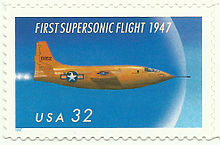
First_Supersonic_Flight_1997_Issue-32c

A glance at the first X-plane, the Bell X-1, gives clues to what was known and what was not known. We already knew that turbulence off the wing would foul up the tail controls at high speed, so the horizontal stabilizer was attached high up on the vertical stabilizer, not on the body. It was not known what negative effect the cockpit bubble would have, so the windscreen was faired into the shape of the fuselage. It was shaped like a 50 caliber bullet – everybody says that without explaining. It is a reference to the machine guns carried on fighter planes. Fired from a ground rest, those bullets would have been sub-sonic. The planes they were mounted on flew at subsonic speeds, but bullets fired from a plane in flight had been going supersonic for a long time.

An aside here for the non-nerd. Planes flying slower than the speed of sound are subsonic. That includes all commercial aviation except the Concorde. Planes flying faster than the speed of sound are supersonic. The X-1 and its follow-ons proved that supersonic flight is not problem. The problem is the transition zone, the trans-sonic region. Slower than sound, the accumulated shock wave is out in front of you. Faster than sound, it is behind you. At the speed of sound, it is right in your lap, trying to tear your plane apart. No modern, supersonic plane lingers at that speed.

The X-1 broke the sound barrier (i.e., passed through the transonic region into the supersonic region) on October 14, 1947, with Chuck Yeager at the controls.

Since this is A Writing Life, I’ll add that I was born about two months after the sound barrier was broken. I was present on the planet for almost all of the early X-craft explorations, although far too young to notice. When I became aware of the X-craft, I fell gloriously in love with them and the infatuation never passed.

The X-2 was a more normal looking aircraft, with swept wings and a pilot’s bubble. It carried supersonic speeds to new heights, but killed its pilot in the process. I will tell that story next Wednesday.

The X-3 was an extreme aircraft, stretched out and incredibly streamlined right down to the tip of its needle nose. It looked faster than any plane before or since, but it wasn’t. All that streamlining couldn’t make up for the fact that the engine slated for the plane wouldn’t fit, and the one that did fit was underpowered. The fastest (looking) plane in the sky flew slowly.

The X-4 was tailless and not successful. The X-5 tested variable sweep wing technology. The X-6 was an aborted project testing out the possibility of a nuclear powered aircraft. The X-8 was a small, unmanned rocket designed for upper atmospheric research. The X-7, and X-9 through X-12 were test beds for missile research. X-13 and X-14 were early attempts at Vertical TakeOff and Landing (VTOL).

Then came the coolest aircraft/spacecraft in the history of mankind, the X-15, which will be the subject of tomorrow’s post.

160. Stranger in a Strange Land

Stranger in a Strange Land proves that Heinlein was a hippie guru. Starship Troopers proves that he was a right wing madman. —-  From last post.

That’s nonsense, of course, but they do seem to stake out the two ends of the Heinlein continuum.

I’m a great fan of Heinlein, but neither of these books is a favorite of mine. I first encountered Stranger hiding in plain sight. It was 1963; we had just moved into a new high school. I was special assistant to an English teacher who was too lazy to shelve books himself. He let me put up all the new arrivals for the new library and Stranger was one of them, looking innocent in hardback with a Rodin statue on the cover. It wouldn’t have lasted long in rural Oklahoma, except no one else ever read it.

Stranger talks a lot about sex, in a fashion the hippie generation (in full disclosure, that would be my generation) took to be an anthem of free love. To many, it was the answer. That was a silly reaction, because Heinlein wasn’t in the answer business; he was in the question business. If you want to know what Heinlein was trying to do, just read what he said:

NOTICE:
All men, gods, and planets in this story are imaginary. Any coincidence of names is regretted.

In other words, “I dare you to to believe I’m not talking about you.” Compare it to the introduction to Huck Finn.

NOTICE
PERSONS attempting to find a motive in this narrative will be prosecuted; persons attempting to find a moral in it will be banished; persons attempting to find a plot in it will be shot.
BY ORDER OF THE AUTHOR, Per G.G., Chief of Ordnance.

If that sounds just a trifle similar, remember that Heinlein was a great fan of Mr. Clemens.

Heinlein had always been a chatty writer. It was a big part of his charm, and why he was able to get scientific ideas across so painlessly. Look at the first part of Have Spacesuit, Will Travel. It is a highly technical exposition of how a space suit works, that nobody else could have managed successfully. Heinlein put his technicalities into the words of a naive young enthusiast, and the boy’s personality pulled us along.

Stranger was a project that Heinlein had wrestled with for years, and when he finally wrote it, he took no heed of market pressures – including length. Even after Putnam asked him to cut the book, it still ran 160,000 words.

For the religious right, it was blasphemy; for the hippie generation, it was the word. For me, even as a teenager, it was a wet firecracker. All chit-chat about sex and everything else, but nothing ever happened. A book that sets out to disrupt society cannot be dull. Stranger was dull.

For me, the best thing about Stranger was that its success allowed Heinlein more freedom from constraints, especially length constraints. He had been a master of compression. Look at Time for the Stars or Door into Summer. Every sentence, even the chit-chat, carries the story forward at a brisk pace. 

Heinlein never wrote like that again, but his later, longer stories – despite occasional clunkers – are fine in a new way. They allowed him to sit in a metaphorical easy chair and tell long, rambling stories to those of us who loved to hear him talk.

151. Not So New Enemies

Part two of a comparison of Christianity and Islam.

Bush Two called those who strap on bombs to kill their enemies, cowards. That was the most monumentally stupid statement to ever come out of the mouth of a man not noted for his wisdom. People who die for their beliefs are not cowards. If we are to defeat them, we have to understand them. Mislabeling them is not useful. And if we call them fanatics, we had better understand what fanaticism is.

We made a start yesterday by looking at Christian fanatics. Now it’s time to make the comparison to Islam.

*****

Muhammad did not claim to be God or his son. He claimed to be God’s messenger, a prophet, making him closer to Moses or Isaiah than to Jesus. Muslims believe that Jesus was also a prophet, but not the Son of God. Christianity grew out of Judaism, fulfilling it and therefore removing its validity, at least according to Christians. Islam grew out of both and recognizes both as sister religions which have been rendered obsolete by the Koran. Christians and Jews get preferential tax treatment in Islamic law as People of the Book.

That doesn’t keep wars from happening.

Christians claim to be a religion of peace, but history does not bear that out. Actual wars of religion occurred throughout the Reformation period, and wars of politics and commerce often had a strong religious component. Think of the conquest of Mexico, with priests marching beside the conquistadores and building their missions in the shadow of the presidio.

Islam was born in conflict and has never hidden its belief that the Koran should be spread by military conquest.

Before the Reformation, Christianity had about a thousand years of supremacy, full of internal strife, but well able to keep that strife in check. When Jan Hus rebelled against the Church, they burned him at the stake; problem solved.

Islam, on the other hand, split into two parts almost from the beginning. Upon Muhammad’s death, two lines of succession emerged. Those who favored Abu Bakr became Sunni; those who favored Ali ibn Abi Talib became the Shia. Both sects follow the five pillars of Islam and both believe in the absolute authority of the Koran. They differ on their interpretations of the Koran, and those disagreements have been passed on by sectarian schools. Each sect would say that the other might think they follow the Koran, but they are following false doctrine, and have abandoned Allah. All of this sounds a lot like my Baptist father arguing with my Catholic uncle.

Each of the two sects of Islam remained unified. This was very different from the Catholic and Protestant split. The Catholic church remained unified, but Protestants exploded into hundreds of different denominations, mostly at verbal war with one another, and occasionally at real war.

Throughout the history of Islam, church and government have interacted closely. Islam was spread by conquest, which isn’t necessarily as bloody as it seems. Wherever Islam conquered, the old underdogs often rode the elevator of change to high position in the new order. Sometimes they were very helpful in easing the road to conquest.

By a century after Muhammad’s death, much of the Holy Land was in Muslim hands, which did not please the Catholic church. When Tariq ibn Ziyad led his armies across the Straits of Gibraltar and conquered Spain in 711, the Catholic church fought back, but it took seven hundred years to expel the conquerors. In 1492, the Catholic rulers of Spain finally drove out the last Muslims, expelled the Jews, sent Columbus exploring, and began the Spanish Inquisition. Lovely year.

Also during that period, the Catholic church decided to take back the Holy Land, and set the Crusades in motion. Everybody knows that. What is not so well known is that for most of the second millennium, Eastern Europe was a battleground where vast areas were conquered by Muslim leaders, then reconquered by Christian leaders a few decades later, then Muslim, then Christian, for a very long and depressing time.

So we come to today, in a section of the world where two warring sects of Islam are filled with fourteen hundred years of hatred for each other; where religious, ethnic, and dynastic differences abound; and where those who would prefer prosperity at any reasonable cost, clash with those who are entirely dedicated to following the word of Allah, as their particular leaders understand that word. Many would love to kill westerners, but satisfy themselves instead by killing members of the opposite sect who are so near at hand, and such an easy target.

Above all, Islam is a religion which never exploded into a hundred sects. When there are only two sects, victory and the destruction of the other seems possible for both.

In Britain during the War of the Three Kingdoms (see tomorrow’s post) even pious men kept switching sides because they were enmeshed in conflicting loyalties to King or Parliament, to home region, to religion, to friends, and to their own particular bottom line. All of these loyalties were absolute, but as the situations changed, one loyalty would override another and a man would find himself fighting along side the ones he was fighting against only months earlier.

That should sound familiar. Change the names and the dates, and it could be the Middle East today.

150. Old Enemies

There are times when a man has to stand up and defend his country. That is the flip side to yesterday’s post criticizing boot camps.

Today we face Islamic extremists who would destroy us. We can bemoan the our mistakes in Iraq, but we have to move forward from where we are. Wishful thinking is of no value in this issue. We call them fanatics. That’s an accurate description, but it is not useful. It’s just another word like evil, enemy, or barbarian – just another word that means THEM, as opposed to US.

If we are going to understand Islamic terrorists in order to defeat them, we have to find the inner fanatic in our own culture, so we can start to see the world through their eyes. Today we will revisit a time when Christians were killing each other over doctrine. Tomorrow, we’ll compare that to Islam.

*****

Trying to compress two thousand years of Christian history into a few hundred words borders on the burlesque, but let’s try. Christianity began with Jesus, who did not write the Bible. Fundamentalists like my people believe that it was written by his immediate followers under the infallible inspiration of God, but textual evidence suggests that it was actually written hundreds of years later.

In any case, by the third century there were hundreds of “books” to chose from. The Church chose some and discarded many in order to create the Bible. This gives some validity to the Catholic notion that the word of the Church is more important than the Bible, or at least others’ interpretations of the Bible.

Within the Roman empire, Christianity went from persecuted, to allowed, to the official religion of the state. Then along came Martin Luther. He was not the first to question the Church, but he was the first one to live through the encounter, because of changes in world politics which pitted proto-German rulers against Rome and provided him with a sanctuary.

The dam broke and here came a vast flood of new denominations, each anti-Catholic and each disputing with its fellow Protestants. For protection, many of these denominations sought the protection of secular leaders. Protection from outside enemies soon moved toward forced conversions within an area. The Dutch and Swiss became largely Calvinist, many Germanic states became Lutheran, Ireland remained Catholic at the core, although under increasing pressure from their English conquerors, France and Spain remained Catholic, England became the realm of the Church of England, and Scotland fell under a particularly Knox-ious form of Calvinism.

From 1618 through 1648 the Thirty Years War decimated Europe as country after country fought to see which form of Christianity would prevail, cementing the notion of one realm, one ruler, one religion. The notion of individual choice in religion was crushed under the boots of Kings and generals. This era provided every denomination with myths of how THEY were trying to destroy OUR beliefs. That WE were also trying to destroy THEIR beliefs tends to be forgotten.

The English Civil War, also called the War of the Three Kingdoms, came hard on the heels of the Thirty Years War. American notions of religious freedom were born out of the horrors of a conflict where various interpretations of God’s Truth were enforced at sword point, and partisan armies swept the land. The American answer to all this was the separation of church and state, found in the First Amendment:

Congress shall make no law respecting an establishment of religion, or prohibiting the free exercise thereof . . .

There is a bit of cynicism in this. Instead of insisting that God’s will be done, Americans have learned that the man in power rarely understands God’s will.

149. Boot Camp

It’s Armed Forces Week again, that time of year when any questioning of the military is taken as a slap at servicemen or veterans. Citizens who have the temerity to say, “Wait a minute, let’s talk this over,” are seen as unpatriotic. When I was in the military, those people were called commie-pinko wimps. I was one of them, but they drafted me anyway. I’ve told that story in 42. The Other Veterans. I also told the flip side of the story in 43. S. L. goes to War and 44. S. L. in Occupation, which detail my father’s WW II experiences. There are times when a man has to stand up and defend his country. There are also times when a man has to stand up and tell his country to back off.

The military has no use for patriots, because patriots think for themselves. In combat, a soldier who shouts, “We must not do this,” is likely to get himself and his teammates killed. He has to go on, following orders.

So how do we turn patriots into yes-men? Boot camp. That’s what it’s there for.

Boot camp is not seen as something important, or morally debilitating. And, I suppose, compared the things that happen later in the field, it isn’t that important. But . . . without boot camp to turn patriots into soldiers, those later events could never happen.

This isn’t about me. I went through boot camp in neutral mode, observing, remembering, and trying not to feel. I wan’t always successful, but I was successful enough to survive intact. I was changed, of course, but by my own experiences, not by pre-programmed manipulations.

This also isn’t about the eighteen year old children who made up most of the recruits, who were eager to follow the path their elders had set, and ready to go over and kick some commie ass. This is about one young man, and those he represents. He came into boot camp a patriot, ready to serve his country, full of love and compassion, but ready to do his duty. They broke him. I can still see him standing in the barracks before lights out, talking to his friends, saying, “This isn’t right. I joined up to fight for my country. Why are they treating us like this?” His friends laughed at him and told him that this was nothing, it was just getting him ready for what was to come.

It wasn’t nothing, but it was getting ready for his life to come. That was the point.

I never talked to him. There was nothing I could say. He was learning in front of my eyes what I had learned years before, at other hands, under other circumstances. But I never forgot him.

Boot camp is what in Anthropology we call a liminal experience, one that tears down an old identity in order to build a new one. The folks at boot camp are really good at this, even in mild boot camps like the one I experienced at the San Diego Naval Training Center. We could see the real thing across the fence at the Marine boot camp, and we thanked God every day that we weren’t Marines. While I was there, a Marine recruit who could no longer take the daily abuse ran off and stowed away on a jet liner at the civilian airport just over the fence. Hours later the jet landed at his home town on the east coast and he fell out of the wheel well, frozen, asphyxiated and dead. The Marines said good riddance. We worms (as Navy recruits are called) laughed. Learning to laugh at the death of others is part of the boot camp experience.

It was all choreographed indignation, play-acting inflicted onto a captive audience. They said that if we didn’t keep our barracks clean enough or our socks rolled tightly enough, the Trouble Shooters would come.

“You worms have been given socks to roll! That’s all we trust you with now! How can we trust you with nuclear bombs once you’re on an aircraft carrier if you can’t roll socks now!”  Every word was delivered at a shout.

Of course, the Trouble Shooters came. They always do. They came in the night, screaming in manufactured rage and tearing the barracks apart while we stood at attention in our shorts at the foot of each bed.

Near-naked, helpless, frightened into immobility, knowing that the only way to survive was to  let the insanity happen. Civilian identities dying; new, military identities growing.

The making of a Navyman. You could put it on a poster.

144. Who Said You Were Mexican?

Happy May fifth, although I’ve already covered Cinco de Mayo in a sneaky way in my post on Saint Patrick’s Day. This last post for Teacher Appreciation Week is also about teaching Mexican-American students.

I was once asked to chose the races of my students.

If you’ve followed A Writing Life at all, you know my belief that we are all one gene pool.  All “blacks” have some “white” ancestors, and all “whites” have some “black” ancestors. There may be a few statistical anomalies that fail to bear this out, but probably not.

Look at any post between January 18 and February 18 of 2016, and you will find out more than you want to know on the subject.

If this is true of the USA, it is doubly true of Mexico. The English came to America as families, and avoided Indians or fought with them. The Spanish came to Mexico as soldiers and married the native women. That’s painting with a broad brush, but it’s a reasonably accurate overview.

Back to the story. When I was a relatively new teacher, I was preparing to administer the yearly state-wide standardized test to my students. I was given a computer printout with their names and told to fill in the appropriate race for each. White, hispanic, black, eskimo . . .  You’ve probably seen similar lists.

I asked how I was to know? I didn’t get a good answer, but it was apparent that I wasn’t supposed to ask the kids themselves. Given the history of Mexico, the Mexican-Americans were all white, at least partially, but that would not have been acceptable.

Okay, there they sit. Help me choose.

What about using skin color as a criterion? I had no student that year that anyone would have called black, so that simplifies things. What about that boy? Is he Mexican, or did he just spend the summer playing shirtless in the sun? What about Khrishna Srinivas; he’s dark enough?

Maybe names will tell us. What about Maria de la Rosa, that pale blonde whose parents just moved here from Madrid? If I don’t put her name down, anyone who just reads these names will think I cheated.

What about Paul Rogers, son of Bill Rogers and Delores Sandoval? White, of course.

But what about his cousin Raul? His father is Jorge Sandoval, Delores’s brother, and his mother is Beth Rogers, Bill’s sister.

Raul Sandoval – Mexican, of course.

If you don’t find this humorous, don’t worry; neither do I. The event actually happened. I made up the examples, but there were real ones I could have used.

This all happened thirty years ago. Things are better now, aren’t they? Maybe? Try this on for size. The man on the six o’clock news says that the latest poll determined that 73 percent of Latinos prefer Hillary Clinton.

Really? How does he know?  Who said the members of the survey group were Latinos? Who set up the criteria for what it takes to be a Latino?

And doesn’t this all sound just a little absurd?