Tag Archives: memoir

208. The Cost of Research

I grew up on science fiction, but that wasn’t all I read. I read about the westward movement, pioneer days, cowboys, and Indians (as opposed to cowboys and Indians). When I discovered adult books, I read a lot of Costain. He was about all we had in the closet sized abandoned library in our elementary school.

I found a set of cheaply bound classics in a stationary store in a nearby town. They were two-ups, with Moby Dick and Two Years Before the Mast in one volume. I loved them both, along with Ivanhoe, Robin Hood, and a half dozen others. I eventually learned that my Moby Dick was an abridged version. When I tried to tackle the original as an adult, I figured out why they abridged it. Damn, that book is long; maybe I’ll finish it next year, when I’m not so busy.

Everything I read, outside of The Scarlet Letter, was an adventure of some sort. Navel gazing literature never crossed my path until I was an adult. I still like my fiction to be doing something, even while the protagonist reflects on life and its meaning. After all, we mix up action and reflection in real life.

That was the way I approached my writing from the beginning. Plenty of action; plenty of things to consider along the way and, hopefully to consider again after closing the book for the last time.

By the time I was ready to write, I could have written in any of a number of genres. I chose science fiction and fantasy for two reasons. First, they are my favorites. I had been reading both for decades and I knew their possibilities and the readers’ expectations. They weren’t all I wanted to write, but they were a place to start.

The other reason was money. Re$earch co$ts dollar$ – and time, which is a form of money. I could create whole worlds out of my imagination, but if I wanted to write about the area west of Philadelphia in 1789, or West Virginia in 1865, or the Mississippi River in 1845 – to name the settings of three novels on my to-write list – it would have taken years of library research and trips to those places. I couldn’t afford that, so half of the things I was ready to write were out of reach.

I was a pleasure to write what I could afford to write, but still frustrating not to be able to crawl out of that box.

Eventually I started teaching, made a few bucks, and had the chance to travel. That opened things up. I‘ll tell you a bit about that over the next two posts, then acquaint you with one of the novels that came out of those travels. more tomorrow

207. I Have a Dream

I’ve told my personal story regarding justice for black citizens several times, and I fleshed it out over a month and a half in February and March of this year. Here is a brief reprise for those who weren’t following yet.

I was born and raised in a small Oklahoma town with no blacks in sight. My father was a Baptist deacon and lay minister, and a dominating man. I never disagreed with him – out loud. He did not hate blacks – really, he didn’t. He expected to see many of them in heaven. He did think they had their place, ordained by God, and they would be happy if they only kept to it. He considered Martin Luther King an agitator and an evil man.

I agreed with his views of God and man when I was very young, but by my teen years I was beginning to question both. Silently question, that is. There was no discussion in our house, only my father’s statements ex cathedra and our silent nods. My final conversion away from his thinking on race came when black marchers were washed down the street by fire hoses in Selma and elsewhere.

This Sunday is the anniversary of the March on Washington, and Martin Luther King’s I Have a Dream speech. When it happened, it passed me by. At the time, I was wrestling with my father’s views on God. My change of view on race was a couple of years in my future.

In our house, it was just another speech by that self-serving agitator King.

When I was doing research for posts earlier this year, I became aware of Philip Randolph, who orchestrated the March on Washington. Shamefully, I had never heard of him. At that time I said that I would find out more about him, and I did. His story is worth telling, but it isn’t mine to tell. I had planned a post detailing the March, but that isn’t my story, either. I’ve decided to leave both to those who fought the battles while I was still coming to realize that there was a war.

The story of the March on Washington isn’t mine to tell, but it changed my life, as it changed all of our lives, even if I didn’t know it at the time.

205. Detroit Riots

This won’t take long.

People thirty to forty years younger than I am may see the Civil Rights movement as history – possibly even ancient history. Unless you are black, or very liberal, chances are you really only know one civil right leader – Martin Luther King.

Martin Luther King was an advocate of non-violence and his commitment to that position helped keep the civil rights movement from becoming bloodier than it was. Nevertheless, he was not loved in my home when I was growing up. My father didn’t hate him – as a Christian, he wasn’t allowed to hate anybody – but his eyes narrowed and his face grew grim whenever he read in the Tulsa World about whatever latest thing Martin Luther King had done.

Martin Luther King was the white man’s friend, but my father couldn’t see that.

When the Detroit Riots occurred 1967, I was a thousand mile away from Oklahoma, spending my college sophomore summer working as an archaeologist in Bay City, Michigan. We were about a hundred miles away from Detroit, and saw nothing of the riots except what was on television, but we were scared. I was pro-Black, pro-Civil Rights, pro-Martin Luther King, and I was scared.

Martin Luther King surely hated the violence that summer, but it was a wake-up call to complacent white America. I’m glad I wasn’t home to see my father’s reaction to the event. Both men hated the violence, but from polar opposite perspectives.

And yet . . .

Recently, I saw a bumper sticker or a passing car. I can’t  quote it, but here is what I remember:

Violence never solved anything – except for ending slavery, ending Fascism, saving the remaining Jews, and keeping America safe at home.

Hmmm?

Now blacks are being killed with depressing frequency by police (Or were they always being killed, and we are just now becoming properly aware of it?), and police are being gunned down in turn. Do I approve? Of course not, not in either case. But I am not surprised.

Do I want to see black violence against whites? Good God, no. Violence brings reprisals, which hurts everybody. Besides, to be personal and selfish, I would be a big white target.

Still, I remember Detroit, and I remember my father’s willingness to turn his back on events and let them pass him by, as long as they didn’t disturb his little world.

I hate that this is true, but fear motivates.

202. Planetary Scale

     Everything in a writer’s life is grist for the mill. For a science fiction writer that includes science itself and, in my case, the teaching of science.
     Here is some more teacher geek. In a book on teaching middle school astronomy, this would be an appendix.

When I was in my early teens and discovered the local library, it not only gave me science fiction, but science as well. I remember the dozen or so books on popular astronomy. I particularly remember How to Build a Telescope, which aroused my lust then dumped me when I found out I didn’t have enough money to but the mirror blanks.

The single issue that most challenged the writers of those books was how to convey the scale of things. Now, if you are under forty, you will have to project your mind back to the days when print technology did not include glossy paper and color photography. Visualize a few grainy black and white photos, a few drawings, and lots and lots of words. Like, “If the distance from the Sun to the Earth were equal to the thickness of a sheet of paper, then the distance to Alpha Centauri . . . “

I grew up figuring out that kind of analogy, but if I gave such a book to one of my modern students, their eyes would glaze over and the wheels would stop turning. The children of Sesame Street have to be shown.

Would you like a simple example? Did you know that a softball is moon-size in comparison to a 12 inch classroom globe of the Earth? And if you hold the softball 30 feet away from the globe, it will be proportional in distance as well as size.

For the rest of the solar system, you can’t show both proportional size and proportional distance in a classroom. You can buy a poster with the proportional sizes, but the planets are all on top of each other. If you make a chart of proportional distances, the individual planets will be too small to see.

You can do both, however, if you are willing to take the exercise outside.

We are about to make a model of the solar system. If you want to get out your calculator, be my guest, but I’ve already done the math and I’m willing to share. The scale I used was one to one billion. It would be easier in metrics, but we will eventually be using a local road map for this, so the good ole American system will have to do.

The chart below is in miles and double-steps. That’s because we want your students to get into the act and count the distance to the planets. A double step is normal walking, counting every time your left foot hits the ground, one-and-two-and-three-and . . .

Your sun will be about five feet in diameter. I looked for years for a balloon that size and never found one, so each year I made a new five foot diameter circle of paper and taped it to the outside wall of my classroom. The distances you need are:

Mercury        38 double steps
Venus            71 double steps
Earth             99 double steps
Mars            150 double steps
Jupiter         513 double steps or 0.5 miles
Saturn                                           0.9 miles
Uranus                                         1.7 miles
Neptune                                       2.7 miles
Pluto                                            3.5 miles

You can skip Pluto if you want, but when I first started doing this, it was still a planet.

Give some of your students models of the planets (we’ll talk about sizes below) and take off with the whole class, counting double steps. At 38, leave the student with the Mercury model and continue with the rest of the class. Et cetera.

My double steps go through Jupiter because our playground allowed us to get almost that far. When we reached the boundary fence, I would tell them, “Jupiter is just beyond that house.” Then I would reel off where Saturn through Pluto would be found. My recital would mean nothing to you; you need to make up your own. Find a large scale local map, measure out distances from your classroom, and memorize them. (For us, Pluto was in the next village.)

None of this would be worthwhile without models to show how small our planets are in comparison to the space they inhabit. I made Mercury, Venus, Earth, Mars, and Pluto out of  beads or glass headed pins, stuck into dowels. Be sure to paint the dowels orange for when Johnny loses one in the long grass. The rest of the planets were made of rubber balls found after multiple trips to toy stores, and painted with artists’ acrylics.

You need these sizes, and this time I’m going metric because it’s way easier.

Mercury       5 mm
Venus        12 mm
Earth         13 mm
Mars           7 mm
Jupiter     143 mm
Saturn     121 mm
Uranus      52 mm
Neptune    50 mm
Pluto            3 mm

Feel free to pass this on to anyone who might want to make this model.

201. Teaching by Feel

I taught science for 27 years in a small school in California. At first it was science and everything else, but each year I had more science classes until I retired teaching science full time. A few years before that, while I was teaching five science classes and one class of perspective drawing, our shop teacher left. I volunteered to keep his class open, so for two semesters, I taught shop. That is when I instituted Pounding Day.

Pounding Day came from my firm belief that kids learn best with their minds when they are also learning with their bodies. This is not the same thing as “hands on”, which is a good idea that too often deteriorates into doing arts and crafts instead of science.

Pounding Day is practice. If you want to learn to add, you practice your addition tables. If you want to be LeBron James, you practice basketball. Driving nails is no different. It makes no sense to drive your first nail into a project you have just spent a week measuring and cutting. Your first nail should be into something disposable, because is it will kink and flatten.

During the first week of class, I gave each student a hammer, two dozen 16 penny nails, and a chunk of 2 x 4. After minimal instruction, I turned them loose.

You’ve never heard such noise. OSHA would not have approved. My friend Adrianna did, however. Every Pounding Day she waved encouragement as she drove her herd from the exercise yard to the playing fields. Adrianna taught PE; she understood kinesthetic learning.

Kinesthetic learning also works for science.

Old science texts used to have kids making up pulleys from sewing thread spools. Modern technique uses prepackaged kits with flimsy plastic pulleys and underweight weights. You tell a kid that he has doubled his mechanical advantage, but he can’t tell because the whole setup is so lightweight he could easily pick it up and hurl it at his buddy in the next row.

Not good enough. Not at all good enough. When I was a new teacher, I built 2 x 4 frames, bought sash weigh pulleys and down-rigger cannonballs. Cannonballs are two and a half pound lead weights used for summer deep lake fishing. When one of my students doubled his mechanical advantage, he could feel the difference.

(Yes, I painted the cannonballs so my students would not be handling lead.)

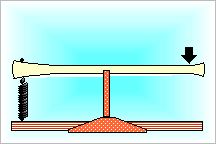
I also built a leverage demonstrator, consisting of a 2 x 4 base with a moveable fulcrum, heavy spring load, and a mattock handle lever. I only built one because there was a dangerous amount of force involved, so I never let students use it unless it was braced by my adult strength.

fulcrum demo

With the fulcrum in the middle of the handle, the downward force is equal to the force of the spring. With the fulcrum near the end of the handle, I couldn’t budge the thing myself. With the fulcrum near the spring, the smallest girl in the class could move the handle with one finger.

If you have earned your students’ trust, and if you are careful not to bruise fragile egos, you can have a lot of fun pitting big boys against little girls in contests of strength rigged to let the little girls win.

[Safety notes: If the fulcrum is next to the spring and a student pushes down, then lets go, the handle will fly 180 degrees to the left and conk whoever is sitting there. Beware. If the fulcrum is far from the spring and your heaviest student jumps up and throws himself on the end of the handle – and they will – you had better be strong enough to keep the whole mechanism from tipping sideways and crunching you both. If you aren’t strong enough, don’t let them do it.]

Our final pulley experiment moved outdoors where I had suspended a bosun’s chair from a basketball goal. Students sat in the chair with the arrangement of pulleys over their heads and lifted their own weight off the ground.

When we did inclined planes, I brought a wheelbarrow, 2 x 12, and concrete blocks from home for the day. I let a student sit in the wheelbarrow while another ran him up increasingly steep ramps. Change students and repeat.

If the subject is force, middle schoolers need to feel that force in their hands and arms, not just calculate forces and imagine how they would feel.

194. Boys at Work: Lee Correy

By at Wk atwIf you didn’t read Monday’s post, you might want to do so before you proceed. This week is on the subject apprenticeship literature.

Lee Correy had a considerable effect on my life. L. C. was a pen name of G. Harry Stine, an author with a long bibliography, but I don’t think of it like that. I have read some of G. Harry’s work without enthusiasm, and I haven’t read Lee Correy’s two seminal novels since high school. I still think of Lee Correy as a real person, separate from G. Harry Stine. It’s an artifact of my nostalgia.

I am referring to Rocket Man and Starship Through Space, both of which were in my high school library. They would be in my personal library right now, but they are rare, and copies are now out of my price range.

Of the two, Starship Through Space is clearer in my memory, probably because of its lame ending. Two young men travel back from Mars where they are attending a space academy, to find that they have been chosen to participate in the building of the first interstellar ship. They participate fully in the building of the Vittoria, are on the crew which flies her to Pluto and back, are deeply involved in the upgrade and rebuilding that follows, and continue on the Alpha Centauri. That is where it all fell apart for me, as the natives of New Terra resemble Native Americans and turn out to be displaced humans, part of the scattering that followed the Tower of Babel.

The two young protagonists participate fully in the work of building and flying the starship, but they are not running the show. They don’t invent a stardrive or save the universe. They are junior members of the crew, in training, and under the command of competent adults whom they respect.

This is the key to apprenticeship literature. The young protagonists are intelligent, well trained, diligent, hard working, and extremely competent. They aren’t the boss, but they will be someday. They have ambition and confidence, but typically don’t have a lot of arrogance.

The novel Rocket Man meant more to me, but is harder to portray. I don’t remember much, just the overwhelming feeling of lust and envy at what the protagonist was getting to do. The novel has all but disappeared, even from the internet. Goodreads list it without reviews or ratings. The only thing I found to jog my memory was a 1955 Kirkus review.

             Update, November 2019: As of today, there is a review on Amazon and the Kirkus review has disappeared.

Here is what I do remember. A young man wants to be a rocket man; to this end he enrolls in the international engineering school in New Mexico. The school is a co-op; students attend classes six months, then work on rockets for six months as apprentice engineers, earning money to cover tuition. I don’t remember too much of the story but I will never forget how badly I wanted to be on that campus.

Four years later I was at Michigan State, on a scholarship but short of cash. One option for my sophomore year was to move into Hedrick House, a student owned co-op. I lived that year in a closet sized room, attended meetings to decide house business, and cooked dinner for the fifty guys who shared the place with me. Every night I went to bed with a smile on my face knowing that I was on my way, and paying my own way. And every night I remembered Rocket Man. Thanks, Mr. Stine, known to me as Lee Correy.

193. Boys at Work

By at Wk atwI grew up in the fifties, when men were men and women were women, at least in the movies, sitcoms, books, and in the minds of the adults I knew.

Reality was a bit different, of course.

Since we didn’t have modern conveniences – for the first few years of my life we didn’t even have running water – just doing “women’s work” was a full time occupation. Still, when you are young and poor, as my parents were, you do what is needed. When we moved to what became the home farm, there were no fences. My mother and I (I was seven)  put a fifty pound roll of barbed wire onto a crowbar and walked the quarter mile south boundary unrolling it, five times repeated, while my father set fence posts, tightened the strands with a block and tackle, and stapled up the wires.

Farm women did things like that whenever it was needed, but it wasn’t considered normal. It wasn’t the way things were supposed to be. Men had their work and women had theirs and crossing over was, if not abnormal, at least out of the ordinary.

I grew up. The fifties became the sixties. When women’s lib came along, I bought in 100%, but I still don’t criticize the old ways indiscriminately. They were a part of the way people made a living. Sometimes those customs made life unnecessarily hard on women – or men – but they weren’t without a basis in need.

The division of labor was also there in the books kids read. Boys read the Hardy Boys and girls read Nancy Drew.

The Hardy Boys worked for a living; they were detectives. But it always seemed more like play, and more like fantasy than reality. Tom Swift (Jr.) was worse; ten minutes at the drawing board and he would pass the plans on to the work force of Swift Enterprises. Three weeks later his rocket ship would be done. It felt like a portrayal of work designed for kids who had never worked, and who wouldn’t notice how fake it was. Frank and Joe and Tom weren’t kids at all. They were watered down, unrealistic pseudo-adults.

I’m sure there were plenty of books about kids living kid’s lives, with kid’s concerns, while their parents stayed in the background. I certainly read enough of those books after I became a teacher, but they never crossed my path when I was young. I don’t think they would have interested me if they had.

There was another kind of book that did interest me; fascinated me, in fact. You would not go far wrong if you called it apprenticeship literature. These were stories about young guys, usually in their teens, who wanted to become men. They worked. They learned from adults who knew the jobs the youngsters wanted to learn. They were young auto mechanics, or wipers in the engine room of a steam ship, or kids who did odd jobs at the air field so they could learn how to fly, or starry eyed young rocket engineers learning their trade.

I plan to spend the rest of the week on that kind of book.

181. Star Trek on Sale

In my favorite used books store, overstocked Star Trek novels went on sale recently, so I bought a sackful – mostly those that appeared to feature Spock.

I hated Star Trek when it aired in the sixties. I was about eighteen, and just coming off of five or six years or reading the best of “real” science fiction. I’ve mellowed since. Reruns today have a nostalgic glow, and besides, the Star Trek movies did a lot to wash the bad taste of the Littlies and the Will of Landru out of my mouth.

I’ve even come to appreciate Shatner. When Star Trek was in its original run, I thought Shatner epitomized everything that was wrong with the series. Now I’m a writer, so now I know better. It wasn’t Shatner, the actor, or Kirk, the character that made me wince. It was the words the writers sometimes put in his mouth.

Some of the stories were excellent, some were acceptable, and almost all had some leavening of humor. But there were clunkers – oh, my, were there clunkers. Looking back, I have to credit Shatner with extreme professionalism for keeping a straight face while saying some of the lines the writers fed him.

Best Star Trek episode — Balance of Terror

Worst Star Trek episode — The Omega Glory

There, how’s that for starting a controversy.

The novels I bought yesterday were as mixed as the original series. I sat down with _______ by _______ and found it so overwritten that I couldn’t get past page ten. Then I picked up The Vulcan Academy Murders by Jean Lorrah, and found it to be a pleasant read despite the title. (There will be a review tomorrow.)

About a year ago, I spent a few hours in another used bookstore, picking out a selection of thirty and forty year old books that I had read as a young man. I was struck by how many authors were there who had written one or two good – sometimes excellent – books and then disappeared. 

It’s hard to get published, and even harder to make a living at writing. Most writers also do something else. Many teach college English; many science fiction writers are actually scientists. I had some early success, followed by a career teaching middle school, so I know the drill.

Actually, this all has a long history. Mark Twain and Charles Dickens did not make their fortunes as writers, despite their success. Mark Twain was a raconteur, a humorist, a sparkling speaker who filled halls across America. He made a bundle as a speaker, which helped sell his books, which in turn helped fill the halls whenever he spoke. Charles Dickens was looking at poverty, half way through his career, when he wrote A Christmas Carol. He spent the rest of his life doing readings of that wonderful tale, and making the money his printed works were not providing.

I think that writing Star Trek novels must be keeping a lot of writers fed. The original TV series certainly did. As I was reading the wiki list of episodes to remind myself of the title of that excrecable tale of the Yangs and Comms, I saw Richard Matheson, Robert Bloch, Theodore Sturgeon, Fredric Brown, Harlan Ellison, Norman Spinrad, David Gerrold, Nathan Butler, and Jerry Sohl, all names I had known from science fiction novels outside Star Trek.

FYI, Nathan Butler is a pen name of Jerry Sohl. I read several of his novels in the local library in my early teens, but he never became a household name in the science fiction universe, despite an admirable list of publications. It appears that he wrote widely, but made his living in television.

Doesn’t that sound familiar?

177. Why Do I Do This?

Why, indeed?

I am writing this on May 14th. I’ve been writing this blog for about a year now. The first post was August 31 of last year, but I hate deadlines, so I wrote these mini-essays for several months and stowed them away before I began posting them. Even now, a year later, I don’t feel comfortable if I have less than a month of posts in the queue.

Fear of failure? Not exactly; more like fear of writer’s block.

Earlier today I was writing posts 164 and 167 when I had a particularly lucid moment. Everything felt familiar and I realized that what I am doing now is an extension of my whole life.

I am still teaching.

I began this website because my novel Cyan was going to be published and I wanted to build a readership to support it. That explains why I started; it does not explain why after three hundred plus posts (counting Serial) I am not yet out of breath, nor out of ideas.

The world is a glorious and terrifying place. If you are alive in the world, it you are paying attention, especially if you read widely and think about what you’ve read, you will find that you have a lot to say. I’ve been been soaking it all in for 68 years and I want to share what i’ve learned.

That’s why I started writing in the first place. Then, after ten years, I had two books published by major publishers, with one translated into German, and I was starving to death. I had to get a day job. I fell into teaching and found that I hadn’t changed professions at all.

There are many kinds of teachers and that’s a good thing, because there are many kinds of students. I guarantee you, no matter how good you are at teaching, some of your students will hate you. And no matter how bad you are (within limits) some students will love you. Every student comes with his or her own unique set of needs.

For me, teaching was storytelling – but I have to clarify that. The teacher (we’ve all had them) who spends his days telling tales instead of teaching deserves to be fired.

The connection of teaching to storytelling is through the act of finding all the things the world has to offer, choosing those things that are within you purview, sorting and winnowing facts, discovering connections where they are not obvious, finding analogies that bring those connections to life, organizing your presentation to match the background and attention span of your audience, and paying attention to feedback.

In short, the teaching storyteller and the writer are two shades of the same hue.

So, after I began this website to support Cyan, I found that writing the blogs was a familiar and satisfying process. The world is a huge and fascinating place; I still want to tell everybody what I’ve learned by studying it.

Most of those who respond to A Writing Life are other bloggers. A larger audience beyond the blogosphere still eludes me. No matter. I don’t give up. And as for all those posts I write that countless millions do not read – I’m used to that. I taught middle school for 27 years, and you would be amazed at how much they don’t listen.

176. Fans, Conventions, and Writers

The first books I read were science fiction. Okay, Tom Swift, Jr. is barely science fiction, but it’s what I cut my teeth on. The first book I checked out on my first trip to a library was science fiction. So were the next thousand. But I wasn’t a fan.

I watched Star Trek when it came on TV during the sixties. Some of the stories were really good. Most were dreck, compared to what I had been reading. If I had understood the financial and political constraints Roddenberry was under, I would have been more charitable. Still, I wasn’t a fan.

Actually, I was never a fan of anything – and that requires some explanation. I had enthusiasms, I had things I loved, I had things that fascinated me to the core of my being. But I never talked about them to anybody. When I occasionally mentioned the “Ecosystem Operable in Weightlessness” I was building for the regional science fair, eyes glazed over. So I didn’t mention it much.

Since you are reading this, I assume that your are at least something of a geek. In my tiny school, I was the only geek. That makes all the difference. And that’s why I was never a fan of anything. To be a fan means talking to other fans about your enthusiasms. I never had that opportunity.

I had plenty of friends, I enjoyed their company and they seemed to enjoy mine. We talked about what interested them, and that was fine. I did all the silly things that high school kids do, and had fun doing them. But I never shared the things that moved me, and when I left high school, I didn’t look back.

When I went to college – Michigan State – I went from a town of 121 people to a campus of 48,000. No one in all that whole crowd knew my name. I didn’t mind. I was used to keeping my inner life so quiet that it was almost secret, so anonymity was no problem.

When I became a writer, I had never met a writer. I wrote science fiction because that is what I knew and loved (the science as well as the fiction). When my first book came out, I was invited by my editor to a party at Charlie Brown’s house in the Oakland hills where he produced Locus at that time. In attendance were some editors, a couple of professional SF writers, and about twenty of us newbies. It was an interesting evening. The pros were working the room, chattering, happy as roosters in a field full of bugs. The editors were having quiet conferences here and there. Four of the newbies had staked out the four corners of the room to hide in and the rest were milling around looking for an empty corner. I felt right at home, in that I didn’t feel at home at all.

I went to Westercon 33 in Los Angeles, where Roger Zelazny was guest of honor. He was one of my three all time favorite writers, but I didn’t seek him out. I actually wouldn’t have spoken to him beyond a nod if we had shared an elevator. What could I say? “I love your work.” He must have heard that five hundred times that weekend.

I went to the World Fantasy Convention in Berkeley and to Westercon 34 in Sacramento, where I delivered a paper (How to Build a Culture). Somewhere along the way, I ended up talking to Chelsea Quinn Yarbro and Marta Randall. Both were quite pleasant, but a ten minute conversation does not equal a friendship.

Most of the time I just wandered around those conventions, quietly enjoying the ambiance and the occasional sight of someone whose work I knew. In LA, I was cornered by a lovely young woman who chattered away at me for twenty minutes. She was a would-be actress, she said. She called herself “just another LA nobody”. She didn’t know I was a published writer; rather, she had picked me out to talk to because I looked alone and lonely. (Don’t look so surprised. I didn’t look so bad myself, back in 1980.)

Yes, I was alone, but I have never found that lonely.

Tomorrow begins Westercon 69 in Portland. I had planned to go again this year, but Cyan is still hung up in pre-publication, and I have too much pride to tell people, “My book is coming out any day now. They promised.”

Maybe I’ll see you in Tempe in 2017.