Tag Archives: politics

Running From President 5

Leap was born in 1952, on Leap Day, which was the start of all his troubles. He made his run from the media in his 64th year. That isn’t an age to start running.

Leap didn’t drink much, had never smoked, and had never had a wife, so he wasn’t too broken down. Still, 64 is 64.

Leap followed the genetic pattern of the American species. He headed west. That wasn’t hard in Nebraska where all county roads are routed by compass. He was in the middle of nowhere, half way to Rockville, when a pickup ground to a stop beside him and the driver motioned him to get in. The cow manure crusted on the wheels and fenders was reassuring; this was not a TV person. Besides, the sun was coming up, Leap was tired, and an old man walking down an empty road would be easy to spot from the air. Paranoia, or whatever you call it when they are really after you, had set in.  Leap had no problem imagining a horde of drones fanning out across the landscape, looking for him.

True to form, all Leap got from the driver was a nod and a grunt until they were back up to speed and a mile had passed under the tires. Then the driver said, “You’re Hed.” Leap admitted that he was. “Saw your picture in the newspaper. Heard about the ruckus in Dannebrog.” Then he called the newsmen a word that two men in a truck might use, but would never like to see written down. Leap agreed with him.

Another mile passed. The driver said, “How did you get into this mess, anyhow?”

“How does a guy get struck by lightning? Bad luck. Real bad luck.”

“How come you’re running for President?”

“I’m not! Some (and he used that word again) from Tulsa called me up and tried to get me to run as a joke. I said no, and he didn’t take no for an answer. Now the whole country wants me to run, or pretend to run, and I don’t know what I’m going to do.”

At Rockville, the driver turned left, crossed the Platte River and followed highway 68 toward Ravenna. He said, “You got any money? If you’re gonna run, you’ll need money.”

“Some. I took the rainy day money out of the sock drawer before I left.”

“I could loan you forty.”

“No, you keep it. But thanks.”

They drove on in silence. Fifteen miles later, as they were coming into Grand Island, the driver said, “I’ll drop you at the bus station.” Leap nodded. He didn’t ask the driver’s name. It didn’t matter, really. In the short time he had lived in Dannebrog, Leap had met a dozen men and women who would have helped him out just as automatically, with no hesitation and no thought of reward. In fact, Leap would have done the same himself.

At the bus station, he walked around the pickup and reached up to shake the hand of his new, anonymous friend.  For the first time he saw him full face, not profile. He was tanned and whiskered, lean, maybe forty years old, with a ball cap and a khaki shirt. He grinned at Leap and said, “Running from president. God almighty. Only in America.”

Leap said, “What would you do if they tried to stick you with the job?”

“Run like a deer, leap like an antelope, burrow like a prairie dog. Anything it took to get away.  Good luck. I hope they don’t catch you.”

**        **       **        **

For those of you who don’t live in Nebraska but still recognized the name Dannebrog in the last two posts, yes, you’re right, this is also an homage to Roger Welsch, who would also run from President. more tomorrow
566. The Negro Speaks of Rivers

The Negro Speaks of Rivers
by Langston Hughes

I’ve known rivers:
I’ve known rivers ancient as the world and older than the
     flow of human blood in human veins.

My soul has grown deep like the rivers.

I bathed in the Euphrates when dawns were young.
I built my hut near the Congo and it lulled me to sleep.
I looked upon the Nile and raised the pyramids above it.
I heard the singing of the Mississippi when Abe Lincoln
     went down to New Orleans, and I’ve seen its muddy
     bosom turn all golden in the sunset.

I’ve known rivers:
Ancient, dusky rivers.

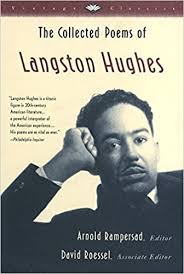
I am a great fan of Langston Hughes. I keep his complete works in my library, and I had hoped to dip into it to publish one of his less well known poems here during Black History Month. I couldn’t.

I try to stay on the sunny side of copyright law out of respect for authors and to keep out of jail. However, I am no lawyer, and copyright law in America is an incredible snarl, so I depend on others for my information. I went to Project Gutenberg, an organization dedicated to placing old literature in ebook format. They are well organized and quite careful about only using material in public domain. They have almost nothing by Hughes, so I googled, which only muddied the picture further.

I like to place pictures as teasers above each post. Other than the ones I have created myself, I get most of them from Wikipedia since they specify (if you click a couple of times on the picture) their copyright standing. I went there following this copyright question and found in Wikisource that:

This work (The Negro Speaks of Rivers) is in the public domain in the United States because it was published before January 1, 1924.

Most of Hughes work was published after that date.

It may seem odd to worry about the copyright status works by a man who died 52 years ago, but theft is theft, even if you are stealing from a dead man. I try not to steal, although sometimes I goof. I posted Hughes’s poem I, Too last Independence Day, not realizing that it was not in public domain. Of course, you can get a view of many copyrighted works on the Internet. I, Too appears in dozens of places.

I have a solution to this conundrum. Go out and buy a book of poems by Langston Hughes. Buy it for Black History Month if you care. Buy it for the beautiful poetry if you don’t care.

You can even go to a used book store to buy it. Resale of books never puts a penny in any author’s pocket, but it keeps their works alive.

Running From President 4

It’s hard to say who made the first mistake. Certainly Leap’s mother should never have named him Leap, even if he was born on Leap Day. Some temptations just have to be resisted. Worse, she should have spoken his name out loud when she named him. Leap Alan Hed, for heaven’s sake. How could she have missed that Alan would become A., and no one could ever meet her son without saying Leap A. Hed.

Leap wasn’t blameless himself. By fighting back to the point of absurdity, he made himself famous enough to come to the public’s attention. Counting his age by leap-day-birthdays and calling himself 16 when he was in his sixties — that’s just asking to be noticed.

Of course Billy Joe Barker was to blame for touting him as a write-in candidate for President. Then when he said that Leap was sane because he really didn’t want to be President, it was the last nail in Leap’s coffin.

People never give you what you want, but they always give you what you don’t want. Didn’t anybody know that?

Shelia Barnstaple of Wilmington, Ohio started a blog called I Want Leap for President. Wilton Damonson of Ash Fork, Arizona started a competing blog called Leap on the Bandwagon, also using the hashtag #LeaponforLeap. You would not believe how many people have 140 characters worth of something to say.

Throughout August, as Donald sank in the polls, people first sighed with relief, then suddenly realized that Hillary would probably win. Someone published a poem anonymously that read:

When Donald came I feared the worst,
If he won it just might kill me.
He surely was the worst of worst,
But second worst was Hillary.

Within days the doggerel was re-posted four million times, and a hundred and ninety-two people were claiming authorship.

Meanwhile, Shelia Barnstaple and Wilton Damonson combined forces and the draft Leap movement really took off. Leap found his house in Dannebrog surrounded by reporters. It looked like Marilyn Lovell’s lawn in Apollo 13. Leap came out with a shotgun to run them off, but they only clicked their cameras faster. He retreated. The shotgun was never loaded, since Leap was basically a peaceful fellow, but the hashtag #Leapforlawandorder raced around the globe at the speed of light.

Leap drew the shades and locked his doors, turned out all the lights but one, and settled in to wait out the silliness with his paperback collection of Nero Wolfe novels. After an hour, the reporters started pounding on his door, then on his windows, and finally on the walls of his house. He couldn’t call for help since he didn’t have a phone, but his neighbors took pity and brought in the county sheriff. He drove the mob back into the street.

That night, Barnstaple and Damonson posted a call to join Leap in his Silent Vigil for America. Three hundred thousand people promised that they would.

Sometime during the night, a darkly clothed figure joined the reporters briefly, then quietly faded away. Once it was light the next morning, Armin Arkin of WFUD noticed that the back door was ajar and announced that he was going in. Within minutes, the street was empty and the house was jammed with anchors and their cameramen elbowing for room to broadcast.

Leap had disappeared. more tomorrow

565. Great (?) Men

This post was begun December 5, 2018, before the shutdown, right after watching President Bush’s funeral. Most of the posts from that time until now were already written to make time for some non-writing activities, so I watched the Federal shut-down from the sidelines. I will summarize my take in one sentence.

Another damn-fool stunt by the Damn-Fool-in-Chief.

Now back to December fifth.

=========

As I watched President Bush’s funeral this morning, I was once again struck by an understanding of how Trump became president. I am not going to offer similarities between the two men; I would be hard pressed to find any. I will suggest instead that the nation’s response to Bush One’s death tells us uncomfortable things about hero worship, individual liberty and responsibility, and America’s closet love affair with The Great Man.

America threw off a king in 1776, and has been in the habit of electing would-be kings to the presidency ever since.  They even asked George Washington to become king. He refused. If there has been a president since who didn’t want the powers of a king, I apologize for lumping him in with the rest. I don’t think I will have to apologize to many. Maybe none.

I get that. I also get that without a combination of arrogance and obstinance, and a massive need for power, no candidate would ever get through a campaign. Obama strikes me as a nice guy, someone I would like to know personally, but he had the need. Bush II was touted as the candidate you would most like to have a beer with — and I would, even though I never considered him competent. Vote for Bush II, hell no; share a laugh with him, of course. Bush II had the need. Bush I had the need. They all had the need for power.

You can be pretty sure that any humility shown by any president is feigned. Was Lincoln humble? He appeared humble, but I seriously doubt that he was. Overwhelmed and saddened by what fate had saddled him with, certainly, but a truly humble man would have withdrawn in favor of someone more qualified.

But Presidents don’t believe anyone else could be more qualified; if they did, they would never make it to the White House.

I understand the motivation of Great (?) Men; I don’t really understand why Americans, who otherwise cling to their liberties, continue electing them. Perhaps they are convinced that the alternative to the Great (?) Man is the wimp. Or maybe it’s just the John Wayne syndrome gone wrong.

Here’s what happens. There is trouble in the town. Every man knows what needs to be done. But only one man has the fastest gun and the toughest fists. So (the Lone Ranger) (John Wayne) (Chuck Norris) (millennials, fill in your own selection, I’m out of touch with current heroes) takes care of business because he is The Great Man.

That’s adequate for TV, but not for governing America. Presidential power has been growing at Congressional expense for several decades. Why? Maybe at the core it is because the President is one man and Congress is many. Is it just part of the American myth that the individual stands up to the mob?

Maybe.

I get it — but I don’t buy it.

Running From President 3

It was a bad week in mid-August. Donald was imploding and Hillary should have been, but Donald kept grabbing the microphone. Nobody was thinking about e-mails because Donald kept spinning out one-liners. The Democrats were simultaneously frightened that he might win, and exulting in the poll numbers that said he never could. The Republicans were furious at lost opportunities, and tearing their hair out over the poll numbers.

On Sunday, August 14th, Billy Joe Barker sat down in front of his computer to compose his weekly commentary for the Tulsa World. The column was called Thank God Its Monday, but this night he simply couldn’t find anything to be thankful for. He had had such high hopes for Trump, but that was only a bitter memory now.

Then inspiration took him by the throat. His fingers flew across the keyboard and he hummed happily as he typed out the doom of a poor schmuck who had never done him any harm.

Please Mr. Custer

If you are old enough, you may remember a novelty song from 1960 called Please Mr. Custer. A trooper was complaining to commanding officer, who happened to be George Armstrong Custer, that he really didn’t want to go with him on his ride out to see what the Indians at the Little Big Horn were up to.

I don’t blame him. Nobody blamed him. It was a good laugh and nobody thought the trooper was unpatriotic for yelling, “I don’t want to go.”

I thought of that trooper today as I remembered my column of August first. It was about Leap Alan Hed, the boy who was born on leap day. Kids teased him so much when he was young about his name, Leap A. Hed, that he got back by counting his age by leap-year birthdays. He told me himself, when I interviewed him over the phone, that it was a piece of silliness he regrets to this day.

I invited him to run for President as a humor candidate, and offered to carry his campaign in this column. He turned me down flat, and I called him the sanest man in America because he really doesn’t want to be President. He doesn’t even want to pretend he wants to be President.

The trooper in the old song said, “I don’t want to go,” and Leap said, “I don’t want to be President.” Fifty-six years apart –- the last two sane men in America.

I wanted to vote for Trump, I really did, but I can’t. Hillary –- never mind. And the outliers, not them either.

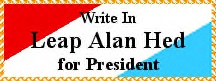
On November 8, I am going to write in Leap Alan Hed, the last sane man in America. If you find Donald and Hillary as unpalatable as I do, I invite you to join me.

The piece was picked up by AP and UPI. All across the nation, every anchor with two minutes to spare read part of it on his broadcast. It became a phenomenon.

The reason was clear to those who paid attention. For a year, Donald Trump had given the talking heads something to cover. He was fun; he was colorful. He was safe. Nobody in his or her right mind thought he would ever win anything, and the rest of the Republican candidates were a dreary lot.

Then he won the nomination. The talking heads felt panic, and a massive sense of guilt at the idea of “What have we done?”

By the time relief arrived through Donald’s spiraling self-destruction, they were really tired of him. And they had always been tired of Hillary. Leap was a breath of fresh air. Leap was something different they could talk about, and he was safe. No one could ever take seriously the candidacy of a man who refused to run.

It seemed as safe as betting against Donald had seemed.

How quickly we forget. more Monday

Running From President 2

Billy Joe Barker, newsman, regular contributor to the Tulsa World was a long time Republican. He had a dalliance with liberalism during the sixties when he thought he was a hippie. He had the hair for it back then, and it’s the only part of that era he misses. By the mid-seventies he was back to a buzz cut and back to being a Republican.

Billy Joe hated Hillary, passionately. He was a Ted Cruz supporter, despite the hesitation Okies have for anything from Texas, but Cruz didn’t last. Billy Joe really tried to like Donald Trump, but he couldn’t. The last straw was watching Trump’s first interview with his new running mate Mike Pence. After that, Barker had a continuing  vision of Edgar Bergen with Charlie McCarthy on his knee. He gave up on Trump even before Cruz said, “Vote your conscience.”

Barker couldn’t begin to support Hillary, couldn’t stand the Libs and Greenies, and knew there was no hope for a third party. He was flummoxed. That’s when he decided to use the Tulsa World to push a pseudo-candidacy. He didn’t care who he ran, it was just a joke in a political season that had lost any taste of humor. He needed someone like Pat Paulsen, back when Billy Joe was briefly a hippie.

On the same day that he came to that conclusion, he read about Leap Alan Hed in Reader’s Digest. The article told about Leap celebrating birthdays only on years with a leap day, and about his claim to be 16 even though he was born in 1952. Billy Joe Barker had found his candidate.

First he had to locate him; that took two days. Leap had moved to Dannebrog, Nebraska, a bustling metropolis of 307 people. Wiki says 306, but that was before Leap moved in. Billy Joe called him long distance. That took a day of phone tag since Leap didn’t have a phone, and had to take the call at a neighbor’s house.

Billy Joe explained his proposition. Leap almost fell off his chair laughing. He said, “You’ve got to be out of your damned mind. The second worst part of what you want me to do is the campaigning. The worst part is, if I lie well enough, I might win. The answer is no!”

Billy wrote up his weekly column for the Tulsa World, telling the story of his aborted search for a candidate. At the end, he said, “If only crazy people run for the office of President, then Leap Alan Hed is the sanest person in America. He really doesn’t want the job.”

Beware of what you ask for. Or what you don’t ask for. more tomorrow

564. The Tale of Leap Alan Hed

In 2016, after a month and a half of extremely serious writing about race in America. I decided to celebrate with a bit of total nonsense. I chose to do it on Leap Day, because what better time for silliness than a day that only comes every fourth year.

I had intended it to be a one time bit of humor about an accidental President. It wasn’t anti-Trump, because at that time the idea that Donald Trump would become president was a million miles from anyone’s mind.

I went on with my life, getting ready for the release of Cyan and writing blogs on writing, science, and science fiction. I wasn’t worried about Trump. I was worried about Clinton. I eventually voted for her, while holding my nose, but my sympathies were with Bernie, or some other Democrat. Apparently a lot of people felt the same way.

I was aware of Trump, but I wasn’t thinking much about him. I just hoped the Republican candidate would be someone I could vote for if Clinton became the Democratic candidate.

By July, Trump was in the race and looking more and more ugly. But lest we forget, the prospects of Clinton as President didn’t look that good to a lot of us either. 2106 was beginning to stack up as a lose-lose situation. Reasonable candidates were failing fast in both parties.

I brought Leap Alan Hed, the nobody who won the Presidency by accident, back for a reprise and continued his story throughout the summer and fall. I bid him farewell the night before the election and faced reality with a post written in September but posted the day after the election.

In September I reprised the poem Hungry, about a border wall. That is another prophetic piece that I wish weren’t so accurate.

All the things I wrote fearfully about that summer have come true, along with more misery than I could have anticipated. Now I am bringing Leap back for a re-run, beginning today over in Serial. Everything has been tweaked to read smoothly, but ninety-nine percent remains unchanged.

Think of this as a presidential campaign in an alternate universe. And besides, politics aside, it’s just a good story about a nice guy who found himself in completely over his head. These posts have never been put in one place before, to simply be enjoyed as a story.

Running From President 1

In 2016, after a month and a half of extremely serious writing about race in America. I decided to celebrate with a bit of total nonsense. It didn’t work out the way I had anticipated. For a longer version of that story, look at today’s AWL post.

This is the story of Leap Alan Hed and his unintended write-in bid for the presidency. Think of this as a presidential campaign in an alternate universe.

======

Once upon a time – 1952, I think it was — there was a kid who was born on Leap Day.

His Dad was named Alan Hed, and he wanted to give his son the same name, but his wife had a quirky sense of humor. She told the nurse to call the boy Leap, as in Leap Alan Hed. When he was really young, his dad called him Alan and his mother called him Leap, but when he got old enough for school, his kindergarten teacher — who was a mean bastard, anyway  — called him Leap A. Hed. That brought about a sudden parent conference and after that the dad got his way, and the boy tried to forget that his first name was Leap.

People wouldn’t let him forget, and finally he gave in and refused to answer to a Alan any more. He went further. He decided that if he was going to be the boy with all those nicknames:

Leap Boy
Leap Frog
Leap for Cover
Leap Forward
Leap Back
.  .  .  and of course, still, interminably, Leap Ahead  .  .  .

.  .  .  if he was going to have to put up with all those stupid names, he was going to go all the way. I refused to celebrate his birthday on the twenty-eighth of February or the first of March. He only celebrated it on February twenty-ninth.

Worse, he counted his age by birthdays. When he was sixteen, he started putting his age down as four. He spent a lot of time talking to the principal about that, but they finally got tired of the whole business. You might say he out-stubborned them.

He couldn’t out-stubborn the draft board. When they said he was eighteen and he said he was four, they didn’t buy it. He claimed discrimination under the Civil Rights Act. He might have made it all the way to the Supreme Court, but when the 1969 draft lottery was held, February twenty-ninth drew number 285, so the draft board dropped the case.

After that his life calmed down. He never married (he claimed he was too young) and the IRS was indulgent. They figured he would regret his claims when he wasn’t eligible for Social Security until he was 260 years old.

Unfortunately for Leap – or Leap Boy, as the media eventually called him – some joker heard about his claims and put him up for President in 2016. This is the story of that event. more tomorrow

549. The Saturn Rockets

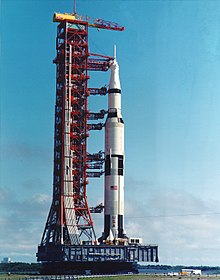
Saturn V

This post is called The Saturn Rockets, plural, because there were two if you speak loosely, or three if you are picky. If we were looking at all of the rockets of the Apollo program, we would have to add Little Joe. Getting men to the moon was a complex operation.

The pre-Apollo manned missions used modified military missiles as launch vehicles. Atlas was designated for Mercury, but delays in achieving reliability caused the first two Mercury flights to be sub-orbital on Redstone missiles. Gemini used Titan II missiles throughout the program.

The Saturn rockets are often said to be designed from the start as space launch vehicles, not military missiles. That is a somewhat limited view. The program that eventually produced the Saturns began in 1956 and ran through an amazing number of paper iterations before anything ever left the ground. “Saturn” development was simultaneous with the developments of Atlas, Titan, and other military missiles, and kept changing as those other missiles refined rocket technology.

The same infighting family of scientists and engineers developed Saturn and all American military missiles, the same set of companies built them, and the same government paid for it all. Saturn was developed through NASA and was never planned to carry warheads, but the entire American manned space program was a child of the cold war. The civilian vs. military distinction is a bit of sleight of hand.

By 1959, the possible types of Saturn rockets had been reduced to eight configurations. Eventually three were built.

Saturn I was designed to put spacecraft into low Earth orbit. Saturn V was designed to put men on the moon, and later tasked with launching Skylab. See 297. Skylab 1 and 298. Skylab 2.

Remember Little Joe? That was an existing rocket that was used early to test out the Apollo capsule’s abort mechanism.

Ten Saturn I rockets flew;. Five were in Saturn development flights. Five others carried early, unmanned versions of Apollo spacecraft, as well as Pegasus micrometeorite satellites.

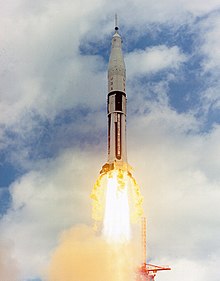
The Saturn I was replaced by the more powerful Saturn IB (shown at left) in 1966. Saturn IB became a workhorse for heavy, low Earth orbit launches.

The first Saturn IB topped by an unmanned CSM was launched in a mission then called Apollo 1. Later, after the deaths of three astronauts in the capsule fire, there was a mass renumbering of past flights in order to call their mission Apollo 1. It was an entirely understandable gesture, but it causes confusion to this day.

Two more Saturn IBs were launched in 1966, then the first Saturn V was launched. The next launch was to test an unmanned LEM in low Earth orbit. That flight fell to the Saturn IB which had been involved in the “Apollo One” disaster, since the capsule fire had not damaged the launch vehicle. Another Saturn V launch in 1968 completed the unmanned phase of Apollo.

On October 11, 1968, the first manned Apollo craft achieved orbit. Manned missions are what we all remember, but by that time there had been seven abort tests, sixteen launches of Saturn I, IB, and V vehicles, and twelve major ground simulation tests.

Apollo 7 was the only manned Apollo mission to use a Saturn IB. Apollo 9 was also a flight to low Earth orbit, but it used a Saturn V because it was  a full, close-in dress rehearsal and first launching of a manned LEM.

The other ten Apollo mission used the Saturn V, cementing a picture of that rocket into everyone’s mind.

After the end of Apollo, a Saturn V launched Skylab. Three subsequent launches of Saturn IBs took up the astronauts who manned it.

The last manned use of Saturn IB was to carry an Apollo CSM to rendezvous with a Soyuz vehicle in 1975.