Tag Archives: literature

581. The Traveler in Black

(The traveler in black) has many names, but one nature, and this unique nature made him subject to certain laws not binding on ordinary persons. In a compensatory fashion, he was also free from certain other laws more commonly in force.

John Brunner was a successful and popular author of science fiction and fantasy, but he is rarely mentioned in the same breath with Clarke or Asimov. He has fifty-nine books listed inside the cover of my copy of Traveler, and he won a Hugo for Stand on Zanzibar, but he never quite made it to the top rung of the ladder. I have a theory about that.

The blurb-quoted reviews on the back cover of my Traveler praise Brunner for his competence. Competence may get you to the party, but it doesn’t make the fans gather ’round you once you are there; and that isn’t completely fair either, since he once wrote a book that was as good as any in science fiction or fantasy. The Traveler in Black was his Old Man and the Sea.

My theory is that, like Clarke, Brunner was an idea man. His characters have just enough blood in their veins to carry the ideas, and not one drop more. Zanzibar is a prime example; all the characters in that novel were cyphers. It was a big book about big ideas, populated by little tiny people.

Traveler avoids the curse of dull character by the oddest of twists; the traveler has no character at all. His character is to not have character. And it works.

The traveler moves through a world of chaos, having no will and no agenda, and changes everything. He is cursed-blessed-given-created to answer wishes in the exact words they were asked.

It’s like a wishing well with a mean streak, but there is no mean streak in the traveler. He sadly shakes his head and does what he was created to do — gives people exactly what they ask for. And since people aren’t too bright, they don’t see the consequences that will attend their wishes. They almost always get what they really didn’t want. Many do not survive their wish fulfillment, and no one survives unscathed.

As you may guess, this uses up a lot of lesser characters. These are précis people; sketched out in a few words and gobbled up by the march of change. Only the traveler survives.

This sounds a bit like a Mad magazine view of history, but Brunner pulls it off through the non-personality of the traveler. He has no backstory. He has no motivations, only the geas to grant wishes. He is slowly carving reason out of chaos by letting chaos devour itself. There is a tremendous cost in human suffering, and the traveler witnesses it all, unable to warn or advise, compelled to grant whatever wish he encounters, whatever the cost to the wisher.

We don’t hear him think about this. He does not converse, although he is often the object of conversations. We only know his inner feeling by a shake of the head, a hesitation to speak, and the slow pace of his progress through the world. That this is one sad and weary entity is only acknowledged in passing. It is all a game of subtlety, conveyed by the stately beauty of the language in which it is written.

Traveler is a fix up novel of individual stories previously published in SF magazines, and stitched together by the traveler himself. It comes in two versions. The one I read first, many years ago, was called The Traveler in Black. Its cover is pictured here. The cover pictured at the top of the post is a later version with one more story called, of course, The Compleat Traveler in Black.

The odd spelling is a literary reference. I won’t elucidate. I’ll just let you feel superior if you recognize it.

580. Pavane

During the Golden Age, most science fiction was in the form of short stories, published in science fiction magazines. When paperbacks became popular, there was a need for novels, mostly short by modern standards. Authors and editors mined the SF magazines for interrelated short stories that could be linked together and somewhat rewritten to appear as if they were novels. They became known as fix-up novels. The next three on my best list are all fix-up novels: Pavane today, The Road to Corlay (set for April 17, but these things sometimes change), and The Traveler in Black this Wednesday.

Pavane by Keith Roberts (publication date 1968) is not to everybody’s taste, but is one of my all time favorites. It is an alternate universe novel, set in the twentieth century in a world where the Catholic Church has maintained its power. The universe-changing event was the assassination of Queen Elizabeth the First, shortly before the arrival of the Spanish Armada.

Of course, the people of Pavane don’t know that they are an alternate. Their world is simply the world. Other than a brief introduction, the novel is written from that perspective. Things are explained, as they must be in any novel, but only enough that someone in the world of Pavane would understand.

(If I wrote a story about a blacksmith, I would explain enough that a college student could understand, not enough for an alien from Alpha Centauri to understand.)

This makes Pavane a bit challenging, but Roberts does his job well. The challenge is slight, and the reward is an abundance of ambiance.

Pavane takes place in a cold, hard world, and the characters fit their situations. Jesse Strange, in the first story The Lady Margaret is so dedicated to the family business (haulage by steam road waggons) that he passes up love and ignores friendship. Rafe, the student signaler, is engaging, but doomed. The story of the artist Brother John is positively grim.

All this sounds like I’m saying, “Don’t read this book,” but in fact I give it my highest recommendation. You will be forced to confront this alternate culture by digging deep into what makes it work, and any time one has to learn another way of thinking from the inside, the mind and the heart are enriched.

The ending called Coda is a disappointment. Roberts gets up on his soap box for a brief but embarrassing moment to try to justify his culture. Cultures don’t need justification; they just are. And every one of them, including yours and mine, is a mixture of joy and horror.

Probably the most notable part of the novel is the sheer beauty of the writing. At least, that is my take. I have found beauty of writing to be extremely subjective, but Pavane hits the sweet spot for me. I invite you to see if it hits yours.

One thing for sure. Thirty pages in, you will already know if you love it or hate it.

Pavane is available used or e-book from Amazon, or if you are lucky at your local used book store.

579. Guilt

How many times have you seen it: the massive city, the grinding machinery of the state, the downtrodden under the wheels of the machine — it’s a classic dystopia. One man (or, rarely, woman) fights back, foments a rebellion, and it all comes crashing down, ushering in a new day.

End of movie or novel.

Well, maybe . . .

It seems to me that this trope has been overused. I have no real argument with all those stories that end with the destruction of a dystopia, but I was looking for something a bit more subtle in Like Clockwork. There is something resembling a downfall (you’ll get no spoilers here) but it doesn’t come at the end, and those who bring it about have to face the reality of what they have done. Here’s a taste.

(Hemmings) laid his head on his crossed arms. His heart hurt.

Life may be nasty, brutish, and short. Life may be eternal in the lap of Jesus. Or life maybe a recurring year, extended far too long, but it is still life. And Hemmings had taken the lives of men who had done him no wrong.

He had not known the others who had died, but he clearly remembered the guard at the waggon door. He grieved for him.

I know exactly where this scene originated.

I was a young teen. I had recently discovered the local public library and my hundredth-or-so book was Underwater Adventure by Willard Price. Overall, it was a good book, although no better or worse that the average I was reading at the time. However, one scene knocked me out.

The villain, posing as a friend, went for a dive with the mentor. The two brothers who were the heroes of the book were elsewhere. The villain contrived to have the mentor trapped underwater, and left him there to drown.

Two things about this affected me. First, the mentor did not make a brilliant and heroic escape. He actually did drown. Second, the villain — who was pretty scummy and eventually came to a well deserved bad end — came up out of the water full of remorse. Not enough remorse to go back and save the mentor, but enough to be shaken.

The scene was told from the villain’s perspective. In that moment, I identified with him far more than I had identified with the cardboard heroes. Through him, I came to an understanding of how it would feel to take the life of a good man. It was something worth knowing, and something a bit more real than most of what I was reading at the time.

So here I am, decades later. I have a debt to Willard Price for that moment of clarity, and I’m paying it forward.

Running From President 11

This has been a tale from an alternate universe. In that world, Hillary did not win and Donald did not win.

Disaffected liberals distanced themselves from Hillary after the Wiki-leaked emails told what her people did to Bernie. Disaffected Christians stuck to their guns over Trump’s immorality. It was like our universe, with a single difference. Leap’s non-candidacy had caught fire and provided an alternative which vast numbers accepted..

Donald Trump denounced him. He said that if Leap claimed to be sixteen years old, that made him too young to be President. Hillary kept her mouth shut; it was one thing she could do better than Trump

Things got out of hand. On November eighth, after a massive write-in campaign by people who surely didn’t really expect to succeed, Leap Alan Hed was voted in as the forty-fifth president of the United States.

Oh, well. Could he be any worse? The people of his alternate universe may never know.

Leap read the election results at a news stand and his heart all but stopped. Then he ran.

It is said that anyone who wants to be President is automatically disqualified by reason of insanity. Maybe; if so Leap was the sanest man in America, because he really didn’t want it. He considered trying for asylum in another country. He thought about Switzerland, but he gets a nosebleed in an elevator. He thought about Russia, but the last thing he needed was to be caught up in that tug-of-war. He considered Great Britain, but he had once lived in California and the thought of all that rain dissuaded him.

He decided to just disappear, and he did. I don’t know where he went; he didn’t tell me. Geraldo claimed to know, but that turned out to be a bluff. Somebody said they saw him heading north, following a compass, but everybody knows you can’t walk to the North Pole now that the ice caps have melted. He was probably looking for a Fortress of Solitude, and you can’t blame him.

All those people who voted for Leap are now wringing their hands and wondering what is going to happen next. Every one of them thought they were the only one who would write him in. They never thought he would win. They certainly never thought he would run to Canada like a modern day draft dodger. Which, essentially, is what he is — drafted to be President, and scared out of his wits.

Hillary has been very quiet about it all. She hopes to win in the House if they can find Leap and get him to resign. But it’s problematical. There are only fourteen Democrats and eleven Republicans in the new Congressional class. Aside from a few Libs and Greenies, the rest are all newly elected Independents, sent by a disgusted America. Bernie is smiling about that.

Donald claims he will still win, and when he does, he plans to invade Canada to bring back that traitor Leap. I think he just might.

We’ll have to leave their alternate universe now, worried sick and talking to each other about the kind of changes one man can make — even if he doesn’t want to. We have to get back to our own universe. We have problems of our own.

finis

Running From President 10

It was late on November seventh. The sun had already set and with its passing, the chill of evening had set in hard. Leap Alan Hed — calling himself Joe and hoping that none of his homeless companions around the fire would recognize him — pulled his coat closer around his shoulders and stretched his hands out to the warmth.

It was a vain hope. The press had hounded him out of his home in Dannebrog, and hounded him half way across America and back again. His picture had been spread across the country in countless newspapers and television broadcasts.

One of his companions said, “Joe,” and his tone made it clear that he knew the real name behind the nom de flight, “tomorrow is the big day. What do you think will happen?”

Leap gave up the masquerade. He said, “I don’t know. They won’t vote for me. They aren’t that stupid, no matter how frustrated they have become. They will vote for Hillary and God knows what that will mean. Or they will vote for Donald, and everybody knows what that will mean.

“In a few days, or maybe a few weeks, I’ll be able to surface again and get back something like a life of my own. I just hope there’s a country for me to go back to.”

His companion shrugged and said, “I don’t have a life to go back to. I haven’t had anything like a life in years. I can’t vote for you, or anybody else. You have to have an address to register to vote and I haven’t had an address in in a long time. But I would vote for you.”

“Why, for God’s sake? Why?”

“Because you aren’t him and you aren’t her, and anybody else is better. Somebody has to do the job. At least you don’t want it, and that means something.”

Leap quoted, “If nominated, I won’t run. If elected, I won’t serve.”

“I don’t think so. I think you would come out of hiding and do your duty.”

Leap shook his head, and just said, “No.”

“Its going to be Donald or Hillary or you,” the other said.

Leap sighed. He said, “No good can come of this.” more tomorrow

Running From President 9

Leap Alan Hed was going to Tulsa, to have it out with Billy Joe Barker. It had been eight weeks since he left his home in Dannebrog, running from the media circus that Barker had set in motion by calling on Americans to write in Leap’s name for President. Barker had started it all; Leap figured Barker owed it to him to at least try to stop it.

It was hard for Leap to travel. He could go by bus, slumped down, face covered by the brim of his hat, and take his chances on being recognized. That was how he got to Hays, Kansas. There he picked up a ride with a friend of a friend from Dannebrog who took him as far as northern Oklahoma. He found himself stranded in Ochelata on a Sunday morning.

By now Leap was hungry for normalcy, and on Sunday morning, that meant church. He couldn’t go in, of course. If you are from the city, or the north, you may not know this, but when you go into a small town southern church as a visitor, everyone in the congregation will come up and shake your hand, ask you your name, welcome you to their fellowship, and half of them will invite you for Sunday dinner. Leap would have loved that, but since his face had been in every newspaper in America . . .

The Ochelata Baptist Church was a long, low green roofed building, built around a courtyard. There was a park on the east, so that was the direction Leap used for his approach. He walked in, as bold as if he belonged there, across the park to the blind back of the sanctuary where he settled down hidden by a few trash cans and sat for two hours listening to the service taking place on the other side of the wall. From time to time, his eyes were awash with the moisture of homesickness.

He slept the day out in a wooded ravine, and walked southward on Highway 75 during the night. Morning found him somewhere, but he didn’t know where, hungry, cold, and discouraged. He was in front of a convenience store, on the outskirts of a small town, so he pulled up the hood of his sweatshirt and went in. He kept his eyes floorward as he picked out a couple of donuts and a cup of coffee, and didn’t look up at the checkout where the surveillance cameras are clustered. Outside again, he found a bench at the edge of the light.

He was on his second donut when a pickup rolled to a stop. A man of fifty got out and exchanged a few parting words with his driver before she u-turned and disappeared. Everything about their casual friendliness said man and wife. He was carrying a brown paper bag that said “lunch”. He crossed to Leap’s bench and sat down.

He glanced at Leap, looked away, then his head snapped back again. He studied Leap for about five seconds, then turned his head back toward the road and didn’t look again.

Discovered! This man knew exactly who Leap was, but he made no acknowledgment. With eyes averted, the man talked as casually as if he hadn’t guessed Leap’s identity. Leap had seen that reaction several times in the farm country and small towns where he had been wandering these last weeks. People in rural America have a respect for privacy and a willingness to mind their own business which he found admirable

Leap’s bench mate said was waiting for a bus that would take him west to Sperry where he had a job as a school custodian. And, yes, there was another bus that went south to Tulsa. After twenty years as a skilled lathe operator in a small factory, the man had lost his job after 2008. He had been out of work, except for odd jobs, for seven years, and now he was pushing a broom at age fifty, and glad to get the work.

He had gone from Democrat, to Republican, then further with the rise of the Tea Party. He had no faith in government, no faith in politicians, but he still had faith in free enterprise. Where he had worked all his life, the owner had been just down the hall, working all day behind a second hand desk in a room with plywood walls. They had gone to the same church, and every decision the owner had made had included concern for his employees.

The factory made small parts, that went onto larger parts, that then went onto automobiles. In 2008, the system collapsed and the factory folded. Leap’s temporary friend blamed free trade and Hillary and Obama. He did not blame large corporations and their CEOs. His vision of free enterprise was a hard working owner in a dusty plywood room, with forty hard working employees out on the floor making things. Multi-national corporations were outside his experience and outside his imagination.

The bus rolled up with whoosh of air brakes. As the man got up, he added, shaking his head, “Donald Trump says he’s going to fix all that.”

“Do you believe him?”

“No, not really.”

“Are you going to vote for him?”

“I might. Maybe not, though. It’s hard to vote for a man that full of hate.”

After a pause, he added, “I might just throw my vote away on this guy called Leap. That way I won’t be responsible for what happens later.” more Monday

Running From President 8

From Leap Alan Hed, somewhere in America,
to Anne, a favorite cousin, location not given.

Dear Anne,

I’m still on the run from the news media and from those who would write me in as President.  I’ve been on the road now for about six weeks. I’ve lost weight and grown a beard, but anyone who looks closely could still recognize me, so I stay hidden most of the time. That was almost a blessing at first. The high Rockies were beautiful when I could stay there. It has been getting colder every day for a while now, and I have had to come down, so I am once again hiding too close to people.

I thought the desert would be open and empty enough for me to go unnoticed, but it isn’t. I stumbled onto a deserted shack and made myself comfortable last night. Then I had midnight visitors. Five Mexicans: two young men, one young woman, a child, and an old man. They must have been a family. You could tell they were just over the border and on their way north looking for work.

Donald would have crapped himself to be caught by a bunch of “rapists and murderers”, but, of course, they were just frightened people, looking for a little peace. And hungry. Both hungry in the long term sense that had sent them looking for work, and hungry in the immediate moment. I don’t speak enough Spanish to matter, but sometimes smiles and gestures are enough. I shared my food with them. I cooked up all I had, but it wasn’t enough. Tomorrow I’ll have to take a chance and find a place to buy more.

They left this morning before the sun came up. They were very quiet as they went, but the child’s voice woke me. The old man was last to leave. He is probably my age but he looks a hundred years old. He saw that I was awake, so I said, “VIa con Dios,” and he made a little wave as he slipped out the door. I wish them well, but I fear for them. I fear that they will be caught, or die in the desert as so many do. And I fear for what will happen to them after November.

Damn these people who chose Hillary and Donald, and now they hound me to run as a joke President. Or worse, a real one. I’ll bet they thought it was funny, when it all started. Well, very little of this seems funny to me now.

I’d better quit so I can mail this when I go looking to buy food. Anyway, if I get any angrier, I’ll set the paper on fire just touching it. Soon November will have come and gone, and I can come out of hiding, and see you and Ted again. Bake me an apple pie, say November 15th, and I’ll be there to eat it.

I wonder what will become of my new Mexican friends in November?

                  Love,
                  Leap

more tomorrow

Running From President 7

This continues the interview with Leap that began last Wednesday.

G S..: “If the choices are so unpalatable, would you choose one anyway?”

Leap: “I would vote for Hillary — reluctantly — if I could, but since I’m on the run from the media, there is no way I can get within miles of my polling place.”

G. S.: “You wouldn’t vote for a write-in, or a registered third party?”

Leap: “Third parties never win. Third party candidates don’t expect to win, they are just using the election to make a statement. If a third party candidate won, it would scare hell out of him. Just like this write-in nonsense has scared me.”

G. S.: “So you don’t really like Hillary, you think third parties are throwing away your vote, and you don’t want the job. So why not Donald Trump?”

Leap: “The wall. A million reasons, but most of all, the wall.”

“I worked as an engineer all my life. My company built farm equipment. Once, they sent me to California for a few years, to a plant near Salinas.

“There weren’t any undocumenteds in our facility, although more than half the staff were Mexican American. Several of them became my close friends, and they are the ones who opened my eyes to how things work.

“I spent a lot of time in the field, checking out the equipment we built. Everywhere I went I saw swarms of migrant farm workers. Mexicans – that’s what everybody called them. Whether they were Mexican American, legal immigrants, or illegal immigrants didn’t matter. Mexicans. I saw how hard they worked and under what terrible conditions. I saw the shacks they lived in, and it didn’t seem right. It didn’t seem American.

“I asked my Mexican American friends back at the plant and they told me that farm workers live in fear of immigration officers. Even the ones who are here legally know a whole community of those who aren’t. Children who were born here, American citizens, live in fear that their parents will be deported.

“It makes them pliable. Deportation is a whip in the hands of their employers.

“A wall – what a joke. We have a wall already. It doesn’t stop the hungry, because it isn’t supposed to stop the hungry. It exists to let workers through, and then remind them that if they step out of line, they will find themselves back on the other side.

“America couldn’t survive without a wall that lets through workers who will be silent and docile and work for slave wages under slave conditions.”

=========

Foolish Leap. He set up the interview to show how much he didn’t want to be a write-in candidate, the made the mistake of letting his passion show. He made the mistake of making sense, in a world that is hungry for sense, so of course he made his own life worse.

The interview galvanized the nation. Leap’s anti-candidacy went from being a curiosity to being a real alternative. New websites sprang up everywhere, along with tweets by the hundreds of thousand, and even a dozen fake Facebook accounts.

The biggest of them all was hashtag #Leapthewall. Commentators were forced to search for a new term to replace “went viral”. Viral didn’t do it justice.

And Leap went back on the run. more tomorrow

567. Bridges of Longing

Every time I print some poetry, my own or favorites from other writers, my readership spikes. It’s got to be the tag POETRY that does it.

The problem is that I don’t like 99.9 percent of the poetry I read today. My rule is: if you can rewrite a poem without line breaks, and that turns it into the first couple of sentences in an unfinished short story, then it isn’t a poem. Almost everything I read nowadays fails that test.

I’m not talking about rhyme. Check out Spoon River Anthology or anything by Yeats or Frost to see the flip side of what I’m complaining about.

When I do find exciting work by a contemporary author, it knocks me out. Example: Marsheila Rockwell.

I met Marsheila at Westercon in 2017 at a reading. She and another author, a couple of author’s friends, and I sat down in a conference room that would have held fifty. I was the only stranger in the room.

Westercon 70 was odd that way. It was very much a home town version of a regional conference. The Cosplay and Filk venues were packed, but the book signings and author’s readings were almost (sometimes completely) empty.

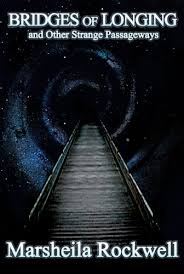
Her stories were fine and her poetry was excellent. I bought her collection Bridges of Longing and there wasn’t a poem in it that wasn’t wonderful. There were some I didn’t like, primarily in the section Those Who Wait, but it was only because they were harsh to the point of hopelessness. It wasn’t because they weren’t true. The same was true of some of her stories. They were superb, whether they matched my taste or not.

You see, Marsheila and her sig-other and writing partner primarily operate in the fields of horror, dark fantasy, and D & D, all places I have no interest in going. I would certainly never have found her except that fate steered me into that reading.

Her poetry, on the other hand, is humane and feminist, and always with a hard edge. It sounds like real life, even when it is supposedly about goddesses and harshly treated mermaids. She is the best new poet I have encountered in many years, even if her novels aren’t in my wheelhouse.

I would say, buy Bridges of Longing. The poems alone are worth the cost many times over, and if you have any liking for fantasy, you will enjoy the stories as well.

You might also check out her website http://marsheilarockwell.com/ .