Tag Archives: memoir

251. Night at the Movies

Over in Raven’s Run in Serial today, Ian Gunn is reminiscing about:

The feeling in a night drive —- the humming of tires; the warm heaviness of the air, the darkness beyond the car —- when you were a child in the back seat —- and the thick air slid in and out of your throat like oil.

That description is pure memory.

Oklahoma is the edge of the South, with thunderstorms, tornadoes, and hot, humid summers. Air conditioner country – but I lived there before people has air conditioners. Days over a hundred were common, and the nights brought thick, moist, warm air. There were scraggly trees in the creek beds and flattish land between that was half native grass pastures and half grain fields.

Was. Now it grows houses, and people live indoors with the AC running, but in the fifties people were sparse on the ground and they spent most of their time outdoors.

I spent my summer days driving a tractor. There were no air conditioned cabs – no cabs at all, actually – but it wasn’t bad. There was an umbrella clamped to the seat, and as long as I was moving, which was at least ten hours a day, there was a breeze.

Nevertheless, nights were a pleasure by contrast. After the cows were milked, we sat in the living room with the west windows open to the wind. My parents watched TV (black and white, two channels). I joined them, or read a book. Once or twice a year, we would all go see a movie.

Those same years, my wife-to-be lived in Saginaw, Michigan. She used to walk to Saturday matinees. It’s a common reminiscence, but my nearest theatre was twenty miles away, so going to a movie was a family expedition.

After the day’s work, and milking the cows, and supper, and cleaning up, we would drive to Collinsville as the sun was going down. When we arrived, we went right in. There was only one theatre with one screen, and it changed movies every three days, so you went on the day your movie of choice was there. It didn’t matter what time the movie started; we went in, sat down, and started watching. Then we watched the coming attractions and the cartoon, and pretty soon the next showing started. We watched until my dad said, “Okay, this is where we came in.” Then we left, with no wasted time, because four AM was coming all too soon, and the cows weren’t going to milk themselves.

What I remember best about movie nights, is the ride home – especially when I was ten or so. Twenty miles on a two lane blacktop, lying stretched out on the back seat, reliving the movie, and the coming attractions which were pretty exciting for a ten year old in the fifties. Imitation of Life previews were disturbing, largely because I didn’t understand the premise of the picture (see 95. Literature of Passing). Then there was a scene of a girl wearing only a towel in a cowboy movie preview that revisited my libido for months. Mostly though, I remember a science fiction movie – something I would never have seen outside of previews – with animated pterosaurs and dinosaurs chasing people as they fled in their cars. Tame stuff for the Jurassic Park generation, but scary to me.

Outside the car, the night dampness amplified the smell of grass and weeds. The soundtrack of the night was the humming of tires and the unending churr of cicadas. The air swirling in through the open windows was syrup thick, damp and cool. The vibrations from the road, softened by the seat and transmitted through to my spine, was electric, and the little shocks from potholes were like tiny bursts of pleasure.

All this comfort was balanced by the emotional rush of hearing those imaginary dinosaurs in pursuit, along with the scree of giant pterosaurs flashing overhead.

I’ve forgotten most of the movies we saw, but I will never forget what the night felt like.

245. Serializing

I’ve been doing a lot of serializing lately. In fact, I’ve been at it for over a year, but lately it has become intense.

Publishing novels serially in periodicals is a very old idea. Most of Charles Dickens work came out that way. What I’m doing is a bit different though, because Dickens wrote his novels to be serialized. The size of each chunk was known to him when he wrote. And the chunks were bigger.

David Copperfield was a novel of 358,551 words. I know this by downloading it from Project Gutenberg, transferring it to my word processor, and using the word count function. You might make note of that; it is a useful technique. David Copperfield was published in twenty monthly installments. That makes each installment was about 18,000 words. In SFWA (Science Fiction Writers of America) terms, each installment was of novella length.

My typical serial post is about 600 words.

Dickens serialized in order to sell to those who could not afford his books, and at the same time, to boost sales of those books when they came out after they appeared in periodicals. Most successful nineteenth century authors followed the same pattern. So did the big names in twentieth century science fiction, although they wrote smaller novels and presented them in fewer, but longer installments. Often they didn’t sell their books for serialization until they were already completed.

That is also my situation. Nothing I have presented in Serial was in progress at the time it was serialized. I’m too slow and picky a writer for that. Some of the things presented had been published, some had not, one was presented as a excerpt from a completed novel, and one was a fragment from a novel I’ll probably never finish. Jandrax was annotated to such a degree that it almost forms a writing primer, and How to Build a Culture was entirely a how-to.

Everything I have presented in Serial has been to assure continued readership of the website. It’s a trick. Leave ‘em hanging, and they’ll come back. And the whole website is to assure a readership for my upcoming novel Cyan, and for others that will follow.

But man, it has been fun.

I’ve enjoyed revisiting old friends. I’ve learned a lot from a close re-reading of old material, especially regarding pacing. Since I post four days a week, each post has to be relatively short, both to keep from running out of material too soon and to keep each reading experience brief for the sake of the daily reader. I didn’t originally choose 600 words; that just evolved.

The actual process of taking a novel and breaking it into pieces has been fascinating, frustrating, and a rewarding learning experience. It begins with a completed novel, which may be decades old, and which will already have been polished to a high shine. Still, I find errors from time to time.

First, using a word processor version, I have to re-read the novel, looking for natural breaks in the action every two and a half to three manuscript pages. I type a nonsense word at each break. I use breakbreak, as one word, which has meaning to me but would never appear in the actual text. This will allow me to use the find function to jump from break to break if I should need to. After typing breakbreak, I highlight what I have chosen, use the word count function, then type in the number of words. If it seems too short or too long, I adjust.

That takes care of post #1. Now to repeat. Jandrax required 92 posts. Raven’s Run will require 150. Some posts make sense on their own, but some require that I start with a sentence or two from the previous day’s post. I use bold-italic to denote this repeat.

All this takes place on a single word processor document. I then make individual documents of each post-to-be. This is a backup to what will actually appear on the website. At this point, I run the spell checker one last time and face the two-space conundrum.

I learned touch typing in high school in the mid-sixties on a mechanical (not even electric) typewriter. This was overseen by Mrs. Worden (AKA the warden) who pounded (pun intended) the rules into our heads. One rule was that you put two spaces between sentences.

Over the years I went from mechanical typewriters, to electric typewriters, to computers, but the rule stuck with me – even after everyone else had stopped using it. Raven’s Run was written before I kicked the two space habit, so now I have to go through each document removing the second space.

The last step is copying from word processor file to website.

Tedious? Yes. Fun? Absolutely. If you write, and you don’t enjoy reading your own work, why bother?

244. Walking by Night

outhouseHere in California, Halloween doesn’t look like itself any more. I suspect the same metamorphosis is taking place across the country. Images from the Mexican Day of the Dead are everywhere, competing with Anglo witches, ghosts, goblins, and jack-o-lanterns.

It’s no surprise, really, since Halloween has become a $econd Chri$tmas, in terms of commerce. I have no trouble understanding why retailers are producing big-eyed, flower painted skulls for sale. I have some trouble understanding why anyone is buying them.

As a matter of full disclosure, I don’t care for Halloween, and at both ends of my life I have had little to do with it. In the middle, when I lived in cities, I hosted the trick-or-treaters who came to my door, just like everyone else. I admit the mid-level kids were fun and putting up with a little pleasant extortion was just being a good grown-up. I wasn’t much impressed by the adults with infants in arms, or the overaged teenagers who grunted and threatened like gang bangers. But many Americans have no sense of age appropriateness, so they were no surprise.

Anyway, I would be a hypocrite if I hated trick-or-treaters after all my praise of Christmas last year. After all, trick-or-treat and wassailing are the same ritual.

I haven’t had a trick-or-treater at my door since I retired to the foothills, and that brings me full circle. When I was young – during the fifties in very rural Oklahoma –  we didn’t trick-or-treat. We were simply too spread out. It would have been impossible to walk to anyone’s house, and in those days parents weren’t about to drive their children all over the county just for their amusement.

Instead, the local tradition was ritualized vandalism by teenagers. That was the night outhouses got turned over – and yes, people still used them. Windows got egged, toilet paper got tossed, there was even some graffiti. In Oologah, the next town south, I saw a business sign which had been tagged with Oologah hoars. Vandals couldn’t spell back then either.

As October rolled around, all the adults started telling outhouse stories from their misspent youths, and current youths started planning. I took no part in any of it, but I heard it all, and one story in particular caught my fancy. I think it was true; at least I knew the old lady in question.

She lived in a little house in town, with no plumbing and an outhouse out back. Every year somebody turned it over on Halloween, and she was tired of it. This year, she went out when it was still light and settled in to wait with a shotgun across her knees. Eventually it got dark, and eventually she heard whispers and the first creak as the local teenagers got a grip the outhouse. She threw the door open, leaped out and gave a mighty scream, and fired both barrels into the air. When the echoes cleared, there was no sound but retreating footsteps.

The old woman went to bed with a smile on her face. The would-be vandals, once they recovered from their fright, had the memory of a priceless adrenaline rush and a story to tell for the rest of their lives.

I love it when everybody wins.

237. Rain

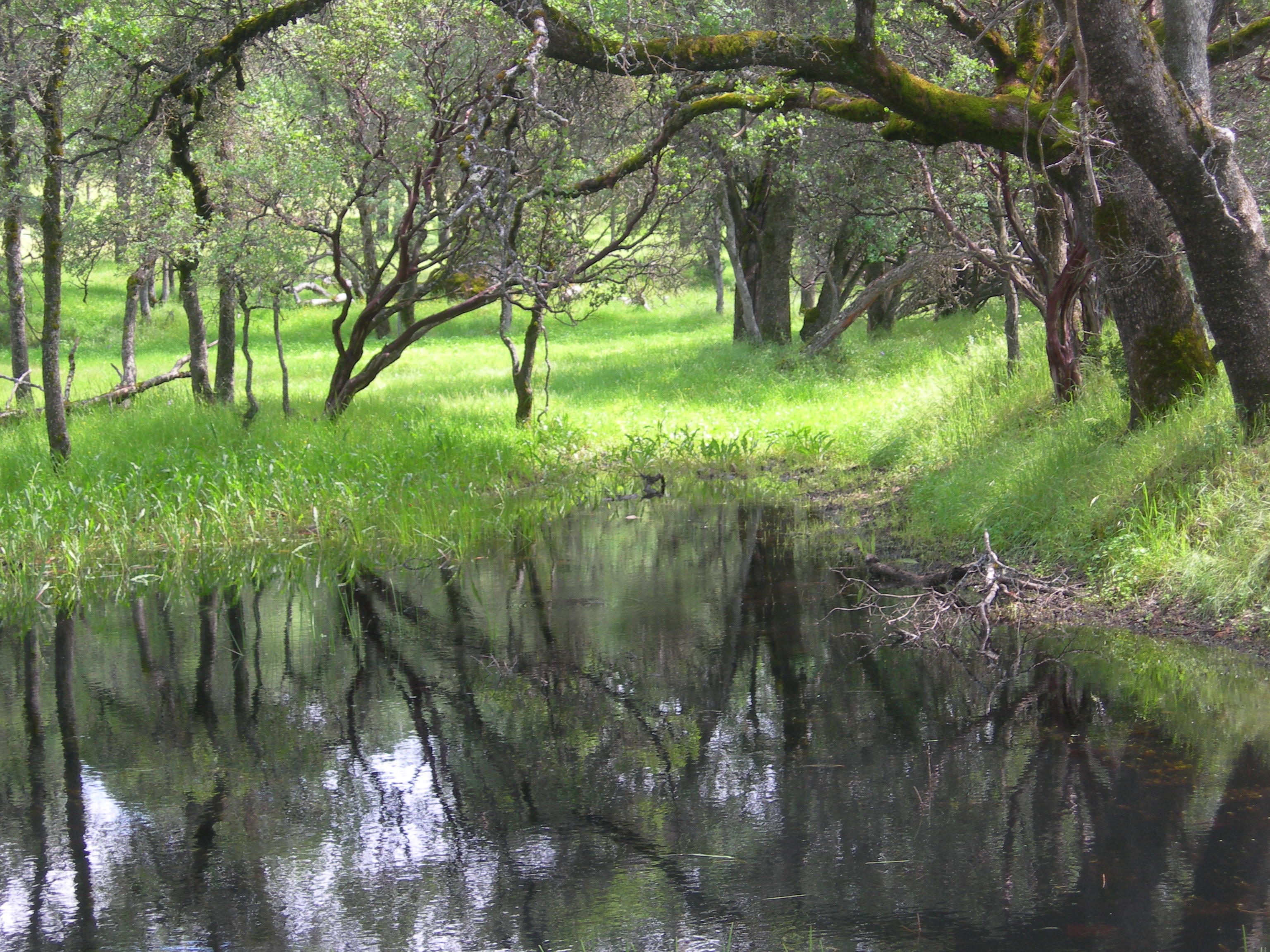
dscn4753This is a vernal pond, a few miles from my home. It will fill with water by Christmas and be dry again by Easter.

Let’s take a break from the world of politics and check into the latest meteorological phenomenon.

It rained last night.

That may not be a big deal to you, but here in the foothills of the Sierras it represents the change from one season to another in a climate that only has two seasons – dry and wet.

Our last rain came in mid-April. Six months without a drop. You may have heard that we are in a drought, but this is a different phenomenon. It is normal here for the last rain to come in mid-April, and normal for the first rain of the rainy (if that is the word) season to come in mid-October. Our drought is because we haven’t been getting enough rain between October and April.

So what does that have to do with my world of writing science fiction? Everything, really.

When I was young, my three favorite SF authors were Clarke, Heinlein, and Norton. Clarke’s stories always took place in artificial environments. Heinlein’s characters inhabited space ships, orbiting habitats, or frontier worlds; it didn’t matter, as long as they could talk incessantly, they were happy. Andre Norton characters, whether they were explorers, soldiers, spies, or interstellar traders, always spent their time outdoors, in wilderness or something like wilderness. The only cities you were likely to see in a Norton novel were in ruins, or the slums of the Dipple which any one of several young men were quick to flee from, usually into more trouble than they could imagine.

That suited me just fine. Her worlds were my world. In rural Oklahoma, I spent from May to September every year outside, usually driving a tractor, through rain, wind, dust, and heat. There were years when I watched the crops dry up and die under the relentless sun – and watched my Dad see six months work disappear before his eyes. There were other years when the rains came on time, the crops were good, and the pastures grew up heavy with grass; when the nights were a symphony of insect whirrings and the days were filled with bird songs and butterflies. Cliché? Paradise always sounds like a cliché.

It was the only life I knew, and I loved it, good years and bad, but I had to leave it, first for college, then to make a living. When I wrote my first book, I sent my protagonist into the mountains and lost him there, then let him find his way out. For my second book, Jandrax, I marooned a shipload of colonists on a barren, unexplored world, and watched them find a way to survive. In Cyan, coming out in a few months, I send a crew of ten to explore a rich new planet, then send them back to colonize.

I lived in a small city for most of my life. I could write about cities, but I don’t want to. My world is the world of nature –  even if it is nature on another planet.

So— it rained last night. About an inch, which isn’t much, even by Oklahoma standards, but the foothills only get thirteen inches in an average year. All the creekbeds remain empty and the hills remain covered with tall, dead grass in shades of brown, but within the soil, the change has begun. Seeds that have lain dormant since spring will be sprouting now, out of sight, and within a week there will be a faint haze of green, invisible beneath the long grass, but showing in the road ditches. This year’s grass will begin to flex its vegetive muscles, forcing its way upward through last year’s dead roots. Unnoticed, those roots will begin to loosen and be shoved aside until one day, a month from now, seemingly all at once, the old year’s grasses will tilt and fall, to disappear beneath the new green.

Suddenly all the brown will be gone and the new year’s grass will clothe every hillside. While the snows of winter cover the midwest, these Sierra foothills will be spring green, and the wildflowers will return.

233. Yearbooks Farewell

In an early science fiction novel/novella (A Fond Farewell to Dying/To Go Not Gently), I gave my protagonist a twenty year gap in his memory. To fill himself in on the events he missed, a friend of his suggests reading encyclopedia yearbooks, one by one.

It was a bad idea on two fronts. Shortly after I wrote that suggestion, Wikipedia drove paper encyclopedias out of business, and yearbooks were no more. My story was set a couple of centuries in the future, and long before we could get there, the immediate future had bit me where it hurts.

Even if that had not happened, it was a bad idea to trust yearbooks, as I found out when I tried it myself. I was planning to plot out a novel set in the sixties, so I accumulated yearbooks as a starting point for research. They were useless, and I kicked myself for not having realized in advance that they would be.

Almost everything the editors of the 1966 yearbook thought was important, turned out to be forgettable by the eighties. The important trends of that era only became obvious in retrospect.

1989 was like that, too. It was a pivotal year, but I missed it while I was living it.

I was alive, awake, and alert in 1989. I had recently returned from spending two summers in Europe. I was writing a teacher novel, and planning the novel Raven’s Run (now being posted in Serial), but I missed 1989’s significance. I didn’t really come to appreciate it until decades later when I was preparing to bring Raven’s Run up to date.

Basically, the cold war ended and the modern era began in 1989. When I realized that, I nudged Raven’s Run into that year so I could add a few events that I had missed when they happened, and set myself up for sequels.

I wrote a bracketing event, a meeting between Ian Gunn and a friend in Luisanne, Switzerland in 2012, where they are revealed as spies, or something like. (Raven’s Run 1) This leads to reminiscence and Ian begins to tell his friend of events that took place in 1989 – which becomes the novel.

I dropped these words into chapter 2:

It was April.  Ayatollah Kohmeni had a few months left to live, and no one had yet heard of Osama ben Ladin.  There were still two Germanies, two Berlins, and a wall; I had had my dealings with that wall a few years earlier, in uniform, when the cold war was even colder.

When I wrote chapter 2 in the mid-nineties, there were “two Germanies, two Berlins, and a wall”. I didn’t have to tell anyone. Not then – but posting Raven’s Run today, it has become necessary to remind my readers.

1989 was a pivotal year. If you don’t remember, or you weren’t born yet, take a look at Thursday’s post.

222. Too Many Mouths

This continues from yesterday’s post The Wall.

When I was a kid in Oklahoma, we had tornadoes just like now, but with less destruction. About the time I was born, a local town was hit, and people were still talking about it when I left for college. It was that unusual.

When I was in my early teens, we watched a tornado drop down and march across the prairie. It was five miles west of us and in plain sight. Every ten minutes or so there was an explosion of wood and tin as another barn got hit, and it collapsed one house just before it lifted up again. It walked six miles across the landscape, destroyed three or four barns, and one house. No one was killed. One woman was slightly injured and scared half to death when her house fell in on her.

If that same storm were to hit today we would see hundreds of homes destroyed, numerous injuries, and probably deaths. The difference — more targets.

**     **     **

I would give you a reference on this next bit of information if I knew it. It came from a classroom lecture during college in the late sixties, and if I ever knew its source, I don’t know it any more. Call it an honest memory, with figures subject to further verification.

When Europeans conquered Africa, according to earliest census information the birth rate and the death rate were both about 4% per year. Medical missionaries saw the massive losses to disease and set about rectifying things. Slowly, the death rate dropped to about 2% per year.

The birth rate never changed.

You can do the math. Kindness, sacrifice, and the eradication of disease took a stable population level and started it on its way toward overpopulation and famine.

**     **     **

Yesterday’s poem Hungry paints a bleak picture of the future. It could be co-oped by conservatives as a call for borders. I reject that interpretation. Walls won’t help. No country is strong enough to survive without a fundamental change throughout the globe.

This world is straining at its limits with five times the population that should exist. The reason is clear – too many births for the number of deaths.

It would be facetious – and heartless – to say we need more deaths. We need fewer births, and the change needs to be world wide. We fight against terrorism, pray for peace, and try to tamp down bigotry, but all of that will get us nowhere if we don’t solve the problem of overpopulation.

Science continues to produce wonders. We may be able to feed the world, even with a population expanded beyond today’s. We may; but where will we house them? And what will be the psychological effects of inhuman crowding?

**     **     **

Let’s get back to the small picture: I used to keep an aquarium in my classroom. Every fall my students would bring me some crawdads. In spring, we let them go. One year the crawdads died unexpectedly in mid-year. I left the aquarium in place and we watched what happened.

Once the crawdads were gone, we just had algae (only visible by a greening of the water) and a few water snails. They multiplied. And they shrank. Every week there were more snails and each snail was smaller. Eventually there were thousands of tiny snails inhabiting the tank, filling the water with veils of snail mucus, covering the bottom, and the sides, and clinging to the surface tension, and filling the mid-waters.

I am afraid that my students and I saw our future. Not a cataclysm. Not a nuclear war sending us all back to barbarism as the science fiction cliche would have it. Just more and more people living smaller and smaller lives, relentlessly moving into a future horrible beyond conception.

Hungry.

220. Planets in Motion

planet story stick 5

Two hundred posts in a little under a year is something of a milestone. What began as an attempt to generate readers for my fiction has almost become a way of life.

I had planned to place this non-writing post as number 200, in celebration, until scheduling issues got in the way. You see, writing a blog isn’t the first activity that I began for the sake of my fiction — which then went on to take over my life. In the early eighties it was clear that I wan’t going to make a living writing novels, and needed a day job. I began working as a substitute teacher to earn some extra money. I was strong, loud, and male so they sent me to middle schools. Substitute teachers don’t like middle school. If you think back a bit, I won’t have to tell you why.

Maybe I’m odd, but I thought the kids were a hoot. I told the dispatcher that I actually liked middle school kids, and suddenly I had full employment. After a year, I went back for my credential (I already had two masters degrees) and got a job at one of the small rural middle schools where I had substituted. I taught there for twenty-seven years, mostly science.

It was an underfunded school and I was a carpenter, so I built a lot of my own science equipment. I shared some of that in posts 201 and 202. A lot of the curriculum sent down from the state was crap, and I was a writer, so I wrote a lot of my own material. I had less hassle from the bosses than most of my friends because good science teachers are hard to find. Ones who aren’t just biding their time, waiting for a chance to move on the high school, are even more rare.

I kept on writing, but at a reduced output. It wasn’t how I had planned my life, but it worked. I once figured out that about 4000 students passed through my classroom during my tenure. I’m proud of that.

Now that I’m retired, I am writing this blog and its sister blog Serial four days a week. Now that’s a day job. This post provides the details about the last big project I built for my science classroom. Pass this on to your science teacher friends.

From this point on, things get technical. If you are a planet geek or a DIY person, you will probably enjoy the details, even if you don’t need the product. Maybe you could make one for your kid’s school?

*****

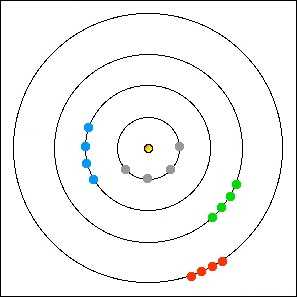
You can show the scale of the solar system with a model you build yourself (see post 202), but showing how the planetary orbits interact with one another takes some time. I figured out how to do it near the end of my career by building a poster that changed over the course of a school year.

You need a piece of hardboard, 6 ft by 6 ft, 1/8 inch thick, a pint of black or blue-black paint, four tubes of artist’s acrylic (pale gray, blue, green, and red), a one-inch brass drawer pull, four foam daubers, (half inch diameter foam cylinders attached to the end of a dowel, used for laying down stencils), and a measuring device you will have to make yourself.

You find the center of the hardboard poster by running lines from corner to corner; they cross at the center. There you drill a 1/8 inch hole and feed the bolt for the drawer pull from the back. Add a matching nut on the front, tighten, then add a drop of Super Glue to keep things from moving. After you paint the board black or blue-back, spin the drawer pull onto the bolt to represent the sun.

For the four colored circles which will represent the inner planets in their initial position, you will need to go to the website www.theplanetstoday.com. Use the double headed date arrow at the top of the page to chose the date of your initial array. Use the measuring device (building instructions below) to establish each distance from the sun and, referring to the website, make your best visual estimate of where to initially put each planet on its trip around the sun.

At the outset, it won’t look like much, but every week you will add another four dots. By the end of the year Mercury will have circled the sun more than twice, Venus nearly once, Earth about eighty percent of the way, and Mars will have moved a fairly short distance – given the length of a typical school year. I put on new planet circles every Wednesday, since Wednesday almost never has a holiday.

Your students will soon have a clear picture of how the planets move in relationship to each other. When Venus is visible in the west at sunset, or in the east at sunrise, or is not visible at all in the night sky, your wall chart will show them why – assuming that you explain it to them, and keep them at least somewhat excited with assignments like, “What is that red dot in the sky, half way up from the eastern horizon at eight o’clock tonight?”.

The measuring device you will build allows you to place additional planet-circles at the appropriate places for subsequent weeks. It has a single 1/8 inch hole at the left, and eight larger holes. Once a week you will remove the drawer-pull-sun and put the small left hole over the bolt. Place the initial Mercury-hole over the previous week’s Mercury circle and put on a new pale-gray circle into the other Mercury hole, using a dauber. Repeat for all four planets —Mercury pale gray, Venus blue, Earth green, and Mars red. Replace the sun drawer pull and  you are done for the week.

planet story stick 3To build the measuring device, begin with a piece of hardboard 36 inches wide and seven inches high. Draw a line about 1 1/2 inches above the bottom and parallel to it. Clearly mark a point on the line about 1 inch from the left side. This will locate the sun-hole. When all further measurements have been made, an 1/8 hole will be bored at the sun-point and 5/8 inch holes will be drilled at the four pairs of planet-points. Don’t drill anything until all nine holes have been marked accurately.

So far, I have used feet and inches since we have been talking about carpentry. The rest of the dimensions will be in millimeters.

On the base line, measure 215 mm from the sun-point and put a point for Mercury. Continuing on the base line, and still measuring from the sun-point, put a point at 402 mm for Venus, a point at 557 mm for Earth, and a point at 848 mm for Mars.

Each planet needs a second hole, the distance between the two representing the distance the planet moves in one week. For me, these required four radii and four calculated angles. I have simplified (honest, it’s simpler) by giving dimensions above (perpendicular to) the base line, and back toward the sun (parallel to the base line).

For Mercury, this will be 104 mm up and 26 mm back toward the left.
For Venus, this will be 78 mm up and 8 mm back toward the left.
For Earth, this will be 67 mm up and 4 mm back toward the left.
For Mars, this will be 53 mm up and 2 mm back toward the left.

These twin dimensions place the pairs of planet-points at two points on a correctly dimensioned circle, representing the orbit.

Drill the sun hole 1/8 inch to match the bolt holding the drawer pull. Drill the eight planet points 5/8 inch to allow clearance for the 1/2 inch dauber. The outline of the measuring device can be trimmed down to any convenient shape, as long as it encloses all nine holes.

218. It Couldn’t Last

I normally avoid long quotations, but  I have to share this one from the novel Cinnamon Skin, written by John D. MacDonald in 1982. The technicalities of this seem a little dated, but his understanding of human reality is still spot on.

Walking back through the mall to the exit nearest our part of the parking lot, we passed one shop which sold computers, printers, software, and games. It was packed with teenagers, the kind who wear wire rims and know what the new world is about. The clerks were indulgent, letting them program the computers. Two hundred yards away, near the six movie houses, a different kind of teenager shoved quarters into the space-war games, tensing over the triggers, releasing the eerie sounds of extraterrestrial combat. Any kid back in the computer store could have told the combatants that because there is no atmosphere in space, there is absolutely no sound at all. Perfect distribution: the future managers and the future managed ones. twenty in the computer store, two hundred in the arcade.

When MacDonald wrote this, I was facing the reality that I wasn’t going to make a living with my writing, and considering options for a day job. Two years later, Apple introduced the Mac. Two years after that, I was teaching middle school and had accumulated enough money to buy my first computer, a Mac SE. It was a joy to use. SuperPaint by Silicon Beach had both dot matrix and vector graphics in one program. I’ve used more sophisticated graphics programs since, but I’ve never used a better one. Microsoft Word for Mac was lean and fast, nothing like the slow, bloated, obese monster it would soon become. HyperCard showed what hypertext could do, long before the internet made it the center of everything. We became masters of our lives, makers instead of consumers, with a powerful tool that answered our commands seamlessly.

If you are reading this, you are probably under forty. If I could take you back to that golden age, you would hate it. It would seem like nothing to you. It would be like trying to imagine what it felt like to ride the first tractor, instead of walking behind a horse, avoiding the semi-solid horse exhaust. Or trying to imagine how empowering it was to shoot the first bow and arrow, instead of throwing rocks at your food.

It couldn’t last. I saw the handwriting on the wall a few years later when Apple came out with its first oversized laptop. For the first time, there was room for more than a minimal keyboard, and laptops could finally handle the third element. The keyboard handled words, the mouse handled graphics, but there was no proper input for numbers. Scientists and businessmen alike needed the ten-key function that was (in those days) on every keyboard of every full size computer. I was sure it would be added, but when I saw the rollout, the keyboard was still minimal. Instead there were a pair of oversized speakers so games would sound better.

It was all over. From that time on, Apple catered to consumers instead of creators. When Steve Jobs came back from Pixar to save Apple, and created an I-Mac that looked suspiciously like the Pixar logo, I knew it was really all over.

The change from creator culture to consumer culture happened in three stages: first the pre-Windows IBM computer was so hard to use that all your effort went into mastering it, not using it. Then the Mac and the mouse made the machine transparent, and you could make things you never dreamed possible. Then came a day when all you had to do was push a button and the finished product appeared, with none of your input and none of your personality.

Life happens. Progress happens. But I liked stage two the best.

214. The Eternal Wannabe

It’s been nearly 110 degrees for a week as I write this. The humidity is under ten percent, thank goodness. It hasn’t rained since April and it won’t rain again until October. There is water in the two lakes that lie a few miles west and a few miles east, but the one our drinking water comes from was dry six months ago.

Welcome to the foothills of the California Sierras.

I saw a rattlesnake go by yesterday, carrying a canteen. He was having a heck of a time keeping it up, since he doesn’t have hips and he doesn’t have shoulders.

No problem. When February comes, it will look like the green hills of Ireland again. But it won’t last.

**     **     **

I grew up in Oklahoma, fifteen hundred miles from salt water, and fell in love with the ocean, though I had never seen it. That’s what comes from too much reading, and from having a beloved grandfather who lived in Florida, had a boat, and had joined the Coast Guard auxiliary.

I went to Michigan for college, found my wife, and married her. That gave me another maritime connection. Her father had crewed on a Great Lakes racing schooner when he was a young man,  a decade before I was born.

My draft number was 41 and they were drafting Marines, so I joined the Navy, but it wasn’t a happy time. Given a choice during boot camp, I chose to be a dental technician; it meant I would never have to man a gun. I spent my naval career on dry land, working at a hospital. I never regretted it. I loved the ocean, but not at the price of pulling a trigger.

I spent a year in Chicago, then came back to California, and settled in to write. I tried to find a place to rent on the coast, but I could only afford inland housing. And here I am.

Everyone has dreams. Most of mine have come true, but we still have to make choices. Choosing one dream often means abandoning another. Most of us have another life, the life we would have lived if things had gone differently. We may not regret our choices, but the things we might have been stay with us.

I wanted to build a sailboat and sail around the world. Not an unusual dream, of course. If you gave me the chance to go back and do that instead of what I have done, I wouldn’t consider it for a second. But still . . .

Because of that dream, I have spent a lifetime studying small boat construction, naval architecture, and maritime history. My second MA thesis was on shipbuilding during the nineteenth century.

Fortunately, I am an author. I can write a novel and call it Raven’s Run (see Serial). In it I can set off in the yawl Wahini, heading for Marseilles, and who knows, maybe a mermaid will fall into my lap along the way.

213. Borders

I don’t need to remind you what Europe is like today. Everyone knows her troubles. Refugees, and terrorists disguised as refugees, are flooding in, and once they arrive, they can move more or less freely from country to country. BREXIT came largely as a result of this crisis, with the threat of terrorism and economic dislocation driving the vote.

It was very different in 1989, the year in which the novel Raven’s Run (see Serial) takes place. There were no open borders, even between friendly countries. When my wife and I traveled from Switzerland to Italy during that era, the train crossed the Italian border at 2 AM. It stopped and a cadre of officials came aboard, moving from car to car, waking everyone up and checking passports. Of course, as Americans, it was a formality. Our passports carried us through without strain, but if there had been an irregularity . . .

There was an irregularity later, coming back from Hungary. A young and carefree European, French as I recall, had gotten into Hungary – God knows how –  with a passport, but without a visa. He confessed his lack to everyone in the coach, and laughed about it. Some very surly individuals took him off at the border. I never saw him again, but I had to wonder how funny it seemed a few hours later.

I had my own irregularity, harmless but thought provoking, earlier that same summer. My wife and I were camping at Innsbruck, Austria. When you camped or stayed in a hotel in those days, the owner confiscated your passport when you checked in and returned it when you left. It was the law throughout most of Europe.

We took a day trip from Innbruck to Reuthe, also in Austria. We did not know that the train passed through Germany on the way. As we crossed the German border, some very severe guards, with automatic pistols at their hips, came demanding passports. My wife had hers; I didn’t.

I took German in high school, which is very close to not taking it at all. I tried to ask why, but my one word “Warum?” (Why?) got me nowhere. The border guard repeated his demand for my passport. My weak German “Ins camping.” (It’s at the campground.) must have made sense to him. He had to know that holding passports at campgrounds and hotels was the law. It didn’t melt his icy stare.

Now I have met many people traveling through Germany, both before and after this incident. They were universally friendly and helpful, and they all spoke English, especially after trying to deal with my attempts at German. Not these guys. They just looked pissed. It was probably an act, but they had me convinced at the time.

Those of us with passport irregularities were taken to another car, without explanation, with just gestures and an intense glare, where we were sealed in. We passed through a piece of Germany and back into Austria, and were released.

It wasn’t life threatening, nor the stuff of spy novels, but it was very much a part of the system the Eurozone was designed to overcome. Open borders did away with a lot of annoyance, and allowed a freedom of movement that helped bring prosperity to Europe.

Today, new circumstances are bringing Europeans to reconsider that openness.