Tag Archives: seasons

648. Limits of Accuracy

The Limits of Accuracy
in World Building

I’m sitting here on October 15th with half a dozen files open on my computer, calculator at the ready, and a page of scratched calculations. I’ve been world building again.

In full disclosure, my last math class was college calculus and I don’t remember much of that. I’m no astrophysicist. I know that because I bought a book on orbital mechanics in hopes of cribbing a few formulas to use in my writing. It didn’t take long to realize that I was out of my element.

My primary source of world building math has always been How to Build a Planet by Poul Anderson. I have kept a xerox copy on hand since I first used it while writing Jandrax back in the seventies of last century/millenium.

Don’t bother to google it. There are so many resources available for world building on the internet today that it gets pushed to a back page. I don’t use the new stuff myself; it looks like a black hole you could fall into and never escape. World building can easily eat up all the time available for writing. Besides, there is a limit to the accuracy we need.

When I set up the solar system around Sirius, a long time ago, I popped in a few inner planets, more or less following Bode’s discredited law, and set their distances after calculating i, luminosity, for the most important planet.

Sirius A, for the record, has about twice Sol’s mass and produces about 23 times its radiation. I calculated the distances from it to where there would be a luminosity of 75% of Earth’s, 100% of Earth’s, and 125% of Earth’s, then dropped Stormking into the middle of that range. That gave me an orbit roughly the equivalent of Jupiter’s, so I took the length of Jupiter’s year and called that the length of Stormking’s year.

That was good enough for then, but not now that I’m actually writing. I have political exiles on Stormking (which has a Uranian tilt) who have to walk for their lives, continuously, to stay in the middle of that planet’s temperature extremes. I have to know the real length of the year on a planet that distance from Sirius, to see how far I have to make them walk.

The exiles have to proceed southward for most of a half a year, rest for a few weeks, then turn north again, forever. It provides all kinds of plot possibilities, but I owe it to the reader to get my figures straight.

Sirius is a double star, and that other star provides complications I can only approximate. Since I began seriously contemplating returning to Dreamsinger, I came to realize that the perihelion of Sirius B would, on some orbits, coincide with Stormking’s position on its orbit in a way that would cause a superheated event. Big trouble for the exiles; great opportunities for the puppet master. (That would be me.) I can’t calculate how often this will happen or how severe it will be, given my skills, so that will be a hole in my accuracy.

I moved the orbit of Stormking out to the 75% luminosity distance of 828 million kilometers to make my exiles slightly more likely to survive, and calculated the year length (in Earth days) from that, using formulae I don’t totally understand, and came up with 4493 Earth days. That is fairly close to my ballpark estimate of 4335, which is Jupiter’s year in Earth days.

Why do all this? Partly it is because you have to consider your audience. If you try to write hard science fiction, set around known stars, a few of your readers will be scientists, and a much larger number will be people who wanted to be scientists, or at least love science. You have an obligation to them not to do something dumb.

Actually, a lot of science fiction writers are scientists or engineers, and can easily do the math I struggle with. I admire them, but I don’t feel inferior to them. I got here by a different route and I know things they don’t know. In all likelihood, you know things I don’t know. It all comes out even in the end, or at least even enough that we can all share the same fraternity of people who enjoy science fiction.

Careful world building is a rule of the game. You wouldn’t play chess with two white queens. You wouldn’t write a western where Wyatt Earp carries a luger instead of a Buntline special. You might, however, give Earp a luger if you were writing steampunk. Different games, different rules. If you take the science out of hard science fiction, all you have left is . . . basically nothing.

Nevertheless, there are limits. I am not good enough at calculating orbits to know for certain what Sirius B would do to my scenario, but I know what has to happen in the story, and by God that’s what is going to happen, no matter what physics says. You have to draw the line somewhere.

Now it you will excuse me, I have three other planets to calculate, so my people can follow reasonable orbits traveling between them. I wouldn’t want to embarrass myself.

You know, sometimes I do miss warp drive. Punch a button, and there you are at Vulcan. It would be so easy.

647. A Prayer For Those Who Need it

A Prayer for Those Who Need It

Dear God,

We thank you for the food before us
We thank you for those who grew the food
We thank you for those who keep us safe
We thank you for our freedom,
         and for our Constitution.

Forgive us for the ways in which we have failed you
          by failing our fellow man.

Help us reunite the families we have separated
Help us succor the allies we have abandoned
Help us accept our own children,
          born beyond the border,
          but ours since childhood
Help us to accept the refugees,
          crying out just beyond the wall
Help us to free those incarcerated
          guilty of believing
          that we would give them
          the refuge we had promised.

Help us to see clearly,
          all the ways that we have failed you
          by failing our fellow men.

And forgive this nation.
          God knows we need it.

646. Stinky Boy and his Cousin

Attribution of pictures is below.

I’ve met a couple of new friends lately.

(Actually this post is a month out of date. It was originally scheduled for October 16, but was displaced by a tribute to Alexi Leonov.)

This has nothing to do with writing, just with the life of a writer up here in the foothills. Over the years I’ve had plenty of wild visitors. By visitors I don’t mean the nuthatches, jays, and woodpeckers who live here all the time; nor the northern flickers (we call them 747 birds because of their size) and rufous-sided towhees who winter over. I also don’t include the turkey vultures who are always overhead.

I do count the great blue heron who came walking by one day. There’s nothing like a six foot blue bird slurping down a gopher to get your attention.

We’ve had coyotes running through our property many times. On two occasions they crawled under bushes in the yard to die. One was a youngster, probably hit by a car. The other was a ragged oldster at the end of his days. Those are the events that bring a settling of dozens of the vultures.

I don’t blame the oldster for picking our place as his last rest. We don’t have dogs to harass, we have lots of shade, and we keep basins of water available through the yearly seven month drought. We can’t stand the thought of a thirsty animal.

We have raccoons, although we rarely see them. Some mornings one of the water basins will be solid mud, and we know they’ve been by to drink and wash their food. Three times we’ve been visited by the neighborhood bobcat, but our elevation is a bit low for mountain lions. I’m all right with that. Bobcats don’t eat people; mountain lions occasionally do.

We have ducks and geese flying by and small hawks and owls living in our trees. Big red-tailed hawks and an occasional bald eagle cruise overhead with the ubiquitous vultures. And of course, bats come out by night.

Deer come by from time to time and eat our tomato crop. We were even visited once by the Christmas Pig. That was a 300 pound escaped porker who passed by one December 25th.

We have a flock of turkeys who come by two or three times a week in winter. I haven’t seen them for months, but they are about due to return. (And here they are, a week after I wrote that.)

I’ve mentioned most of our normal visitors before. Recently we’ve had two new ones. The first announced his presence several nights a week for a month or so, sending us an odoriferous wake-up call through the open window. We knew we had him before we saw him. I was walking back to the house at dusk one evening when I almost stepped on him. He looked up quizzically and I retreated.

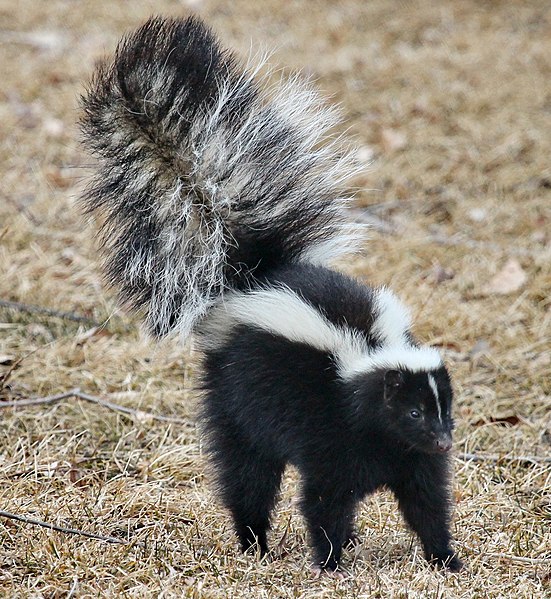
Then for a few weeks, he showed up in the daytime. Who knew that a skunk is one of nature’s most beautiful creatures? I haven’t seen him for a while now and I miss him, odor notwithstanding.

Then, on the last day of September, Stinky Boy’s cousin showed up.

Now I know a badger is not a biological cousin of a skunk, but they share a striped face and that’s close enough for me.

In the interest of full disclosure, my wife saw him for full-faced positive identification. By the time I got there, all I saw was wide brown, furry butt disappearing at high speed into the distance.

So close, and yet so far.

The skunk photo is in public domain, the badger photo is via GNU. Both critters avoided my camera when they came to visit. Actually the skunk was in plain sight, but I didn’t dare get close enough for a good shot. You know, friendly fire.

634.1 Critter Count

I have a post about two new critters who came to visit, called Stinky Boy and his Cousin. It was supposed to be posted yesterday, but the tribute to Alexi Leonov pushed it forward to the Monday before Thanksgiving.

As I was writing that post, I was a little uneasy. It ended up mentioning a large cadre of critters. Even though I made it clear that many only came by once in more than a decade, I still wondered if some readers would imagine that I live in a virtual zoo, instead of normal foothills full of sweet but ordinary creatures, and more rarely visited by the exotic.

Then today happened.

We went out early by car to watch a cattle drive which happens twice a year, going to the high country in spring and back down to the foothills in the fall. The critter count included cows, horses, dogs, and cowboys, but they don’t really count because they are all domesticated. Except the cowboys.

Driving back to my house, I had to brake for quail flying across the road. Driving on down toward the valley afterward, we had to dodge a tarantula crossing the road —

“Why did the tarantula cross the road? Mating season.”

— then passed a flock of turkeys in a neighbor’s yard. Still less than two miles from home I saw an egret standing at the edge of the lake waiting for a fish. Yesterday at the same spot I saw a flock of geese floating on the water.

A moment later a vulture swooped down. For a moment we were bracing for a collision but he was only interested in a piece of road kill in the ditch.

Okay, you’re right. I do live in a zoo.

The Gods of Wind and Air 9

5.

When the pot is broken on the hearth
       and the fire is out;
and the cold, north dragon wind
       is riding on the clouds.

When there’s howling in the smokehole
       and snuffling at the door;
when that beast is storm and darkness,
       and endless, biting cold.

Then the gods of wind and air
       demand their portion.

He stood under the fury of her countenance; not brave, not bowing, not defiant, not cringing. Numb.

She looked long upon him, and then was gone.

The wind still howled. The snow still swirled, but less fiercely because he had reached the edge of the valley and the beginning of the forest. He even knew where he was, or thought he did. If his strength held out, he could reach his hartwa in an hour.

And once there, he and his wife and child would die together, for there was nothing left in him.

He started forward, stumbled and fell. Something lay beneath the snow, frozen hard, and it had tripped him up. He moved past it, still intent on his goal, but there was just one spark left — hope perhaps, or maybe only curiosity. He brushed aside a bit of snow and found coarse hair. He dug deeper, faster, and exposed the carcass of a deer, wolf-killed, much mangled and partially eaten. On a day in spring, he would not have touched it. Now he ran his hands over the frozen body and tears came to his eyes.

#             #             #

When he had dragged the frozen carcass home, built a fire and made a stew to feed them all, Pellan settled in under the furs with his wife and child. The chill took a long time to leave him. Sleep tried to claim him, but he fought back because he wanted to stay awake long enough to savor this feeling of safety and repletion. These moments didn’t come often between first snow and final melt.

Gods, he thought — real or not, we need them. Poor men especially need them when the Lord and his soldiers, and his tax collectors and the priests, all stand with their hands out. When the crops fail, and the cow dies, and the woman is sick. When there is no food in the larder and only a whistle of wind where the chimney fire belongs, men need to believe that someone still cares.

And some men, pushed even harder than that, need gods to blame and gods to hate. When they are forced back up against death, left with no hope — when it would be easier to give up than to live — that’s when a certain kind of man needs his gods more than ever. He needs to curse them, to revile them, to scream at them when the night and hunger and cold and storm come all at once. He needs to hate them for what they are doing to him, whether he believes in them or not — to hate them so badly that he will walk barefoot through hell before he will let them see him fall.

Sometimes that hatred is all that keeps a man alive. So, thank you, Gods. But don’t get cocky. This mood won’t last long.

finis

The Gods of Wind and Air 8

Pellan trudged on, heading back toward his home by the feel of the wind. The sun had gone down and the darkness was complete. The few leathers of bitter melon Pellan had eaten near noon were long gone from his body. He was moving on nerve and anger, but the anger was fading in the storm.

He wished the priest was with him, so he could have someone to lash out at. If not the priest, he thought, then let some god appear, so he would have someone to curse.

The snow burned his face; the wind tore at his clothing and all but overturned his hearing. Then there was light, faint light, small in the distance. As he headed toward it, thinking of fire and warmth and food, it resolved into the figure of a man, strong, heavy, wide in the shoulders, dressed for battle with a sword drawn.

God or illusion? Does anyone ever really know?

Pellan spoke his name, “Simicababar,” and the figure nodded. Then he said, “How is it that you are here?”

“You called me and I came.”

“But it is said that you cannot leave your pocket universe, that the Changer locked you there forever.”

“I am here for you, because you called me. I stood through siege of war, unwavering, to protect my brother’s wife. That endurance is what you sought.”

“Can you give me strength to reach my own wife?”

“I can give you nothing. I can only show you what you lack.” And he was gone.

The storm, the cold and the darkness remained. Pellan began walking again, into the storm, toward his hartwa, and his wife and child. He wondered if they were still alive.

Encaritremanta appeared before him next, but he didn’t even acknowledge her presence. He had no need of a beautiful woman, scarcely clothed, to inflame his desire. He had a woman; plain faced, skeletal from hunger, holding his child to her breast. She was the one he wanted to reach. He growled, “Step aside, you glorious bitch, and let me go on to the one I love.”

Next Elmirandel stood by to watch him, but Pellan trudged past without even looking up.

There were other gods in the storm that night, less known to him, faint and half perceived. They surrounded him as he trudged onward. He could see them from time to time out of the corner of his eye. They meant nothing to him, except that he sometimes turned to curse them. Hunger walked with him; death walked by his left hand. He knew that this time he might not defeat them, but he knew that he would never stop trying.

The last goddess was the oldest of them all. She was there before Man was born. The Weathermistress in a green cloak, open to show her breasts, remained unaffected as she stood in the middle of the storm of her own creation. She was not cruel, although many call her that. She was not kind. She poured out the sweet honey of life with one hand and the icy stream of death with the other. She could be beseeched, but she never listened. She was neither kind nor cruel, but she was capricious.

Pellan stopped still before her. Here was the goddess he feared, for she had all power and no mercy. She looked him through with calm eyes. Her names were life and death. Whichever name she answered to tonight, was not his to command. He looked deeply into her eyes of ice and said, “I will not beg.”      Final post tomorrow.

The Gods of Wind and Air 7

4.

Now storm clouds hang above the trees
       and the homeward trail is long,
and darkness hides beneath the boughs
       with the creeping of the cold.

There’s hunger gnawing deep within
       that weakens all his limbs,
when the icy hearted temptress comes
       to torture him again.

Then the gods of wind and air
       demand their portion

Taipai was a priest, so naturally he talked.

Pellan hated priests, and lords, and men at arms, and all the serfs who knuckled under to them. It was a slow burning hatred that lived in his gut. Food might have extinguished it, but even when replete, the memory of hunger remained, so Pellan was always angry.

After a long time of listening to Taipai, Pellan told him to shut up. He said, “I have no use for gods. They have no place in my life.”

“You don’t deny them!”

“No, I don’t. I know they are real. I just wish they would go away and stop bothering us all.”

It was such an unbelievable assertion that Taipai was struck dumb. For a brief moment, anyway. Then he extolled the virtues of the Damesept, and Pellan replied that they had never done anything for him. Taipai fell back on praising the elder gods and Pellan admitted a grudging admiration for the Flower of the Waning Day, but added, “When they had done their work, they disappeared and no longer interfered in the lives of men. The other gods should take a hint and do the same.”

For all the kindness of his nature, Taipai still wondered if he had done wrong in giving this angry man food, and thus preserving his life. Not that he could have done otherwise, being who he was.

As they left the forest and set out across the fallow fields of the valley, the wind carried snow in billows and whorls, to blind them both and to suck the heat from their bodies. Pellan put his head down and plowed on, with Taipai in his wake. He knew that the priest would not have had the strength to breast the wind. Taipai knew it as well, and it hurt him to cause Pellan more trouble, when his life was so full of trouble already.

The wind roared and made conversation impossible. Pellan gave thanks for that, but he gave that thanks to no one in particular. He had chosen to go his way without the gods, and to hope that they would leave him alone as well.

The cold bored in and the road went on. Eventually the village and the menhir loomed up. Taipai tried to thank Pellan, but he only lifted his hand and turned back into the storm.

Taipai watched the swirling snow, long after he could no longer see Pellan’s retreating back.     More Tuesday.

The Gods of Wind and Air 6

Even Pellan, who lived on the edge of humanity, knew that not all stones of enreithment are man made, and that beshes which are not menhirs can appear anywhere people have brought their dead. He understood at once that this was a minor besh, that Taipai was in communion with it, and that it was best to stand back and let him finish whatever he was doing. So he settled in, ignoring the falling snow, and became as patient as the stones themselves.

The snow continued and the sky darkened further. Gradually Pellan’s cloak of ragged fur and Taipai’s cloak of coarse cloth became identical under the falling flakes. Finally, Taipai sat up in an explosion of snow, shook himself, and made a movement with his hands that evoked a rose which glowed briefly in the air.

So. Taipai had come here, away from his home menhir, to worship the ancient gods. Pellan could hear him reciting:

Elmirandel, the Stem,
Simicababar, the Deep Root,
Encaritremanta, the Blossom.
The Three who were One
       at the end of their world,
The Flower of the Waning Day.

He nodded approval. If you had to worship, the Three were a pretty good choice. At least they had stood with mankind against the other gods in the last days of the Comanyi. Of the new gods who inhabited Taipai’s menhir today, Pellan had no good opinion.

Taipai turned back toward the valley and saw him for the first time. Pellan stood, shook the snow off himself, and said, “Are you ready to go back?”

“Why are you here?”

“Not to spy on your worship, that’s for sure. You gave me food when I needed it. I owe you a debt. I will see you safely back to your temple, and then we will be even.”

Taipai looked surprised. He said, “I did not intend for you to feel a debt.”

“No matter. The debt is there, whatever you intended. Now let’s get back down, so I can get back to hunting.”

“I don’t really see any need . . .”

“It’s stupid to argue in a snowstorm,” Pellan said, and turned down toward the streambed. Taipai shrugged, and followed.     More next Monday.

The Gods of Wind and Air 5

3.

A man takes up a burden
       when he takes a wife to heart.
He takes another burden
       when he calls a man a friend.

Between that pair of burdens
       a man may well be torn.

He had not told the whole truth to his wife. He would hunt because their lives depended on it. But he had an additional debt now, to the priest who had given him food. It was no small gift, and therefore no small debt.

Pellan littered the trail behind him with curses. If he had only killed the priest before he could perform an act of mercy, he would not have this new burden. A starving wife and child were burden enough.

The day had advanced. The sun was nearing zenith, but no more visible that it had been earlier in the morning. The wind had increased. The clouds were gathering, rolling above his head  and now the snow had begun to fall.

No deer appeared as Pellan slogged on, hunting on his way back to the place he had met the priest. There he found footprints and followed them, moving fast because the snowfall was wiping them out, but still looking for animals as he went.

Damned priest. Why couldn’t he just stay safe and warm in his temple until the storm passed, Pellan grumbled to himself as he moved up the stream. He knew that if Taipai had stayed by his fire, his wife and child would not have food now, but he was too hungry to be reasonable.

The priest had moved far and fast. Pellan realized that he must be in pretty good physical shape, for somebody who spent his days in prayer. Of course, not being hungry made the difference.

The afternoon came in like nightfall, and the snow increased. Probably the priest didn’t need any help from Pellan. Not that that made any difference.

Pellan found the place where Taipai had left the streambed and had scrambled up into the forest. HIs path had gained altitude. Pellan could occasionally see bare hilltops through the thinning trees. Then he saw the priest.

There was a rounded boulder, about the height of a man and perhaps thirty feet across. Taipai had broken off the limb of an evergreen, and had used it as a broom to clear snow from one face of the boulder. Now he lay in an odd posture, knees against the base of the rock and sprawled forward so that his whole body was in contact with it.    More Wednesday.

The Gods of Wind and Air 4

“And your wife and child are starving as well?”

Pellan gave no answer.

Taipai went on, “Well, of course they are. If you take me to them, I will do what I can.”

Pellan shook his head. Taipai waited. The one leather of bitter melon could not have satisfied the man, but he did not ask for another, though he could easily have taken them all. Taipai considered his stance, his obvious emaciation, and the fact that he was almost shaking with fatigue. He said, “You don’t trust me?”

“In fact, I do. But not with the lives of my wife and child.”

“They need food. I have food and you could take it. Why don’t you?”

“You gave me food when I was hungry. I cannot rob you now.”

Taipai understood. He said, “Every man has a wall he will not crawl over. It is a puzzle you cannot solve, but I can.” He held out the sack again and said, “I give you all of it. Take it to your family.”

The priest turned his back on Pellan and his spear, and began picking his way up the frozen waterway. Pellan clutched the sack to his chest and watched him out of sight.

The way back to his hartwa was short enough, and made lighter by the food in his belly. He gave a leather to his wife to chew on, took up his axe, and went out for wood. It took some time, since he had long since harvested all the nearby down wood. He returned and built up a fire. His wife held out a piece of bitter melon and he took it. Even though he wanted to give it all to his wife and child, he had to keep up his own strength for the hunt.

This bag of food would have kept the priest fed for a day. It might keep Pellan and his family alive for a week, but it would not last until snow melt.

It was a reprieve, not salvation.

Pellan dozed by the fire, warm for the first time in days. His wife chewed the melon, softening it with the juices of her mouth, and pressed the result into the mouth of her child. He was too young for solid food, but until her milk returned, it was all she had to give him.

An hour passed. Pellan woke with a start, and began to gather up his axe and spear. His wife watched him, cradling the infant to her empty breasts. He said, “I must go out again to hunt. I will return.”

She smiled. That smile was always a wonder to him, and the treasure of his heart. She said, “Of course you will. We will wait for you.” If she harbored doubt behind her eyes, she hid it so well that he could not see it.     More Tuesday.